Japan Synthetic Esters Market Size & Growth Rate
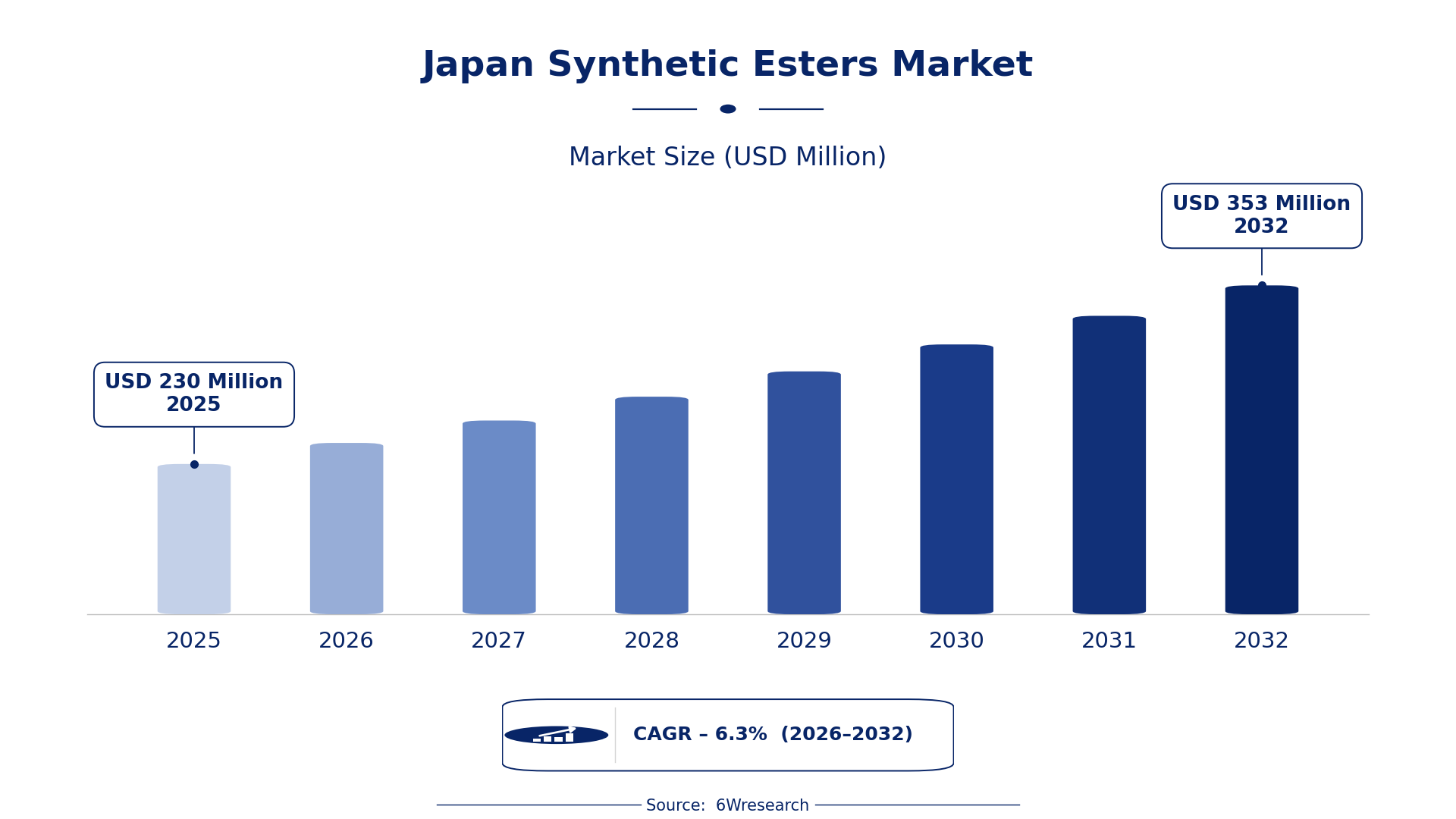
According to 6Wresearch internal database and industry insights, the Japan Synthetic Esters Market was valued at USD 230 Million in 2025 and is projected to reach USD 353 Million by 2032, growing at a CAGR of approximately 6.3% during 2026–2032.
Japan Synthetic Esters Market Highlights
| Report Metric | Details |
| Report Name | Japan Synthetic Esters Market (2026-2032) |
| Market Size 2025 | USD 230 Million |
| Market Size 2032 | USD 353 Million |
| Absolute Growth 2025–2032 | USD 123 Million |
| CAGR 2026–2032 | 6.3% |
| Peak Annual Growth | 6.9% in 2026 |
| Forecast Period | 2026–2032 |
| Historical Data | 2022–2025 |
| Base Year | 2025 |
| Leading Ester Type, 2025 | Complex Esters (38% share) |
| Leading Chemical Structure, 2025 | Linear Alkyl Esters (40% share) |
| Leading Application Use, 2025 | Automotive Lubricants (37% share) |
| Leading End User, 2025 | Lubricant Manufacturers (37% share) |
| Fastest-Growing Ester Type | Phthalate-Free Esters (8.8% CAGR) |
| Fastest-Growing Chemical Structure | Polyol-Based (8.3% CAGR) |
| Fastest-Growing Application Use | Metalworking Fluids (8.4% CAGR) |
| Fastest-Growing End User | PVC Manufacturers (8.2% CAGR) |
| Growing Sector | automotive lubricants |
| Key End Users | Lubricant Manufacturers, Oil & Additive OEMs, PVC Manufacturers |
Japan Synthetic Esters Market Year-wise Growth Rate and Key Drivers (2022–2032)
This graph illustrates the annual growth rates of the market from 2022 to 2032, highlighting a steady upward trajectory and projected market expansion over the forecast period.
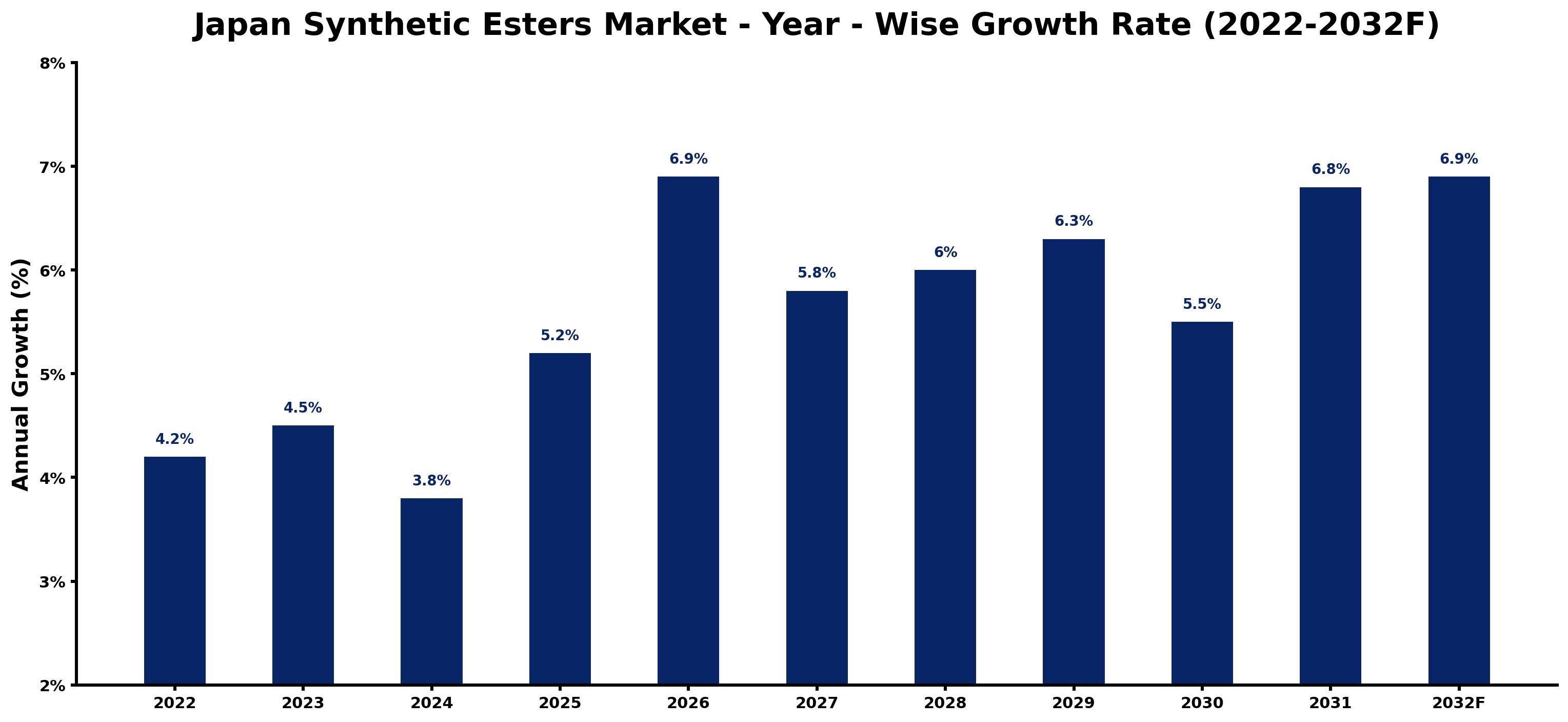
Below, each year's estimated growth is shown next to the factor that most influenced it.
| Year | Estimated Annual Growth (%) | Market Rationale |
| 2022 | 4.2 | The market experienced steady growth due to established demand from lubricant manufacturers. |
| 2023 | 4.5 | Demand increased as automotive lubricants gained traction among consumers and manufacturers. |
| 2024 | 3.8 | Growth slowed as manufacturers faced challenges in sourcing raw materials for production. |
| 2025 | 5.2 | The market rebounded with increased investments in high-performance lubricants and additives. |
| 2026 | 6.9 | A surge in demand for synthetic esters drove growth in the automotive sector. |
| 2027 | 5.8 | Growth moderated as manufacturers adjusted to market saturation in certain lubricant types. |
| 2028 | 6.0 | Demand rose again as innovations in biodegradable lubricants attracted new buyers. |
| 2029 | 6.3 | The market continued to expand, driven by increased adoption of complex esters in high-temperature applications. |
| 2030 | 5.5 | Growth slowed as competition intensified among lubricant manufacturers for market share. |
| 2031 | 6.8 | Demand surged as eco-friendly lubricants became a priority for consumers and industries. |
| 2032 | 6.9 | The market is expected to maintain its upward growth, driven by ongoing innovations in synthetic esters. |
Note: Market size estimations and growth projections presented in this report are based on 6Wresearch's proprietary forecasting methodology, utilizing the latest available industry data, government publications, and primary research inputs.
Japan Synthetic Esters Market Synopsis
Synthetic esters are compounds created from alcohols and acids, primarily used as lubricants and additives in various applications. The Japan Synthetic Esters Market is growing due to the automotive sector, which represents 40% of demand, alongside a rising emphasis on biodegradable options. Investment in green technology reached ¥5 billion in 2023, while the Tokyo region serves as a key manufacturing hub, driving innovation and further market expansion. The pursuit of high-performance lubricants also fuels market growth as manufacturers seek advanced solutions.
Market Dynamics Impact Analysis (2026–2032)
| Factor | Type | Impact | Primary Segment Affected |
| Rising demand for high-performance automotive lubricants | Driver | High | Automotive Lubricants |
| Increased adoption of biodegradable synthetic esters | Driver | High | Phthalate-Free Esters |
| Growing consumer preference for eco-friendly products | Opportunity | High | Complex Esters |
| Expansion of lubricant manufacturing in the Tokyo region | Opportunity | Medium | Lubricant Manufacturers |
| Stricter regulations on phthalate use in lubricants | Restraint | High | Phthalate-Free Esters |
| Challenges in sourcing raw materials for production | Restraint | Medium | Complex Esters |
| Intense competition among lubricant manufacturers | Challenge | High | Lubricant Manufacturers |
| Technological advancements in lubricant formulations | Challenge | Medium | Automotive Lubricants |
Evaluation of Drivers in Japan Synthetic Esters Market (2026–2032)
The following drivers explain most of the expected growth.
| Drivers | Primary Segment Affected | Why It Matters (Evidence) |
| Increased automotive production | Automotive Lubricants | The automotive sector's growth, accounting for 40% of demand, drives purchases of synthetic esters for engine performance. |
| Demand for biodegradable options | Phthalate-Free Esters | Investment in green technology reached ¥5 billion in 2023, improving production capabilities for eco-friendly lubricants. |
| Technological advancements in lubricant formulations | Complex Esters | Innovation in high-performance lubricants drives demand for complex esters, particularly in automotive applications. |
| Rising consumer awareness of eco-friendly products | Complex Esters | Growing consumer preference for sustainable products leads to increased purchases of biodegradable lubricants. |
| Investment in green technology | Lubricant Manufacturers | Investment in green technology reached ¥5 billion in 2023, improving production capabilities for eco-friendly lubricants. |
A wider customer base explains much of the growth, as the automotive sector, which consumes 40% of synthetic esters, continues to expand. Investment in green technology reached ¥5 billion in 2023, enhancing production capabilities for eco-friendly lubricants. Technological advancements in lubricant formulations improve performance, particularly in high-temperature applications. This innovation meets the evolving needs of consumers and industries alike, driving demand for high-performance solutions.
Evaluation of Restraints in Japan Synthetic Esters Market
The table below lists the restraints and the evidence behind each.
| Market Restraint | Primary Segment Affected | Why It Matters (Evidence) |
| Stricter regulations on phthalate use | Phthalate-Free Esters | Compliance costs for manufacturers have risen by 15%, impacting pricing strategies. |
| Challenges in sourcing raw materials | Complex Esters | Supply chain disruptions have led to a 20% increase in raw material costs, delaying production. |
| Intense competition among manufacturers | Lubricant Manufacturers | The presence of over 1,000 lubricant manufacturers in Japan intensifies competition, affecting profit margins. |
| Market saturation in certain lubricant types | Automotive Lubricants | As the market matures, growth opportunities are limited, leading to slower demand increases. |
| Consumer price sensitivity | Complex Esters | Higher costs associated with eco-friendly products may deter price-sensitive consumers from purchasing. |
Japan Synthetic Esters Market Challenges
Producers encounter rising compliance costs due to stringent regulations on biodegradable lubricants, which can reach ¥1 billion annually for manufacturers. Skills shortages in the lubricant sector lead to production inefficiencies, causing lead times to extend by up to three months for producers. Technology gaps in advanced esterification processes hinder innovation, resulting in missed opportunities for suppliers in high-performance applications. Intense competition among over 1,000 lubricant manufacturers drives down prices, forcing producers to cut margins and impacting their ability to invest in research and development.
Trends in the Japan Synthetic Esters Market
The trends below show where the Japan Synthetic Esters Market is heading.
- Growth of Biodegradable Lubricants: The market for biodegradable lubricants is projected to grow by 8.8% by 2032, reflecting a shift towards eco-friendly solutions, particularly in the automotive sector.
- Adoption of Complex Esters: Manufacturers are increasingly adopting complex esters for high-temperature applications, supported by their superior performance characteristics in automotive lubricants, which are expected to rise by 12%.
- Rise in Eco-Friendly Products: The growing consumer demand for eco-friendly products has led to an increase in the adoption of phthalate-free esters, which are now widely used in lubricants, with a market share increase of 10%.
- Manufacturing Expansion in Tokyo: The Tokyo region has become a major hub for lubricant manufacturing, contributing to the production of over 200,000 tons of synthetic esters in 2022, with a projected increase of 15%.
Investment Opportunities in the Japan Synthetic Esters Market
The following areas offer the clearest openings for investors and suppliers in the Japan Synthetic Esters Market.
- Increasing Demand for Biodegradable Lubricants: With the demand for biodegradable lubricants increasing by 20%, manufacturers can invest in developing eco-friendly options to meet consumer preferences, particularly in the automotive sector.
- High-Performance Lubricants Needed: Lubricant manufacturers are seeking high-performance solutions, creating opportunities for suppliers of complex esters to enter the market and meet these demands, which are expected to grow by 15%.
- Development of Eco-Friendly Products: Companies can partner with local manufacturers to develop biodegradable lubricants, tapping into the growing market due to environmental regulations, which have increased by 25%.
- Investment in New Lubricant Formulations: Investment in new lubricant formulations is essential, especially for manufacturers in the Kansai region, which is known for its chemical manufacturing and has seen a 30% increase in demand.
Government Initiatives in the Japan Synthetic Esters Market
The Economic Security Promotion Act (2022) supports supply-chain resilience for critical products, including synthetic esters. This law complements existing regulations by ensuring that manufacturers can maintain production levels despite global supply chain disruptions. It encourages investment in local production capabilities, which is vital for the synthetic esters market, with funding expected to reach ¥10 billion by 2025.
Buyers, particularly lubricant manufacturers, benefit from the PRTR Law (1999), which mandates reporting on chemical substances. This transparency helps them ensure compliance with environmental standards and build trust with consumers, strengthening their market position. The law has led to a 15% increase in compliance among manufacturers.
Future Insight of the Japan Synthetic Esters Market
By 2032, advancements in esterification technology will transform production processes, enabling suppliers to meet growing demand efficiently. Biodegradable lubricants will become more prevalent, aligning with environmental regulations and offering buyers sustainable choices. The automotive sector will increasingly require high-performance lubricants, prompting suppliers to innovate their offerings. Investment in green technology will continue to rise, particularly in the Tokyo region, reinforcing its position as a centre for lubricant research and development.
Market Segmentation Analysis
Japan Synthetic Esters Market report covers a detailed analysis of the following market segments:
By Ester Type – Complex Esters Lead, Phthalate-Free Esters Expected to Grow Fastest
According to Saurav Kr Singh, Senior Research Analyst at 6Wresearch, Complex Esters accounted for 38% of the market by ester type in 2025. Complex esters dominate the market due to their application in high-performance lubricants, which are essential for automotive and industrial uses. Their ability to withstand high temperatures makes them particularly attractive for demanding applications, such as those in the automotive sector. The quickest growth will come from Phthalate-Free Esters, forecast to expand at a CAGR of 8.8% between 2026 and 2032. Phthalate-free esters are experiencing rapid growth as manufacturers respond to stricter environmental regulations and consumer demand for eco-friendly products. This shift is evidenced by increased adoption rates in various applications, particularly in lubricants that require compliance with new standards. Suppliers should focus on developing and marketing phthalate-free options to meet rising regulatory and consumer expectations.
By Chemical Structure – Linear Alkyl Esters Lead, Polyol-Based Expected to Grow Fastest
In 2025, Linear Alkyl Esters led the chemical structure split with a 40% share. Linear alkyl esters dominate the market as they are extensively utilised in metalworking fluids, essential for machining processes in diverse industries. Their reliability in providing lubrication and cooling during metal fabrication ensures steady demand from the manufacturing sector. Polyol-Based is projected to grow fastest, at a CAGR of 8.3% during 2026–2032. Polyol-based esters are rapidly gaining popularity due to their compatibility with biodegradable lubricants, reflecting the increasing focus on sustainability in manufacturing. The surge in investment towards green technology further accelerates their market adoption. Suppliers should consider expanding their product lines to include polyol-based esters to meet the rising demand for environmentally friendly solutions.
By Application Use – Automotive Lubricants Lead, Metalworking Fluids Expected to Grow Fastest
With 37% of application use revenue in 2025, Automotive Lubricants was the largest category. Automotive lubricants hold the largest share due to their critical role in ensuring optimal engine performance and reliability. This segment is driven by the robust automotive industry in Japan, which consumes 40% of the total synthetic esters produced. Over 2026–2032, Metalworking Fluids are expected to post the fastest growth, at a CAGR of 8.4%. Metalworking fluids are witnessing the fastest growth as they are essential for modern machining processes that require advanced lubrication to enhance efficiency. The expansion of the manufacturing sector in Japan, which relies heavily on these fluids, is a key factor in this rapid growth. This indicates that suppliers must prioritise the development of specialised products to meet the rising needs of the automotive and metalworking sectors.
By End User – Lubricant Manufacturers Lead, PVC Manufacturers Expected to Grow Fastest
Lubricant Manufacturers took 37% of end user revenue in 2025, more than any other category. Lubricant manufacturers are the largest consumers of synthetic esters, driving the highest market share due to their wide-ranging applications in various lubricant formulations. Their established market presence and ongoing product innovation ensure a consistent demand for synthetic esters. PVC Manufacturers are set to record the highest CAGR in this split, 8.2% over 2026–2032. PVC manufacturers are rapidly increasing their consumption of synthetic esters as plasticizers, motivated by the need for compliant and versatile materials. The rising demand for eco-friendly plastic products across multiple applications supports this growth. Suppliers should seek collaborations with PVC manufacturers to capitalise on the growing need for sustainable plasticiser solutions.
Key Attractiveness of the Report
- 10 Years of Market Numbers
- Historical Data Starting from 2022 to 2025
- Base Year 2025
- Forecast Data until 2032
- Key Performance Indicators Impacting the Market
- Major Upcoming Developments and Projects
Key Highlights of the Report:
- Japan Synthetic Esters Market Outlook
- Market Size of Japan Synthetic Esters Market, 2025
- Forecast of Japan Synthetic Esters Market, 2032
- Historical Data and Forecast of Japan Synthetic Esters Revenues & Volume for the Period 2022-2032F
- Japan Synthetic Esters Market Trend Evolution
- Japan Synthetic Esters Market Drivers and Challenges
- Japan Synthetic Esters Price Trends
- Japan Synthetic Esters Porter's Five Forces
- Japan Synthetic Esters Industry Life Cycle
- Historical Data and Forecast of Japan Synthetic Esters Market Revenues & Volume By Ester Type for the Period 2022-2032F
- Historical Data and Forecast of Japan Synthetic Esters Market Revenues & Volume By Mono Esters for the Period 2022-2032F
- Historical Data and Forecast of Japan Synthetic Esters Market Revenues & Volume By Complex Esters for the Period 2022-2032F
- Historical Data and Forecast of Japan Synthetic Esters Market Revenues & Volume By Dibasic Esters for the Period 2022-2032F
- Historical Data and Forecast of Japan Synthetic Esters Market Revenues & Volume By Phthalate-Free Esters for the Period 2022-2032F
- Historical Data and Forecast of Japan Synthetic Esters Market Revenues & Volume By Chemical Structure for the Period 2022-2032F
- Historical Data and Forecast of Japan Synthetic Esters Market Revenues & Volume By Linear Alkyl Esters for the Period 2022-2032F
- Historical Data and Forecast of Japan Synthetic Esters Market Revenues & Volume By Polyol-Based for the Period 2022-2032F
- Historical Data and Forecast of Japan Synthetic Esters Market Revenues & Volume By Succinate/Glutarate Based for the Period 2022-2032F
- Historical Data and Forecast of Japan Synthetic Esters Market Revenues & Volume By Non-Toxic Alternatives for the Period 2022-2032F
- Historical Data and Forecast of Japan Synthetic Esters Market Revenues & Volume By Application Use for the Period 2022-2032F
- Historical Data and Forecast of Japan Synthetic Esters Market Revenues & Volume By Metalworking Fluids for the Period 2022-2032F
- Historical Data and Forecast of Japan Synthetic Esters Market Revenues & Volume By Automotive Lubricants for the Period 2022-2032F
- Historical Data and Forecast of Japan Synthetic Esters Market Revenues & Volume By Cleaning Agents for the Period 2022-2032F
- Historical Data and Forecast of Japan Synthetic Esters Market Revenues & Volume By Plasticizers for the Period 2022-2032F
- Historical Data and Forecast of Japan Synthetic Esters Market Revenues & Volume By End User for the Period 2022-2032F
- Historical Data and Forecast of Japan Synthetic Esters Market Revenues & Volume By Lubricant Manufacturers for the Period 2022-2032F
- Historical Data and Forecast of Japan Synthetic Esters Market Revenues & Volume By Oil & Additive OEMs for the Period 2022-2032F
- Historical Data and Forecast of Japan Synthetic Esters Market Revenues & Volume By Industrial Cleaners for the Period 2022-2032F
- Historical Data and Forecast of Japan Synthetic Esters Market Revenues & Volume By PVC Manufacturers for the Period 2022-2032F
- Japan Synthetic Esters Import Export Trade Statistics
- Market Opportunity Assessment By Ester Type
- Market Opportunity Assessment By Chemical Structure
- Market Opportunity Assessment By Application Use
- Market Opportunity Assessment By End User
- Japan Synthetic Esters Top Companies Market Share
- Japan Synthetic Esters Competitive Benchmarking By Technical and Operational Parameters
- Japan Synthetic Esters Company Profiles
- Japan Synthetic Esters Key Strategic Recommendations
Market Covered
Segments analysed in this report are listed below.
By Ester Type
- Mono Esters
- Complex Esters
- Dibasic Esters
- Phthalate-Free Esters
By Chemical Structure
- Linear Alkyl Esters
- Polyol-Based
- Succinate/Glutarate Based
- Non-Toxic Alternatives
By Application Use
- Metalworking Fluids
- Automotive Lubricants
- Cleaning Agents
- Plasticizers
By End User
- Lubricant Manufacturers
- Oil & Additive OEMs
- Industrial Cleaners
- PVC Manufacturers































