Japan Synthetic Flavoring Market Size & Growth Rate
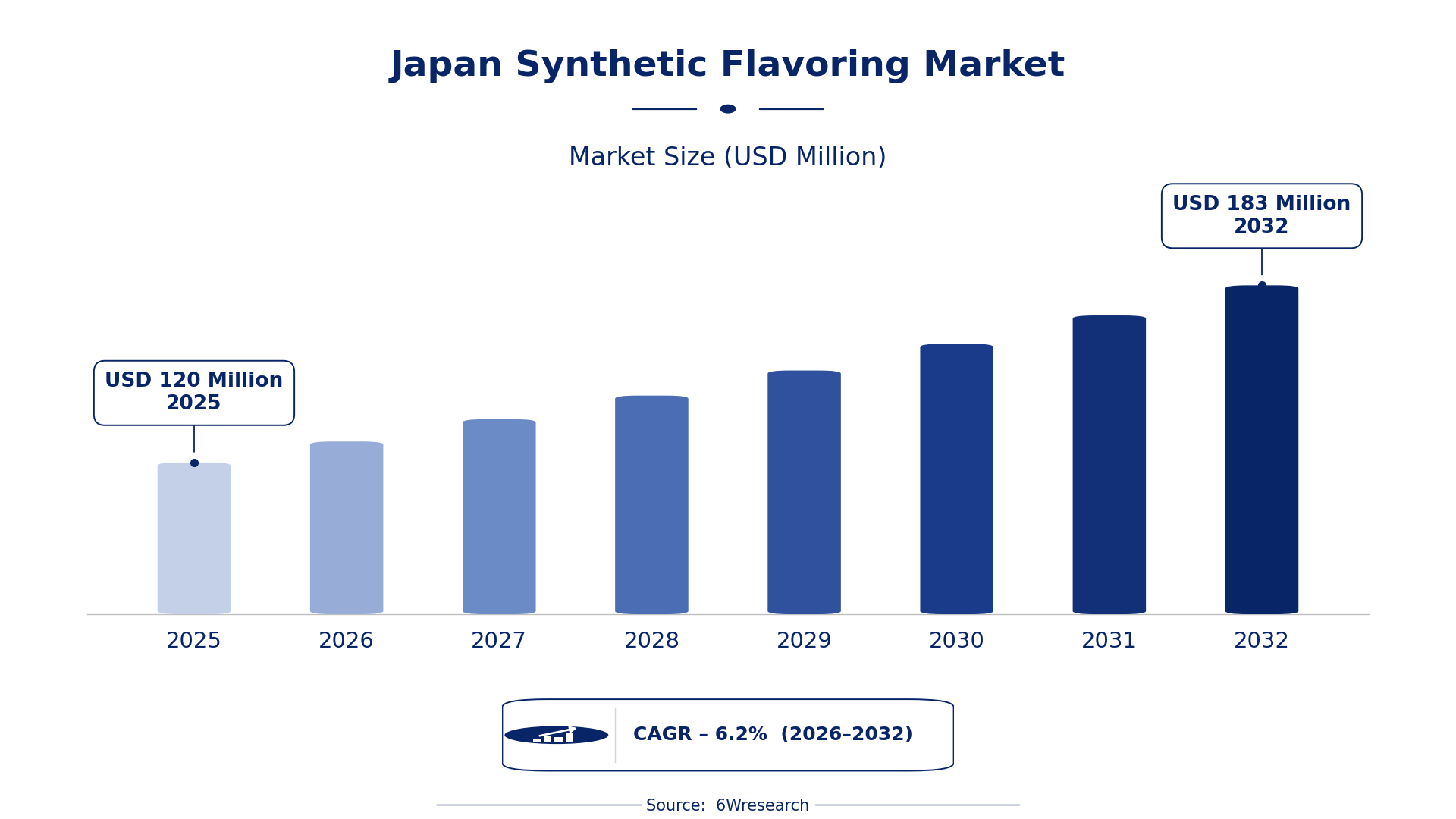
According to 6Wresearch internal database and industry insights, the Japan Synthetic Flavoring Market was valued at USD 120 Million in 2025 and is projected to reach USD 183 Million by 2032, growing at a CAGR of approximately 6.2% during 2026–2032.
Japan Synthetic Flavoring Market Highlights
| Report Metric | Details |
| Report Name | Japan Synthetic Flavoring Market (2026-2032) |
| Market Size 2025 | USD 120 Million |
| Market Size 2032 | USD 183 Million |
| Absolute Growth 2025–2032 | USD 63 Million |
| CAGR 2026–2032 | 6.2% |
| Peak Annual Growth | 7.2% in 2028 |
| Forecast Period | 2026–2032 |
| Historical Data | 2022–2025 |
| Base Year | 2025 |
| Leading Flavor Type, 2025 | Fruit Flavors (47% share) |
| Leading Base Compound, 2025 | Esters/Aldehydes (46% share) |
| Leading Application Segment, 2025 | Beverages (36% share) |
| Leading End User, 2025 | F&B Manufacturers (38% share) |
| Fastest-Growing Flavor Type | Meat Flavors (8.7% CAGR) |
| Fastest-Growing Base Compound | Maillard Reaction Agents (8.2% CAGR) |
| Fastest-Growing Application Segment | Instant Meals (9.2% CAGR) |
| Fastest-Growing End User | Snack Brands (7.8% CAGR) |
| Growing Sector | Instant Meals |
| Key End Users | Beverages, Instant Meals, Baked Goods, Ready-to-Eat Foods |
Japan Synthetic Flavoring Market Year-wise Growth Rate and Key Drivers (2022–2032)
This graph illustrates the annual growth rates of the market from 2022 to 2032, highlighting a steady upward trajectory and projected market expansion over the forecast period.
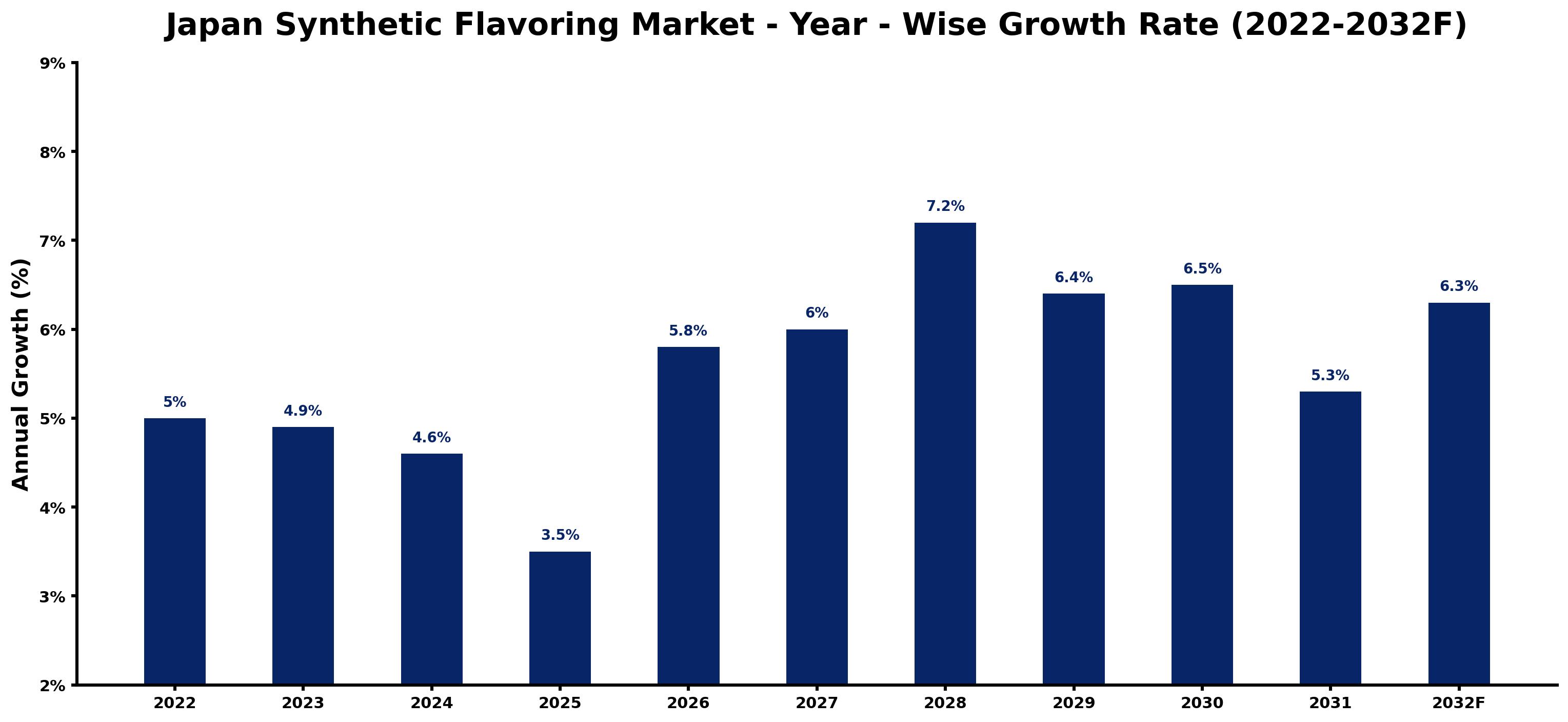
The yearly estimates that follow link every growth rate to its principal driver, so readers can see why the pace changed in each period.
| Year | Estimated Annual Growth (%) | Market Rationale |
| 2022 | 5.0 | The market experienced stable growth, supported by consistent demand from food manufacturers. |
| 2023 | 4.9 | Growth slowed slightly as buyers adjusted to ingredient sourcing and market conditions. |
| 2024 | 4.6 | The market continued to grow, though at a reduced pace due to heightened competition. |
| 2025 | 3.5 | Demand growth slowed further as manufacturers focused on cost management strategies. |
| 2026 | 5.8 | Growth is expected to accelerate as food innovation programmes spark renewed interest in flavoring. |
| 2027 | 6.0 | The market will see a rise in demand as new product lines are introduced across sectors. |
| 2028 | 7.2 | The peak growth year will be driven by investments in flavor technology and production. |
| 2029 | 6.4 | Growth is projected to slow as market saturation begins to affect new flavor introductions. |
| 2030 | 6.5 | Demand will increase again as manufacturers expand their offerings to meet consumer preferences. |
| 2031 | 5.3 | Growth is expected to slow due to a focus on regulatory compliance and quality assurance. |
| 2032 | 6.3 | Demand is projected to rise as new applications for synthetic flavors emerge. |
Note: Market size estimations and growth projections presented in this report are based on 6Wresearch's proprietary forecasting methodology, utilizing the latest available industry data, government publications, and primary research inputs.
Japan Synthetic Flavoring Market Synopsis
Synthetic flavoring is a chemical product created through methods like esterification and fermentation, primarily used to improve taste and aroma in food and beverages. The Japan Synthetic Flavoring Market is expanding due to rising demand from food manufacturers and snack brands. This growth stems from a focus on processed foods and beverages, with beverages accounting for 40% of synthetic flavor usage. The government's promotion of food innovation further stimulates market expansion, creating opportunities for suppliers.
Market Dynamics Impact Analysis (2026–2032)
| Factor | Type | Impact | Primary Segment Affected |
| Rising demand from F&B manufacturers for innovative flavors | Driver | High | F&B Manufacturers |
| Increasing popularity of instant meals among consumers | Driver | High | Instant Meals |
| Expansion of snack brands seeking new flavor profiles | Opportunity | High | Snack Brands |
| Growth in beverage production requiring diverse flavoring options | Opportunity | High | Beverages |
| Strict regulations on synthetic flavoring compliance | Restraint | High | Fruit Flavors |
| Market saturation limiting new product introductions | Restraint | Medium | Fruit Flavors |
| High costs of compliance with food safety standards | Challenge | High | Fruit Flavors |
| Challenges in sourcing quality raw materials for production | Challenge | Medium | Fruit Flavors |
Evaluation of Drivers in Japan Synthetic Flavoring Market (2026–2032)
The main growth drivers and the segments they affect most are set out below.
| Drivers | Primary Segment Affected | Why It Matters (Evidence) |
| Growing demand for diverse flavors in processed foods | F&B Manufacturers | This demand drives purchases as manufacturers seek to differentiate their products in a competitive market. |
| Rising consumption of instant meals among busy consumers | Instant Meals | The trend leads to increased purchases of synthetic flavors to improve convenience food offerings. |
| Expansion of beverage production with unique flavor profiles | Beverages | This expansion results in higher demand for synthetic flavors to meet consumer preferences. |
| Increased focus on product quality and safety standards | Fruit Flavors | Compliance with regulations encourages manufacturers to invest in higher quality synthetic flavors. |
| Growing popularity of snack foods requiring unique flavoring | Snack Brands | This trend boosts demand for synthetic flavors as brands innovate to attract consumers. |
Much of the new demand traces back to the increasing consumption of processed foods, with approximately 40% of synthetic flavors used in beverages. The annual consumption of synthetic flavors in Japan stands at around 50,000 tons, as food manufacturers seek creative flavoring solutions. Instant meals are projected to account for 30% of synthetic flavors by 2025, reflecting busy lifestyles. Snack brands are also expanding their use of synthetic flavors, indicating a growing trend in consumer preferences for unique taste experiences. This shift arises from a heightened focus on product quality and safety standards, prompting manufacturers to invest in higher quality flavoring solutions.
Evaluation of Restraints in Japan Synthetic Flavoring Market
The key brakes on demand, and where they bite hardest, are shown below.
| Market Restraint | Primary Segment Affected | Why It Matters (Evidence) |
| Strict compliance with food safety regulations | Fruit Flavors | Compliance costs can be high, affecting profit margins for food manufacturers by up to 15%. |
| Market saturation limiting new product development | Fruit Flavors | Saturation leads to increased competition, making it harder for new flavors to gain traction. |
| High costs associated with sourcing quality raw materials | Fruit Flavors | These costs can deter smaller producers from entering the market, limiting competition. |
| Complexity in meeting diverse consumer preferences | Fruit Flavors | This complexity can slow down product development and increase time to market. |
| Challenges in maintaining consistent flavor quality | Fruit Flavors | Inconsistent quality can lead to customer dissatisfaction and loss of brand loyalty. |
Japan Synthetic Flavoring Market Challenges
Producers incur rising production costs due to supply chain disruptions, inflating expenses by approximately 15%. Strict regulations on synthetic flavoring increase compliance costs for suppliers, delaying product launches and reducing their market competitiveness. Buyers face limited options as competition among suppliers intensifies, leading to price hikes that can reach 10% annually. A shortage of skilled professionals in flavour development restricts innovation, making it challenging for producers to meet consumer demands, potentially resulting in a 20% decline in new product introductions.
Trends in the Japan Synthetic Flavoring Market
Four trends stand out in the Japan Synthetic Flavoring Market.
- Transition towards Natural Flavor Alternatives: Japan is experiencing a shift towards natural flavor alternatives as consumers become more health-conscious. The demand for natural flavors has increased, prompting manufacturers to adapt their offerings to meet this trend, with a reported rise of 20% in natural flavor usage.
- Expansion of Flavor Profiles in Snack Foods: Snack brands are diversifying their flavor profiles, with a reported rise in unique flavor combinations. This trend is reflected in new product launches across various snack categories, enhancing consumer choice and leading to a 15% increase in flavor variety.
- Growth in Ready-to-Eat Meal Options: The rise of ready-to-eat meals is reshaping flavoring needs, with a projected increase in flavor usage by 25% over the next few years. This trend is particularly strong among urban consumers seeking convenience in their meals.
- Increased Focus on Sustainable Flavoring Practices: Sustainable practices in flavor production are gaining traction, with a notable percentage of producers adopting eco-friendly methods. This shift aligns with consumer demand for environmentally responsible products, resulting in a 30% increase in sustainable flavor options.
Investment Opportunities in the Japan Synthetic Flavoring Market
The opportunities below stand out in the Japan Synthetic Flavoring Market for new entrants and existing suppliers.
- Investment in Innovative Flavoring Technologies: With an annual market value of 200 billion yen, there is a significant opportunity for suppliers to invest in innovative flavoring technologies. F&B manufacturers are increasingly looking for unique flavors to enhance their products, creating a gap for new entrants.
- Expansion of Natural Flavor Offerings: As consumer preferences shift towards healthier options, there is a growing demand for natural flavors. This trend presents an opportunity for suppliers to develop and market natural flavor alternatives, particularly in urban areas where health consciousness is rising.
- Development of Flavor Solutions for Instant Meals: The projected 30% usage of synthetic flavors in instant meals by 2025 indicates a strong opportunity for suppliers. F&B manufacturers are seeking partnerships to create convenient and flavorful meal options, which can be achieved through local collaborations.
- Enhancing Flavor Profiles in Snack Foods: With snack brands expanding their flavor profiles, there is a significant opportunity for suppliers to provide innovative flavor solutions. The growing market for unique snacks can be tapped into through strategic partnerships with local producers.
Government Initiatives in the Japan Synthetic Flavoring Market
The Food Sanitation Act, amended in 2018, introduced a positive list system for synthetic resins used in food utensils, containers, and packaging, which is now in force. Compliance with this law ensures safety and quality in synthetic flavor production, impacting manufacturers directly.
The Ministry of Health, Labour and Welfare oversees the implementation of food safety standards, including HACCP-based hygiene management, which became mandatory in June 2021. This regulation requires food businesses to adhere to strict safety protocols, enhancing consumer confidence in synthetic flavor products.
Future Insight of the Japan Synthetic Flavoring Market
Investment in new synthesis technologies will create opportunities for suppliers to develop unique flavour profiles that align with consumer preferences. By 2032, the annual consumption of synthetic flavors in Japan is projected to reach around 60,000 tons, driven by increased demand in processed foods. The government's food innovation programme will encourage advancements in flavor production, enabling suppliers to offer safer and more diverse options. Compliance with JIS standards will improve food safety, benefiting buyers and suppliers alike.
Market Segmentation Analysis
Japan Synthetic Flavoring Market report covers a detailed analysis of the following market segments:
By Flavor Type – Fruit Flavors Lead, Meat Flavors Expected to Grow Fastest
According to Saurav Kr Singh, Senior Research Analyst at 6Wresearch, in 2025, Fruit Flavors led the flavor type split with a 47% share. Fruit flavors hold the largest market share due to their extensive application in beverages and desserts, catering to consumer preferences. The beverage sector's notable consumption, comprising 40% of synthetic flavors, illustrates the robust demand for these flavor types. Meat Flavors are set to record the highest CAGR in this split, 8.7% over 2026–2032. The surge in meat flavors is propelled by the rising trend of savoury snacks among consumers. As snack brands increasingly incorporate meat flavors into their products, this segment is set for rapid expansion. Suppliers should focus on strengthening their fruit flavor offerings while also tapping into the growing meat flavor market.
By Base Compound – Esters/Aldehydes Lead, Maillard Reaction Agents Expected to Grow Fastest
Esters/Aldehydes accounted for 46% of the market by base compound in 2025. Esters and aldehydes lead the market as they are essential in creating diverse flavour profiles for various food products. Their significant role in numerous applications highlights their importance in the synthetic flavoring sector. Maillard Reaction Agents are projected to grow fastest, at a CAGR of 8.2% during 2026–2032. The demand for Maillard reaction agents is accelerating due to their critical role in browning processes, enhancing the visual and taste appeal of processed foods. As manufacturers prioritise quality improvements, this segment is likely to experience substantial growth. Buyers should ensure their suppliers are well-versed in the latest developments in ester and aldehyde production to stay competitive.
By Application Segment – Beverages Lead, Instant Meals Expected to Grow Fastest
The largest application segment category in 2025 was Beverages, at 36% of revenue. Beverages lead the application segment due to their high demand for flavouring, representing a considerable share of synthetic flavor usage. This trend is supported by the popularity of diverse beverage options among consumers. The quickest growth will come from Instant Meals, forecast to expand at a CAGR of 9.2% between 2026 and 2032. Instant meals are rapidly gaining traction as consumer preferences shift towards convenience foods that require minimal preparation. This trend is expected to drive increased demand for synthetic flavors tailored for instant meal applications. Suppliers must adapt their offerings to meet the rising demand for flavours specifically designed for instant meals.
By End User – F&B Manufacturers Lead, Snack Brands Expected to Grow Fastest
With 38% of end user revenue in 2025, F&B Manufacturers was the largest category. F&B manufacturers represent the largest consumer group of synthetic flavors, employing them extensively in their product formulations to improve taste. Their dominant market position underscores the vital role of flavors in food production processes. Over 2026–2032, Snack Brands are expected to post the fastest growth, at a CAGR of 7.8%. Snack brands are rapidly increasing their use of synthetic flavors as they innovate and diversify their product offerings to attract consumers. This trend signals a shift towards more flavourful snacks, driving growth in this segment. Suppliers should explore tailored solutions for snack brands to capitalise on the increasing demand for enhanced flavours.
Key Attractiveness of the Report
- 10 Years of Market Numbers
- Historical Data Starting from 2022 to 2025
- Base Year 2025
- Forecast Data until 2032
- Key Performance Indicators Impacting the Market
- Major Upcoming Developments and Projects
Key Highlights of the Report:
- Japan Synthetic Flavoring Market Outlook
- Market Size of Japan Synthetic Flavoring Market, 2025
- Forecast of Japan Synthetic Flavoring Market, 2032
- Historical Data and Forecast of Japan Synthetic Flavoring Revenues & Volume for the Period 2022-2032F
- Japan Synthetic Flavoring Market Trend Evolution
- Japan Synthetic Flavoring Market Drivers and Challenges
- Japan Synthetic Flavoring Price Trends
- Japan Synthetic Flavoring Porter's Five Forces
- Japan Synthetic Flavoring Industry Life Cycle
- Historical Data and Forecast of Japan Synthetic Flavoring Market Revenues & Volume By Flavor Type for the Period 2022-2032F
- Historical Data and Forecast of Japan Synthetic Flavoring Market Revenues & Volume By Fruit Flavors for the Period 2022-2032F
- Historical Data and Forecast of Japan Synthetic Flavoring Market Revenues & Volume By Meat Flavors for the Period 2022-2032F
- Historical Data and Forecast of Japan Synthetic Flavoring Market Revenues & Volume By Sweet & Dessert Notes for the Period 2022-2032F
- Historical Data and Forecast of Japan Synthetic Flavoring Market Revenues & Volume By Savory Flavors for the Period 2022-2032F
- Historical Data and Forecast of Japan Synthetic Flavoring Market Revenues & Volume By Base Compound for the Period 2022-2032F
- Historical Data and Forecast of Japan Synthetic Flavoring Market Revenues & Volume By Esters/Aldehydes for the Period 2022-2032F
- Historical Data and Forecast of Japan Synthetic Flavoring Market Revenues & Volume By Maillard Reaction Agents for the Period 2022-2032F
- Historical Data and Forecast of Japan Synthetic Flavoring Market Revenues & Volume By Vanillin/Ethyl Maltol for the Period 2022-2032F
- Historical Data and Forecast of Japan Synthetic Flavoring Market Revenues & Volume By MSG Replacements for the Period 2022-2032F
- Historical Data and Forecast of Japan Synthetic Flavoring Market Revenues & Volume By Application Segment for the Period 2022-2032F
- Historical Data and Forecast of Japan Synthetic Flavoring Market Revenues & Volume By Beverages for the Period 2022-2032F
- Historical Data and Forecast of Japan Synthetic Flavoring Market Revenues & Volume By Instant Meals for the Period 2022-2032F
- Historical Data and Forecast of Japan Synthetic Flavoring Market Revenues & Volume By Baked Goods for the Period 2022-2032F
- Historical Data and Forecast of Japan Synthetic Flavoring Market Revenues & Volume By Ready-to-Eat Foods for the Period 2022-2032F
- Historical Data and Forecast of Japan Synthetic Flavoring Market Revenues & Volume By End User for the Period 2022-2032F
- Historical Data and Forecast of Japan Synthetic Flavoring Market Revenues & Volume By F&B Manufacturers for the Period 2022-2032F
- Historical Data and Forecast of Japan Synthetic Flavoring Market Revenues & Volume By Snack Brands for the Period 2022-2032F
- Historical Data and Forecast of Japan Synthetic Flavoring Market Revenues & Volume By Bakery Chains for the Period 2022-2032F
- Historical Data and Forecast of Japan Synthetic Flavoring Market Revenues & Volume By Food Additive Suppliers for the Period 2022-2032F
- Japan Synthetic Flavoring Import Export Trade Statistics
- Market Opportunity Assessment By Flavor Type
- Market Opportunity Assessment By Base Compound
- Market Opportunity Assessment By Application Segment
- Market Opportunity Assessment By End User
- Japan Synthetic Flavoring Top Companies Market Share
- Japan Synthetic Flavoring Competitive Benchmarking By Technical and Operational Parameters
- Japan Synthetic Flavoring Company Profiles
- Japan Synthetic Flavoring Key Strategic Recommendations
Market Covered
The report covers the following segments.
By Flavor Type
- Fruit Flavors
- Meat Flavors
- Sweet & Dessert Notes
- Savory Flavors
By Base Compound
- Esters/Aldehydes
- Maillard Reaction Agents
- Vanillin/Ethyl Maltol
- MSG Replacements
By Application Segment
- Beverages
- Instant Meals
- Baked Goods
- Ready-to-Eat Foods
By End User
- F&B Manufacturers
- Snack Brands
- Bakery Chains
- Food Additive Suppliers































