Japan Synthetic Flooring Market Size & Growth Rate
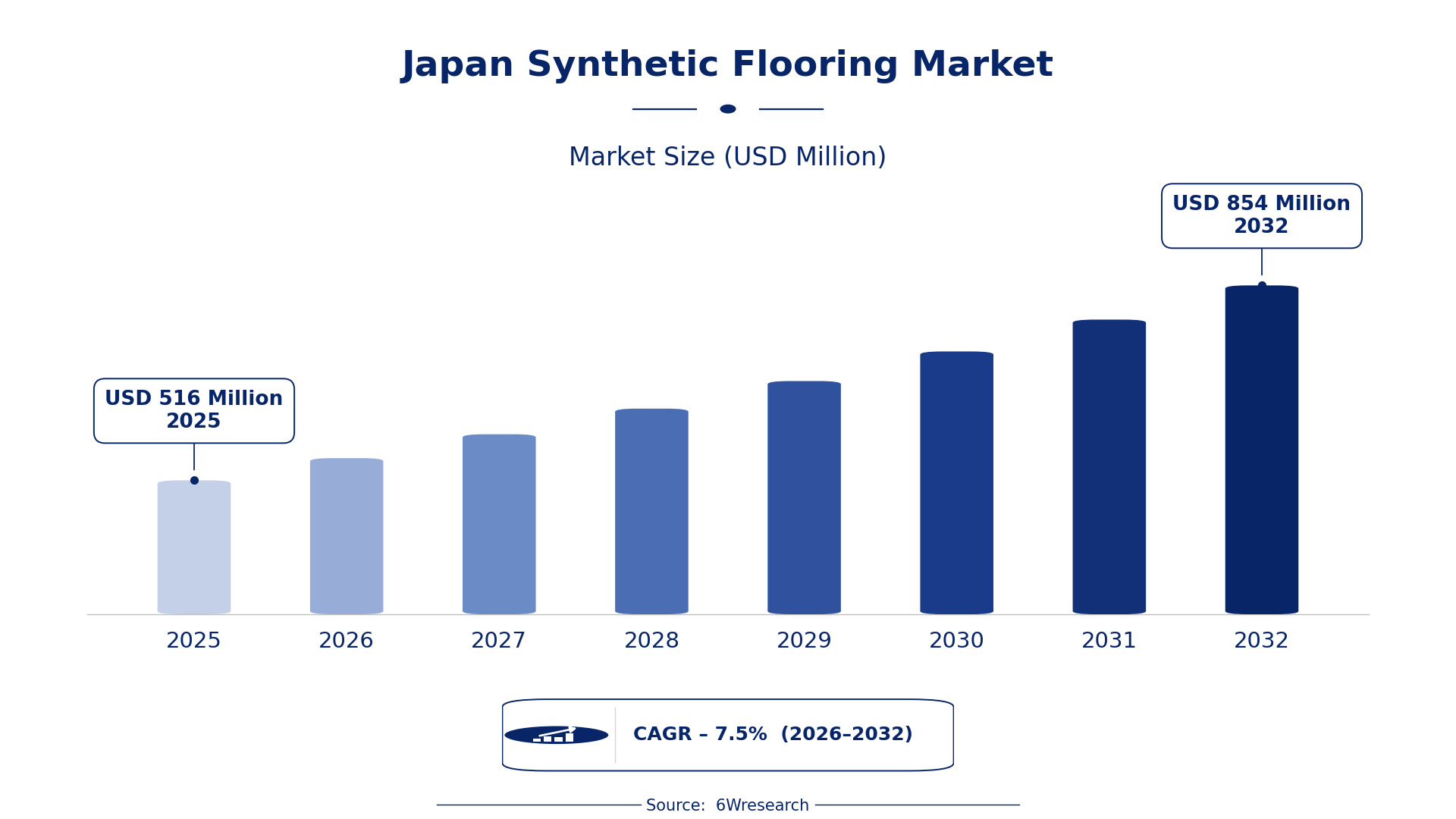
According to 6Wresearch internal database and industry insights, the Japan Synthetic Flooring Market was valued at USD 516 Million in 2025 and is projected to reach USD 854 Million by 2032, growing at a CAGR of approximately 7.5% during 2026–2032.
Japan Synthetic Flooring Market Highlights
| Report Metric | Details |
| Report Name | Japan Synthetic Flooring Market (2026-2032) |
| Market Size 2025 | USD 516 Million |
| Market Size 2032 | USD 854 Million |
| Absolute Growth 2025–2032 | USD 338 Million |
| CAGR 2026–2032 | 7.5% |
| Peak Annual Growth | 8.9% in 2032 |
| Forecast Period | 2026–2032 |
| Historical Data | 2022–2025 |
| Base Year | 2025 |
| Leading Flooring Type, 2025 | Vinyl Tiles (42% share) |
| Leading Base Material, 2025 | PVC (49% share) |
| Leading Installation Area, 2025 | Residential/Commercial (43% share) |
| Leading End User, 2025 | Flooring Contractors (36% share) |
| Fastest-Growing Flooring Type | Engineered Wood (10.5% CAGR) |
| Fastest-Growing Base Material | HDF with Laminate Layer (11.0% CAGR) |
| Fastest-Growing Installation Area | Luxury Apartments (9.4% CAGR) |
| Fastest-Growing End User | Interior Designers (9.7% CAGR) |
| Growing Sector | Residential construction |
| Key End Users | Flooring Contractors, Property Developers, Interior Designers, Fitness Facilities |
Japan Synthetic Flooring Market Year-wise Growth Rate and Key Drivers (2022–2032)
This graph illustrates the annual growth rates of the market from 2022 to 2032, highlighting a steady upward trajectory and projected market expansion over the forecast period.
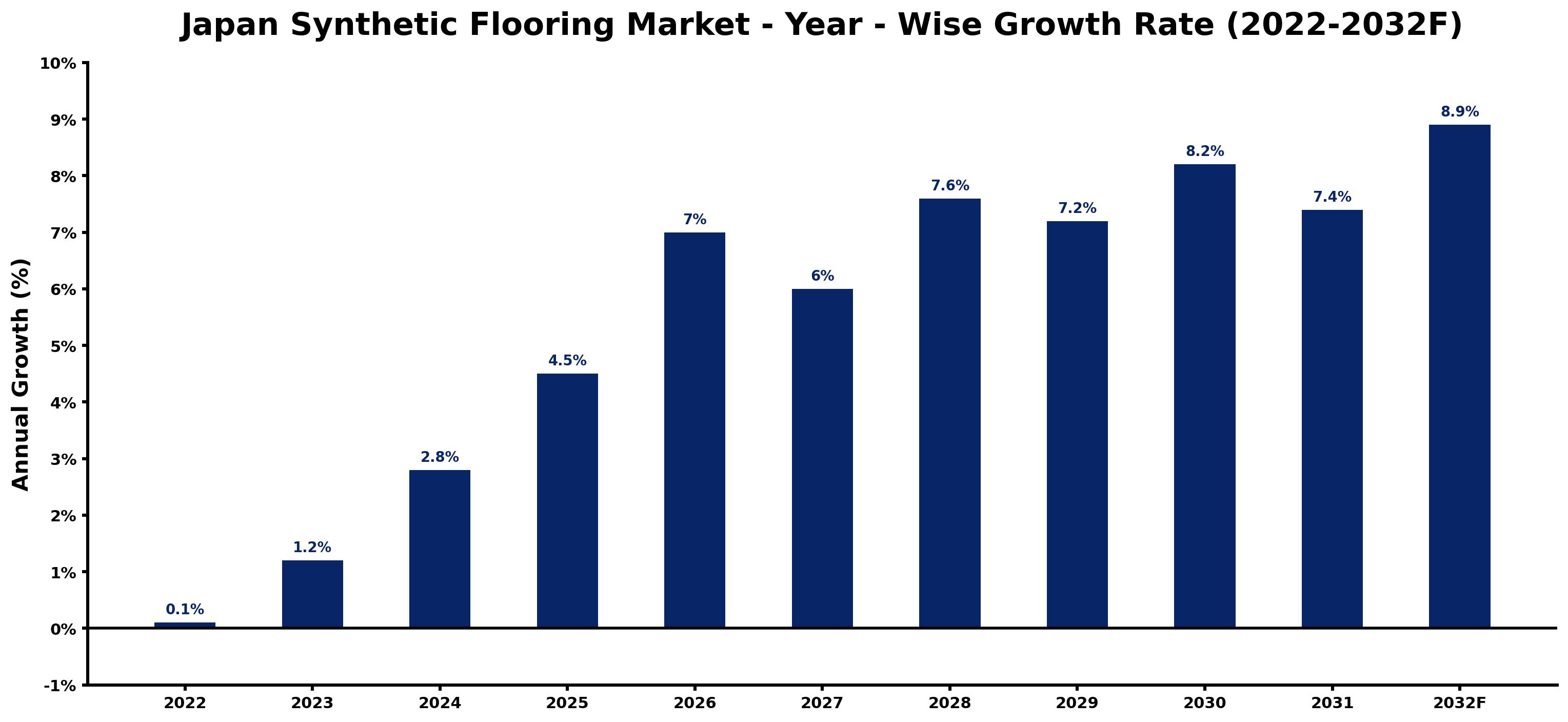
Annual growth estimates for each year appear below with the principal reason behind them, explaining the shifts that set the pace of the market.
| Year | Estimated Annual Growth (%) | Market Rationale |
| 2022 | 0.1 | The market experienced minimal growth due to limited construction activity and cautious spending. |
| 2023 | 1.2 | Urban development projects gained traction, resulting in faster growth than the previous year. |
| 2024 | 2.8 | Increased consumer interest in durable flooring options drove higher demand across sectors. |
| 2025 | 4.5 | Strong residential construction and renovation activities boosted sales, marking a peak year. |
| 2026 | 7.0 | Demand is expected to rise as eco-friendly flooring options gain popularity among consumers. |
| 2027 | 6.0 | Growth is projected to slow slightly as the market adjusts to previous high levels of activity. |
| 2028 | 7.6 | Renewed interest in luxury apartments is expected to spur a rebound in flooring purchases. |
| 2029 | 7.2 | The market is projected to experience another slowdown as growth stabilises after rapid expansion. |
| 2030 | 8.2 | New building codes will encourage the use of sustainable materials, driving demand. |
| 2031 | 7.4 | Growth is expected to decelerate slightly as the market reaches a more mature phase. |
| 2032 | 8.9 | Increasing investments in urban infrastructure and safety standards will peak the market. |
Note: Market size estimations and growth projections presented in this report are based on 6Wresearch's proprietary forecasting methodology, utilizing the latest available industry data, government publications, and primary research inputs.
Japan Synthetic Flooring Market Synopsis
Synthetic flooring offers durable solutions for residential and commercial spaces, primarily using materials like vinyl, rubber, and stone-polymer composites. The Japan Synthetic Flooring Market is expanding, driven by urban development and a growing focus on sustainability. In 2023, a green building initiative promoted sustainable materials, while the urban population of approximately 125 million continues to influence flooring choices and preferences.
Market Dynamics Impact Analysis (2026–2032)
| Factor | Type | Impact | Primary Segment Affected |
| Urban development projects are increasing demand for durable flooring solutions. | Driver | High | Residential/Commercial |
| Consumer preference for eco-friendly materials is driving innovation in flooring options. | Driver | High | Vinyl Tiles |
| The rise in luxury apartment construction creates opportunities for premium flooring solutions. | Opportunity | High | Luxury Apartments |
| Growing fitness facility numbers are increasing demand for specialized flooring types. | Opportunity | Medium | Rubber Flooring |
| Regulatory compliance with environmental standards can increase production costs. | Restraint | High | SPC Flooring |
| Limited awareness of synthetic flooring benefits among traditional buyers can hinder market growth. | Restraint | Medium | Engineered Wood |
| High competition among flooring contractors can lead to price wars affecting margins. | Challenge | High | Flooring Contractors |
| Supply chain disruptions can delay material availability for construction projects. | Challenge | Medium | Property Developers |
Evaluation of Drivers in Japan Synthetic Flooring Market (2026–2032)
The factors lifting demand, and the evidence behind each, are summarised below.
| Drivers | Primary Segment Affected | Why It Matters (Evidence) |
| Urbanisation is driving demand for durable flooring in residential and commercial projects. | Residential/Commercial | In 2022, residential construction accounted for approximately 1.1 million units, increasing flooring purchases. |
| The shift towards sustainable building practices is increasing the adoption of eco-friendly flooring materials. | Vinyl Tiles | In 2023, the government launched a green building initiative promoting sustainable materials. |
| The growth of fitness facilities is boosting the demand for specialized rubber flooring. | Rubber Flooring | The number of fitness facilities in Japan was estimated at over 30,000 in 2022, driving demand. |
| Rising disposable incomes are enabling consumers to invest in premium flooring options for luxury apartments. | Luxury Apartments | The demand for premium flooring solutions is increasing as urban living spaces evolve. |
| The increasing focus on safety standards in building regulations is driving demand for high-quality flooring materials. | SPC Flooring | The Tokyo Metropolitan Government initiated a program in 2023 to enhance building safety standards. |
Most of the extra volume comes from urbanisation, particularly in major cities where residential construction accounted for approximately 1.1 million units in 2022. Additionally, the increasing number of fitness facilities, estimated at over 30,000, is driving demand for specialised flooring. As disposable incomes rise, consumers are investing in premium flooring options, particularly in urban developments, while updated safety standards are pushing buyers towards higher-quality materials.
Evaluation of Restraints in Japan Synthetic Flooring Market
Several factors work against faster growth; the main ones are summarised below.
| Market Restraint | Primary Segment Affected | Why It Matters (Evidence) |
| Compliance with environmental regulations can increase production costs for flooring manufacturers. | SPC Flooring | The Plastic Resource Circulation Act requires manufacturers to invest in sustainable practices, raising costs by up to 10%. |
| Limited awareness of synthetic flooring benefits among traditional buyers can hinder market growth. | Engineered Wood | Many consumers still prefer traditional flooring options, affecting adoption rates significantly. |
| High competition among flooring contractors can lead to price wars affecting margins. | Flooring Contractors | The influx of new entrants into the market has intensified competition, squeezing profit margins. |
| Supply chain disruptions can delay material availability for construction projects. | Property Developers | Global supply chain issues have affected the timely delivery of flooring materials, causing project delays. |
| Economic fluctuations can impact consumer spending on renovation projects. | Luxury Apartments | Economic uncertainty can lead to reduced investments in high-end flooring, affecting demand. |
Japan Synthetic Flooring Market Challenges
Producers face a shortage of skilled labour, which delays project completions for contractors and increases costs. Many manufacturers utilise outdated technology, resulting in longer lead times that affect distributors' ability to meet market demand. Buyers encounter rising costs as they seek sustainable flooring options, with the government's green building initiative potentially increasing prices by 15%. Intense competition among suppliers results in price wars, squeezing margins for importers and limiting their capacity to invest in quality materials.
Trends in the Japan Synthetic Flooring Market
Several trends are reshaping the Japan Synthetic Flooring Market; the most important are set out below.
- Increase in Fitness Facilities Driving Demand for Rubber Flooring: The number of fitness facilities in Japan exceeded 30,000 in 2022, creating a surge in demand for durable rubber flooring, reflecting a growing focus on health.
- Rising Popularity of Luxury Apartments: Luxury apartments are gaining traction in urban areas, with flooring demand projected to grow at a CAGR of 9.4%, driving interest in premium solutions.
- Shift towards Eco-Friendly Flooring Solutions: In 2023, a government initiative promoted sustainable flooring materials, leading to increased adoption among flooring contractors, with many prioritising eco-friendly options.
- Emphasis on Building Safety Standards: The Tokyo Metropolitan Government's 2023 program to enhance building safety standards is influencing flooring choices, pushing buyers towards high-quality materials that comply with new regulations.
Investment Opportunities in the Japan Synthetic Flooring Market
The following opportunities in the Japan Synthetic Flooring Market pair current demand with a clear way in.
- Property Developers Seeking Sustainable Flooring Solutions: Property developers are increasingly looking for eco-friendly flooring options, particularly in urban areas. The 2023 green building initiative supports this shift, encouraging investments in sustainable materials.
- Flooring Contractors Adopting New Materials: Flooring contractors are exploring new synthetic materials to meet growing consumer demand. Collaborating with local suppliers can facilitate access to innovative flooring solutions.
- Growing Demand for Luxury Flooring in Urban Areas: With urbanisation driving demand, there is a significant opportunity to supply premium flooring solutions. Targeting luxury apartment developments can yield substantial returns.
- Expansion of Fitness Facilities Creating Flooring Demand: The rise in fitness facilities presents a chance to supply specialised rubber flooring. Engaging with fitness centre operators can lead to fruitful partnerships.
Government Initiatives in the Japan Synthetic Flooring Market
The Plastic Resource Circulation Act, enacted in 2021, mandates the reduction, reuse, and recycling of plastics, impacting flooring producers by encouraging the use of sustainable materials. Compliance with this act requires investments in eco-friendly practices, which can increase costs by 10% for manufacturers and appeal to environmentally conscious buyers.
The Ministry of Land, Infrastructure, Transport and Tourism oversees building regulations affecting flooring materials. In practice, flooring contractors must adhere to updated safety standards, ensuring that their products meet the latest requirements for durability and safety.
Future Insight of the Japan Synthetic Flooring Market
Advancements in polymerisation technology will transform synthetic flooring demand by 2032, enhancing durability and eco-friendliness. Government initiatives promoting sustainable materials will encourage suppliers to adopt compliant products, creating new opportunities. Stricter building safety standards will necessitate higher-quality flooring choices, influencing buyer preferences. Urban development will drive the need for adaptable flooring solutions, with residential construction expected to reach approximately 1.2 million units annually, shaping future market dynamics.
Market Segmentation Analysis
Japan Synthetic Flooring Market report covers a detailed analysis of the following market segments:
By Flooring Type – Vinyl Tiles Lead, Engineered Wood Expected to Grow Fastest
According to Saurav Kr Singh, Senior Research Analyst at 6Wresearch, in 2025, Vinyl Tiles led the flooring type split with a 42% share. Vinyl tiles dominate the market due to their versatility and durability, making them a preferred choice for both residential and commercial spaces. Their widespread use in urban areas like Tokyo and Osaka showcases their importance in high-traffic environments. Engineered Wood is projected to grow fastest, at a CAGR of 10.5% during 2026–2032. Engineered wood is experiencing rapid growth as consumers increasingly seek aesthetically pleasing options for home interiors. The rising popularity of engineered wood in newly constructed luxury apartments drives this segment's expansion. Suppliers should focus on promoting vinyl tiles while also exploring opportunities in engineered wood to capture emerging trends.
By Base Material – PVC Leads, HDF with Laminate Layer Expected to Grow Fastest
PVC took 49% of base material revenue in 2025, more than any other category. PVC is the primary material for various synthetic flooring types, which solidifies its leading position in the market. Its extensive application in both residential and commercial sectors, particularly in urban areas, highlights its essential role in flooring solutions throughout Japan. HDF with Laminate Layer is set to record the highest CAGR in this split, 11.0% over 2026–2032. HDF with laminate layer is witnessing rapid growth, especially in engineered wood products, as consumers increasingly prefer cost-effective and visually appealing flooring options. This trend is particularly evident in upscale residential developments, where demand for such materials is on the rise. Suppliers should prioritise PVC production while also considering HDF with laminate layer options to meet evolving consumer demands.
By Installation Area – Residential/Commercial Leads, Luxury Apartments Expected to Grow Fastest
Residential/Commercial accounted for 43% of the market by installation area in 2025. The residential and commercial sectors are the largest application areas for synthetic flooring, reflecting diverse demand across various building types. This segment's significance is especially pronounced in urban regions, where construction activities are thriving. The quickest growth will come from Luxury Apartments, forecast to expand at a CAGR of 9.4% between 2026 and 2032. Luxury apartments are the fastest-growing segment in flooring installation areas, as developers prioritise high-end finishes to appeal to affluent buyers. The rising number of such developments in urban locales is driving this growth. Suppliers must adapt their product offerings to meet the needs of both residential/commercial markets and the premium demands of luxury apartment developments.
By End User – Flooring Contractors Lead, Interior Designers Expected to Grow Fastest
Flooring Contractors held 36% of the Japan Synthetic Flooring Market by end user in 2025. Flooring contractors are the main users of synthetic flooring, significantly contributing to installation and renovation projects across various sectors. Their reliance on durable materials and expertise in the field is essential for maintaining market momentum. Over 2026–2032, Interior Designers are expected to post the fastest growth, at a CAGR of 9.7%. Interior designers are becoming more pivotal in selecting flooring materials, as they strive to create unique environments for their clients. Their increasing participation in residential projects is driving notable growth in this segment. Engaging with interior designers can provide suppliers with critical insights and opportunities to influence flooring choices in the market.
Key Attractiveness of the Report
- 10 Years of Market Numbers
- Historical Data Starting from 2022 to 2025
- Base Year 2025
- Forecast Data until 2032
- Key Performance Indicators Impacting the Market
- Major Upcoming Developments and Projects
Key Highlights of the Report:
- Japan Synthetic Flooring Market Outlook
- Market Size of Japan Synthetic Flooring Market, 2025
- Forecast of Japan Synthetic Flooring Market, 2032
- Historical Data and Forecast of Japan Synthetic Flooring Revenues & Volume for the Period 2022-2032F
- Japan Synthetic Flooring Market Trend Evolution
- Japan Synthetic Flooring Market Drivers and Challenges
- Japan Synthetic Flooring Price Trends
- Japan Synthetic Flooring Porter's Five Forces
- Japan Synthetic Flooring Industry Life Cycle
- Historical Data and Forecast of Japan Synthetic Flooring Market Revenues & Volume By Flooring Type for the Period 2022-2032F
- Historical Data and Forecast of Japan Synthetic Flooring Market Revenues & Volume By Vinyl Tiles for the Period 2022-2032F
- Historical Data and Forecast of Japan Synthetic Flooring Market Revenues & Volume By Engineered Wood for the Period 2022-2032F
- Historical Data and Forecast of Japan Synthetic Flooring Market Revenues & Volume By Rubber Flooring for the Period 2022-2032F
- Historical Data and Forecast of Japan Synthetic Flooring Market Revenues & Volume By SPC Flooring for the Period 2022-2032F
- Historical Data and Forecast of Japan Synthetic Flooring Market Revenues & Volume By Base Material for the Period 2022-2032F
- Historical Data and Forecast of Japan Synthetic Flooring Market Revenues & Volume By PVC for the Period 2022-2032F
- Historical Data and Forecast of Japan Synthetic Flooring Market Revenues & Volume By HDF with Laminate Layer for the Period 2022-2032F
- Historical Data and Forecast of Japan Synthetic Flooring Market Revenues & Volume By Synthetic Rubber for the Period 2022-2032F
- Historical Data and Forecast of Japan Synthetic Flooring Market Revenues & Volume By Stone-Polymer Composite for the Period 2022-2032F
- Historical Data and Forecast of Japan Synthetic Flooring Market Revenues & Volume By Installation Area for the Period 2022-2032F
- Historical Data and Forecast of Japan Synthetic Flooring Market Revenues & Volume By Residential/Commercial for the Period 2022-2032F
- Historical Data and Forecast of Japan Synthetic Flooring Market Revenues & Volume By Luxury Apartments for the Period 2022-2032F
- Historical Data and Forecast of Japan Synthetic Flooring Market Revenues & Volume By Gyms, Schools for the Period 2022-2032F
- Historical Data and Forecast of Japan Synthetic Flooring Market Revenues & Volume By High Traffic Areas for the Period 2022-2032F
- Historical Data and Forecast of Japan Synthetic Flooring Market Revenues & Volume By End User for the Period 2022-2032F
- Historical Data and Forecast of Japan Synthetic Flooring Market Revenues & Volume By Flooring Contractors for the Period 2022-2032F
- Historical Data and Forecast of Japan Synthetic Flooring Market Revenues & Volume By Interior Designers for the Period 2022-2032F
- Historical Data and Forecast of Japan Synthetic Flooring Market Revenues & Volume By Fitness Facilities for the Period 2022-2032F
- Historical Data and Forecast of Japan Synthetic Flooring Market Revenues & Volume By Property Developers for the Period 2022-2032F
- Japan Synthetic Flooring Import Export Trade Statistics
- Market Opportunity Assessment By Flooring Type
- Market Opportunity Assessment By Base Material
- Market Opportunity Assessment By Installation Area
- Market Opportunity Assessment By End User
- Japan Synthetic Flooring Top Companies Market Share
- Japan Synthetic Flooring Competitive Benchmarking By Technical and Operational Parameters
- Japan Synthetic Flooring Company Profiles
- Japan Synthetic Flooring Key Strategic Recommendations
Market Covered
The study includes the following segmentation.
By Flooring Type
- Vinyl Tiles
- Engineered Wood
- Rubber Flooring
- SPC Flooring
By Base Material
- PVC
- HDF with Laminate Layer
- Synthetic Rubber
- Stone-Polymer Composite
By Installation Area
- Residential/Commercial
- Luxury Apartments
- Gyms
- Schools
- High Traffic Areas
By End User
- Flooring Contractors
- Interior Designers
- Fitness Facilities
- Property Developers































