Japan Synthetic Food Color Market Size & Growth Rate
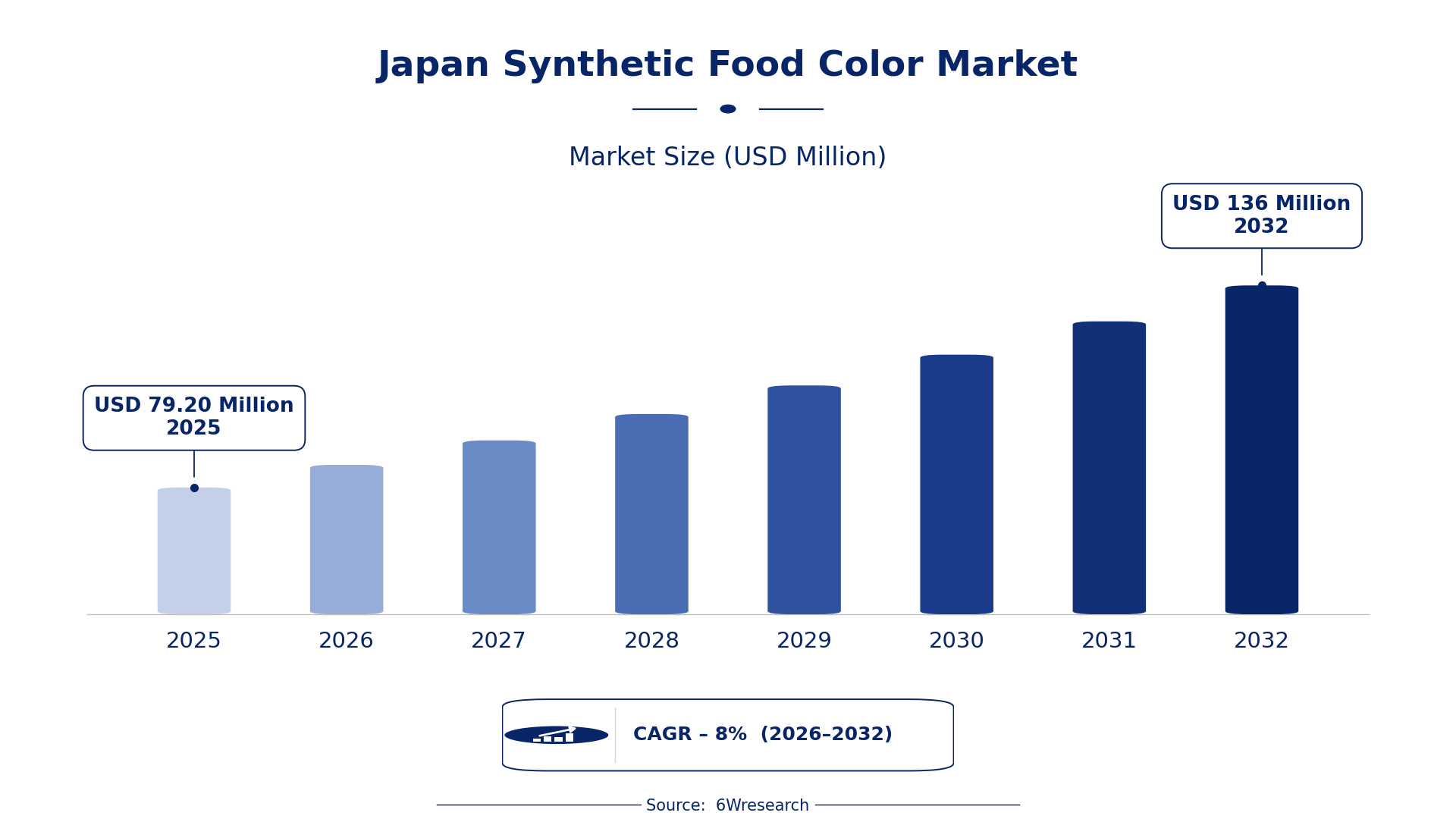
According to 6Wresearch internal database and industry insights, the Japan Synthetic Food Color Market was valued at USD 79.20 Million in 2025 and is projected to reach USD 136 Million by 2032, growing at a CAGR of approximately 8% during 2026–2032.
Japan Synthetic Food Color Market Highlights
| Report Metric | Details |
| Report Name | Japan Synthetic Food Color Market (2026-2032) |
| Market Size 2025 | USD 79.20 Million |
| Market Size 2032 | USD 136 Million |
| Absolute Growth 2025–2032 | USD 56.80 Million |
| CAGR 2026–2032 | 8% |
| Peak Annual Growth | 8.5% in 2028 |
| Forecast Period | 2026–2032 |
| Historical Data | 2022–2025 |
| Base Year | 2025 |
| Leading Color Type, 2025 | Red (Allura Red) (42% share) |
| Leading Chemical Source, 2025 | Azo Dye (40% share) |
| Leading Food Category, 2025 | Confectionery (40% share) |
| Leading End User, 2025 | Candy Manufacturers (55% share) |
| Fastest-Growing Color Type | Yellow (Tartrazine) (12.0% CAGR) |
| Fastest-Growing Food Category | Beverages (10.3% CAGR) |
| Fastest-Growing End User | Juice Makers (10.0% CAGR) |
| Growing Sector | Juice Makers |
| Key End Users | Candy Manufacturers, Juice Makers, Ice Cream Brands, Baking Brands |
Japan Synthetic Food Color Market Year-wise Growth Rate and Key Drivers (2022–2032)
This graph illustrates the annual growth rates of the market from 2022 to 2032, highlighting a steady upward trajectory and projected market expansion over the forecast period.
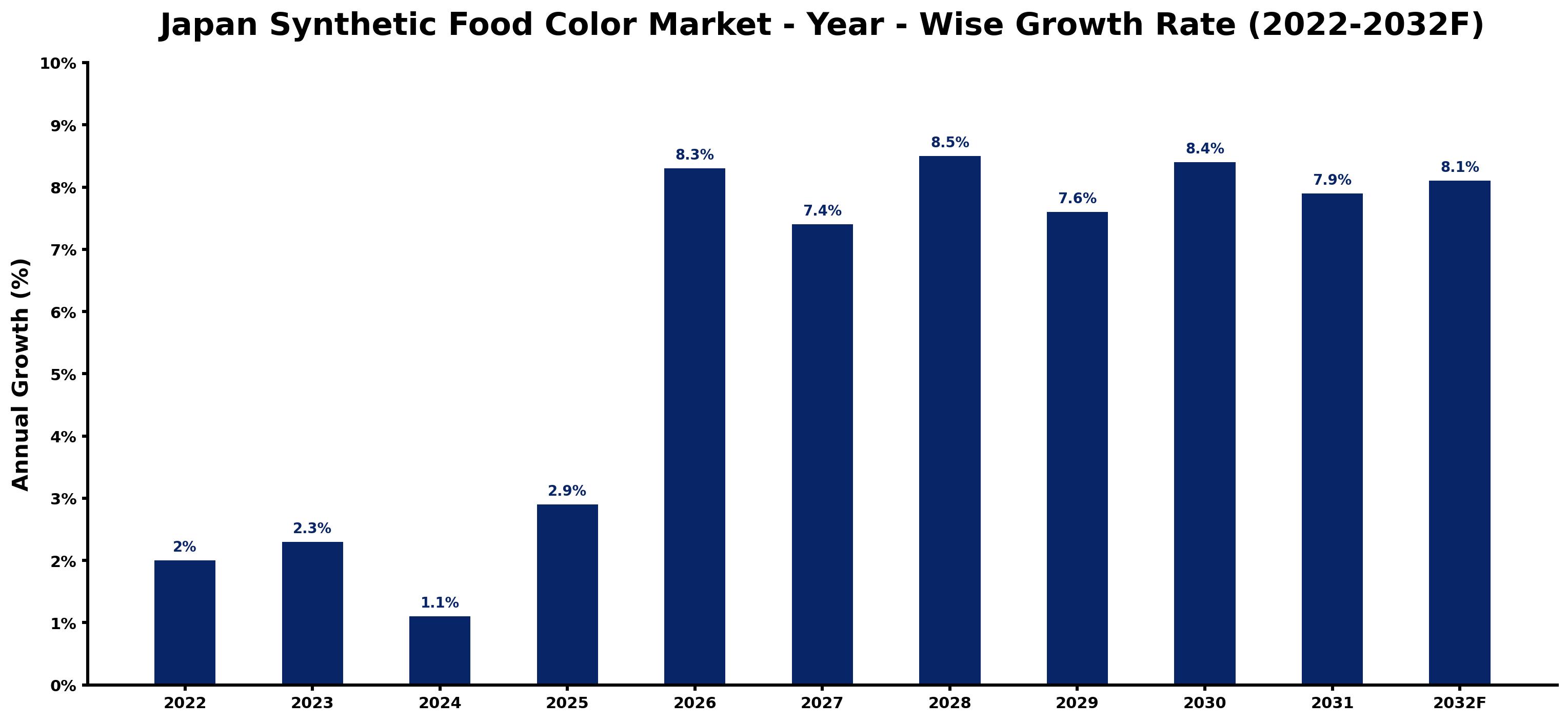
Each row of the following table gives one year's estimated growth and the event or demand shift that explains it.
| Year | Estimated Annual Growth (%) | Market Rationale |
| 2022 | 2.0 | The market experienced steady growth due to consistent demand from the confectionery sector. |
| 2023 | 2.3 | Growth accelerated as manufacturers increased production in response to rising consumer preferences. |
| 2024 | 1.1 | A slowdown occurred as market conditions adjusted to changing consumer tastes and preferences. |
| 2025 | 2.9 | Demand surged as the bakery industry expanded, driving higher consumption of food colors. |
| 2026 | 8.3 | Growth is expected to rise due to increasing production capacities in the beverage sector. |
| 2027 | 7.4 | A slight slowdown is projected as the market stabilises after rapid growth in previous years. |
| 2028 | 8.5 | The market is expected to peak as the confectionery sector sees unprecedented demand for vibrant colors. |
| 2029 | 7.6 | Growth is projected to slow slightly as manufacturers adjust to market saturation in certain segments. |
| 2030 | 8.4 | Demand is expected to rebound as innovative products in the beverage sector emerge, boosting consumption. |
| 2031 | 7.9 | A moderate slowdown is anticipated as market growth begins to stabilise after rapid expansion. |
| 2032 | 8.1 | Growth is projected to resume as the dairy segment expands, increasing the need for synthetic colors. |
Note: Market size estimations and growth projections presented in this report are based on 6Wresearch's proprietary forecasting methodology, utilizing the latest available industry data, government publications, and primary research inputs.
Japan Synthetic Food Color Market Synopsis
Synthetic food colors are artificial colorants used to enhance the visual appeal of food products, particularly in confectionery, beverages, dairy products, and baked goods. The Japan Synthetic Food Color Market is expanding due to increasing demand from the confectionery and beverage sectors. Valued at approximately 2 trillion JPY in 2022, the confectionery market drives manufacturers to utilise synthetic colors to meet consumer preferences for visually appealing items. The anticipated growth in the bakery industry further supports this trend, as more products require vibrant coloration, indicating a strong market outlook.
Market Dynamics Impact Analysis (2026–2032)
| Factor | Type | Impact | Primary Segment Affected |
| Rising demand from the confectionery sector | Driver | High | Confectionery |
| Expansion of the beverage industry | Driver | High | Beverages |
| Increasing production capabilities in the bakery sector | Opportunity | High | Bakery & Snacks |
| Growing interest in visually appealing dairy products | Opportunity | Medium | Dairy Products |
| Regulatory compliance costs affecting small manufacturers | Restraint | High | Red (Allura Red) |
| Market saturation in certain color segments | Restraint | Medium | Red (Allura Red) |
| Rising competition from natural food color alternatives | Challenge | High | Red (Allura Red) |
| Fluctuating raw material prices impacting production costs | Challenge | Medium | Red (Allura Red) |
Evaluation of Drivers in Japan Synthetic Food Color Market (2026–2032)
The table below links each growth driver to the segment it affects and the evidence for it.
| Drivers | Primary Segment Affected | Why It Matters (Evidence) |
| Increased consumption of confectionery products | Confectionery | As Japan's confectionery market was valued at approximately 2 trillion JPY in 2022, manufacturers are investing in vibrant colors to attract consumers. |
| Growth in the beverage sector | Beverages | The beverage industry accounted for a significant share of synthetic color usage, driving demand for colorants in soft drinks and juices. |
| Expansion of the bakery industry | Bakery & Snacks | The bakery industry is projected to grow by 5% annually, increasing the need for synthetic food colors to improve product appeal. |
| Rising consumer preference for visually appealing dairy products | Dairy Products | With the dairy segment accounting for 15% of total food color usage, manufacturers are investing in synthetic colors to meet consumer expectations. |
| Innovation in product formulations | Red (Allura Red) | The introduction of new products with unique color requirements is driving demand for diverse synthetic color options. |
Spending rises because the confectionery market, valued at approximately 2 trillion JPY in 2022, has led to increased demand for vibrant synthetic colors. The beverage sector also plays a major role, as it is a primary consumer of food colorants, especially soft drinks. The bakery industry is projected to expand by 5% annually, which will increase the need for synthetic food colors to improve product appeal. The dairy segment, accounting for 15% of total food color usage, is driving manufacturers to invest in synthetic colors to meet consumer expectations. New product formulations are creating opportunities for unique color applications, further boosting demand.
Evaluation of Restraints in Japan Synthetic Food Color Market
The main factors holding the market back are set out below.
| Market Restraint | Primary Segment Affected | Why It Matters (Evidence) |
| Compliance costs with food safety regulations | Red (Allura Red) | Regulatory compliance costs can burden small manufacturers, limiting their ability to compete effectively in the market. |
| Market saturation in certain color segments | Red (Allura Red) | Market saturation in specific color segments can restrict growth opportunities for manufacturers, affecting overall market performance. |
| Consumer shift towards natural colorants | Red (Allura Red) | The rising popularity of natural food color alternatives is challenging the market share of synthetic colors among health-conscious consumers. |
| Fluctuating raw material prices | Red (Allura Red) | Fluctuating prices of raw materials can impact production costs, leading to pricing pressures for synthetic food color manufacturers. |
| Limited awareness of synthetic color benefits | Red (Allura Red) | Limited consumer awareness regarding the advantages of synthetic colors can hinder market growth and acceptance. |
Japan Synthetic Food Color Market Challenges
Japan's synthetic food color market faces competition from natural alternatives, which attract health-conscious consumers, forcing manufacturers to reduce prices and erode profit margins. Rising production costs, linked to a national minimum wage increase to JPY 1,055 per hour, burden food manufacturers, delaying product launches and limiting their responsiveness. Compliance with stringent JIS and ISO 22000 standards for food safety adds financial pressure on producers, restricting their ability to innovate and meet market demands. Regulatory requirements, such as mandatory labeling of synthetic colors, complicate marketing efforts for buyers, extending their time to market by several weeks.
Trends in the Japan Synthetic Food Color Market
The following changes are redrawing the Japan Synthetic Food Color Market.
- Shift towards vibrant color formulations: Manufacturers are increasingly focusing on vibrant color formulations to meet consumer preferences, especially in the confectionery sector. In 2023, the annual consumption of synthetic food colors in Japan was estimated at 5,000 tons, reflecting this trend.
- Growing demand for custom color solutions: The demand for custom color solutions is rising as manufacturers seek to differentiate their products. This trend is evident in the bakery industry, where unique color formulations are becoming popular, with the segment projected to grow significantly.
- Increased regulation on food safety: Regulations surrounding food safety are tightening, leading to greater scrutiny of synthetic food colors. The Food Sanitation Act amendment in 2018 introduced a positive list system, impacting how manufacturers formulate their products.
- Emergence of specialty food products: The emergence of specialty food products, particularly in the dairy and beverage sectors, is driving the need for unique synthetic colors. The ice cream market in Japan is projected to reach 800 billion JPY by 2025, showcasing this trend.
Investment Opportunities in the Japan Synthetic Food Color Market
Below are the investment opportunities with the strongest case in the Japan Synthetic Food Color Market.
- Candy Manufacturers seeking vibrant colors: Candy manufacturers are looking for vibrant synthetic colors to enhance product appeal. With the confectionery market valued at approximately 2 trillion JPY, there is a significant opportunity for suppliers to provide vibrant color options.
- Bakery industry expansion: The bakery industry is expected to grow, creating a demand for synthetic food colors. The projected growth in this sector presents an opportunity for suppliers to cater to the needs of baking brands.
- Dairy product innovation: Dairy producers are increasingly interested in synthetic colors to improve product aesthetics. As the dairy segment accounts for 15% of total food color usage, suppliers can focus on this growing market.
- Beverage sector growth: The beverage industry remains a major consumer of synthetic colors, especially soft drinks. Suppliers can target this sector by providing innovative color solutions to meet evolving consumer preferences.
Government Initiatives in the Japan Synthetic Food Color Market
The Food Sanitation Act, established in 1947, regulates safety and quality standards for synthetic food colors. Amendments in 2018 introduced a positive list system for synthetic resins used in food packaging, ensuring that all food colorants meet safety requirements. This law benefits both producers and consumers by ensuring compliance with safety standards.
The Japan Food Additives Association oversees the implementation of food safety regulations, approving new food additives and funding initiatives to promote food safety. In 2023, the government allocated 500 million JPY for food safety initiatives, supporting compliance and safety standards for synthetic food colors.
Future Insight of the Japan Synthetic Food Color Market
The upcoming food safety programme initiated by the Ministry of Health, Labour and Welfare will improve compliance and safety standards for synthetic food colors, benefiting both suppliers and buyers. By 2032, advancements in production technology will streamline manufacturing processes, enabling suppliers to reduce costs and improve efficiency. The bakery industry's growth will drive demand for synthetic colors, with the dairy product segment accounting for 15% of total usage, creating new opportunities for producers. As consumer preferences shift, suppliers must adapt their offerings to meet the increasing demand for visually appealing foods.
Market Segmentation Analysis
Japan Synthetic Food Color Market report covers a detailed analysis of the following market segments:
By Color Type – Red (Allura Red) Leads, Yellow (Tartrazine) Expected to Grow Fastest
According to Saurav Kr Singh, Senior Research Analyst at 6Wresearch, Red (Allura Red) took 42% of color type revenue in 2025, more than any other category. Red (Allura Red) holds the largest share due to its prevalent use in candies and beverages, which are highly sought after by consumers. The confectionery sector's preference for vibrant colours significantly drives the demand for this particular colorant. Yellow (Tartrazine) is projected to grow fastest, at a CAGR of 12.0% during 2026–2032. Yellow (Tartrazine) is experiencing rapid growth, mainly because of its widespread use in soft drinks and snacks, which are becoming increasingly popular. This surge reflects the overall market expansion for synthetic food colors as consumer preferences shift towards these products. Suppliers should prioritise their offerings in the beverage sector to take advantage of the rising demand for Yellow (Tartrazine).
By Chemical Source – Azo Dye Leads and Records the Fastest Growth
The largest chemical source category in 2025 was Azo Dye, at 40% of revenue. Azo Dye is the leading chemical source for synthetic colors, as it serves as the primary source for many colorants used across various food products. Its established presence in the market ensures a steady supply to meet the demands of food manufacturers. Its lead should widen, with a projected CAGR of 10.9% during 2026–2032, the highest in this split. Azo Dye is also the fastest-growing segment, as its versatility allows for a wider application in various food categories, maintaining its dominance. The continued expansion of the food processing industry contributes to this growth. Suppliers should invest in Azo Dye production capabilities to meet the rising demand from food manufacturers across multiple segments.
By Food Category – Confectionery Leads, Beverages Expected to Grow Fastest
With 40% of food category revenue in 2025, Confectionery was the largest category. Confectionery is the leading category for synthetic food colors, mainly due to its prominent use in candies and sweets that appeal to consumers. The strong consumer preference for visually attractive confectionery items drives the demand for synthetic colorants in this sector. The quickest growth will come from Beverages, forecast to expand at a CAGR of 10.3% between 2026 and 2032. Beverages are the fastest-growing category, largely attributed to the rising consumption of soft drinks among the population. This shift towards colourful and visually appealing beverages indicates a growing market for synthetic food colors. Suppliers should target the beverage industry to align with the growing trend of colourful drink products.
By End User – Candy Manufacturers Lead, Juice Makers Expected to Grow Fastest
Candy Manufacturers held 55% of the Japan Synthetic Food Color Market by end user in 2025. Candy Manufacturers dominate the market as they rely heavily on synthetic colors to enhance the visual appeal of their products. This sector's strong demand for colourful confections ensures a consistent market for synthetic food colors. Over 2026–2032, Juice Makers are expected to post the fastest growth, at a CAGR of 10.0%. Juice Makers are the fastest-growing end-user segment, spurred by the rising demand for visually appealing juices. The trend towards health-conscious choices drives the need for attractively coloured juice products. Suppliers should create customised solutions for Juice Makers to leverage the increasing trend for vibrant and appealing juice offerings.
Key Attractiveness of the Report
- 10 Years of Market Numbers
- Historical Data Starting from 2022 to 2025
- Base Year 2025
- Forecast Data until 2032
- Key Performance Indicators Impacting the Market
- Major Upcoming Developments and Projects
Key Highlights of the Report:
- Japan Synthetic Food Color Market Outlook
- Market Size of Japan Synthetic Food Color Market, 2025
- Forecast of Japan Synthetic Food Color Market, 2032
- Historical Data and Forecast of Japan Synthetic Food Color Revenues & Volume for the Period 2022-2032F
- Japan Synthetic Food Color Market Trend Evolution
- Japan Synthetic Food Color Market Drivers and Challenges
- Japan Synthetic Food Color Price Trends
- Japan Synthetic Food Color Porter's Five Forces
- Japan Synthetic Food Color Industry Life Cycle
- Historical Data and Forecast of Japan Synthetic Food Color Market Revenues & Volume By Color Type for the Period 2022-2032F
- Historical Data and Forecast of Japan Synthetic Food Color Market Revenues & Volume By Red (Allura Red) for the Period 2022-2032F
- Historical Data and Forecast of Japan Synthetic Food Color Market Revenues & Volume By Yellow (Tartrazine) for the Period 2022-2032F
- Historical Data and Forecast of Japan Synthetic Food Color Market Revenues & Volume By Blue (Brilliant Blue) for the Period 2022-2032F
- Historical Data and Forecast of Japan Synthetic Food Color Market Revenues & Volume By Green (Fast Green) for the Period 2022-2032F
- Historical Data and Forecast of Japan Synthetic Food Color Market Revenues & Volume By Chemical Source for the Period 2022-2032F
- Historical Data and Forecast of Japan Synthetic Food Color Market Revenues & Volume By Azo Dye for the Period 2022-2032F
- Historical Data and Forecast of Japan Synthetic Food Color Market Revenues & Volume By Sulfonated Azo for the Period 2022-2032F
- Historical Data and Forecast of Japan Synthetic Food Color Market Revenues & Volume By Triarylmethane Dye for the Period 2022-2032F
- Historical Data and Forecast of Japan Synthetic Food Color Market Revenues & Volume By Combined Dyes for the Period 2022-2032F
- Historical Data and Forecast of Japan Synthetic Food Color Market Revenues & Volume By Food Category for the Period 2022-2032F
- Historical Data and Forecast of Japan Synthetic Food Color Market Revenues & Volume By Confectionery for the Period 2022-2032F
- Historical Data and Forecast of Japan Synthetic Food Color Market Revenues & Volume By Beverages for the Period 2022-2032F
- Historical Data and Forecast of Japan Synthetic Food Color Market Revenues & Volume By Dairy Products for the Period 2022-2032F
- Historical Data and Forecast of Japan Synthetic Food Color Market Revenues & Volume By Bakery & Snacks for the Period 2022-2032F
- Historical Data and Forecast of Japan Synthetic Food Color Market Revenues & Volume By End User for the Period 2022-2032F
- Historical Data and Forecast of Japan Synthetic Food Color Market Revenues & Volume By Candy Manufacturers for the Period 2022-2032F
- Historical Data and Forecast of Japan Synthetic Food Color Market Revenues & Volume By Juice Makers for the Period 2022-2032F
- Historical Data and Forecast of Japan Synthetic Food Color Market Revenues & Volume By Ice Cream Brands for the Period 2022-2032F
- Historical Data and Forecast of Japan Synthetic Food Color Market Revenues & Volume By Baking Brands for the Period 2022-2032F
- Japan Synthetic Food Color Import Export Trade Statistics
- Market Opportunity Assessment By Color Type
- Market Opportunity Assessment By Chemical Source
- Market Opportunity Assessment By Food Category
- Market Opportunity Assessment By End User
- Japan Synthetic Food Color Top Companies Market Share
- Japan Synthetic Food Color Competitive Benchmarking By Technical and Operational Parameters
- Japan Synthetic Food Color Company Profiles
- Japan Synthetic Food Color Key Strategic Recommendations
Market Covered
Coverage by segment is as follows.
By Color Type
- Red (Allura Red)
- Yellow (Tartrazine)
- Blue (Brilliant Blue)
- Green (Fast Green)
By Chemical Source
- Azo Dye
- Sulfonated Azo
- Triarylmethane Dye
- Combined Dyes
By Food Category
- Confectionery
- Beverages
- Dairy Products
- Bakery & Snacks
By End User
- Candy Manufacturers
- Juice Makers
- Ice Cream Brands
- Baking Brands































