Japan Synthetic Grass Market Size & Growth Rate
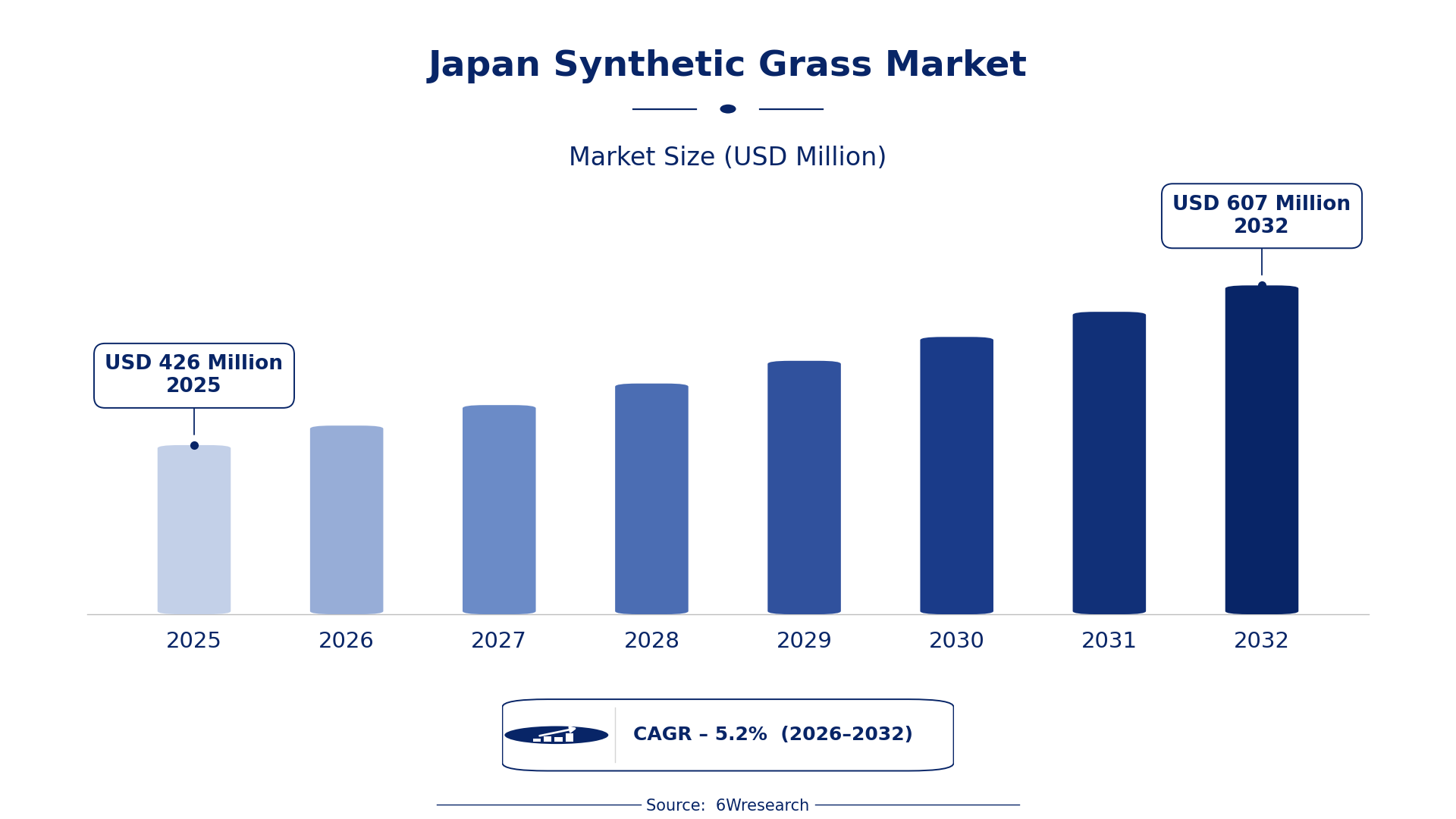
According to 6Wresearch internal database and industry insights, the Japan Synthetic Grass Market was valued at USD 426 Million in 2025 and is projected to reach USD 607 Million by 2032, growing at a CAGR of approximately 5.2% during 2026–2032.
Japan Synthetic Grass Market Highlights
| Report Metric | Details |
| Report Name | Japan Synthetic Grass Market (2026-2032) |
| Market Size 2025 | USD 426 Million |
| Market Size 2032 | USD 607 Million |
| Absolute Growth 2025–2032 | USD 181 Million |
| CAGR 2026–2032 | 5.2% |
| Peak Annual Growth | 5.9% in 2031 |
| Forecast Period | 2026–2032 |
| Historical Data | 2022–2025 |
| Base Year | 2025 |
| Leading Synthetic Grass, 2025 | Sports Turf (50% share) |
| Leading Product Type, 2025 | Monofilament Turf (43% share) |
| Leading Material Type, 2025 | Polyethylene (42% share) |
| Leading Distribution Channel, 2025 | Direct Sales (47% share) |
| Leading End User Industry, 2025 | Sports Stadiums (47% share) |
| Fastest-Growing Synthetic Grass | Hybrid Grass (7.0% CAGR) |
| Fastest-Growing Material Type | Polypropylene (7.3% CAGR) |
| Fastest-Growing Distribution Channel | Online Platforms (6.7% CAGR) |
| Fastest-Growing End User Industry | Residential Landscaping (6.6% CAGR) |
| Growing Sector | landscaping and sports facilities |
| Key End Users | homeowners, sports facility managers, landscapers, urban planners |
Japan Synthetic Grass Market Year-wise Growth Rate and Key Drivers (2022–2032)
This graph illustrates the annual growth rates of the market from 2022 to 2032, highlighting a steady upward trajectory and projected market expansion over the forecast period.
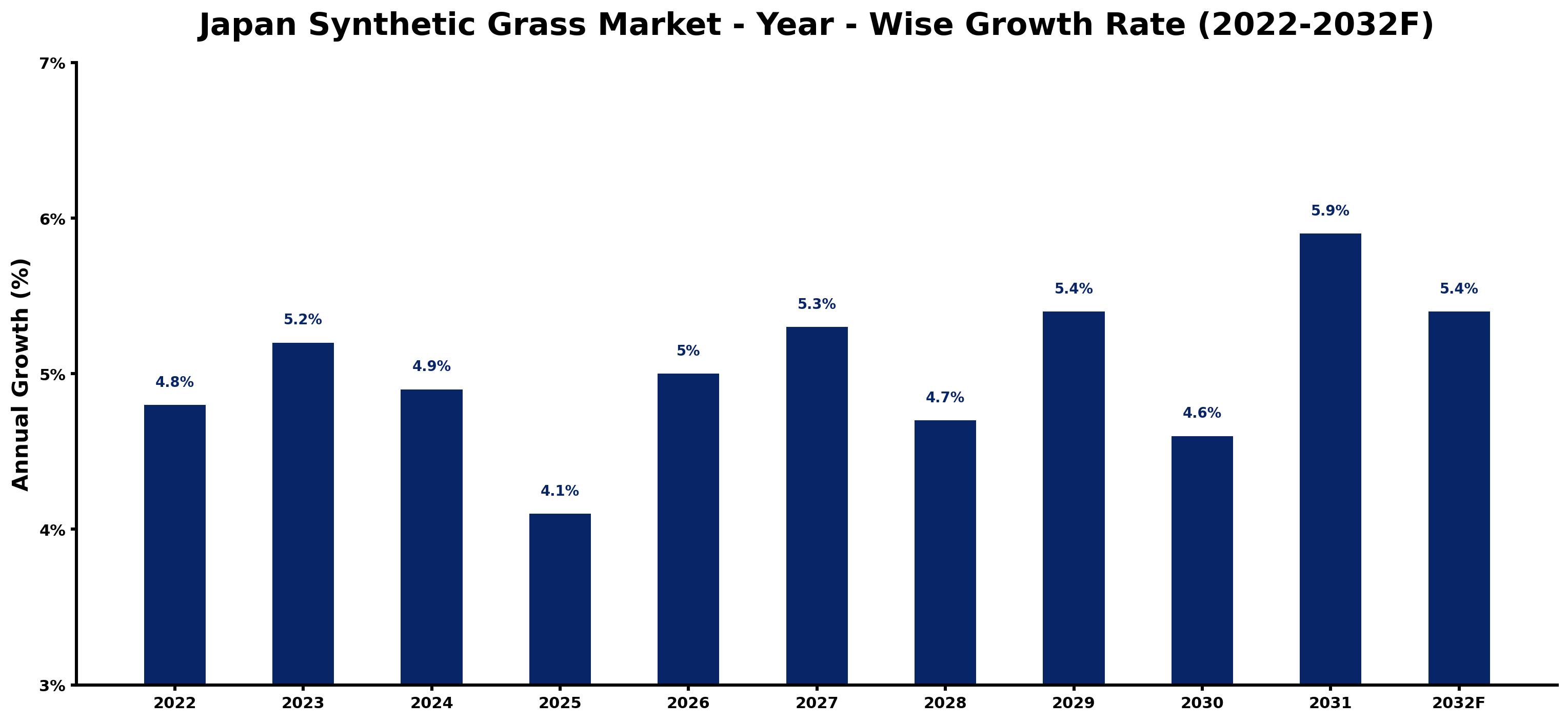
Year by year, the estimates below pair each growth rate with the development that shaped it.
| Year | Estimated Annual Growth (%) | Market Rationale |
| 2022 | 4.8 | The market experienced steady growth due to increasing awareness of synthetic grass benefits. |
| 2023 | 5.2 | Demand surged as urban areas adopted synthetic grass for landscaping and recreational use. |
| 2024 | 4.9 | Growth slowed slightly as market saturation began in some regions. |
| 2025 | 4.1 | A further slowdown occurred as competition intensified among suppliers. |
| 2026 | 5.0 | Demand is expected to rise again with new eco-friendly initiatives gaining traction. |
| 2027 | 5.3 | The market is projected to grow as urban landscaping projects expand further. |
| 2028 | 4.7 | Growth will slow as the market stabilises after rapid expansion in recent years. |
| 2029 | 5.4 | A rebound in demand is anticipated as more sports facilities upgrade to synthetic grass. |
| 2030 | 4.6 | Growth is expected to moderate as the market reaches maturity. |
| 2031 | 5.9 | The peak growth year will be driven by increased investments in sports infrastructure. |
| 2032 | 5.4 | Growth will slow slightly as the market adjusts to new supply conditions. |
Note: Market size estimations and growth projections presented in this report are based on 6Wresearch's proprietary forecasting methodology, utilizing the latest available industry data, government publications, and primary research inputs.
Japan Synthetic Grass Market Synopsis
Synthetic grass, made from synthetic fibres such as polyethylene and polypropylene, replicates natural grass and finds its primary applications in landscaping, sports fields, and recreational areas. The Japan Synthetic Grass Market is growing due to heightened demand from urban regions, especially Tokyo, which accounts for 30% of national consumption. The typical installation cost for synthetic grass in residential settings is around ¥1,500 per square meter, prompting homeowners to opt for this sustainable alternative. Government initiatives are encouraging the use of eco-friendly materials, further propelling market growth.
Market Dynamics Impact Analysis (2026–2032)
| Factor | Type | Impact | Primary Segment Affected |
| Rising urbanisation and landscaping projects | Driver | High | Landscape Turf |
| Increasing adoption in sports facilities | Driver | High | Sports Turf |
| Growing interest in eco-friendly landscaping solutions | Opportunity | High | Landscape Turf |
| Expansion of online sales channels for synthetic grass | Opportunity | Medium | Direct Sales |
| High installation costs for synthetic grass | Restraint | High | Residential Landscaping |
| Limited awareness in rural areas about synthetic grass benefits | Restraint | Medium | Landscape Turf |
| Competition from natural grass suppliers | Challenge | High | Sports Turf |
| Regulatory compliance costs for synthetic grass producers | Challenge | Medium | Monofilament Turf |
Evaluation of Drivers in Japan Synthetic Grass Market (2026–2032)
Key forces behind demand, with the segment each one moves most, are listed below.
| Drivers | Primary Segment Affected | Why It Matters (Evidence) |
| Urbanisation driving landscaping projects | Sports Turf | Tokyo accounts for 30% of synthetic grass demand, leading to increased installations in urban areas. |
| Investment in sports facilities | Sports Turf | Over 500 sports facilities in Japan are using synthetic grass, boosting demand for quality turf. |
| Government initiatives promoting eco-friendly materials | Sports Turf | In 2023, the government allocated ¥200 million for urban green space initiatives, encouraging synthetic grass adoption. |
| Growth of online sales platforms | Direct Sales | Online platforms are becoming a key channel, catering to the rising consumer demand for synthetic grass. |
| Technological advancements in synthetic grass production | Monofilament Turf | New production methods are improving the quality and durability of synthetic grass, attracting more buyers. |
The strongest pull on demand comes from urbanisation, particularly in metropolitan areas. The average installation cost for residential projects is about ¥1,500 per square meter, encouraging homeowners to adopt this sustainable option. Investment in sports facilities has led to numerous installations, increasing the need for high-quality turf. Advances in production technology are improving the quality of synthetic grass, attracting more buyers in various applications.
Evaluation of Restraints in Japan Synthetic Grass Market
Several factors work against faster growth; the main ones are summarised below.
| Market Restraint | Primary Segment Affected | Why It Matters (Evidence) |
| High installation costs for synthetic grass | Residential Landscaping | The average installation cost of ¥1,500 per square meter limits adoption among budget-conscious homeowners. |
| Limited awareness in rural areas | Sports Turf | Consumer awareness of synthetic grass benefits is around 70% in urban areas, leaving rural markets underserved. |
| Competition from natural grass suppliers | Sports Turf | Natural grass remains a popular choice for some facilities, impacting synthetic grass market penetration. |
| Regulatory compliance costs for producers | Monofilament Turf | Producers face costs associated with meeting the JIS A 1450 standard, affecting profitability. |
| Market saturation in urban areas | Sports Turf | As urban areas become saturated with installations, growth potential may diminish. |
Japan Synthetic Grass Market Challenges
Installation costs can rise by about ¥1,500 per square meter due to a shortage of skilled workers in synthetic grass installation, which can extend project timelines. Producers encounter supply chain issues stemming from reliance on polyethylene, resulting in longer lead times and higher costs for importers. Suppliers face pressure from competition with cheaper alternatives, which may squeeze profit margins and restrict investments in quality improvements. Compliance with the JIS A 1450 standard complicates production processes for manufacturers, potentially increasing installation prices for end-users.
Trends in the Japan Synthetic Grass Market
The shifts below are changing how Japan Synthetic Grass Market products are bought and supplied.
- Shift from Natural to Synthetic Grass in Urban Areas: Since 2023, urban regions like Tokyo have increasingly embraced synthetic grass for landscaping, representing 30% of demand. This transition is motivated by the need for low-maintenance green spaces in densely populated areas.
- Rise of Eco-Friendly Landscaping Initiatives: In 2023, the Tokyo Metropolitan Government initiated a programme to promote green spaces using synthetic turf. This initiative aligns with the growing trend towards sustainable landscaping, encouraging more homeowners to explore synthetic options.
- Increased Online Sales of Synthetic Grass: With the growth of e-commerce, online platforms have emerged as a key distribution channel for synthetic grass. In 2023, this channel experienced a notable sales increase, reflecting shifts in consumer purchasing behaviour.
- Expansion of Sports Facilities Upgrading to Synthetic Turf: The Japan Sports Association has endorsed synthetic turf for sports facilities, resulting in a surge of installations. This trend is clear as over 500 sports facilities have transitioned to synthetic grass, enhancing playing conditions.
Investment Opportunities in the Japan Synthetic Grass Market
The opportunities below stand out in the Japan Synthetic Grass Market for new entrants and existing suppliers.
- Residential Homeowners Seeking Sustainable Options: Homeowners in urban areas are increasingly interested in sustainable landscaping solutions, with consumer awareness of synthetic grass benefits around 70%. Partnering with local landscaping firms can facilitate market entry.
- Collaboration with Local Governments on Green Initiatives: Local governments are promoting eco-friendly materials in landscaping, creating opportunities for suppliers. Engaging in joint ventures with municipalities can strengthen market presence and credibility.
- Expansion in Urban Landscaping Projects: Urban areas are prioritising green spaces, leading to increased demand for synthetic grass. Focusing on metropolitan regions can yield substantial returns for suppliers.
- Growth in Online Retail for Synthetic Grass: The online sales channel is expanding rapidly, with increasing consumer interest in purchasing synthetic grass online. Establishing an online presence can capture this growing market segment.
Government Initiatives in the Japan Synthetic Grass Market
In 2023, the government introduced a new programme to boost the use of eco-friendly materials in landscaping, building on the Plastic Resource Circulation Act of 2021. This initiative promotes sustainable practices among producers and encourages the adoption of synthetic grass, aligning with environmental objectives. The programme aims to improve urban green spaces, with an allocation of ¥200 million to support projects integrating synthetic grass into landscaping efforts across Japan.
The Ministry of the Environment oversees various initiatives that fund urban green space projects and advocate for sustainable landscaping practices. This agency approves funding for local governments and organisations implementing synthetic grass solutions, ensuring compliance with environmental standards. The Japan Sports Association also endorses synthetic turf for sports facilities, further stimulating demand for this product.
Future Insight of the Japan Synthetic Grass Market
The upcoming urban green space initiatives will promote synthetic grass in city landscapes, improving aesthetic appeal and sustainability. By 2032, advancements in eco-friendly materials will likely reduce installation costs by 15%, benefiting both buyers and suppliers. Increased government support for educational campaigns will raise consumer awareness, driving demand further. Ongoing research from industry associations will lead to improved product performance and wider applications, making synthetic grass a preferred choice for various environments.
Market Segmentation Analysis
Japan Synthetic Grass Market report covers a detailed analysis of the following market segments:
By Synthetic Grass – Sports Turf Leads, Hybrid Grass Expected to Grow Fastest
According to Saurav Kr Singh, Senior Research Analyst at 6Wresearch, the largest synthetic grass category in 2025 was Sports Turf, at 50% of revenue. Sports turf holds the largest share due to its essential role in over 500 sports facilities across Japan, catering to various sporting events. The endorsement from the Japan Sports Association further solidifies its significance in this segment. Hybrid Grass is projected to grow fastest, at a CAGR of 7.0% during 2026–2032. The hybrid grass segment is expanding rapidly, particularly in urban areas, as government initiatives promote the use of eco-friendly materials. The Tokyo Metropolitan Government's programme to enhance green spaces exemplifies this growing trend. Suppliers should focus on expanding offerings in hybrid grass to capitalise on its increasing adoption.
By Product Type – Monofilament Turf Leads and Records the Fastest Growth
With 43% of product type revenue in 2025, Monofilament Turf was the largest category. Monofilament turf leads the market as it is commonly used in high-quality applications, providing durability and a natural appearance that appeals to various users. Its acceptance in both sports and landscaping projects reinforces its strong market position. Its lead should widen, with a projected CAGR of 7.5% during 2026–2032, the highest in this split. Monofilament turf is also the fastest-growing segment, as its quality continues to attract installations across diverse applications. The rising consumer awareness of its advantages supports its sustained growth trajectory. Suppliers must ensure a steady supply of monofilament turf to meet the rising demand.
By Material Type – Polyethylene Leads, Polypropylene Expected to Grow Fastest
Polyethylene held 42% of the Japan Synthetic Grass Market by material type in 2025. Polyethylene dominates the market, accounting for over 60% of synthetic grass products due to its versatility, especially in sports fields and landscaping. Its widespread use is backed by established standards like JIS A 1450 governing turf specifications. Polypropylene is set to record the highest CAGR in this split, 7.3% over 2026–2032. Polypropylene is experiencing the fastest growth as it provides a lower-cost alternative for certain applications, appealing to budget-conscious buyers. The increasing interest in cost-effective solutions among consumers is propelling this segment's expansion. Suppliers should consider diversifying their product lines to include polypropylene options to attract a broader customer base.
By Distribution Channel – Direct Sales Leads, Online Platforms Expected to Grow Fastest
In 2025, Direct Sales led the distribution channel split with a 47% share. Direct sales is the leading distribution channel, primarily serving large installations in sports facilities and commercial projects. Its efficiency in managing bulk orders ensures it remains the preferred choice for major buyers. Over 2026–2032, Online Platforms are expected to post the fastest growth, at a CAGR of 6.7%. Online platforms are rapidly growing as a distribution channel, propelled by increasing consumer interest in home installations and the convenience of online shopping. The government's campaign to educate homeowners about synthetic grass benefits is further accelerating this trend. Suppliers should enhance their online presence to capture the growing consumer market for synthetic grass.
By End User Industry – Sports Stadiums Lead, Residential Landscaping Expected to Grow Fastest
Sports Stadiums took 47% of end user industry revenue in 2025, more than any other category. Sports stadiums represent the largest end user industry, with major installations across the country for various sporting events. Continued investment in sports infrastructure ensures sustained demand for synthetic grass in this sector. Residential Landscaping is projected to grow fastest, at a CAGR of 6.6% during 2026–2032. Residential landscaping is the fastest-growing end user industry as more homeowners seek low-maintenance solutions for their outdoor spaces. The average consumer awareness of synthetic grass benefits at around 70% in urban areas drives this trend. Suppliers should target residential markets with tailored marketing strategies to leverage the increasing interest in synthetic grass.
Key Attractiveness of the Report
- 10 Years of Market Numbers
- Historical Data Starting from 2022 to 2025
- Base Year 2025
- Forecast Data until 2032
- Key Performance Indicators Impacting the Market
- Major Upcoming Developments and Projects
Key Highlights of the Report:
- Japan Synthetic Grass Market Outlook
- Market Size of Japan Synthetic Grass Market, 2025
- Forecast of Japan Synthetic Grass Market, 2032
- Historical Data and Forecast of Japan Synthetic Grass Revenues & Volume for the Period 2022-2032F
- Japan Synthetic Grass Market Trend Evolution
- Japan Synthetic Grass Market Drivers and Challenges
- Japan Synthetic Grass Price Trends
- Japan Synthetic Grass Porter's Five Forces
- Japan Synthetic Grass Industry Life Cycle
- Historical Data and Forecast of Japan Synthetic Grass Market Revenues & Volume By Synthetic Grass for the Period 2022-2032F
- Historical Data and Forecast of Japan Synthetic Grass Market Revenues & Volume By Landscape Turf for the Period 2022-2032F
- Historical Data and Forecast of Japan Synthetic Grass Market Revenues & Volume By Sports Turf for the Period 2022-2032F
- Historical Data and Forecast of Japan Synthetic Grass Market Revenues & Volume By Hybrid Grass for the Period 2022-2032F
- Historical Data and Forecast of Japan Synthetic Grass Market Revenues & Volume By Indoor Turf for the Period 2022-2032F
- Historical Data and Forecast of Japan Synthetic Grass Market Revenues & Volume By Product Type for the Period 2022-2032F
- Historical Data and Forecast of Japan Synthetic Grass Market Revenues & Volume By Monofilament Turf for the Period 2022-2032F
- Historical Data and Forecast of Japan Synthetic Grass Market Revenues & Volume By Slit-Film Turf for the Period 2022-2032F
- Historical Data and Forecast of Japan Synthetic Grass Market Revenues & Volume By Natural + Synthetic for the Period 2022-2032F
- Historical Data and Forecast of Japan Synthetic Grass Market Revenues & Volume By Multi-Use Carpet for the Period 2022-2032F
- Historical Data and Forecast of Japan Synthetic Grass Market Revenues & Volume By Material Type for the Period 2022-2032F
- Historical Data and Forecast of Japan Synthetic Grass Market Revenues & Volume By Polyethylene for the Period 2022-2032F
- Historical Data and Forecast of Japan Synthetic Grass Market Revenues & Volume By Polypropylene for the Period 2022-2032F
- Historical Data and Forecast of Japan Synthetic Grass Market Revenues & Volume By Nylon/PE Blend for the Period 2022-2032F
- Historical Data and Forecast of Japan Synthetic Grass Market Revenues & Volume By Nylon for the Period 2022-2032F
- Historical Data and Forecast of Japan Synthetic Grass Market Revenues & Volume By Distribution Channel for the Period 2022-2032F
- Historical Data and Forecast of Japan Synthetic Grass Market Revenues & Volume By Direct Sales for the Period 2022-2032F
- Historical Data and Forecast of Japan Synthetic Grass Market Revenues & Volume By Specialty Stores for the Period 2022-2032F
- Historical Data and Forecast of Japan Synthetic Grass Market Revenues & Volume By Online Platforms for the Period 2022-2032F
- Historical Data and Forecast of Japan Synthetic Grass Market Revenues & Volume By Retail Chains for the Period 2022-2032F
- Historical Data and Forecast of Japan Synthetic Grass Market Revenues & Volume By End User Industry for the Period 2022-2032F
- Historical Data and Forecast of Japan Synthetic Grass Market Revenues & Volume By Residential Landscaping for the Period 2022-2032F
- Historical Data and Forecast of Japan Synthetic Grass Market Revenues & Volume By Sports Stadiums for the Period 2022-2032F
- Historical Data and Forecast of Japan Synthetic Grass Market Revenues & Volume By Golf Courses for the Period 2022-2032F
- Historical Data and Forecast of Japan Synthetic Grass Market Revenues & Volume By Fitness Centers for the Period 2022-2032F
- Japan Synthetic Grass Import Export Trade Statistics
- Market Opportunity Assessment By Synthetic Grass
- Market Opportunity Assessment By Product Type
- Market Opportunity Assessment By Material Type
- Market Opportunity Assessment By Distribution Channel
- Market Opportunity Assessment By End User Industry
- Japan Synthetic Grass Top Companies Market Share
- Japan Synthetic Grass Competitive Benchmarking By Technical and Operational Parameters
- Japan Synthetic Grass Company Profiles
- Japan Synthetic Grass Key Strategic Recommendations
Market Covered
The study includes the following segmentation.
By Synthetic Grass
- Landscape Turf
- Sports Turf
- Hybrid Grass
- Indoor Turf
By Product Type
- Monofilament Turf
- Slit-Film Turf
- Natural + Synthetic
- Multi-Use Carpet
By Material Type
- Polyethylene
- Polypropylene
- Nylon/PE Blend
- Nylon
By Distribution Channel
- Direct Sales
- Specialty Stores
- Online Platforms
- Retail Chains
By End User Industry
- Residential Landscaping
- Sports Stadiums
- Golf Courses
- Fitness Centers































