Japan Synthetic Plants Market Size & Growth Rate
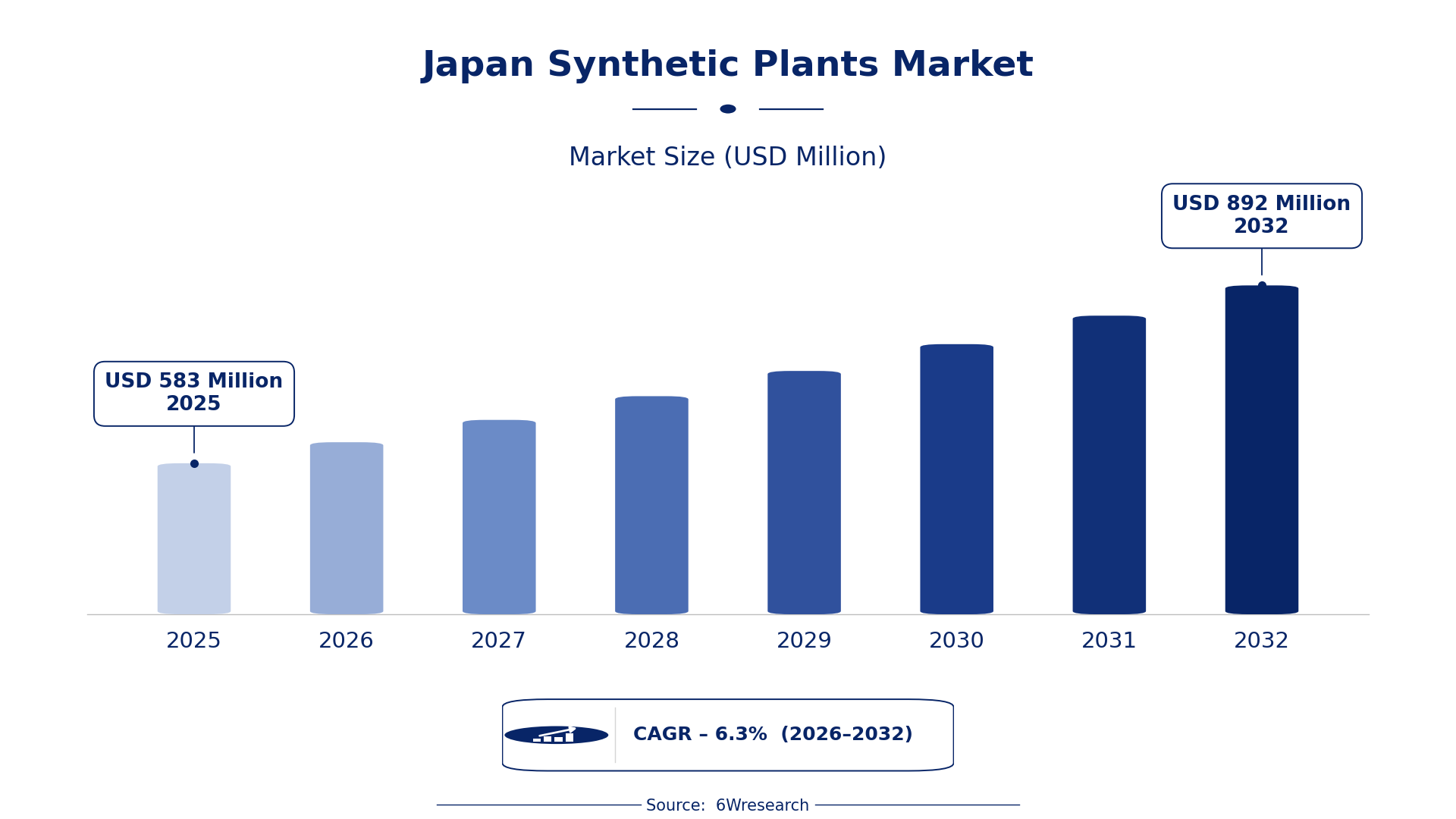
According to 6Wresearch internal database and industry insights, the Japan Synthetic Plants Market was valued at USD 583 Million in 2025 and is projected to reach USD 892 Million by 2032, growing at a CAGR of approximately 6.3% during 2026–2032.
Japan Synthetic Plants Market Highlights
| Report Metric | Details |
| Report Name | Japan Synthetic Plants Market (2026-2032) |
| Market Size 2025 | USD 583 Million |
| Market Size 2032 | USD 892 Million |
| Absolute Growth 2025–2032 | USD 309 Million |
| CAGR 2026–2032 | 6.3% |
| Peak Annual Growth | 8.1% in 2032 |
| Forecast Period | 2026–2032 |
| Historical Data | 2022–2025 |
| Base Year | 2025 |
| Leading Synthetic Plants, 2025 | Decorative Plants (42% share) |
| Leading Product Type, 2025 | Potted Plants (41% share) |
| Leading Material Type, 2025 | Plastic/Silk (52% share) |
| Leading Distribution Channel, 2025 | Online Platforms (50% share) |
| Leading End User Industry, 2025 | Home Decor (44% share) |
| Fastest-Growing Synthetic Plants | Artificial Trees (8.5% CAGR) |
| Fastest-Growing Product Type | Indoor Trees (8.9% CAGR) |
| Fastest-Growing Material Type | PE + Fabric (9.0% CAGR) |
| Fastest-Growing Distribution Channel | Retail Stores (8.4% CAGR) |
| Fastest-Growing End User Industry | Hotels & Offices (8.3% CAGR) |
| Growing Sector | Home Decor |
| Key End Users | Home Decor, Landscaping Services, Hotels & Offices, Restaurants |
Japan Synthetic Plants Market Year-wise Growth Rate and Key Drivers (2022–2032)
This graph illustrates the annual growth rates of the market from 2022 to 2032, highlighting a steady upward trajectory and projected market expansion over the forecast period.
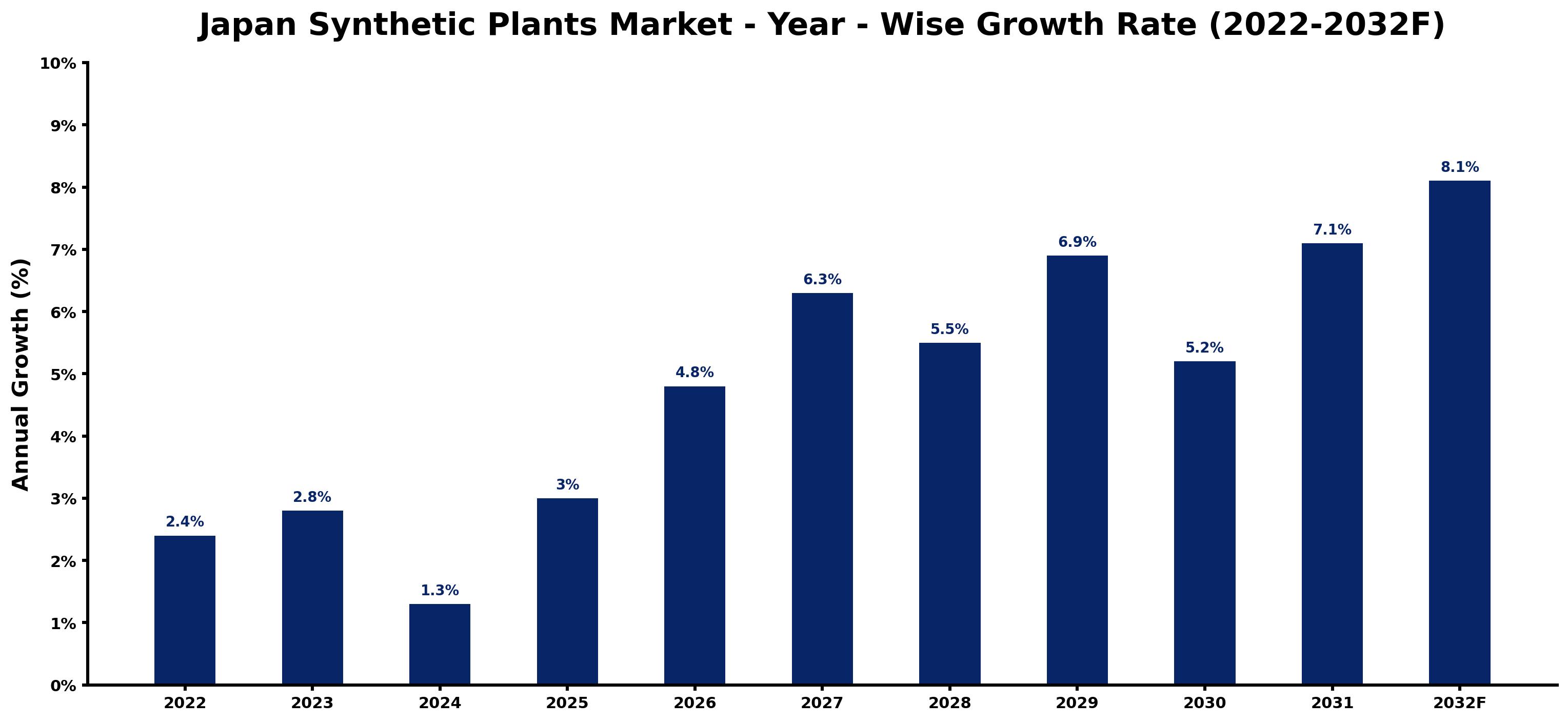
The table below sets out the estimated growth rate for each year and the main factor behind it.
| Year | Estimated Annual Growth (%) | Market Rationale |
| 2022 | 2.4 | The market experienced steady growth, driven by increased interest in home aesthetics. |
| 2023 | 2.8 | Demand for synthetic plants rose as consumers sought low-maintenance decor options. |
| 2024 | 1.3 | Growth slowed as market saturation limited new product introductions. |
| 2025 | 3.0 | The market saw a resurgence in growth as home decor spending increased. |
| 2026 | 4.8 | Investment in urban beautification projects is expected to boost demand for synthetic plants. |
| 2027 | 6.3 | Growing interest in sustainable decor options will lead to higher sales. |
| 2028 | 5.5 | Demand growth is projected to slow as consumers become more selective in purchases. |
| 2029 | 6.9 | Interest in outdoor synthetic plants is expected to surge due to changing landscaping trends. |
| 2030 | 5.2 | Competition among suppliers will moderate growth rates as they vie for market share. |
| 2031 | 7.1 | A rise in urban greening initiatives will spur demand for synthetic plants. |
| 2032 | 8.1 | The market is projected to peak as new designs attract buyers. |
Note: Market size estimations and growth projections presented in this report are based on 6Wresearch's proprietary forecasting methodology, utilizing the latest available industry data, government publications, and primary research inputs.
Japan Synthetic Plants Market Synopsis
Synthetic plants are artificial replicas made from materials like plastic and silk, designed for home decoration, commercial spaces, and landscaping. The Japan Synthetic Plants Market is growing due to rising consumer interest in low-maintenance decor and urban beautification projects. The home decor market, valued at approximately 1.5 trillion JPY in 2023, drives demand, while online sales of decorative items increased by 15% in 2022. The landscaping industry employs over 200,000 people, many of whom utilise synthetic plants for aesthetic purposes.
Market Dynamics Impact Analysis (2026–2032)
| Factor | Type | Impact | Primary Segment Affected |
| Increased consumer spending on home decor drives demand for synthetic plants. | Driver | High | Decorative Plants |
| Urban beautification projects create opportunities for synthetic plant suppliers. | Opportunity | High | Landscaping Services |
| Strict quality standards may limit the range of materials used in production. | Restraint | Medium | Plastic/Silk |
| The rising popularity of live plants poses a challenge to synthetic alternatives. | Challenge | Medium | Artificial Trees |
| Growing online retail channels expand market access for synthetic plants. | Driver | High | Online Platforms |
| The demand for UV-resistant synthetic plants is increasing due to outdoor usage. | Opportunity | Medium | UV-Resistant Plants |
| High competition among suppliers can lead to price pressures. | Restraint | Medium | Potted Plants |
| Supply chain disruptions can delay product availability. | Challenge | High | Faux Succulents |
Evaluation of Drivers in Japan Synthetic Plants Market (2026–2032)
The following drivers explain most of the expected growth.
| Drivers | Primary Segment Affected | Why It Matters (Evidence) |
| Increased consumer spending on home decor | Decorative Plants | The average household in Japan spends around 10,000 JPY annually on home decor items, boosting synthetic plant purchases. |
| Urban beautification initiatives | Landscaping Services | The Tokyo Metropolitan Government supports urban beautification projects, increasing the use of synthetic plants. |
| Growth of online retail channels | Online Platforms | In 2022, online purchases for decorative items increased by 15%, expanding access for synthetic plants. |
| Rising demand for UV-resistant synthetic plants | UV-Resistant Plants | In 2023, demand for UV-resistant options rose due to increased outdoor usage. |
| Interest in low-maintenance decor solutions | Faux Succulents | Consumers prefer synthetic plants for their durability and low upkeep, driving sales. |
Orders keep climbing as consumer spending on home decor rises, with the average household in Japan investing around 10,000 JPY annually. Urban beautification projects are further increasing demand for synthetic plants, as evidenced by rising investments in city aesthetics. The growth of online retail channels has made purchasing easier, as shown by a 15% rise in online decorative item sales in 2022. Demand for UV-resistant synthetic plants surged in 2023, reflecting a shift towards outdoor usage. Low-maintenance decor solutions continue to drive purchases, particularly among homeowners seeking aesthetic improvements.
Evaluation of Restraints in Japan Synthetic Plants Market
The table below lists the restraints and the evidence behind each.
| Market Restraint | Primary Segment Affected | Why It Matters (Evidence) |
| Strict quality standards limit material options for production. | Plastic/Silk | Japan has stringent quality standards for synthetic materials, which can restrict production flexibility. |
| High competition among suppliers can lead to price pressures. | Potted Plants | Intense market competition may force suppliers to lower prices, impacting profitability. |
| Supply chain disruptions can delay product availability. | Faux Succulents | Global supply chain issues have caused delays in sourcing materials for synthetic plants. |
| Consumer preference for live plants affects synthetic plant sales. | Artificial Trees | The growing trend towards live plants can limit the market for synthetic alternatives. |
| Market saturation can hinder new product introductions. | Outdoor Plants | A crowded market makes it challenging for new synthetic plant designs to gain traction. |
Japan Synthetic Plants Market Challenges
Japan's strict quality regulations impose high JIS standards on producers, complicating manufacturing and delaying product launches by up to six months. Many importers face challenges with outdated technology, leading to inefficiencies and increasing operational costs by 20%. Buyers encounter rising prices as production costs escalate, with the average household spending around 10,000 JPY annually on home decor items, including synthetic plants. Supply chain disruptions have impacted the availability of key materials, forcing distributors to extend lead times by an average of four weeks.
Trends in the Japan Synthetic Plants Market
The shifts below are changing how Japan Synthetic Plants Market products are bought and supplied.
- Shift towards Online Purchasing: Tokyo is experiencing a shift towards online purchasing of synthetic plants, with online platforms holding a 50% market share in 2025. This trend reflects changing consumer preferences for convenience and accessibility.
- Rise in Demand for UV-Resistant Options: In 2023, demand for UV-resistant synthetic plants increased, driven by outdoor usage. This shift highlights the need for durable products that withstand sunlight exposure.
- Growing Interest in Low-Maintenance Decor: Since 2022, consumers have increasingly sought low-maintenance decor solutions, particularly in urban areas. This trend is reflected in the rising popularity of faux succulents, which require minimal care.
- Expansion of Urban Beautification Projects: The Tokyo Metropolitan Government's initiatives for urban beautification, launched in 2022, have led to increased use of synthetic plants in public spaces. This trend supports the growth of the landscaping sector.
Investment Opportunities in the Japan Synthetic Plants Market
The openings below show where demand in the Japan Synthetic Plants Market is visible and how suppliers can enter.
- Investment in Urban Beautification: Tokyo's urban beautification projects present opportunities for suppliers of synthetic plants, with funding increasing by 20% in 2023. Collaborating with local governments can facilitate market entry.
- Growing Online Retail Market: With online decorative item purchases rising by 15% in 2022, investing in e-commerce platforms is essential for reaching consumers. Specialty stores can benefit from this growing channel.
- Demand for UV-Resistant Plants: The increase in outdoor usage of synthetic plants creates a gap in the market for UV-resistant options. Suppliers should focus on developing these products to meet rising demand.
- Expansion of Landscaping Services: The landscaping industry, employing over 200,000 people, is seeking innovative synthetic plant solutions. Suppliers can enter this sector by forming partnerships with landscaping firms.
Government Initiatives in the Japan Synthetic Plants Market
The Food Recycling Law, enacted in 2000, mandates food businesses to reduce waste and recycle it into useful products. This law indirectly supports the synthetic plants market by promoting sustainable practices in urban settings. Additionally, the Plastic Resource Circulation Act, introduced in 2021, encourages the reduction and recycling of plastics, creating a market for synthetic alternatives that meet these standards.
The Ministry of the Environment oversees initiatives that promote the use of synthetic plants in urban greening projects. These efforts aim to improve city aesthetics and air quality, benefiting both producers and buyers of synthetic plants.
Future Insight of the Japan Synthetic Plants Market
A policy-driven shift towards urban beautification will create new opportunities for synthetic plants by 2032. Suppliers will implement advanced manufacturing technologies, improving efficiency and reducing costs. Innovations in design will diversify product offerings, appealing to buyers seeking unique decor options. The landscaping industry, employing over 200,000 people, will increasingly rely on synthetic plants to meet growing urban greening demands.
Market Segmentation Analysis
Japan Synthetic Plants Market report covers a detailed analysis of the following market segments:
By Synthetic Plants – Decorative Plants Lead, Artificial Trees Expected to Grow Fastest
According to Saurav Kr Singh, Senior Research Analyst at 6Wresearch, in 2025, Decorative Plants led the synthetic plants split with a 42% share. Decorative plants hold the largest share due to their extensive use for aesthetic purposes in homes and businesses, particularly in Tokyo where numerous specialty stores cater to this demand. The appeal of enhancing visual spaces drives significant purchases from both domestic users and imports. Over 2026–2032, Artificial Trees are expected to post the fastest growth, at a CAGR of 8.5%. Artificial trees are witnessing rapid growth as they are increasingly used in large spaces for decoration, especially in hotels and offices that seek to create inviting atmospheres. This trend is further supported by urban beautification initiatives promoted by local governments. Suppliers should enhance their product lines of artificial trees to meet the rising demand in urban settings.
By Product Type – Potted Plants Lead, Indoor Trees Expected to Grow Fastest
Potted Plants accounted for 41% of the market by product type in 2025. Potted plants lead the market as they are commonly used for decoration in homes and offices, appealing to a wide range of consumers looking for versatile decor options. Their practicality and aesthetic appeal make them a preferred choice in various interior designs. Indoor Trees are projected to grow fastest, at a CAGR of 8.9% during 2026–2032. Indoor trees are experiencing accelerated growth as they are favoured for enhancing indoor environments, reflecting a shift towards larger decorative elements in both residential and commercial spaces. This trend indicates a growing preference for impactful decor solutions. Buyers may increasingly seek suppliers with a broad selection of indoor trees to align with changing aesthetic preferences.
By Material Type – Plastic/Silk Leads, PE + Fabric Expected to Grow Fastest
Plastic/Silk took 52% of material type revenue in 2025, more than any other category. Plastic and silk are the primary materials for synthetic plants due to their durability and realistic appearance, making them the preferred choice among consumers. Their widespread availability contributes to their leading position. The quickest growth will come from PE + Fabric, forecast to expand at a CAGR of 9.0% between 2026 and 2032. PE and fabric are emerging as the fastest-growing materials, as they provide more realistic textures in synthetic plants, appealing to consumers seeking authenticity. This trend indicates a demand for higher-quality products. Suppliers should consider expanding their product lines to include PE and fabric options to attract quality-conscious buyers.
By Distribution Channel – Online Platforms Lead, Retail Stores Expected to Grow Fastest
The largest distribution channel category in 2025 was Online Platforms, at 50% of revenue. Online platforms are the leading distribution channel for synthetic plants, reflecting a growing trend in e-commerce and consumer convenience. The increase in online purchases for decorative items indicates a shift in buying behaviour. Retail Stores are set to record the highest CAGR in this split, 8.4% over 2026–2032. Retail stores are experiencing the fastest growth as they provide traditional consumer access, particularly for those who prefer to see products in person before purchasing. This suggests a resurgence in physical shopping experiences. Suppliers should maintain a balanced presence in both online and retail channels to cater to diverse consumer preferences.
By End User Industry – Home Decor Leads, Hotels & Offices Expected to Grow Fastest
With 44% of end user industry revenue in 2025, Home Decor was the largest category. The home decor sector is the primary end-user for synthetic plants, driven by consumer demand for aesthetic improvements in living spaces. This industry's growth is bolstered by a heightened focus on interior design and decoration trends. Over 2026–2032, Hotels & Offices are expected to post the fastest growth, at a CAGR of 8.3%. Hotels and offices represent the fastest-growing end-users, as they place a strong emphasis on maintaining appealing aesthetics in their environments, particularly in urban settings. This trend underscores the critical role of visual appeal in commercial spaces. Suppliers should focus on the hotel and office sectors to capitalise on the increasing demand for decorative solutions.
Key Attractiveness of the Report
- 10 Years of Market Numbers
- Historical Data Starting from 2022 to 2025
- Base Year 2025
- Forecast Data until 2032
- Key Performance Indicators Impacting the Market
- Major Upcoming Developments and Projects
Key Highlights of the Report:
- Japan Synthetic Plants Market Outlook
- Market Size of Japan Synthetic Plants Market, 2025
- Forecast of Japan Synthetic Plants Market, 2032
- Historical Data and Forecast of Japan Synthetic Plants Revenues & Volume for the Period 2022-2032F
- Japan Synthetic Plants Market Trend Evolution
- Japan Synthetic Plants Market Drivers and Challenges
- Japan Synthetic Plants Price Trends
- Japan Synthetic Plants Porter's Five Forces
- Japan Synthetic Plants Industry Life Cycle
- Historical Data and Forecast of Japan Synthetic Plants Market Revenues & Volume By Synthetic Plants for the Period 2022-2032F
- Historical Data and Forecast of Japan Synthetic Plants Market Revenues & Volume By Decorative Plants for the Period 2022-2032F
- Historical Data and Forecast of Japan Synthetic Plants Market Revenues & Volume By Artificial Trees for the Period 2022-2032F
- Historical Data and Forecast of Japan Synthetic Plants Market Revenues & Volume By Faux Succulents for the Period 2022-2032F
- Historical Data and Forecast of Japan Synthetic Plants Market Revenues & Volume By Outdoor Plants for the Period 2022-2032F
- Historical Data and Forecast of Japan Synthetic Plants Market Revenues & Volume By Product Type for the Period 2022-2032F
- Historical Data and Forecast of Japan Synthetic Plants Market Revenues & Volume By Potted Plants for the Period 2022-2032F
- Historical Data and Forecast of Japan Synthetic Plants Market Revenues & Volume By Indoor Trees for the Period 2022-2032F
- Historical Data and Forecast of Japan Synthetic Plants Market Revenues & Volume By Miniatures for the Period 2022-2032F
- Historical Data and Forecast of Japan Synthetic Plants Market Revenues & Volume By UV-Resistant Plants for the Period 2022-2032F
- Historical Data and Forecast of Japan Synthetic Plants Market Revenues & Volume By Material Type for the Period 2022-2032F
- Historical Data and Forecast of Japan Synthetic Plants Market Revenues & Volume By Plastic/Silk for the Period 2022-2032F
- Historical Data and Forecast of Japan Synthetic Plants Market Revenues & Volume By PE + Fabric for the Period 2022-2032F
- Historical Data and Forecast of Japan Synthetic Plants Market Revenues & Volume By Rubber for the Period 2022-2032F
- Historical Data and Forecast of Japan Synthetic Plants Market Revenues & Volume By Polyethylene for the Period 2022-2032F
- Historical Data and Forecast of Japan Synthetic Plants Market Revenues & Volume By Distribution Channel for the Period 2022-2032F
- Historical Data and Forecast of Japan Synthetic Plants Market Revenues & Volume By Online Platforms for the Period 2022-2032F
- Historical Data and Forecast of Japan Synthetic Plants Market Revenues & Volume By Retail Stores for the Period 2022-2032F
- Historical Data and Forecast of Japan Synthetic Plants Market Revenues & Volume By Specialty Stores for the Period 2022-2032F
- Historical Data and Forecast of Japan Synthetic Plants Market Revenues & Volume By Direct Sales for the Period 2022-2032F
- Historical Data and Forecast of Japan Synthetic Plants Market Revenues & Volume By End User Industry for the Period 2022-2032F
- Historical Data and Forecast of Japan Synthetic Plants Market Revenues & Volume By Home Decor for the Period 2022-2032F
- Historical Data and Forecast of Japan Synthetic Plants Market Revenues & Volume By Hotels & Offices for the Period 2022-2032F
- Historical Data and Forecast of Japan Synthetic Plants Market Revenues & Volume By Restaurants for the Period 2022-2032F
- Historical Data and Forecast of Japan Synthetic Plants Market Revenues & Volume By Landscaping Services for the Period 2022-2032F
- Japan Synthetic Plants Import Export Trade Statistics
- Market Opportunity Assessment By Synthetic Plants
- Market Opportunity Assessment By Product Type
- Market Opportunity Assessment By Material Type
- Market Opportunity Assessment By Distribution Channel
- Market Opportunity Assessment By End User Industry
- Japan Synthetic Plants Top Companies Market Share
- Japan Synthetic Plants Competitive Benchmarking By Technical and Operational Parameters
- Japan Synthetic Plants Company Profiles
- Japan Synthetic Plants Key Strategic Recommendations
Market Covered
The report covers the following segments.
By Synthetic Plants
- Decorative Plants
- Artificial Trees
- Faux Succulents
- Outdoor Plants
By Product Type
- Potted Plants
- Indoor Trees
- Miniatures
- UV-Resistant Plants
By Material Type
- Plastic/Silk
- PE + Fabric
- Rubber
- Polyethylene
By Distribution Channel
- Online Platforms
- Retail Stores
- Specialty Stores
- Direct Sales
By End User Industry
- Home Decor
- Hotels & Offices
- Restaurants
- Landscaping Services































