Japan Synthetic Tanning Agents Market Size & Growth Rate
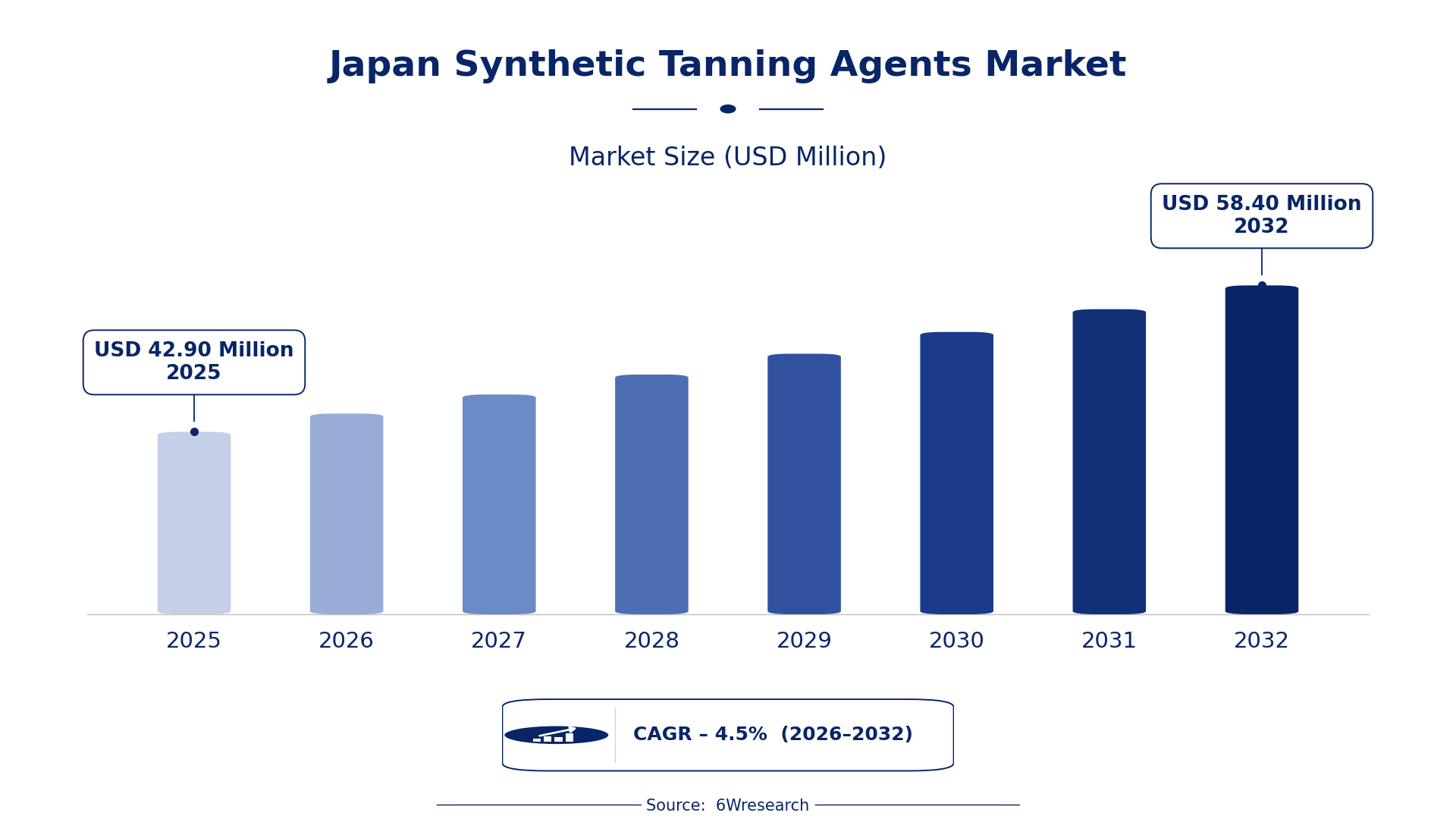
According to 6Wresearch internal database and industry insights, the Japan Synthetic Tanning Agents Market was valued at USD 42.90 Million in 2025 and is projected to reach USD 58.40 Million by 2032, growing at a CAGR of approximately 4.5% during 2026–2032.
Japan Synthetic Tanning Agents Market Highlights
| Report Metric | Details |
| Report Name | Japan Synthetic Tanning Agents Market (2026-2032) |
| Market Size 2025 | USD 42.90 Million |
| Market Size 2032 | USD 58.40 Million |
| Absolute Growth 2025–2032 | USD 15.50 Million |
| CAGR 2026–2032 | 4.5% |
| Peak Annual Growth | 5.5% in 2029 |
| Forecast Period | 2026–2032 |
| Historical Data | 2022–2025 |
| Base Year | 2025 |
| Leading Synthetic Tanning Agents, 2025 | Acrylic Tanning Agents (34% share) |
| Leading Product Type, 2025 | Acrylic Polymers (49% share) |
| Leading Agent Type, 2025 | Synthetic Acrylic (53% share) |
| Leading Distribution Channel, 2025 | Direct Sales (38% share) |
| Leading End User Industry, 2025 | Leather Manufacturing (42% share) |
| Fastest-Growing Synthetic Tanning Agents | Phenolic Agents (5.9% CAGR) |
| Fastest-Growing Product Type | Resin-Based Agents (6.4% CAGR) |
| Fastest-Growing Agent Type | Phenolic (6.7% CAGR) |
| Fastest-Growing Distribution Channel | Industrial Distributors (6.0% CAGR) |
| Fastest-Growing End User Industry | Footwear Industry (6.3% CAGR) |
| Growing Sector | Footwear Industry |
| Key End Users | Leather Manufacturing, Footwear Industry, Automotive Upholstery, Garment Industry |
Japan Synthetic Tanning Agents Market Year-wise Growth Rate and Key Drivers (2022–2032)
This graph illustrates the annual growth rates of the market from 2022 to 2032, highlighting a steady upward trajectory and projected market expansion over the forecast period.
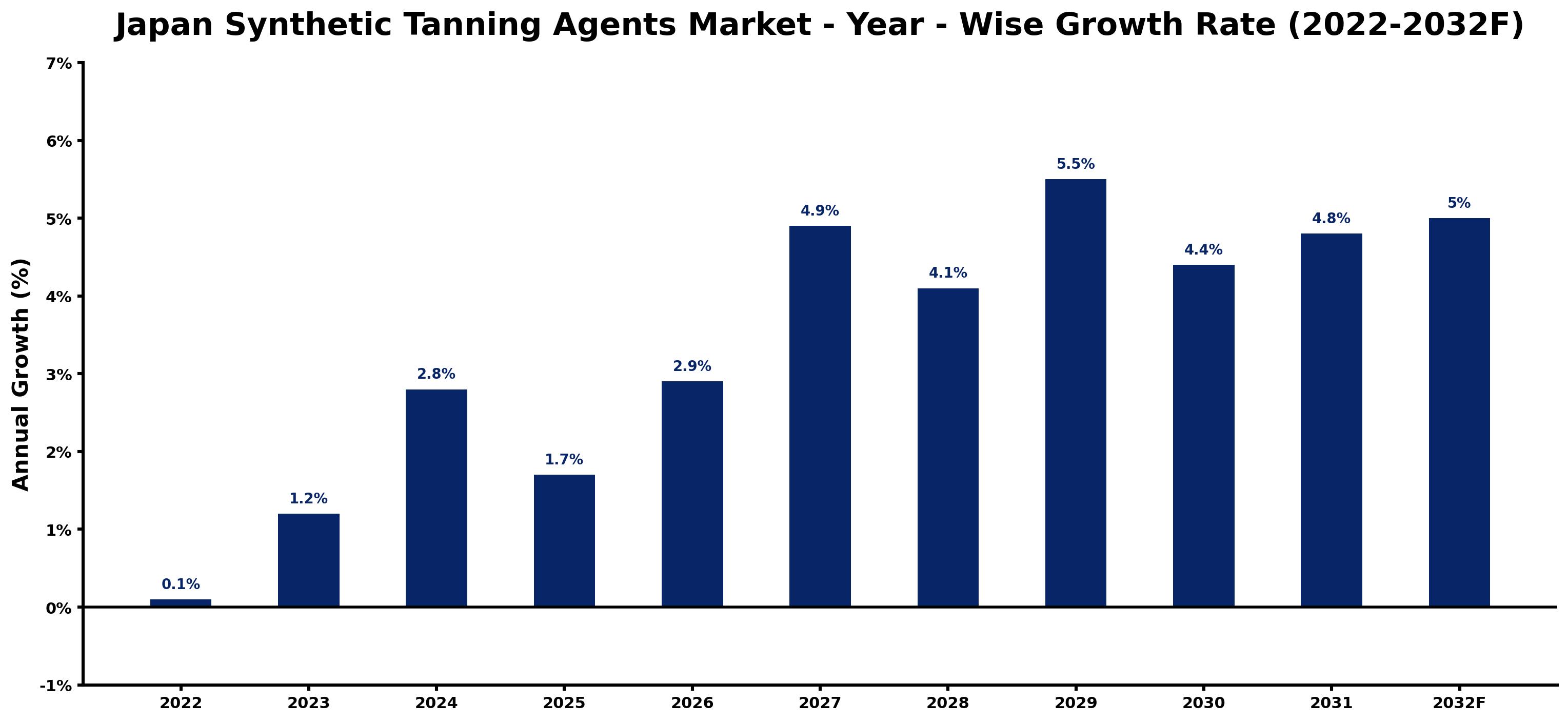
The following figures match every annual growth estimate with the main market development of that year, giving the reasoning behind each rise or slowdown.
| Year | Estimated Annual Growth (%) | Market Rationale |
| 2022 | 0.1 | The market showed minimal growth due to stable demand from domestic leather producers. |
| 2023 | 1.2 | Demand increased as leather production resumed, boosting synthetic tanning agent use. |
| 2024 | 2.8 | Growth accelerated with rising exports of leather goods, increasing the need for tanning agents. |
| 2025 | 1.7 | A slowdown occurred as production stabilised, impacting the growth rate despite ongoing demand. |
| 2026 | 2.9 | Growth is expected to resume as investments in leather production technologies yield results. |
| 2027 | 4.9 | The market will expand rapidly due to increased domestic consumption of leather products. |
| 2028 | 4.1 | A slight slowdown is projected as production capacities adjust to meet demand fluctuations. |
| 2029 | 5.5 | Peak growth will be driven by heightened demand from the automotive upholstery sector. |
| 2030 | 4.4 | Growth is projected to slow as market saturation in some segments begins to take effect. |
| 2031 | 4.8 | Demand will rise again as new fashion trends drive leather consumption higher. |
| 2032 | 5.0 | The market is expected to stabilise with steady growth from ongoing investments in technology. |
Note: Market size estimations and growth projections presented in this report are based on 6Wresearch's proprietary forecasting methodology, utilizing the latest available industry data, government publications, and primary research inputs.
Japan Synthetic Tanning Agents Market Synopsis
Synthetic tanning agents are chemical compounds used to treat animal hides in the leather industry. These agents, produced through polymerization processes, improve the durability and appearance of leather products. The Japan Synthetic Tanning Agents Market is growing due to rising demand from the leather manufacturing sector, particularly in Hyogo Prefecture, and the footwear industry valued at approximately 1.5 trillion yen. Investments in sustainable practices and innovations further drive growth, with an average annual consumption of 20,000 tons of synthetic tanning agents.
Market Dynamics Impact Analysis (2026–2032)
| Factor | Type | Impact | Primary Segment Affected |
| Increasing demand from the automotive upholstery sector | Driver | High | Polyurethane Agents |
| Rising exports of leather goods boosting production | Driver | High | Phenolic Agents |
| Growing demand for eco-friendly tanning solutions | Opportunity | Medium | Acrylic Tanning Agents |
| Investment in leather production technologies | Opportunity | Medium | Synthetic Acrylic |
| Regulatory compliance costs impacting production | Restraint | High | Aldehyde Tanning Agents |
| Market saturation in certain leather segments | Restraint | Medium | Polyurethane Agents |
| High competition among domestic producers | Challenge | High | Synthetic Acrylic |
| Dependence on traditional tanning methods | Challenge | Medium | Phenolic Agents |
Evaluation of Drivers in Japan Synthetic Tanning Agents Market (2026–2032)
Key forces behind demand, with the segment each one moves most, are listed below.
| Drivers | Primary Segment Affected | Why It Matters (Evidence) |
| Increased demand for high-quality automotive upholstery | Polyurethane Agents | This sector's growth drives the need for durable leather, resulting in higher purchases of synthetic tanning agents. |
| Rising exports of leather products | Phenolic Agents | As exports grow, manufacturers require more tanning agents to meet international quality standards. |
| Shift towards sustainable leather production | Acrylic Tanning Agents | This trend encourages manufacturers to invest in eco-friendly tanning solutions, boosting demand. |
| Technological advancements in leather processing | Synthetic Acrylic | Investments in new technologies improve production efficiency, increasing the need for synthetic tanning agents. |
| Growing consumer interest in leather fashion products | Aldehyde Tanning Agents | This trend leads to higher production volumes, necessitating more tanning agents for leather treatment. |
A wider customer base explains much of the growth, as the automotive upholstery sector demands high-quality leather, driving up the consumption of polyurethane agents. In 2022, Japan produced around 3 million pairs of leather shoes annually, increasing the need for phenolic agents. The shift towards sustainable practices in leather production is evident, with investments in eco-friendly solutions gaining traction. Technological advancements are enhancing production efficiency, which is expected to boost the demand for synthetic acrylic agents. Rising consumer interest in leather fashion products is leading to increased production volumes and higher purchases of aldehyde tanning agents.
Evaluation of Restraints in Japan Synthetic Tanning Agents Market
The key brakes on demand, and where they bite hardest, are shown below.
| Market Restraint | Primary Segment Affected | Why It Matters (Evidence) |
| Compliance costs with JIS standards for leather products | Aldehyde Tanning Agents | Manufacturers face increased costs to meet quality and safety regulations, impacting profit margins. |
| Market saturation in the leather goods sector | Polyurethane Agents | As the market matures, growth opportunities diminish, resulting in increased competition and price pressures. |
| Dependence on traditional tanning methods | Phenolic Agents | This reliance limits innovation and the adoption of more efficient processes, hindering overall market growth. |
| Limited availability of eco-friendly raw materials | Acrylic Tanning Agents | The scarcity of sustainable inputs hampers production capabilities, restricting market expansion. |
| High competition among domestic producers | Synthetic Acrylic | Intense rivalry can lead to price wars, affecting profitability and market stability. |
Japan Synthetic Tanning Agents Market Challenges
In Hyogo Prefecture, producers encounter high costs due to strict JIS standards, delaying production timelines by up to three weeks for buyers needing compliant leather. Regulatory measures complicate sourcing synthetic tanning agents, raising procurement costs by 10% for manufacturers. Supply chain disruptions arise as the automotive upholstery sector demands high-quality leather, potentially halting production for up to a month for producers. Technology adoption remains slow, limiting buyers' access to improved product features and quality, which can diminish their competitiveness in the leather market.
Trends in the Japan Synthetic Tanning Agents Market
The trends below show where the Japan Synthetic Tanning Agents Market is heading.
- Shift towards Eco-Friendly Tanning Processes: Japan's leather industry is embracing eco-friendly tanning methods, driven by consumer demand for sustainable products. The garment industry is at the forefront of this change, with a 20% increase in eco-friendly leather production in recent years.
- Transition from Traditional to Advanced Tanning Technologies: The adoption of advanced tanning technologies is transforming leather production in Hyogo Prefecture. In 2023, a government programme launched to improve production technologies is expected to increase efficiency by 15%, benefiting local manufacturers.
- Emerging Demand for Specialty Leather Products: The market is seeing a surge in demand for specialty leather products, particularly in the automotive sector. In 2023, leather exports were valued at 50 billion yen, underscoring the need for high-quality tanning agents to meet this demand.
- Growing Influence of Fashion Trends on Leather Consumption: Fashion trends are increasingly shaping leather consumption patterns in Japan. The footwear industry, valued at approximately 1.5 trillion yen, is adapting to these trends, driving up the demand for synthetic tanning agents.
Investment Opportunities in the Japan Synthetic Tanning Agents Market
The following opportunities in the Japan Synthetic Tanning Agents Market pair current demand with a clear way in.
- Timing for Investment in Eco-Friendly Solutions: With the increasing focus on sustainability, now is the time to invest in eco-friendly synthetic tanning agents. The leather manufacturing sector in Hyogo Prefecture is actively seeking sustainable solutions, creating a gap for suppliers.
- Growing Demand from the Footwear Industry: The footwear industry, valued at approximately 1.5 trillion yen, presents an opportunity for suppliers of synthetic tanning agents. Investing in partnerships with local manufacturers can facilitate market entry and growth.
- Expansion in Automotive Upholstery Sector: The automotive upholstery sector is expanding, necessitating higher-quality synthetic tanning agents. Suppliers can target this sector by showcasing their products' durability and performance characteristics.
- Investment in Advanced Tanning Technologies: As the market evolves, there is a need for advanced tanning technologies. Suppliers should consider collaborating with local manufacturers to meet this demand and improve production capabilities.
Government Initiatives in the Japan Synthetic Tanning Agents Market
The regulation of synthetic tanning agents ensures their safe use in leather production. This law requires manufacturers to test and report on chemical safety, impacting their operational costs. Additionally, the Act on the Rational Use of Energy promotes sustainable practices in the leather industry by encouraging large energy users to improve efficiency and report their energy consumption.
In 2023, the Japanese government launched a programme to support leather production technologies, overseen by the Ministry of Economy, Trade and Industry. This initiative aims to assist manufacturers in adopting innovative practices, with funding allocated to projects that enhance efficiency and sustainability in leather processing.
Future Insight of the Japan Synthetic Tanning Agents Market
Investment in leather production technologies will drive demand for synthetic tanning agents by 2032. Government initiatives promoting sustainable practices will motivate producers to implement eco-friendly tanning processes. New quality standards will ensure buyers receive superior leather products. The annual Leather Fair will showcase advancements in processing, stimulating growth and aligning with consumer preferences.
Market Segmentation Analysis
Japan Synthetic Tanning Agents Market report covers a detailed analysis of the following market segments:
By Synthetic Tanning Agents – Acrylic Tanning Agents Lead, Phenolic Agents Expected to Grow Fastest
According to Saurav Kr Singh, Senior Research Analyst at 6Wresearch, in 2025, Acrylic Tanning Agents led the synthetic tanning agents split with a 34% share. Acrylic Tanning Agents hold the largest share due to their extensive use in leather production, providing essential flexibility and strength. The high-quality leather production concentrated in Hyogo Prefecture significantly drives the demand for these agents. Phenolic Agents are set to record the highest CAGR in this split, 5.9% over 2026–2032. Phenolic Agents are experiencing rapid growth owing to their superior fixation properties, increasingly valued in high-quality leather applications. This trend is particularly evident in the automotive upholstery sector, where performance is critical. Suppliers should focus on enhancing their Phenolic Agent offerings to capitalise on the rising demand.
By Product Type – Acrylic Polymers Lead, Resin-Based Agents Expected to Grow Fastest
The largest product type category in 2025 was Acrylic Polymers, at 49% of revenue. Acrylic Polymers lead the market as they are integral to formulations used in leather production, despite not being directly involved in tanning. Their versatility makes them essential in the leather manufacturing process, especially for high-quality applications. The quickest growth will come from Resin-Based Agents, forecast to expand at a CAGR of 6.4% between 2026 and 2032. Resin-Based Agents are witnessing swift growth as they play a vital role in finishing processes, which are gaining importance in the leather industry. The increasing focus on the aesthetic appeal of leather products is propelling this growth. Buyers may need to adjust their sourcing strategies to incorporate more Resin-Based Agents to align with market trends.
By Agent Type – Synthetic Acrylic Leads, Phenolic Expected to Grow Fastest
Synthetic Acrylic accounted for 53% of the market by agent type in 2025. Synthetic Acrylic agents dominate the market as they are frequently used in formulations that enhance leather product quality. Their indirect yet crucial role in the leather manufacturing process ensures consistent demand. Phenolic is projected to grow fastest, at a CAGR of 6.7% during 2026–2032. Phenolic agents are gaining popularity due to their specific applications that enhance leather characteristics, especially in high-performance sectors. The rising emphasis on quality in leather goods is driving this growth. Suppliers should contemplate expanding their portfolios to include more Phenolic agents to meet the increasing demand for quality improvements.
By Distribution Channel – Direct Sales Leads, Industrial Distributors Expected to Grow Fastest
Direct Sales held 38% of the Japan Synthetic Tanning Agents Market by distribution channel in 2025. Direct Sales is the primary channel for industrial transactions, fostering direct relationships between manufacturers and buyers in the leather industry. This channel's effectiveness supports the substantial volume of synthetic tanning agents needed for production. Over 2026–2032, Industrial Distributors are expected to post the fastest growth, at a CAGR of 6.0%. Industrial Distributors are experiencing rapid growth as they provide crucial access to a wide range of end users in the leather sector. Their capability to effectively reach various markets is propelling this trend. Suppliers may need to strengthen their collaborations with industrial distributors to broaden their market reach.
By End User Industry – Leather Manufacturing Leads, Footwear Industry Expected to Grow Fastest
With 42% of end user industry revenue in 2025, Leather Manufacturing was the largest category. Leather Manufacturing is the leading end user of synthetic tanning agents, as these agents are essential for producing high-quality leather. The continuous demand for leather products ensures a steady requirement for these agents. Footwear Industry is set to record the highest CAGR in this split, 6.3% over 2026–2032. The Footwear Industry is the fastest-growing segment due to its substantial consumption of leather treated with tanning agents. The expansion of the footwear sector aligns with the overall growth of the leather goods market. Suppliers should focus on tailoring their products to meet the specific requirements of the footwear industry to maximise opportunities.
Key Attractiveness of the Report
- 10 Years of Market Numbers
- Historical Data Starting from 2022 to 2025
- Base Year 2025
- Forecast Data until 2032
- Key Performance Indicators Impacting the Market
- Major Upcoming Developments and Projects
Key Highlights of the Report:
- Japan Synthetic Tanning Agents Market Outlook
- Market Size of Japan Synthetic Tanning Agents Market, 2025
- Forecast of Japan Synthetic Tanning Agents Market, 2032
- Historical Data and Forecast of Japan Synthetic Tanning Agents Revenues & Volume for the Period 2022-2032F
- Japan Synthetic Tanning Agents Market Trend Evolution
- Japan Synthetic Tanning Agents Market Drivers and Challenges
- Japan Synthetic Tanning Agents Price Trends
- Japan Synthetic Tanning Agents Porter's Five Forces
- Japan Synthetic Tanning Agents Industry Life Cycle
- Historical Data and Forecast of Japan Synthetic Tanning Agents Market Revenues & Volume By Synthetic Tanning Agents for the Period 2022-2032F
- Historical Data and Forecast of Japan Synthetic Tanning Agents Market Revenues & Volume By Acrylic Tanning Agents for the Period 2022-2032F
- Historical Data and Forecast of Japan Synthetic Tanning Agents Market Revenues & Volume By Phenolic Agents for the Period 2022-2032F
- Historical Data and Forecast of Japan Synthetic Tanning Agents Market Revenues & Volume By Polyurethane Agents for the Period 2022-2032F
- Historical Data and Forecast of Japan Synthetic Tanning Agents Market Revenues & Volume By Aldehyde Tanning Agents for the Period 2022-2032F
- Historical Data and Forecast of Japan Synthetic Tanning Agents Market Revenues & Volume By Product Type for the Period 2022-2032F
- Historical Data and Forecast of Japan Synthetic Tanning Agents Market Revenues & Volume By Acrylic Polymers for the Period 2022-2032F
- Historical Data and Forecast of Japan Synthetic Tanning Agents Market Revenues & Volume By Resin-Based Agents for the Period 2022-2032F
- Historical Data and Forecast of Japan Synthetic Tanning Agents Market Revenues & Volume By PU Dispersions for the Period 2022-2032F
- Historical Data and Forecast of Japan Synthetic Tanning Agents Market Revenues & Volume By Glutaraldehyde for the Period 2022-2032F
- Historical Data and Forecast of Japan Synthetic Tanning Agents Market Revenues & Volume By Agent Type for the Period 2022-2032F
- Historical Data and Forecast of Japan Synthetic Tanning Agents Market Revenues & Volume By Synthetic Acrylic for the Period 2022-2032F
- Historical Data and Forecast of Japan Synthetic Tanning Agents Market Revenues & Volume By Phenolic for the Period 2022-2032F
- Historical Data and Forecast of Japan Synthetic Tanning Agents Market Revenues & Volume By Polyurethane for the Period 2022-2032F
- Historical Data and Forecast of Japan Synthetic Tanning Agents Market Revenues & Volume By Synthetic Aldehyde for the Period 2022-2032F
- Historical Data and Forecast of Japan Synthetic Tanning Agents Market Revenues & Volume By Distribution Channel for the Period 2022-2032F
- Historical Data and Forecast of Japan Synthetic Tanning Agents Market Revenues & Volume By Direct Sales for the Period 2022-2032F
- Historical Data and Forecast of Japan Synthetic Tanning Agents Market Revenues & Volume By Industrial Distributors for the Period 2022-2032F
- Historical Data and Forecast of Japan Synthetic Tanning Agents Market Revenues & Volume By Online Platforms for the Period 2022-2032F
- Historical Data and Forecast of Japan Synthetic Tanning Agents Market Revenues & Volume By Specialty Stores for the Period 2022-2032F
- Historical Data and Forecast of Japan Synthetic Tanning Agents Market Revenues & Volume By End User Industry for the Period 2022-2032F
- Historical Data and Forecast of Japan Synthetic Tanning Agents Market Revenues & Volume By Leather Manufacturing for the Period 2022-2032F
- Historical Data and Forecast of Japan Synthetic Tanning Agents Market Revenues & Volume By Footwear Industry for the Period 2022-2032F
- Historical Data and Forecast of Japan Synthetic Tanning Agents Market Revenues & Volume By Automotive Upholstery for the Period 2022-2032F
- Historical Data and Forecast of Japan Synthetic Tanning Agents Market Revenues & Volume By Garment Industry for the Period 2022-2032F
- Japan Synthetic Tanning Agents Import Export Trade Statistics
- Market Opportunity Assessment By Synthetic Tanning Agents
- Market Opportunity Assessment By Product Type
- Market Opportunity Assessment By Agent Type
- Market Opportunity Assessment By Distribution Channel
- Market Opportunity Assessment By End User Industry
- Japan Synthetic Tanning Agents Top Companies Market Share
- Japan Synthetic Tanning Agents Competitive Benchmarking By Technical and Operational Parameters
- Japan Synthetic Tanning Agents Company Profiles
- Japan Synthetic Tanning Agents Key Strategic Recommendations
Market Covered
The study includes the following segmentation.
By Synthetic Tanning Agents
- Acrylic Tanning Agents
- Phenolic Agents
- Polyurethane Agents
- Aldehyde Tanning Agents
By Product Type
- Acrylic Polymers
- Resin-Based Agents
- PU Dispersions
- Glutaraldehyde
By Agent Type
- Synthetic Acrylic
- Phenolic
- Polyurethane
- Synthetic Aldehyde
By Distribution Channel
- Direct Sales
- Industrial Distributors
- Online Platforms
- Specialty Stores
By End User Industry
- Leather Manufacturing
- Footwear Industry
- Automotive Upholstery
- Garment Industry































