Japan Synthetic Textile Market Size & Growth Rate
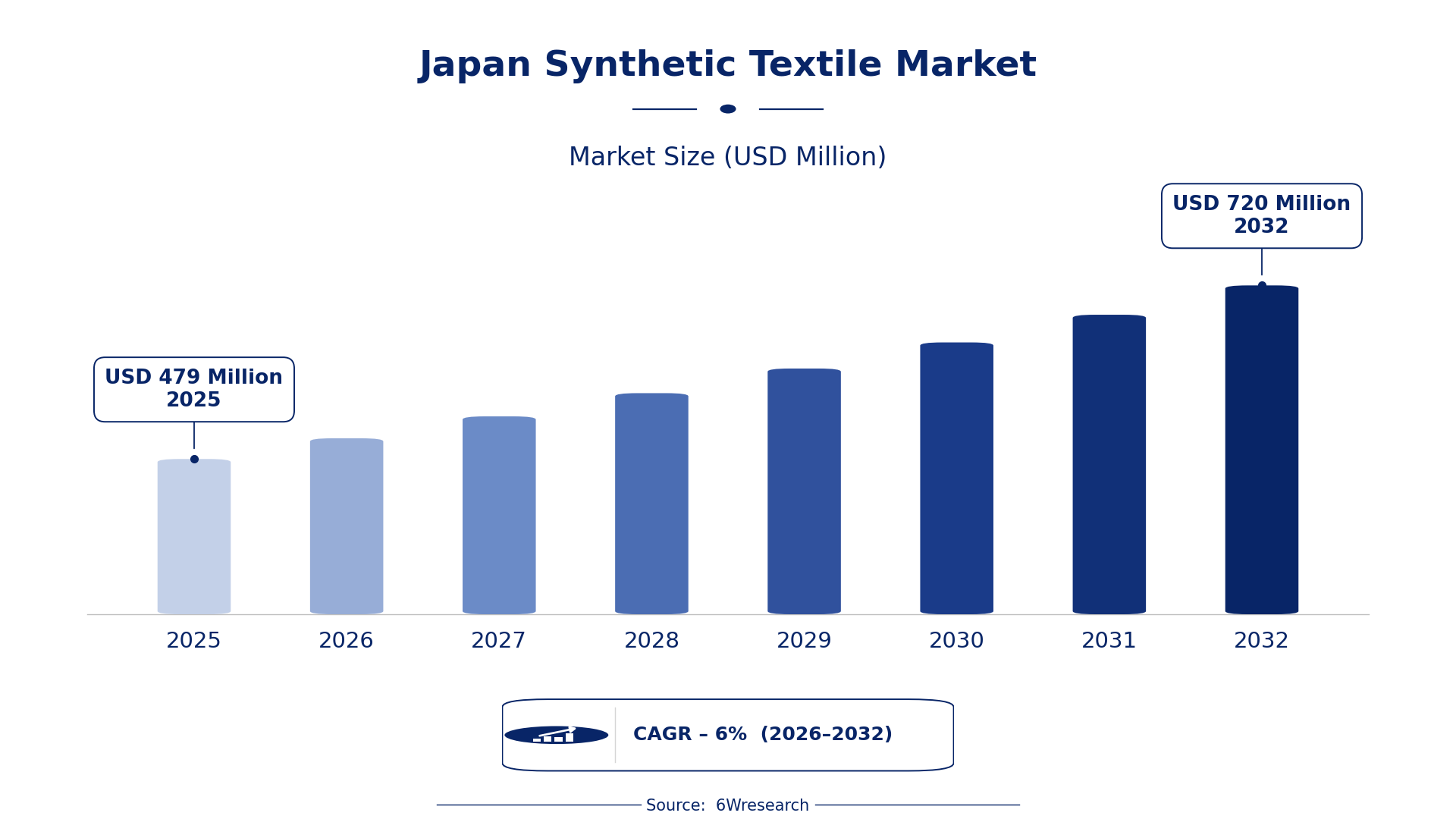
According to 6Wresearch internal database and industry insights, the Japan Synthetic Textile Market was valued at USD 479 Million in 2025 and is projected to reach USD 720 Million by 2032, growing at a CAGR of approximately 6% during 2026–2032.
Japan Synthetic Textile Market Highlights
| Report Metric | Details |
| Report Name | Japan Synthetic Textile Market (2026-2032) |
| Market Size 2025 | USD 479 Million |
| Market Size 2032 | USD 720 Million |
| Absolute Growth 2025–2032 | USD 241 Million |
| CAGR 2026–2032 | 6% |
| Peak Annual Growth | 6.8% in 2032 |
| Forecast Period | 2026–2032 |
| Historical Data | 2022–2025 |
| Base Year | 2025 |
| Leading Synthetic Textile, 2025 | Polyester Fabrics (47% share) |
| Leading Product Type, 2025 | Woven/Knitted (39% share) |
| Leading Fiber Type, 2025 | Polyester (37% share) |
| Leading Distribution Channel, 2025 | Direct Sales (39% share) |
| Leading End User Industry, 2025 | Apparel Manufacturing (52% share) |
| Fastest-Growing Synthetic Textile | Acrylic Fabrics (7.9% CAGR) |
| Fastest-Growing Product Type | Stretchable Wear (8.9% CAGR) |
| Fastest-Growing Fiber Type | Spandex/Elastane (8.6% CAGR) |
| Fastest-Growing Distribution Channel | Online Platforms (8.1% CAGR) |
| Fastest-Growing End User Industry | Fitness Wear Sector (7.8% CAGR) |
| Growing Sector | activewear |
| Key End Users | apparel manufacturers, home textile producers, sportswear brands, fitness wear sector |
Japan Synthetic Textile Market Year-wise Growth Rate and Key Drivers (2022–2032)
This graph illustrates the annual growth rates of the market from 2022 to 2032, highlighting a steady upward trajectory and projected market expansion over the forecast period.
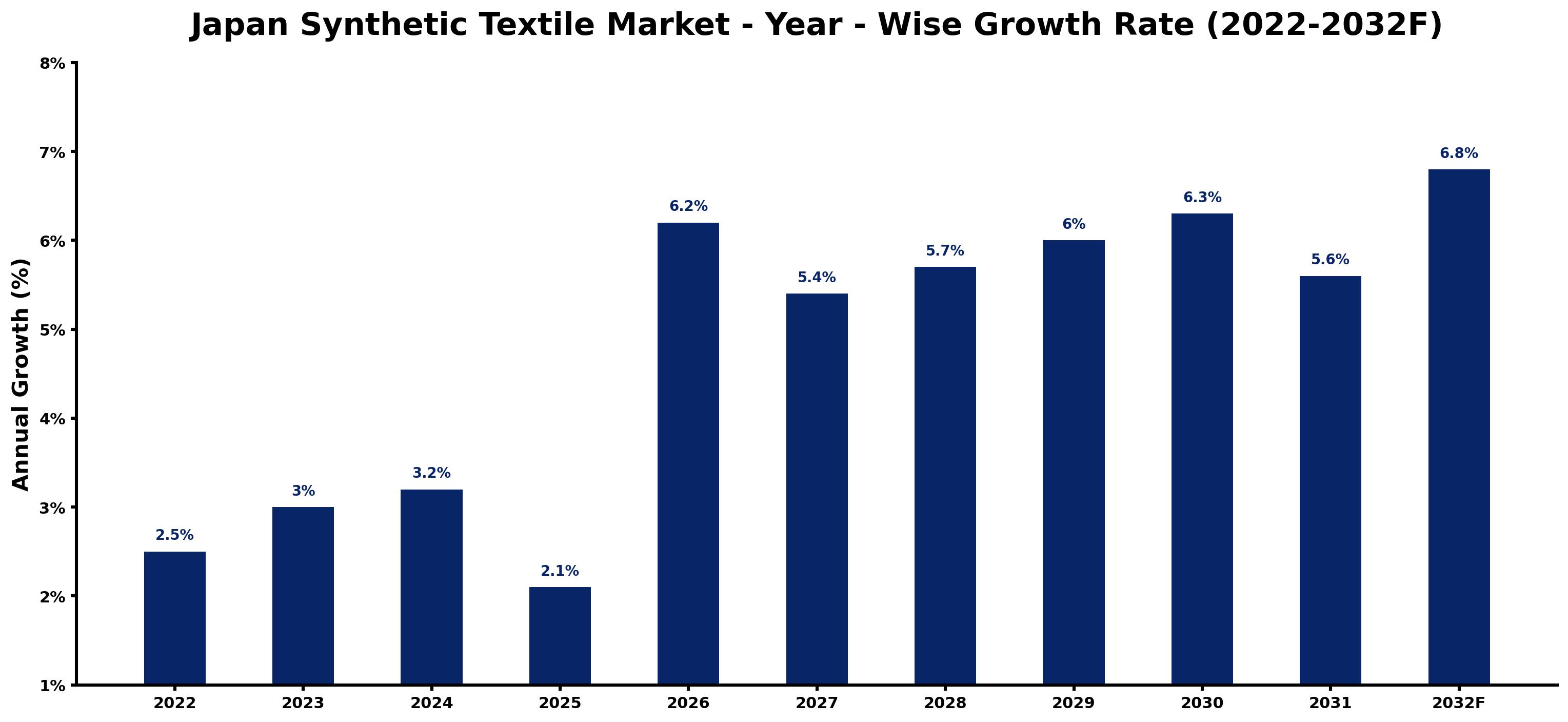
Year by year, the estimates below pair each growth rate with the development that shaped it.
| Year | Estimated Annual Growth (%) | Market Rationale |
| 2022 | 2.5 | The market showed stable growth as demand for synthetic textiles increased steadily. |
| 2023 | 3.0 | Growth accelerated due to rising consumer interest in activewear and home textiles. |
| 2024 | 3.2 | The market continued to expand, driven by increased production capacities and innovations. |
| 2025 | 2.1 | Growth slowed as manufacturers faced challenges in sourcing raw materials efficiently. |
| 2026 | 6.2 | Demand is expected to surge as the fitness wear sector begins to gain traction. |
| 2027 | 5.4 | Growth will decelerate slightly due to market saturation in certain textile segments. |
| 2028 | 5.7 | The market is projected to rebound as new technologies improve production efficiency and quality. |
| 2029 | 6.0 | Demand will continue to rise with the growing popularity of sustainable textiles. |
| 2030 | 6.3 | Growth is expected to remain strong as eco-friendly initiatives gain momentum in production. |
| 2031 | 5.6 | Growth will slow as competition intensifies among existing producers. |
| 2032 | 6.8 | Demand is projected to peak as the market adapts to technological advancements in textile production. |
Note: Market size estimations and growth projections presented in this report are based on 6Wresearch's proprietary forecasting methodology, utilizing the latest available industry data, government publications, and primary research inputs.
Japan Synthetic Textile Market Synopsis
Synthetic textiles are man-made fibres created from petroleum-based materials, primarily used in clothing, upholstery, and industrial applications. The Japan Synthetic Textile Market is expanding, driven by strong demand from apparel manufacturing and home textiles. The Tokyo region serves as a major manufacturing hub, while innovations in eco-friendly production methods are stimulating growth. The market reflects a growing interest in sustainable practices and activewear, with textile exports reaching 1.5 billion USD in 2022.
Market Dynamics Impact Analysis (2026–2032)
| Factor | Type | Impact | Primary Segment Affected |
| Rising demand for activewear and home textiles drives production. | Driver | High | Home Textiles |
| Technological advancements in manufacturing processes enhance efficiency. | Driver | High | Polyester Fabrics |
| Growing interest in sustainable textiles creates new market opportunities. | Opportunity | High | Polyester Fabrics |
| Expansion of online sales channels increases market accessibility. | Opportunity | High | Polyester Fabrics |
| Challenges in sourcing raw materials can limit production capabilities. | Restraint | Medium | Polyester Fabrics |
| Intense competition among manufacturers may affect pricing strategies. | Restraint | Medium | Polyester Fabrics |
| Supply chain disruptions impact timely delivery of products. | Challenge | High | Polyester Fabrics |
| Regulatory compliance costs can burden smaller producers. | Challenge | Medium | Polyester Fabrics |
Evaluation of Drivers in Japan Synthetic Textile Market (2026–2032)
The following drivers explain most of the expected growth.
| Drivers | Primary Segment Affected | Why It Matters (Evidence) |
| Increasing consumer preference for activewear drives demand for synthetic textiles. | Fitness Wear Sector | The fitness wear sector is projected to grow by 5% annually, prompting manufacturers to increase production. |
| Technological advancements in smart manufacturing improve production efficiency. | Polyester Fabrics | Digital transformation efforts in the textile industry enhance output and reduce costs. |
| The popularity of home textiles fuels demand for synthetic fabrics. | Home Textiles | The average annual consumption of textiles per capita in Japan is about 10 kg, indicating strong market potential. |
| Rising exports of synthetic textiles open new markets for producers. | Polyester Fabrics | Japan's textile exports reached 1.5 billion USD in 2022, showcasing international demand. |
| Sustainability trends encourage innovation in textile production. | Polyester Fabrics | Government initiatives aimed at eco-friendly textile production are attracting investments. |
Orders keep climbing as consumer interest in activewear rises, with the fitness wear sector projected to grow by 5% annually. Technological advancements in smart manufacturing are improving production efficiency, driven by the ongoing digital transformation in the textile industry. The average annual consumption of textiles per capita in Japan is about 10 kg, indicating strong demand for home textiles. Exports of synthetic textiles reached 1.5 billion USD in 2022, opening new markets for producers.
Evaluation of Restraints in Japan Synthetic Textile Market
Below are the constraints most often cited by buyers and suppliers, with the segment each affects.
| Market Restraint | Primary Segment Affected | Why It Matters (Evidence) |
| Challenges in sourcing raw materials can limit production capabilities. | Polyester Fabrics | The Japanese textile industry employs around 200,000 people, and any disruptions can impact output. |
| Intense competition among manufacturers may affect pricing strategies. | Polyester Fabrics | The market's competitive nature can lead to price wars, squeezing profit margins for producers. |
| Supply chain disruptions impact timely delivery of products. | Polyester Fabrics | Recent global supply chain issues have delayed shipments, affecting customer satisfaction. |
| Regulatory compliance costs can burden smaller producers. | Polyester Fabrics | Strict regulations on textile waste management increase operational costs for manufacturers. |
| The average lifespan of synthetic textiles is estimated at 3-5 years, limiting repeat purchases. | Polyester Fabrics | This lifespan affects the frequency of consumer purchases, impacting overall market growth. |
Japan Synthetic Textile Market Challenges
Japan's textile industry employs around 200,000 people, but skills shortages in advanced textile manufacturing lead to production inefficiencies for buyers, causing delays in order fulfilment. Strict regulations on textile waste management impose compliance costs on suppliers, extending product launch timelines by up to six months. Suppliers struggle with technology adoption, as the digital transformation requires heavy investments that can burden smaller manufacturers. Buyers experience rising costs due to supply chain disruptions, with prices increasing by 10-15% during peak demand periods, complicating their purchasing strategies.
Trends in the Japan Synthetic Textile Market
Buyers and suppliers in the Japan Synthetic Textile Market are adjusting to the following trends.
- Shift towards Eco-friendly Production: In 2023, the Tokyo Metropolitan Government launched a textile recycling initiative, promoting sustainable practices. This shift is likely to encourage manufacturers to adopt eco-friendly production methods, aligning with consumer preferences for sustainability.
- Growth of Online Sales Channels: The rise of online platforms for textile sales has transformed distribution strategies. With an expected CAGR of 8.1% for online platforms, this trend allows consumers greater access to synthetic textiles.
- Increased Demand for Activewear: The fitness wear sector is rapidly expanding, with a projected growth rate of 5% annually. This trend is prompting manufacturers to invest in high-performance synthetic fabrics to meet consumer expectations.
- Emergence of Smart Manufacturing Technologies: Since 2022, the Japanese textile industry has been undergoing digital transformation. This shift towards smart manufacturing is likely to improve production efficiency and product quality.
Investment Opportunities in the Japan Synthetic Textile Market
Below are the investment opportunities with the strongest case in the Japan Synthetic Textile Market.
- Growing Interest in Sustainable Textiles: With sustainability becoming a priority, manufacturers can invest in eco-friendly production methods. The Japan Textile Federation promotes sustainable practices, creating opportunities for innovation in textile production.
- Expansion of Online Sales Channels: The surge in online shopping presents an opportunity for textile distributors. By investing in e-commerce platforms, businesses can reach a broader customer base and increase sales.
- Rising Demand for Activewear: As the fitness wear sector grows, there is a clear opportunity for producers to develop high-performance synthetic fabrics. Apparel manufacturers are increasingly seeking materials to meet consumer demands.
- Investment in Smart Manufacturing Technologies: Now is the time to invest in smart manufacturing technologies to improve production efficiency. The digital transformation in the textile industry is supported by initiatives and funding.
Government Initiatives in the Japan Synthetic Textile Market
The Industrial Standardization Act governs product and test standards, ensuring quality in synthetic textile production. Compliance with ISO 9001 is essential for manufacturers to maintain quality management systems, thereby meeting buyer expectations.
The GX Basic Policy aims for about JPY 150 trillion in public-private decarbonisation investment over ten years. The Ministry of Economy, Trade and Industry oversees initiatives that support innovation and sustainability in the textile sector.
Future Insight of the Japan Synthetic Textile Market
By 2032, advancements in smart manufacturing will transform production processes, enabling suppliers to enhance efficiency and lower costs. The Ministry of Economy, Trade and Industry's initiatives will drive innovation, resulting in new products that align with market demands. Activewear demand is expected to increase by 5% annually, prompting suppliers to adapt their offerings. The Tokyo Metropolitan Government's textile recycling initiative will promote sustainability, encouraging buyers to favour eco-friendly products in their purchasing decisions.
Market Segmentation Analysis
Japan Synthetic Textile Market report covers a detailed analysis of the following market segments:
By Synthetic Textile – Polyester Fabrics Lead, Acrylic Fabrics Expected to Grow Fastest
According to Saurav Kr Singh, Senior Research Analyst at 6Wresearch, the largest synthetic textile category in 2025 was Polyester Fabrics, at 47% of revenue. Polyester fabrics dominate the market as they are extensively used in both apparel and home textiles, making them essential for manufacturers. In Japan, polyester accounts for over 60% of synthetic fiber production, highlighting its pivotal role in the industry. Over 2026–2032, Acrylic Fabrics are expected to post the fastest growth, at a CAGR of 7.9%. Acrylic fabrics are experiencing rapid growth, primarily due to increasing demand for home textiles like blankets and carpets. Government initiatives promoting eco-friendly textile production further support this upward trend, ensuring a bright future for acrylics. Suppliers should consider expanding their acrylic product offerings to take advantage of this rising demand.
By Product Type – Woven/Knitted Leads, Stretchable Wear Expected to Grow Fastest
Woven/Knitted accounted for 39% of the market by product type in 2025. Woven and knitted fabrics lead the market as they are the primary methods for fabric construction, widely utilised across various textile applications. Their dominance is evident in the substantial volume of synthetic textiles produced in Japan, underscoring their significance. Stretchable Wear is projected to grow fastest, at a CAGR of 8.9% during 2026–2032. The stretchable wear segment is witnessing growth, particularly in the activewear market where comfort and flexibility are increasingly desired. This trend is expected to continue as consumers gravitate towards versatile clothing options that accommodate active lifestyles. Buyers will benefit from suppliers broadening their stretchable wear selections to satisfy the growing demand.
By Fiber Type – Polyester Leads, Spandex/Elastane Expected to Grow Fastest
With 37% of fiber type revenue in 2025, Polyester was the largest category. Polyester remains the leading fiber in textile production, holding a considerable share of synthetic textiles utilised in Japan. Its versatility and cost-effectiveness make it a preferred choice for both apparel and industrial applications, solidifying its market position. Spandex/Elastane is set to record the highest CAGR in this split, 8.6% over 2026–2032. Spandex and elastane are gaining traction due to their crucial role in providing elasticity in clothing, especially within the activewear sector. As health and fitness trends rise, the demand for these fibers is projected to increase significantly. Suppliers should focus on enhancing spandex and elastane production to align with market trends and consumer preferences.
By Distribution Channel – Direct Sales Leads, Online Platforms Expected to Grow Fastest
Direct Sales held 39% of the Japan Synthetic Textile Market by distribution channel in 2025. Direct sales serve as the primary channel for textile distribution, allowing manufacturers to establish strong relationships with their buyers. This method is particularly effective in the textile industry, where quality and service are vital for customer satisfaction. The quickest growth will come from Online Platforms, forecast to expand at a CAGR of 8.1% between 2026 and 2032. Online platforms are rapidly emerging as a growing channel for consumer sales, driven by the increasing shift towards e-commerce in the textile sector. As consumer preference for online shopping rises, this trend is likely to accelerate further. Suppliers must strengthen their online presence to capture the expanding market of digital consumers.
By End User Industry – Apparel Manufacturing Leads, Fitness Wear Sector Expected to Grow Fastest
In 2025, Apparel Manufacturing led the end user industry split with a 52% share. Apparel manufacturing is the largest consumer of synthetic textiles, supported by the substantial value of the Japanese apparel market, which is approximately 30 billion USD. This sector consistently demands synthetic textiles due to ongoing fashion trends and consumer preferences. Over 2026–2032, Fitness Wear Sector is expected to post the fastest growth, at a CAGR of 7.8%. The fitness wear sector is expanding quickly, reflecting a growing consumer emphasis on health and wellness. This growth is bolstered by a projected annual increase of 5% in demand for activewear, indicating a shift in consumer habits. Suppliers should prioritise collaborations with fitness wear brands to capitalise on the growth in this sector.
Key Attractiveness of the Report
- 10 Years of Market Numbers
- Historical Data Starting from 2022 to 2025
- Base Year 2025
- Forecast Data until 2032
- Key Performance Indicators Impacting the Market
- Major Upcoming Developments and Projects
Key Highlights of the Report:
- Japan Synthetic Textile Market Outlook
- Market Size of Japan Synthetic Textile Market, 2025
- Forecast of Japan Synthetic Textile Market, 2032
- Historical Data and Forecast of Japan Synthetic Textile Revenues & Volume for the Period 2022-2032F
- Japan Synthetic Textile Market Trend Evolution
- Japan Synthetic Textile Market Drivers and Challenges
- Japan Synthetic Textile Price Trends
- Japan Synthetic Textile Porter's Five Forces
- Japan Synthetic Textile Industry Life Cycle
- Historical Data and Forecast of Japan Synthetic Textile Market Revenues & Volume By Synthetic Textile for the Period 2022-2032F
- Historical Data and Forecast of Japan Synthetic Textile Market Revenues & Volume By Polyester Fabrics for the Period 2022-2032F
- Historical Data and Forecast of Japan Synthetic Textile Market Revenues & Volume By Nylon Fabrics for the Period 2022-2032F
- Historical Data and Forecast of Japan Synthetic Textile Market Revenues & Volume By Acrylic Fabrics for the Period 2022-2032F
- Historical Data and Forecast of Japan Synthetic Textile Market Revenues & Volume By Spandex Fabrics for the Period 2022-2032F
- Historical Data and Forecast of Japan Synthetic Textile Market Revenues & Volume By Product Type for the Period 2022-2032F
- Historical Data and Forecast of Japan Synthetic Textile Market Revenues & Volume By Woven/Knitted for the Period 2022-2032F
- Historical Data and Forecast of Japan Synthetic Textile Market Revenues & Volume By Tulle, Satin for the Period 2022-2032F
- Historical Data and Forecast of Japan Synthetic Textile Market Revenues & Volume By Sweaters, Blankets for the Period 2022-2032F
- Historical Data and Forecast of Japan Synthetic Textile Market Revenues & Volume By Stretchable Wear for the Period 2022-2032F
- Historical Data and Forecast of Japan Synthetic Textile Market Revenues & Volume By Fiber Type for the Period 2022-2032F
- Historical Data and Forecast of Japan Synthetic Textile Market Revenues & Volume By Polyester for the Period 2022-2032F
- Historical Data and Forecast of Japan Synthetic Textile Market Revenues & Volume By Nylon for the Period 2022-2032F
- Historical Data and Forecast of Japan Synthetic Textile Market Revenues & Volume By Acrylic for the Period 2022-2032F
- Historical Data and Forecast of Japan Synthetic Textile Market Revenues & Volume By Spandex/Elastane for the Period 2022-2032F
- Historical Data and Forecast of Japan Synthetic Textile Market Revenues & Volume By Distribution Channel for the Period 2022-2032F
- Historical Data and Forecast of Japan Synthetic Textile Market Revenues & Volume By Direct Sales for the Period 2022-2032F
- Historical Data and Forecast of Japan Synthetic Textile Market Revenues & Volume By Textile Distributors for the Period 2022-2032F
- Historical Data and Forecast of Japan Synthetic Textile Market Revenues & Volume By Online Platforms for the Period 2022-2032F
- Historical Data and Forecast of Japan Synthetic Textile Market Revenues & Volume By Specialty Stores for the Period 2022-2032F
- Historical Data and Forecast of Japan Synthetic Textile Market Revenues & Volume By End User Industry for the Period 2022-2032F
- Historical Data and Forecast of Japan Synthetic Textile Market Revenues & Volume By Apparel Manufacturing for the Period 2022-2032F
- Historical Data and Forecast of Japan Synthetic Textile Market Revenues & Volume By Sportswear Brands for the Period 2022-2032F
- Historical Data and Forecast of Japan Synthetic Textile Market Revenues & Volume By Home Textiles for the Period 2022-2032F
- Historical Data and Forecast of Japan Synthetic Textile Market Revenues & Volume By Fitness Wear Sector for the Period 2022-2032F
- Japan Synthetic Textile Import Export Trade Statistics
- Market Opportunity Assessment By Synthetic Textile
- Market Opportunity Assessment By Product Type
- Market Opportunity Assessment By Fiber Type
- Market Opportunity Assessment By Distribution Channel
- Market Opportunity Assessment By End User Industry
- Japan Synthetic Textile Top Companies Market Share
- Japan Synthetic Textile Competitive Benchmarking By Technical and Operational Parameters
- Japan Synthetic Textile Company Profiles
- Japan Synthetic Textile Key Strategic Recommendations
Market Covered
Coverage by segment is as follows.
By Synthetic Textile
- Polyester Fabrics
- Nylon Fabrics
- Acrylic Fabrics
- Spandex Fabrics
By Product Type
- Woven/Knitted
- Tulle
- Satin
- Sweaters
- Blankets
- Stretchable Wear
By Fiber Type
- Polyester
- Nylon
- Acrylic
- Spandex/Elastane
By Distribution Channel
- Direct Sales
- Textile Distributors
- Online Platforms
- Specialty Stores
By End User Industry
- Apparel Manufacturing
- Sportswear Brands
- Home Textiles
- Fitness Wear Sector































