Japan Synthetic Turf Market Size & Growth Rate
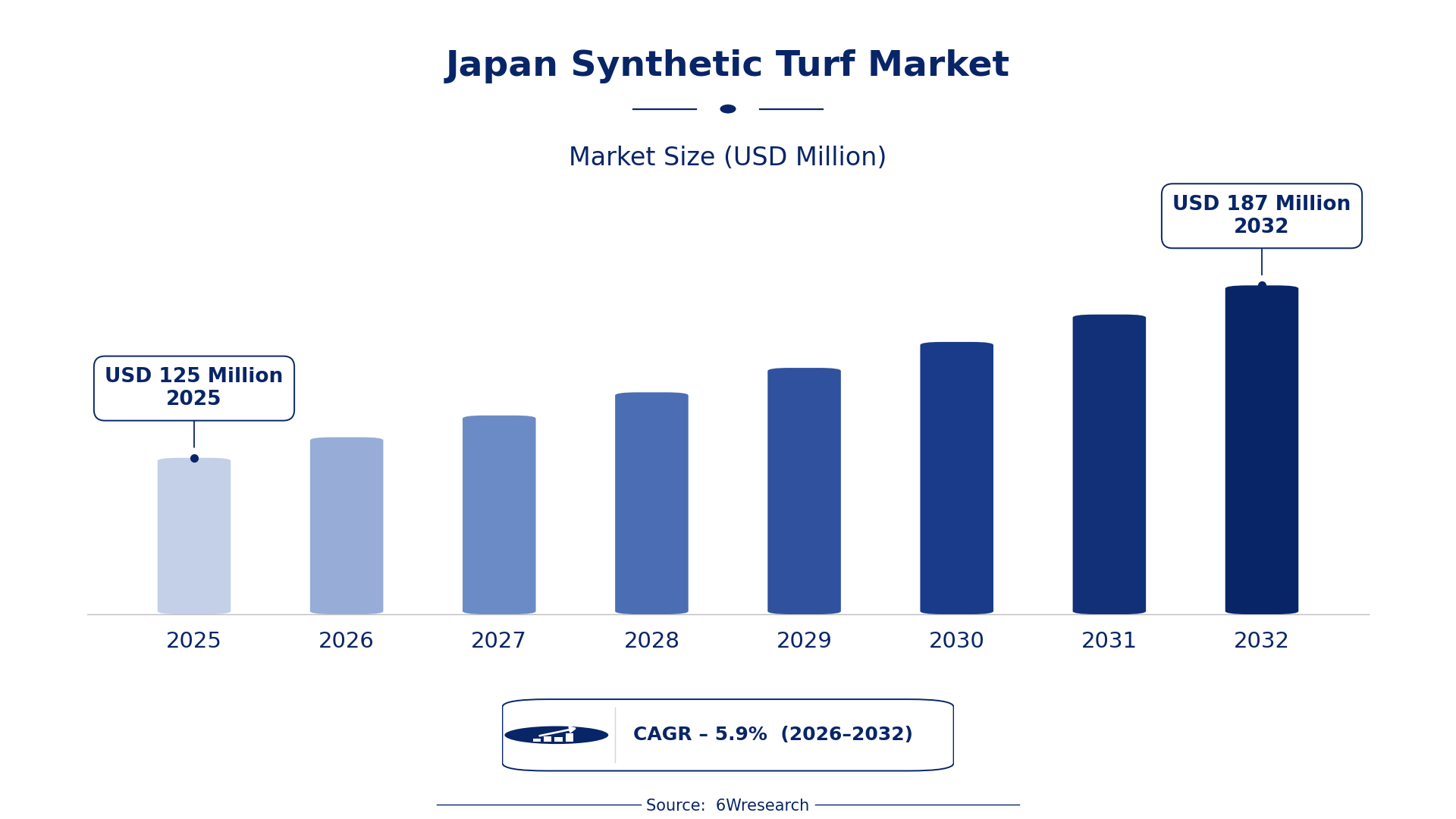
According to 6Wresearch internal database and industry insights, the Japan Synthetic Turf Market was valued at USD 125 Million in 2025 and is projected to reach USD 187 Million by 2032, growing at a CAGR of approximately 5.9% during 2026–2032.
Japan Synthetic Turf Market Highlights
| Report Metric | Details |
| Report Name | Japan Synthetic Turf Market (2026-2032) |
| Market Size 2025 | USD 125 Million |
| Market Size 2032 | USD 187 Million |
| Absolute Growth 2025–2032 | USD 62 Million |
| CAGR 2026–2032 | 5.9% |
| Peak Annual Growth | 6.8% in 2028 |
| Forecast Period | 2026–2032 |
| Historical Data | 2022–2025 |
| Base Year | 2025 |
| Leading Synthetic Turf, 2025 | Sports Turf (43% share) |
| Leading Product Type, 2025 | Multi-Sport Turf (47% share) |
| Leading Material Type, 2025 | Polyethylene (46% share) |
| Leading Distribution Channel, 2025 | Direct Sales (42% share) |
| Leading End User Industry, 2025 | Athletic Facilities (47% share) |
| Fastest-Growing Synthetic Turf | Rooftop Turf (7.5% CAGR) |
| Fastest-Growing Product Type | Lawns & Gardens (8.2% CAGR) |
| Fastest-Growing Distribution Channel | Online Platforms (7.6% CAGR) |
| Fastest-Growing End User Industry | Urban Constructions (7.4% CAGR) |
| Growing Sector | Urban Constructions |
| Key End Users | Athletic Facilities, Homeowners, Real Estate Projects, Urban Constructions |
Japan Synthetic Turf Market Year-wise Growth Rate and Key Drivers (2022–2032)
This graph illustrates the annual growth rates of the market from 2022 to 2032, highlighting a steady upward trajectory and projected market expansion over the forecast period.
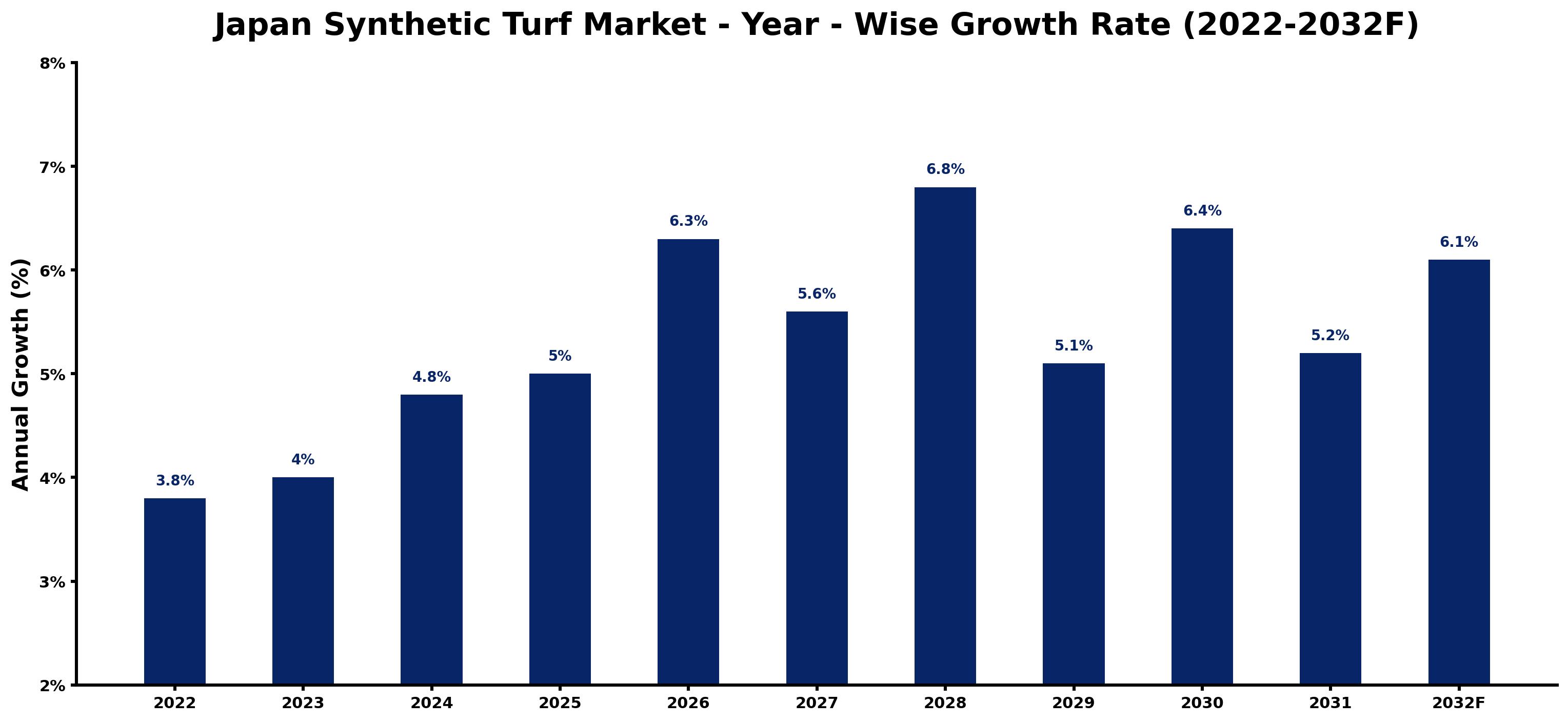
For each year, the table pairs the estimated growth rate with the leading influence on demand, showing how the drivers changed across the period.
| Year | Estimated Annual Growth (%) | Market Rationale |
| 2022 | 3.8 | The market showed steady growth, supported by increasing urbanisation and demand for synthetic surfaces. |
| 2023 | 4.0 | Growth accelerated due to heightened interest in sustainable landscaping solutions and urban greening. |
| 2024 | 4.8 | Demand continued to rise as more athletic facilities opted for synthetic turf for its durability. |
| 2025 | 5.0 | The market reached a historical peak, driven by the Tokyo 2020 Olympics showcasing synthetic turf. |
| 2026 | 6.3 | Growth is expected to rise as residential installations increase, reflecting homeowners' preference for low-maintenance options. |
| 2027 | 5.6 | A slowdown is projected as market saturation begins in certain urban areas, yet growth persists. |
| 2028 | 6.8 | The peak annual growth is anticipated, with increased investments in urban construction and sports facilities. |
| 2029 | 5.1 | Growth is expected to slow slightly, reflecting a stabilisation in new installations across various sectors. |
| 2030 | 6.4 | Demand will pick up again as urban greening initiatives gain traction in metropolitan areas. |
| 2031 | 5.2 | A further slowdown is projected as the market adjusts to previous rapid expansions. |
| 2032 | 6.1 | Growth is expected to resume, driven by ongoing urban development and increasing awareness of environmental benefits. |
Note: Market size estimations and growth projections presented in this report are based on 6Wresearch's proprietary forecasting methodology, utilizing the latest available industry data, government publications, and primary research inputs.
Japan Synthetic Turf Market Synopsis
Synthetic turf is an artificial grass surface made from synthetic fibres, primarily used in sports and landscaping. Its durability and low maintenance appeal to athletic facilities, residential lawns, and commercial landscaping. The Japan Synthetic Turf Market is expanding due to urbanisation, driven by strong demand from athletic facilities and residential users. Urban greening projects are encouraging its use in public spaces, while the Tokyo 2020 Olympics showcased its advantages.
Market Dynamics Impact Analysis (2026–2032)
| Factor | Type | Impact | Primary Segment Affected |
| Urban greening initiatives are driving demand for synthetic turf in public parks, leading to increased installations by local governments. | Driver | High | Commercial Turf |
| The growing popularity of synthetic turf in residential landscaping is encouraging homeowners to invest in low-maintenance solutions. | Driver | High | Residential Turf |
| The rising demand for sustainable landscaping solutions presents opportunities for producers to expand their offerings in urban areas. | Opportunity | High | Commercial Turf |
| The increasing trend of rooftop gardens in urban constructions creates a demand for versatile synthetic turf products. | Opportunity | High | Rooftop Turf |
| High installation costs, averaging 2,500 yen per square meter, limit accessibility for many potential buyers. | Restraint | High | Residential Turf |
| A shortage of skilled installers is causing delays in project completions, impacting the ability to meet growing demand. | Restraint | High | Sports Turf |
| Intense competition from natural grass alternatives forces producers to lower prices, impacting profitability. | Challenge | Medium | Sports Turf |
| Supply chain disruptions are affecting material availability, leading to delays in urban greening projects. | Challenge | Medium | Commercial Turf |
Evaluation of Drivers in Japan Synthetic Turf Market (2026–2032)
These are the developments adding the most demand over the forecast period.
| Drivers | Primary Segment Affected | Why It Matters (Evidence) |
| Urban greening initiatives are increasing demand for synthetic turf in public spaces. | Commercial Turf | In 2023, 30% of new sports facilities incorporated synthetic turf, demonstrating its growing acceptance. |
| The Tokyo 2020 Olympics showcased synthetic turf, boosting its visibility and acceptance. | Sports Turf | The event highlighted synthetic turf's performance, leading to a rise in installations in athletic facilities. |
| Rising residential installations are driven by homeowners seeking low-maintenance landscaping options. | Residential Turf | Since 2020, residential synthetic turf installations have increased by 15%, reflecting changing preferences. |
| The average lifespan of synthetic turf encourages long-term investment from buyers. | Multi-Sport Turf | With an estimated lifespan of 8-10 years, it appeals to facilities looking for durability. |
| Government funding for urban greening projects supports synthetic turf adoption. | Urban Constructions | Local governments are incentivising the use of synthetic turf in public parks, promoting its appeal. |
Purchasing is picking up as urban greening projects gain traction, with local governments incentivising synthetic turf in public parks. The average lifespan of synthetic turf, estimated at 8-10 years, encourages long-term investments from buyers. Recent trends show that residential installations have surged, as homeowners opt for low-maintenance landscaping solutions. In 2023, 30% of new sports facilities incorporated synthetic turf, reflecting its growing acceptance among athletic facilities. The Tokyo 2020 Olympics showcased synthetic turf's performance, resulting in increased installations nationwide.
Evaluation of Restraints in Japan Synthetic Turf Market
The following restraints limit how fast demand can grow.
| Market Restraint | Primary Segment Affected | Why It Matters (Evidence) |
| High initial installation costs can deter potential buyers from adopting synthetic turf. | Residential Turf | The average installation cost is around 2,500 yen per square meter, which may limit uptake. |
| Limited awareness of synthetic turf benefits among certain buyer groups restricts growth. | Commercial Turf | Many corporate landscapes still prefer natural grass due to traditional perceptions. |
| Competition from natural grass alternatives can impede market penetration. | Sports Turf | Natural grass is often seen as more environmentally friendly, affecting buyer preferences. |
| Supply chain disruptions can delay projects and increase costs for buyers. | Residential Turf | These disruptions affect availability and timely delivery of synthetic turf products. |
| Regulatory hurdles can complicate the approval process for new installations. | Urban Constructions | Compliance with local standards can slow down project timelines and increase costs. |
Japan Synthetic Turf Market Challenges
High installation costs limit accessibility, with residential turf averaging 2,500 yen per square metre, making it unaffordable for many homeowners. A shortage of skilled installers results in project delays, affecting contractors' ability to meet rising demand. Intense competition from natural grass alternatives pressures producers to lower prices, significantly squeezing their profit margins. Supply chain disruptions impact material availability, causing urban greening projects to experience delays that can extend installation timelines in public parks by several months.
Trends in the Japan Synthetic Turf Market
The shifts below are changing how Japan Synthetic Turf Market products are bought and supplied.
- Tokyo 2020 Olympics Showcasing Synthetic Turf: The Tokyo 2020 Olympics highlighted the advantages of synthetic turf, resulting in increased installations in athletic facilities nationwide. Approximately 60% of new sports fields now incorporate synthetic turf, reflecting its growing popularity.
- Urban Greening Initiatives in Tokyo: Urban greening initiatives in Tokyo are increasingly adopting synthetic turf for public parks, improving green spaces in densely populated areas. This trend supports sustainability efforts, with local governments promoting its use.
- Rooftop Gardens in Urban Developments: Rooftop gardens in urban developments are gaining traction, with synthetic turf providing aesthetic appeal and low maintenance. Recent projects have seen a rise in rooftop gardens, contributing to urban greening efforts.
- Homeowners Seeking Low-Maintenance Landscaping: Homeowners are increasingly opting for synthetic turf in gardens, motivated by a desire for low-maintenance landscaping. Residential installations have increased by 15% since 2020, reflecting changing consumer preferences.
Investment Opportunities in the Japan Synthetic Turf Market
The following areas offer the clearest openings for investors and suppliers in the Japan Synthetic Turf Market.
- Demand for Eco-Friendly Landscaping Solutions: With an annual demand of around 1 million square metres, there is a gap in sustainable landscaping solutions. Commercial developers are increasingly seeking synthetic turf for eco-friendly projects, presenting investment opportunities.
- Urban Developments Integrating Green Solutions: Urban developments in Tokyo are increasingly incorporating synthetic turf into their designs, motivated by sustainability goals. Collaborating with local governments can facilitate entry into this expanding market.
- Partnerships for Upgrading Athletic Facilities: Athletic facilities are looking to upgrade to synthetic turf, creating opportunities for partnerships with suppliers. Engaging in joint ventures can streamline the installation process and strengthen market presence.
- Approval Pathways for Public Parks: Local governments are promoting synthetic turf use in public parks, creating a demand for suppliers. Securing approvals through local partnerships can help suppliers access this growing market.
Government Initiatives in the Japan Synthetic Turf Market
The Building Energy Efficiency Act, amended in 2022, mandates that all new buildings meet energy standards from April 2025. This regulation affects synthetic turf producers by ensuring that installations in new buildings comply with energy efficiency requirements, promoting sustainable practices.
The Digital Agency oversees government digital transformation efforts and approves funding for projects that incorporate modern solutions, including synthetic turf in urban greening initiatives, supporting buyers in accessing contemporary landscaping options.
Future Insight of the Japan Synthetic Turf Market
A policy shift towards urban greening will drive the adoption of synthetic turf, as local governments allocate funds for green spaces. The implementation of JIS A 5759 will standardise quality, benefiting both buyers and suppliers. Technological advancements in manufacturing processes will increase durability, potentially extending the average lifespan of synthetic turf beyond 10 years. Urbanisation trends will fuel the growth of rooftop gardens, contributing to an annual demand expected to reach 1 million square metres.
Market Segmentation Analysis
Japan Synthetic Turf Market report covers a detailed analysis of the following market segments:
By Synthetic Turf – Sports Turf Leads, Rooftop Turf Expected to Grow Fastest
According to Saurav Kr Singh, Senior Research Analyst at 6Wresearch, with 43% of synthetic turf revenue in 2025, Sports Turf was the largest category. Sports turf holds the largest share due to its extensive use in over 500 athletic facilities across Japan, catering to various sports. The Tokyo 2020 Olympics showcased synthetic turf, further solidifying its importance in sports infrastructure. Rooftop Turf is set to record the highest CAGR in this split, 7.5% over 2026–2032. Rooftop turf is experiencing rapid growth as urban construction projects increasingly incorporate green roofs, with local governments incentivising this trend. The rise in rooftop gardens in urban areas reflects a shift towards sustainable landscaping solutions. Suppliers should focus on urban construction projects to capitalise on the growing demand for rooftop turf.
By Product Type – Multi-Sport Turf Leads, Lawns & Gardens Expected to Grow Fastest
Multi-Sport Turf held 47% of the Japan Synthetic Turf Market by product type in 2025. Multi-sport turf holds the largest share due to its design for versatility, making it ideal for various sports applications in over 500 athletic facilities nationwide. This widespread use is further supported by the incorporation of synthetic turf in 30% of new sports facilities across the country. Over 2026–2032, Lawns & Gardens are expected to post the fastest growth, at a CAGR of 8.2%. Lawns and gardens are experiencing rapid growth, with a notable 15% increase in residential installations since 2020 reflecting a shift towards low-maintenance landscaping solutions. This trend is further encouraged by local governments incentivising the use of synthetic turf in public parks, enhancing its appeal. Suppliers should focus on promoting multi-sport turf while also addressing the increasing demand for residential installations to capture a broader market.
By Material Type – Polyethylene Leads and Records the Fastest Growth
In 2025, Polyethylene led the material type split with a 46% share. Polyethylene is the leading material type for synthetic turf due to its durability and softness, making it ideal for both sports and landscaping applications. Its widespread acceptance is reflected in the majority of synthetic turf installations across Japan. Polyethylene is also forecast to expand faster than any other category, at a CAGR of 8.0% over 2026–2032. The growth of polyethylene as a material type will continue as it remains the preferred choice for both sports and residential applications, ensuring consistent demand. Its properties cater effectively to the needs of various end users, solidifying its market position. Suppliers should prioritise polyethylene products to meet the ongoing demand in both sports and landscaping sectors.
By Distribution Channel – Direct Sales Leads, Online Platforms Expected to Grow Fastest
Direct Sales accounted for 42% of the market by distribution channel in 2025. Direct sales remains the leading distribution channel, primarily serving bulk purchases for athletic facilities and large-scale projects. This channel's strength is highlighted by established relationships between suppliers and major buyers in the market. The quickest growth will come from Online Platforms, forecast to expand at a CAGR of 7.6% between 2026 and 2032. Online platforms are emerging as the fastest-growing channel, appealing to consumers seeking convenience for residential purchases. The shift towards e-commerce is encouraging more buyers to explore synthetic turf options online. Suppliers need to strengthen their online strategies to effectively reach the expanding consumer base for synthetic turf.
By End User Industry – Athletic Facilities Lead, Urban Constructions Expected to Grow Fastest
The largest end user industry category in 2025 was Athletic Facilities, at 47% of revenue. Athletic facilities are the leading end user of synthetic turf, utilising it extensively for various sports applications across the country. This sector's reliance on synthetic turf is underscored by its use in over 60% of new sports fields. Urban Constructions are set to record the highest CAGR in this split, 7.4% over 2026–2032. Urban constructions are experiencing rapid growth as cities integrate synthetic turf into their planning for green spaces, supported by government funding for urban greening projects. This trend reflects a broader commitment to sustainable urban development. Suppliers should engage with urban planners to explore opportunities in the growing urban construction sector.
Key Attractiveness of the Report
- 10 Years of Market Numbers
- Historical Data Starting from 2022 to 2025
- Base Year 2025
- Forecast Data until 2032
- Key Performance Indicators Impacting the Market
- Major Upcoming Developments and Projects
Key Highlights of the Report:
- Japan Synthetic Turf Market Outlook
- Market Size of Japan Synthetic Turf Market, 2025
- Forecast of Japan Synthetic Turf Market, 2032
- Historical Data and Forecast of Japan Synthetic Turf Revenues & Volume for the Period 2022-2032F
- Japan Synthetic Turf Market Trend Evolution
- Japan Synthetic Turf Market Drivers and Challenges
- Japan Synthetic Turf Price Trends
- Japan Synthetic Turf Porter's Five Forces
- Japan Synthetic Turf Industry Life Cycle
- Historical Data and Forecast of Japan Synthetic Turf Market Revenues & Volume By Synthetic Turf for the Period 2022-2032F
- Historical Data and Forecast of Japan Synthetic Turf Market Revenues & Volume By Sports Turf for the Period 2022-2032F
- Historical Data and Forecast of Japan Synthetic Turf Market Revenues & Volume By Residential Turf for the Period 2022-2032F
- Historical Data and Forecast of Japan Synthetic Turf Market Revenues & Volume By Commercial Turf for the Period 2022-2032F
- Historical Data and Forecast of Japan Synthetic Turf Market Revenues & Volume By Rooftop Turf for the Period 2022-2032F
- Historical Data and Forecast of Japan Synthetic Turf Market Revenues & Volume By Product Type for the Period 2022-2032F
- Historical Data and Forecast of Japan Synthetic Turf Market Revenues & Volume By Multi-Sport Turf for the Period 2022-2032F
- Historical Data and Forecast of Japan Synthetic Turf Market Revenues & Volume By Lawns & Gardens for the Period 2022-2032F
- Historical Data and Forecast of Japan Synthetic Turf Market Revenues & Volume By Corporate Landscapes for the Period 2022-2032F
- Historical Data and Forecast of Japan Synthetic Turf Market Revenues & Volume By Lightweight Turf for the Period 2022-2032F
- Historical Data and Forecast of Japan Synthetic Turf Market Revenues & Volume By Material Type for the Period 2022-2032F
- Historical Data and Forecast of Japan Synthetic Turf Market Revenues & Volume By Polyethylene for the Period 2022-2032F
- Historical Data and Forecast of Japan Synthetic Turf Market Revenues & Volume By Polypropylene for the Period 2022-2032F
- Historical Data and Forecast of Japan Synthetic Turf Market Revenues & Volume By Nylon for the Period 2022-2032F
- Historical Data and Forecast of Japan Synthetic Turf Market Revenues & Volume By Composite Blends for the Period 2022-2032F
- Historical Data and Forecast of Japan Synthetic Turf Market Revenues & Volume By Distribution Channel for the Period 2022-2032F
- Historical Data and Forecast of Japan Synthetic Turf Market Revenues & Volume By Direct Sales for the Period 2022-2032F
- Historical Data and Forecast of Japan Synthetic Turf Market Revenues & Volume By Online Platforms for the Period 2022-2032F
- Historical Data and Forecast of Japan Synthetic Turf Market Revenues & Volume By Retail Stores for the Period 2022-2032F
- Historical Data and Forecast of Japan Synthetic Turf Market Revenues & Volume By Specialty Suppliers for the Period 2022-2032F
- Historical Data and Forecast of Japan Synthetic Turf Market Revenues & Volume By End User Industry for the Period 2022-2032F
- Historical Data and Forecast of Japan Synthetic Turf Market Revenues & Volume By Athletic Facilities for the Period 2022-2032F
- Historical Data and Forecast of Japan Synthetic Turf Market Revenues & Volume By Homeowners for the Period 2022-2032F
- Historical Data and Forecast of Japan Synthetic Turf Market Revenues & Volume By Real Estate Projects for the Period 2022-2032F
- Historical Data and Forecast of Japan Synthetic Turf Market Revenues & Volume By Urban Constructions for the Period 2022-2032F
- Japan Synthetic Turf Import Export Trade Statistics
- Market Opportunity Assessment By Synthetic Turf
- Market Opportunity Assessment By Product Type
- Market Opportunity Assessment By Material Type
- Market Opportunity Assessment By Distribution Channel
- Market Opportunity Assessment By End User Industry
- Japan Synthetic Turf Top Companies Market Share
- Japan Synthetic Turf Competitive Benchmarking By Technical and Operational Parameters
- Japan Synthetic Turf Company Profiles
- Japan Synthetic Turf Key Strategic Recommendations
Market Covered
Coverage by segment is as follows.
By Synthetic Turf
- Sports Turf
- Residential Turf
- Commercial Turf
- Rooftop Turf
By Product Type
- Multi-Sport Turf
- Lawns & Gardens
- Corporate Landscapes
- Lightweight Turf
By Material Type
- Polyethylene
- Polypropylene
- Nylon
- Composite Blends
By Distribution Channel
- Direct Sales
- Online Platforms
- Retail Stores
- Specialty Suppliers
By End User Industry
- Athletic Facilities
- Homeowners
- Real Estate Projects
- Urban Constructions































