Japan Synthetic Upholstery Market Size & Growth Rate
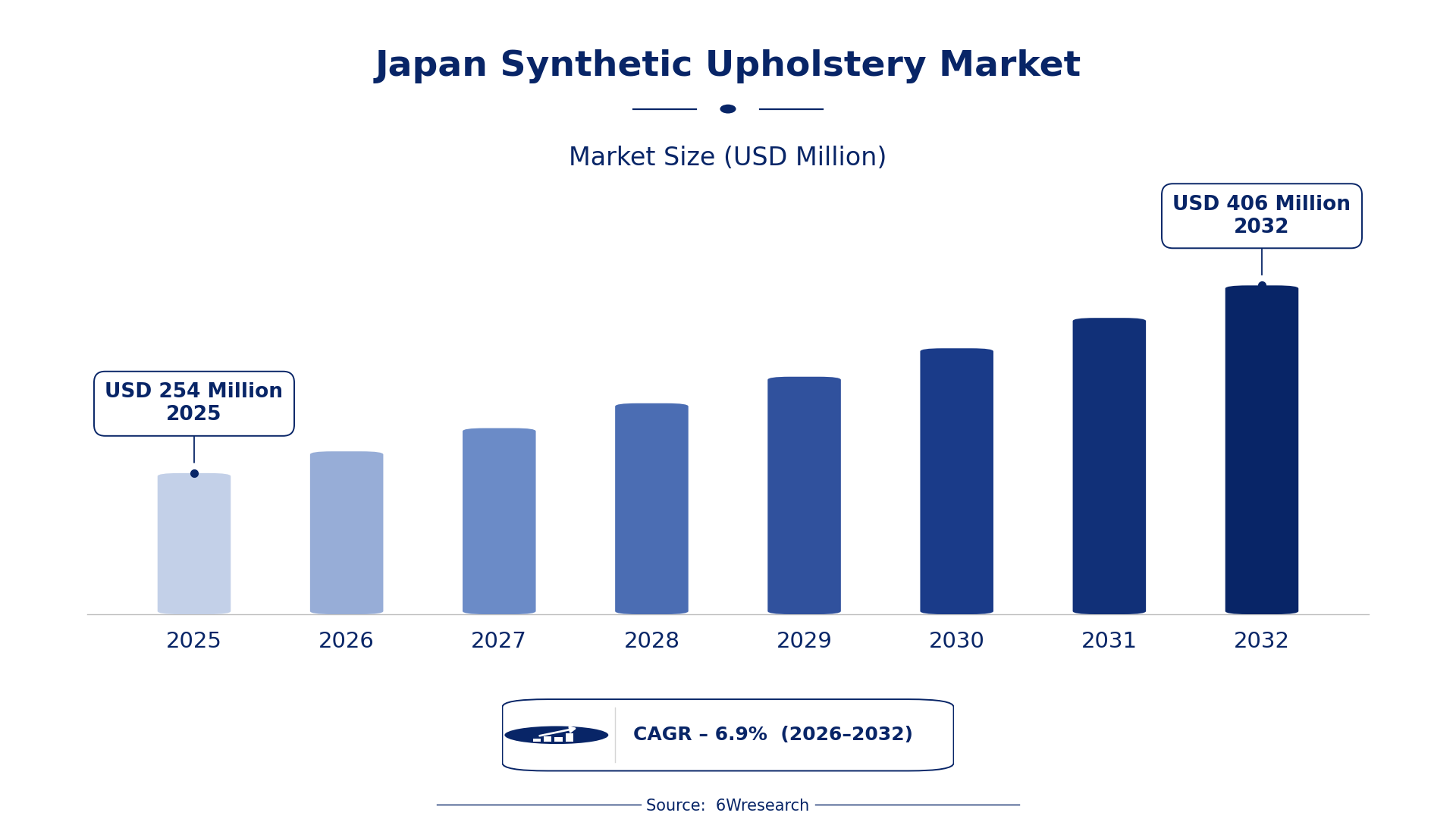
According to 6Wresearch internal database and industry insights, the Japan Synthetic Upholstery Market was valued at USD 254 Million in 2025 and is projected to reach USD 406 Million by 2032, growing at a CAGR of approximately 6.9% during 2026–2032.
Japan Synthetic Upholstery Market Highlights
| Report Metric | Details |
| Report Name | Japan Synthetic Upholstery Market (2026-2032) |
| Market Size 2025 | USD 254 Million |
| Market Size 2032 | USD 406 Million |
| Absolute Growth 2025–2032 | USD 152 Million |
| CAGR 2026–2032 | 6.9% |
| Peak Annual Growth | 7.4% in 2026 |
| Forecast Period | 2026–2032 |
| Historical Data | 2022–2025 |
| Base Year | 2025 |
| Leading Synthetic Upholstery, 2025 | PU Leather Upholstery (50% share) |
| Leading Product Type, 2025 | Faux Leather (46% share) |
| Leading Material Type, 2025 | Polyurethane (45% share) |
| Leading Distribution Channel, 2025 | OEM Supply Chains (41% share) |
| Leading End User Industry, 2025 | Automotive Interiors (45% share) |
| Fastest-Growing Synthetic Upholstery | Vinyl Upholstery (9.2% CAGR) |
| Fastest-Growing Product Type | Eco-Friendly Leather (9.6% CAGR) |
| Fastest-Growing Distribution Channel | Online Platforms (9.1% CAGR) |
| Fastest-Growing End User Industry | Home Decor (8.8% CAGR) |
| Growing Sector | Home Decor |
| Key End Users | Automotive Interiors, Furniture Industry, Office Furniture, Home Decor |
Japan Synthetic Upholstery Market Year-wise Growth Rate and Key Drivers (2022–2032)
This graph illustrates the annual growth rates of the market from 2022 to 2032, highlighting a steady upward trajectory and projected market expansion over the forecast period.
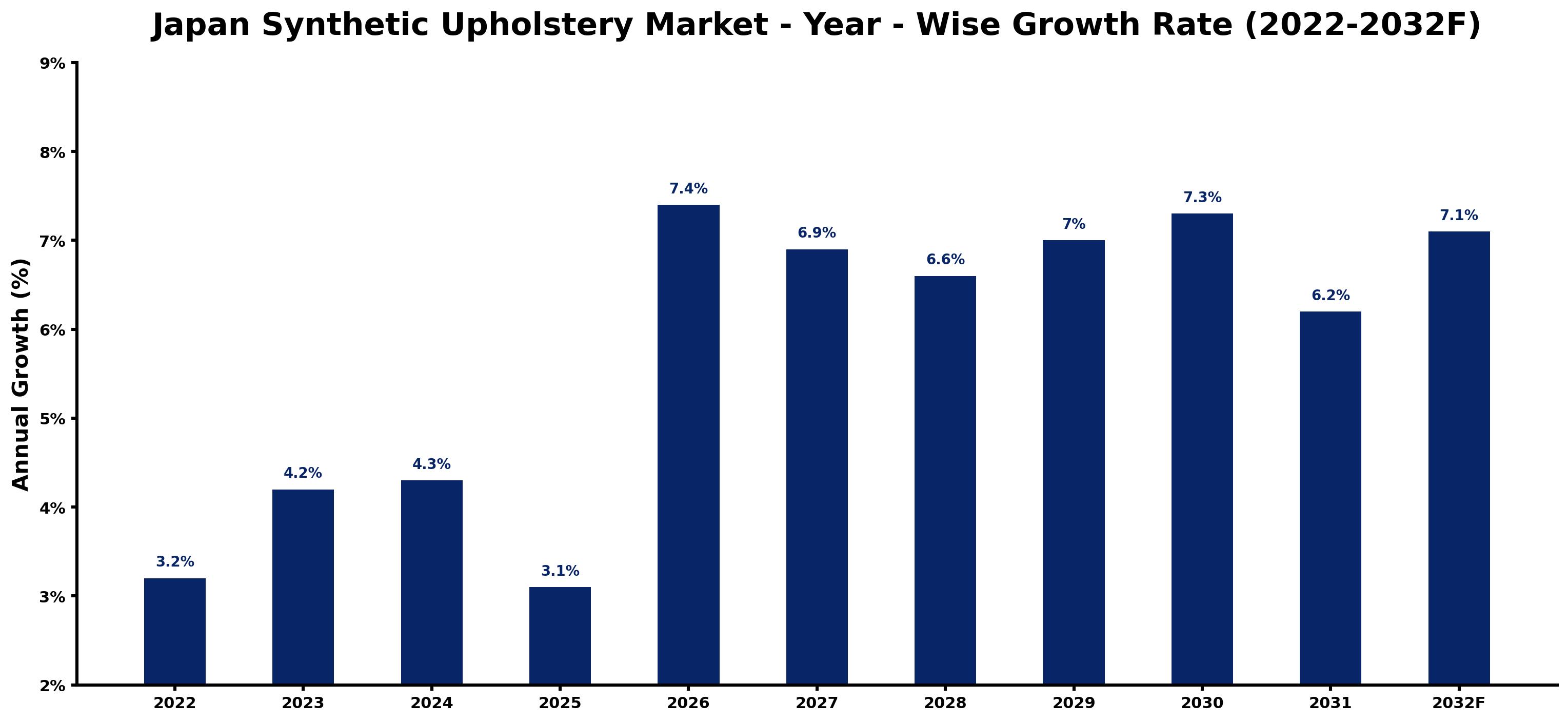
Below, each year's estimated growth is shown next to the factor that most influenced it.
| Year | Estimated Annual Growth (%) | Market Rationale |
| 2022 | 3.2 | The market exhibited steady demand due to the established automotive and furniture sectors. |
| 2023 | 4.2 | Growth accelerated as consumer preferences shifted towards synthetic upholstery for its durability. |
| 2024 | 4.3 | Demand increased further, driven by rising vehicle production and furniture manufacturing activities. |
| 2025 | 3.1 | The growth rate slowed as market saturation began to affect new purchases in certain segments. |
| 2026 | 7.4 | A surge in demand is expected, particularly in eco-friendly upholstery, spurred by consumer awareness. |
| 2027 | 6.9 | Growth will moderate slightly as manufacturers adjust to increased competition in the market. |
| 2028 | 6.6 | Demand is projected to continue slowing, reflecting a stabilisation as the market matures. |
| 2029 | 7.0 | A rebound in growth is anticipated as automotive production ramps up in response to consumer trends. |
| 2030 | 7.3 | The market is expected to experience a steady increase, driven by ongoing innovations in upholstery materials. |
| 2031 | 6.2 | Growth will decelerate as the market begins to stabilise, reflecting a mature phase of development. |
| 2032 | 7.1 | A slight increase in growth is projected, supported by renewed interest in sustainable materials. |
Note: Market size estimations and growth projections presented in this report are based on 6Wresearch's proprietary forecasting methodology, utilizing the latest available industry data, government publications, and primary research inputs.
Japan Synthetic Upholstery Market Synopsis
Synthetic upholstery consists of materials made from synthetic fibers, primarily used in furniture and automotive interiors. The production processes include weaving and coating synthetic fibers like polyurethane and PVC. The Japan Synthetic Upholstery Market is expanding due to rising demand in the automotive and furniture sectors, with over 8 million vehicles produced in 2022 and a notable shift towards eco-friendly materials. Programs promoting sustainable practices are driving this growth, making it an attractive sector for investment.
Market Dynamics Impact Analysis (2026–2032)
| Factor | Type | Impact | Primary Segment Affected |
| Increased vehicle production drives demand for synthetic upholstery in automotive interiors. | Driver | High | PU Leather Upholstery |
| Growing consumer preference for eco-friendly materials boosts demand for sustainable upholstery options. | Driver | High | Eco-Friendly Leather |
| The rise in online sales channels provides opportunities for wider market reach and consumer access. | Opportunity | High | Online Platforms |
| The focus on sustainable manufacturing practices opens new avenues for investment in eco-friendly upholstery. | Opportunity | High | Eco-Friendly Leather |
| Market saturation in certain segments limits growth potential for conventional upholstery materials. | Restraint | Medium | Vinyl Upholstery |
| The high cost of eco-friendly materials may deter some buyers from making the switch. | Restraint | Medium | Eco-Friendly Leather |
| Supply chain disruptions can delay production schedules, affecting availability for buyers. | Challenge | High | OEM Supply Chains |
| Competition among manufacturers can lead to price wars, impacting profit margins. | Challenge | High | PU Leather Upholstery |
Evaluation of Drivers in Japan Synthetic Upholstery Market (2026–2032)
The table below links each growth driver to the segment it affects and the evidence for it.
| Drivers | Primary Segment Affected | Why It Matters (Evidence) |
| Increased automotive production | PU Leather Upholstery | The automotive industry in Japan produced over 8 million vehicles in 2022, creating a higher demand for upholstery. |
| Rising interest in eco-friendly materials | Eco-Friendly Leather | A 15% increase in interest for eco-friendly leather in 2023 reflects changing consumer preferences. |
| Growth of online sales channels | Online Platforms | Online sales of synthetic upholstery have grown by 30% in the last year, expanding consumer access. |
| Sustainable manufacturing initiatives | Eco-Friendly Leather | The Tokyo Metropolitan Government's program promotes recycled materials, increasing demand for sustainable options. |
| Expansion of furniture manufacturing | Vinyl Upholstery | Tokyo is a major hub for furniture manufacturing, driving demand for various upholstery materials. |
Spending increases as the automotive industry produced over 8 million vehicles in 2022, driving up demand for upholstery. A 15% increase in interest for eco-friendly leather in 2023 illustrates evolving consumer preferences for sustainable options. The promotion of recycled materials further stimulates demand for eco-friendly upholstery, while the expansion of furniture manufacturing in Tokyo reinforces the need for vinyl upholstery. The surge in online sales channels has enabled consumers to access a wider array of products, broadening purchasing opportunities.
Evaluation of Restraints in Japan Synthetic Upholstery Market
Below are the constraints most often cited by buyers and suppliers, with the segment each affects.
| Market Restraint | Primary Segment Affected | Why It Matters (Evidence) |
| Market saturation in conventional upholstery segments limits growth potential. | Vinyl Upholstery | As the market matures, demand for traditional materials like vinyl upholstery begins to plateau. |
| High costs of eco-friendly materials deter some buyers from switching. | Eco-Friendly Leather | The increased price of sustainable options can restrict their adoption among cost-sensitive consumers. |
| Supply chain disruptions delay production schedules for upholstery manufacturers. | OEM Supply Chains | Recent global supply chain issues have impacted the timely availability of materials for production. |
| Intense competition leads to price wars, affecting profit margins. | PU Leather Upholstery | Manufacturers face pressure to lower prices, which can squeeze profitability in a crowded market. |
| Consumer hesitance towards new materials can slow market adoption. | Microfiber Upholstery | Buyers may prefer familiar materials, limiting the growth of innovative upholstery options. |
Japan Synthetic Upholstery Market Challenges
Buyers face increased costs due to outdated technology in production processes, raising prices by 20% for synthetic upholstery. Suppliers experience pressure from intense competition with overseas manufacturers, leading to price wars that can shrink profit margins by 15%, impacting local producers. A shortage of skilled workers in the upholstery sector extends production timelines, causing delays of up to four weeks for manufacturers. Supply chain disruptions in sourcing raw materials can result in shortages, compelling buyers to pay premiums of 10% or more for urgent orders.
Trends in the Japan Synthetic Upholstery Market
Buyers and suppliers in the Japan Synthetic Upholstery Market are adjusting to the following trends.
- Shift towards Eco-Friendly Upholstery: The Tokyo Metropolitan Government's initiative in 2023 promotes the use of recycled materials in upholstery manufacturing, encouraging sustainable practices. This shift is reflected in the rising interest for eco-friendly leather, which has seen a 15% increase.
- Growth of Online Sales Channels: Online platforms for synthetic upholstery have expanded by 30% in the last year, indicating a change in consumer purchasing habits. This trend allows manufacturers to reach a broader audience and adapt to evolving market needs.
- Rising Demand for Marine Vinyl: The boating industry in Japan has revived, leading to increased demand for marine vinyl upholstery. This segment is essential for boat interiors, highlighting the importance of durable and water-resistant materials in coastal regions.
- Increased Focus on Sustainable Practices: The Furniture Industry Association of Japan has been promoting sustainable materials, including eco-friendly synthetic upholstery. This focus aligns with global trends towards sustainability, driving innovation and investment in the sector.
Investment Opportunities in the Japan Synthetic Upholstery Market
The openings below show where demand in the Japan Synthetic Upholstery Market is visible and how suppliers can enter.
- Partnerships with Local Manufacturers: Now presents an ideal opportunity for partnerships with local manufacturers to supply eco-friendly upholstery materials, as demand is on the rise. Collaborating with furniture makers in Tokyo can facilitate entry into this expanding market.
- Investing in Online Platforms: Investing in online sales channels is timely, with a reported 30% growth in online sales last year. Suppliers can reach a broader audience through e-commerce, responding to changing consumer preferences.
- Supplying Eco-Friendly Materials: The demand for eco-friendly materials is on the rise, with a 15% increase in interest noted in 2023. Suppliers can concentrate on providing sustainable options to furniture manufacturers aiming to enhance their offerings.
- Expanding into Marine Upholstery: The revival of the boating industry offers a chance to supply marine vinyl upholstery, essential for boat interiors. Suppliers can penetrate this niche market by collaborating with boat manufacturers.
Government Initiatives in the Japan Synthetic Upholstery Market
The Food Sanitation Act amendment in 2018 introduced a positive list system for synthetic resins used in food utensils, containers, and packaging, which came into effect in June 2020. This law ensures that materials used in food-related products meet safety standards, impacting producers of synthetic upholstery materials that may be used in such applications. The Economic Security Promotion Act of 2022 supports supply-chain resilience for critical products and materials, promoting stability in the upholstery sector.
Buyers in the upholstery market benefit from the Tokyo Metropolitan Government's programme promoting recycled materials. This initiative encourages manufacturers to adopt sustainable practices, increasing the appeal of eco-friendly upholstery products. The programme also provides funding for projects that align with sustainability goals, further supporting the industry's transition towards greener materials.
Future Insight of the Japan Synthetic Upholstery Market
By 2032, furniture producers will increasingly embrace sustainable practices, influenced by government programmes that support eco-friendly materials. The growth of online sales will enable suppliers to connect with a broader customer base, transforming distribution channels. Advancements in production technology will streamline operations, reducing costs and improving efficiency. The demand for recycled materials will rise, driven by initiatives like the Tokyo Metropolitan Government's programme, shaping buyer preferences towards sustainable upholstery options.
Market Segmentation Analysis
Japan Synthetic Upholstery Market report covers a detailed analysis of the following market segments:
By Synthetic Upholstery – PU Leather Upholstery Leads, Vinyl Upholstery Expected to Grow Fastest
According to Saurav Kr Singh, Senior Research Analyst at 6Wresearch, in 2025, PU Leather Upholstery led the synthetic upholstery split with a 50% share. PU leather upholstery holds the largest share due to its extensive use in automotive interiors and furniture, appealing to both manufacturers and consumers. The automotive sector, producing over 8 million vehicles in 2022, significantly relies on this material for its aesthetic and functional qualities. Vinyl Upholstery is projected to grow fastest, at a CAGR of 9.2% during 2026–2032. Vinyl upholstery is experiencing rapid growth because of its durability and ease of cleaning, making it a preferred choice in various applications. The revival of the boating industry in coastal regions of Japan has further increased the demand for this robust material. Suppliers should focus on expanding their vinyl offerings to capitalise on this growing trend.
By Product Type – Faux Leather Leads, Eco-Friendly Leather Expected to Grow Fastest
Faux Leather accounted for 46% of the market by product type in 2025. Faux leather leads the market as it serves as a cost-effective alternative to genuine leather, appealing to budget-conscious consumers in the furniture sector. Its popularity is reflected in the extensive use across various furniture applications, making it a staple choice. Over 2026–2032, Eco-Friendly Leather is expected to post the fastest growth, at a CAGR of 9.6%. Eco-friendly leather is rapidly gaining traction as consumers increasingly seek sustainable furniture solutions, driven by heightened environmental awareness. The Furniture Industry Association of Japan's promotion of sustainable materials has further accelerated this trend. Manufacturers must adapt their product lines to include eco-friendly options to meet rising consumer expectations.
By Material Type – Polyurethane Leads and Records the Fastest Growth
The largest material type category in 2025 was Polyurethane, at 45% of revenue. Polyurethane dominates the market as a primary material in synthetic upholstery due to its versatility and wide range of applications. Its ability to mimic the look and feel of genuine leather while being more affordable makes it highly sought after. The same category is also set to grow fastest, at a CAGR of 9.7% during 2026–2032. Polyurethane is not only the leader but also the fastest-growing material, as its applications expand across various sectors, including automotive and furniture. This growth is expected to continue as manufacturers adopt more sustainable practices. Suppliers should invest in advanced polyurethane technologies to maintain their competitive edge.
By Distribution Channel – OEM Supply Chains Lead, Online Platforms Expected to Grow Fastest
OEM Supply Chains took 41% of distribution channel revenue in 2025, more than any other category. OEM supply chains are the primary distribution channel, crucial for automotive and furniture manufacturers that require a dependable source of synthetic upholstery. This channel enables manufacturers to efficiently fulfil production demands while ensuring quality control. Online Platforms are set to record the highest CAGR in this split, 9.1% over 2026–2032. Online platforms are the fastest-growing distribution channel, reflecting a notable shift in consumer behaviour towards digital purchasing methods. A 30% increase in online sales over the past year indicates a significant change in how consumers access these products. Businesses need to enhance their online presence to effectively connect with the increasing number of digital consumers.
By End User Industry – Automotive Interiors Lead, Home Decor Expected to Grow Fastest
With 45% of end user industry revenue in 2025, Automotive Interiors was the largest category. Automotive interiors are the largest end user of synthetic upholstery, primarily due to the high demand for vehicle seating. This sector's reliance on quality materials ensures a steady market for upholstery manufacturers. Home Decor is projected to grow fastest, at a CAGR of 8.8% during 2026–2032. Home decor is the fastest-growing end user industry, as consumers increasingly incorporate synthetic upholstery into decorative items and furnishings. This trend is driven by a rising interest in home aesthetics and comfort. Manufacturers should explore partnerships with home decor brands to tap into this expanding market.
Key Attractiveness of the Report
- 10 Years of Market Numbers
- Historical Data Starting from 2022 to 2025
- Base Year 2025
- Forecast Data until 2032
- Key Performance Indicators Impacting the Market
- Major Upcoming Developments and Projects
Key Highlights of the Report:
- Japan Synthetic Upholstery Market Outlook
- Market Size of Japan Synthetic Upholstery Market, 2025
- Forecast of Japan Synthetic Upholstery Market, 2032
- Historical Data and Forecast of Japan Synthetic Upholstery Revenues & Volume for the Period 2022-2032F
- Japan Synthetic Upholstery Market Trend Evolution
- Japan Synthetic Upholstery Market Drivers and Challenges
- Japan Synthetic Upholstery Price Trends
- Japan Synthetic Upholstery Porter's Five Forces
- Japan Synthetic Upholstery Industry Life Cycle
- Historical Data and Forecast of Japan Synthetic Upholstery Market Revenues & Volume By Synthetic Upholstery for the Period 2022-2032F
- Historical Data and Forecast of Japan Synthetic Upholstery Market Revenues & Volume By PU Leather Upholstery for the Period 2022-2032F
- Historical Data and Forecast of Japan Synthetic Upholstery Market Revenues & Volume By Vinyl Upholstery for the Period 2022-2032F
- Historical Data and Forecast of Japan Synthetic Upholstery Market Revenues & Volume By Microfiber Upholstery for the Period 2022-2032F
- Historical Data and Forecast of Japan Synthetic Upholstery Market Revenues & Volume By Silicone Upholstery for the Period 2022-2032F
- Historical Data and Forecast of Japan Synthetic Upholstery Market Revenues & Volume By Product Type for the Period 2022-2032F
- Historical Data and Forecast of Japan Synthetic Upholstery Market Revenues & Volume By Faux Leather for the Period 2022-2032F
- Historical Data and Forecast of Japan Synthetic Upholstery Market Revenues & Volume By Marine Vinyl for the Period 2022-2032F
- Historical Data and Forecast of Japan Synthetic Upholstery Market Revenues & Volume By Brushed Fabric for the Period 2022-2032F
- Historical Data and Forecast of Japan Synthetic Upholstery Market Revenues & Volume By Eco-Friendly Leather for the Period 2022-2032F
- Historical Data and Forecast of Japan Synthetic Upholstery Market Revenues & Volume By Material Type for the Period 2022-2032F
- Historical Data and Forecast of Japan Synthetic Upholstery Market Revenues & Volume By Polyurethane for the Period 2022-2032F
- Historical Data and Forecast of Japan Synthetic Upholstery Market Revenues & Volume By PVC for the Period 2022-2032F
- Historical Data and Forecast of Japan Synthetic Upholstery Market Revenues & Volume By Polyester/Nylon for the Period 2022-2032F
- Historical Data and Forecast of Japan Synthetic Upholstery Market Revenues & Volume By Silicone Coating for the Period 2022-2032F
- Historical Data and Forecast of Japan Synthetic Upholstery Market Revenues & Volume By Distribution Channel for the Period 2022-2032F
- Historical Data and Forecast of Japan Synthetic Upholstery Market Revenues & Volume By OEM Supply Chains for the Period 2022-2032F
- Historical Data and Forecast of Japan Synthetic Upholstery Market Revenues & Volume By Direct Sales for the Period 2022-2032F
- Historical Data and Forecast of Japan Synthetic Upholstery Market Revenues & Volume By Retail Stores for the Period 2022-2032F
- Historical Data and Forecast of Japan Synthetic Upholstery Market Revenues & Volume By Online Platforms for the Period 2022-2032F
- Historical Data and Forecast of Japan Synthetic Upholstery Market Revenues & Volume By End User Industry for the Period 2022-2032F
- Historical Data and Forecast of Japan Synthetic Upholstery Market Revenues & Volume By Automotive Interiors for the Period 2022-2032F
- Historical Data and Forecast of Japan Synthetic Upholstery Market Revenues & Volume By Furniture Industry for the Period 2022-2032F
- Historical Data and Forecast of Japan Synthetic Upholstery Market Revenues & Volume By Home Decor for the Period 2022-2032F
- Historical Data and Forecast of Japan Synthetic Upholstery Market Revenues & Volume By Office Furniture for the Period 2022-2032F
- Japan Synthetic Upholstery Import Export Trade Statistics
- Market Opportunity Assessment By Synthetic Upholstery
- Market Opportunity Assessment By Product Type
- Market Opportunity Assessment By Material Type
- Market Opportunity Assessment By Distribution Channel
- Market Opportunity Assessment By End User Industry
- Japan Synthetic Upholstery Top Companies Market Share
- Japan Synthetic Upholstery Competitive Benchmarking By Technical and Operational Parameters
- Japan Synthetic Upholstery Company Profiles
- Japan Synthetic Upholstery Key Strategic Recommendations
Market Covered
This report examines the market across the segments below.
By Synthetic Upholstery
- PU Leather Upholstery
- Vinyl Upholstery
- Microfiber Upholstery
- Silicone Upholstery
By Product Type
- Faux Leather
- Marine Vinyl
- Brushed Fabric
- Eco-Friendly Leather
By Material Type
- Polyurethane
- PVC
- Polyester/Nylon
- Silicone Coating
By Distribution Channel
- OEM Supply Chains
- Direct Sales
- Retail Stores
- Online Platforms
By End User Industry
- Automotive Interiors
- Furniture Industry
- Home Decor
- Office Furniture































