Japan Synthetic Vision Technology Market Size & Growth Rate
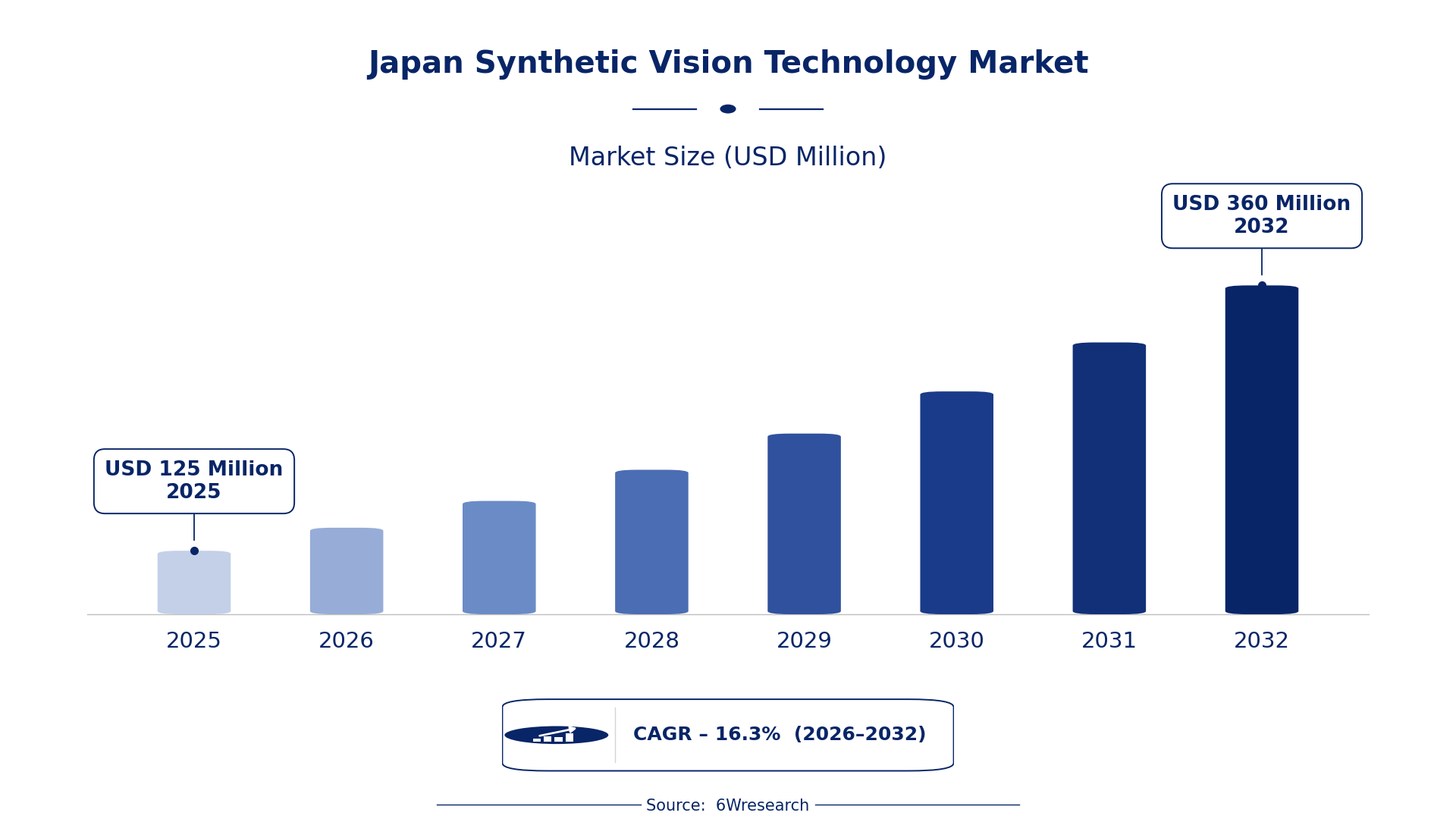
According to 6Wresearch internal database and industry insights, the Japan Synthetic Vision Technology Market was valued at USD 125 Million in 2025 and is projected to reach USD 360 Million by 2032, growing at a CAGR of approximately 16.3% during 2026–2032.
Japan Synthetic Vision Technology Market Highlights
| Report Metric | Details |
| Report Name | Japan Synthetic Vision Technology Market (2026-2032) |
| Market Size 2025 | USD 125 Million |
| Market Size 2032 | USD 360 Million |
| Absolute Growth 2025–2032 | USD 235 Million |
| CAGR 2026–2032 | 16.3% |
| Peak Annual Growth | 17.2% in 2028 |
| Forecast Period | 2026–2032 |
| Historical Data | 2022–2025 |
| Base Year | 2025 |
| Leading Synthetic Vision Tech, 2025 | Cockpit Display Systems (44% share) |
| Leading Product Type, 2025 | 3D Flight Display (53% share) |
| Leading Technology Type, 2025 | SVS (Synthetic Vision) (39% share) |
| Leading Distribution Channel, 2025 | OEM Suppliers (38% share) |
| Leading End User Industry, 2025 | Aviation Industry (37% share) |
| Fastest-Growing Synthetic Vision Tech | Training Simulators (20.9% CAGR) |
| Fastest-Growing Product Type | Pilot Simulators (23.4% CAGR) |
| Fastest-Growing Technology Type | Augmented Vision (18.1% CAGR) |
| Fastest-Growing Distribution Channel | Direct Sales (21.4% CAGR) |
| Fastest-Growing End User Industry | Aerospace Institutions (20.7% CAGR) |
| Growing Sector | Aviation Industry |
| Key End Users | Aviation Industry, Commercial Airlines, Defense Aircraft, Aerospace Institutions |
Japan Synthetic Vision Technology Market Year-wise Growth Rate and Key Drivers (2022–2032)
This graph illustrates the annual growth rates of the market from 2022 to 2032, highlighting a steady upward trajectory and projected market expansion over the forecast period.
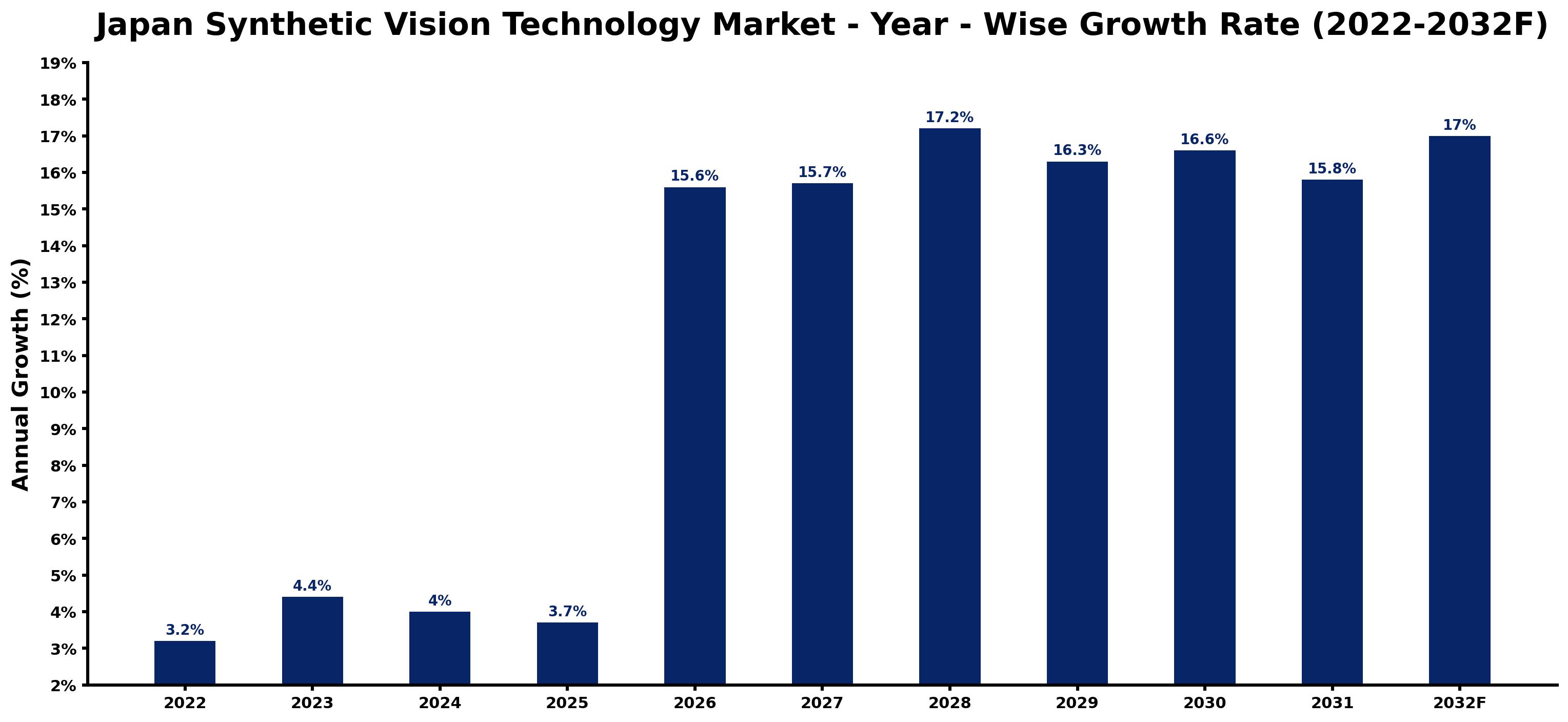
The following figures match every annual growth estimate with the main market development of that year, giving the reasoning behind each rise or slowdown.
| Year | Estimated Annual Growth (%) | Market Rationale |
| 2022 | 3.2 | The market showed steady growth due to increasing adoption of advanced technologies. |
| 2023 | 4.4 | Growth accelerated as aviation safety became a priority following recent incidents. |
| 2024 | 4.0 | A slowdown occurred as manufacturers adjusted to new regulations and standards. |
| 2025 | 3.7 | Continued growth was observed as demand for training simulators rose. |
| 2026 | 15.6 | An increase in growth is anticipated due to heightened investments in aviation technology. |
| 2027 | 15.7 | Growth is expected to rise further as new aircraft models integrate advanced SVT systems. |
| 2028 | 17.2 | The market is projected to peak with increased focus on safety and navigation improvements. |
| 2029 | 16.3 | A slight slowdown in growth is expected as the market stabilises after peak demand. |
| 2030 | 16.6 | Growth is anticipated to rebound as new technologies are adopted in the aviation sector. |
| 2031 | 15.8 | A moderate slowdown is expected as the market adjusts to evolving consumer needs. |
| 2032 | 17.0 | Growth is projected to accelerate again as regulatory requirements for SVT systems come into effect. |
Note: Market size estimations and growth projections presented in this report are based on 6Wresearch's proprietary forecasting methodology, utilizing the latest available industry data, government publications, and primary research inputs.
Japan Synthetic Vision Technology Market Synopsis
Synthetic Vision Technology enhances situational awareness by providing pilots with a 3D representation of terrain and obstacles, essential for safety and navigation. The Japan Synthetic Vision Technology Market is expanding due to rising demand from the aviation sector, driven by government investments in safety improvements. In 2023, the Japanese government allocated ¥2 billion for these initiatives, while the Tokyo area remains a hub for aviation technology development, encouraging further investment and innovation in this field.
Market Dynamics Impact Analysis (2026–2032)
| Factor | Type | Impact | Primary Segment Affected |
| Increasing focus on aviation safety standards | Driver | High | Training Simulators |
| Growing adoption of advanced navigation systems | Driver | High | Navigation Systems |
| Rising demand for pilot training due to increased air travel | Opportunity | High | Pilot Simulators |
| Expansion of aviation technology firms in Tokyo | Opportunity | Medium | Cockpit Display Systems |
| High costs associated with implementing advanced SVT systems | Restraint | High | SVS (Synthetic Vision) |
| Limited availability of skilled personnel for advanced training | Restraint | Medium | Training Simulators |
| Technological integration challenges in existing aircraft | Challenge | High | Advanced SVT |
| Regulatory compliance costs for new aircraft models | Challenge | Medium | HUD Devices |
Evaluation of Drivers in Japan Synthetic Vision Technology Market (2026–2032)
The factors lifting demand, and the evidence behind each, are summarised below.
| Drivers | Primary Segment Affected | Why It Matters (Evidence) |
| Increased air travel leading to higher demand for safety technologies | Aviation Industry | Japan's aviation sector employs approximately 200,000 people, driving the need for safety systems. |
| Government funding for aviation safety improvements | Training Simulators | In 2023, the government allocated ¥2 billion specifically for improving aviation safety. |
| Integration of SVT systems into new aircraft models | Cockpit Display Systems | SVT systems are increasingly incorporated into new aircraft designs to improve safety. |
| Growing number of aviation schools adopting training simulators | Pilot Simulators | Training simulators are used in over 50 aviation schools across Japan, enhancing pilot skills. |
| Development of advanced navigation systems by local firms | Navigation Systems | The Japanese Civil Aviation Bureau promotes advanced navigation systems, increasing demand. |
Spending increases as the aviation industry sees a rise in air travel, creating a greater need for safety technologies. The sector employs approximately 200,000 people, which fuels the demand for advanced systems. The integration of SVT systems into new aircraft models is becoming standard, as manufacturers strive to improve safety and efficiency. Additionally, the growing number of aviation schools implementing training simulators enhances pilot skills and boosts demand for these technologies.
Evaluation of Restraints in Japan Synthetic Vision Technology Market
The table below lists the restraints and the evidence behind each.
| Market Restraint | Primary Segment Affected | Why It Matters (Evidence) |
| High costs associated with implementing advanced SVT systems | SVS (Synthetic Vision) | Such costs can deter smaller operators from adopting these technologies, limiting market reach. |
| Limited availability of skilled personnel for advanced training | Training Simulators | A shortage of qualified trainers can hinder the effective use of training simulators in aviation schools. |
| Technological integration challenges in existing aircraft | Advanced SVT | Modifications to existing aircraft may be necessary to accommodate new SVT systems, raising costs. |
| Regulatory compliance costs for new aircraft models | HUD Devices | Compliance with new regulations can impose financial burdens on manufacturers, affecting pricing strategies. |
| Market saturation in certain technology segments | Navigation Systems | As the market matures, increased competition leads to price pressures that may affect profitability. |
Japan Synthetic Vision Technology Market Challenges
Buyers face increased costs as regulations require SVT systems in new commercial aircraft by 2025, which may raise aircraft prices and limit options. Producers encounter delays due to the integration of advanced technologies, which can extend development timelines and increase project budgets. Importers struggle with supply issues as the availability of critical SVT components fluctuates, potentially delaying aircraft deliveries and impacting operational schedules. Aviation schools experience rising expenses for pilot training as demand for simulators grows, straining financial resources and limiting training capacity.
Trends in the Japan Synthetic Vision Technology Market
Several trends are reshaping the Japan Synthetic Vision Technology Market; the most important are set out below.
- Shift from Traditional to Advanced Navigation Systems: Since 2023, the aviation industry has been transitioning to advanced navigation systems, particularly in the Tokyo Metropolitan area where firms are developing new technologies. This shift aims to improve safety and efficiency in air travel.
- Transition from Basic to Enhanced Training Simulators: In 2023, training simulators are being increasingly upgraded to incorporate advanced SVT features. This trend is reflected in over 50 aviation schools adopting new technologies, leading to better pilot training outcomes.
- Emergence of Augmented Vision in Pilot Training: Augmented Vision technology is being trialled in several pilot training programs starting in 2023, with a focus on enhancing situational awareness. This development is expected to improve training effectiveness.
- Growing Integration of SVT in New Aircraft Models: Beginning in 2023, SVT systems are being integrated into new aircraft models, demonstrating a commitment to safety within the aviation industry. This trend is supported by regulatory measures.
Investment Opportunities in the Japan Synthetic Vision Technology Market
Investors looking at the Japan Synthetic Vision Technology Market should consider the following areas.
- Partnerships with Aviation Schools: Now is an opportune time to partner with aviation schools that require advanced training simulators. The demand for pilot training, with over 50 schools adopting new technologies, presents a valuable investment opportunity.
- Joint Ventures with Technology Firms: Establishing joint ventures with local aviation technology firms is essential to capitalise on the growing market. The Tokyo area is a hub for innovation, with numerous firms developing advanced systems.
- Supply of Advanced Navigation Systems: The demand for advanced navigation systems is rising, especially among commercial airlines. Suppliers can enter the market by collaborating with local manufacturers to meet this need.
- Investment in SVT Research and Development: Investing in SVT research and development is important as the government allocated ¥2 billion for aviation safety improvements in 2023. Collaborating with the Japan Aerospace Exploration Agency can facilitate entry into this sector.
Government Initiatives in the Japan Synthetic Vision Technology Market
The GX Promotion Act, enacted in 2023, establishes a framework for improving aviation safety through technological advancements. This act builds on previous regulations by mandating the integration of SVT systems in new commercial aircraft by 2025, ensuring compliance with safety standards.
In 2023, the Japanese government allocated ¥2 billion for aviation safety improvements, overseen by the Ministry of Land, Infrastructure, Transport and Tourism. This funding aims to support the development and integration of advanced technologies in the aviation sector.
Future Insight of the Japan Synthetic Vision Technology Market
A policy-driven shift towards improved aviation safety will encourage suppliers to adopt advanced SVT technologies by 2032, aligning with government objectives. The Japanese government’s investment of ¥2 billion for safety initiatives will stimulate the development of new training solutions. As research from the Japan Aerospace Exploration Agency progresses, buyers will benefit from enhanced safety features in aircraft. The integration of SVT systems into pilot training will raise training standards, ensuring a skilled workforce prepared for future aviation challenges.
Market Segmentation Analysis
Japan Synthetic Vision Technology Market report covers a detailed analysis of the following market segments:
By Synthetic Vision Tech – Cockpit Display Systems Lead, Training Simulators Expected to Grow Fastest
According to Saurav Kr Singh, Senior Research Analyst at 6Wresearch, Cockpit Display Systems accounted for 44% of the market by synthetic vision tech in 2025. Cockpit Display Systems hold the largest share due to their critical role in pilot visibility and navigation. With over 1,000 registered aircraft in Japan employing these systems, they are integral to maintaining operational safety. The quickest growth will come from Training Simulators, forecast to expand at a CAGR of 20.9% between 2026 and 2032. Training Simulators are witnessing rapid growth as the demand for effective pilot training environments rises, with more than 50 aviation schools across Japan utilising them. This trend is expected to persist alongside increasing air travel. Suppliers should focus on enhancing training simulator offerings to meet the growing demand.
By Product Type – 3D Flight Display Leads, Pilot Simulators Expected to Grow Fastest
In 2025, 3D Flight Display led the product type split with a 53% share. 3D Flight Display technology leads the market as it is essential for providing pilots with enhanced situational awareness. Its widespread integration into new aircraft models in Japan reinforces its dominant position. Pilot Simulators are set to record the highest CAGR in this split, 23.4% over 2026–2032. Pilot Simulators are experiencing swift growth due to the rising need for effective training solutions, particularly as the government aims to boost aviation safety by 2025. This focus on safety will likely drive further investment in simulators. Buyers should prioritise acquiring advanced pilot simulators to ensure compliance with upcoming safety regulations.
By Technology Type – SVS (Synthetic Vision) Leads, Augmented Vision Expected to Grow Fastest
The largest technology type category in 2025 was SVS (Synthetic Vision), at 39% of revenue. SVS (Synthetic Vision) technology is the leading segment because it is vital for ensuring terrain awareness in aviation. Its integration into new aircraft models underscores its importance in enhancing flight safety. Over 2026–2032, Augmented Vision is expected to post the fastest growth, at a CAGR of 18.1%. Augmented Vision technology is growing rapidly as it complements primary vision systems, with several pilot training programs currently testing its capabilities. This trend indicates a shift towards more comprehensive situational awareness solutions. Suppliers must invest in developing augmented vision capabilities to stay competitive in the market.
By Distribution Channel – OEM Suppliers Lead, Direct Sales Expected to Grow Fastest
OEM Suppliers took 38% of distribution channel revenue in 2025, more than any other category. OEM Suppliers dominate the distribution channel as they are the primary source for integrating SVT technology into aircraft. Their established relationships with manufacturers ensure a reliable supply of essential systems. Direct Sales is projected to grow fastest, at a CAGR of 21.4% during 2026–2032. Direct Sales are expanding quickly as they improve customer engagement and offer tailored solutions to buyers. This shift reflects a growing preference for direct interaction in the purchasing process, enhancing buyer satisfaction. Suppliers should enhance their direct sales strategies to better connect with customers and meet their specific needs.
By End User Industry – Aviation Industry Leads, Aerospace Institutions Expected to Grow Fastest
With 37% of end user industry revenue in 2025, Aviation Industry was the largest category. The Aviation Industry is the largest user of SVT technology, employing it to enhance flight safety and operational efficiency. The substantial workforce of approximately 200,000 people in aviation-related industries further highlights its significance. The quickest growth will come from Aerospace Institutions, forecast to expand at a CAGR of 20.7% between 2026 and 2032. Aerospace Institutions are experiencing the fastest growth as they support research and development initiatives for advanced aviation technologies. Their active involvement in SVT research will likely drive future innovations and applications. Buyers in the aerospace sector should collaborate closely with institutions to leverage advancements in SVT technology.
Key Attractiveness of the Report
- 10 Years of Market Numbers
- Historical Data Starting from 2022 to 2025
- Base Year 2025
- Forecast Data until 2032
- Key Performance Indicators Impacting the Market
- Major Upcoming Developments and Projects
Key Highlights of the Report:
- Japan Synthetic Vision Technology Market Outlook
- Market Size of Japan Synthetic Vision Technology Market, 2025
- Forecast of Japan Synthetic Vision Technology Market, 2032
- Historical Data and Forecast of Japan Synthetic Vision Technology Revenues & Volume for the Period 2022-2032F
- Japan Synthetic Vision Technology Market Trend Evolution
- Japan Synthetic Vision Technology Market Drivers and Challenges
- Japan Synthetic Vision Technology Price Trends
- Japan Synthetic Vision Technology Porter's Five Forces
- Japan Synthetic Vision Technology Industry Life Cycle
- Historical Data and Forecast of Japan Synthetic Vision Technology Market Revenues & Volume By Synthetic Vision Tech for the Period 2022-2032F
- Historical Data and Forecast of Japan Synthetic Vision Technology Market Revenues & Volume By Cockpit Display Systems for the Period 2022-2032F
- Historical Data and Forecast of Japan Synthetic Vision Technology Market Revenues & Volume By Head-Up Displays for the Period 2022-2032F
- Historical Data and Forecast of Japan Synthetic Vision Technology Market Revenues & Volume By Navigation Systems for the Period 2022-2032F
- Historical Data and Forecast of Japan Synthetic Vision Technology Market Revenues & Volume By Training Simulators for the Period 2022-2032F
- Historical Data and Forecast of Japan Synthetic Vision Technology Market Revenues & Volume By Product Type for the Period 2022-2032F
- Historical Data and Forecast of Japan Synthetic Vision Technology Market Revenues & Volume By 3D Flight Display for the Period 2022-2032F
- Historical Data and Forecast of Japan Synthetic Vision Technology Market Revenues & Volume By HUD Devices for the Period 2022-2032F
- Historical Data and Forecast of Japan Synthetic Vision Technology Market Revenues & Volume By Advanced SVT for the Period 2022-2032F
- Historical Data and Forecast of Japan Synthetic Vision Technology Market Revenues & Volume By Pilot Simulators for the Period 2022-2032F
- Historical Data and Forecast of Japan Synthetic Vision Technology Market Revenues & Volume By Technology Type for the Period 2022-2032F
- Historical Data and Forecast of Japan Synthetic Vision Technology Market Revenues & Volume By SVS (Synthetic Vision) for the Period 2022-2032F
- Historical Data and Forecast of Japan Synthetic Vision Technology Market Revenues & Volume By Augmented Vision for the Period 2022-2032F
- Historical Data and Forecast of Japan Synthetic Vision Technology Market Revenues & Volume By Sensor Fusion for the Period 2022-2032F
- Historical Data and Forecast of Japan Synthetic Vision Technology Market Revenues & Volume By VR + SVT for the Period 2022-2032F
- Historical Data and Forecast of Japan Synthetic Vision Technology Market Revenues & Volume By Distribution Channel for the Period 2022-2032F
- Historical Data and Forecast of Japan Synthetic Vision Technology Market Revenues & Volume By OEM Suppliers for the Period 2022-2032F
- Historical Data and Forecast of Japan Synthetic Vision Technology Market Revenues & Volume By Direct Sales for the Period 2022-2032F
- Historical Data and Forecast of Japan Synthetic Vision Technology Market Revenues & Volume By Industrial Distributors for the Period 2022-2032F
- Historical Data and Forecast of Japan Synthetic Vision Technology Market Revenues & Volume By Specialty Contractors for the Period 2022-2032F
- Historical Data and Forecast of Japan Synthetic Vision Technology Market Revenues & Volume By End User Industry for the Period 2022-2032F
- Historical Data and Forecast of Japan Synthetic Vision Technology Market Revenues & Volume By Aviation Industry for the Period 2022-2032F
- Historical Data and Forecast of Japan Synthetic Vision Technology Market Revenues & Volume By Defense Aircraft for the Period 2022-2032F
- Historical Data and Forecast of Japan Synthetic Vision Technology Market Revenues & Volume By Commercial Airlines for the Period 2022-2032F
- Historical Data and Forecast of Japan Synthetic Vision Technology Market Revenues & Volume By Aerospace Institutions for the Period 2022-2032F
- Japan Synthetic Vision Technology Import Export Trade Statistics
- Market Opportunity Assessment By Synthetic Vision Tech
- Market Opportunity Assessment By Product Type
- Market Opportunity Assessment By Technology Type
- Market Opportunity Assessment By Distribution Channel
- Market Opportunity Assessment By End User Industry
- Japan Synthetic Vision Technology Top Companies Market Share
- Japan Synthetic Vision Technology Competitive Benchmarking By Technical and Operational Parameters
- Japan Synthetic Vision Technology Company Profiles
- Japan Synthetic Vision Technology Key Strategic Recommendations
Market Covered
The following segment groups are covered in the report.
By Synthetic Vision Tech
- Cockpit Display Systems
- Head-Up Displays
- Navigation Systems
- Training Simulators
By Product Type
- 3D Flight Display
- HUD Devices
- Advanced SVT
- Pilot Simulators
By Technology Type
- SVS (Synthetic Vision)
- Augmented Vision
- Sensor Fusion
- VR + SVT
By Distribution Channel
- OEM Suppliers
- Direct Sales
- Industrial Distributors
- Specialty Contractors
By End User Industry
- Aviation Industry
- Defense Aircraft
- Commercial Airlines
- Aerospace Institutions































