Japan Synthetic Yarn Market Size & Growth Rate
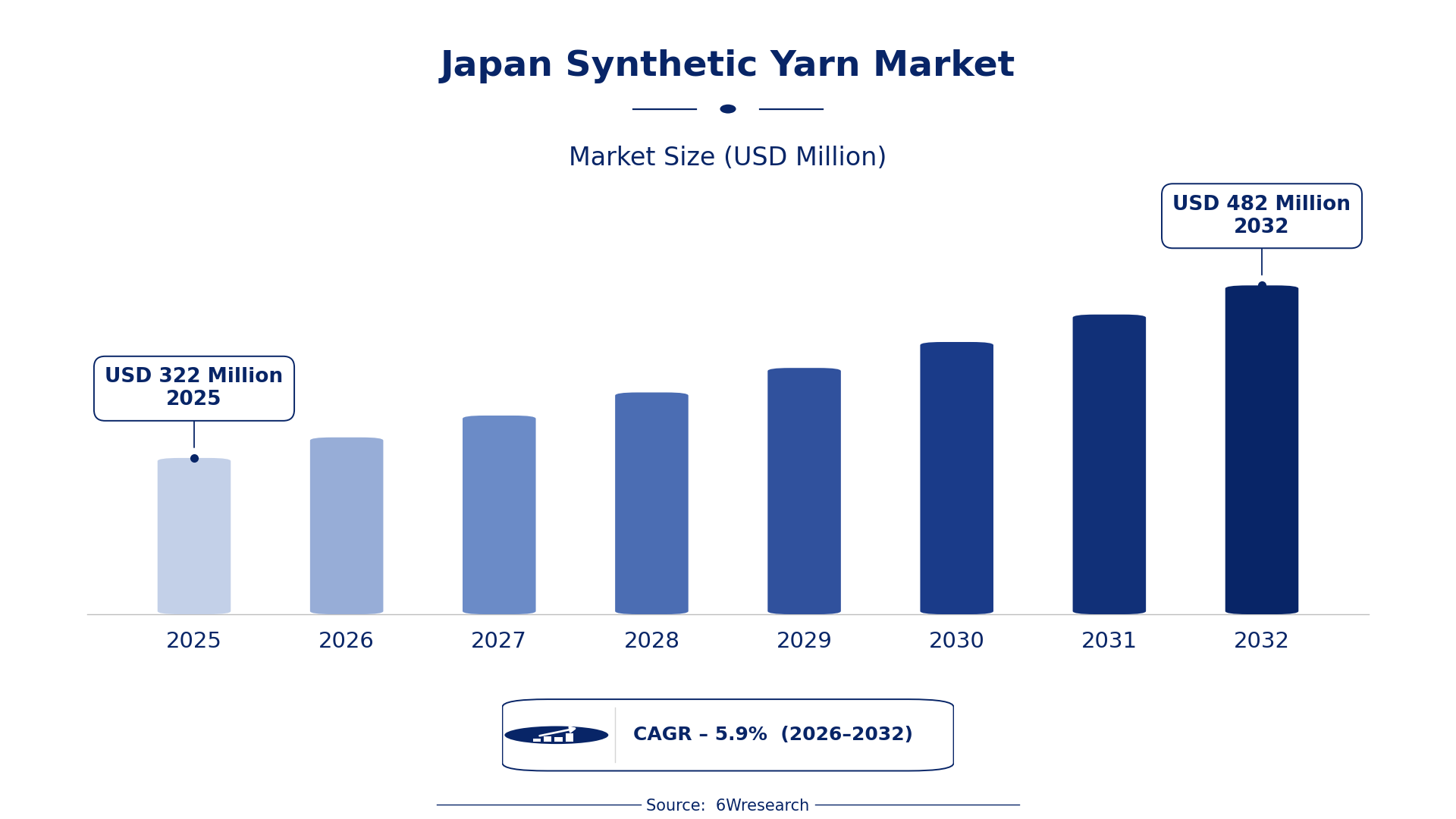
According to 6Wresearch internal database and industry insights, the Japan Synthetic Yarn Market was valued at USD 322 Million in 2025 and is projected to reach USD 482 Million by 2032, growing at a CAGR of approximately 5.9% during 2026–2032.
Japan Synthetic Yarn Market Highlights
| Report Metric | Details |
| Report Name | Japan Synthetic Yarn Market (2026-2032) |
| Market Size 2025 | USD 322 Million |
| Market Size 2032 | USD 482 Million |
| Absolute Growth 2025–2032 | USD 160 Million |
| CAGR 2026–2032 | 5.9% |
| Peak Annual Growth | 6.8% in 2026 |
| Forecast Period | 2026–2032 |
| Historical Data | 2022–2025 |
| Base Year | 2025 |
| Leading Synthetic Yarn, 2025 | Polyester Yarn (40% share) |
| Leading Product Type, 2025 | POY/DTY/FDY (42% share) |
| Leading Fiber Type, 2025 | Polyester (37% share) |
| Leading Distribution Channel, 2025 | Direct Sales (35% share) |
| Leading End User Industry, 2025 | Textile Manufacturing (36% share) |
| Fastest-Growing Synthetic Yarn | Acrylic Yarn (7.6% CAGR) |
| Fastest-Growing Product Type | Textured Yarn (8.5% CAGR) |
| Fastest-Growing Fiber Type | Acrylic (8.3% CAGR) |
| Fastest-Growing Distribution Channel | Online Platforms (7.7% CAGR) |
| Fastest-Growing End User Industry | Knitwear Manufacturers (7.8% CAGR) |
| Growing Sector | Textile Manufacturing |
| Key End Users | Textile Manufacturers, Knitwear Manufacturers, Hosiery & Lingerie Producers, Carpet & Rugs Industry |
Japan Synthetic Yarn Market Year-wise Growth Rate and Key Drivers (2022–2032)
This graph illustrates the annual growth rates of the market from 2022 to 2032, highlighting a steady upward trajectory and projected market expansion over the forecast period.
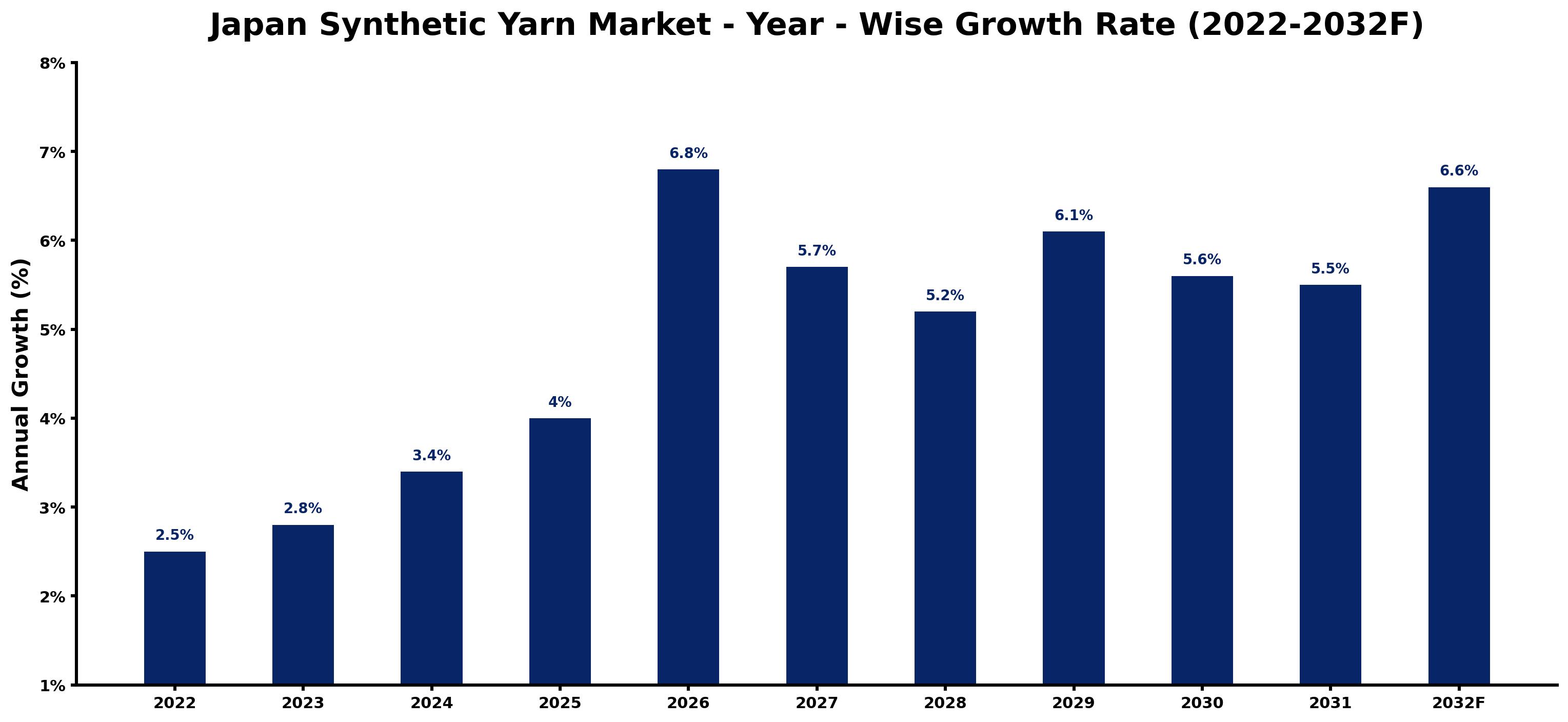
For each year, the table pairs the estimated growth rate with the leading influence on demand, showing how the drivers changed across the period.
| Year | Estimated Annual Growth (%) | Market Rationale |
| 2022 | 2.5 | The market showed steady demand from textile manufacturers and exports. |
| 2023 | 2.8 | Growth was supported by increased domestic consumption and export activities. |
| 2024 | 3.4 | Demand rose as textile manufacturers expanded production capabilities. |
| 2025 | 4.0 | The market experienced strong growth due to rising fashion trends. |
| 2026 | 6.8 | Demand surged with the introduction of new sustainable practices in production. |
| 2027 | 5.7 | Growth slowed as market adjustments to new standards took place. |
| 2028 | 5.2 | A further slowdown occurred as competition intensified in the market. |
| 2029 | 6.1 | Demand increased as new textile applications emerged. |
| 2030 | 5.6 | Growth slowed due to market saturation in certain segments. |
| 2031 | 5.5 | A slowdown in growth was noted as production stabilised. |
| 2032 | 6.6 | The market is projected to grow faster with new technological advancements. |
Note: Market size estimations and growth projections presented in this report are based on 6Wresearch's proprietary forecasting methodology, utilizing the latest available industry data, government publications, and primary research inputs.
Japan Synthetic Yarn Market Synopsis
Synthetic yarn, produced from fibers like polyester and nylon, is essential for clothing, upholstery, and industrial applications. The Japan Synthetic Yarn Market is expanding due to strong demand from textile manufacturing and exports, particularly in fashion and automotive sectors. Approximately 500,000 tons of synthetic fibers were produced in 2022, with growth driven by sustainable practices and supported by the Ministry of Economy, Trade and Industry's programme for sustainable textile production.
Market Dynamics Impact Analysis (2026–2032)
| Factor | Type | Impact | Primary Segment Affected |
| Strong demand from textile manufacturing and exports drives growth. | Driver | High | Textile Manufacturing |
| Technological advancements in production processes enhance supply capabilities. | Driver | High | PP |
| Increased focus on sustainable production methods presents new opportunities. | Opportunity | Medium | PP |
| Growing interest in innovative textile applications opens new markets. | Opportunity | Medium | PP |
| High competition among manufacturers may limit profit margins. | Restraint | High | Polyester Yarn |
| Fluctuating raw material prices can impact production costs. | Restraint | Medium | Polyester Yarn |
| The need for compliance with stringent environmental regulations increases costs. | Challenge | High | Polyester Yarn |
| Adapting to rapid technological changes can be resource-intensive. | Challenge | Medium | Polyester Yarn |
Evaluation of Drivers in Japan Synthetic Yarn Market (2026–2032)
The table below links each growth driver to the segment it affects and the evidence for it.
| Drivers | Primary Segment Affected | Why It Matters (Evidence) |
| Rising demand from textile manufacturing sectors. | Textile Manufacturing | Japan's textile manufacturing employs over 1 million people, creating a strong need for synthetic yarn. |
| Technological advancements in production processes. | PP | Recent innovations in production methods have improved supply capabilities in the Tokyo region. |
| Increased exports of synthetic textiles. | Polyester Yarn | Japan's textile exports reached 1.5 billion USD in 2022, boosting production levels. |
| Growing consumer interest in sustainable textiles. | Polyester Yarn | The government aims to reduce textile waste by 30% by 2030, influencing production practices. |
| Expansion of the fashion industry in Japan. | PP | Fashion trends are increasing the need for synthetic yarn, particularly in clothing applications. |
Most of the extra volume comes from the textile manufacturing sector, which employs over 1 million people, creating a strong demand for synthetic yarn. In 2022, Japan produced approximately 500,000 tons of synthetic fibres, demonstrating the industry's capacity to meet growing needs. Exports of synthetic textiles reached 1.5 billion USD in 2022, further stimulating production. The Tokyo region is adapting to these changes, enhancing production capabilities.
Evaluation of Restraints in Japan Synthetic Yarn Market
The main factors holding the market back are set out below.
| Market Restraint | Primary Segment Affected | Why It Matters (Evidence) |
| High competition among manufacturers limits profit margins. | Polyester Yarn | With over 200 textile manufacturers, competition is fierce, impacting pricing strategies. |
| Fluctuating raw material prices affect production costs. | Polyester Yarn | Variability in prices for synthetic fibers can lead to unpredictable cost structures. |
| Compliance with environmental regulations increases operational costs. | Polyester Yarn | The Industrial Safety and Health Act mandates strict adherence to safety standards, raising costs. |
| Limited availability of skilled workforce in textile manufacturing. | Textile Manufacturing | The industry faces challenges in attracting skilled workers, impacting production efficiency. |
| Market saturation in certain segments may hinder growth. | PP | As demand stabilises, growth opportunities in established segments become limited. |
Japan Synthetic Yarn Market Challenges
Japan produced approximately 500,000 tons of synthetic fibres in 2022, but outdated technology limits production efficiency, raising operational costs for manufacturers. A lack of skilled labour persists as the industry struggles to attract younger workers, resulting in a 15% decline in production timelines for textile producers. Supply chain disruptions from global events have led to a 20% increase in lead times for raw materials, affecting delivery schedules for buyers. Intense competition from lower-cost regions pressures local manufacturers to cut prices, which can compromise quality and profitability for suppliers.
Trends in the Japan Synthetic Yarn Market
Buyers and suppliers in the Japan Synthetic Yarn Market are adjusting to the following trends.
- Shift from Traditional to Sustainable Practices: Textile manufacturers are increasingly adopting sustainable production methods, responding to consumer demand. The 2023 programme by the Ministry of Economy, Trade and Industry supports this shift, aiming for a 30% reduction in textile waste by 2030.
- Emergence of New Textile Applications: New applications for synthetic yarn are emerging, particularly in fashion and automotive sectors. The Tokyo Textile Fair showcases these advancements, highlighting the industry's adaptability and growth potential.
- Increase in Online Sales Channels: Online platforms are gaining traction as a distribution channel for synthetic yarn. This segment is projected to grow at a CAGR of 7.7% from 2026 to 2032, reflecting changing consumer purchasing behaviours.
- Focus on High-Performance Textiles: Knitwear manufacturers are increasingly prioritising high-performance textiles, driving demand for acrylic yarn. This segment is projected to grow at a CAGR of 7.8% from 2026 to 2032, indicating a shift in consumer preferences.
Investment Opportunities in the Japan Synthetic Yarn Market
Where to invest in the Japan Synthetic Yarn Market: the main openings are set out below.
- Textile Manufacturers Seeking Sustainable Solutions: With the government's target to reduce textile waste by 30% by 2030, manufacturers are looking for sustainable yarn options. This presents an opportunity for suppliers to offer eco-friendly synthetic yarn solutions, particularly in the Tokyo region.
- Tokyo as a Hub for Advanced Textile Production: The Tokyo region is a focal point for advancements in synthetic yarn production. Investing in local partnerships can facilitate entry into this growing market, with significant potential for innovation and collaboration.
- Growing Demand for High-Performance Textiles: The increasing focus on high-performance textiles in the knitwear segment creates opportunities for suppliers. The market is projected to grow rapidly, indicating a need for quality synthetic yarn, especially in the fashion industry.
- Expansion of Direct Sales Channels: With Direct Sales expected to hold a 35% share in 2025, suppliers can enhance their market presence. Establishing partnerships with textile manufacturers can drive sales and improve distribution capabilities.
Government Initiatives in the Japan Synthetic Yarn Market
The Industrial Safety and Health Act mandates that employers in the textile industry ensure safe working conditions, impacting synthetic yarn producers. Compliance requires manufacturers to implement safety measures and report on hazardous substances, ensuring a safer environment for workers. This legislation is important for maintaining industry standards and protecting employees, with over 200 manufacturers needing to adhere to these regulations.
The Digital Agency, established in September 2021, leads the government's digital transformation efforts. It supports initiatives aimed at modernising textile production processes, facilitating access to new technologies and improving operational efficiency for synthetic yarn manufacturers. Funding for these initiatives is expected to reach 10 million USD by 2025, benefiting numerous textile producers.
Future Insight of the Japan Synthetic Yarn Market
Advancements in recycling methods will reshape demand for synthetic yarn, aligning with the government's target to reduce textile waste by 30% by 2030. By 2032, the integration of advanced production methods will improve quality and consistency, benefiting both suppliers and buyers. The Tokyo Textile Fair will showcase innovations that attract interest from both domestic and international markets. Japan's textile exports reached 1.5 billion USD in 2022, and the focus on sustainable practices will resonate with environmentally conscious consumers.
Market Segmentation Analysis
Japan Synthetic Yarn Market report covers a detailed analysis of the following market segments:
By Synthetic Yarn – Polyester Yarn Leads, Acrylic Yarn Expected to Grow Fastest
According to Saurav Kr Singh, Senior Research Analyst at 6Wresearch, the largest synthetic yarn category in 2025 was Polyester Yarn, at 40% of revenue. Polyester yarn holds the largest share due to its extensive use in clothing and upholstery, with production concentrated in the Tokyo region. The substantial demand from both domestic markets and exports, particularly in fashion, solidifies its leading status. The quickest growth will come from Acrylic Yarn, forecast to expand at a CAGR of 7.6% between 2026 and 2032. Acrylic yarn is rapidly growing in popularity for knitwear and blankets, reflecting a shift towards comfort and warmth in consumer preferences. The increasing focus on sustainable textile options is also contributing to this segment's swift expansion. Suppliers should enhance their acrylic yarn offerings to take advantage of this rising demand.
By Product Type – POY/DTY/FDY Leads, Textured Yarn Expected to Grow Fastest
POY/DTY/FDY accounted for 42% of the market by product type in 2025. POY/DTY/FDY yarns dominate the market as they are essential for producing various yarn types, serving a wide array of textile applications. The robust presence of over 200 textile manufacturers in Japan supports this segment's leadership. Textured Yarn is projected to grow fastest, at a CAGR of 8.5% during 2026–2032. Textured yarn is experiencing the fastest growth due to its capacity to improve fabric texture, making it highly desirable for manufacturers looking to differentiate their products. The trend towards unique fabric finishes is a significant factor in this segment's rapid growth. Buyers should prioritise sourcing textured yarn to align with the increasing demand for distinctive fabric aesthetics.
By Fiber Type – Polyester Leads, Acrylic Expected to Grow Fastest
In 2025, Polyester led the fiber type split with a 37% share. Polyester is the dominant fiber in synthetic yarn production, accounting for a substantial portion of the market due to its versatility and performance in various applications. Its widespread use in both domestic and export markets solidifies its leading position. Over 2026–2032, Acrylic is expected to post the fastest growth, at a CAGR of 8.3%. Acrylic fiber is growing rapidly as it is widely used for knitwear, appealing to consumers looking for soft and warm clothing options. The increasing popularity of knitwear in the fashion industry is propelling this segment forward. Suppliers must ensure a steady supply of acrylic fibers to meet the rising demand in the knitwear sector.
By Distribution Channel – Direct Sales Leads, Online Platforms Expected to Grow Fastest
Direct Sales held 35% of the Japan Synthetic Yarn Market by distribution channel in 2025. Direct sales remain the primary channel for large orders, as textile manufacturers prefer this method for bulk procurement. This established channel benefits from strong relationships between suppliers and manufacturers, ensuring reliability in supply. Online Platforms are set to record the highest CAGR in this split, 7.7% over 2026–2032. Online platforms are the fastest-growing distribution channel, driven by the increasing trend of e-commerce in the textile industry. The convenience and accessibility of online shopping are attracting more buyers to this channel. Suppliers should invest in online sales strategies to reach a broader customer base.
By End User Industry – Textile Manufacturing Leads, Knitwear Manufacturers Expected to Grow Fastest
With 36% of end user industry revenue in 2025, Textile Manufacturing was the largest category. Textile manufacturing is the largest consumer of synthetic yarn, driven by the extensive production of clothing and upholstery in Japan. This sector's substantial scale and demand for various yarn types solidify its leading position. The quickest growth will come from Knitwear Manufacturers, forecast to expand at a CAGR of 7.8% between 2026 and 2032. Knitwear manufacturers are the fastest-growing end user industry, increasingly utilising acrylic and polyester yarn for their products. The surge in demand for knitwear, especially in colder seasons, is fuelling this growth. Manufacturers should align their production with the needs of knitwear manufacturers to capture this expanding market.
Key Attractiveness of the Report
- 10 Years of Market Numbers
- Historical Data Starting from 2022 to 2025
- Base Year 2025
- Forecast Data until 2032
- Key Performance Indicators Impacting the Market
- Major Upcoming Developments and Projects
Key Highlights of the Report:
- Japan Synthetic Yarn Market Outlook
- Market Size of Japan Synthetic Yarn Market, 2025
- Forecast of Japan Synthetic Yarn Market, 2032
- Historical Data and Forecast of Japan Synthetic Yarn Revenues & Volume for the Period 2022-2032F
- Japan Synthetic Yarn Market Trend Evolution
- Japan Synthetic Yarn Market Drivers and Challenges
- Japan Synthetic Yarn Price Trends
- Japan Synthetic Yarn Porter's Five Forces
- Japan Synthetic Yarn Industry Life Cycle
- Historical Data and Forecast of Japan Synthetic Yarn Market Revenues & Volume By Synthetic Yarn for the Period 2022-2032F
- Historical Data and Forecast of Japan Synthetic Yarn Market Revenues & Volume By Polyester Yarn for the Period 2022-2032F
- Historical Data and Forecast of Japan Synthetic Yarn Market Revenues & Volume By Nylon Yarn for the Period 2022-2032F
- Historical Data and Forecast of Japan Synthetic Yarn Market Revenues & Volume By Acrylic Yarn for the Period 2022-2032F
- Historical Data and Forecast of Japan Synthetic Yarn Market Revenues & Volume By Polypropylene Yarn for the Period 2022-2032F
- Historical Data and Forecast of Japan Synthetic Yarn Market Revenues & Volume By Product Type for the Period 2022-2032F
- Historical Data and Forecast of Japan Synthetic Yarn Market Revenues & Volume By POY/DTY/FDY for the Period 2022-2032F
- Historical Data and Forecast of Japan Synthetic Yarn Market Revenues & Volume By Textured Yarn for the Period 2022-2032F
- Historical Data and Forecast of Japan Synthetic Yarn Market Revenues & Volume By Spun Yarn for the Period 2022-2032F
- Historical Data and Forecast of Japan Synthetic Yarn Market Revenues & Volume By Multifilament Yarn for the Period 2022-2032F
- Historical Data and Forecast of Japan Synthetic Yarn Market Revenues & Volume By Fiber Type for the Period 2022-2032F
- Historical Data and Forecast of Japan Synthetic Yarn Market Revenues & Volume By Polyester for the Period 2022-2032F
- Historical Data and Forecast of Japan Synthetic Yarn Market Revenues & Volume By Nylon 6/66 for the Period 2022-2032F
- Historical Data and Forecast of Japan Synthetic Yarn Market Revenues & Volume By Acrylic for the Period 2022-2032F
- Historical Data and Forecast of Japan Synthetic Yarn Market Revenues & Volume By PP for the Period 2022-2032F
- Historical Data and Forecast of Japan Synthetic Yarn Market Revenues & Volume By Distribution Channel for the Period 2022-2032F
- Historical Data and Forecast of Japan Synthetic Yarn Market Revenues & Volume By Direct Sales for the Period 2022-2032F
- Historical Data and Forecast of Japan Synthetic Yarn Market Revenues & Volume By Industrial Distributors for the Period 2022-2032F
- Historical Data and Forecast of Japan Synthetic Yarn Market Revenues & Volume By Online Platforms for the Period 2022-2032F
- Historical Data and Forecast of Japan Synthetic Yarn Market Revenues & Volume By Retail Chains for the Period 2022-2032F
- Historical Data and Forecast of Japan Synthetic Yarn Market Revenues & Volume By End User Industry for the Period 2022-2032F
- Historical Data and Forecast of Japan Synthetic Yarn Market Revenues & Volume By Textile Manufacturing for the Period 2022-2032F
- Historical Data and Forecast of Japan Synthetic Yarn Market Revenues & Volume By Hosiery & Lingerie for the Period 2022-2032F
- Historical Data and Forecast of Japan Synthetic Yarn Market Revenues & Volume By Knitwear Manufacturers for the Period 2022-2032F
- Historical Data and Forecast of Japan Synthetic Yarn Market Revenues & Volume By Carpet & Rugs Industry for the Period 2022-2032F
- Japan Synthetic Yarn Import Export Trade Statistics
- Market Opportunity Assessment By Synthetic Yarn
- Market Opportunity Assessment By Product Type
- Market Opportunity Assessment By Fiber Type
- Market Opportunity Assessment By Distribution Channel
- Market Opportunity Assessment By End User Industry
- Japan Synthetic Yarn Top Companies Market Share
- Japan Synthetic Yarn Competitive Benchmarking By Technical and Operational Parameters
- Japan Synthetic Yarn Company Profiles
- Japan Synthetic Yarn Key Strategic Recommendations
Market Covered
Segments analysed in this report are listed below.
By Synthetic Yarn
- Polyester Yarn
- Nylon Yarn
- Acrylic Yarn
- Polypropylene Yarn
By Product Type
- POY/DTY/FDY
- Textured Yarn
- Spun Yarn
- Multifilament Yarn
By Fiber Type
- Polyester
- Nylon 6/66
- Acrylic
- PP
By Distribution Channel
- Direct Sales
- Industrial Distributors
- Online Platforms
- Retail Chains
By End User Industry
- Textile Manufacturing
- Hosiery & Lingerie
- Knitwear Manufacturers
- Carpet & Rugs Industry































