Japan Systemic Autoimmune Treatment Market Size & Growth Rate
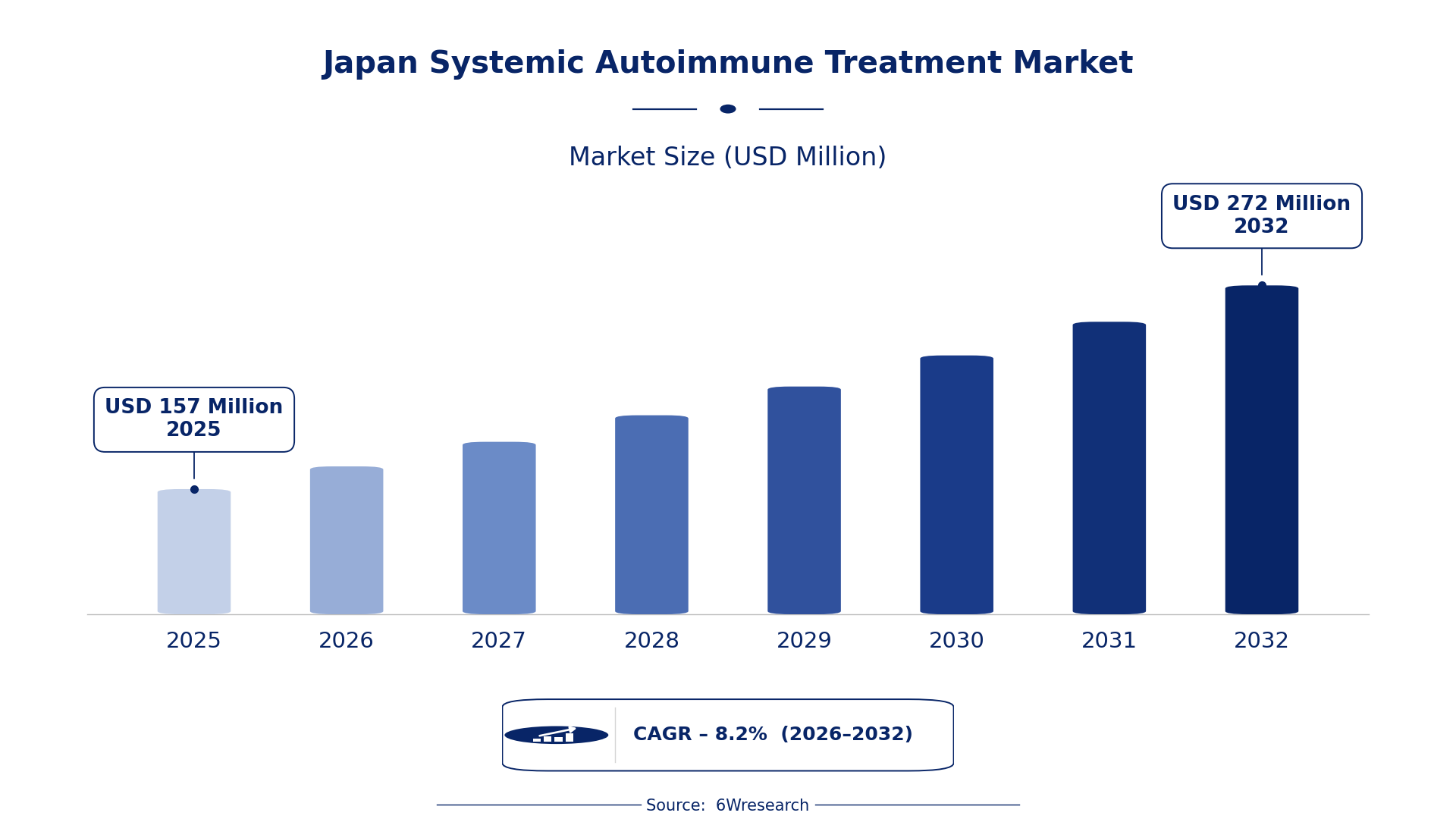
According to 6Wresearch internal database and industry insights, the Japan Systemic Autoimmune Treatment Market was valued at USD 157 Million in 2025 and is projected to reach USD 272 Million by 2032, growing at a CAGR of approximately 8.2% during 2026–2032.
Japan Systemic Autoimmune Treatment Market Highlights
| Report Metric | Details |
| Report Name | Japan Systemic Autoimmune Treatment Market (2026-2032) |
| Market Size 2025 | USD 157 Million |
| Market Size 2032 | USD 272 Million |
| Absolute Growth 2025–2032 | USD 115 Million |
| CAGR 2026–2032 | 8.2% |
| Peak Annual Growth | 9.0% in 2028 |
| Forecast Period | 2026–2032 |
| Historical Data | 2022–2025 |
| Base Year | 2025 |
| Leading Autoimmune Treatment, 2025 | Biologics (39% share) |
| Leading Product Type, 2025 | Monoclonal Antibodies (42% share) |
| Leading Therapy Type, 2025 | TNF Inhibitors (40% share) |
| Leading Distribution Channel, 2025 | Hospital Distributors (48% share) |
| Leading End User Industry, 2025 | Rheumatology Clinics (54% share) |
| Fastest-Growing Autoimmune Treatment | Immunosuppressants (10.9% CAGR) |
| Fastest-Growing Product Type | Oral Pills (11.5% CAGR) |
| Fastest-Growing Therapy Type | Calcineurin Inhibitors (11.2% CAGR) |
| Fastest-Growing Distribution Channel | Specialty Pharmacies (10.7% CAGR) |
| Fastest-Growing End User Industry | Autoimmune Care Centers (10.5% CAGR) |
| Growing Sector | Rheumatology |
| Key End Users | Hospitals, Specialty Clinics, Rheumatology Clinics, Autoimmune Care Centers |
Japan Systemic Autoimmune Treatment Market Year-wise Growth Rate and Key Drivers (2022–2032)
This graph illustrates the annual growth rates of the market from 2022 to 2032, highlighting a steady upward trajectory and projected market expansion over the forecast period.
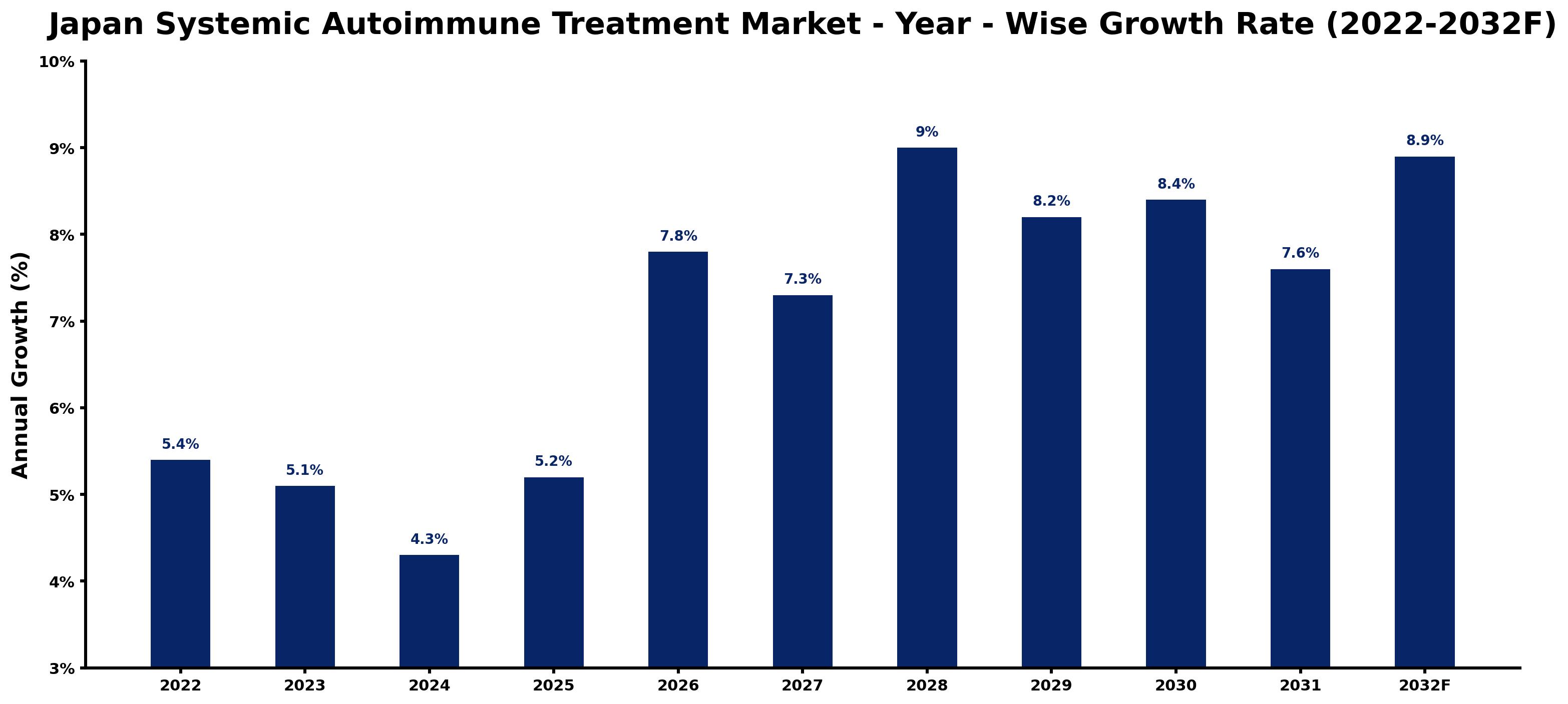
The table below sets out the estimated growth rate for each year and the main factor behind it.
| Year | Estimated Annual Growth (%) | Market Rationale |
| 2022 | 5.4 | The market showed steady growth due to increased awareness of autoimmune diseases. |
| 2023 | 5.1 | Growth slowed slightly as healthcare providers adjusted to new treatment protocols. |
| 2024 | 4.3 | Demand continued to rise, although at a slower pace amid market adjustments. |
| 2025 | 5.2 | Growth accelerated as new biologics received reimbursement approval, boosting access. |
| 2026 | 7.8 | Investment in research and development for new therapies is projected to drive demand. |
| 2027 | 7.3 | Growth is expected to slow again as the market stabilises after rapid expansions. |
| 2028 | 9.0 | The introduction of new treatments is projected to spur demand increases. |
| 2029 | 8.2 | Growth is expected to moderate slightly as the market matures and competition increases. |
| 2030 | 8.4 | Continued advancements in treatment options are likely to sustain demand growth. |
| 2031 | 7.6 | The market is projected to grow at a slower rate as saturation begins to occur. |
| 2032 | 8.9 | Demand is expected to rise again as new therapies enter the market and gain acceptance. |
Note: Market size estimations and growth projections presented in this report are based on 6Wresearch's proprietary forecasting methodology, utilizing the latest available industry data, government publications, and primary research inputs.
Japan Systemic Autoimmune Treatment Market Synopsis
Systemic autoimmune treatments encompass biologics, immunosuppressants, and corticosteroids, aimed at managing chronic autoimmune diseases. The Japan Systemic Autoimmune Treatment Market is growing due to a substantial patient population, with around 2 million individuals undergoing treatment. Key growth drivers include heightened investment in research and development, an increasing prevalence of autoimmune diseases, and the continuous expansion of specialty clinics and rheumatology services. The Japanese healthcare system supports these trends through targeted reimbursement policies and initiatives designed to improve access to new therapies.
Market Dynamics Impact Analysis (2026–2032)
| Factor | Type | Impact | Primary Segment Affected |
| Increased investment in research and development for new therapies | Driver | High | Biologics |
| Growing prevalence of autoimmune diseases among the population | Driver | High | Immunosuppressants |
| Expansion of specialty pharmacies providing tailored services | Opportunity | Medium | Specialty Pharmacies |
| Rising patient demand for convenient treatment options | Opportunity | Medium | Oral Pills |
| Limited local production of biologics leading to reliance on imports | Restraint | High | Biologics |
| High treatment costs impacting patient access to therapies | Restraint | High | Immunosuppressants |
| Competition from alternative therapies affecting market share | Challenge | Medium | JAK Inhibitors |
| Regulatory hurdles delaying the approval of new treatments | Challenge | Medium | Corticosteroids |
Evaluation of Drivers in Japan Systemic Autoimmune Treatment Market (2026–2032)
These are the developments adding the most demand over the forecast period.
| Drivers | Primary Segment Affected | Why It Matters (Evidence) |
| Investment in biologics development | Biologics | This investment leads to the introduction of new therapies, increasing treatment options for patients, with over 2 million patients currently receiving treatment. |
| Rising patient population diagnosed with autoimmune diseases | Immunosuppressants | As more individuals are diagnosed, demand for effective treatments rises, with rheumatoid arthritis affecting around 0.5% of the population. |
| Growth of rheumatology clinics across the country | Rheumatology Clinics | Increased clinic numbers enhance patient access to specialized care and treatment, with over 1,000 clinics currently operating. |
| Adoption of advanced treatment protocols by healthcare providers | Monoclonal Antibodies | This adoption improves patient outcomes, encouraging more healthcare providers to prescribe these therapies, reflecting a shift in treatment preferences. |
| Increased awareness of autoimmune diseases among the public | Dermatology Clinics | Greater awareness leads to more patients seeking treatment, boosting demand for therapies, as evidenced by rising patient visits. |
Buyers are adding capacity as healthcare providers invest in advanced biologics to manage autoimmune diseases. Approximately 2 million patients are currently receiving treatment, prompting clinics to expand their services. The prevalence of rheumatoid arthritis, affecting about 0.5% of the population, drives demand for immunosuppressants. The number of rheumatology clinics has surpassed 1,000, improving patient access to specialized care.
Evaluation of Restraints in Japan Systemic Autoimmune Treatment Market
The following restraints limit how fast demand can grow.
| Market Restraint | Primary Segment Affected | Why It Matters (Evidence) |
| Limited local production capabilities for biologics | Biologics | This limitation forces reliance on imports, increasing costs and affecting availability for healthcare providers. |
| High annual treatment costs exceeding ¥1 million per patient | Immunosuppressants | Such costs restrict access for many patients, limiting market growth and affecting treatment decisions. |
| Regulatory delays in the approval of new therapies | JAK Inhibitors | These delays hinder timely access to potentially life-saving treatments, impacting patient outcomes. |
| Competition from alternative treatment options | Corticosteroids | Increased competition can lead to market share erosion for established therapies, affecting sales and market performance. |
| Limited awareness among patients about available treatments | Monoclonal Antibodies | This lack of awareness can slow down the adoption of new therapies, limiting market penetration. |
Japan Systemic Autoimmune Treatment Market Challenges
High treatment costs burden buyers, as the average annual expense for rheumatoid arthritis exceeds ¥1 million per patient, straining healthcare budgets. Limited local production capabilities hinder suppliers, resulting in a heavy reliance on imports that can delay access to essential treatments for hospitals. A shortage of specialised skills in the workforce impacts the quality of care, making it challenging for clinics to deliver optimal treatment options. Regulatory complexities, overseen by the Ministry of Health, Labour and Welfare, can prolong the approval process for new therapies, affecting timely access for patients seeking effective solutions.
Trends in the Japan Systemic Autoimmune Treatment Market
Four trends stand out in the Japan Systemic Autoimmune Treatment Market.
- Shift towards Biologics in Autoimmune Treatment: The Japanese healthcare system is increasingly prioritising biologics for autoimmune treatment, reflecting a trend towards targeted therapies. In 2023, the government launched a national program to improve access to biologics, benefiting approximately 2 million patients.
- Expansion of Specialty Pharmacies: Specialty pharmacies are emerging as important players in the autoimmune treatment market, providing tailored medication management. The number of these pharmacies has increased, with a projected growth rate of 10.7% through 2032.
- Increased Use of JAK Inhibitors: There is a notable rise in the use of JAK inhibitors for conditions like rheumatoid arthritis, reflecting a shift in treatment preferences. Recent data shows a significant increase in JAK inhibitor prescriptions over the past few years.
- Focus on Patient-Centric Care: Rheumatology clinics are adopting patient-centric care models, enhancing treatment experiences. This trend is evident as clinics report an average of 4-6 patient visits per year, indicating strong engagement in treatment plans.
Investment Opportunities in the Japan Systemic Autoimmune Treatment Market
The opportunities below stand out in the Japan Systemic Autoimmune Treatment Market for new entrants and existing suppliers.
- Growing Demand for Oral Treatment Options: With approximately 2 million patients seeking treatment, there is a gap for oral therapies. Investing in oral medication development can cater to the needs of rheumatology clinics, which are expanding rapidly.
- Investment in Research for New Therapies: The Japanese government allocated ¥5 billion for autoimmune treatment research in 2023, presenting an opportunity for investment in new therapies. Collaborating with research institutions can facilitate market entry and innovation.
- Expansion of Rheumatology Clinics: The increasing number of rheumatology clinics, exceeding 1,000, indicates a growing market. Suppliers can establish partnerships with these clinics to provide essential treatments and services.
- Improving Access to Biologics: With the government's focus on improving access to biologics, there is a need for suppliers to ensure availability. Engaging with healthcare providers and specialty pharmacies can facilitate market entry.
Government Initiatives in the Japan Systemic Autoimmune Treatment Market
The Water Supply Act of 1957 and the Sewerage Act of 1958 set foundational standards for healthcare facilities, ensuring safe environments for systemic autoimmune treatment. These laws have shaped the infrastructure necessary for effective patient care and treatment delivery, benefiting healthcare providers and patients alike.
In 2023, the Japanese government launched a program to improve access to biologics, overseen by the Ministry of Health, Labour and Welfare. This initiative aims to reduce the time to access new treatments to under six months by 2025, benefiting millions of patients and increasing treatment availability.
Future Insight of the Japan Systemic Autoimmune Treatment Market
By 2032, hospitals will experience improved access to treatments as the government targets a reduction in new therapy approval times to under six months. The national programme launched in 2023 aims to increase the availability of biologics for patients. Investment in research for new therapies will lead to more options for patients, supported by a budget of ¥5 billion. Enhanced collaboration through networks like the Japan Autoimmune Disease Research Network will ensure suppliers can effectively respond to the needs of healthcare providers.
Market Segmentation Analysis
Japan Systemic Autoimmune Treatment Market report covers a detailed analysis of the following market segments:
By Autoimmune Treatment – Biologics Lead, Immunosuppressants Expected to Grow Fastest
According to Saurav Kr Singh, Senior Research Analyst at 6Wresearch, in 2025, Biologics led the autoimmune treatment split with a 39% share. Biologics dominate the market due to their targeted approach in treating chronic autoimmune diseases, particularly in rheumatology. The Japanese healthcare system has specific reimbursement policies that support their widespread use, making them the preferred choice among healthcare providers. The quickest growth will come from Immunosuppressants, forecast to expand at a CAGR of 10.9% between 2026 and 2032. Immunosuppressants are experiencing rapid growth as they are essential for managing immune responses in various autoimmune disorders. The increasing number of patients receiving treatment, estimated at 2 million in 2023, drives demand for these therapies. Suppliers should focus on expanding their immunosuppressant offerings to meet the rising demand in the market.
By Product Type – Monoclonal Antibodies Lead, Oral Pills Expected to Grow Fastest
The largest product type category in 2025 was Monoclonal Antibodies, at 42% of revenue. Monoclonal antibodies hold the largest market share due to their critical role in targeted therapy for autoimmune conditions, which are widespread in Japan. Their utilisation in over 1,000 rheumatology clinics underscores the robust demand from healthcare providers. Oral Pills are set to record the highest CAGR in this split, 11.5% over 2026–2032. Oral pills are rapidly gaining traction as they offer convenient administration for chronic treatment, appealing to patients who prefer simpler methods. This trend is likely to persist as healthcare professionals increasingly favour patient-friendly options. Suppliers should focus on expanding their oral treatment offerings to meet the rising demand for convenient administration.
By Therapy Type – TNF Inhibitors Lead, Calcineurin Inhibitors Expected to Grow Fastest
TNF Inhibitors took 40% of therapy type revenue in 2025, more than any other category. TNF inhibitors lead the market as they are essential for managing inflammatory autoimmune diseases, demonstrating strong efficacy in clinical settings. Their endorsement in treatment guidelines by the Japanese Society of Rheumatology highlights their critical role in patient care. Over 2026–2032, Calcineurin Inhibitors are expected to post the fastest growth, at a CAGR of 11.2%. Calcineurin inhibitors are experiencing swift growth due to their targeted applications in specific autoimmune conditions, capturing the attention of both clinicians and patients. This trend is expected to accelerate as new therapies gain acceptance and market presence. Suppliers should consider incorporating calcineurin inhibitors into their portfolios to align with the increasing interest in this therapy type.
By Distribution Channel – Hospital Distributors Lead, Specialty Pharmacies Expected to Grow Fastest
Hospital Distributors held 48% of the Japan Systemic Autoimmune Treatment Market by distribution channel in 2025. Hospital distributors dominate the market as the primary channel for delivering treatments, ensuring healthcare facilities have timely access to essential medications. Their established relationships with hospitals facilitate effective distribution, which is vital for patient care. Specialty Pharmacies are projected to grow fastest, at a CAGR of 10.7% during 2026–2032. Specialty pharmacies are rapidly expanding as they focus on complex medication management for autoimmune treatments, catering to the unique needs of patients. This growth indicates a shift towards more personalised care within the healthcare system. Suppliers should strengthen ties with specialty pharmacies to enhance their distribution strategies.
By End User Industry – Rheumatology Clinics Lead, Autoimmune Care Centers Expected to Grow Fastest
With 54% of end user industry revenue in 2025, Rheumatology Clinics was the largest category. Rheumatology clinics are the leading end user as they provide specialised care for autoimmune patients, ensuring tailored treatment plans are effectively implemented. The high prevalence of conditions like rheumatoid arthritis necessitates dedicated facilities for optimal management. The quickest growth will come from Autoimmune Care Centers, forecast to expand at a CAGR of 10.5% between 2026 and 2032. Autoimmune care centers are emerging quickly as they offer comprehensive treatment solutions, attracting patients seeking specialised care. Their growth aligns with the increasing recognition of the need for focused treatment environments. Suppliers should target autoimmune care centers to align with the shift towards comprehensive treatment approaches.
Key Attractiveness of the Report
- 10 Years of Market Numbers
- Historical Data Starting from 2022 to 2025
- Base Year 2025
- Forecast Data until 2032
- Key Performance Indicators Impacting the Market
- Major Upcoming Developments and Projects
Key Highlights of the Report:
- Japan Systemic Autoimmune Treatment Market Outlook
- Market Size of Japan Systemic Autoimmune Treatment Market, 2025
- Forecast of Japan Systemic Autoimmune Treatment Market, 2032
- Historical Data and Forecast of Japan Systemic Autoimmune Treatment Revenues & Volume for the Period 2022-2032F
- Japan Systemic Autoimmune Treatment Market Trend Evolution
- Japan Systemic Autoimmune Treatment Market Drivers and Challenges
- Japan Systemic Autoimmune Treatment Price Trends
- Japan Systemic Autoimmune Treatment Porter's Five Forces
- Japan Systemic Autoimmune Treatment Industry Life Cycle
- Historical Data and Forecast of Japan Systemic Autoimmune Treatment Market Revenues & Volume By Autoimmune Treatment for the Period 2022-2032F
- Historical Data and Forecast of Japan Systemic Autoimmune Treatment Market Revenues & Volume By Biologics for the Period 2022-2032F
- Historical Data and Forecast of Japan Systemic Autoimmune Treatment Market Revenues & Volume By Immunosuppressants for the Period 2022-2032F
- Historical Data and Forecast of Japan Systemic Autoimmune Treatment Market Revenues & Volume By JAK Inhibitors for the Period 2022-2032F
- Historical Data and Forecast of Japan Systemic Autoimmune Treatment Market Revenues & Volume By Corticosteroids for the Period 2022-2032F
- Historical Data and Forecast of Japan Systemic Autoimmune Treatment Market Revenues & Volume By Product Type for the Period 2022-2032F
- Historical Data and Forecast of Japan Systemic Autoimmune Treatment Market Revenues & Volume By Monoclonal Antibodies for the Period 2022-2032F
- Historical Data and Forecast of Japan Systemic Autoimmune Treatment Market Revenues & Volume By Oral Pills for the Period 2022-2032F
- Historical Data and Forecast of Japan Systemic Autoimmune Treatment Market Revenues & Volume By Oral Therapy for the Period 2022-2032F
- Historical Data and Forecast of Japan Systemic Autoimmune Treatment Market Revenues & Volume By Injectable/Oral for the Period 2022-2032F
- Historical Data and Forecast of Japan Systemic Autoimmune Treatment Market Revenues & Volume By Therapy Type for the Period 2022-2032F
- Historical Data and Forecast of Japan Systemic Autoimmune Treatment Market Revenues & Volume By TNF Inhibitors for the Period 2022-2032F
- Historical Data and Forecast of Japan Systemic Autoimmune Treatment Market Revenues & Volume By Calcineurin Inhibitors for the Period 2022-2032F
- Historical Data and Forecast of Japan Systemic Autoimmune Treatment Market Revenues & Volume By JAK Inhibitors for the Period 2022-2032F
- Historical Data and Forecast of Japan Systemic Autoimmune Treatment Market Revenues & Volume By Steroidal for the Period 2022-2032F
- Historical Data and Forecast of Japan Systemic Autoimmune Treatment Market Revenues & Volume By Distribution Channel for the Period 2022-2032F
- Historical Data and Forecast of Japan Systemic Autoimmune Treatment Market Revenues & Volume By Hospital Distributors for the Period 2022-2032F
- Historical Data and Forecast of Japan Systemic Autoimmune Treatment Market Revenues & Volume By Specialty Pharmacies for the Period 2022-2032F
- Historical Data and Forecast of Japan Systemic Autoimmune Treatment Market Revenues & Volume By Online Pharmacies for the Period 2022-2032F
- Historical Data and Forecast of Japan Systemic Autoimmune Treatment Market Revenues & Volume By Retail Pharmacies for the Period 2022-2032F
- Historical Data and Forecast of Japan Systemic Autoimmune Treatment Market Revenues & Volume By End User Industry for the Period 2022-2032F
- Historical Data and Forecast of Japan Systemic Autoimmune Treatment Market Revenues & Volume By Rheumatology Clinics for the Period 2022-2032F
- Historical Data and Forecast of Japan Systemic Autoimmune Treatment Market Revenues & Volume By Autoimmune Care Centers for the Period 2022-2032F
- Historical Data and Forecast of Japan Systemic Autoimmune Treatment Market Revenues & Volume By Dermatology Clinics for the Period 2022-2032F
- Historical Data and Forecast of Japan Systemic Autoimmune Treatment Market Revenues & Volume By Primary Healthcare Units for the Period 2022-2032F
- Japan Systemic Autoimmune Treatment Import Export Trade Statistics
- Market Opportunity Assessment By Autoimmune Treatment
- Market Opportunity Assessment By Product Type
- Market Opportunity Assessment By Therapy Type
- Market Opportunity Assessment By Distribution Channel
- Market Opportunity Assessment By End User Industry
- Japan Systemic Autoimmune Treatment Top Companies Market Share
- Japan Systemic Autoimmune Treatment Competitive Benchmarking By Technical and Operational Parameters
- Japan Systemic Autoimmune Treatment Company Profiles
- Japan Systemic Autoimmune Treatment Key Strategic Recommendations
Market Covered
Segments analysed in this report are listed below.
By Autoimmune Treatment
- Biologics
- Immunosuppressants
- JAK Inhibitors
- Corticosteroids
By Product Type
- Monoclonal Antibodies
- Oral Pills
- Oral Therapy
- Injectable/Oral
By Therapy Type
- TNF Inhibitors
- Calcineurin Inhibitors
- JAK Inhibitors
- Steroidal
By Distribution Channel
- Hospital Distributors
- Specialty Pharmacies
- Online Pharmacies
- Retail Pharmacies
By End User Industry
- Rheumatology Clinics
- Autoimmune Care Centers
- Dermatology Clinics
- Primary Healthcare Units































