Japan Tactical Airborne ISR Market Size & Growth Rate
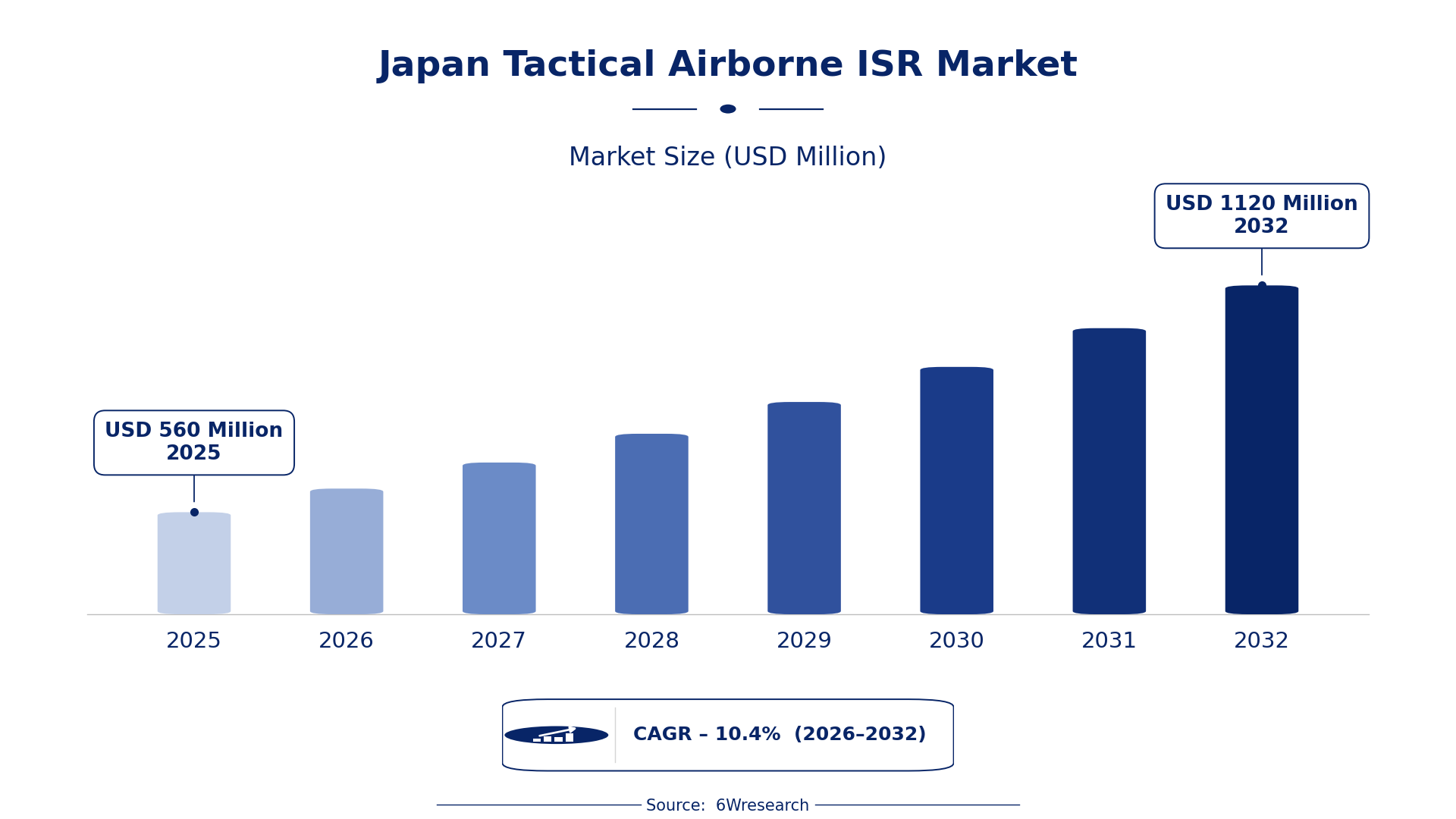
According to 6Wresearch internal database and industry insights, the Japan Tactical Airborne ISR Market was valued at USD 560 Million in 2025 and is projected to reach USD 1,120 Million by 2032, growing at a CAGR of approximately 10.4% during 2026–2032.
Japan Tactical Airborne ISR Market Highlights
| Report Metric | Details |
| Report Name | Japan Tactical Airborne ISR Market (2026-2032) |
| Market Size 2025 | USD 560 Million |
| Market Size 2032 | USD 1,120 Million |
| Absolute Growth 2025–2032 | USD 560 Million |
| CAGR 2026–2032 | 10.4% |
| Peak Annual Growth | 11.6% in 2026 |
| Forecast Period | 2026–2032 |
| Historical Data | 2022–2025 |
| Base Year | 2025 |
| Leading ISR Platform, 2025 | UAV-Based ISR (56% share) |
| Leading Sensor Type, 2025 | EO/IR Cameras (45% share) |
| Leading Operation Type, 2025 | Surveillance (46% share) |
| Leading End User, 2025 | Defense Agencies (46% share) |
| Fastest-Growing ISR Platform | Fixed-Wing ISR Aircraft (14.2% CAGR) |
| Fastest-Growing Sensor Type | SAR/GMTI Radar (15.5% CAGR) |
| Fastest-Growing Operation Type | Reconnaissance (14.7% CAGR) |
| Fastest-Growing End User | Air Force (13.0% CAGR) |
| Growing Sector | defense technology |
| Key End Users | Defense Agencies, Air Force, Special Forces Units |
Japan Tactical Airborne ISR Market Year-wise Growth Rate and Key Drivers (2022–2032)
This graph illustrates the annual growth rates of the market from 2022 to 2032, highlighting a steady upward trajectory and projected market expansion over the forecast period.
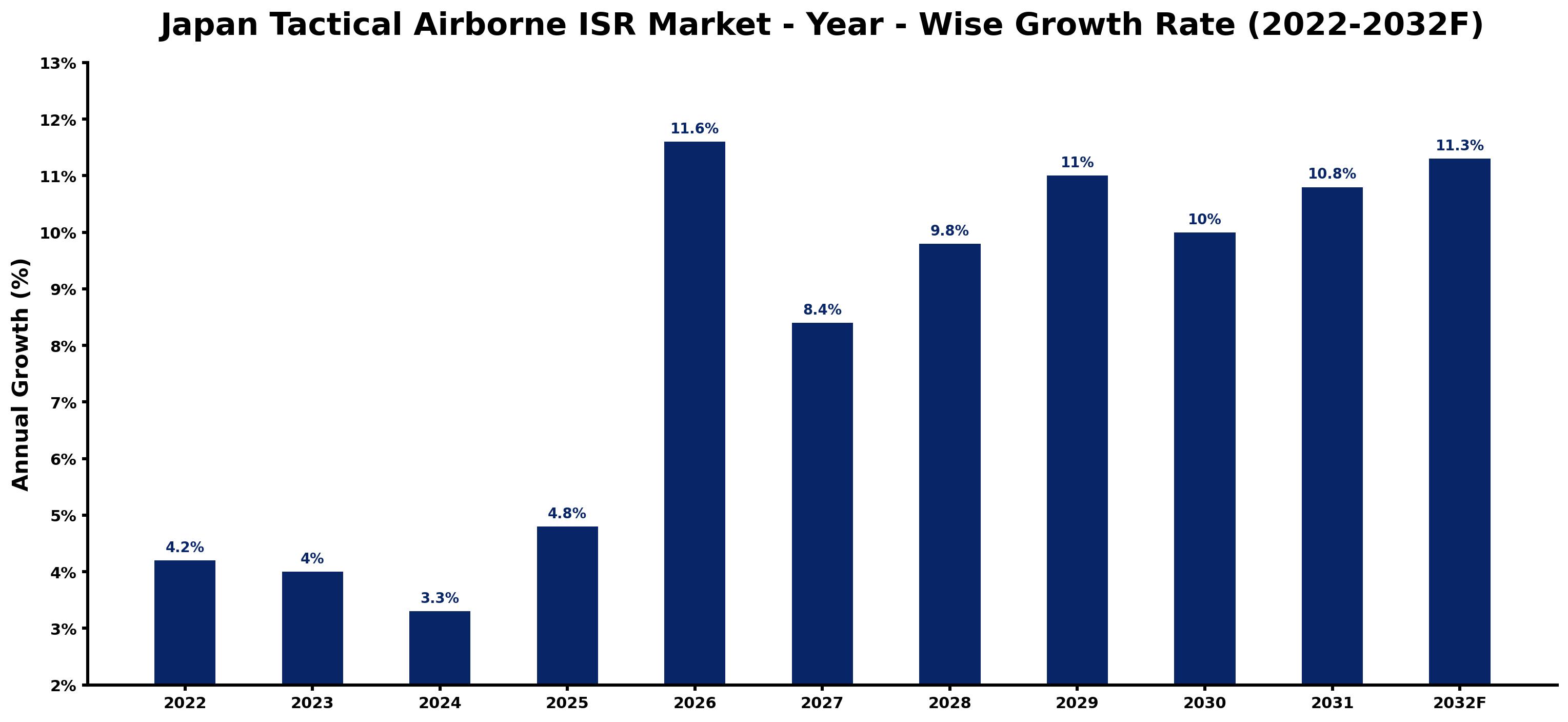
Each row of the following table gives one year's estimated growth and the event or demand shift that explains it.
| Year | Estimated Annual Growth (%) | Market Rationale |
| 2022 | 4.2 | The market experienced steady growth, reflecting ongoing investments in defense capabilities. |
| 2023 | 4.0 | Growth slowed slightly due to budget adjustments and strategic planning within defense agencies. |
| 2024 | 3.3 | The market continued to slow as agencies focused on long-term ISR capability improvements. |
| 2025 | 4.8 | Growth accelerated as the Ministry of Defense initiated new ISR programs. |
| 2026 | 11.6 | The market is expected to peak due to increased defense spending and heightened focus on surveillance technologies. |
| 2027 | 8.4 | Growth is projected to slow as agencies begin to consolidate ISR capabilities and assess effectiveness. |
| 2028 | 9.8 | Demand is expected to rise again as new technologies are integrated into existing ISR frameworks. |
| 2029 | 11.0 | The market is projected to experience strong growth driven by joint operations with allied forces. |
| 2030 | 10.0 | Growth is expected to slow as the market stabilises following rapid technological advancements. |
| 2031 | 10.8 | Demand is projected to increase as defense agencies expand their ISR capabilities with new investments. |
| 2032 | 11.3 | The market is projected to grow as Japan enhances its defense posture and capabilities. |
Note: Market size estimations and growth projections presented in this report are based on 6Wresearch's proprietary forecasting methodology, utilizing the latest available industry data, government publications, and primary research inputs.
Japan Tactical Airborne ISR Market Synopsis
Tactical Airborne ISR encompasses intelligence, surveillance, and reconnaissance capabilities deployed from airborne platforms, primarily utilising advanced technology integration such as sensors and communication systems. The Japan Tactical Airborne ISR Market is expanding due to demand from domestic defense agencies and air force units, driven by increased defense budgets and the need for improved surveillance. Initiatives to improve ISR capabilities by 2025 further contribute to market growth, reflecting a commitment to national security and operational effectiveness.
Market Dynamics Impact Analysis (2026–2032)
| Factor | Type | Impact | Primary Segment Affected |
| Increased defense budget allocations | Driver | High | UAV-Based ISR |
| Growing demand for advanced surveillance technologies | Driver | High | EO/IR Cameras |
| Expansion of ISR capabilities in the defense sector | Opportunity | High | Fixed-Wing ISR Aircraft |
| Investment in joint ISR operations with allied forces | Opportunity | Medium | Air Force |
| Budget constraints affecting procurement timelines | Restraint | High | Manned ISR Jets |
| Challenges in integrating new technologies | Restraint | Medium | Rotary ISR Systems |
| High costs of advanced ISR systems | Challenge | High | SAR/GMTI Radar |
| Dependence on foreign technology for some systems | Challenge | Medium | SIGINT/ELINT |
Evaluation of Drivers in Japan Tactical Airborne ISR Market (2026–2032)
Demand rests on the following drivers, each shown with the segment it touches most.
| Drivers | Primary Segment Affected | Why It Matters (Evidence) |
| Increased defense budget allocations | UAV-Based ISR | Japan's defense budget for 2023 is approximately 6.8 trillion yen, enabling more UAV acquisitions. |
| Growing demand for advanced surveillance technologies | EO/IR Cameras | The JASDF has deployed EO/IR cameras on various aircraft for improved surveillance capabilities. |
| Expansion of ISR capabilities in the defense sector | Fixed-Wing ISR Aircraft | The Ministry of Defense has initiated a program to improve ISR capabilities by 2025. |
| Investment in joint ISR operations with allied forces | Air Force | The Japan Self-Defense Forces are increasing joint ISR operations with allied forces. |
| Technological advancements in sensor integration | SAR/GMTI Radar | LIDAR technology is integrated into reconnaissance missions, improving effectiveness. |
What keeps demand rising is the increase in Japan's defense budget, which reached approximately 6.8 trillion yen in 2023, allowing for expanded procurement of UAV systems. The deployment of EO/IR cameras on various aircraft by the Air Self-Defense Force improves surveillance capabilities, driving further investments. Joint ISR operations with allied forces will further stimulate the market. Technological advancements in sensor integration, such as LIDAR, are also improving the effectiveness of ISR missions, leading to higher procurement rates across the sector.
Evaluation of Restraints in Japan Tactical Airborne ISR Market
Several factors work against faster growth; the main ones are summarised below.
| Market Restraint | Primary Segment Affected | Why It Matters (Evidence) |
| Budget constraints affecting procurement timelines | Manned ISR Jets | Japan's defense budget adjustments may delay procurement of essential ISR systems, impacting readiness. |
| Challenges in integrating new technologies | Rotary ISR Systems | Integrating advanced technologies into existing systems can slow down operational deployment. |
| High costs of advanced ISR systems | SAR/GMTI Radar | The investment required for advanced ISR systems limits procurement by smaller defense agencies. |
| Dependence on foreign technology for some systems | SIGINT/ELINT | Reliance on foreign technology can create supply chain vulnerabilities and delays in operational readiness. |
| Regulatory hurdles in technology adoption | LIDAR/Optical Sensors | Compliance with JIS and ISO regulations can slow down the introduction of new ISR technologies. |
Japan Tactical Airborne ISR Market Challenges
Producers face escalating costs due to Japan's defense budget of approximately 6.8 trillion yen, which fuels intense competition among ISR system manufacturers. Training expenses rise as the Japan Self-Defense Forces expand ISR capabilities, causing project timelines to extend by up to six months for contractors. Integration challenges emerge as the Ministry of Defense works to improve ISR capabilities by 2025, risking project overruns that can diminish suppliers' profit margins. Lengthy approval processes tied to compliance with JIS and ISO standards can delay procurement, hindering operational readiness for military units.
Trends in the Japan Tactical Airborne ISR Market
Buyers and suppliers in the Japan Tactical Airborne ISR Market are adjusting to the following trends.
- Shift towards Integrated ISR Systems: Tokyo is experiencing a shift towards integrated ISR systems, improving operational efficiency. The Ministry of Defense's program to enhance ISR capabilities by 2025 supports this trend, with a projected budget increase of 6.8 trillion yen.
- Increased Focus on Joint Operations: Defense agencies are prioritising joint ISR operations with allied forces, particularly in the Tokyo region. This focus is reflected in the Ministry of Defense's initiatives to enhance collaboration, aiming for increased operational effectiveness.
- Emergence of Advanced Sensor Technologies: The integration of advanced sensor technologies is becoming prominent in ISR operations, particularly with LIDAR. The Japan Aerospace Exploration Agency's collaboration on sensor technology development is driving this trend, with expected investments in 2024.
- Transition from Traditional to Modern ISR Platforms: The Japan Self-Defense Forces are transitioning from traditional ISR platforms to modern systems, improving capabilities. The deployment of UAVs and fixed-wing aircraft exemplifies this shift, focusing on real-time data collection.
Investment Opportunities in the Japan Tactical Airborne ISR Market
Below are the investment opportunities with the strongest case in the Japan Tactical Airborne ISR Market.
- Investment in UAV-Based ISR Systems: There is a growing opportunity to invest in UAV-Based ISR systems, with defense agencies seeking advanced capabilities. The Air Force is actively looking to improve its ISR capabilities, presenting a chance for local partnerships.
- Supply of EO/IR Cameras: The demand for EO/IR cameras is increasing due to military reconnaissance needs. Defense agencies are looking to procure more advanced imaging systems, providing opportunities for suppliers to enter the market.
- Development of Fixed-Wing ISR Aircraft: The need for fixed-wing ISR aircraft is rising, particularly for long-range surveillance. The Tokyo region, home to many defense technology companies, is ideal for collaboration and investment in this area.
- Collaboration on Advanced Sensor Technologies: Collaboration on advanced sensor technologies presents an opportunity for growth. The Japan Aerospace Exploration Agency's focus on sensor development offers a pathway for partnerships and innovation.
Government Initiatives in the Japan Tactical Airborne ISR Market
The Industrial Standardization Act (1949; amended and renamed the Act on Japanese Industrial Standards in 2019) governs product and test standards for ISR technologies, ensuring compliance and quality. The Semiconductor and Digital Industry Strategy (METI, June 2021) sets measures to secure domestic semiconductor manufacturing, which is essential for ISR systems.
The Japan Defense Agency oversees the procurement of ISR systems, approving projects that support national security. In 2024, the agency allocated funds for research in advanced ISR technologies, promoting innovation and development within the sector.
Future Insight of the Japan Tactical Airborne ISR Market
A policy-driven shift will prompt substantial investments in advanced ISR technologies, compelling suppliers to innovate and adapt. The Ministry of Defense prioritises joint ISR operations with allied forces, fostering collaboration across the sector. Research funding allocated for advanced ISR technologies in 2024 will lead to breakthroughs in sensor integration, significantly improving mission effectiveness. New defense technology standards will ensure systems comply with national and international requirements, creating opportunities for buyers and suppliers.
Market Segmentation Analysis
Japan Tactical Airborne ISR Market report covers a detailed analysis of the following market segments:
By ISR Platform – UAV-Based ISR Leads, Fixed-Wing ISR Aircraft Expected to Grow Fastest
According to Saurav Kr Singh, Senior Research Analyst at 6Wresearch, UAV-Based ISR accounted for 56% of the market by isr platform in 2025. UAV-Based ISR commands the largest market share due to its widespread application in reconnaissance missions, particularly by the Air Self-Defense Force. This segment benefits from a robust installed base and continuous investment in UAV technology, reflecting the priorities set by the Japan Defense Agency. Fixed-Wing ISR Aircraft is set to record the highest CAGR in this split, 14.2% over 2026–2032. The Fixed-Wing ISR Aircraft segment is rapidly expanding as Japan enhances its long-range surveillance capabilities, with the Ministry of Defense prioritising advancements in this area. The growing necessity for comprehensive maritime border monitoring is a significant factor propelling this growth. Suppliers should concentrate on developing advanced UAV technology to satisfy the increasing demand from defense agencies.
By Sensor Type – EO/IR Cameras Lead, SAR/GMTI Radar Expected to Grow Fastest
EO/IR Cameras took 45% of sensor type revenue in 2025, more than any other category. EO/IR Cameras lead the market as they are essential for real-time imaging in various ISR applications, particularly for the Japan Self-Defense Forces. Their established role in operational scenarios makes them the preferred choice among defense agencies for surveillance tasks. Over 2026–2032, SAR/GMTI Radar is expected to post the fastest growth, at a CAGR of 15.5%. SAR/GMTI Radar is witnessing the fastest growth due to its critical role in detecting ground movement, which is vital for contemporary reconnaissance missions. Recent technological advancements are accelerating the integration of this radar into ISR platforms. Buyers should invest in advanced radar technologies to strengthen their ISR capabilities.
By Operation Type – Surveillance Leads, Reconnaissance Expected to Grow Fastest
Surveillance held 46% of the Japan Tactical Airborne ISR Market by operation type in 2025. Surveillance is the dominant operation type as it serves as the primary function of ISR systems used by the Japan Self-Defense Forces. The focus on enhancing surveillance capabilities aligns with national security strategies, making this segment particularly resilient. The quickest growth will come from Reconnaissance, forecast to expand at a CAGR of 14.7% between 2026 and 2032. Reconnaissance is the fastest-growing operation type, driven by the increasing demand for intelligence gathering in tactical operations. The emphasis on reconnaissance by the Special Forces Group for mission planning highlights its rising significance in the market. Suppliers must adjust their offerings to support the growing focus on reconnaissance operations.
By End User – Defense Agencies Lead, Air Force Expected to Grow Fastest
With 46% of end user revenue in 2025, Defense Agencies was the largest category. Defense Agencies constitute the largest end user group, as they are the primary consumers of ISR technologies in Japan, supported by a substantial defense budget. Their ongoing investments in ISR capabilities ensure consistent demand for these systems. Air Force is projected to grow fastest, at a CAGR of 13.0% during 2026–2032. The Air Force is the fastest-growing end user, reflecting a heightened emphasis on airborne ISR operations to bolster national defense. The expansion of ISR capabilities within the Air Self-Defense Force clearly indicates this trend. Suppliers should customise their products to meet the specific requirements of the Air Force to capitalise on this growth.
Key Attractiveness of the Report
- 10 Years of Market Numbers
- Historical Data Starting from 2022 to 2025
- Base Year 2025
- Forecast Data until 2032
- Key Performance Indicators Impacting the Market
- Major Upcoming Developments and Projects
Key Highlights of the Report:
- Japan Tactical Airborne ISR Market Outlook
- Market Size of Japan Tactical Airborne ISR Market, 2025
- Forecast of Japan Tactical Airborne ISR Market, 2032
- Historical Data and Forecast of Japan Tactical Airborne ISR Revenues & Volume for the Period 2022-2032F
- Japan Tactical Airborne ISR Market Trend Evolution
- Japan Tactical Airborne ISR Market Drivers and Challenges
- Japan Tactical Airborne ISR Price Trends
- Japan Tactical Airborne ISR Porter's Five Forces
- Japan Tactical Airborne ISR Industry Life Cycle
- Historical Data and Forecast of Japan Tactical Airborne ISR Market Revenues & Volume By ISR Platform for the Period 2022-2032F
- Historical Data and Forecast of Japan Tactical Airborne ISR Market Revenues & Volume By UAV-Based ISR for the Period 2022-2032F
- Historical Data and Forecast of Japan Tactical Airborne ISR Market Revenues & Volume By Fixed-Wing ISR Aircraft for the Period 2022-2032F
- Historical Data and Forecast of Japan Tactical Airborne ISR Market Revenues & Volume By Rotary ISR Systems for the Period 2022-2032F
- Historical Data and Forecast of Japan Tactical Airborne ISR Market Revenues & Volume By Manned ISR Jets for the Period 2022-2032F
- Historical Data and Forecast of Japan Tactical Airborne ISR Market Revenues & Volume By Sensor Type for the Period 2022-2032F
- Historical Data and Forecast of Japan Tactical Airborne ISR Market Revenues & Volume By EO/IR Cameras for the Period 2022-2032F
- Historical Data and Forecast of Japan Tactical Airborne ISR Market Revenues & Volume By SAR/GMTI Radar for the Period 2022-2032F
- Historical Data and Forecast of Japan Tactical Airborne ISR Market Revenues & Volume By LIDAR/Optical Sensors for the Period 2022-2032F
- Historical Data and Forecast of Japan Tactical Airborne ISR Market Revenues & Volume By SIGINT/ELINT for the Period 2022-2032F
- Historical Data and Forecast of Japan Tactical Airborne ISR Market Revenues & Volume By Operation Type for the Period 2022-2032F
- Historical Data and Forecast of Japan Tactical Airborne ISR Market Revenues & Volume By Surveillance for the Period 2022-2032F
- Historical Data and Forecast of Japan Tactical Airborne ISR Market Revenues & Volume By Reconnaissance for the Period 2022-2032F
- Historical Data and Forecast of Japan Tactical Airborne ISR Market Revenues & Volume By Border Monitoring for the Period 2022-2032F
- Historical Data and Forecast of Japan Tactical Airborne ISR Market Revenues & Volume By Tactical Intel Gathering for the Period 2022-2032F
- Historical Data and Forecast of Japan Tactical Airborne ISR Market Revenues & Volume By End User for the Period 2022-2032F
- Historical Data and Forecast of Japan Tactical Airborne ISR Market Revenues & Volume By Defense Agencies for the Period 2022-2032F
- Historical Data and Forecast of Japan Tactical Airborne ISR Market Revenues & Volume By Air Force for the Period 2022-2032F
- Historical Data and Forecast of Japan Tactical Airborne ISR Market Revenues & Volume By Homeland Security for the Period 2022-2032F
- Historical Data and Forecast of Japan Tactical Airborne ISR Market Revenues & Volume By Special Forces Units for the Period 2022-2032F
- Japan Tactical Airborne ISR Import Export Trade Statistics
- Market Opportunity Assessment By ISR Platform
- Market Opportunity Assessment By Sensor Type
- Market Opportunity Assessment By Operation Type
- Market Opportunity Assessment By End User
- Japan Tactical Airborne ISR Top Companies Market Share
- Japan Tactical Airborne ISR Competitive Benchmarking By Technical and Operational Parameters
- Japan Tactical Airborne ISR Company Profiles
- Japan Tactical Airborne ISR Key Strategic Recommendations
Market Covered
The report covers the following segments.
By ISR Platform
- UAV-Based ISR
- Fixed-Wing ISR Aircraft
- Rotary ISR Systems
- Manned ISR Jets
By Sensor Type
- EO/IR Cameras
- SAR/GMTI Radar
- LIDAR/Optical Sensors
- SIGINT/ELINT
By Operation Type
- Surveillance
- Reconnaissance
- Border Monitoring
- Tactical Intel Gathering
By End User
- Defense Agencies
- Air Force
- Homeland Security
- Special Forces Units































