Japan Tactical Apparel Market Size & Growth Rate
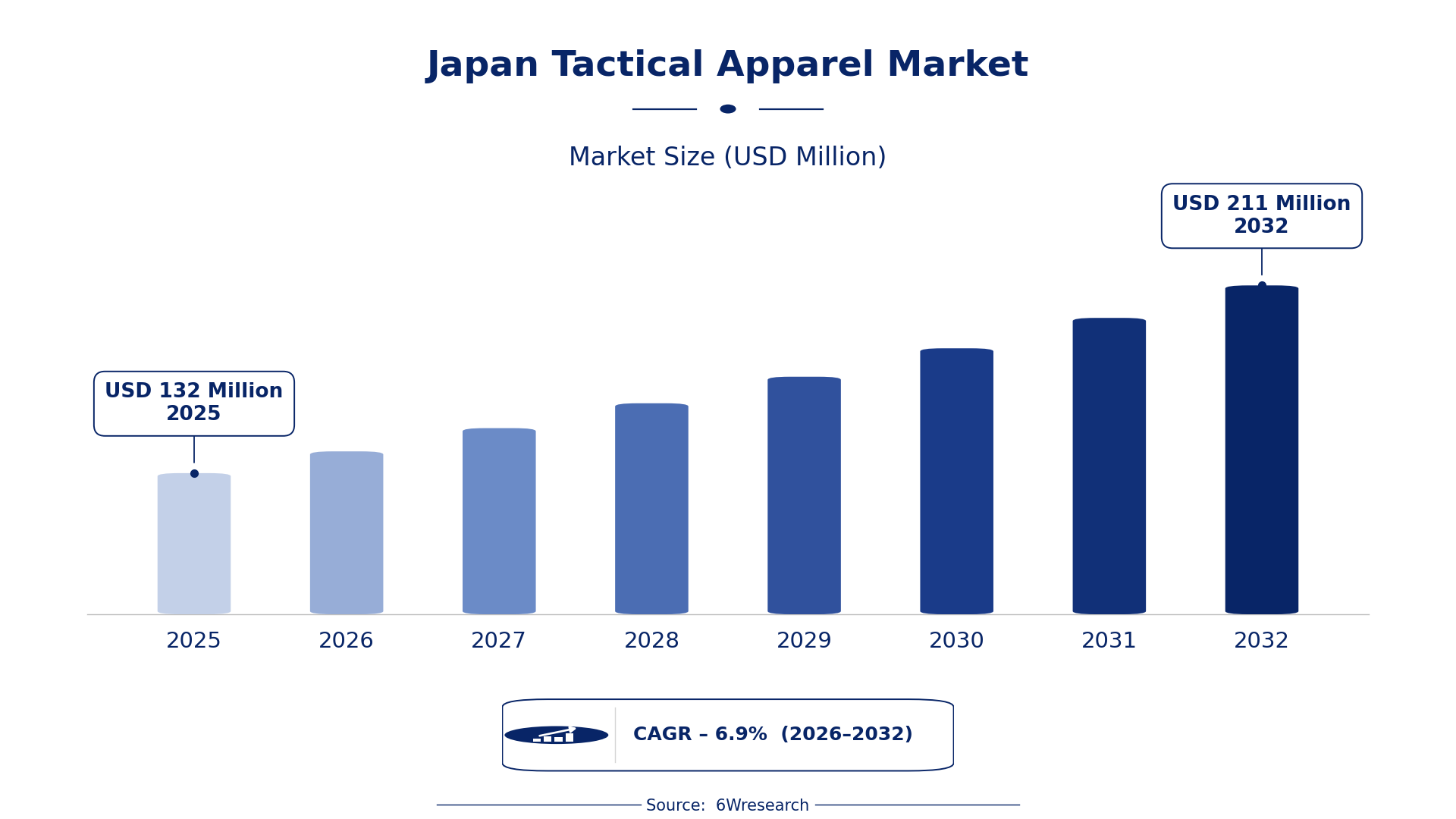
According to 6Wresearch internal database and industry insights, the Japan Tactical Apparel Market was valued at USD 132 Million in 2025 and is projected to reach USD 211 Million by 2032, growing at a CAGR of approximately 6.9% during 2026–2032.
Japan Tactical Apparel Market Highlights
| Report Metric | Details |
| Report Name | Japan Tactical Apparel Market (2026-2032) |
| Market Size 2025 | USD 132 Million |
| Market Size 2032 | USD 211 Million |
| Absolute Growth 2025–2032 | USD 79 Million |
| CAGR 2026–2032 | 6.9% |
| Peak Annual Growth | 8.0% in 2026 |
| Forecast Period | 2026–2032 |
| Historical Data | 2022–2025 |
| Base Year | 2025 |
| Leading Apparel Type, 2025 | Combat Uniforms (48% share) |
| Leading Material Used, 2025 | Kevlar/Nylon (34% share) |
| Leading Protection Level, 2025 | Ballistic Resistant (48% share) |
| Leading End User, 2025 | Military Forces (44% share) |
| Fastest-Growing Apparel Type | Tactical Vests (9.4% CAGR) |
| Fastest-Growing Material Used | Ripstop Cotton Blends (10.0% CAGR) |
| Fastest-Growing Protection Level | Cut & Impact Protection (9.1% CAGR) |
| Fastest-Growing End User | Private Security (8.6% CAGR) |
| Growing Sector | Private Security |
| Key End Users | Military Forces, Law Enforcement, Special Ops Units, Private Security |
Japan Tactical Apparel Market Year-wise Growth Rate and Key Drivers (2022–2032)
This graph illustrates the annual growth rates of the market from 2022 to 2032, highlighting a steady upward trajectory and projected market expansion over the forecast period.
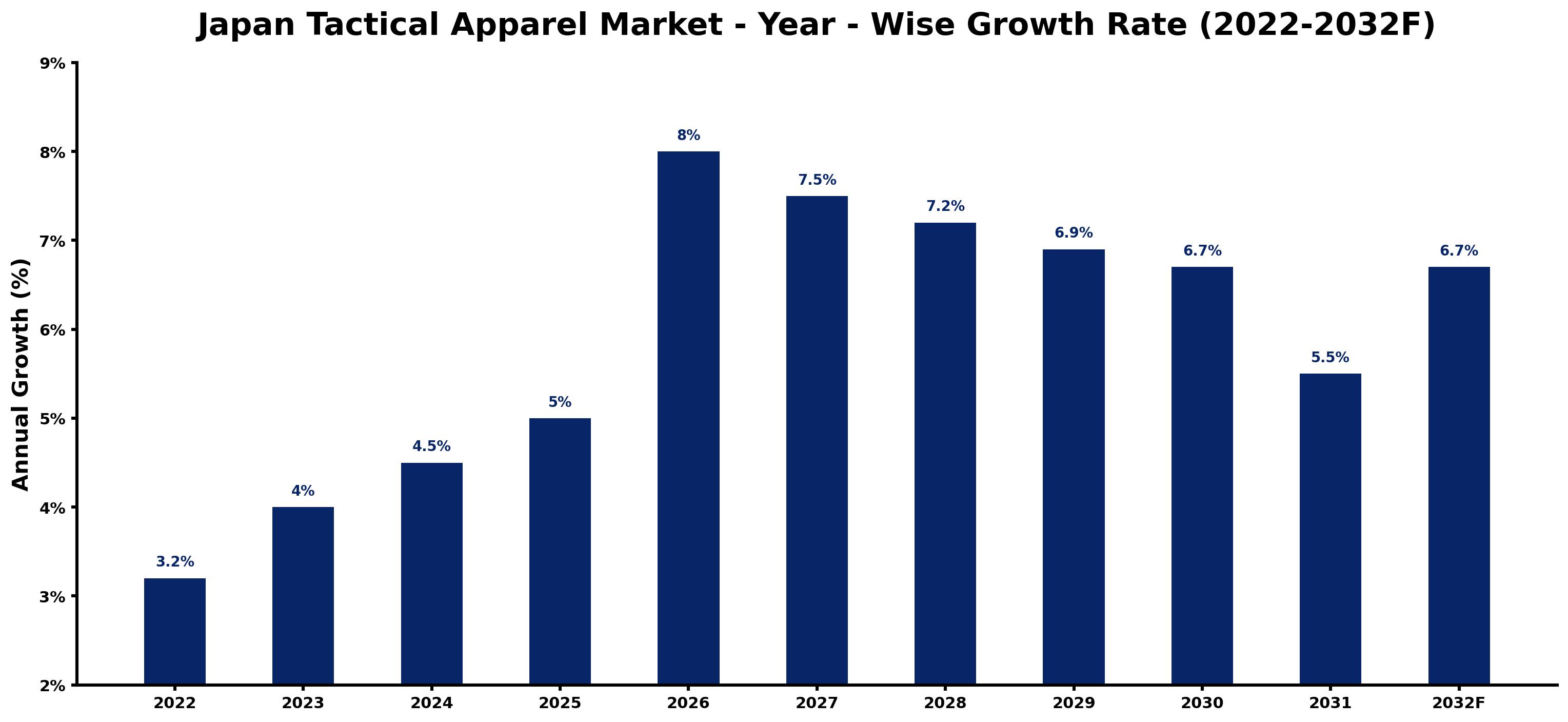
The table below sets out the estimated growth rate for each year and the main factor behind it.
| Year | Estimated Annual Growth (%) | Market Rationale |
| 2022 | 3.2 | The market experienced steady growth with increasing demand from military forces. |
| 2023 | 4.0 | Demand continued to rise as law enforcement agencies expanded their tactical apparel needs. |
| 2024 | 4.5 | Growth accelerated due to heightened security concerns and increased military budgets. |
| 2025 | 5.0 | The market reached a peak growth rate, driven by procurement from the Japan Self-Defense Forces. |
| 2026 | 8.0 | A surge in investment in tactical gear pushed growth to its highest forecast peak. |
| 2027 | 7.5 | Growth is projected to slow as the market begins to stabilise after rapid expansion in previous years. |
| 2028 | 7.2 | Demand from military and law enforcement is expected to keep the market growing, albeit at a slower pace. |
| 2029 | 6.9 | The market will maintain growth as tactical apparel remains essential for operational readiness. |
| 2030 | 6.7 | Growth is anticipated to continue slowing as the market adjusts to previous high demand levels. |
| 2031 | 5.5 | The market is projected to show further slowing, reflecting a more mature phase of growth. |
| 2032 | 6.7 | Demand is expected to rise again as new technology improves tactical apparel. |
Note: Market size estimations and growth projections presented in this report are based on 6Wresearch's proprietary forecasting methodology, utilizing the latest available industry data, government publications, and primary research inputs.
Japan Tactical Apparel Market Synopsis
Tactical apparel consists of specialised clothing designed for military and law enforcement use, crafted from durable materials like Kevlar and nylon. The Japan Tactical Apparel Market is growing, primarily driven by the Japan Self-Defense Forces and law enforcement agencies, with a rising focus on advanced protective gear. Increased defence budgets, with approximately 5 trillion yen allocated, and heightened security needs are propelling this growth, alongside ongoing investments in tactical solutions. The Tokyo region serves as a key hub for manufacturers, further shaping market trends.
Market Dynamics Impact Analysis (2026–2032)
| Factor | Type | Impact | Primary Segment Affected |
| Increased defense spending by the Ministry of Defense | Driver | High | Tactical Vests |
| Growing demand for advanced protective gear among law enforcement agencies | Driver | High | Combat Uniforms |
| Rising private security sector requiring tactical apparel | Opportunity | Medium | Tactical Footwear |
| Expansion of tactical apparel manufacturers in the Tokyo region | Opportunity | Medium | Tactical Gloves |
| Regulatory compliance with JIS standards for ballistic materials | Restraint | High | Ballistic Resistant |
| Limited availability of advanced textile technologies for production | Restraint | Medium | Kevlar/Nylon |
| Supply chain disruptions affecting material availability | Challenge | High | Tactical Vests |
| Competition from international suppliers in tactical gear | Challenge | Medium | Combat Uniforms |
Evaluation of Drivers in Japan Tactical Apparel Market (2026–2032)
The main growth drivers and the segments they affect most are set out below.
| Drivers | Primary Segment Affected | Why It Matters (Evidence) |
| Increased defense budgets from the Ministry of Defense | Tactical Vests | The Ministry of Defense's procurement budget of approximately 5 trillion yen boosts demand for tactical vests among military personnel. |
| Growing law enforcement personnel requiring tactical gear | Combat Uniforms | With over 40,000 officers in the Tokyo Metropolitan Police Department, demand for combat uniforms rises as they expand their tactical capabilities. |
| Expansion of private security firms needing tactical apparel | Tactical Footwear | The rapid growth of the private security sector, with an 8.6% growth rate, drives demand for durable tactical footwear designed for various terrains. |
| Technological advancements in textile materials | Tactical Gloves | Innovations in textile technology improve the performance of tactical gloves, increasing their adoption by law enforcement agencies. |
| Rising operational requirements from Special Operations Forces | Ballistic Resistant | The demand for advanced ballistic resistant materials is influenced by operational needs from Special Operations Forces. |
A wider customer base explains much of the growth, as increased defense spending, with a budget of approximately 5 trillion yen, fuels demand for tactical vests. The expansion of private security firms creates a need for tactical footwear designed for durability. Innovations in textile materials improve tactical gloves, driving their adoption among police forces. Operational requirements from Special Operations Forces necessitate ballistic resistant materials, further increasing demand.
Evaluation of Restraints in Japan Tactical Apparel Market
Below are the constraints most often cited by buyers and suppliers, with the segment each affects.
| Market Restraint | Primary Segment Affected | Why It Matters (Evidence) |
| Compliance with stringent JIS standards for ballistic materials | Ballistic Resistant | Manufacturers must adhere to JIS standards, which can limit production flexibility and increase costs. |
| Limited access to advanced textile technologies for production | Kevlar/Nylon | The scarcity of advanced textile technologies can hinder the production capabilities of tactical apparel. |
| High costs associated with advanced protective gear development | Tactical Vests | The investment required for R&D in advanced protective gear can deter smaller manufacturers from entering the market. |
| Supply chain disruptions affecting material availability | Combat Uniforms | Disruptions in the supply chain can lead to delays in the availability of essential materials for combat uniforms. |
| Market saturation in certain tactical apparel segments | Tactical Footwear | An oversaturated market can lead to intense competition, affecting pricing strategies and profitability. |
Japan Tactical Apparel Market Challenges
High production costs challenge buyers because domestic tactical apparel manufacturing is limited, resulting in prices that can exceed 20% compared to imports. Skills shortages exist as advanced textile technology is not widely taught, which can delay product development for manufacturers by several months. Regulatory compliance with JIS standards complicates the process, causing lead times of up to six months for suppliers to launch new products. Intense competition from international markets offering lower prices pressures local producers, making it difficult to satisfy the Japan Self-Defense Forces and law enforcement agencies while preserving profit margins.
Trends in the Japan Tactical Apparel Market
The shifts below are changing how Japan Tactical Apparel Market products are bought and supplied.
- Shift towards Advanced Protective Gear: In 2023, Japan hosted a defence technology exhibition focusing on tactical gear innovations, showcasing new ballistic resistant materials. This event highlighted the shift towards advanced protective gear, with an increasing emphasis on safety and functionality.
- Transition from Standard to Custom Tactical Apparel: The demand for customised tactical apparel is rising, driven by specific operational needs of law enforcement. This trend reflects a broader shift towards tailored solutions, improving operational efficiency for police forces.
- Emergence of Eco-Friendly Tactical Materials: The Japan Tactical Association is promoting standards for eco-friendly materials in tactical apparel, responding to growing environmental concerns. This shift is expected to influence purchasing decisions among environmentally conscious buyers.
- Prioritisation of Comfort in Tactical Footwear: Recent developments in tactical footwear emphasise comfort and performance, particularly for military personnel. This trend is clear as the Japan Self-Defense Forces adopt new designs that improve mobility and reduce fatigue.
Investment Opportunities in the Japan Tactical Apparel Market
Several openings in the Japan Tactical Apparel Market merit attention from investors.
- Timing for Investment in Tactical Vests: With a projected growth rate of 9.4% for tactical vests, now is an ideal time for investment in production capabilities. The military sector's ongoing procurement needs present opportunities for manufacturers.
- Expansion in the Tokyo Region: The Tokyo region is a key hub for tactical apparel manufacturers, making it an ideal location for new entrants. Investing in local partnerships can facilitate market entry and improve distribution networks.
- Growing Demand from Private Security Sector: The private security sector is expanding rapidly, with an 8.6% growth rate for tactical apparel. Suppliers should focus on developing tailored solutions to meet the specific needs of this buyer group.
- Entry through Joint Ventures with Local Firms: Forming joint ventures with established local manufacturers can provide access to the Japanese market. This approach allows for shared resources and compliance with local regulations.
Government Initiatives in the Japan Tactical Apparel Market
The National Police Agency oversees the use of tactical apparel in law enforcement, ensuring compliance with safety standards. This agency mandates that tactical gear meets specific performance criteria, impacting procurement decisions for police forces across Japan. Additionally, the Ministry of Defense's regulations on ballistic materials influence the design and production of tactical apparel, ensuring that it meets operational requirements and safety standards.
The Japan Defense Procurement Agency manages the acquisition of tactical gear for military use, approving contracts and funding for new equipment. This agency plays a significant role in ensuring that tactical apparel meets the needs of the Japan Self-Defense Forces, with a focus on quality and performance standards. Furthermore, the Japan Security Industry Association supports the private security sector's needs for tactical apparel, facilitating compliance with regulations and promoting best practices.
Future Insight of the Japan Tactical Apparel Market
Technological advancements will drive demand for tactical apparel by 2032, as new materials will create lighter and more durable clothing options. The Ministry of Defense's procurement budget of approximately 5 trillion yen will support the acquisition of high-quality uniforms for military personnel, enhancing their operational capabilities. Updated standards from the Japan Tactical Association will improve safety and performance in tactical apparel. Innovations presented at defence technology exhibitions will inspire manufacturers to develop cutting-edge products, benefiting both buyers and suppliers in the market.
Market Segmentation Analysis
Japan Tactical Apparel Market report covers a detailed analysis of the following market segments:
By Apparel Type – Combat Uniforms Lead, Tactical Vests Expected to Grow Fastest
According to Saurav Kr Singh, Senior Research Analyst at 6Wresearch, Combat Uniforms accounted for 48% of the market by apparel type in 2025. Combat uniforms are the standard issue for military personnel in Japan, ensuring consistency and functionality across the armed forces. The Japan Self-Defense Forces, consisting of about 250,000 personnel, heavily rely on these uniforms for operational readiness. Tactical Vests are projected to grow fastest, at a CAGR of 9.4% during 2026–2032. The rapid adoption of tactical vests is due to their essential role in carrying equipment and providing protection in the field. This growth is further propelled by the increasing emphasis on operational efficiency among military and private security sectors. Suppliers should prioritise the development of tactical vests to cater to the rising demand from various end users.
By Material Used – Kevlar/Nylon Leads, Ripstop Cotton Blends Expected to Grow Fastest
With 34% of material used revenue in 2025, Kevlar/Nylon was the largest category. Kevlar and nylon are core materials for ballistic protection in tactical gear, making them vital for military and law enforcement applications. Their extensive use is underscored by the standard issue of tactical uniforms to military personnel, ensuring safety and durability in operations. The quickest growth will come from Ripstop Cotton Blends, forecast to expand at a CAGR of 10.0% between 2026 and 2032. Ripstop cotton blends are gaining traction due to their durability in less critical applications, appealing to a broader range of users. This trend reflects the demand for reliable materials in tactical apparel, particularly among private security personnel. Manufacturers should consider expanding their product lines to include ripstop cotton blends to capture this growing market segment.
By Protection Level – Ballistic Resistant Leads, Cut & Impact Protection Expected to Grow Fastest
In 2025, Ballistic Resistant led the protection level split with a 48% share. Ballistic resistant apparel is essential for safeguarding personnel from projectiles, making it a top priority for military forces. The stringent regulations under JIS standards further reinforce its significance in the procurement of tactical apparel. Over 2026–2032, Cut & Impact Protection is expected to post the fastest growth, at a CAGR of 9.1%. Cut and impact protection is increasingly vital for preventing injuries in high-risk environments, leading to its rapid growth among tactical apparel users. The rising frequency of security incidents necessitates improved protective measures across various sectors. Suppliers must focus on advancing cut and impact protection technologies to address the changing needs of end users.
By End User – Military Forces Lead, Private Security Expected to Grow Fastest
The largest end user category in 2025 was Military Forces, at 44% of revenue. Military forces are the primary users of tactical apparel, ensuring operational readiness with standardised gear. The large personnel base of the Japan Self-Defense Forces underlines the substantial demand for military-specific tactical clothing. Private Security is set to record the highest CAGR in this split, 8.6% over 2026–2032. Private security is experiencing rapid growth as security personnel increasingly require tactical apparel for protection during assignments. The expansion of the private security sector is a key factor driving this segment's growth. Vendors should tailor their products to meet the specific needs of the private security market to capitalise on this growth opportunity.
Key Attractiveness of the Report
- 10 Years of Market Numbers
- Historical Data Starting from 2022 to 2025
- Base Year 2025
- Forecast Data until 2032
- Key Performance Indicators Impacting the Market
- Major Upcoming Developments and Projects
Key Highlights of the Report:
- Japan Tactical Apparel Market Outlook
- Market Size of Japan Tactical Apparel Market, 2025
- Forecast of Japan Tactical Apparel Market, 2032
- Historical Data and Forecast of Japan Tactical Apparel Revenues & Volume for the Period 2022-2032F
- Japan Tactical Apparel Market Trend Evolution
- Japan Tactical Apparel Market Drivers and Challenges
- Japan Tactical Apparel Price Trends
- Japan Tactical Apparel Porter's Five Forces
- Japan Tactical Apparel Industry Life Cycle
- Historical Data and Forecast of Japan Tactical Apparel Market Revenues & Volume By Apparel Type for the Period 2022-2032F
- Historical Data and Forecast of Japan Tactical Apparel Market Revenues & Volume By Tactical Vests for the Period 2022-2032F
- Historical Data and Forecast of Japan Tactical Apparel Market Revenues & Volume By Combat Uniforms for the Period 2022-2032F
- Historical Data and Forecast of Japan Tactical Apparel Market Revenues & Volume By Tactical Footwear for the Period 2022-2032F
- Historical Data and Forecast of Japan Tactical Apparel Market Revenues & Volume By Tactical Gloves for the Period 2022-2032F
- Historical Data and Forecast of Japan Tactical Apparel Market Revenues & Volume By Material Used for the Period 2022-2032F
- Historical Data and Forecast of Japan Tactical Apparel Market Revenues & Volume By Kevlar/Nylon for the Period 2022-2032F
- Historical Data and Forecast of Japan Tactical Apparel Market Revenues & Volume By Ripstop Cotton Blends for the Period 2022-2032F
- Historical Data and Forecast of Japan Tactical Apparel Market Revenues & Volume By Rubber/Suede/Leather for the Period 2022-2032F
- Historical Data and Forecast of Japan Tactical Apparel Market Revenues & Volume By Leather/Kevlar for the Period 2022-2032F
- Historical Data and Forecast of Japan Tactical Apparel Market Revenues & Volume By Protection Level for the Period 2022-2032F
- Historical Data and Forecast of Japan Tactical Apparel Market Revenues & Volume By Ballistic Resistant for the Period 2022-2032F
- Historical Data and Forecast of Japan Tactical Apparel Market Revenues & Volume By Camouflage/Flame Resistant for the Period 2022-2032F
- Historical Data and Forecast of Japan Tactical Apparel Market Revenues & Volume By Slip & Water Resistant for the Period 2022-2032F
- Historical Data and Forecast of Japan Tactical Apparel Market Revenues & Volume By Cut & Impact Protection for the Period 2022-2032F
- Historical Data and Forecast of Japan Tactical Apparel Market Revenues & Volume By End User for the Period 2022-2032F
- Historical Data and Forecast of Japan Tactical Apparel Market Revenues & Volume By Military Forces for the Period 2022-2032F
- Historical Data and Forecast of Japan Tactical Apparel Market Revenues & Volume By Special Ops Units for the Period 2022-2032F
- Historical Data and Forecast of Japan Tactical Apparel Market Revenues & Volume By Law Enforcement for the Period 2022-2032F
- Historical Data and Forecast of Japan Tactical Apparel Market Revenues & Volume By Private Security for the Period 2022-2032F
- Japan Tactical Apparel Import Export Trade Statistics
- Market Opportunity Assessment By Apparel Type
- Market Opportunity Assessment By Material Used
- Market Opportunity Assessment By Protection Level
- Market Opportunity Assessment By End User
- Japan Tactical Apparel Top Companies Market Share
- Japan Tactical Apparel Competitive Benchmarking By Technical and Operational Parameters
- Japan Tactical Apparel Company Profiles
- Japan Tactical Apparel Key Strategic Recommendations
Market Covered
Segments analysed in this report are listed below.
By Apparel Type
- Tactical Vests
- Combat Uniforms
- Tactical Footwear
- Tactical Gloves
By Material Used
- Kevlar/Nylon
- Ripstop Cotton Blends
- Rubber/Suede/Leather
- Leather/Kevlar
By Protection Level
- Ballistic Resistant
- Camouflage/Flame Resistant
- Slip & Water Resistant
- Cut & Impact Protection
By End User
- Military Forces
- Special Ops Units
- Law Enforcement
- Private Security































