Japan Tactical Communication Radar Market Size & Growth Rate
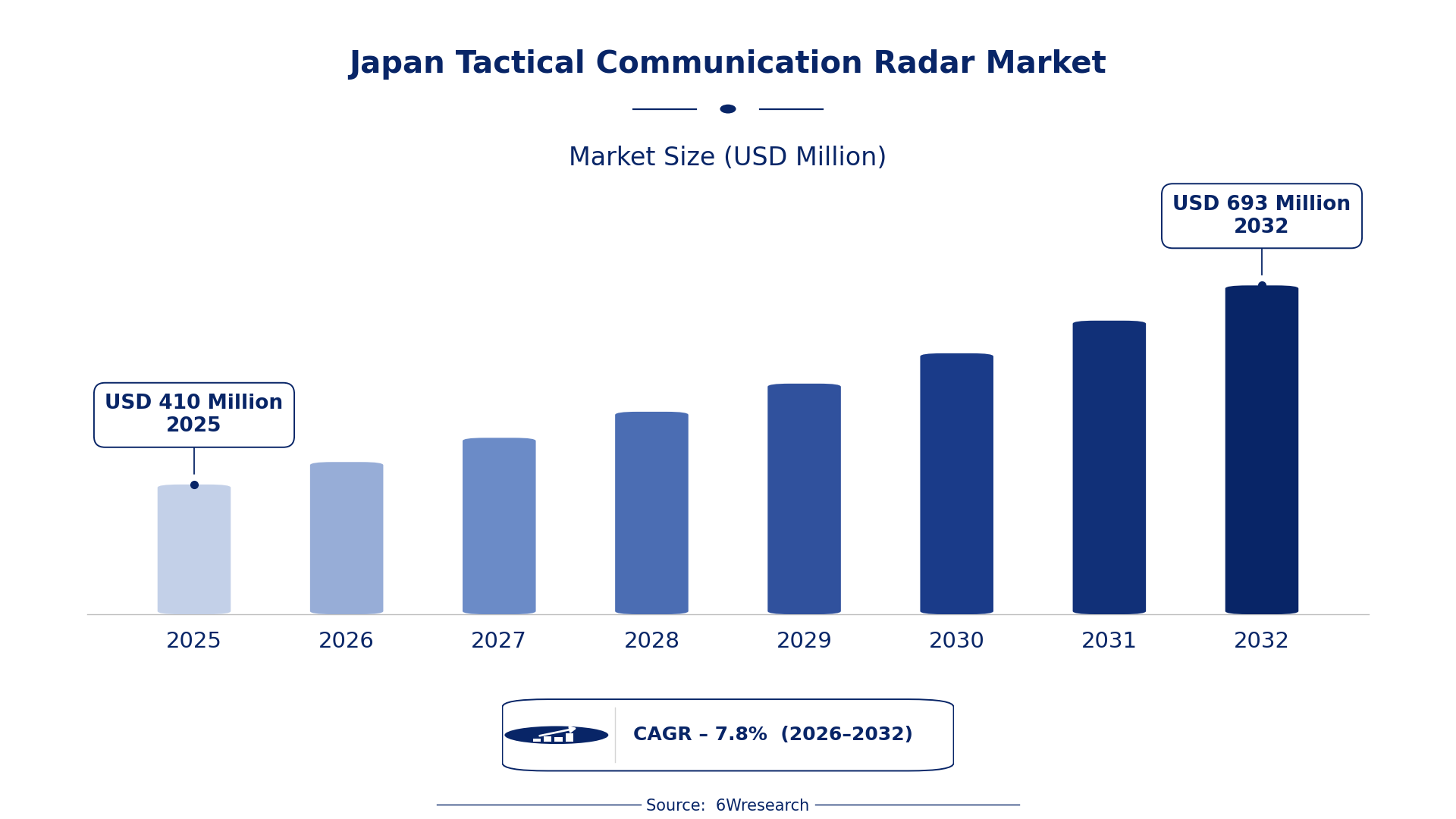
According to 6Wresearch internal database and industry insights, the Japan Tactical Communication Radar Market was valued at USD 410 Million in 2025 and is projected to reach USD 693 Million by 2032, growing at a CAGR of approximately 7.8% during 2026–2032.
Japan Tactical Communication Radar Market Highlights
| Report Metric | Details |
| Report Name | Japan Tactical Communication Radar Market (2026-2032) |
| Market Size 2025 | USD 410 Million |
| Market Size 2032 | USD 693 Million |
| Absolute Growth 2025–2032 | USD 283 Million |
| CAGR 2026–2032 | 7.8% |
| Peak Annual Growth | 8.4% in 2026 |
| Forecast Period | 2026–2032 |
| Historical Data | 2022–2025 |
| Base Year | 2025 |
| Leading Radar Type, 2025 | Ground Surveillance (48% share) |
| Leading Frequency Band, 2025 | X-Band (43% share) |
| Leading Deployment Mode, 2025 | Mobile (46% share) |
| Leading End User, 2025 | Military Bases (51% share) |
| Fastest-Growing Radar Type | Man-Portable Radar (10.9% CAGR) |
| Fastest-Growing Frequency Band | L-Band (9.9% CAGR) |
| Fastest-Growing Deployment Mode | Handheld (10.8% CAGR) |
| Fastest-Growing End User | Infantry Units (9.8% CAGR) |
| Growing Sector | military operations |
| Key End Users | military bases, infantry units, ISR operators |
Japan Tactical Communication Radar Market Year-wise Growth Rate and Key Drivers (2022–2032)
This graph illustrates the annual growth rates of the market from 2022 to 2032, highlighting a steady upward trajectory and projected market expansion over the forecast period.
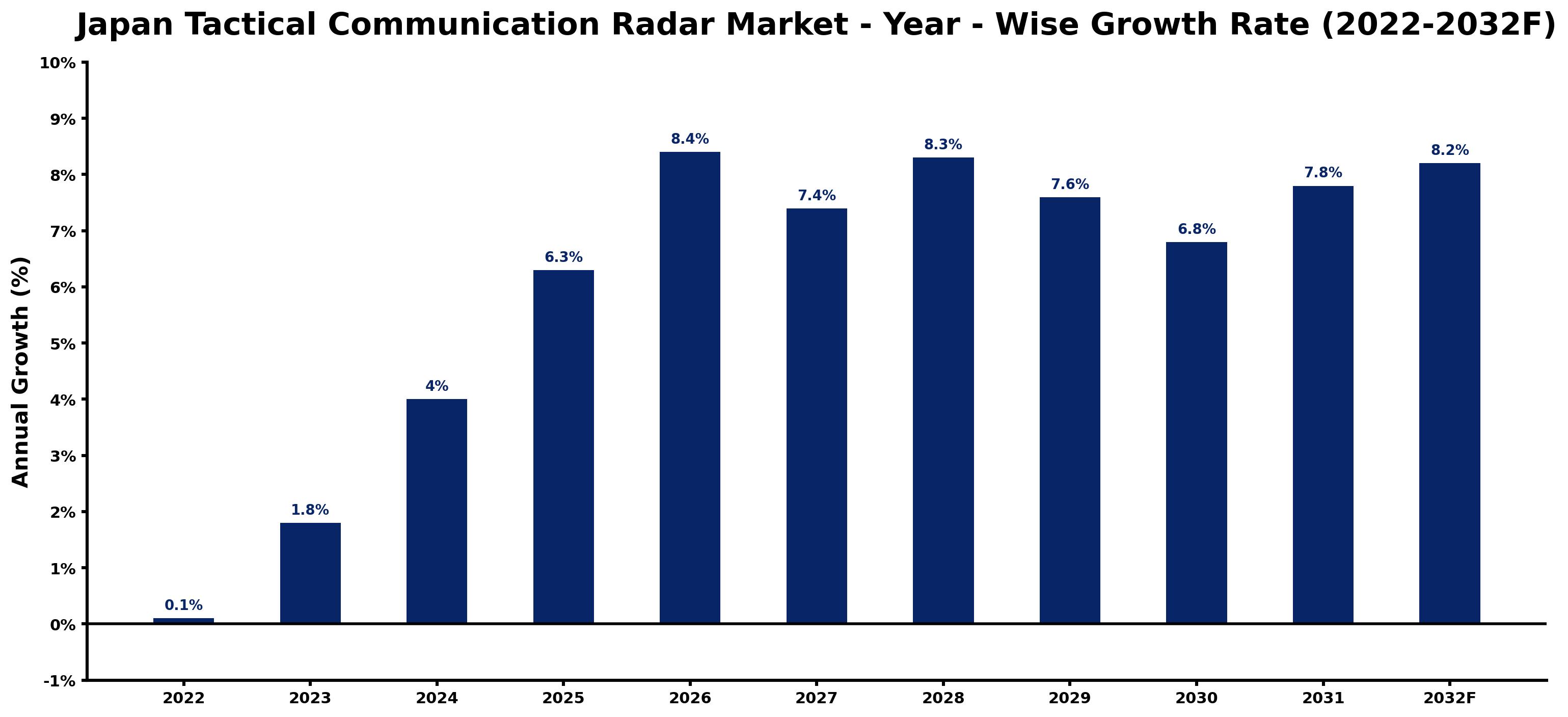
The following figures match every annual growth estimate with the main market development of that year, giving the reasoning behind each rise or slowdown.
| Year | Estimated Annual Growth (%) | Market Rationale |
| 2022 | 0.1 | The market showed minimal growth due to initial recovery efforts following the economic downturn. |
| 2023 | 1.8 | Increased defense spending contributed to a faster growth rate compared to the previous year. |
| 2024 | 4.0 | The demand for advanced surveillance capabilities drove further growth in the market. |
| 2025 | 6.3 | The market experienced strong growth as military exercises intensified across the nation. |
| 2026 | 8.4 | The peak growth rate is expected as modernization efforts in communication systems accelerate. |
| 2027 | 7.4 | Growth is projected to slow slightly as the market adjusts to the previous year's rapid expansion. |
| 2028 | 8.3 | Demand is expected to rebound with renewed focus on mobile radar solutions for military operations. |
| 2029 | 7.6 | A slight slowdown is anticipated as the market stabilizes after a period of rapid growth. |
| 2030 | 6.8 | Growth is projected to continue slowing as the market reaches a more mature phase of development. |
| 2031 | 7.8 | An increase in investment in advanced radar technologies is expected to spur growth once more. |
| 2032 | 8.2 | The market is projected to maintain strong growth as military capabilities expand. |
Note: Market size estimations and growth projections presented in this report are based on 6Wresearch's proprietary forecasting methodology, utilizing the latest available industry data, government publications, and primary research inputs.
Japan Tactical Communication Radar Market Synopsis
Tactical Communication Radar is a sophisticated technology essential for military operations, enabling ground surveillance, target tracking, and coordination of assets. The Japan Tactical Communication Radar Market is expanding due to increased defense spending, with the Ministry of Defense allocating ¥5 trillion for 2023. Demand is further driven by the adoption of advanced radar systems in military bases and ongoing modernization initiatives, including the upgrade of existing radar systems by 2026. This growth reflects a strategic emphasis on improving military capabilities and operational readiness.
Market Dynamics Impact Analysis (2026–2032)
| Factor | Type | Impact | Primary Segment Affected |
| Increased defense spending | Driver | High | Ground Surveillance |
| Adoption of Multi-Band radars | Driver | High | Multi-Band |
| Growing demand for mobile radar solutions | Opportunity | High | Mobile |
| Expansion of military bases in Hokkaido | Opportunity | Medium | Military Bases |
| High costs of advanced radar systems | Restraint | High | UAV-Based Radar |
| Limited applications of Ku-Band radars | Restraint | Medium | Ku-Band |
| Challenges in integrating new technologies | Challenge | High | Vehicle-Mounted Radar |
| Dependence on government funding for upgrades | Challenge | Medium | Man-Portable Radar |
Evaluation of Drivers in Japan Tactical Communication Radar Market (2026–2032)
The following drivers explain most of the expected growth.
| Drivers | Primary Segment Affected | Why It Matters (Evidence) |
| Increased defense budget allocations | Ground Surveillance | The Ministry of Defense allocated ¥5 trillion for defense spending in 2023, boosting surveillance capabilities. |
| Growing focus on ISR capabilities | UAV-Based Radar | The Self-Defense Forces aim to improve ISR capabilities by 2025, driving demand for UAV-based systems. |
| Expansion of military bases | Military Bases | Military bases in the Tokyo region are increasing demand for tactical communication radar systems. |
| Adoption of Multi-Band radars | Multi-Band | Operational flexibility is driving the adoption of Multi-Band radars among various military units. |
| Investment in mobile radar solutions | Mobile | The Self-Defense Forces are increasing investment in mobile radar solutions for rapid deployment. |
The Self-Defense Forces aim to improve ISR capabilities by 2025, which will drive demand for UAV-based systems. Military bases in the Tokyo region are increasing their demand for tactical communication radar, reflecting the growing focus on operational effectiveness. Investment in mobile radar solutions is expected to support rapid deployment capabilities, while the adoption of advanced radar systems is enhancing situational awareness for military units.
Evaluation of Restraints in Japan Tactical Communication Radar Market
Several factors work against faster growth; the main ones are summarised below.
| Market Restraint | Primary Segment Affected | Why It Matters (Evidence) |
| High costs of advanced radar systems | UAV-Based Radar | The high costs associated with advanced UAV-based radar systems limit procurement by military units. |
| Limited applications of Ku-Band radars | Ku-Band | Ku-Band radars have limited applications in tactical communication, reducing their market potential. |
| Integration challenges with new technologies | Vehicle-Mounted Radar | Integration challenges can delay the deployment of vehicle-mounted radar systems, impacting operational readiness. |
| Dependence on government funding for upgrades | Man-Portable Radar | Dependence on government funding for upgrades creates uncertainty for suppliers in the market. |
| Supply chain disruptions affecting production | Ground Surveillance | Supply chain disruptions have affected the production timelines of ground surveillance radar systems. |
Japan Tactical Communication Radar Market Challenges
Japan's defense producers face a skills gap, as the sector struggles to recruit qualified engineers, delaying project timelines and raising costs by 20% for manufacturers. Strict adherence to ISO 9001 standards imposes regulatory hurdles, extending the approval process by six months for new systems, which disrupts delivery schedules for distributors. Heightened competition among domestic firms drives prices down, forcing suppliers to reduce margins by 15%, limiting their ability to invest in research and development. Rapid technological advancements necessitate frequent upgrades, increasing operational costs for buyers who must adapt to new systems within tight budgets.
Trends in the Japan Tactical Communication Radar Market
Several trends are reshaping the Japan Tactical Communication Radar Market; the most important are set out below.
- Shift Towards Mobile Radar Solutions: Military bases are increasingly adopting mobile radar solutions, with a 20% increase in deployment in 2023, improving operational flexibility.
- Transition from Single-Band to Multi-Band Systems: A 15% rise in Multi-Band radar adoption is observed, particularly in Hokkaido, as military operations demand greater versatility.
- Increase in Joint Exercises with Allied Forces: Joint exercises with allied forces have led to a 30% increase in the use of Tactical Communication Radar systems in 2023, improving interoperability.
- Growing Focus on ISR Capabilities: The Self-Defense Forces are targeting a 25% improvement in ISR capabilities by 2025, driving advancements in radar technology.
Investment Opportunities in the Japan Tactical Communication Radar Market
The openings below show where demand in the Japan Tactical Communication Radar Market is visible and how suppliers can enter.
- Investment in Mobile Radar Solutions: Mobile radar systems are in high demand due to increased military operations, with a projected market growth of 10% in 2023. Suppliers can partner with military bases for deployment.
- Supply of Multi-Band Radar Systems: The growing need for operational flexibility creates opportunities for suppliers of Multi-Band radar systems, especially in urban military operations, with a notable increase in demand.
- Development of UAV-Based Radar Technologies: UAV-based radar technologies are gaining traction, with a notable increase in funding for development initiatives, particularly in collaboration with the Japan Aerospace Exploration Agency.
- Enhancement of Ground Surveillance Capabilities: The focus on improving ground surveillance capabilities presents opportunities for suppliers, particularly in Hokkaido, where military bases are expanding.
Government Initiatives in the Japan Tactical Communication Radar Market
The policy framework for Tactical Communication Radar is shaped by the National Defense Program Guidelines, which emphasise modernization efforts initiated in 2023. The government has committed to increasing funding for advanced radar systems, targeting a budget increase of 10% by 2025 to support these initiatives and improve military capabilities.
Military bases in Japan utilise the Defense Technology Promotion Program to fund radar development initiatives. This program has allocated ¥50 billion for upgrades and new technology integration, improving the effectiveness of tactical communication radar systems.
Future Insight of the Japan Tactical Communication Radar Market
A policy-driven shift towards modernization will prompt upgrades in communication systems, leading to increased demand for advanced technology. The collaboration between the Japan Aerospace Exploration Agency and military entities will yield new UAV solutions, enhancing operational capabilities. The upgrade program for existing systems by 2026 will improve integration across military operations. By 2025, enhanced ISR capabilities will provide buyers with superior surveillance and coordination, ensuring Japan's defense remains robust and responsive.
Market Segmentation Analysis
Japan Tactical Communication Radar Market report covers a detailed analysis of the following market segments:
By Radar Type – Ground Surveillance Leads, Man-Portable Radar Expected to Grow Fastest
According to Saurav Kr Singh, Senior Research Analyst at 6Wresearch, Ground Surveillance took 48% of radar type revenue in 2025, more than any other category. Ground Surveillance holds the largest share due to its critical role in monitoring and detecting threats during military operations. The Japan Self-Defense Forces rely heavily on these systems to ensure security and readiness across various regions. The quickest growth will come from Man-Portable Radar, forecast to expand at a CAGR of 10.9% between 2026 and 2032. Man-Portable Radar is experiencing rapid growth as it provides the necessary flexibility for infantry units to adapt in diverse environments. The increasing emphasis on portable solutions for ground troops is driving this segment's expansion. Suppliers should focus on developing portable radar solutions to meet the operational demands of military forces.
By Frequency Band – X-Band Leads, L-Band Expected to Grow Fastest
With 43% of frequency band revenue in 2025, X-Band was the largest category. X-Band leads the market as it is predominantly used for high-resolution radar applications essential for effective surveillance. Its widespread adoption in military operations underscores its importance in enhancing national defence capabilities. Over 2026–2032, L-Band is expected to post the fastest growth, at a CAGR of 9.9%. L-Band is witnessing notable growth due to its long-range detection capabilities, which are increasingly desirable for military operations requiring extensive coverage. The rising demand for such capabilities is propelling this segment's rapid expansion. Buyers should consider investing in advanced L-Band systems to enhance their long-range operational effectiveness.
By Deployment Mode – Mobile Leads, Handheld Expected to Grow Fastest
In 2025, Mobile led the deployment mode split with a 46% share. Mobile deployment is the largest segment, vital for ensuring rapid response in field operations. The ability to quickly set up and relocate these systems is crucial for maintaining military effectiveness in dynamic situations. Handheld is set to record the highest CAGR in this split, 10.8% over 2026–2032. Handheld radar systems are growing swiftly as they offer portable solutions that significantly improve the operational efficiency of ground troops. The rising demand for lightweight and easily transportable equipment is fuelling this trend. Suppliers must prioritise the development of handheld radar solutions to align with the needs of modern infantry units.
By End User – Military Bases Lead, Infantry Units Expected to Grow Fastest
Military Bases accounted for 51% of the market by end user in 2025. Military Bases dominate the market as they are the primary users of tactical communication radar systems essential for maintaining operational readiness. The concentration of advanced radar systems at these facilities highlights their critical role in national defence strategies. Infantry Units are projected to grow fastest, at a CAGR of 9.8% during 2026–2032. Infantry Units are rapidly increasing their utilisation of tactical communication radar to enhance operational effectiveness. The ongoing focus on improving capabilities for ground troops is a key factor in this segment's growth. Suppliers should tailor their offerings to meet the specific requirements of infantry units to capitalise on this expanding market.
Key Attractiveness of the Report
- 10 Years of Market Numbers
- Historical Data Starting from 2022 to 2025
- Base Year 2025
- Forecast Data until 2032
- Key Performance Indicators Impacting the Market
- Major Upcoming Developments and Projects
Key Highlights of the Report:
- Japan Tactical Communication Radar Market Outlook
- Market Size of Japan Tactical Communication Radar Market, 2025
- Forecast of Japan Tactical Communication Radar Market, 2032
- Historical Data and Forecast of Japan Tactical Communication Radar Revenues & Volume for the Period 2022-2032F
- Japan Tactical Communication Radar Market Trend Evolution
- Japan Tactical Communication Radar Market Drivers and Challenges
- Japan Tactical Communication Radar Price Trends
- Japan Tactical Communication Radar Porter's Five Forces
- Japan Tactical Communication Radar Industry Life Cycle
- Historical Data and Forecast of Japan Tactical Communication Radar Market Revenues & Volume By Radar Type for the Period 2022-2032F
- Historical Data and Forecast of Japan Tactical Communication Radar Market Revenues & Volume By Ground Surveillance for the Period 2022-2032F
- Historical Data and Forecast of Japan Tactical Communication Radar Market Revenues & Volume By Man-Portable Radar for the Period 2022-2032F
- Historical Data and Forecast of Japan Tactical Communication Radar Market Revenues & Volume By Vehicle-Mounted Radar for the Period 2022-2032F
- Historical Data and Forecast of Japan Tactical Communication Radar Market Revenues & Volume By UAV-Based Radar for the Period 2022-2032F
- Historical Data and Forecast of Japan Tactical Communication Radar Market Revenues & Volume By Frequency Band for the Period 2022-2032F
- Historical Data and Forecast of Japan Tactical Communication Radar Market Revenues & Volume By X-Band for the Period 2022-2032F
- Historical Data and Forecast of Japan Tactical Communication Radar Market Revenues & Volume By L-Band for the Period 2022-2032F
- Historical Data and Forecast of Japan Tactical Communication Radar Market Revenues & Volume By Ku-Band for the Period 2022-2032F
- Historical Data and Forecast of Japan Tactical Communication Radar Market Revenues & Volume By Multi-Band for the Period 2022-2032F
- Historical Data and Forecast of Japan Tactical Communication Radar Market Revenues & Volume By Deployment Mode for the Period 2022-2032F
- Historical Data and Forecast of Japan Tactical Communication Radar Market Revenues & Volume By Mobile for the Period 2022-2032F
- Historical Data and Forecast of Japan Tactical Communication Radar Market Revenues & Volume By Handheld for the Period 2022-2032F
- Historical Data and Forecast of Japan Tactical Communication Radar Market Revenues & Volume By Tactical Convoy Support for the Period 2022-2032F
- Historical Data and Forecast of Japan Tactical Communication Radar Market Revenues & Volume By Airborne Tactical Comms for the Period 2022-2032F
- Historical Data and Forecast of Japan Tactical Communication Radar Market Revenues & Volume By End User for the Period 2022-2032F
- Historical Data and Forecast of Japan Tactical Communication Radar Market Revenues & Volume By Military Bases for the Period 2022-2032F
- Historical Data and Forecast of Japan Tactical Communication Radar Market Revenues & Volume By Infantry Units for the Period 2022-2032F
- Historical Data and Forecast of Japan Tactical Communication Radar Market Revenues & Volume By Military Vehicles for the Period 2022-2032F
- Historical Data and Forecast of Japan Tactical Communication Radar Market Revenues & Volume By ISR Operators for the Period 2022-2032F
- Japan Tactical Communication Radar Import Export Trade Statistics
- Market Opportunity Assessment By Radar Type
- Market Opportunity Assessment By Frequency Band
- Market Opportunity Assessment By Deployment Mode
- Market Opportunity Assessment By End User
- Japan Tactical Communication Radar Top Companies Market Share
- Japan Tactical Communication Radar Competitive Benchmarking By Technical and Operational Parameters
- Japan Tactical Communication Radar Company Profiles
- Japan Tactical Communication Radar Key Strategic Recommendations
Market Covered
The study includes the following segmentation.
By Radar Type
- Ground Surveillance
- Man-Portable Radar
- Vehicle-Mounted Radar
- UAV-Based Radar
By Frequency Band
- X-Band
- L-Band
- Ku-Band
- Multi-Band
By Deployment Mode
- Mobile
- Handheld
- Tactical Convoy Support
- Airborne Tactical Comms
By End User
- Military Bases
- Infantry Units
- Military Vehicles
- ISR Operators































