Japan Tactical Equipment Market Size & Growth Rate
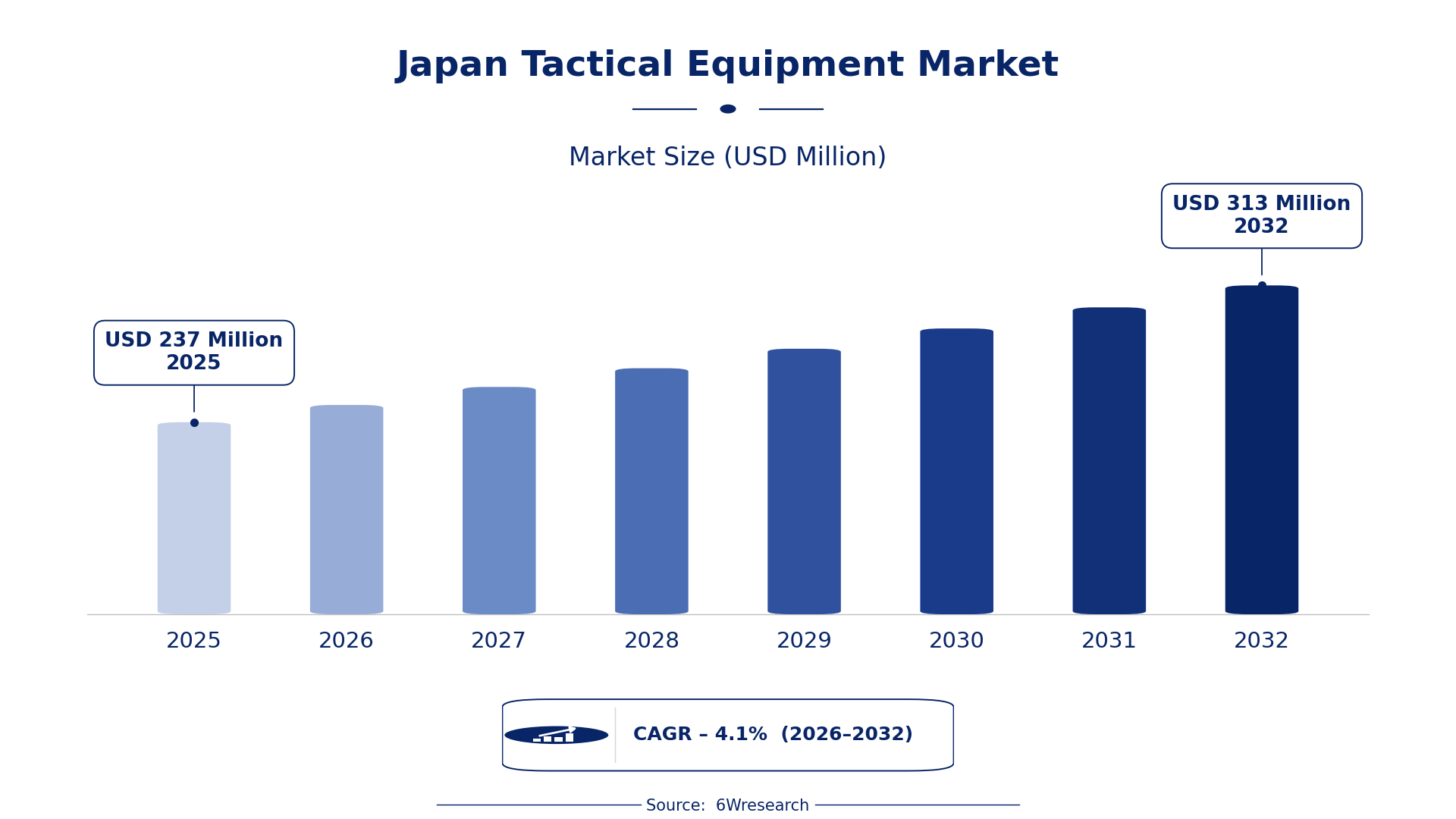
According to 6Wresearch internal database and industry insights, the Japan Tactical Equipment Market was valued at USD 237 Million in 2025 and is projected to reach USD 313 Million by 2032, growing at a CAGR of approximately 4.1% during 2026–2032.
Japan Tactical Equipment Market Highlights
| Report Metric | Details |
| Report Name | Japan Tactical Equipment Market (2026-2032) |
| Market Size 2025 | USD 237 Million |
| Market Size 2032 | USD 313 Million |
| Absolute Growth 2025–2032 | USD 76 Million |
| CAGR 2026–2032 | 4.1% |
| Peak Annual Growth | 4.6% in 2028 |
| Forecast Period | 2026–2032 |
| Historical Data | 2022–2025 |
| Base Year | 2025 |
| Leading Equipment Type, 2025 | Load-Bearing Gear (52% share) |
| Leading Usage Area, 2025 | Infantry Operations (48% share) |
| Leading Material Used, 2025 | Nylon/Kevlar (45% share) |
| Leading End User, 2025 | Ground Forces (40% share) |
| Fastest-Growing Equipment Type | Tactical Flashlights (5.6% CAGR) |
| Fastest-Growing Usage Area | Low-Light Combat (5.1% CAGR) |
| Fastest-Growing Material Used | Aluminum Alloys (6.0% CAGR) |
| Fastest-Growing End User | Recon Teams (5.2% CAGR) |
| Growing Sector | military and law enforcement applications |
| Key End Users | Ground Forces, Police Forces, Recon Teams, Special Ops Units |
Japan Tactical Equipment Market Year-wise Growth Rate and Key Drivers (2022–2032)
This graph illustrates the annual growth rates of the market from 2022 to 2032, highlighting a steady upward trajectory and projected market expansion over the forecast period.
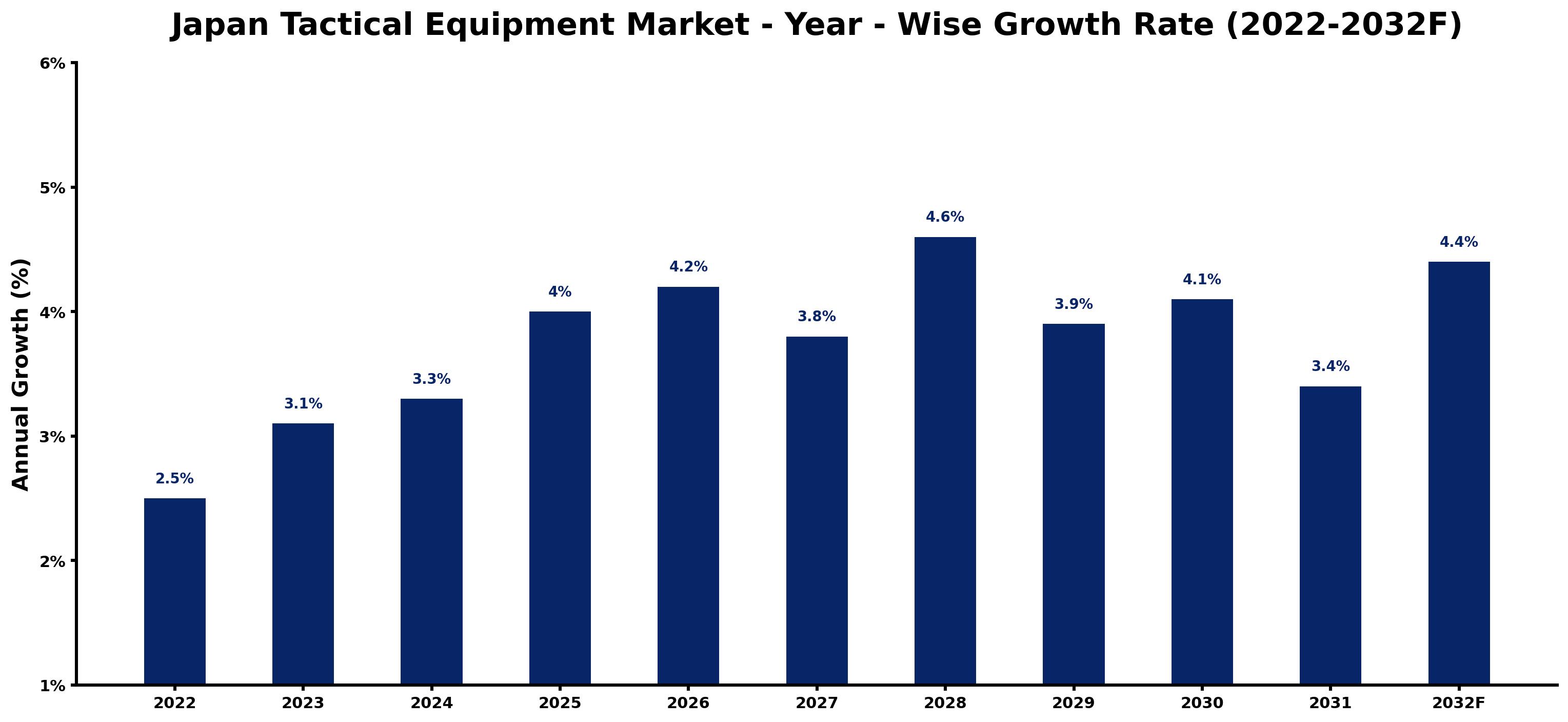
Year by year, the estimates below pair each growth rate with the development that shaped it.
| Year | Estimated Annual Growth (%) | Market Rationale |
| 2022 | 2.5 | The market experienced steady growth due to ongoing military modernization efforts. |
| 2023 | 3.1 | Demand increased as police forces upgraded tactical equipment for urban operations. |
| 2024 | 3.3 | The introduction of new night vision technologies further boosted market activity. |
| 2025 | 4.0 | A significant procurement program by the Ministry of Defense spurred growth in tactical equipment. |
| 2026 | 4.2 | The market continued to expand as tactical flashlights gained popularity among law enforcement. |
| 2027 | 3.8 | Growth slowed slightly as the market adjusted to previous high demand levels. |
| 2028 | 4.6 | A peak in growth occurred due to heightened focus on night operations by military forces. |
| 2029 | 3.9 | The market saw a slowdown as tactical gear purchases stabilised after rapid expansion. |
| 2030 | 4.1 | Demand rose again as ground forces sought to enhance operational capabilities. |
| 2031 | 3.4 | A slight slowdown occurred as the market matured and demand became more consistent. |
| 2032 | 4.4 | The market is expected to grow as new technologies are integrated into tactical gear. |
Note: Market size estimations and growth projections presented in this report are based on 6Wresearch's proprietary forecasting methodology, utilizing the latest available industry data, government publications, and primary research inputs.
Japan Tactical Equipment Market Synopsis
Tactical equipment encompasses gear designed for military and law enforcement applications, including load-bearing gear, flashlights, and night vision devices. The Japan Tactical Equipment Market is expanding due to increased investments in military modernization, particularly in night vision technology and tactical gear for police operations. With over 250,000 personnel in the Self-Defense Forces, demand is driven by the need for advanced equipment in various operational conditions, supported by government procurement programs and standards set by industry associations.
Market Dynamics Impact Analysis (2026–2032)
| Factor | Type | Impact | Primary Segment Affected |
| Increased military modernization efforts drive demand for advanced tactical gear. | Driver | High | Load-Bearing Gear |
| Growing focus on night vision technology enhances operational capabilities. | Driver | High | Night Vision Devices |
| The annual demand for tactical flashlights exceeds 100,000 units, indicating a significant market gap. | Opportunity | High | Tactical Flashlights |
| The Tokyo Metropolitan Police's investment in advanced tactical gear opens new supply channels. | Opportunity | Medium | Utility Pouches |
| The average lifespan of tactical gear is approximately 5 years, necessitating regular replacements. | Restraint | High | Load-Bearing Gear |
| High production costs for advanced materials like Nylon and Kevlar can limit profit margins. | Restraint | Medium | Nylon/Kevlar |
| Rising costs of materials have increased tactical gear prices, affecting buyer budgets. | Challenge | High | Night Vision Devices |
| The need for compliance with JIS standards can delay product approvals and market entry. | Challenge | Medium | Tactical Flashlights |
Evaluation of Drivers in Japan Tactical Equipment Market (2026–2032)
The main growth drivers and the segments they affect most are set out below.
| Drivers | Primary Segment Affected | Why It Matters (Evidence) |
| Military modernization efforts | Load-Bearing Gear | Japan's Self-Defense Forces utilize tactical equipment for over 250,000 personnel, leading to increased purchases. |
| Focus on night operations | Night Vision Devices | The integration of IR sensors into night vision devices improves performance, prompting military upgrades. |
| Urban police operations | Tactical Flashlights | Tactical flashlights are essential for visibility in urban policing, driving annual demand above 100,000 units. |
| Government procurement programs | Utility Pouches | Recent investments by the Ministry of Defense in tactical gear support demand for utility pouches. |
| Disaster response operations | Load-Bearing Gear | Tactical equipment is essential for disaster response, increasing demand from various emergency services. |
The strongest pull on demand comes from military modernization, with the Self-Defense Forces utilizing tactical equipment for over 250,000 personnel. This has led to increased purchases of load-bearing gear, essential for carrying equipment during operations. The focus on night operations is expected to drive demand for night vision devices, particularly with the integration of advanced IR sensors. Urban police operations require tactical flashlights for visibility, resulting in annual demand exceeding 100,000 units.
Evaluation of Restraints in Japan Tactical Equipment Market
The main factors holding the market back are set out below.
| Market Restraint | Primary Segment Affected | Why It Matters (Evidence) |
| The average lifespan of tactical gear is approximately 5 years, necessitating regular replacements. | Load-Bearing Gear | This leads to a consistent need for new purchases, impacting budget allocations for military and law enforcement. |
| High production costs for advanced materials like Nylon and Kevlar can limit profit margins. | Nylon/Kevlar | Manufacturers face challenges in maintaining competitiveness while ensuring quality and durability. |
| Rising costs of materials have increased tactical gear prices, affecting buyer budgets. | Night Vision Devices | Higher prices can deter smaller agencies from upgrading their equipment. |
| The need for compliance with JIS standards can delay product approvals and market entry. | Tactical Flashlights | Manufacturers must invest time and resources to meet these regulatory requirements. |
| Limited availability of specialized gear for specific units can restrict operational effectiveness. | Utility Pouches | Recon teams often require tailored solutions that are not readily available in the market. |
Japan Tactical Equipment Market Challenges
In Japan, producers face supply chain disruptions due to reliance on specific materials like nylon and Kevlar, delaying production timelines by three months for tactical gear. Regulatory hurdles stem from stringent JIS standards, imposing compliance costs that can exceed JPY 5 million annually for manufacturers. Importers contend with fierce competition from foreign tactical equipment, resulting in a 15% loss in market share for local brands. Buyers experience rising costs as the average defence budget for tactical equipment procurement has increased annually since 2020, forcing them to allocate more resources for essential gear.
Trends in the Japan Tactical Equipment Market
The following changes are redrawing the Japan Tactical Equipment Market.
- Shift towards Advanced Night Vision Technology: In 2023, a new procurement program focusing on night vision devices reflects a shift towards improved operational capabilities. This trend is clear in the increasing demand for advanced night vision solutions, with the market for night vision expected to grow by 15%.
- Increase in Tactical Gear for Urban Policing: Police forces are increasingly adopting advanced tactical gear, with the Tokyo Metropolitan Police investing heavily in specialised equipment. This shift is reflected in the rising demand for tactical flashlights, essential for urban operations, with annual demand exceeding 100,000 units.
- Growing Emphasis on Modular Gear Systems: The trend towards modular gear setups has gained traction, particularly among ground forces. This change allows for greater customisation and adaptability in various mission types, improving operational efficiency and effectiveness in the field, with a projected 20% increase in modular gear adoption.
- Rising Integration of IR Sensors in Tactical Equipment: Since 2022, there has been a notable increase in the integration of IR sensors into tactical gear, particularly night vision devices. This trend improves performance and situational awareness, driving demand for advanced tactical solutions, with a 25% rise in sensor-enabled devices.
Investment Opportunities in the Japan Tactical Equipment Market
Several openings in the Japan Tactical Equipment Market merit attention from investors.
- Demand for Tactical Flashlights: With annual demand exceeding 100,000 units, there is a clear opportunity to supply tactical flashlights to law enforcement agencies. Collaborating with police forces can facilitate market entry and establish strong partnerships, leading to a 30% increase in sales potential.
- Expansion of Utility Pouch Offerings: The Tokyo Metropolitan Police's investment in advanced tactical gear presents an opportunity to supply utility pouches. Establishing local partnerships can streamline entry into this growing segment, with a projected 15% growth in utility pouch demand.
- Growth in Night Vision Device Market: The focus on night operations has created a gap in the market for advanced night vision devices. Suppliers can target military and police forces looking to improve their capabilities, with the market expected to expand by 20%.
- Investment in Modular Gear Solutions: The trend towards modular gear setups indicates a need for suppliers to provide customisable solutions. Engaging with ground forces can help identify specific requirements and promote collaboration, potentially increasing modular gear sales by 25%.
Government Initiatives in the Japan Tactical Equipment Market
Japan's Ministry of Defense announced a new procurement program in 2023, modernising the existing Industrial Standardization Act. This program aims to upgrade tactical equipment standards, ensuring that products meet the latest technological advancements and operational requirements, with a focus on improving the quality of gear used by military and law enforcement agencies.
The Japan Tactical Equipment Association plays a key role in promoting standards and best practices in the industry. It approves various tactical gear certifications, ensuring compliance with JIS standards and improving the quality of products available to military and law enforcement agencies.
Future Insight of the Japan Tactical Equipment Market
Buyers in Japan's tactical equipment market will experience notable changes by 2032 as advancements in night vision technology, particularly with IR sensors, will enhance operational performance. Strategic government funding will drive the modernisation of defence equipment, allowing suppliers to deliver more advanced products. New procurement programs will streamline acquisition processes, reducing lead times for gear. The demand for tactical gear is expected to rise, with annual requirements projected to exceed 100,000 units, underscoring the need for reliable equipment in law enforcement.
Market Segmentation Analysis
Japan Tactical Equipment Market report covers a detailed analysis of the following market segments:
By Equipment Type – Load-Bearing Gear Leads, Tactical Flashlights Expected to Grow Fastest
According to Saurav Kr Singh, Senior Research Analyst at 6Wresearch, the largest equipment type category in 2025 was Load-Bearing Gear, at 52% of revenue. Load-bearing gear plays a vital role in transporting essential equipment during operations, making it indispensable for Japan's Self-Defense Forces. Its widespread use among military and law enforcement personnel solidifies its leading position in the tactical equipment market. Over 2026–2032, Tactical Flashlights are expected to post the fastest growth, at a CAGR of 5.6%. The rising demand for tactical flashlights is driven by their critical function in providing visibility during low-light situations, with annual requirements surpassing 100,000 units. This growth is further supported by their frequent use in urban police operations, which rely on effective lighting solutions. Suppliers must enhance the features of tactical flashlights to meet the increasing demand from law enforcement agencies.
By Usage Area – Infantry Operations Lead, Low-Light Combat Expected to Grow Fastest
Infantry Operations took 48% of usage area revenue in 2025, more than any other category. Infantry operations are the primary application for tactical gear, forming the backbone of Japan's military effectiveness. This segment's significance is underscored by the extensive deployment of tactical equipment among ground troops in various missions. The quickest growth will come from Low-Light Combat, forecast to expand at a CAGR of 5.1% between 2026 and 2032. The necessity for low-light combat capabilities is driving growth as military and law enforcement adapt to operations in darkness. This trend highlights the increasing design focus on tactical gear suited for such challenging environments. Buyers must ensure their tactical gear is specifically designed for low-light conditions to maintain operational effectiveness.
By Material Used – Nylon/Kevlar Leads, Aluminum Alloys Expected to Grow Fastest
Nylon/Kevlar held 45% of the Japan Tactical Equipment Market by material used in 2025. Nylon and Kevlar are the primary materials for durability in tactical gear production, ensuring that equipment can withstand the rigours of military and law enforcement use. Their widespread adoption in various tactical applications underpins the leading position of this material segment. Aluminum Alloys are set to record the highest CAGR in this split, 6.0% over 2026–2032. Aluminum alloys are gaining traction due to their lightweight yet strong properties, which are increasingly favoured in the design of tactical equipment. This shift is driven by the need for mobility and efficiency in operations. Suppliers should consider integrating more aluminium alloys into their product lines to cater to the demand for lightweight tactical solutions.
By End User – Ground Forces Lead, Recon Teams Expected to Grow Fastest
With 40% of end user revenue in 2025, Ground Forces was the largest category. Ground forces constitute the largest user group of tactical equipment, relying on it to fulfil their operational needs effectively. Their significant size and the necessity for reliable gear ensure this segment maintains its leading status in the market. Recon Teams are projected to grow fastest, at a CAGR of 5.2% during 2026–2032. Recon teams have distinct operational requirements that necessitate specialised gear, resulting in a rapid increase in tailored equipment solutions. This growth is in line with the military's focus on enhancing reconnaissance capabilities for effective operations. Suppliers should concentrate on developing specialised gear for recon teams to capitalise on this growing market opportunity.
Key Attractiveness of the Report
- 10 Years of Market Numbers
- Historical Data Starting from 2022 to 2025
- Base Year 2025
- Forecast Data until 2032
- Key Performance Indicators Impacting the Market
- Major Upcoming Developments and Projects
Key Highlights of the Report:
- Japan Tactical Equipment Market Outlook
- Market Size of Japan Tactical Equipment Market, 2025
- Forecast of Japan Tactical Equipment Market, 2032
- Historical Data and Forecast of Japan Tactical Equipment Revenues & Volume for the Period 2022-2032F
- Japan Tactical Equipment Market Trend Evolution
- Japan Tactical Equipment Market Drivers and Challenges
- Japan Tactical Equipment Price Trends
- Japan Tactical Equipment Porter's Five Forces
- Japan Tactical Equipment Industry Life Cycle
- Historical Data and Forecast of Japan Tactical Equipment Market Revenues & Volume By Equipment Type for the Period 2022-2032F
- Historical Data and Forecast of Japan Tactical Equipment Market Revenues & Volume By Load-Bearing Gear for the Period 2022-2032F
- Historical Data and Forecast of Japan Tactical Equipment Market Revenues & Volume By Tactical Flashlights for the Period 2022-2032F
- Historical Data and Forecast of Japan Tactical Equipment Market Revenues & Volume By Night Vision Devices for the Period 2022-2032F
- Historical Data and Forecast of Japan Tactical Equipment Market Revenues & Volume By Utility Pouches for the Period 2022-2032F
- Historical Data and Forecast of Japan Tactical Equipment Market Revenues & Volume By Usage Area for the Period 2022-2032F
- Historical Data and Forecast of Japan Tactical Equipment Market Revenues & Volume By Infantry Operations for the Period 2022-2032F
- Historical Data and Forecast of Japan Tactical Equipment Market Revenues & Volume By Low-Light Combat for the Period 2022-2032F
- Historical Data and Forecast of Japan Tactical Equipment Market Revenues & Volume By Night Patrol for the Period 2022-2032F
- Historical Data and Forecast of Japan Tactical Equipment Market Revenues & Volume By Field Missions for the Period 2022-2032F
- Historical Data and Forecast of Japan Tactical Equipment Market Revenues & Volume By Material Used for the Period 2022-2032F
- Historical Data and Forecast of Japan Tactical Equipment Market Revenues & Volume By Nylon/Kevlar for the Period 2022-2032F
- Historical Data and Forecast of Japan Tactical Equipment Market Revenues & Volume By Aluminum Alloys for the Period 2022-2032F
- Historical Data and Forecast of Japan Tactical Equipment Market Revenues & Volume By IR Sensors/Optics for the Period 2022-2032F
- Historical Data and Forecast of Japan Tactical Equipment Market Revenues & Volume By Modular Hook & Loop for the Period 2022-2032F
- Historical Data and Forecast of Japan Tactical Equipment Market Revenues & Volume By End User for the Period 2022-2032F
- Historical Data and Forecast of Japan Tactical Equipment Market Revenues & Volume By Ground Forces for the Period 2022-2032F
- Historical Data and Forecast of Japan Tactical Equipment Market Revenues & Volume By Recon Teams for the Period 2022-2032F
- Historical Data and Forecast of Japan Tactical Equipment Market Revenues & Volume By Special Ops Units for the Period 2022-2032F
- Historical Data and Forecast of Japan Tactical Equipment Market Revenues & Volume By Police Forces for the Period 2022-2032F
- Japan Tactical Equipment Import Export Trade Statistics
- Market Opportunity Assessment By Equipment Type
- Market Opportunity Assessment By Usage Area
- Market Opportunity Assessment By Material Used
- Market Opportunity Assessment By End User
- Japan Tactical Equipment Top Companies Market Share
- Japan Tactical Equipment Competitive Benchmarking By Technical and Operational Parameters
- Japan Tactical Equipment Company Profiles
- Japan Tactical Equipment Key Strategic Recommendations
Market Covered
Segments analysed in this report are listed below.
By Equipment Type
- Load-Bearing Gear
- Tactical Flashlights
- Night Vision Devices
- Utility Pouches
By Usage Area
- Infantry Operations
- Low-Light Combat
- Night Patrol
- Field Missions
By Material Used
- Nylon/Kevlar
- Aluminum Alloys
- IR Sensors/Optics
- Modular Hook & Loop
By End User
- Ground Forces
- Recon Teams
- Special Ops Units
- Police Forces































