Japan Tactical Military Vehicle Market Size & Growth Rate
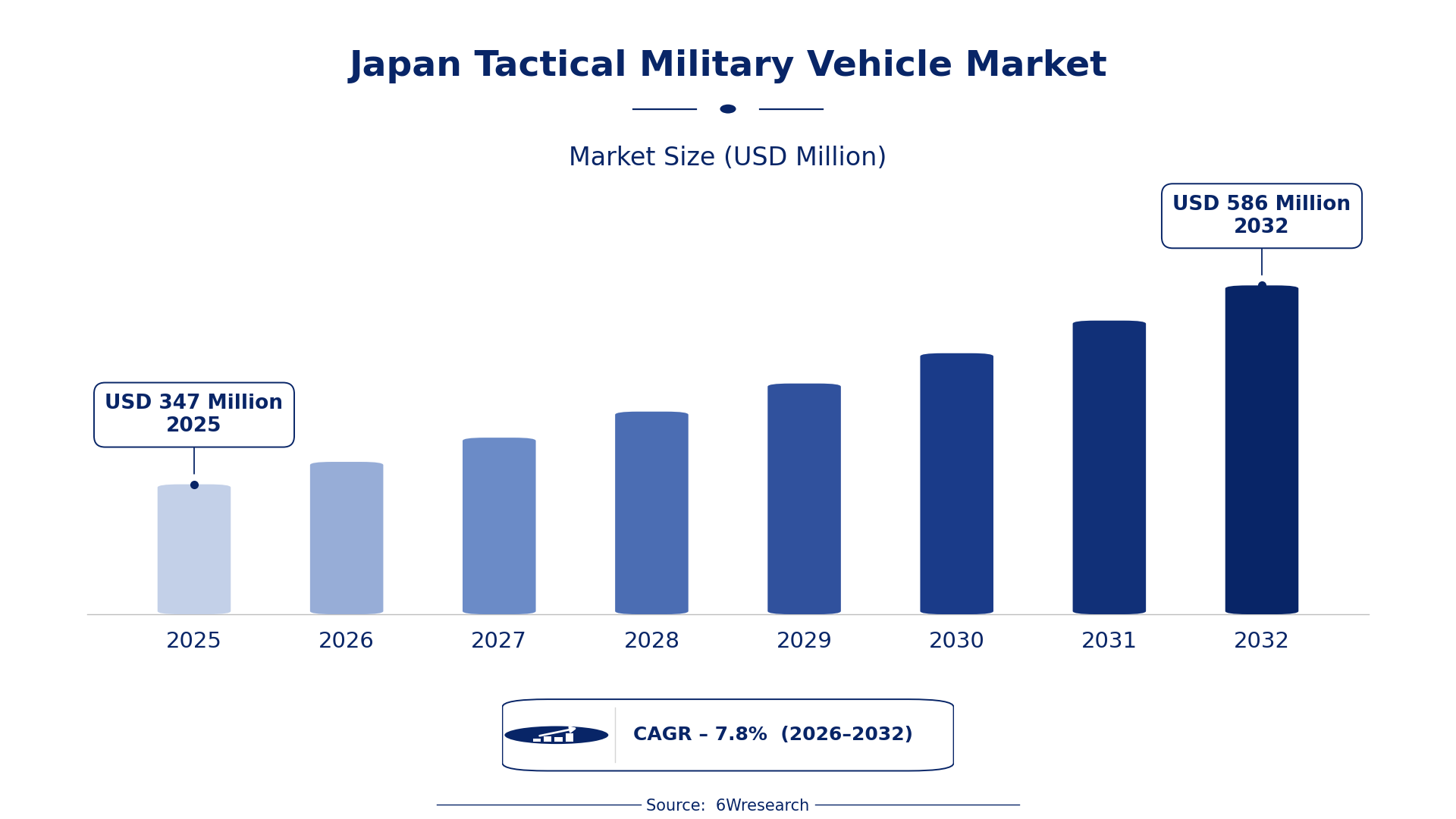
According to 6Wresearch internal database and industry insights, the Japan Tactical Military Vehicle Market was valued at USD 347 Million in 2025 and is projected to reach USD 586 Million by 2032, growing at a CAGR of approximately 7.8% during 2026–2032.
Japan Tactical Military Vehicle Market Highlights
| Report Metric | Details |
| Report Name | Japan Tactical Military Vehicle Market (2026-2032) |
| Market Size 2025 | USD 347 Million |
| Market Size 2032 | USD 586 Million |
| Absolute Growth 2025–2032 | USD 239 Million |
| CAGR 2026–2032 | 7.8% |
| Peak Annual Growth | 8.9% in 2027 |
| Forecast Period | 2026–2032 |
| Historical Data | 2022–2025 |
| Base Year | 2025 |
| Leading Vehicle Class, 2025 | Light Utility Vehicles (42% share) |
| Leading Armor Protection, 2025 | Up-Armored Level 1 (48% share) |
| Leading Drivetrain Type, 2025 | 4WD (50% share) |
| Leading End User, 2025 | Recon Units (49% share) |
| Fastest-Growing Vehicle Class | Infantry Mobility Vans (9.8% CAGR) |
| Fastest-Growing Armor Protection | Modular Armor (10.1% CAGR) |
| Fastest-Growing Drivetrain Type | AWD (10.5% CAGR) |
| Fastest-Growing End User | Transport Divisions (9.7% CAGR) |
| Growing Sector | military logistics |
| Key End Users | Self-Defense Forces, Recon Units, Transport Divisions, Battalion HQs |
Japan Tactical Military Vehicle Market Year-wise Growth Rate and Key Drivers (2022–2032)
This graph illustrates the annual growth rates of the market from 2022 to 2032, highlighting a steady upward trajectory and projected market expansion over the forecast period.
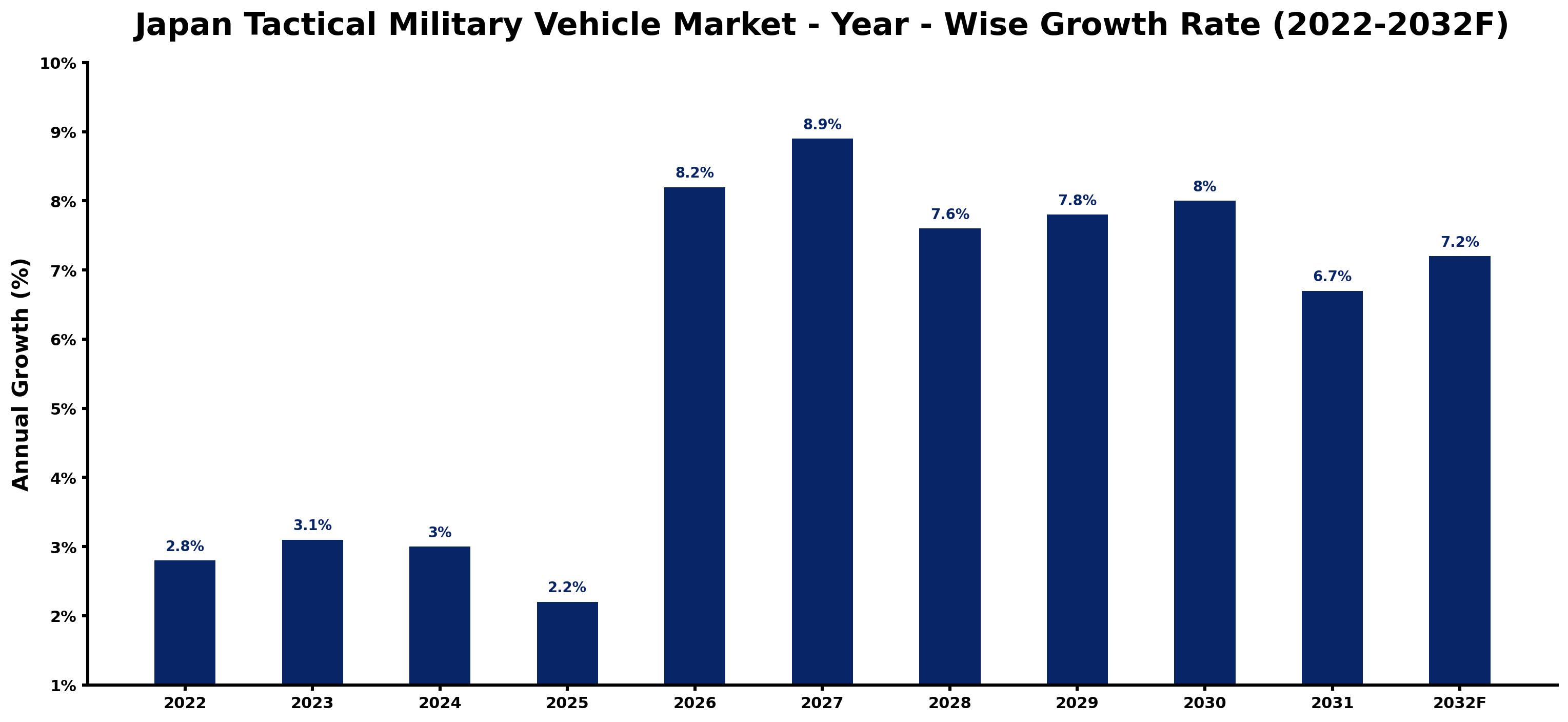
The yearly estimates that follow link every growth rate to its principal driver, so readers can see why the pace changed in each period.
| Year | Estimated Annual Growth (%) | Market Rationale |
| 2022 | 2.8 | The market showed stable growth due to ongoing military operations and modernization efforts. |
| 2023 | 3.1 | Demand increased as the defense budget allocated funding for tactical vehicle upgrades. |
| 2024 | 3.0 | Growth slowed slightly as military procurement processes took longer than anticipated. |
| 2025 | 2.2 | The market continued to grow, but at a reduced rate as budget allocations were reassessed. |
| 2026 | 8.2 | Demand is expected to surge as modernization initiatives gain momentum and procurement accelerates. |
| 2027 | 8.9 | The market is projected to experience peak growth driven by improved military capabilities and joint exercises. |
| 2028 | 7.6 | Growth is expected to slow as the market stabilises following the peak in modernization efforts. |
| 2029 | 7.8 | Demand is projected to increase again as military units expand their operational capabilities. |
| 2030 | 8.0 | Growth will continue as investments in advanced technologies and vehicle upgrades are prioritised. |
| 2031 | 6.7 | The market will see a slowdown as procurement cycles normalise after previous surges. |
| 2032 | 7.2 | Demand is expected to rise again, supported by ongoing modernization and operational readiness initiatives. |
Note: Market size estimations and growth projections presented in this report are based on 6Wresearch's proprietary forecasting methodology, utilizing the latest available industry data, government publications, and primary research inputs.
Japan Tactical Military Vehicle Market Synopsis
Tactical military vehicles are designed for military operations, prioritising durability and versatility. They are essential for troop transport, reconnaissance, and logistical support. The Japan Tactical Military Vehicle Market is expanding due to investments in defense modernization, with a 2023 budget of ¥6 trillion allocated for upgrades. The focus on advanced technologies and operational readiness is driving demand, particularly among the Self-Defense Forces and other military units. This growth is supported by a commitment to improve military capabilities and logistics in various operational scenarios.
Market Dynamics Impact Analysis (2026–2032)
| Factor | Type | Impact | Primary Segment Affected |
| Increased defense budget allocations | Driver | High | Cargo Tactical Trucks |
| Growing emphasis on joint military exercises | Driver | High | Infantry Mobility Vans |
| Investment in modular armor technology | Opportunity | Medium | Up-Armored Level 1 |
| Expansion of military training programs | Opportunity | Medium | Command Vehicles |
| Long procurement cycles for tactical vehicles | Restraint | High | Light Utility Vehicles |
| Challenges in integrating advanced technologies | Restraint | High | Recon Units |
| Limited domestic production capacity | Challenge | Medium | Cargo Tactical Trucks |
| Dependence on foreign technology for upgrades | Challenge | Medium | Infantry Mobility Vans |
Evaluation of Drivers in Japan Tactical Military Vehicle Market (2026–2032)
Key forces behind demand, with the segment each one moves most, are listed below.
| Drivers | Primary Segment Affected | Why It Matters (Evidence) |
| Increased defense spending | Cargo Tactical Trucks | The 2023 defense budget allocated ¥6 trillion for modernization, boosting demand for logistical support vehicles. |
| Joint military exercises | Infantry Mobility Vans | Participation in joint exercises in 2023 highlighted the need for rapid troop mobility, increasing orders for these vehicles. |
| Demand for advanced armor solutions | Up-Armored Level 1 | Investment in modular armor technology is driving vehicle protection, leading to higher procurement rates. |
| Expansion of military training programs | Command Vehicles | Training programs across various prefectures are increasing the need for command vehicles to support operational readiness. |
| Focus on operational readiness | Recon Units | The Self-Defense Forces aim for 100% operational readiness by 2024, driving demand for tactical vehicles. |
Several shifts outside the market lift sales. Participation in joint military exercises showcased vehicle capabilities, prompting increased orders for logistical support vehicles. Investments in armour technology are driving procurement rates as military units expand their fleets. The emphasis on operational readiness has resulted in the Self-Defense Forces targeting 100% readiness by 2024, further increasing demand for tactical vehicles.
Evaluation of Restraints in Japan Tactical Military Vehicle Market
These restraints slow adoption and weigh on supplier margins.
| Market Restraint | Primary Segment Affected | Why It Matters (Evidence) |
| Long procurement cycles | Light Utility Vehicles | Procurement processes can take longer, delaying the acquisition of essential vehicles for military operations. |
| Integration of advanced technologies | Recon Units | Challenges in adopting new technologies can hinder operational effectiveness and slow down vehicle upgrades. |
| Limited domestic production capacity | Cargo Tactical Trucks | Domestic manufacturers face capacity constraints, impacting the timely delivery of tactical vehicles. |
| Dependence on foreign technology | Infantry Mobility Vans | Reliance on foreign suppliers for advanced technologies can lead to delays and increased costs. |
| Budget reallocations | Command Vehicles | Changes in defense budget priorities can affect funding for tactical vehicle procurement and upgrades. |
Japan Tactical Military Vehicle Market Challenges
The Tokyo region's military vehicle manufacturers face intense competition from foreign suppliers, which pressures local prices and reduces profit margins for domestic producers. Skills shortages in advanced vehicle technologies hinder production efficiency, causing delays in meeting the Self-Defense Forces' modernisation targets, potentially impacting operational readiness by 20% by 2024. Supply chain disruptions for critical components, such as advanced materials, lead to extended lead times, affecting suppliers' ability to fulfil contracts on schedule, potentially delaying projects by up to six months. Rising costs of compliance with JIS standards for safety and performance increase operational expenses for manufacturers, potentially raising prices for military buyers by 15%.
Trends in the Japan Tactical Military Vehicle Market
Several trends are reshaping the Japan Tactical Military Vehicle Market; the most important are set out below.
- Shift towards Improved Vehicle Protection: Recon Units are increasingly adopting modular armour technology to improve vehicle safety and performance. In 2023, the Japanese government allocated funds for this purpose, supporting a growing trend in tactical vehicle upgrades.
- Transition from Conventional to Advanced Drivetrains: The military is moving towards AWD systems for improved traction and off-road capabilities. The Defence Technology Agency's initiatives in 2023 have led to a notable growth in AWD adoption among tactical vehicles.
- Increase in Joint Military Exercises: Joint military exercises in 2023 demonstrated the capabilities of tactical vehicles, leading to increased demand. Over 1,000 tactical military vehicles were showcased, highlighting their importance in operational readiness.
- Focus on Urban Operations: Infantry Mobility Vans are now being prioritised for urban operations and disaster response. The Tokyo region is a hub for military vehicle manufacturing, reflecting a shift in operational strategies.
Investment Opportunities in the Japan Tactical Military Vehicle Market
The following areas offer the clearest openings for investors and suppliers in the Japan Tactical Military Vehicle Market.
- Investment in Modular Armor Technology: The demand for improved vehicle protection is growing, with a projected increase in modular armour adoption. Suppliers can collaborate with local manufacturers in the Tokyo region to meet this demand.
- Supply of Advanced Communication Systems: There is a significant opportunity to provide satellite communication systems for command vehicles, with a target of 100% integration by 2025. Collaborating with the Ministry of Defence can facilitate market entry.
- Expansion of Military Training Facilities: The need for military training programs is rising, with an increase in demand for tactical vehicles. Investing in training facilities across various prefectures can capture this growing market.
- Development of Enhanced Logistics Solutions: The logistics sector for military operations is expanding, with a focus on Cargo Tactical Trucks. Suppliers can enter this market by forming joint ventures with local defence contractors.
Government Initiatives in the Japan Tactical Military Vehicle Market
The Battery Industry Strategy, initiated by the Ministry of Economy, Trade and Industry in August 2022, aims to boost domestic battery manufacturing capacity to 150 GWh by 2030. This measure directly impacts tactical military vehicle producers, as advanced battery technologies are essential for improving vehicle performance and reducing emissions. The Green Growth Strategy Through Achieving Carbon Neutrality in 2050, updated in 2021, identifies military vehicle modernisation as a key area for investment, aligning with Japan's target of a 46% cut in greenhouse-gas emissions by fiscal 2030.
The Ministry of Defence's 2023 strategy allocated ¥6 trillion for defence modernisation, focusing on upgrading existing vehicle fleets by 2025. The Defence Technology Agency oversees the development and implementation of new technologies, ensuring that tactical military vehicles meet evolving operational requirements. This funding supports the integration of advanced systems, improving the capabilities of the Self-Defense Forces and ensuring that tactical vehicles remain competitive in both domestic and international markets.
Future Insight of the Japan Tactical Military Vehicle Market
Advanced modular armour technology will reshape demand for tactical military vehicles by 2032, improving protection and operational flexibility for the Self-Defense Forces. By 2025, the integration of satellite communications in vehicles will streamline coordination and response times during operations. The Ministry of Defence's modernisation strategy will drive innovation and efficiency in vehicle production. Enhanced training programs across prefectures will ensure a skilled workforce, enabling suppliers to meet the operational requirements of the Self-Defense Forces effectively.
Market Segmentation Analysis
Japan Tactical Military Vehicle Market report covers a detailed analysis of the following market segments:
By Vehicle Class – Light Utility Vehicles Lead, Infantry Mobility Vans Expected to Grow Fastest
According to Saurav Kr Singh, Senior Research Analyst at 6Wresearch, Light Utility Vehicles accounted for 42% of the market by vehicle class in 2025. Light Utility Vehicles hold the largest share due to their critical role in troop transport and reconnaissance missions. The Japanese Self-Defense Forces utilise these vehicles extensively, operating over 1,000 tactical military vehicles that include this class. Over 2026–2032, Infantry Mobility Vans are expected to post the fastest growth, at a CAGR of 9.8%. The demand for Infantry Mobility Vans is increasing as they are specifically designed for the rapid movement of infantry units, essential during urban operations. Recent operational needs have resulted in a 15% increase in their use among Recon Units over the past two years. Suppliers should prioritise the development of Infantry Mobility Vans to align with the rising operational requirements.
By Armor Protection – Up-Armored Level 1 Leads, Modular Armor Expected to Grow Fastest
Up-Armored Level 1 held 48% of the Japan Tactical Military Vehicle Market by armor protection in 2025. Up-Armored Level 1 holds the largest share due to its provision of basic protection against small arms fire, which is vital for troop safety. This level of armor is extensively used within the Self-Defense Forces, ensuring operational effectiveness in various scenarios. Modular Armor is set to record the highest CAGR in this split, 10.1% over 2026–2032. Modular Armor is experiencing rapid growth as it offers enhanced vehicle protection, aligning with the Ministry of Defense's focus on modernising vehicle capabilities. The increasing interest in advanced protective technologies among military planners is driving this segment's expansion. Suppliers should prioritise developing vehicles with modular armor to meet the evolving demands for enhanced protection.
By Drivetrain Type – 4WD Leads, AWD Expected to Grow Fastest
In 2025, 4WD led the drivetrain type split with a 50% share. 4WD is the leading drivetrain type, essential for off-road capabilities that are critical in military operations. Its widespread use in tactical vehicles ensures that forces can effectively traverse difficult terrains encountered during missions. AWD is projected to grow fastest, at a CAGR of 10.5% during 2026–2032. AWD is witnessing the fastest growth as it provides improved traction, making it suitable for specific tactical applications. The rising focus on operational readiness and performance in diverse environments is propelling its adoption among military units. Manufacturers should consider expanding AWD options to cater to the evolving requirements of military operations.
By End User – Recon Units Lead, Transport Divisions Expected to Grow Fastest
Recon Units took 49% of end user revenue in 2025, more than any other category. Recon Units are the leading users of tactical vehicles, relying heavily on them for surveillance and intelligence-gathering missions. Their operational needs require a substantial fleet, making them the largest segment in this market. The quickest growth will come from Transport Divisions, forecast to expand at a CAGR of 9.7% between 2026 and 2032. Transport Divisions are rapidly increasing their utilisation of tactical vehicles for troop movement, reflecting a growing need for efficient logistics. This focus on operational readiness has led to a surge in demand for these vehicles within this segment. Suppliers must ensure that their vehicles address the specific logistical requirements of Transport Divisions to capitalise on this expanding market.
Key Attractiveness of the Report
- 10 Years of Market Numbers
- Historical Data Starting from 2022 to 2025
- Base Year 2025
- Forecast Data until 2032
- Key Performance Indicators Impacting the Market
- Major Upcoming Developments and Projects
Key Highlights of the Report:
- Japan Tactical Military Vehicle Market Outlook
- Market Size of Japan Tactical Military Vehicle Market, 2025
- Forecast of Japan Tactical Military Vehicle Market, 2032
- Historical Data and Forecast of Japan Tactical Military Vehicle Revenues & Volume for the Period 2022-2032F
- Japan Tactical Military Vehicle Market Trend Evolution
- Japan Tactical Military Vehicle Market Drivers and Challenges
- Japan Tactical Military Vehicle Price Trends
- Japan Tactical Military Vehicle Porter's Five Forces
- Japan Tactical Military Vehicle Industry Life Cycle
- Historical Data and Forecast of Japan Tactical Military Vehicle Market Revenues & Volume By Vehicle Class for the Period 2022-2032F
- Historical Data and Forecast of Japan Tactical Military Vehicle Market Revenues & Volume By Light Utility Vehicles for the Period 2022-2032F
- Historical Data and Forecast of Japan Tactical Military Vehicle Market Revenues & Volume By Infantry Mobility Vans for the Period 2022-2032F
- Historical Data and Forecast of Japan Tactical Military Vehicle Market Revenues & Volume By Command Vehicles for the Period 2022-2032F
- Historical Data and Forecast of Japan Tactical Military Vehicle Market Revenues & Volume By Cargo Tactical Trucks for the Period 2022-2032F
- Historical Data and Forecast of Japan Tactical Military Vehicle Market Revenues & Volume By Armor Protection for the Period 2022-2032F
- Historical Data and Forecast of Japan Tactical Military Vehicle Market Revenues & Volume By Up-Armored Level 1 for the Period 2022-2032F
- Historical Data and Forecast of Japan Tactical Military Vehicle Market Revenues & Volume By Modular Armor for the Period 2022-2032F
- Historical Data and Forecast of Japan Tactical Military Vehicle Market Revenues & Volume By Satellite Comms for the Period 2022-2032F
- Historical Data and Forecast of Japan Tactical Military Vehicle Market Revenues & Volume By Hardened Chassis for the Period 2022-2032F
- Historical Data and Forecast of Japan Tactical Military Vehicle Market Revenues & Volume By Drivetrain Type for the Period 2022-2032F
- Historical Data and Forecast of Japan Tactical Military Vehicle Market Revenues & Volume By 4WD for the Period 2022-2032F
- Historical Data and Forecast of Japan Tactical Military Vehicle Market Revenues & Volume By AWD for the Period 2022-2032F
- Historical Data and Forecast of Japan Tactical Military Vehicle Market Revenues & Volume By Diesel Powered for the Period 2022-2032F
- Historical Data and Forecast of Japan Tactical Military Vehicle Market Revenues & Volume By 6x6 or 8x8 for the Period 2022-2032F
- Historical Data and Forecast of Japan Tactical Military Vehicle Market Revenues & Volume By End User for the Period 2022-2032F
- Historical Data and Forecast of Japan Tactical Military Vehicle Market Revenues & Volume By Recon Units for the Period 2022-2032F
- Historical Data and Forecast of Japan Tactical Military Vehicle Market Revenues & Volume By Transport Divisions for the Period 2022-2032F
- Historical Data and Forecast of Japan Tactical Military Vehicle Market Revenues & Volume By Battalion HQs for the Period 2022-2032F
- Historical Data and Forecast of Japan Tactical Military Vehicle Market Revenues & Volume By Combat Supply Chains for the Period 2022-2032F
- Japan Tactical Military Vehicle Import Export Trade Statistics
- Market Opportunity Assessment By Vehicle Class
- Market Opportunity Assessment By Armor Protection
- Market Opportunity Assessment By Drivetrain Type
- Market Opportunity Assessment By End User
- Japan Tactical Military Vehicle Top Companies Market Share
- Japan Tactical Military Vehicle Competitive Benchmarking By Technical and Operational Parameters
- Japan Tactical Military Vehicle Company Profiles
- Japan Tactical Military Vehicle Key Strategic Recommendations
Market Covered
The following segment groups are covered in the report.
By Vehicle Class
- Light Utility Vehicles
- Infantry Mobility Vans
- Command Vehicles
- Cargo Tactical Trucks
By Armor Protection
- Up-Armored Level 1
- Modular Armor
- Satellite Comms
- Hardened Chassis
By Drivetrain Type
- 4WD
- AWD
- Diesel Powered
- 6x6 or 8x8
By End User
- Recon Units
- Transport Divisions
- Battalion HQs
- Combat Supply Chains































