Japan Tactical Radar Equipment Market Size & Growth Rate
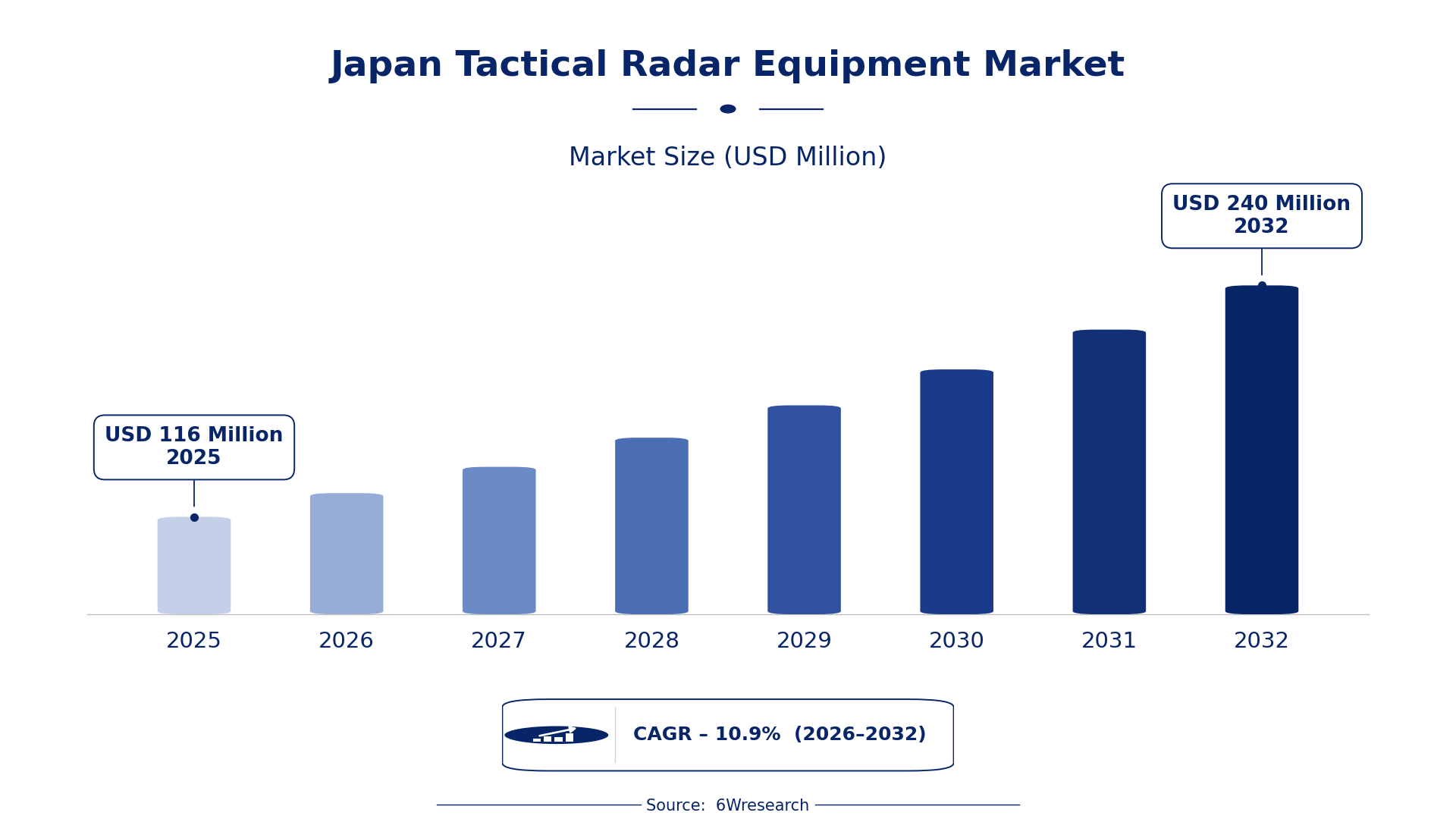
According to 6Wresearch internal database and industry insights, the Japan Tactical Radar Equipment Market was valued at USD 116 Million in 2025 and is projected to reach USD 240 Million by 2032, growing at a CAGR of approximately 10.9% during 2026–2032.
Japan Tactical Radar Equipment Market Highlights
| Report Metric | Details |
| Report Name | Japan Tactical Radar Equipment Market (2026-2032) |
| Market Size 2025 | USD 116 Million |
| Market Size 2032 | USD 240 Million |
| Absolute Growth 2025–2032 | USD 124 Million |
| CAGR 2026–2032 | 10.9% |
| Peak Annual Growth | 12.6% in 2026 |
| Forecast Period | 2026–2032 |
| Historical Data | 2022–2025 |
| Base Year | 2025 |
| Leading Radar Configuration, 2025 | Mobile Tactical Radar (44% share) |
| Leading Band Type, 2025 | C/X Band (37% share) |
| Leading Deployment Format, 2025 | Vehicle-Mounted (39% share) |
| Leading End User, 2025 | Field Troops (48% share) |
| Fastest-Growing Radar Configuration | Portable Radar Systems (14.4% CAGR) |
| Fastest-Growing Band Type | L/S Band (14.8% CAGR) |
| Fastest-Growing End User | Reconnaissance Teams (13.6% CAGR) |
| Growing Sector | military surveillance |
| Key End Users | military forces, emergency response teams, defense contractors, government agencies |
Japan Tactical Radar Equipment Market Year-wise Growth Rate and Key Drivers (2022–2032)
This graph illustrates the annual growth rates of the market from 2022 to 2032, highlighting a steady upward trajectory and projected market expansion over the forecast period.
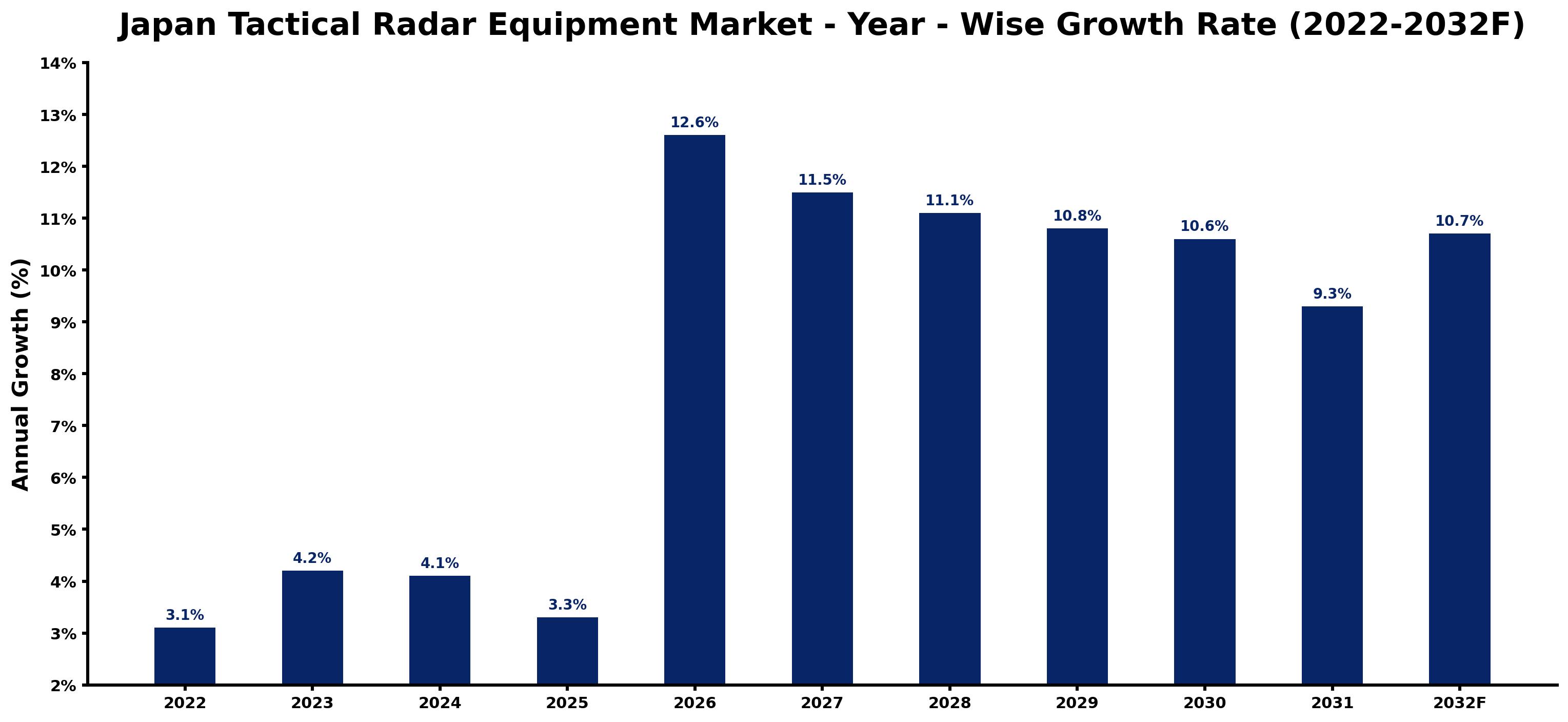
Each row of the following table gives one year's estimated growth and the event or demand shift that explains it.
| Year | Estimated Annual Growth (%) | Market Rationale |
| 2022 | 3.1 | The market exhibited steady growth due to ongoing modernization efforts in the defense sector. |
| 2023 | 4.2 | Demand increased as the Ministry of Defense allocated ¥1.2 trillion for radar technology advancements. |
| 2024 | 4.1 | Growth slowed slightly due to a temporary pause in procurement cycles for military equipment. |
| 2025 | 3.3 | Market expansion continued but at a reduced rate amid budgetary constraints impacting procurement. |
| 2026 | 12.6 | A surge in demand is expected following the introduction of new military programmes and exercises. |
| 2027 | 11.5 | Growth is projected to decelerate as the market adjusts to increased production capacities and competition. |
| 2028 | 11.1 | Continued demand for advanced systems will contribute to a slower growth rate in the coming years. |
| 2029 | 10.8 | The market is expected to maintain growth as military exercises highlight the need for upgrades and modernization. |
| 2030 | 10.6 | Demand will remain steady, supported by ongoing investments in defense technology and system upgrades. |
| 2031 | 9.3 | Growth is projected to slow as procurement processes become more stringent and competitive in nature. |
| 2032 | 10.7 | A resurgence in demand is anticipated due to new technological advancements and increased military funding. |
Note: Market size estimations and growth projections presented in this report are based on 6Wresearch's proprietary forecasting methodology, utilizing the latest available industry data, government publications, and primary research inputs.
Japan Tactical Radar Equipment Market Synopsis
Tactical radar equipment encompasses advanced systems tailored for military surveillance and target acquisition, employing sophisticated electronic components for airspace monitoring and battlefield management. The Japan Tactical Radar Equipment Market is expanding, propelled by the Self-Defense Forces' utilisation of over 200 systems and a ¥1.2 trillion budget allocation for defence technology advancements in 2023. Increased investments in radar technology and modernisation efforts, including the deployment of 3D Surveillance Radar in urban areas for airspace security, are key contributors to this growth.
Market Dynamics Impact Analysis (2026–2032)
| Factor | Type | Impact | Primary Segment Affected |
| Increased military expenditure | Driver | High | Mobile Tactical Radar |
| Technological advancements in radar systems | Driver | High | 3D Surveillance Radar |
| Growing demand for disaster response capabilities | Opportunity | High | Portable Radar Systems |
| Expansion of military exercises and training | Opportunity | Medium | Stationary Ground Radar |
| Budgetary constraints affecting procurement | Restraint | High | Vehicle-Mounted |
| Compliance with international standards | Restraint | Medium | C/X Band |
| High costs of advanced radar systems | Challenge | High | Fixed Emplacement |
| Limited local manufacturing capacity | Challenge | Medium | All-Domain Monitoring |
Evaluation of Drivers in Japan Tactical Radar Equipment Market (2026–2032)
Demand rests on the following drivers, each shown with the segment it touches most.
| Drivers | Primary Segment Affected | Why It Matters (Evidence) |
| Increased military expenditure | Mobile Tactical Radar | Japan's defense budget for 2023 includes ¥300 billion for radar upgrades, leading to higher procurement of mobile systems. |
| Technological advancements in radar systems | 3D Surveillance Radar | The deployment of 3D Surveillance Radar in urban areas improves airspace security, driving demand for advanced systems. |
| Growing demand for disaster response capabilities | Portable Radar Systems | The increased use of Portable Radar Systems in disaster response operations reflects a growing need for flexible surveillance solutions. |
| Expansion of military exercises and training | Stationary Ground Radar | Joint exercises conducted by the Self-Defense Forces in 2023 highlighted the need for enhanced stationary radar capabilities. |
| Rising operational efficiency among field troops | Field Troops | Field Troops reported a 30% increase in operational efficiency due to the integration of new systems. |
A wider customer base explains much of the growth, as Japan's defense budget for 2023 includes ¥300 billion for radar system upgrades. The need for improved airspace security drives procurement, particularly with the deployment of advanced systems in urban areas. Recent military exercises underscored the requirement for enhanced capabilities, prompting increased investments. Reports indicate that operational efficiency among field troops increased by 30% due to the integration of new technologies, further boosting demand for tactical radar solutions.
Evaluation of Restraints in Japan Tactical Radar Equipment Market
These are the pressures that could keep growth below its potential.
| Market Restraint | Primary Segment Affected | Why It Matters (Evidence) |
| Budgetary constraints affecting procurement | Vehicle-Mounted | Budget limitations have slowed the procurement of vehicle-mounted systems, impacting operational readiness and capability. |
| Compliance with international standards | C/X Band | Adhering to ISO 9001 standards increases production costs for C/X Band radar systems, affecting pricing strategies. |
| High costs of advanced radar systems | Fixed Emplacement | The high costs associated with advanced fixed emplacement systems limit their acquisition by smaller units or agencies. |
| Limited local manufacturing capacity | All-Domain Monitoring | The lack of local manufacturing capabilities delays the deployment of all-domain monitoring systems, affecting readiness. |
| Fluctuations in government funding | Stationary Ground Radar | Variability in government funding can disrupt procurement schedules for stationary ground radar systems, causing delays. |
Japan Tactical Radar Equipment Market Challenges
Importers struggle with fierce competition from foreign manufacturers, which forces them to reduce prices and leads to a 15% decline in profit margins. Producers encounter skills shortages in radar technology, limiting their ability to innovate and delaying project timelines for military clients by up to six months. Buyers face challenges with outdated systems, as many existing tactical radar units do not meet current operational requirements, potentially reducing mission effectiveness by 30%. Supply chain disruptions hinder the availability of essential components, causing procurement delays for the Self-Defense Forces and negatively impacting their operational readiness.
Trends in the Japan Tactical Radar Equipment Market
Four trends stand out in the Japan Tactical Radar Equipment Market.
- Shift from Stationary to Mobile Systems: The military is increasingly prioritising mobile radar systems, evidenced by a 44% market share for Mobile Tactical Radar in 2025. This shift allows for greater flexibility in deployment and operational efficiency.
- Rising Adoption of 3D Surveillance Technology: The deployment of 3D Surveillance Radar in urban areas has led to improved airspace security, with investments reflecting a growing trend towards advanced surveillance capabilities, particularly in metropolitan regions.
- Increased Use of Portable Radar in Disaster Response: Portable Radar Systems are now vital in disaster response, with a notable increase in their deployment during emergencies, highlighting their versatility and effectiveness in various terrains.
- Expansion of Joint Military Exercises: Joint military exercises conducted by the Self-Defense Forces in 2023 have led to increased demand for advanced radar systems, showcasing the importance of real-time surveillance capabilities in training scenarios.
Investment Opportunities in the Japan Tactical Radar Equipment Market
The following opportunities in the Japan Tactical Radar Equipment Market pair current demand with a clear way in.
- Investment in Mobile Tactical Radar Facilities: The Tokyo region is experiencing growth in mobile tactical radar facilities, with a projected increase of 14.9% in this segment. Collaborating with local defense contractors can facilitate market entry and expansion.
- Growing Need for Disaster Response Equipment: With a 30% increase in operational efficiency reported by Field Troops, there is a pressing need for portable radar systems. Targeting local emergency response teams can yield fruitful partnerships and contracts.
- Expansion of Surveillance Technology in Urban Areas: Urban areas like Tokyo are prioritising advanced surveillance technology, with a notable investment gap in portable systems. Engaging with municipal authorities can open new avenues for supply and collaboration.
- Development of Advanced Fixed Emplacement Systems: The demand for fixed emplacement systems is rising, particularly in strategic locations. Suppliers can enter this market by establishing partnerships with military procurement agencies to meet emerging needs.
Government Initiatives in the Japan Tactical Radar Equipment Market
The Industrial Safety and Health Act mandates that producers of tactical radar equipment adhere to stringent safety standards, ensuring that hazardous substances are managed effectively. Compliance with this law is essential for manufacturers to maintain operational licenses and avoid penalties. The Act also promotes a safer working environment, which is necessary for the production of complex radar systems, with significant implications for operational efficiency.
Regulations encourage energy-efficient practices in radar system operations, requiring large energy users to report energy consumption. This enables military units to optimise their operational costs while ensuring compliance with energy standards, ultimately benefiting the Self-Defense Forces and their procurement strategies.
Future Insight of the Japan Tactical Radar Equipment Market
Advancements in portable radar systems for disaster response will transform demand by 2032, improving operational flexibility for emergency services. The Ministry of Defense's budget of ¥1.2 trillion for defence technology advancements will drive substantial improvements in system capabilities. Collaborations with the Japan Aerospace Exploration Agency will facilitate the development of cutting-edge radar technologies. Consequently, buyers will experience increased operational efficiency, while suppliers will need to adjust to the higher quality standards established by evolving military requirements.
Market Segmentation Analysis
Japan Tactical Radar Equipment Market report covers a detailed analysis of the following market segments:
By Radar Configuration – Mobile Tactical Radar Leads, Portable Radar Systems Expected to Grow Fastest
According to Saurav Kr Singh, Senior Research Analyst at 6Wresearch, Mobile Tactical Radar accounted for 44% of the market by radar configuration in 2025. Mobile Tactical Radar holds the largest market share due to its essential role in real-time battlefield surveillance, which is crucial for mission success. The Ground Self-Defense Force extensively employs these systems, ensuring their dominance in military operations. The quickest growth will come from Portable Radar Systems, forecast to expand at a CAGR of 14.4% between 2026 and 2032. The rapid uptake of Portable Radar Systems is driven by their adaptability for flexible deployment in various terrains, particularly during disaster response operations. This trend is further supported by significant investments in surveillance technology in the Tokyo region. Suppliers should focus on enhancing the versatility of portable systems to meet the increasing demand in diverse operational scenarios.
By Band Type – C/X Band Leads, L/S Band Expected to Grow Fastest
C/X Band held 37% of the Japan Tactical Radar Equipment Market by band type in 2025. C/X Band leads the market because it is widely used for medium-range detection, making it suitable for various military applications. Its established presence in Japan's air defense systems reinforces its leading position. L/S Band is projected to grow fastest, at a CAGR of 14.8% during 2026–2032. The L/S Band is experiencing rapid growth due to its effectiveness in long-range surveillance, which is becoming increasingly vital for national security. The Ministry of Defense's emphasis on modernising radar capabilities supports this upward trend. Buyers will benefit from investing in L/S Band technology to enhance their long-range operational capabilities.
By Deployment Format – Vehicle-Mounted Leads and Records the Fastest Growth
In 2025, Vehicle-Mounted led the deployment format split with a 39% share. Vehicle-Mounted systems dominate the market as they are integrated into military vehicles, providing essential mobility for tactical operations. This format is crucial for the Ground Self-Defense Force, which relies on quick deployment in dynamic environments. Vehicle-Mounted is also forecast to expand faster than any other category, at a CAGR of 14.9% over 2026–2032. Vehicle-Mounted systems also represent the fastest-growing segment, as their mobility remains a key advantage in modern warfare. Ongoing upgrades in military vehicle capabilities will further reinforce this growth. Suppliers must ensure that vehicle-mounted solutions are adaptable to evolving military vehicle technologies to maintain competitiveness.
By End User – Field Troops Lead, Reconnaissance Teams Expected to Grow Fastest
Field Troops took 48% of end user revenue in 2025, more than any other category. Field Troops are the primary users of tactical radar equipment in combat scenarios, solidifying their leading share in the market. Their direct involvement in operations necessitates reliable and efficient radar systems for situational awareness. Reconnaissance Teams are set to record the highest CAGR in this split, 13.6% over 2026–2032. Reconnaissance Teams are the fastest-growing segment, as their intelligence gathering missions increasingly rely on advanced radar technologies for remote operations. This trend underscores the need for enhanced capabilities in reconnaissance equipment. Suppliers should prioritise the development of advanced radar systems tailored for reconnaissance applications to capture this growing market segment.
Key Attractiveness of the Report
- 10 Years of Market Numbers
- Historical Data Starting from 2022 to 2025
- Base Year 2025
- Forecast Data until 2032
- Key Performance Indicators Impacting the Market
- Major Upcoming Developments and Projects
Key Highlights of the Report:
- Japan Tactical Radar Equipment Market Outlook
- Market Size of Japan Tactical Radar Equipment Market, 2025
- Forecast of Japan Tactical Radar Equipment Market, 2032
- Historical Data and Forecast of Japan Tactical Radar Equipment Revenues & Volume for the Period 2022-2032F
- Japan Tactical Radar Equipment Market Trend Evolution
- Japan Tactical Radar Equipment Market Drivers and Challenges
- Japan Tactical Radar Equipment Price Trends
- Japan Tactical Radar Equipment Porter's Five Forces
- Japan Tactical Radar Equipment Industry Life Cycle
- Historical Data and Forecast of Japan Tactical Radar Equipment Market Revenues & Volume By Radar Configuration for the Period 2022-2032F
- Historical Data and Forecast of Japan Tactical Radar Equipment Market Revenues & Volume By Mobile Tactical Radar for the Period 2022-2032F
- Historical Data and Forecast of Japan Tactical Radar Equipment Market Revenues & Volume By Stationary Ground Radar for the Period 2022-2032F
- Historical Data and Forecast of Japan Tactical Radar Equipment Market Revenues & Volume By 3D Surveillance Radar for the Period 2022-2032F
- Historical Data and Forecast of Japan Tactical Radar Equipment Market Revenues & Volume By Portable Radar Systems for the Period 2022-2032F
- Historical Data and Forecast of Japan Tactical Radar Equipment Market Revenues & Volume By Band Type for the Period 2022-2032F
- Historical Data and Forecast of Japan Tactical Radar Equipment Market Revenues & Volume By C/X Band for the Period 2022-2032F
- Historical Data and Forecast of Japan Tactical Radar Equipment Market Revenues & Volume By L/S Band for the Period 2022-2032F
- Historical Data and Forecast of Japan Tactical Radar Equipment Market Revenues & Volume By Multi-Axis Array for the Period 2022-2032F
- Historical Data and Forecast of Japan Tactical Radar Equipment Market Revenues & Volume By Man-Deployable for the Period 2022-2032F
- Historical Data and Forecast of Japan Tactical Radar Equipment Market Revenues & Volume By Deployment Format for the Period 2022-2032F
- Historical Data and Forecast of Japan Tactical Radar Equipment Market Revenues & Volume By Vehicle-Mounted for the Period 2022-2032F
- Historical Data and Forecast of Japan Tactical Radar Equipment Market Revenues & Volume By Fixed Emplacement for the Period 2022-2032F
- Historical Data and Forecast of Japan Tactical Radar Equipment Market Revenues & Volume By All-Domain Monitoring for the Period 2022-2032F
- Historical Data and Forecast of Japan Tactical Radar Equipment Market Revenues & Volume By Short-Range Situational Use for the Period 2022-2032F
- Historical Data and Forecast of Japan Tactical Radar Equipment Market Revenues & Volume By End User for the Period 2022-2032F
- Historical Data and Forecast of Japan Tactical Radar Equipment Market Revenues & Volume By Field Troops for the Period 2022-2032F
- Historical Data and Forecast of Japan Tactical Radar Equipment Market Revenues & Volume By Base Perimeter Units for the Period 2022-2032F
- Historical Data and Forecast of Japan Tactical Radar Equipment Market Revenues & Volume By Air Defense Operators for the Period 2022-2032F
- Historical Data and Forecast of Japan Tactical Radar Equipment Market Revenues & Volume By Reconnaissance Teams for the Period 2022-2032F
- Japan Tactical Radar Equipment Import Export Trade Statistics
- Market Opportunity Assessment By Radar Configuration
- Market Opportunity Assessment By Band Type
- Market Opportunity Assessment By Deployment Format
- Market Opportunity Assessment By End User
- Japan Tactical Radar Equipment Top Companies Market Share
- Japan Tactical Radar Equipment Competitive Benchmarking By Technical and Operational Parameters
- Japan Tactical Radar Equipment Company Profiles
- Japan Tactical Radar Equipment Key Strategic Recommendations
Market Covered
This report examines the market across the segments below.
By Radar Configuration
- Mobile Tactical Radar
- Stationary Ground Radar
- 3D Surveillance Radar
- Portable Radar Systems
By Band Type
- C/X Band
- L/S Band
- Multi-Axis Array
- Man-Deployable
By Deployment Format
- Vehicle-Mounted
- Fixed Emplacement
- All-Domain Monitoring
- Short-Range Situational Use
By End User
- Field Troops
- Base Perimeter Units
- Air Defense Operators
- Reconnaissance Teams































