Japan Tactical Reconnaissance Radar Market Size & Growth Rate
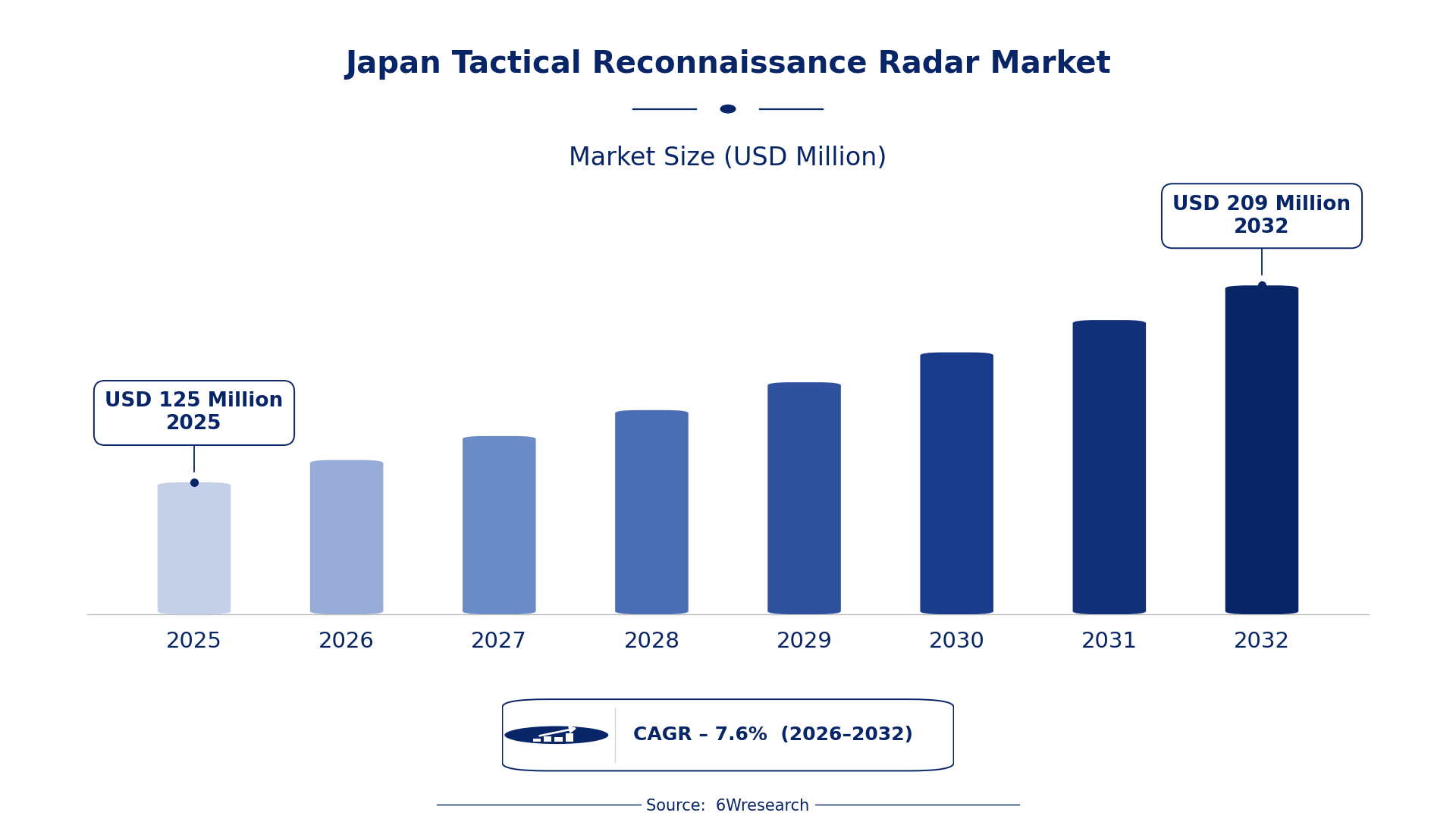
According to 6Wresearch internal database and industry insights, the Japan Tactical Reconnaissance Radar Market was valued at USD 125 Million in 2025 and is projected to reach USD 209 Million by 2032, growing at a CAGR of approximately 7.6% during 2026–2032.
Japan Tactical Reconnaissance Radar Market Highlights
| Report Metric | Details |
| Report Name | Japan Tactical Reconnaissance Radar Market (2026-2032) |
| Market Size 2025 | USD 125 Million |
| Market Size 2032 | USD 209 Million |
| Absolute Growth 2025–2032 | USD 84 Million |
| CAGR 2026–2032 | 7.6% |
| Peak Annual Growth | 8.9% in 2032 |
| Forecast Period | 2026–2032 |
| Historical Data | 2022–2025 |
| Base Year | 2025 |
| Leading Tactical Reconnaissance Radar, 2025 | Ground Surveillance Radar (44% share) |
| Leading Product Type, 2025 | Fixed Radar (35% share) |
| Leading Technology, 2025 | AESA (46% share) |
| Leading Distribution Channel, 2025 | Government Contracts (40% share) |
| Leading End User Industry, 2025 | Air Force Units (47% share) |
| Fastest-Growing Tactical Reconnaissance Radar | UAV Reconnaissance Radar (10.0% CAGR) |
| Fastest-Growing Product Type | Compact Radar (10.7% CAGR) |
| Fastest-Growing Technology | Synthetic Aperture (11.0% CAGR) |
| Fastest-Growing Distribution Channel | Defense Suppliers (9.7% CAGR) |
| Fastest-Growing End User Industry | Drone Operators (9.9% CAGR) |
| Growing Sector | Drone Operators |
| Key End Users | Air Force Units, Naval Forces, Border Security Forces, Drone Operators |
Japan Tactical Reconnaissance Radar Market Year-wise Growth Rate and Key Drivers (2022–2032)
This graph illustrates the annual growth rates of the market from 2022 to 2032, highlighting a steady upward trajectory and projected market expansion over the forecast period.
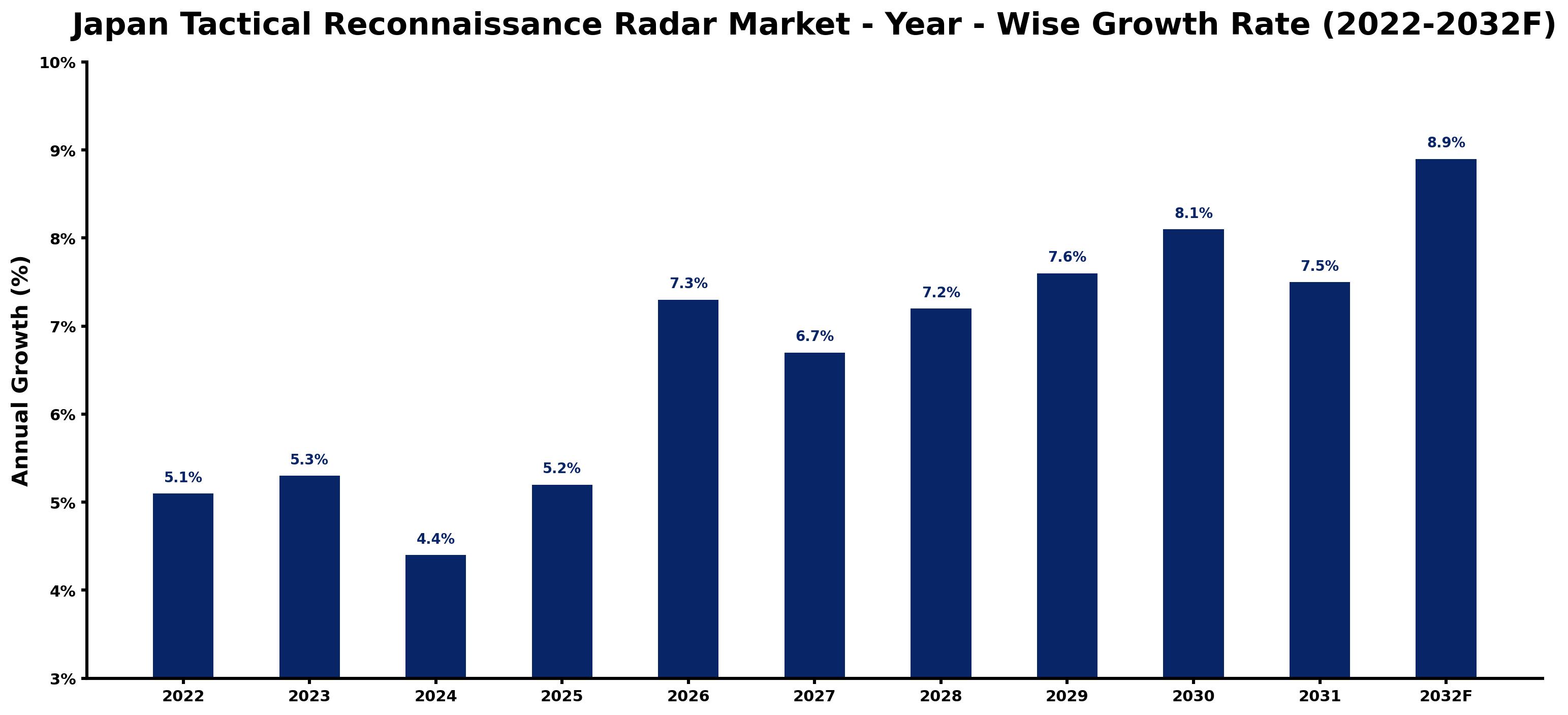
For each year, the table pairs the estimated growth rate with the leading influence on demand, showing how the drivers changed across the period.
| Year | Estimated Annual Growth (%) | Market Rationale |
| 2022 | 5.1 | The market showed solid growth due to increased defence spending. |
| 2023 | 5.3 | Demand rose as the Ministry of Defense allocated a larger budget for upgrades. |
| 2024 | 4.4 | Growth slowed as procurement processes faced delays and adjustments. |
| 2025 | 5.2 | The market rebounded with renewed contracts for tactical reconnaissance systems. |
| 2026 | 7.3 | Investment in advanced radar technology is expected to boost market expansion. |
| 2027 | 6.7 | Growth is projected to slow as suppliers face challenges in meeting rising demand. |
| 2028 | 7.2 | Demand will increase with new military exercises focusing on UAV capabilities. |
| 2029 | 7.6 | The market is expected to continue expanding as technological advancements gain traction. |
| 2030 | 8.1 | Growth will remain strong as new radar systems are integrated into operations. |
| 2031 | 7.5 | A slight slowdown is projected as the market adjusts to new procurement cycles. |
| 2032 | 8.9 | Demand is expected to surge with the introduction of next-generation radar technologies. |
Note: Market size estimations and growth projections presented in this report are based on 6Wresearch's proprietary forecasting methodology, utilizing the latest available industry data, government publications, and primary research inputs.
Japan Tactical Reconnaissance Radar Market Synopsis
Tactical reconnaissance radar is a sophisticated technology used for surveillance and reconnaissance, essential for monitoring borders, airspace, and naval operations. The Japan Tactical Reconnaissance Radar Market is expanding due to increased defence spending, with a budget of ¥5 trillion allocated for 2023. Key buyers include the Japan Self-Defense Forces, which drive demand for advanced systems, particularly in airborne and naval applications. The focus on improving reconnaissance capabilities is supported by ongoing military exercises and collaboration among defense suppliers, indicating strong growth in the coming years.
Market Dynamics Impact Analysis (2026–2032)
| Factor | Type | Impact | Primary Segment Affected |
| Increased defence budget allocations | Driver | High | Ground Surveillance Radar |
| Growing demand for UAV reconnaissance capabilities | Driver | High | UAV Reconnaissance Radar |
| Expansion of military exercises focusing on advanced technologies | Opportunity | High | Airborne Recon Radar |
| Investment in next-generation radar systems | Opportunity | Medium | Ground Surveillance Radar |
| Delays in procurement processes | Restraint | High | Naval Recon Radar |
| Challenges in integrating new technologies | Restraint | Medium | Fixed Radar |
| High costs associated with advanced radar systems | Challenge | High | Ground Surveillance Radar |
| Competition from international suppliers | Challenge | Medium | UAV Reconnaissance Radar |
Evaluation of Drivers in Japan Tactical Reconnaissance Radar Market (2026–2032)
The following drivers explain most of the expected growth.
| Drivers | Primary Segment Affected | Why It Matters (Evidence) |
| Increased defence spending | Ground Surveillance Radar | The Ministry of Defense allocated ¥5 trillion for 2023, driving procurement of advanced systems. |
| Growing focus on UAV capabilities | UAV Reconnaissance Radar | Joint military exercises in 2023 increased demand for UAV systems, boosting procurement. |
| Emphasis on advanced surveillance technologies | Airborne Recon Radar | The Acquisition, Technology & Logistics Agency promotes advanced reconnaissance, boosting radar purchases. |
| Investment in radar technology upgrades | Naval Recon Radar | The Japan Maritime Self-Defense Force is enhancing its radar systems for maritime operations. |
| Collaboration among defense suppliers | Ground Surveillance Radar | The Japan Defense Industry Association promotes partnerships, increasing local production capacity. |
Volumes grow on the back of increased defence spending, with ¥5 trillion allocated for 2023, leading to heightened procurement of tactical reconnaissance systems. The focus on UAV capabilities is clear, as joint military exercises in 2023 boosted demand for UAV reconnaissance systems. Investment in radar technology upgrades is also significant, with enhancements in naval systems expected to improve operational efficiency. Partnerships among defense suppliers are increasing local production capacity, further driving market growth. The emphasis on advanced surveillance technologies is reshaping procurement strategies across military branches.
Evaluation of Restraints in Japan Tactical Reconnaissance Radar Market
These restraints slow adoption and weigh on supplier margins.
| Market Restraint | Primary Segment Affected | Why It Matters (Evidence) |
| Delays in procurement processes | Naval Recon Radar | Procurement delays hinder timely upgrades, affecting operational readiness for naval forces. |
| Integration challenges of new technologies | Fixed Radar | Difficulties in integrating advanced technologies lead to project delays. |
| High costs of advanced radar systems | Ground Surveillance Radar | The high investment required restricts procurement capabilities for smaller defence suppliers. |
| Limited domestic production capacity | UAV Reconnaissance Radar | A reliance on foreign technology restricts the growth of local UAV radar production. |
| Regulatory hurdles in defence procurement | Ground Surveillance Radar | Complex regulations slow down the approval process for new radar systems. |
Japan Tactical Reconnaissance Radar Market Challenges
Japan's emphasis on sophisticated radar technology creates immediate costs for buyers as they face system upgrade requirements. Existing radar systems often need extensive modifications, delaying procurement processes by up to four months, which hinders military readiness. Limited domestic production capabilities result in supply chain disruptions, forcing buyers to consider foreign alternatives that can take an additional six months to arrive. Compliance with ISO standards raises costs for suppliers, increasing the overall price of tactical reconnaissance radar systems by around 15% for government contracts.
Trends in the Japan Tactical Reconnaissance Radar Market
The following changes are redrawing the Japan Tactical Reconnaissance Radar Market.
- Shift towards UAV Integration in Reconnaissance: The focus on UAV reconnaissance capabilities has intensified, particularly after joint military exercises in 2023. Demand for UAV reconnaissance radar is projected to grow by 10% annually as military strategies evolve.
- Transition from Fixed to Mobile Radar Systems: Japan is moving towards mobile radar systems to enhance operational flexibility. The Ministry of Defense's investment in mobile platforms has increased, reflecting a shift in operational strategy, with a projected 15% rise in mobile deployments.
- Emergence of Synthetic Aperture Technology: Synthetic Aperture Radar technology is gaining traction, particularly in airborne applications. The Japan Air Self-Defense Force is adopting this technology to improve image resolution for reconnaissance, with a 20% increase in its usage expected by 2025.
- Prioritisation of Advanced Surveillance Technologies: The government's focus on advanced surveillance technologies is driving the adoption of next-generation radar systems. This emphasis is expected to increase investments across military branches, with funding projected to rise by 25% by 2025.
Investment Opportunities in the Japan Tactical Reconnaissance Radar Market
Where to invest in the Japan Tactical Reconnaissance Radar Market: the main openings are set out below.
- Partnership with Local Suppliers: With a projected market size of USD 209 million by 2032, there is a significant opportunity to partner with local defense suppliers to enhance radar system production capabilities.
- Investment in Mobile Radar Systems: The shift towards mobile radar systems presents an opportunity to supply advanced mobile platforms, particularly in the Tokyo Metropolitan area, where demand is rising.
- Development of Synthetic Aperture Technology: Investing in Synthetic Aperture Radar technology is crucial, as the Japan Air Self-Defense Force aims to enhance reconnaissance capabilities, with a 20% increase in adoption expected.
- Focus on UAV Reconnaissance Systems: The growing emphasis on UAV capabilities offers opportunities for suppliers to develop advanced UAV reconnaissance radar systems, especially following the 2023 military exercises.
Government Initiatives in the Japan Tactical Reconnaissance Radar Market
The Industrial Standardization Act governs product and test standards for defense technologies, ensuring compliance with quality and safety measures. This law, amended in 2019, lays the foundation for the rigorous standards that tactical reconnaissance radar systems must meet, impacting producers and suppliers in the market.
The Acquisition, Technology & Logistics Agency oversees the procurement of defense systems, approving funding for advanced radar technologies. This agency's role is crucial in facilitating the timely acquisition of tactical reconnaissance radar systems, ensuring that the Japan Self-Defense Forces have access to cutting-edge technology.
Future Insight of the Japan Tactical Reconnaissance Radar Market
Advancements in radar technology will reshape demand for tactical reconnaissance systems by 2032, starting with the integration of next-generation capabilities. The Ministry of Defense's budget for 2023 will facilitate upgrades and new acquisitions, with funding expected to exceed ¥5 trillion. Collaborative efforts between defence manufacturers and the Japan Aerospace Exploration Agency will yield innovative surveillance solutions. Enhanced border security initiatives will drive the need for more advanced reconnaissance technologies, ensuring a robust market for suppliers.
Market Segmentation Analysis
Japan Tactical Reconnaissance Radar Market report covers a detailed analysis of the following market segments:
By Tactical Reconnaissance Radar – Ground Surveillance Radar Leads, UAV Reconnaissance Radar Expected to Grow Fastest
According to Saurav Kr Singh, Senior Research Analyst at 6Wresearch, the largest tactical reconnaissance radar category in 2025 was Ground Surveillance Radar, at 44% of revenue. Ground surveillance radar holds the largest share due to its essential function in monitoring land areas and detecting intrusions, particularly for the Japan Ground Self-Defense Force. The ongoing demand for effective land monitoring is reinforced by substantial government contracts allocated for these systems. Over 2026–2032, UAV Reconnaissance Radar is expected to post the fastest growth, at a CAGR of 10.0%. UAV reconnaissance radar is experiencing rapid growth as it becomes increasingly integrated into drones for real-time reconnaissance. The rising demand from drone operators seeking enhanced surveillance capabilities is a key factor driving this sub-segment's expansion. Suppliers should focus on developing advanced UAV reconnaissance solutions to meet the growing demand from drone operators.
By Product Type – Fixed Radar Leads, Compact Radar Expected to Grow Fastest
Fixed Radar held 35% of the Japan Tactical Reconnaissance Radar Market by product type in 2025. Fixed radar leads the product type segment as it provides stationary installations for continuous monitoring, which is crucial for the Japan Self-Defense Forces. Its reliability and effectiveness in surveillance applications make it a preferred choice for military operations. Compact Radar is projected to grow fastest, at a CAGR of 10.7% during 2026–2032. Compact radar is gaining traction due to its specific applications in limited scopes, appealing to niche markets within the defense sector. This growth is propelled by the need for versatile and portable radar solutions in various operational contexts. Buyers may benefit from exploring compact radar options to enhance operational flexibility in reconnaissance missions.
By Technology – AESA Leads, Synthetic Aperture Expected to Grow Fastest
AESA took 46% of technology revenue in 2025, more than any other category. AESA technology commands the largest share as it offers advanced capabilities for improved tracking, making it essential for modern military operations. Its adoption by the Japan Air Force highlights its critical role in tactical reconnaissance. The quickest growth will come from Synthetic Aperture, forecast to expand at a CAGR of 11.0% between 2026 and 2032. Synthetic aperture technology is advancing rapidly as it significantly enhances image resolution for reconnaissance, addressing the demands for clearer and more detailed surveillance data. This trend is supported by ongoing investments in radar system upgrades by the Ministry of Defense. Suppliers should prioritise the development of synthetic aperture technology to align with the increasing demand for high-resolution reconnaissance capabilities.
By Distribution Channel – Government Contracts Lead, Defense Suppliers Expected to Grow Fastest
Government Contracts accounted for 40% of the market by distribution channel in 2025. Government contracts serve as the primary distribution channel, facilitating the procurement of military equipment vital for national defense. The substantial budget allocations from the Japan Ministry of Defense underscore the importance of this channel in the tactical reconnaissance radar market. Defense Suppliers are set to record the highest CAGR in this split, 9.7% over 2026–2032. Defense suppliers are experiencing rapid growth as they provide essential components and systems, reflecting the increasing complexity of military requirements. Their role is crucial as the demand for integrated solutions rises within the defense sector. Suppliers should strengthen partnerships with defense suppliers to enhance their market presence and meet evolving procurement needs.
By End User Industry – Air Force Units Lead, Drone Operators Expected to Grow Fastest
With 47% of end user industry revenue in 2025, Air Force Units was the largest category. Air Force units represent the largest end user industry as they are key operators of airborne reconnaissance systems, relying heavily on tactical reconnaissance radar for operational success. Their strategic importance is underscored by ongoing military exercises and upgrades in radar capabilities. Over 2026–2032, Drone Operators are expected to post the fastest growth, at a CAGR of 9.9%. Drone operators are the fastest-growing end user industry, utilising UAVs equipped with reconnaissance radar to enhance surveillance operations. The increasing reliance on drones for military and security purposes is driving this rapid growth. Suppliers should target drone operators to capitalise on the expanding market for UAV reconnaissance solutions.
Key Attractiveness of the Report
- 10 Years of Market Numbers
- Historical Data Starting from 2022 to 2025
- Base Year 2025
- Forecast Data until 2032
- Key Performance Indicators Impacting the Market
- Major Upcoming Developments and Projects
Key Highlights of the Report:
- Japan Tactical Reconnaissance Radar Market Outlook
- Market Size of Japan Tactical Reconnaissance Radar Market, 2025
- Forecast of Japan Tactical Reconnaissance Radar Market, 2032
- Historical Data and Forecast of Japan Tactical Reconnaissance Radar Revenues & Volume for the Period 2022-2032F
- Japan Tactical Reconnaissance Radar Market Trend Evolution
- Japan Tactical Reconnaissance Radar Market Drivers and Challenges
- Japan Tactical Reconnaissance Radar Price Trends
- Japan Tactical Reconnaissance Radar Porter's Five Forces
- Japan Tactical Reconnaissance Radar Industry Life Cycle
- Historical Data and Forecast of Japan Tactical Reconnaissance Radar Market Revenues & Volume By Tactical Reconnaissance Radar for the Period 2022-2032F
- Historical Data and Forecast of Japan Tactical Reconnaissance Radar Market Revenues & Volume By Ground Surveillance Radar for the Period 2022-2032F
- Historical Data and Forecast of Japan Tactical Reconnaissance Radar Market Revenues & Volume By Airborne Recon Radar for the Period 2022-2032F
- Historical Data and Forecast of Japan Tactical Reconnaissance Radar Market Revenues & Volume By UAV Reconnaissance Radar for the Period 2022-2032F
- Historical Data and Forecast of Japan Tactical Reconnaissance Radar Market Revenues & Volume By Naval Recon Radar for the Period 2022-2032F
- Historical Data and Forecast of Japan Tactical Reconnaissance Radar Market Revenues & Volume By Product Type for the Period 2022-2032F
- Historical Data and Forecast of Japan Tactical Reconnaissance Radar Market Revenues & Volume By Fixed Radar for the Period 2022-2032F
- Historical Data and Forecast of Japan Tactical Reconnaissance Radar Market Revenues & Volume By Pod-Mounted Radar for the Period 2022-2032F
- Historical Data and Forecast of Japan Tactical Reconnaissance Radar Market Revenues & Volume By Compact Radar for the Period 2022-2032F
- Historical Data and Forecast of Japan Tactical Reconnaissance Radar Market Revenues & Volume By Shipboard Radar for the Period 2022-2032F
- Historical Data and Forecast of Japan Tactical Reconnaissance Radar Market Revenues & Volume By Technology for the Period 2022-2032F
- Historical Data and Forecast of Japan Tactical Reconnaissance Radar Market Revenues & Volume By AESA for the Period 2022-2032F
- Historical Data and Forecast of Japan Tactical Reconnaissance Radar Market Revenues & Volume By Synthetic Aperture for the Period 2022-2032F
- Historical Data and Forecast of Japan Tactical Reconnaissance Radar Market Revenues & Volume By LPI Radar for the Period 2022-2032F
- Historical Data and Forecast of Japan Tactical Reconnaissance Radar Market Revenues & Volume By X-Band for the Period 2022-2032F
- Historical Data and Forecast of Japan Tactical Reconnaissance Radar Market Revenues & Volume By Distribution Channel for the Period 2022-2032F
- Historical Data and Forecast of Japan Tactical Reconnaissance Radar Market Revenues & Volume By Government Contracts for the Period 2022-2032F
- Historical Data and Forecast of Japan Tactical Reconnaissance Radar Market Revenues & Volume By Defense Suppliers for the Period 2022-2032F
- Historical Data and Forecast of Japan Tactical Reconnaissance Radar Market Revenues & Volume By OEMs for the Period 2022-2032F
- Historical Data and Forecast of Japan Tactical Reconnaissance Radar Market Revenues & Volume By Direct Sales for the Period 2022-2032F
- Historical Data and Forecast of Japan Tactical Reconnaissance Radar Market Revenues & Volume By End User Industry for the Period 2022-2032F
- Historical Data and Forecast of Japan Tactical Reconnaissance Radar Market Revenues & Volume By Border Security Forces for the Period 2022-2032F
- Historical Data and Forecast of Japan Tactical Reconnaissance Radar Market Revenues & Volume By Air Force Units for the Period 2022-2032F
- Historical Data and Forecast of Japan Tactical Reconnaissance Radar Market Revenues & Volume By Drone Operators for the Period 2022-2032F
- Historical Data and Forecast of Japan Tactical Reconnaissance Radar Market Revenues & Volume By Naval Forces for the Period 2022-2032F
- Japan Tactical Reconnaissance Radar Import Export Trade Statistics
- Market Opportunity Assessment By Tactical Reconnaissance Radar
- Market Opportunity Assessment By Product Type
- Market Opportunity Assessment By Technology
- Market Opportunity Assessment By Distribution Channel
- Market Opportunity Assessment By End User Industry
- Japan Tactical Reconnaissance Radar Top Companies Market Share
- Japan Tactical Reconnaissance Radar Competitive Benchmarking By Technical and Operational Parameters
- Japan Tactical Reconnaissance Radar Company Profiles
- Japan Tactical Reconnaissance Radar Key Strategic Recommendations
Market Covered
The following segment groups are covered in the report.
By Tactical Reconnaissance Radar
- Ground Surveillance Radar
- Airborne Recon Radar
- UAV Reconnaissance Radar
- Naval Recon Radar
By Product Type
- Fixed Radar
- Pod-Mounted Radar
- Compact Radar
- Shipboard Radar
By Technology
- AESA
- Synthetic Aperture
- LPI Radar
- X-Band
By Distribution Channel
- Government Contracts
- Defense Suppliers
- OEMs
- Direct Sales
By End User Industry
- Border Security Forces
- Air Force Units
- Drone Operators
- Naval Forces































