Japan Tactical Training Market Size & Growth Rate
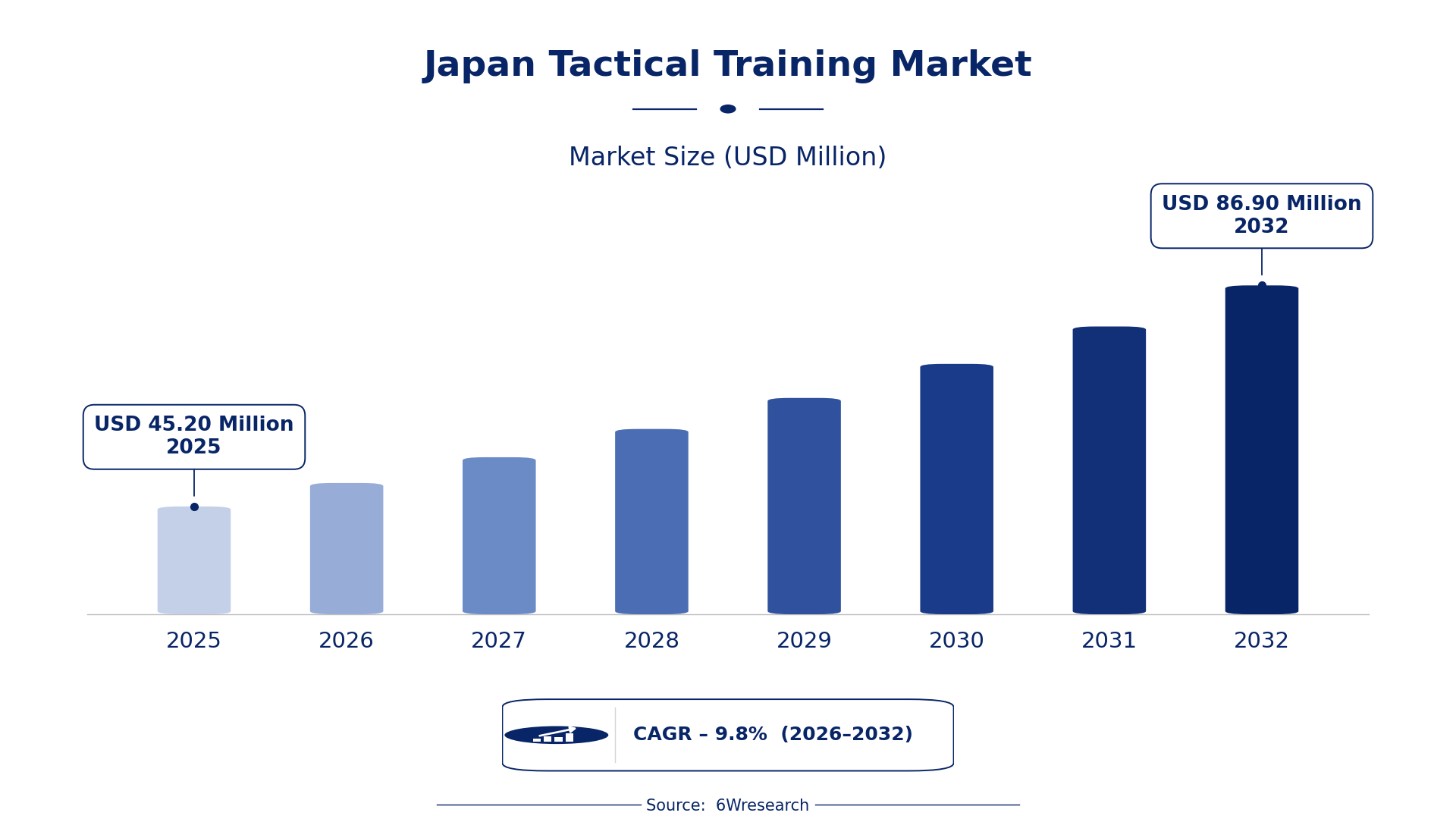
According to 6Wresearch internal database and industry insights, the Japan Tactical Training Market was valued at USD 45.20 Million in 2025 and is projected to reach USD 86.90 Million by 2032, growing at a CAGR of approximately 9.8% during 2026–2032.
Japan Tactical Training Market Highlights
| Report Metric | Details |
| Report Name | Japan Tactical Training Market (2026-2032) |
| Market Size 2025 | USD 45.20 Million |
| Market Size 2032 | USD 86.90 Million |
| Absolute Growth 2025–2032 | USD 41.70 Million |
| CAGR 2026–2032 | 9.8% |
| Peak Annual Growth | 10.9% in 2029 |
| Forecast Period | 2026–2032 |
| Historical Data | 2022–2025 |
| Base Year | 2025 |
| Leading Tactical Training, 2025 | Live Training Systems (47% share) |
| Leading Product Type, 2025 | Force-on-Force Kits (48% share) |
| Leading Mode, 2025 | Live Simulation (38% share) |
| Leading Distribution Channel, 2025 | Military Contracts (45% share) |
| Leading End User Industry, 2025 | Armed Forces (39% share) |
| Fastest-Growing Tactical Training | Virtual Training (13.0% CAGR) |
| Fastest-Growing Product Type | VR/AR Based Systems (13.5% CAGR) |
| Fastest-Growing Mode | Virtual Simulation (12.9% CAGR) |
| Fastest-Growing Distribution Channel | Online Solutions (12.6% CAGR) |
| Fastest-Growing End User Industry | Training Centers (12.3% CAGR) |
| Growing Sector | military training |
| Key End Users | armed forces, defense academies, training centers, military contractors |
Japan Tactical Training Market Year-wise Growth Rate and Key Drivers (2022–2032)
This graph illustrates the annual growth rates of the market from 2022 to 2032, highlighting a steady upward trajectory and projected market expansion over the forecast period.
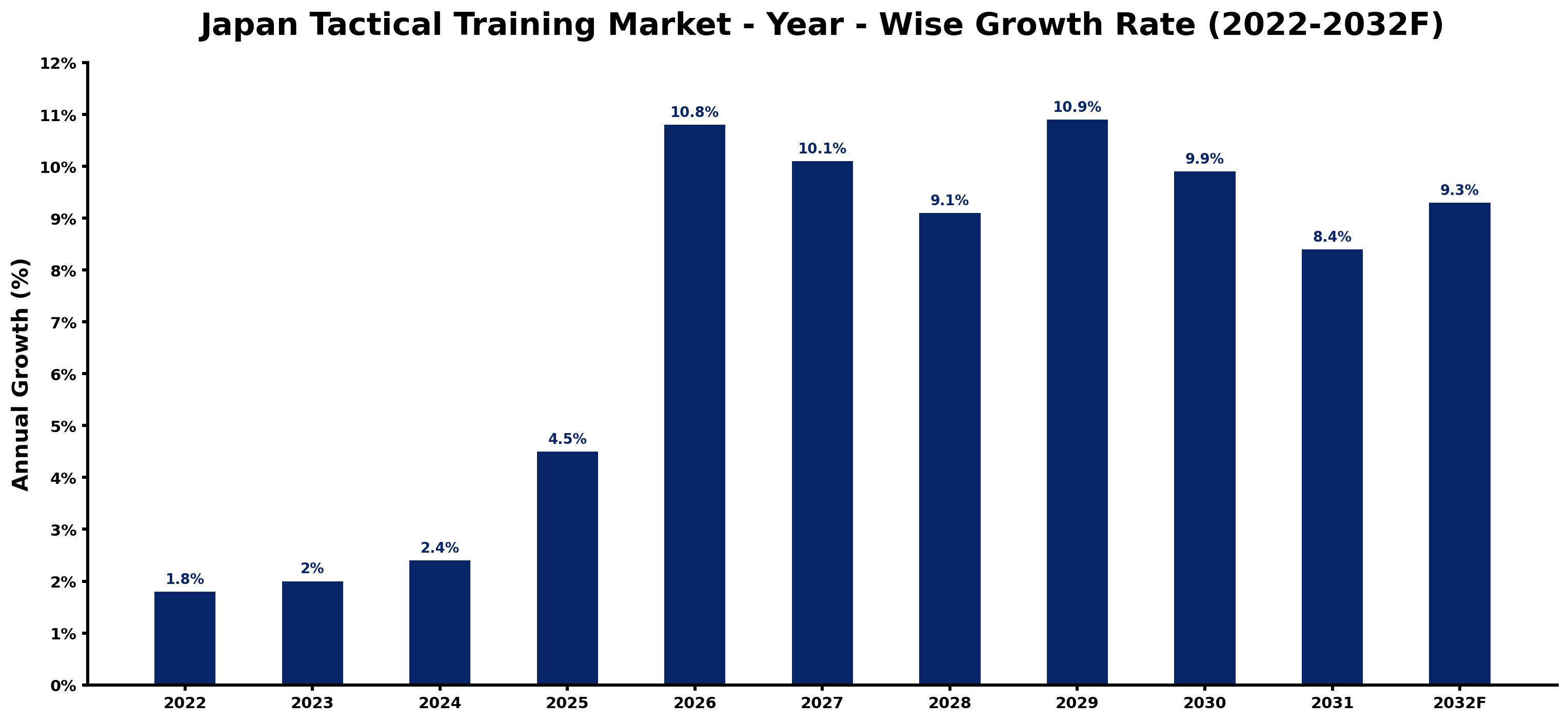
The following figures match every annual growth estimate with the main market development of that year, giving the reasoning behind each rise or slowdown.
| Year | Estimated Annual Growth (%) | Market Rationale |
| 2022 | 1.8 | The market showed steady growth reflecting ongoing military modernization efforts. |
| 2023 | 2.0 | Demand increased due to the adoption of VR training systems by the Japan Self-Defense Forces. |
| 2024 | 2.4 | Growth accelerated as training centers in Kanagawa Prefecture improved live training systems. |
| 2025 | 4.5 | The market peaked historically as military contracts expanded. |
| 2026 | 10.8 | Growth surged with rising investments in virtual training technologies. |
| 2027 | 10.1 | The growth rate slowed slightly as market saturation began to set in. |
| 2028 | 9.1 | Demand continued to rise, albeit at a slower pace due to increased competition. |
| 2029 | 10.9 | The market reached its peak growth as new training initiatives were launched. |
| 2030 | 9.9 | Growth decelerated as the market began to stabilise after rapid expansion. |
| 2031 | 8.4 | The market continued to grow, driven by sustained investments in training technologies. |
| 2032 | 9.3 | Demand increased as the Ministry of Defense's budget for training technologies rose. |
Note: Market size estimations and growth projections presented in this report are based on 6Wresearch's proprietary forecasting methodology, utilizing the latest available industry data, government publications, and primary research inputs.
Japan Tactical Training Market Synopsis
Tactical training in Japan utilises various simulation technologies to prepare military personnel for real-world scenarios, improving combat readiness and decision-making skills. The Japan Tactical Training Market is growing due to rising demand for advanced training solutions, particularly from the armed forces and defence academies.
Market Dynamics Impact Analysis (2026–2032)
| Factor | Type | Impact | Primary Segment Affected |
| Increasing military modernization efforts drive demand for advanced training solutions. | Driver | High | Live Training Systems |
| Growing adoption of VR and AR technologies enhances training effectiveness. | Driver | High | Virtual Training |
| The need for enhanced combat readiness creates opportunities for innovative training products. | Opportunity | High | Live Training Systems |
| Rising investments in defense technology present avenues for new entrants. | Opportunity | High | Hybrid Training |
| High costs associated with advanced training systems may limit accessibility for some users. | Restraint | Medium | Integrated Systems |
| Competition among suppliers can lead to price wars, affecting margins. | Restraint | Medium | Force-on-Force Kits |
| Delays in procurement processes can hinder timely training implementations. | Challenge | High | Military Contracts |
| Shortage of skilled personnel in simulation technology development poses risks. | Challenge | Medium | Simulation Software |
Evaluation of Drivers in Japan Tactical Training Market (2026–2032)
The table below links each growth driver to the segment it affects and the evidence for it.
| Drivers | Primary Segment Affected | Why It Matters (Evidence) |
| Military modernization initiatives increase training system procurement. | Live Training Systems | The focus on combat readiness leads to increased purchases of advanced training solutions. |
| Growing integration of VR technologies improves training effectiveness. | Virtual Training | The adoption of VR training systems since 2020 has resulted in a surge in demand for immersive training environments. |
| Rising defense budgets support procurement of advanced training systems. | Live Training Systems | Substantial funds allocated annually for military training enhancements drive demand for live training solutions. |
| Increased collaboration between academia and defense fosters innovation. | Hybrid Training | Joint initiatives between educational institutions and military bodies create new training methodologies and products. |
| Expansion of training centers boosts demand for comprehensive training solutions. | Integrated Systems | Training centers in Kanagawa Prefecture are investing in advanced simulation technologies, increasing the need for integrated systems. |
Buyers are adding capacity as military modernization efforts intensify, particularly within the armed forces. The annual budget for training technologies is projected to increase in 2024, driving demand for advanced training systems. The adoption of VR training systems since 2020 has resulted in a rise in immersive training environments, with training centers in Kanagawa improving live training capabilities. Collaboration between educational institutions and military bodies drives innovation, leading to new methodologies in tactical training. As a result, military contractors are increasingly involved in developing hybrid training solutions, further expanding the market.
Evaluation of Restraints in Japan Tactical Training Market
The main factors holding the market back are set out below.
| Market Restraint | Primary Segment Affected | Why It Matters (Evidence) |
| High costs associated with advanced training systems limit accessibility. | Integrated Systems | The financial investment required for advanced training solutions can deter smaller defense organizations from upgrading. |
| Intense competition among suppliers may lead to price wars. | Force-on-Force Kits | As more companies enter the market, aggressive pricing strategies can impact profitability for existing suppliers. |
| Delays in procurement processes hinder timely training implementations. | Military Contracts | Lengthy approval times for military contracts can disrupt training schedules and operational readiness. |
| Shortage of skilled personnel in simulation technology development poses risks. | Simulation Software | The lack of qualified professionals in this niche can slow down the development and deployment of new training systems. |
| Regulatory compliance requirements can complicate product development. | Hybrid Training | Stringent standards for military training products can extend development timelines and increase costs. |
Japan Tactical Training Market Challenges
Buyers struggle with the inconsistent supply of simulation technologies, as local suppliers often lack the necessary integration capabilities, which delays training schedules for military personnel. Regulatory challenges stem from strict adherence to ISO 9001 standards, extending development timelines by six months for suppliers and impacting the timely delivery of training systems. A shortage of skilled software developers limits suppliers' ability to innovate, resulting in outdated training methods that fail to meet contemporary military requirements. Buyers experience rising costs due to increased competition for limited resources, with training budgets expected to rise by 15% in 2024, straining financial allocations for military enhancements.
Trends in the Japan Tactical Training Market
These developments are changing demand patterns in the Japan Tactical Training Market.
- Shift Towards Virtual Training Solutions: The Tokyo Defence Academy is increasingly adopting AR-based systems for learning, reflecting a broader shift towards virtual training solutions. In 2023, Japan hosted a defence technology exhibition focusing on simulation training, highlighting the growing interest in immersive training environments.
- Increased Focus on Live Training Systems: Training centres in Osaka are now equipped with advanced simulation technologies, marking a shift towards live training systems. This transition is driven by the need for realistic engagement scenarios, with approximately 45% of military contracts now focusing on live training.
- Emergence of Hybrid Training Solutions: Military contractors are developing hybrid training solutions that combine various methods for effective training. This trend is gaining traction, with a projected CAGR of 13.0% for Virtual Training from 2026 to 2032, indicating strong demand for integrated approaches.
- Growing Demand for Integrated Systems: The Japanese armed forces are prioritising mixed reality applications in training, leading to a surge in demand for integrated systems. This shift is evident as training centres in Kanagawa expand their offerings to include advanced training solutions.
Investment Opportunities in the Japan Tactical Training Market
The openings below show where demand in the Japan Tactical Training Market is visible and how suppliers can enter.
- Market Gap in Advanced Training Technologies: There is a gap in advanced training technologies. Suppliers can target military contractors in Tokyo, forming local partnerships to improve offerings.
- Timing for Investment in VR Training: As demand for VR training systems grows, now is an opportune time for investment. The increasing budget for training technologies presents opportunities for suppliers to enter the market.
- Expansion of Training Centers: The ongoing expansion of training centres in Kanagawa Prefecture creates a demand for advanced training solutions. Suppliers should consider establishing local partnerships to facilitate entry into this growing market.
- Focus on Hybrid Training Solutions: The rising interest in hybrid training solutions presents a unique opportunity for investment. Suppliers can target military contractors, particularly in regions like Saitama Prefecture, to meet the demand for effective training systems.
Government Initiatives in the Japan Tactical Training Market
The Japan Defense Agency establishes and oversees tactical training standards and practices, ensuring compliance with established regulations. The Building Energy Efficiency Act, amended in 2022, mandates that new buildings adopt energy-efficient technologies by April 2025, indirectly influencing training facilities to improve their operational efficiencies. Additionally, the AI Promotion Act, set to be implemented in 2025, aims to create a national framework for AI research and development, which may improve training methodologies in the future.
The Ministry of Defense allocates substantial annual budgets for military training enhancements, with a projected increase in 2024, facilitating the procurement of advanced training systems. This agency funds projects aimed at integrating advanced technologies into military training, supporting the development of effective training solutions.
Future Insight of the Japan Tactical Training Market
Investment in advanced simulation technologies will surge, generating demand for innovative training solutions. By 2032, military modernisation initiatives will drive the need for AR-based systems, reshaping training methodologies. The Ministry of Defense's budget for training technologies is set to increase by 20% in 2024, reflecting a commitment to realistic training environments. Collaboration between academia and defence will result in new training approaches, improving skill development for military personnel.
Market Segmentation Analysis
Japan Tactical Training Market report covers a detailed analysis of the following market segments:
By Tactical Training – Live Training Systems Lead, Virtual Training Expected to Grow Fastest
According to Saurav Kr Singh, Senior Research Analyst at 6Wresearch, Live Training Systems held 47% of the Japan Tactical Training Market by tactical training in 2025. Live Training Systems hold the largest share as they provide hands-on experience in realistic scenarios, crucial for the Japan Self-Defense Forces. Facilities in Kanagawa Prefecture are specifically designed to enhance combat readiness through these systems. Over 2026–2032, Virtual Training is expected to post the fastest growth, at a CAGR of 13.0%. Virtual Training is experiencing rapid growth due to the increasing adoption of immersive environments, with the Ministry of Defense's budget for training technologies projected to rise in 2024. This shift indicates a continued focus on advanced training methodologies. Suppliers should prioritise the development of both live and virtual training solutions to meet the evolving demands of military training.
By Product Type – Force-on-Force Kits Lead, VR/AR Based Systems Expected to Grow Fastest
Force-on-Force Kits took 48% of product type revenue in 2025, more than any other category. Force-on-Force Kits dominate the market as they enable realistic engagement between trainees, which is essential for effective training. The armed forces extensively utilise these kits to simulate combat scenarios, ensuring preparedness. VR/AR Based Systems are projected to grow fastest, at a CAGR of 13.5% during 2026–2032. VR/AR Based Systems are rapidly gaining traction as they enhance training with immersive technology, reflecting a broader trend towards modernisation in military training. The rising demand for simulation software among military contractors further accelerates this growth. Buyers can anticipate a wider range of training solutions that incorporate advanced technologies, thereby improving overall training effectiveness.
By Mode – Live Simulation Leads, Virtual Simulation Expected to Grow Fastest
The largest mode category in 2025 was Live Simulation, at 38% of revenue. Live Simulation is the leading mode because it offers real-time feedback and interaction, which are vital for effective training. This method is widely adopted by the armed forces to prepare personnel for real-world situations. Virtual Simulation is set to record the highest CAGR in this split, 12.9% over 2026–2032. Virtual Simulation is growing quickly due to its flexibility in creating diverse training environments, aligning with the Japanese government's support for military training enhancements. This adaptability is crucial for meeting various training needs. Suppliers should focus on developing versatile training modes to cater to the diverse requirements of military training.
By Distribution Channel – Military Contracts Lead, Online Solutions Expected to Grow Fastest
Military Contracts accounted for 45% of the market by distribution channel in 2025. Military Contracts are the primary channel for procuring training solutions, ensuring compliance with government standards and requirements. The Japanese government allocates substantial funds annually for military training enhancements through these contracts. The quickest growth will come from Online Solutions, forecast to expand at a CAGR of 12.6% between 2026 and 2032. Online Solutions are rapidly gaining popularity as they provide supplementary training resources, reflecting the increasing digitalisation of training methodologies. This trend is evident in the growing demand for accessible training options. Suppliers must enhance their online offerings to capitalise on the expanding market for digital training resources.
By End User Industry – Armed Forces Lead, Training Centers Expected to Grow Fastest
In 2025, Armed Forces led the end user industry split with a 39% share. The Armed Forces represent the largest user of tactical training systems, utilising these technologies to maintain combat readiness and operational effectiveness. Their ongoing commitment to military modernisation ensures sustained demand for training solutions. Over 2026–2032, Training Centers are expected to post the fastest growth, at a CAGR of 12.3%. Training Centers are experiencing the fastest growth as key facilities for conducting training programs, reflecting the increasing emphasis on specialised training environments. This trend highlights the need for tailored training solutions. Suppliers should focus on partnerships with training centres to develop customised solutions that meet specific training needs.
Key Attractiveness of the Report
- 10 Years of Market Numbers
- Historical Data Starting from 2022 to 2025
- Base Year 2025
- Forecast Data until 2032
- Key Performance Indicators Impacting the Market
- Major Upcoming Developments and Projects
Key Highlights of the Report:
- Japan Tactical Training Market Outlook
- Market Size of Japan Tactical Training Market, 2025
- Forecast of Japan Tactical Training Market, 2032
- Historical Data and Forecast of Japan Tactical Training Revenues & Volume for the Period 2022-2032F
- Japan Tactical Training Market Trend Evolution
- Japan Tactical Training Market Drivers and Challenges
- Japan Tactical Training Price Trends
- Japan Tactical Training Porter's Five Forces
- Japan Tactical Training Industry Life Cycle
- Historical Data and Forecast of Japan Tactical Training Market Revenues & Volume By Tactical Training for the Period 2022-2032F
- Historical Data and Forecast of Japan Tactical Training Market Revenues & Volume By Live Training Systems for the Period 2022-2032F
- Historical Data and Forecast of Japan Tactical Training Market Revenues & Volume By Virtual Training for the Period 2022-2032F
- Historical Data and Forecast of Japan Tactical Training Market Revenues & Volume By Constructive Training for the Period 2022-2032F
- Historical Data and Forecast of Japan Tactical Training Market Revenues & Volume By Hybrid Training for the Period 2022-2032F
- Historical Data and Forecast of Japan Tactical Training Market Revenues & Volume By Product Type for the Period 2022-2032F
- Historical Data and Forecast of Japan Tactical Training Market Revenues & Volume By Force-on-Force Kits for the Period 2022-2032F
- Historical Data and Forecast of Japan Tactical Training Market Revenues & Volume By VR/AR Based Systems for the Period 2022-2032F
- Historical Data and Forecast of Japan Tactical Training Market Revenues & Volume By Command Post Exercises for the Period 2022-2032F
- Historical Data and Forecast of Japan Tactical Training Market Revenues & Volume By Integrated Systems for the Period 2022-2032F
- Historical Data and Forecast of Japan Tactical Training Market Revenues & Volume By Mode for the Period 2022-2032F
- Historical Data and Forecast of Japan Tactical Training Market Revenues & Volume By Live Simulation for the Period 2022-2032F
- Historical Data and Forecast of Japan Tactical Training Market Revenues & Volume By Virtual Simulation for the Period 2022-2032F
- Historical Data and Forecast of Japan Tactical Training Market Revenues & Volume By Simulation Software for the Period 2022-2032F
- Historical Data and Forecast of Japan Tactical Training Market Revenues & Volume By Mixed Reality for the Period 2022-2032F
- Historical Data and Forecast of Japan Tactical Training Market Revenues & Volume By Distribution Channel for the Period 2022-2032F
- Historical Data and Forecast of Japan Tactical Training Market Revenues & Volume By Military Contracts for the Period 2022-2032F
- Historical Data and Forecast of Japan Tactical Training Market Revenues & Volume By Online Solutions for the Period 2022-2032F
- Historical Data and Forecast of Japan Tactical Training Market Revenues & Volume By Direct Sales for the Period 2022-2032F
- Historical Data and Forecast of Japan Tactical Training Market Revenues & Volume By Specialty Providers for the Period 2022-2032F
- Historical Data and Forecast of Japan Tactical Training Market Revenues & Volume By End User Industry for the Period 2022-2032F
- Historical Data and Forecast of Japan Tactical Training Market Revenues & Volume By Armed Forces for the Period 2022-2032F
- Historical Data and Forecast of Japan Tactical Training Market Revenues & Volume By Training Centers for the Period 2022-2032F
- Historical Data and Forecast of Japan Tactical Training Market Revenues & Volume By Defense Academies for the Period 2022-2032F
- Historical Data and Forecast of Japan Tactical Training Market Revenues & Volume By Military Contractors for the Period 2022-2032F
- Japan Tactical Training Import Export Trade Statistics
- Market Opportunity Assessment By Tactical Training
- Market Opportunity Assessment By Product Type
- Market Opportunity Assessment By Mode
- Market Opportunity Assessment By Distribution Channel
- Market Opportunity Assessment By End User Industry
- Japan Tactical Training Top Companies Market Share
- Japan Tactical Training Competitive Benchmarking By Technical and Operational Parameters
- Japan Tactical Training Company Profiles
- Japan Tactical Training Key Strategic Recommendations
Market Covered
The study includes the following segmentation.
By Tactical Training
- Live Training Systems
- Virtual Training
- Constructive Training
- Hybrid Training
By Product Type
- Force-on-Force Kits
- VR/AR Based Systems
- Command Post Exercises
- Integrated Systems
By Mode
- Live Simulation
- Virtual Simulation
- Simulation Software
- Mixed Reality
By Distribution Channel
- Military Contracts
- Online Solutions
- Direct Sales
- Specialty Providers
By End User Industry
- Armed Forces
- Training Centers
- Defense Academies
- Military Contractors































