Japan Tactical Wheeled Vehicle Market Size & Growth Rate
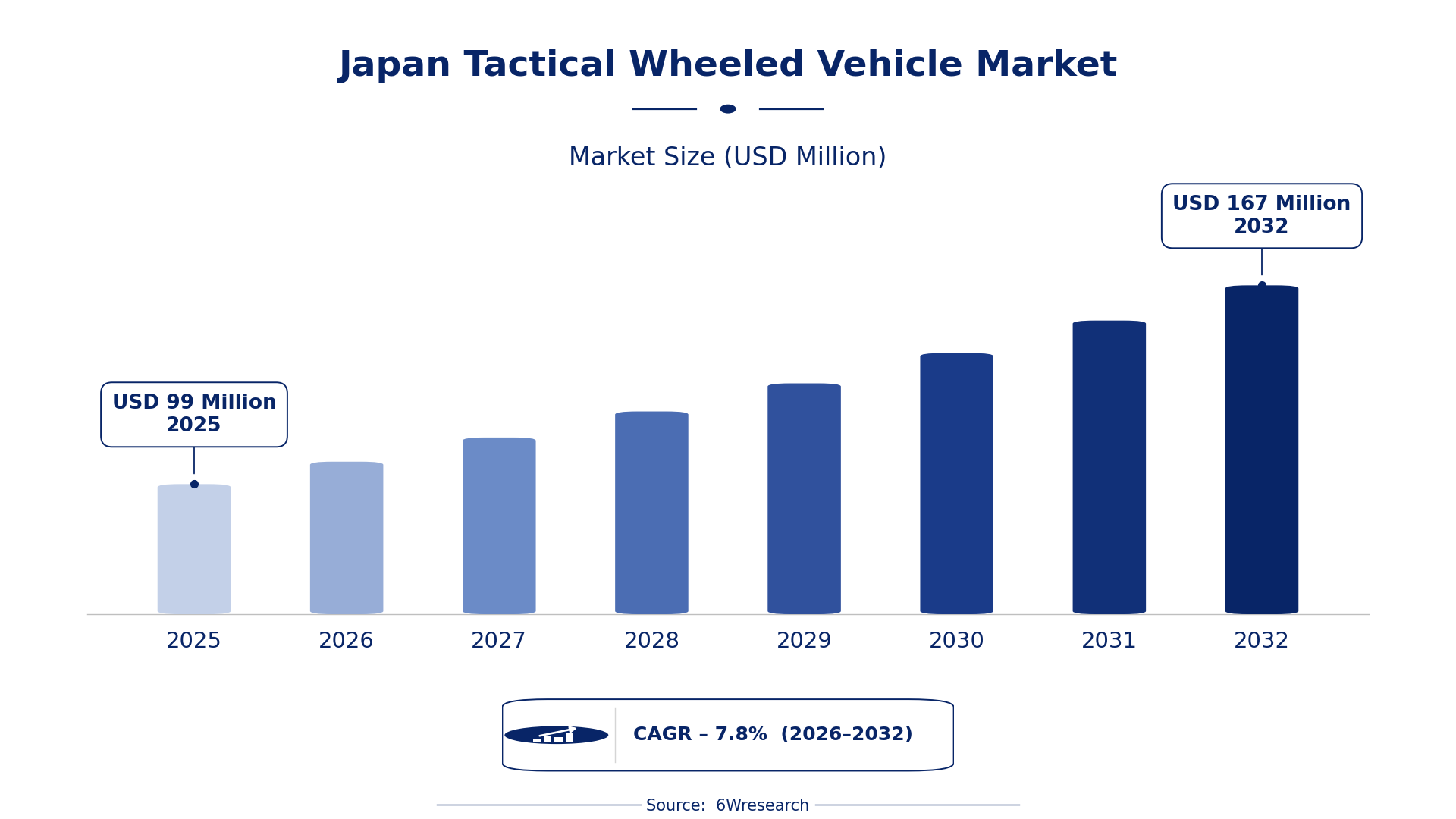
According to 6Wresearch internal database and industry insights, the Japan Tactical Wheeled Vehicle Market was valued at USD 99 Million in 2025 and is projected to reach USD 167 Million by 2032, growing at a CAGR of approximately 7.8% during 2026–2032.
Japan Tactical Wheeled Vehicle Market Highlights
| Report Metric | Details |
| Report Name | Japan Tactical Wheeled Vehicle Market (2026-2032) |
| Market Size 2025 | USD 99 Million |
| Market Size 2032 | USD 167 Million |
| Absolute Growth 2025–2032 | USD 68 Million |
| CAGR 2026–2032 | 7.8% |
| Peak Annual Growth | 8.9% in 2030 |
| Forecast Period | 2026–2032 |
| Historical Data | 2022–2025 |
| Base Year | 2025 |
| Leading Tactical Wheeled Vehicles, 2025 | Armored Personnel Carriers (40% share) |
| Leading Product Type, 2025 | Infantry Vehicles (49% share) |
| Leading Payload Class, 2025 | Medium (34% share) |
| Leading Distribution Channel, 2025 | Military Contracts (40% share) |
| Leading End User Industry, 2025 | Defense Forces (52% share) |
| Fastest-Growing Tactical Wheeled Vehicles | Tactical Ambulances (9.9% CAGR) |
| Fastest-Growing Product Type | Medical Evac Units (10.9% CAGR) |
| Fastest-Growing Payload Class | Light (10.2% CAGR) |
| Fastest-Growing End User Industry | Logistics Corps (10.3% CAGR) |
| Growing Sector | Military logistics |
| Key End Users | Defense Forces, Logistics Corps, Border Security Units |
Japan Tactical Wheeled Vehicle Market Year-wise Growth Rate and Key Drivers (2022–2032)
This graph illustrates the annual growth rates of the market from 2022 to 2032, highlighting a steady upward trajectory and projected market expansion over the forecast period.
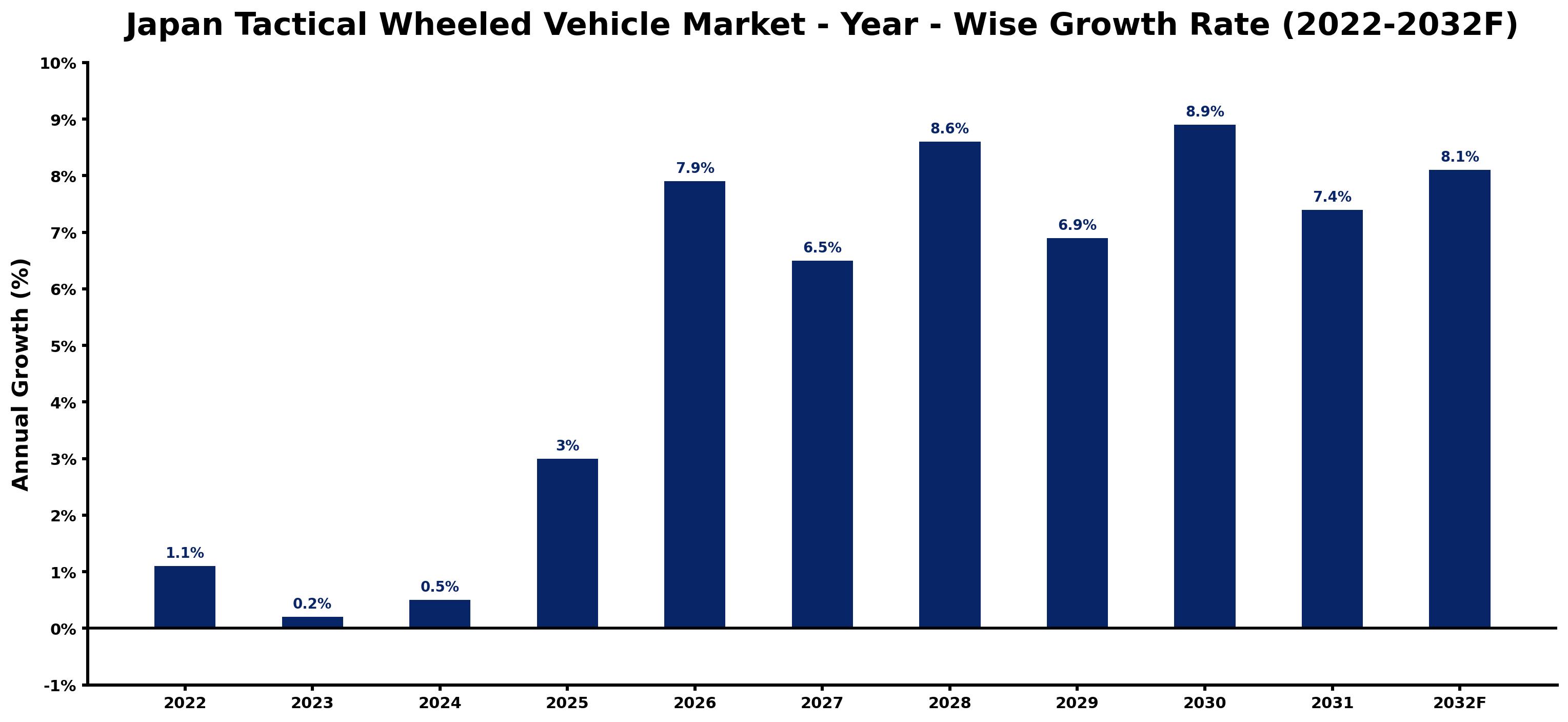
Annual growth estimates for each year appear below with the principal reason behind them, explaining the shifts that set the pace of the market.
| Year | Estimated Annual Growth (%) | Market Rationale |
| 2022 | 1.1 | The market experienced modest growth due to steady domestic military needs. |
| 2023 | 0.2 | Growth slowed as defense spending adjustments were made amid budget considerations. |
| 2024 | 0.5 | Demand increased as the government allocated more resources for military modernization. |
| 2025 | 3.0 | The market saw growth driven by heightened regional security concerns. |
| 2026 | 7.9 | Demand surged as investments in vehicle mobility and modernization accelerated. |
| 2027 | 6.5 | Growth slowed as the market adjusted to previous high spending levels. |
| 2028 | 8.6 | The market rebounded with increased investments in tactical vehicle capabilities. |
| 2029 | 6.9 | Growth slowed as procurement processes became more stringent and competitive. |
| 2030 | 8.9 | Demand peaked due to substantial military contracts and modernization efforts. |
| 2031 | 7.4 | Growth slowed as the market stabilised after peak procurement activities. |
| 2032 | 8.1 | Demand is expected to rise as modernization initiatives continue to unfold. |
Note: Market size estimations and growth projections presented in this report are based on 6Wresearch's proprietary forecasting methodology, utilizing the latest available industry data, government publications, and primary research inputs.
Japan Tactical Wheeled Vehicle Market Synopsis
Tactical Wheeled Vehicles are specialised military vehicles used for transportation, logistics, and medical evacuation. According to the Japan Tactical Wheeled Vehicle Market is expanding due to increased defence spending, with the Ministry of Defence allocating ¥5 trillion in 2023. Demand is driven by domestic military needs and government contracts, particularly for armoured personnel carriers and tactical ambulances, as the Self-Defence Forces modernise their fleet and improve operational capabilities.
Market Dynamics Impact Analysis (2026–2032)
| Factor | Type | Impact | Primary Segment Affected |
| Increased defense spending and modernization initiatives drive demand for Tactical Wheeled Vehicles. | Driver | High | Utility Vehicles |
| Growing regional security concerns lead to heightened procurement of military vehicles. | Driver | High | Armored Personnel Carriers |
| The Japanese government is enhancing border security capabilities, creating demand for tactical vehicles. | Opportunity | High | Tactical Ambulances |
| The modernization of the Self-Defense Forces creates a need for advanced logistical support vehicles. | Opportunity | High | Cargo Carriers |
| Budget constraints may limit the speed of procurement processes for military vehicles. | Restraint | Medium | Infantry Vehicles |
| Stringent regulations on vehicle manufacturing may slow down production timelines. | Restraint | Medium | Utility Vehicles |
| Supply chain disruptions can delay the delivery of essential components for vehicles. | Challenge | High | Armored Personnel Carriers |
| Competition among suppliers can lead to price pressures affecting profitability. | Challenge | Medium | Tactical Ambulances |
Evaluation of Drivers in Japan Tactical Wheeled Vehicle Market (2026–2032)
The following drivers explain most of the expected growth.
| Drivers | Primary Segment Affected | Why It Matters (Evidence) |
| Increased defense budget allocations support the procurement of Tactical Wheeled Vehicles. | Utility Vehicles | The Ministry of Defense allocated ¥5 trillion for defense spending in 2023, leading to more purchases. |
| Heightened security concerns in the region drive demand for Armored Personnel Carriers. | Armored Personnel Carriers | The Self-Defense Forces are expanding their fleet in response to regional threats, increasing procurement. |
| The need for rapid medical response boosts demand for Tactical Ambulances. | Tactical Ambulances | Field hospitals are being equipped with advanced medical evacuation units to improve response times, increasing operational readiness. |
| Modernization initiatives within the Self-Defense Forces increase demand for Cargo Carriers. | Cargo Carriers | The Logistics Corps is essential for supply chain management in military contexts, driving the need for more vehicles. |
| Technological advancements in vehicle design improve the performance of Tactical Wheeled Vehicles. | Infantry Vehicles | JIS standards are applied for vehicle manufacturing and safety, improving overall quality and reliability. |
Volumes grow on the back of increased spending on military modernisation and the need for improved operational capabilities. Regional security concerns have led to an expansion of the armoured personnel carrier fleet, focusing on troop protection. Medical evacuation units are being integrated into field hospitals, improving rapid response capabilities. The need for efficient supply chains further drives demand for cargo carriers, ensuring that logistics operations remain effective.
Evaluation of Restraints in Japan Tactical Wheeled Vehicle Market
The main factors holding the market back are set out below.
| Market Restraint | Primary Segment Affected | Why It Matters (Evidence) |
| Budget constraints may limit the speed of procurement processes for military vehicles. | Infantry Vehicles | The Ministry of Defense's budget allocations can restrict the number of vehicles procured. |
| Stringent regulations on vehicle manufacturing may slow down production timelines. | Utility Vehicles | Compliance with JIS standards can extend the time required for vehicle production. |
| Supply chain disruptions can delay the delivery of essential components for vehicles. | Armored Personnel Carriers | Global supply chain issues have affected the availability of critical parts, impacting timely deliveries. |
| Competition among suppliers can lead to price pressures affecting profitability. | Tactical Ambulances | Increased competition may force suppliers to lower prices, impacting margins and sustainability. |
| Technological challenges in vehicle design can hinder innovation and efficiency. | Cargo Carriers | Complexities in developing new technologies may slow down advancements, affecting overall production. |
Japan Tactical Wheeled Vehicle Market Challenges
Producers face high manufacturing costs linked to JIS standards, raising production expenses by 15% and increasing prices for buyers. Competition intensifies as regional manufacturers offer lower-cost alternatives, pressuring local producers to cut margins, which can compromise quality. Supply chain disruptions occur in the Tokyo Metropolitan Area, where congestion delays deliveries by an average of three weeks for distributors. Skills shortages in advanced vehicle technologies hinder production efficiency, extending lead times for new models by 20%, ultimately affecting military readiness for the Self-Defence Forces.
Trends in the Japan Tactical Wheeled Vehicle Market
Four trends stand out in the Japan Tactical Wheeled Vehicle Market.
- Military Contracts Increasing for Tactical Vehicles: The Japanese government is increasing military contracts for Tactical Wheeled Vehicles, with a projected growth of 10.6% in military contracts by 2032. This trend reflects rising regional security concerns.
- Shift Towards Advanced Medical Evacuation Units: Field hospitals are increasingly equipped with advanced medical evacuation units, reflecting a shift in military logistics. This change is driven by the need for rapid medical response capabilities in the field, focusing on improving operational efficiency.
- Border Security Initiatives Expanding: The Japanese government has initiated programs to bolster border security capabilities, leading to increased demand for tactical vehicles. This focus on security aligns with rising regional tensions and military preparedness, with substantial investments planned.
- Growing Emphasis on Local Manufacturing: The Japan Defence Industry Association promotes local manufacturing of defence vehicles, which is becoming a priority. This initiative aims to strengthen domestic production capabilities and reduce reliance on imports, ensuring a more resilient supply chain.
Investment Opportunities in the Japan Tactical Wheeled Vehicle Market
The opportunities below stand out in the Japan Tactical Wheeled Vehicle Market for new entrants and existing suppliers.
- Increasing Demand for Tactical Ambulances: The demand for tactical ambulances is rising due to heightened medical response needs. Investing in this segment can benefit military logistics corps, particularly in urban areas where rapid response is critical.
- Investment in Medium Payload Vehicles: The demand for medium payload vehicles is essential for troop transport, with a notable market gap. Collaborating with local defence suppliers can facilitate entry into this segment, ensuring timely procurement.
- Expansion of Military Contracts: Military contracts for Tactical Wheeled Vehicles are expected to increase, driven by regional security concerns. Engaging in joint ventures with local manufacturers can boost market presence and ensure compliance with procurement standards.
- Focus on Vehicle Mobility Improvements: The Ministry of Defence aims to improve vehicle mobility by 2026, creating opportunities for suppliers of specialised vehicles. Partnering with military logistics units can streamline market entry and improve operational capabilities.
Government Initiatives in the Japan Tactical Wheeled Vehicle Market
The legal framework for Tactical Wheeled Vehicles is shaped by various laws, including the Defence Procurement Act (2008) and the Acquisition of Defence Equipment Act (2014). These laws mandate specific standards for vehicle procurement and ensure compliance with safety regulations. The government has also set ambitious targets for defence spending, including a substantial allocation in 2023 to modernise military capabilities.
The Defence Agency oversees the procurement and deployment of tactical vehicles, ensuring adherence to established standards. The agency has approved multiple projects aimed at improving military logistics, with funding allocated for the development of advanced medical evacuation units. These initiatives directly benefit the Defence Forces by enhancing operational readiness and response capabilities.
Future Insight of the Japan Tactical Wheeled Vehicle Market
Investment in modernised Tactical Wheeled Vehicles will surge, driven by the Ministry of Defence's ¥5 trillion allocation for 2023. By 2032, advancements in vehicle mobility will enhance operational effectiveness, benefiting both buyers and suppliers. Government initiatives will promote technology development, leading to more efficient manufacturing processes. As military contracts increase due to regional security concerns, suppliers will need to meet the evolving demands of the Self-Defence Forces.
Market Segmentation Analysis
Japan Tactical Wheeled Vehicle Market report covers a detailed analysis of the following market segments:
By Tactical Wheeled Vehicles – Armored Personnel Carriers Lead, Tactical Ambulances Expected to Grow Fastest
According to Saurav Kr Singh, Senior Research Analyst at 6Wresearch, Armored Personnel Carriers accounted for 40% of the market by tactical wheeled vehicles in 2025. Armored Personnel Carriers hold the largest share due to their critical role in troop protection during operations, with over 1,000 units operated by Japan's Self-Defense Forces. This extensive installed base highlights the reliance on these vehicles for military effectiveness. Tactical Ambulances are set to record the highest CAGR in this split, 9.9% over 2026–2032. Tactical Ambulances are experiencing rapid growth as the demand for medical evacuation capabilities increases, particularly with field hospitals being equipped with advanced units. This trend reflects a heightened focus on rapid medical response in military operations. Suppliers should prioritise the development of advanced tactical ambulances to meet the growing demand.
By Product Type – Infantry Vehicles Lead, Medical Evac Units Expected to Grow Fastest
Infantry Vehicles took 49% of product type revenue in 2025, more than any other category. Infantry Vehicles hold the largest share as they are essential for troop deployment and support, forming the backbone of military operations. Their extensive use within Japan's Self-Defense Forces, which operate over 1,000 Tactical Wheeled Vehicles, underscores their critical role. Over 2026–2032, Medical Evac Units are expected to post the fastest growth, at a CAGR of 10.9%. Medical Evac Units are witnessing rapid growth due to the urgent need for efficient transportation of injured personnel, particularly as military operations become more complex. The increasing emphasis on medical capabilities in the field reflects a shift towards prioritising rapid medical response. Suppliers should focus on developing advanced medical evacuation solutions to address the growing demand.
By Payload Class – Medium Leads, Light Expected to Grow Fastest
Medium held 34% of the Japan Tactical Wheeled Vehicle Market by payload class in 2025. Medium payload vehicles lead the market as they are used for versatile operations that balance capacity and mobility, making them essential for troop transport in urban areas. Their adaptability to various mission profiles solidifies their position. Light is projected to grow fastest, at a CAGR of 10.2% during 2026–2032. Light payload vehicles are growing rapidly, commonly used for rapid deployment and manoeuvrability, which is increasingly important in modern military engagements. This trend suggests a shift towards more agile operational strategies. Suppliers should focus on developing lightweight solutions to cater to the demand for agility in military operations.
By Distribution Channel – Military Contracts Lead and Record the Fastest Growth
The largest distribution channel category in 2025 was Military Contracts, at 40% of revenue. Military Contracts lead the distribution channel as they are essential for government procurement, guaranteeing a consistent flow of orders for Tactical Wheeled Vehicles. The substantial ¥5 trillion allocated for defense spending in 2023 reinforces the importance of this channel. Its lead should widen, with a projected CAGR of 10.6% during 2026–2032, the highest in this split. Military Contracts are also the fastest-growing channel, fuelled by rising military budgets and heightened regional security concerns. This dual growth indicates a strong and expanding market for Tactical Wheeled Vehicles, ensuring sustained demand. Suppliers must strategically align with government procurement processes to effectively capture this growth.
By End User Industry – Defense Forces Lead, Logistics Corps Expected to Grow Fastest
In 2025, Defense Forces led the end user industry split with a 52% share. Defense Forces represent the largest user group for Tactical Wheeled Vehicles, as they are primarily responsible for national security and military readiness. Their extensive operational requirements ensure consistent demand for these vehicles across a range of missions. Logistics Corps are set to record the highest CAGR in this split, 10.3% over 2026–2032. Logistics Corps are experiencing rapid growth due to their vital role in managing supply chains within military operations, especially as the Defense Forces modernise their vehicle fleet. This trend highlights the increasing importance of logistics in enhancing military effectiveness. Buyers in the logistics sector must strengthen their capabilities to meet the evolving demands of military operations.
Key Attractiveness of the Report
- 10 Years of Market Numbers
- Historical Data Starting from 2022 to 2025
- Base Year 2025
- Forecast Data until 2032
- Key Performance Indicators Impacting the Market
- Major Upcoming Developments and Projects
Key Highlights of the Report:
- Japan Tactical Wheeled Vehicle Market Outlook
- Market Size of Japan Tactical Wheeled Vehicle Market, 2025
- Forecast of Japan Tactical Wheeled Vehicle Market, 2032
- Historical Data and Forecast of Japan Tactical Wheeled Vehicle Revenues & Volume for the Period 2022-2032F
- Japan Tactical Wheeled Vehicle Market Trend Evolution
- Japan Tactical Wheeled Vehicle Market Drivers and Challenges
- Japan Tactical Wheeled Vehicle Price Trends
- Japan Tactical Wheeled Vehicle Porter's Five Forces
- Japan Tactical Wheeled Vehicle Industry Life Cycle
- Historical Data and Forecast of Japan Tactical Wheeled Vehicle Market Revenues & Volume By Tactical Wheeled Vehicles for the Period 2022-2032F
- Historical Data and Forecast of Japan Tactical Wheeled Vehicle Market Revenues & Volume By Utility Vehicles for the Period 2022-2032F
- Historical Data and Forecast of Japan Tactical Wheeled Vehicle Market Revenues & Volume By Cargo Carriers for the Period 2022-2032F
- Historical Data and Forecast of Japan Tactical Wheeled Vehicle Market Revenues & Volume By Armored Personnel Carriers for the Period 2022-2032F
- Historical Data and Forecast of Japan Tactical Wheeled Vehicle Market Revenues & Volume By Tactical Ambulances for the Period 2022-2032F
- Historical Data and Forecast of Japan Tactical Wheeled Vehicle Market Revenues & Volume By Product Type for the Period 2022-2032F
- Historical Data and Forecast of Japan Tactical Wheeled Vehicle Market Revenues & Volume By Recon & Patrol for the Period 2022-2032F
- Historical Data and Forecast of Japan Tactical Wheeled Vehicle Market Revenues & Volume By Transport Trucks for the Period 2022-2032F
- Historical Data and Forecast of Japan Tactical Wheeled Vehicle Market Revenues & Volume By Infantry Vehicles for the Period 2022-2032F
- Historical Data and Forecast of Japan Tactical Wheeled Vehicle Market Revenues & Volume By Medical Evac Units for the Period 2022-2032F
- Historical Data and Forecast of Japan Tactical Wheeled Vehicle Market Revenues & Volume By Payload Class for the Period 2022-2032F
- Historical Data and Forecast of Japan Tactical Wheeled Vehicle Market Revenues & Volume By Light for the Period 2022-2032F
- Historical Data and Forecast of Japan Tactical Wheeled Vehicle Market Revenues & Volume By Medium for the Period 2022-2032F
- Historical Data and Forecast of Japan Tactical Wheeled Vehicle Market Revenues & Volume By Heavy for the Period 2022-2032F
- Historical Data and Forecast of Japan Tactical Wheeled Vehicle Market Revenues & Volume By Light-Medium for the Period 2022-2032F
- Historical Data and Forecast of Japan Tactical Wheeled Vehicle Market Revenues & Volume By Distribution Channel for the Period 2022-2032F
- Historical Data and Forecast of Japan Tactical Wheeled Vehicle Market Revenues & Volume By OEMs for the Period 2022-2032F
- Historical Data and Forecast of Japan Tactical Wheeled Vehicle Market Revenues & Volume By Defense Suppliers for the Period 2022-2032F
- Historical Data and Forecast of Japan Tactical Wheeled Vehicle Market Revenues & Volume By Military Contracts for the Period 2022-2032F
- Historical Data and Forecast of Japan Tactical Wheeled Vehicle Market Revenues & Volume By Specialty Suppliers for the Period 2022-2032F
- Historical Data and Forecast of Japan Tactical Wheeled Vehicle Market Revenues & Volume By End User Industry for the Period 2022-2032F
- Historical Data and Forecast of Japan Tactical Wheeled Vehicle Market Revenues & Volume By Border Security Units for the Period 2022-2032F
- Historical Data and Forecast of Japan Tactical Wheeled Vehicle Market Revenues & Volume By Logistics Corps for the Period 2022-2032F
- Historical Data and Forecast of Japan Tactical Wheeled Vehicle Market Revenues & Volume By Defense Forces for the Period 2022-2032F
- Historical Data and Forecast of Japan Tactical Wheeled Vehicle Market Revenues & Volume By Field Hospitals for the Period 2022-2032F
- Japan Tactical Wheeled Vehicle Import Export Trade Statistics
- Market Opportunity Assessment By Tactical Wheeled Vehicles
- Market Opportunity Assessment By Product Type
- Market Opportunity Assessment By Payload Class
- Market Opportunity Assessment By Distribution Channel
- Market Opportunity Assessment By End User Industry
- Japan Tactical Wheeled Vehicle Top Companies Market Share
- Japan Tactical Wheeled Vehicle Competitive Benchmarking By Technical and Operational Parameters
- Japan Tactical Wheeled Vehicle Company Profiles
- Japan Tactical Wheeled Vehicle Key Strategic Recommendations
Market Covered
The following segment groups are covered in the report.
By Tactical Wheeled Vehicles
- Utility Vehicles
- Cargo Carriers
- Armored Personnel Carriers
- Tactical Ambulances
By Product Type
- Recon & Patrol
- Transport Trucks
- Infantry Vehicles
- Medical Evac Units
By Payload Class
- Light
- Medium
- Heavy
- Light-Medium
By Distribution Channel
- OEMs
- Defense Suppliers
- Military Contracts
- Specialty Suppliers
By End User Industry
- Border Security Units
- Logistics Corps
- Defense Forces
- Field Hospitals































