Japan Tail Cone Fairing Market Size & Growth Rate
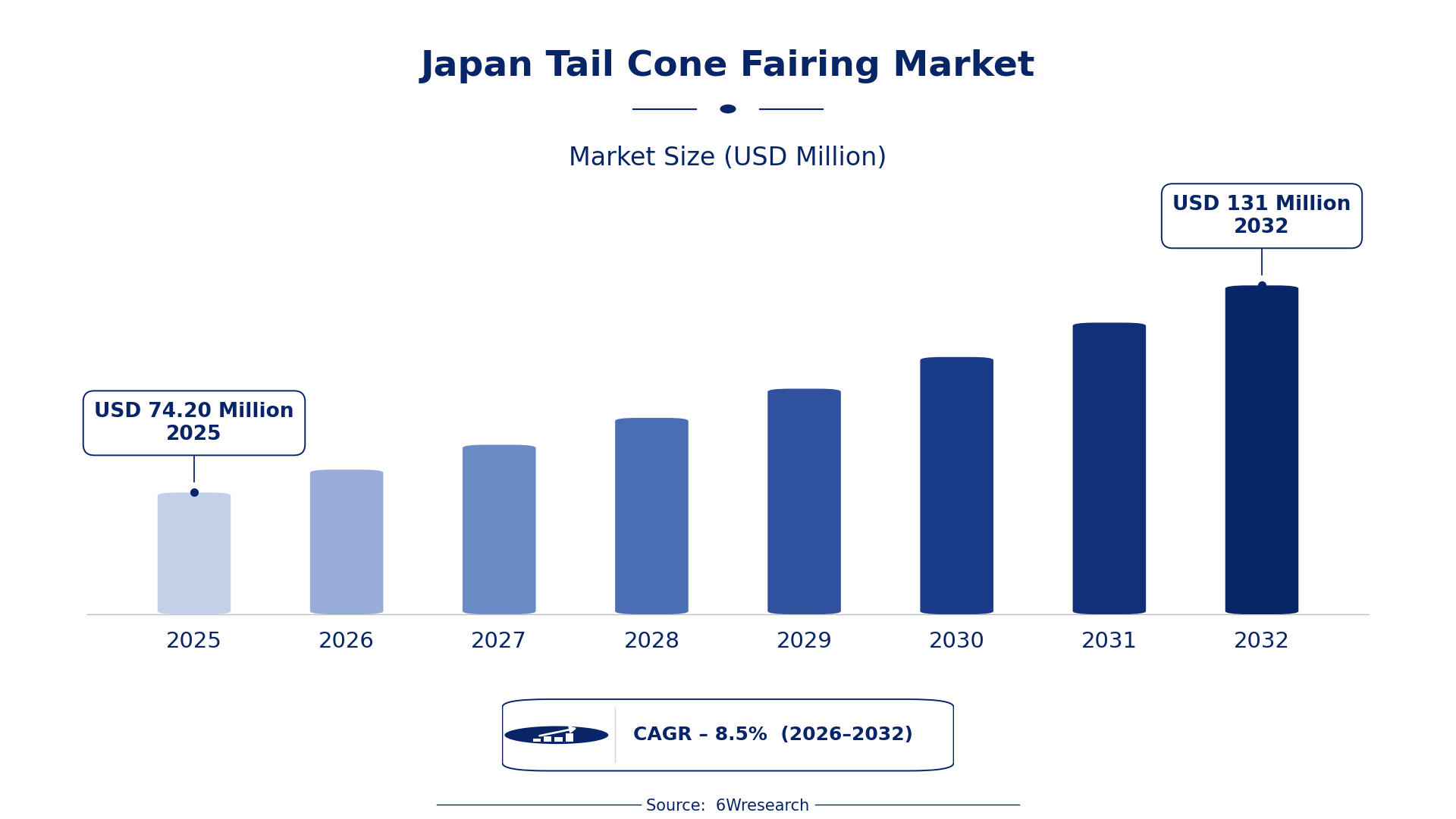
According to 6Wresearch internal database and industry insights, the Japan Tail Cone Fairing Market was valued at USD 74.20 Million in 2025 and is projected to reach USD 131 Million by 2032, growing at a CAGR of approximately 8.5% during 2026–2032.
Japan Tail Cone Fairing Market Highlights
| Report Metric | Details |
| Report Name | Japan Tail Cone Fairing Market (2026-2032) |
| Market Size 2025 | USD 74.20 Million |
| Market Size 2032 | USD 131 Million |
| Absolute Growth 2025–2032 | USD 56.80 Million |
| CAGR 2026–2032 | 8.5% |
| Peak Annual Growth | 9.2% in 2032 |
| Forecast Period | 2026–2032 |
| Historical Data | 2022–2025 |
| Base Year | 2025 |
| Leading Tail Cone Fairing, 2025 | Commercial Jet Fairings (43% share) |
| Leading Product Type, 2025 | Aft Body Covers (48% share) |
| Leading Material Type, 2025 | Carbon Fiber (47% share) |
| Leading Distribution Channel, 2025 | OEM Sales (46% share) |
| Leading End User Industry, 2025 | Aircraft Manufacturers (39% share) |
| Fastest-Growing Tail Cone Fairing | Military Aircraft Fairings (11.0% CAGR) |
| Fastest-Growing Product Type | Tail Structures (11.8% CAGR) |
| Fastest-Growing Material Type | Aluminum Alloy (12.0% CAGR) |
| Fastest-Growing Distribution Channel | Aerospace Suppliers (11.1% CAGR) |
| Fastest-Growing End User Industry | Defense Aircraft (10.9% CAGR) |
| Growing Sector | Aerospace Manufacturing |
| Key End Users | Aircraft Manufacturers, Defense Contractors, UAV Developers, Aviation Maintenance Providers |
Japan Tail Cone Fairing Market Year-wise Growth Rate and Key Drivers (2022–2032)
This graph illustrates the annual growth rates of the market from 2022 to 2032, highlighting a steady upward trajectory and projected market expansion over the forecast period.
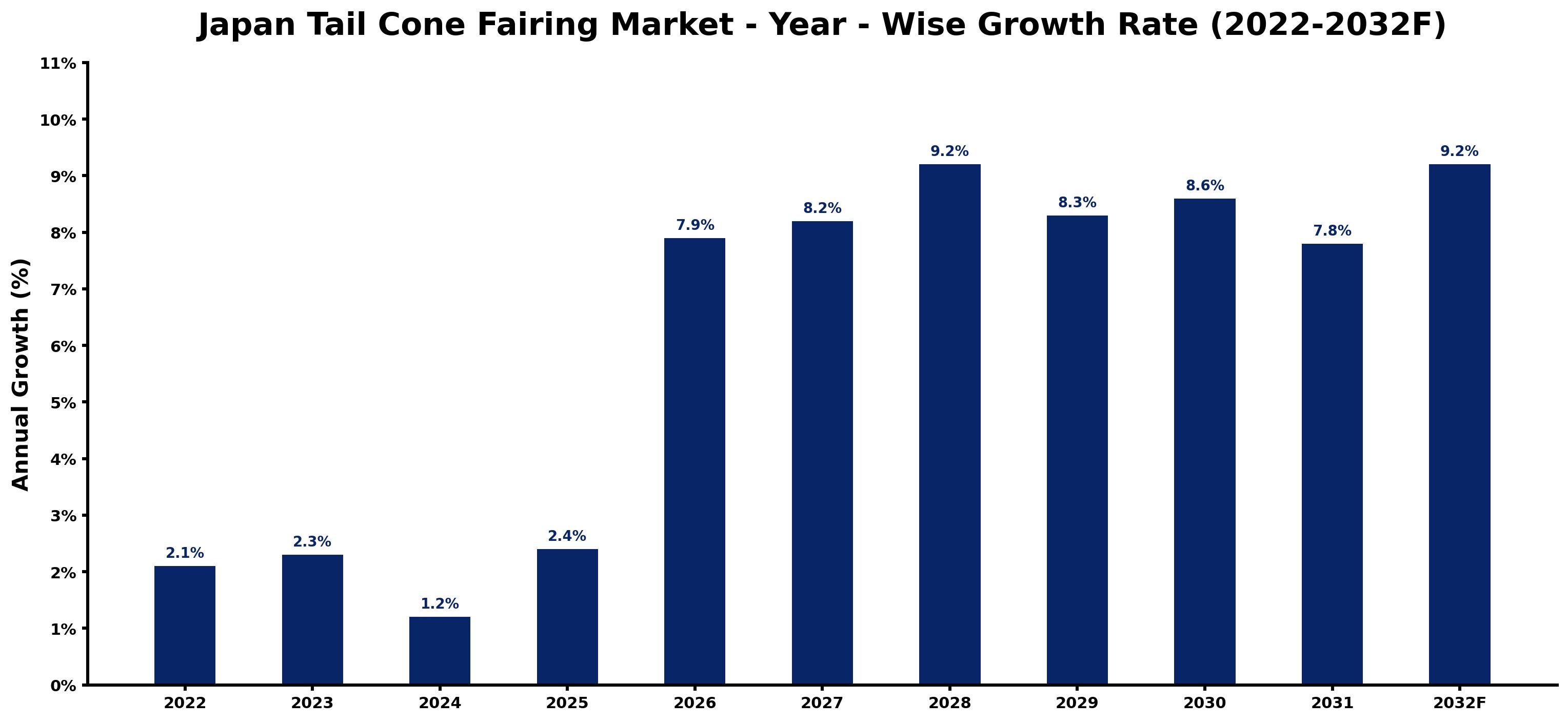
The following figures match every annual growth estimate with the main market development of that year, giving the reasoning behind each rise or slowdown.
| Year | Estimated Annual Growth (%) | Market Rationale |
| 2022 | 2.1 | The market showed moderate growth due to stable demand from aircraft manufacturers. |
| 2023 | 2.3 | Demand increased as domestic aircraft production ramped up, reflecting industry recovery. |
| 2024 | 1.2 | Growth slowed as manufacturers faced supply chain challenges affecting production rates. |
| 2025 | 2.4 | A surge in military aircraft production drove faster growth in the market. |
| 2026 | 7.9 | Investment in aerospace innovation is anticipated to boost demand. |
| 2027 | 8.2 | Rising defense budgets are projected to further increase military aircraft orders. |
| 2028 | 9.2 | The market will peak as demand for advanced components surges. |
| 2029 | 8.3 | Growth will moderate as production stabilises after the peak. |
| 2030 | 8.6 | Continued investments in aerospace technology will sustain market expansion. |
| 2031 | 7.8 | A slight slowdown is anticipated as the market adjusts to previous highs. |
| 2032 | 9.2 | The market is expected to experience renewed growth driven by emerging technologies. |
Note: Market size estimations and growth projections presented in this report are based on 6Wresearch's proprietary forecasting methodology, utilizing the latest available industry data, government publications, and primary research inputs.
Japan Tail Cone Fairing Market Synopsis
Tail cone fairings are aerodynamic structures that improve fuel efficiency and structural integrity in aircraft. The Japan Tail Cone Fairing Market is growing due to the aerospace industry's strong performance, valued at approximately 1.5 trillion JPY. Key factors include increased military aircraft production, supported by a defense budget of 6.8 trillion JPY in 2023, and ongoing investments in aerospace innovation programs, stimulating demand from manufacturers and maintenance providers.
Market Dynamics Impact Analysis (2026–2032)
| Factor | Type | Impact | Primary Segment Affected |
| Rising defense budgets are driving demand for military aircraft components. | Driver | High | Military Aircraft Fairings |
| Growing domestic aircraft production is boosting fairing requirements. | Driver | High | Commercial Jet Fairings |
| Increased aircraft production is creating opportunities for tail cone fairing suppliers. | Opportunity | High | Commercial Jet Fairings |
| The growing trend of UAVs is increasing demand for specialized fairings. | Opportunity | Medium | UAV Fairings |
| Supply chain disruptions are limiting the availability of materials for production. | Restraint | High | Carbon Fiber |
| Market fluctuations in raw material prices are affecting production costs. | Restraint | Medium | Military Aircraft Fairings |
| Technological advancements in materials are creating challenges for traditional manufacturers. | Challenge | High | Tail Structures |
| Increasing competition from international suppliers is pressuring local manufacturers. | Challenge | Medium | Aft Body Covers |
Evaluation of Drivers in Japan Tail Cone Fairing Market (2026–2032)
The following drivers explain most of the expected growth.
| Drivers | Primary Segment Affected | Why It Matters (Evidence) |
| Increased military spending is driving demand for advanced military aircraft. | Military Aircraft Fairings | Japan's defense budget allocated 6.8 trillion JPY in 2023, leading to higher orders for military aircraft. |
| Growing domestic aircraft production is boosting fairing requirements. | Commercial Jet Fairings | With over 500 commercial jets in 2023, manufacturers are increasing their fairing purchases. |
| Investment in aerospace innovation is improving production capabilities. | UAV Fairings | Support for projects that stimulate demand for UAV components is growing. |
| Rising fuel efficiency standards are increasing demand for aerodynamic solutions. | Aerodynamic Fairings | The ISO 9001 standard adoption encourages manufacturers to invest in advanced fairing technologies. |
| The expansion of the defense industrial base is increasing local production. | Tail Structures | Japan's defense aircraft production is expected to increase by 10% by 2025, driving fairing demand. |
Purchasing is picking up as increased military spending drives demand for military aircraft components, with Japan's defence budget reaching 6.8 trillion JPY in 2023. Domestic aircraft production is also boosting fairing requirements, with over 500 commercial jets in operation. Rising fuel efficiency standards compel manufacturers to adopt advanced fairing technologies, while the expected 10% increase in defence aircraft production by 2025 will further drive demand for tail structures.
Evaluation of Restraints in Japan Tail Cone Fairing Market
The following restraints limit how fast demand can grow.
| Market Restraint | Primary Segment Affected | Why It Matters (Evidence) |
| Producers face challenges in sourcing high-quality carbon fiber, which has become increasingly scarce, affecting production timelines for Military Aircraft Fairings. | Military Aircraft Fairings | This scarcity leads to delays in manufacturing schedules, impacting timely deliveries to defense contractors. |
| Compliance with the ISO 9001 standard can impose additional costs on manufacturers, particularly smaller firms, which may struggle to meet stringent quality requirements. | Commercial Jet Fairings | These costs can reduce profit margins and limit the ability of smaller producers to compete effectively in the market. |
| The fluctuating prices of aluminum alloys can create uncertainty for producers, as price increases can lead to budget overruns for UAV Fairings. | UAV Fairings | Such budget overruns can deter investment in new projects, impacting overall market growth. |
| Limited skilled workforce in the aerospace sector restricts production capacity for Aft Body Covers, as many positions remain unfilled. | Aft Body Covers | This shortage can lead to longer lead times and increased costs for buyers seeking timely production. |
| Regulatory changes related to environmental standards may require additional investments in compliance for Tail Structures, straining financial resources. | Tail Structures | Increased compliance costs can divert funds from innovation and production improvements, hindering market competitiveness. |
Japan Tail Cone Fairing Market Challenges
Producers encounter rising costs, as advanced materials like carbon fibre have surged by 15% over the past year, forcing manufacturers to pass these expenses onto buyers. Compliance with regulations from the Japan Aerospace Exploration Agency can extend production timelines by six months for smaller producers, delaying deliveries for airlines. Many producers struggle with technology integration, lacking the capabilities to adopt advanced manufacturing processes, which can reduce output by 20%, resulting in longer lead times for buyers. Skills shortages are evident, with 30% of aerospace positions unfilled, limiting production capacity and increasing costs for buyers seeking timely deliveries.
Trends in the Japan Tail Cone Fairing Market
These developments are changing demand patterns in the Japan Tail Cone Fairing Market.
- Shift from Aluminum to Composite Materials: A noticeable shift towards composite materials is occurring in aerospace manufacturing, particularly in Tokyo. This transition is driven by the need for lighter, more fuel-efficient aircraft, with carbon fibre usage projected to rise by 20% by 2025.
- Emerging Demand for UAV Fairings: The growing interest in UAV technology is evident in Nagoya, where demand for UAV fairings has surged. This segment is projected to grow by 15% annually as drone applications expand across various industries.
- Increased Focus on Aerodynamic Efficiency: A heightened emphasis on aerodynamic efficiency is observed in Japan's aerospace sector, particularly among commercial jet manufacturers. The adoption of advanced aerodynamic fairings is expected to improve fuel efficiency by up to 5%.
- Expansion of Defense Aircraft Production: Japan's defence aircraft production is set to expand significantly, particularly in regions like Aichi. This growth is expected to increase the demand for military aircraft fairings by 10% by 2025.
Investment Opportunities in the Japan Tail Cone Fairing Market
Where to invest in the Japan Tail Cone Fairing Market: the main openings are set out below.
- Aerospace Manufacturing Facilities in Tokyo: Tokyo's aerospace manufacturing facilities are experiencing a surge in demand for tail cone fairings, with an expected market gap of 15% by 2025. Suppliers can enter this market through partnerships with local manufacturers.
- Growing UAV Market in Nagoya: With UAV demand projected to grow by 15% annually, suppliers should focus on providing specialised fairings for drone manufacturers in Nagoya. Collaborating with local UAV developers can facilitate market entry.
- Investment in Defense Aircraft Production: The expected 10% increase in defence aircraft production by 2025 presents an opportunity for suppliers of military aircraft fairings. Engaging with defence contractors can lead to valuable contracts.
- Emerging Online Distribution Channels: The rise of online distribution channels offers a new avenue for tail cone fairing suppliers. With an estimated 20% growth in online sales, establishing partnerships with e-commerce platforms can expand market reach.
Government Initiatives in the Japan Tail Cone Fairing Market
The Economic Security Promotion Act (2022) strengthens supply-chain resilience for critical products, adding to existing regulations like the Chemical Substances Control Law. This law mandates strict evaluation of chemical substances, ensuring that tail cone fairing manufacturers comply with safety standards and maintain product quality.
The Japan Aerospace Exploration Agency oversees the approval of aerospace innovation programmes, funding initiatives that support the development of advanced materials. This funding is essential for tail cone fairing manufacturers looking to innovate and improve their production processes.
Future Insight of the Japan Tail Cone Fairing Market
The investment pipeline for aerospace innovation will expand, stimulating demand for tail cone fairings. By 2025, production of defence aircraft is projected to rise by 10%, necessitating a greater supply of aerodynamic structures. Adoption of advanced manufacturing technologies will enhance production efficiency, lowering costs for suppliers. A commitment to fuel efficiency will prompt manufacturers to refine fairing designs, creating advantages for both producers and buyers in the evolving aerospace market.
Market Segmentation Analysis
Japan Tail Cone Fairing Market report covers a detailed analysis of the following market segments:
By Tail Cone Fairing – Commercial Jet Fairings Lead, Military Aircraft Fairings Expected to Grow Fastest
According to Prakhar Dixit, Senior Research Analyst at 6Wresearch, Commercial Jet Fairings held 43% of the Japan Tail Cone Fairing Market by tail cone fairing in 2025. Commercial jet fairings hold the largest share due to their essential role in enhancing the aerodynamic efficiency of Japan's fleet of over 500 commercial jets. This segment benefits from the robust demand from local manufacturers who prioritise fuel efficiency in their designs. Military Aircraft Fairings are projected to grow fastest, at a CAGR of 11.0% during 2026–2032. Military aircraft fairings are experiencing rapid growth, driven by a projected 10% increase in defense aircraft production by 2025. The substantial allocation of 6.8 trillion JPY in the defence budget for military aircraft underscores the focus on enhancing military capabilities. Suppliers should strategically target the military segment to capitalise on the increasing demand for advanced performance components.
By Product Type – Aft Body Covers Lead, Tail Structures Expected to Grow Fastest
Aft Body Covers took 48% of product type revenue in 2025, more than any other category. Aft body covers account for the largest share as they are critical components of the tail assembly in both commercial and military aircraft. Their prevalent use highlights the importance of aerodynamics in aircraft performance and design. The quickest growth will come from Tail Structures, forecast to expand at a CAGR of 11.8% between 2026 and 2032. Tail structures are the fastest-growing segment, propelled by advancements in aircraft design that necessitate more efficient tail configurations. This growth is supported by ongoing innovations in aerospace engineering that prioritise performance and safety. Manufacturers should invest in developing tail structures to meet the rising demand for enhanced aircraft performance.
By Material Type – Carbon Fiber Leads, Aluminum Alloy Expected to Grow Fastest
In 2025, Carbon Fiber led the material type split with a 47% share. Carbon fiber leads the market due to its lightweight properties that are essential for improving aircraft performance and fuel efficiency. Its extensive use in both commercial and military applications showcases its critical role in modern aerospace engineering. Over 2026–2032, Aluminum Alloy is expected to post the fastest growth, at a CAGR of 12.0%. Aluminum alloy is experiencing the fastest growth, primarily due to its durability and cost-effectiveness in aircraft manufacturing. This material's adaptability to various design requirements makes it increasingly popular among manufacturers. Suppliers should focus on aluminium alloy offerings to cater to the growing demand for durable and cost-efficient aircraft components.
By Distribution Channel – OEM Sales Leads, Aerospace Suppliers Expected to Grow Fastest
The largest distribution channel category in 2025 was OEM Sales, at 46% of revenue. OEM sales dominate the market as they serve as the primary channel for manufacturers to supply tail cone fairings directly to aircraft producers. This channel ensures that components adhere to the stringent quality and performance standards required in aerospace applications. Aerospace Suppliers are set to record the highest CAGR in this split, 11.1% over 2026–2032. Aerospace suppliers represent the fastest-growing distribution channel, reflecting the increasing reliance on specialised distributors for sourcing high-quality components. Their role in streamlining the supply chain is becoming more critical as the industry expands. Distributors should enhance their partnerships with manufacturers to optimise the supply chain for aerospace components.
By End User Industry – Aircraft Manufacturers Lead, Defense Aircraft Expected to Grow Fastest
Aircraft Manufacturers accounted for 39% of the market by end user industry in 2025. Aircraft manufacturers lead the market as they are the primary users of tail cone fairings, which are essential for both commercial and military aircraft. Their ongoing production activities drive consistent demand for these components in the aerospace sector. Defense Aircraft is projected to grow fastest, at a CAGR of 10.9% during 2026–2032. Defense aircraft are the fastest-growing end user segment, fuelled by a heightened focus on military capabilities and a significant rise in defence spending. This trend reflects a broader commitment to modernising military fleets. Manufacturers should align their production strategies with the needs of the defence sector to capitalise on this growth opportunity.
Key Attractiveness of the Report
- 10 Years of Market Numbers
- Historical Data Starting from 2022 to 2025
- Base Year 2025
- Forecast Data until 2032
- Key Performance Indicators Impacting the Market
- Major Upcoming Developments and Projects
Key Highlights of the Report:
- Japan Tail Cone Fairing Market Outlook
- Market Size of Japan Tail Cone Fairing Market, 2025
- Forecast of Japan Tail Cone Fairing Market, 2032
- Historical Data and Forecast of Japan Tail Cone Fairing Revenues & Volume for the Period 2022-2032F
- Japan Tail Cone Fairing Market Trend Evolution
- Japan Tail Cone Fairing Market Drivers and Challenges
- Japan Tail Cone Fairing Price Trends
- Japan Tail Cone Fairing Porter's Five Forces
- Japan Tail Cone Fairing Industry Life Cycle
- Historical Data and Forecast of Japan Tail Cone Fairing Market Revenues & Volume By Tail Cone Fairing for the Period 2022-2032F
- Historical Data and Forecast of Japan Tail Cone Fairing Market Revenues & Volume By Commercial Jet Fairings for the Period 2022-2032F
- Historical Data and Forecast of Japan Tail Cone Fairing Market Revenues & Volume By Military Aircraft Fairings for the Period 2022-2032F
- Historical Data and Forecast of Japan Tail Cone Fairing Market Revenues & Volume By UAV Fairings for the Period 2022-2032F
- Historical Data and Forecast of Japan Tail Cone Fairing Market Revenues & Volume By Retrofit Fairings for the Period 2022-2032F
- Historical Data and Forecast of Japan Tail Cone Fairing Market Revenues & Volume By Product Type for the Period 2022-2032F
- Historical Data and Forecast of Japan Tail Cone Fairing Market Revenues & Volume By Aft Body Covers for the Period 2022-2032F
- Historical Data and Forecast of Japan Tail Cone Fairing Market Revenues & Volume By Tail Structures for the Period 2022-2032F
- Historical Data and Forecast of Japan Tail Cone Fairing Market Revenues & Volume By Aerodynamic Fairings for the Period 2022-2032F
- Historical Data and Forecast of Japan Tail Cone Fairing Market Revenues & Volume By Aftermarket Parts for the Period 2022-2032F
- Historical Data and Forecast of Japan Tail Cone Fairing Market Revenues & Volume By Material Type for the Period 2022-2032F
- Historical Data and Forecast of Japan Tail Cone Fairing Market Revenues & Volume By Carbon Fiber for the Period 2022-2032F
- Historical Data and Forecast of Japan Tail Cone Fairing Market Revenues & Volume By Aluminum Alloy for the Period 2022-2032F
- Historical Data and Forecast of Japan Tail Cone Fairing Market Revenues & Volume By Composite Blends for the Period 2022-2032F
- Historical Data and Forecast of Japan Tail Cone Fairing Market Revenues & Volume By Thermoplastics for the Period 2022-2032F
- Historical Data and Forecast of Japan Tail Cone Fairing Market Revenues & Volume By Distribution Channel for the Period 2022-2032F
- Historical Data and Forecast of Japan Tail Cone Fairing Market Revenues & Volume By OEM Sales for the Period 2022-2032F
- Historical Data and Forecast of Japan Tail Cone Fairing Market Revenues & Volume By Aerospace Suppliers for the Period 2022-2032F
- Historical Data and Forecast of Japan Tail Cone Fairing Market Revenues & Volume By Online Distributors for the Period 2022-2032F
- Historical Data and Forecast of Japan Tail Cone Fairing Market Revenues & Volume By MRO Providers for the Period 2022-2032F
- Historical Data and Forecast of Japan Tail Cone Fairing Market Revenues & Volume By End User Industry for the Period 2022-2032F
- Historical Data and Forecast of Japan Tail Cone Fairing Market Revenues & Volume By Aircraft Manufacturers for the Period 2022-2032F
- Historical Data and Forecast of Japan Tail Cone Fairing Market Revenues & Volume By Defense Aircraft for the Period 2022-2032F
- Historical Data and Forecast of Japan Tail Cone Fairing Market Revenues & Volume By Drone Makers for the Period 2022-2032F
- Historical Data and Forecast of Japan Tail Cone Fairing Market Revenues & Volume By Aviation Maintenance for the Period 2022-2032F
- Japan Tail Cone Fairing Import Export Trade Statistics
- Market Opportunity Assessment By Tail Cone Fairing
- Market Opportunity Assessment By Product Type
- Market Opportunity Assessment By Material Type
- Market Opportunity Assessment By Distribution Channel
- Market Opportunity Assessment By End User Industry
- Japan Tail Cone Fairing Top Companies Market Share
- Japan Tail Cone Fairing Competitive Benchmarking By Technical and Operational Parameters
- Japan Tail Cone Fairing Company Profiles
- Japan Tail Cone Fairing Key Strategic Recommendations
Market Covered
The following segment groups are covered in the report.
By Tail Cone Fairing
- Commercial Jet Fairings
- Military Aircraft Fairings
- UAV Fairings
- Retrofit Fairings
By Product Type
- Aft Body Covers
- Tail Structures
- Aerodynamic Fairings
- Aftermarket Parts
By Material Type
- Carbon Fiber
- Aluminum Alloy
- Composite Blends
- Thermoplastics
By Distribution Channel
- OEM Sales
- Aerospace Suppliers
- Online Distributors
- MRO Providers
By End User Industry
- Aircraft Manufacturers
- Defense Aircraft
- Drone Makers
- Aviation Maintenance































