Japan Tail Rotor Shaft Market Size & Growth Rate
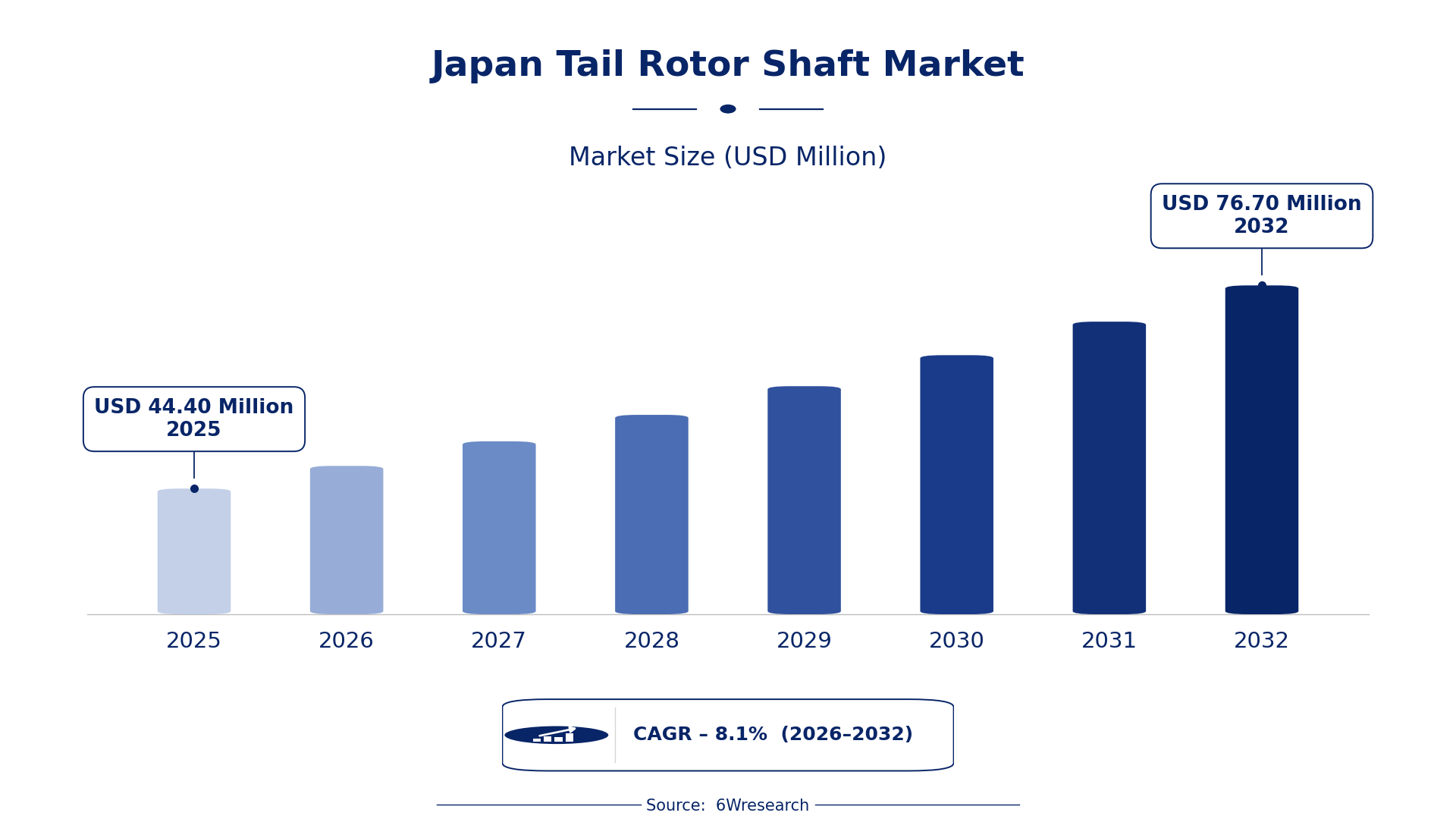
According to 6Wresearch internal database and industry insights, the Japan Tail Rotor Shaft Market was valued at USD 44.40 Million in 2025 and is projected to reach USD 76.70 Million by 2032, growing at a CAGR of approximately 8.1% during 2026–2032.
Japan Tail Rotor Shaft Market Highlights
| Report Metric | Details |
| Report Name | Japan Tail Rotor Shaft Market (2026-2032) |
| Market Size 2025 | USD 44.40 Million |
| Market Size 2032 | USD 76.70 Million |
| Absolute Growth 2025–2032 | USD 32.30 Million |
| CAGR 2026–2032 | 8.1% |
| Peak Annual Growth | 9.1% in 2032 |
| Forecast Period | 2026–2032 |
| Historical Data | 2022–2025 |
| Base Year | 2025 |
| Leading Tail Rotor Shaft, 2025 | Intermediate Shafts (45% share) |
| Leading Product Type, 2025 | Transmission Links (43% share) |
| Leading Shaft Type, 2025 | Hollow Shafts (47% share) |
| Leading Distribution Channel, 2025 | OEM Supply Chains (39% share) |
| Leading End User Industry, 2025 | Helicopter OEMs (36% share) |
| Fastest-Growing Tail Rotor Shaft | Flexible Drive Shafts (10.6% CAGR) |
| Fastest-Growing Product Type | Replacement Units (11.4% CAGR) |
| Fastest-Growing Shaft Type | Carbon Fiber (12.0% CAGR) |
| Fastest-Growing Distribution Channel | Aviation Distributors (10.3% CAGR) |
| Fastest-Growing End User Industry | Maintenance Companies (10.5% CAGR) |
| Growing Sector | Aerospace and Defense |
| Key End Users | Helicopter OEMs, Maintenance Companies, Aviation Maintenance, MRO Stores |
Japan Tail Rotor Shaft Market Year-wise Growth Rate and Key Drivers (2022–2032)
This graph illustrates the annual growth rates of the market from 2022 to 2032, highlighting a steady upward trajectory and projected market expansion over the forecast period.
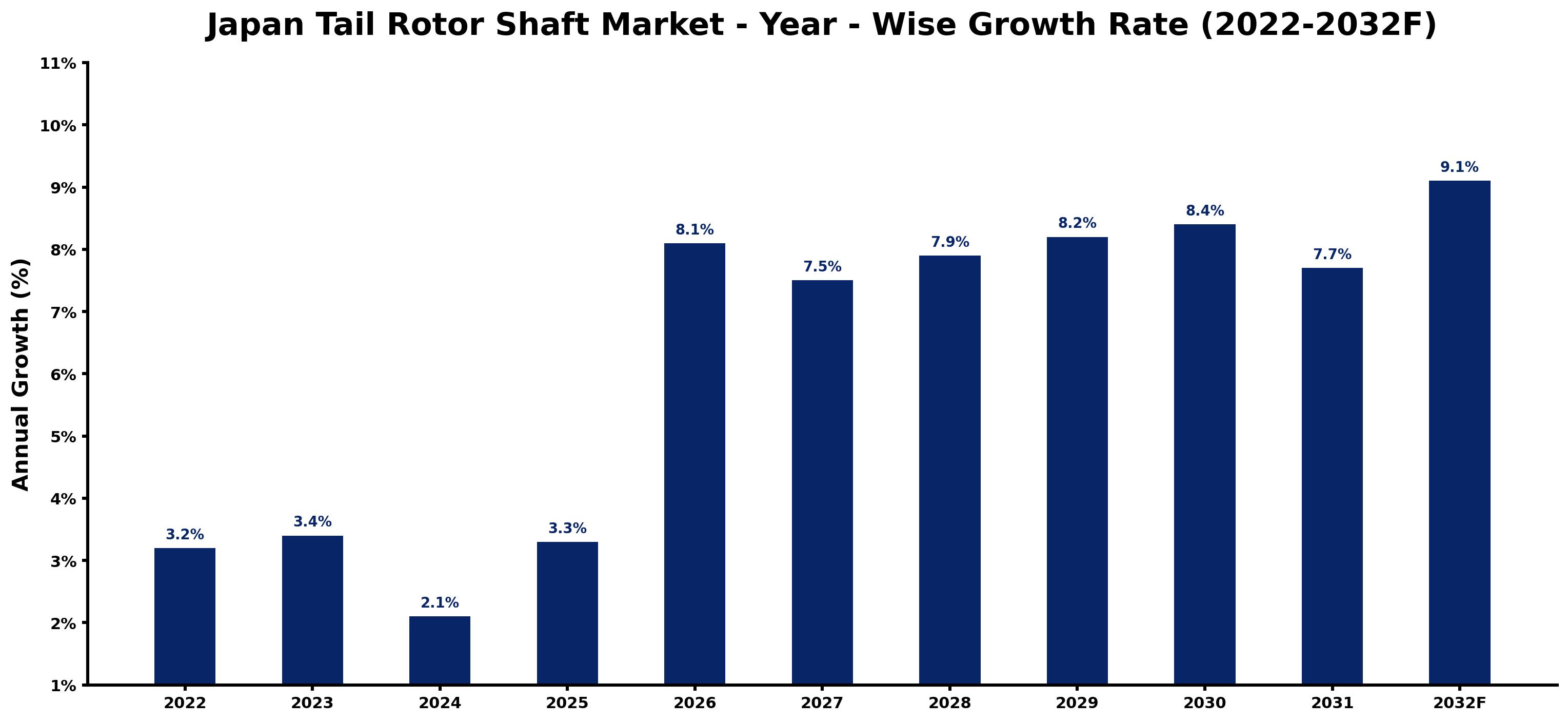
The table below sets out the estimated growth rate for each year and the main factor behind it.
| Year | Estimated Annual Growth (%) | Market Rationale |
| 2022 | 3.2 | Demand was stable due to ongoing helicopter operations and maintenance. |
| 2023 | 3.4 | Growth was driven by increased helicopter usage and maintenance services. |
| 2024 | 2.1 | Demand growth slowed as the market adjusted to previous highs. |
| 2025 | 3.3 | A slight uptick in orders was noted as maintenance activities resumed. |
| 2026 | 8.1 | Demand surged due to rising orders from helicopter OEMs and MRO services. |
| 2027 | 7.5 | Growth is expected to moderate as the market stabilises after rapid expansion. |
| 2028 | 7.9 | Demand is projected to increase again with more helicopter operations and maintenance needs. |
| 2029 | 8.2 | Orders will rise as the helicopter fleet ages, necessitating replacements. |
| 2030 | 8.4 | Growth will continue as maintenance companies expand their service offerings. |
| 2031 | 7.7 | Demand growth is expected to slow as the market approaches saturation levels. |
| 2032 | 9.1 | A peak in growth is projected, driven by new safety regulations. |
Note: Market size estimations and growth projections presented in this report are based on 6Wresearch's proprietary forecasting methodology, utilizing the latest available industry data, government publications, and primary research inputs.
Japan Tail Rotor Shaft Market Synopsis
The tail rotor shaft is a critical component in helicopter rotor systems, made from materials like steel and aluminum. The Japan Tail Rotor Shaft Market is driven by over 200 registered helicopters and a vibrant manufacturing sector. Growth is propelled by increased helicopter operations, maintenance services, and investments in safety measures, particularly in regions like Tokyo and Osaka, where helicopter OEMs are concentrated. This demand is further supported by government initiatives aimed at enhancing aviation safety and infrastructure.
Market Dynamics Impact Analysis (2026–2032)
| Factor | Type | Impact | Primary Segment Affected |
| Rising helicopter operations in Japan | Driver | High | Aftermarket Shafts |
| Increased demand for maintenance services | Driver | High | MRO Stores |
| Growing investment in aviation safety measures | Opportunity | High | Helicopter OEMs |
| Expansion of helicopter operations in urban areas | Opportunity | Medium | Aviation Maintenance |
| High costs associated with advanced materials | Restraint | Medium | Carbon Fiber |
| Limited availability of skilled technicians | Restraint | High | Maintenance Companies |
| Supply chain disruptions affecting production | Challenge | High | OEM Supply Chains |
| Regulatory compliance costs for manufacturers | Challenge | Medium | Helicopter OEMs |
Evaluation of Drivers in Japan Tail Rotor Shaft Market (2026–2032)
The factors lifting demand, and the evidence behind each, are summarised below.
| Drivers | Primary Segment Affected | Why It Matters (Evidence) |
| Increased helicopter operations drive demand for replacement parts | Aftermarket Shafts | With over 200 helicopters in Japan, maintenance companies require reliable replacement parts to ensure operational readiness. |
| Rising orders from helicopter OEMs boost production | OEM Supply Chains | Demand for new helicopters leads to increased orders for tail rotor shafts, particularly in Tokyo's manufacturing hub. |
| Growing focus on safety measures boosts demand for components | Transmission Links | The 2023 government program to improve helicopter safety has led to higher procurement of safety-critical components. |
| Aging helicopter fleets necessitate more maintenance | MRO Stores | As the average lifespan of a tail rotor shaft is around 10 years, maintenance services are increasingly in demand. |
| Technological advancements in helicopter design spur innovation | Hollow Shafts | The shift towards lightweight materials like carbon fiber is driving demand for advanced tail rotor shafts. |
Behind the steady rise in orders sits a growing need for replacement parts driven by increased helicopter operations. The average lifespan of a tail rotor shaft is approximately 10 years, prompting maintenance companies to procure more aftermarket shafts. The concentration of helicopter OEMs in regions like Tokyo has also increased orders for OEM supply chains. Adoption of lightweight materials is driving innovation in hollow shafts, further boosting demand for these components.
Evaluation of Restraints in Japan Tail Rotor Shaft Market
These restraints slow adoption and weigh on supplier margins.
| Market Restraint | Primary Segment Affected | Why It Matters (Evidence) |
| High costs associated with advanced materials limit accessibility | Carbon Fiber | The average cost of a tail rotor shaft ranges from 1,000 to 5,000 USD, making advanced options less accessible for some users. |
| Limited availability of skilled technicians hampers growth | Maintenance Companies | The demand for skilled technicians in Japan is rising, yet the supply remains constrained, affecting service delivery. |
| Supply chain disruptions affect timely production | OEM Supply Chains | Global supply chain issues have caused delays in the procurement of essential materials for production. |
| Regulatory compliance costs for manufacturers increase expenses | Helicopter OEMs | Compliance with the Economic Security Promotion Act adds financial burdens on manufacturers, impacting pricing. |
| Market saturation may limit new investments | Aviation Maintenance | As the market matures, potential investors may hesitate due to perceived lower returns. |
Japan Tail Rotor Shaft Market Challenges
Replacement units for tail rotor shafts can range from 1,000 to 5,000 USD, putting pressure on budgets for maintenance companies that must keep helicopters operational. The high costs associated with advanced materials impede technology adoption, delaying upgrades for producers reliant on outdated components. Compliance with regulations such as JIS B 1501 leads to longer production times for suppliers struggling to meet these standards. Buyers encounter sourcing difficulties as maintenance companies favour direct sales channels, potentially causing downtime during critical operations and affecting overall fleet readiness.
Trends in the Japan Tail Rotor Shaft Market
Below are the shifts with the largest effect on the Japan Tail Rotor Shaft Market.
- Shift towards Lightweight Materials in Helicopter Design: Tokyo is experiencing a shift towards carbon fiber shafts in helicopter designs, with adoption rates increasing by 20% in 2023. This trend improves performance and reduces weight, appealing to manufacturers.
- Transition from Traditional to Advanced Maintenance Practices: Since 2023, helicopter maintenance companies have begun adopting advanced maintenance practices, leading to a 15% increase in efficiency. This shift responds to the need for improved safety and operational readiness.
- Emergence of New Safety Standards for Helicopters: The introduction of JIS B 1501 in 2023 has set new standards for helicopter components, impacting manufacturers across Japan. Compliance is essential for maintaining market competitiveness.
- Growth of Urban Helicopter Operations: Since 2022, urban areas like Osaka have seen a rise in helicopter operations, with a 25% increase in flights. This trend reshapes the demand for tail rotor shafts.
Investment Opportunities in the Japan Tail Rotor Shaft Market
The following opportunities in the Japan Tail Rotor Shaft Market pair current demand with a clear way in.
- Investment in Advanced Materials for Tail Rotor Shafts: With the growing demand for lightweight helicopters, there is an opportunity to invest in carbon fibre shafts, which are projected to grow by 12% annually. Helicopter OEMs represent key buyers.
- Expansion of MRO Services in Key Regions: Now is an opportune moment to invest in MRO services in Tokyo and Osaka, where helicopter operations are on the rise. The market for MRO services is expected to grow significantly.
- Partnerships with Local Maintenance Companies: Forming joint ventures with local maintenance companies can ease market entry, particularly in regions with high helicopter activity. This strategy can tap into a burgeoning market.
- Funding Opportunities for Aviation Infrastructure Improvements: The government allocated USD 5 million in 2023 for aviation infrastructure improvements, creating opportunities for suppliers in the helicopter sector to engage in new projects.
Government Initiatives in the Japan Tail Rotor Shaft Market
The Economic Security Promotion Act of 2022 supports supply chain resilience for critical products, including tail rotor shafts. This legislation requires manufacturers to ensure the availability of essential materials, which strengthens local production and reduces dependence on imports.
In 2023, the Ministry of Land, Infrastructure, Transport and Tourism allocated USD 5 million for aviation infrastructure improvements. This funding aims to enhance safety and operational capabilities in the helicopter sector, benefiting both manufacturers and maintenance companies.
Future Insight of the Japan Tail Rotor Shaft Market
A policy-driven shift towards improved helicopter safety measures will compel suppliers to adopt advanced materials for lighter and more efficient tail rotor shafts. Government investments in aviation infrastructure will improve access to maintenance services, enabling buyers to benefit from quicker turnaround times. As MRO services expand due to aging helicopter fleets, suppliers must innovate to meet specific demands. Support from the Japan Aerospace Exploration Agency for aerospace innovations will stimulate technological advancements, reshaping production processes and improving operational efficiency.
Market Segmentation Analysis
Japan Tail Rotor Shaft Market report covers a detailed analysis of the following market segments:
By Tail Rotor Shaft – Intermediate Shafts Lead, Flexible Drive Shafts Expected to Grow Fastest
According to Saurav Kr Singh, Senior Research Analyst at 6Wresearch, Intermediate Shafts took 45% of tail rotor shaft revenue in 2025, more than any other category. Intermediate shafts are vital for transmitting torque in helicopter rotor systems, ensuring stability and control. The robust demand in Japan, particularly from the Tokyo region with over 200 registered helicopters, underlines their significance in the market. Flexible Drive Shafts are projected to grow fastest, at a CAGR of 10.6% during 2026–2032. Flexible drive shafts are witnessing rapid growth due to their adaptability in specific helicopter designs, enhancing operational flexibility. The increasing complexity of helicopter systems is propelling the swift adoption of these components. Suppliers should focus on developing flexible drive shafts to meet the specific needs of helicopter manufacturers.
By Product Type – Transmission Links Lead, Replacement Units Expected to Grow Fastest
Transmission Links accounted for 43% of the market by product type in 2025. Transmission links are essential for connecting various helicopter components, ensuring seamless operation and safety. Their critical role in helicopter assembly and maintenance makes them the preferred choice among manufacturers in Japan. The quickest growth will come from Replacement Units, forecast to expand at a CAGR of 11.4% between 2026 and 2032. Replacement units are increasingly sought after due to the aging helicopter fleets in Japan, necessitating regular updates for operational readiness. This trend highlights the need for reliable replacement parts in the market. Buyers must ensure a steady supply of replacement units to maintain the operational efficiency of their helicopter fleets.
By Shaft Type – Hollow Shafts Lead, Carbon Fiber Expected to Grow Fastest
The largest shaft type category in 2025 was Hollow Shafts, at 47% of revenue. Hollow shafts are preferred for their lightweight design, which significantly improves helicopter performance and fuel efficiency. This characteristic is particularly valued by manufacturers focused on enhancing the capabilities of their aircraft. Over 2026–2032, Carbon Fiber is expected to post the fastest growth, at a CAGR of 12.0%. Carbon fiber shafts are gaining popularity due to their weight reduction benefits in advanced helicopter designs, appealing to manufacturers aiming to optimise performance. The shift towards lightweight materials is likely to accelerate their market adoption. Suppliers should invest in carbon fiber technology to align with the industry's emphasis on lightweight components.
By Distribution Channel – OEM Supply Chains Lead, Aviation Distributors Expected to Grow Fastest
With 39% of distribution channel revenue in 2025, OEM Supply Chains was the largest category. OEM supply chains are the primary channel for new helicopter parts, ensuring manufacturers receive high-quality components directly from producers. This direct relationship is crucial for maintaining production schedules and quality standards. Aviation Distributors are set to record the highest CAGR in this split, 10.3% over 2026–2032. Aviation distributors are expanding their role by supplying parts to various users, responding to the rising demand for quick access to helicopter components. Their ability to streamline distribution is enhancing their market position. Suppliers should strengthen partnerships with aviation distributors to improve market reach and service delivery.
By End User Industry – Helicopter OEMs Lead, Maintenance Companies Expected to Grow Fastest
In 2025, Helicopter OEMs led the end user industry split with a 36% share. Helicopter OEMs are the largest consumers of tail rotor shafts, as they require these components for new aircraft production. Their ongoing projects and new model launches in Japan ensure a consistent demand for these parts. Maintenance Companies are projected to grow fastest, at a CAGR of 10.5% during 2026–2032. Maintenance companies are experiencing increased demand for tail rotor shafts due to the rise in helicopter flight operations, necessitating regular servicing and parts replacement. This trend is expected to continue as the operational fleet ages. Buyers in the maintenance sector should prioritise sourcing reliable suppliers to ensure timely access to essential components.
Key Attractiveness of the Report
- 10 Years of Market Numbers
- Historical Data Starting from 2022 to 2025
- Base Year 2025
- Forecast Data until 2032
- Key Performance Indicators Impacting the Market
- Major Upcoming Developments and Projects
Key Highlights of the Report:
- Japan Tail Rotor Shaft Market Outlook
- Market Size of Japan Tail Rotor Shaft Market, 2025
- Forecast of Japan Tail Rotor Shaft Market, 2032
- Historical Data and Forecast of Japan Tail Rotor Shaft Revenues & Volume for the Period 2022-2032F
- Japan Tail Rotor Shaft Market Trend Evolution
- Japan Tail Rotor Shaft Market Drivers and Challenges
- Japan Tail Rotor Shaft Price Trends
- Japan Tail Rotor Shaft Porter's Five Forces
- Japan Tail Rotor Shaft Industry Life Cycle
- Historical Data and Forecast of Japan Tail Rotor Shaft Market Revenues & Volume By Tail Rotor Shaft for the Period 2022-2032F
- Historical Data and Forecast of Japan Tail Rotor Shaft Market Revenues & Volume By Intermediate Shafts for the Period 2022-2032F
- Historical Data and Forecast of Japan Tail Rotor Shaft Market Revenues & Volume By Output Shafts for the Period 2022-2032F
- Historical Data and Forecast of Japan Tail Rotor Shaft Market Revenues & Volume By Flexible Drive Shafts for the Period 2022-2032F
- Historical Data and Forecast of Japan Tail Rotor Shaft Market Revenues & Volume By Aftermarket Shafts for the Period 2022-2032F
- Historical Data and Forecast of Japan Tail Rotor Shaft Market Revenues & Volume By Product Type for the Period 2022-2032F
- Historical Data and Forecast of Japan Tail Rotor Shaft Market Revenues & Volume By Transmission Links for the Period 2022-2032F
- Historical Data and Forecast of Japan Tail Rotor Shaft Market Revenues & Volume By Rotor Drive Shafts for the Period 2022-2032F
- Historical Data and Forecast of Japan Tail Rotor Shaft Market Revenues & Volume By Coupled Sections for the Period 2022-2032F
- Historical Data and Forecast of Japan Tail Rotor Shaft Market Revenues & Volume By Replacement Units for the Period 2022-2032F
- Historical Data and Forecast of Japan Tail Rotor Shaft Market Revenues & Volume By Shaft Type for the Period 2022-2032F
- Historical Data and Forecast of Japan Tail Rotor Shaft Market Revenues & Volume By Hollow Shafts for the Period 2022-2032F
- Historical Data and Forecast of Japan Tail Rotor Shaft Market Revenues & Volume By Steel/Aluminum for the Period 2022-2032F
- Historical Data and Forecast of Japan Tail Rotor Shaft Market Revenues & Volume By Carbon Fiber for the Period 2022-2032F
- Historical Data and Forecast of Japan Tail Rotor Shaft Market Revenues & Volume By Composite for the Period 2022-2032F
- Historical Data and Forecast of Japan Tail Rotor Shaft Market Revenues & Volume By Distribution Channel for the Period 2022-2032F
- Historical Data and Forecast of Japan Tail Rotor Shaft Market Revenues & Volume By OEM Supply Chains for the Period 2022-2032F
- Historical Data and Forecast of Japan Tail Rotor Shaft Market Revenues & Volume By Aviation Distributors for the Period 2022-2032F
- Historical Data and Forecast of Japan Tail Rotor Shaft Market Revenues & Volume By Direct Sales for the Period 2022-2032F
- Historical Data and Forecast of Japan Tail Rotor Shaft Market Revenues & Volume By MRO Stores for the Period 2022-2032F
- Historical Data and Forecast of Japan Tail Rotor Shaft Market Revenues & Volume By End User Industry for the Period 2022-2032F
- Historical Data and Forecast of Japan Tail Rotor Shaft Market Revenues & Volume By Helicopter OEMs for the Period 2022-2032F
- Historical Data and Forecast of Japan Tail Rotor Shaft Market Revenues & Volume By Helicopter Assemblers for the Period 2022-2032F
- Historical Data and Forecast of Japan Tail Rotor Shaft Market Revenues & Volume By Maintenance Companies for the Period 2022-2032F
- Historical Data and Forecast of Japan Tail Rotor Shaft Market Revenues & Volume By Aviation Maintenance for the Period 2022-2032F
- Japan Tail Rotor Shaft Import Export Trade Statistics
- Market Opportunity Assessment By Tail Rotor Shaft
- Market Opportunity Assessment By Product Type
- Market Opportunity Assessment By Shaft Type
- Market Opportunity Assessment By Distribution Channel
- Market Opportunity Assessment By End User Industry
- Japan Tail Rotor Shaft Top Companies Market Share
- Japan Tail Rotor Shaft Competitive Benchmarking By Technical and Operational Parameters
- Japan Tail Rotor Shaft Company Profiles
- Japan Tail Rotor Shaft Key Strategic Recommendations
Market Covered
Coverage by segment is as follows.
By Tail Rotor Shaft
- Intermediate Shafts
- Output Shafts
- Flexible Drive Shafts
- Aftermarket Shafts
By Product Type
- Transmission Links
- Rotor Drive Shafts
- Coupled Sections
- Replacement Units
By Shaft Type
- Hollow Shafts
- Steel/Aluminum
- Carbon Fiber
- Composite
By Distribution Channel
- OEM Supply Chains
- Aviation Distributors
- Direct Sales
- MRO Stores
By End User Industry
- Helicopter OEMs
- Helicopter Assemblers
- Maintenance Companies
- Aviation Maintenance































