Japan Tail Stabilizer Market Size & Growth Rate
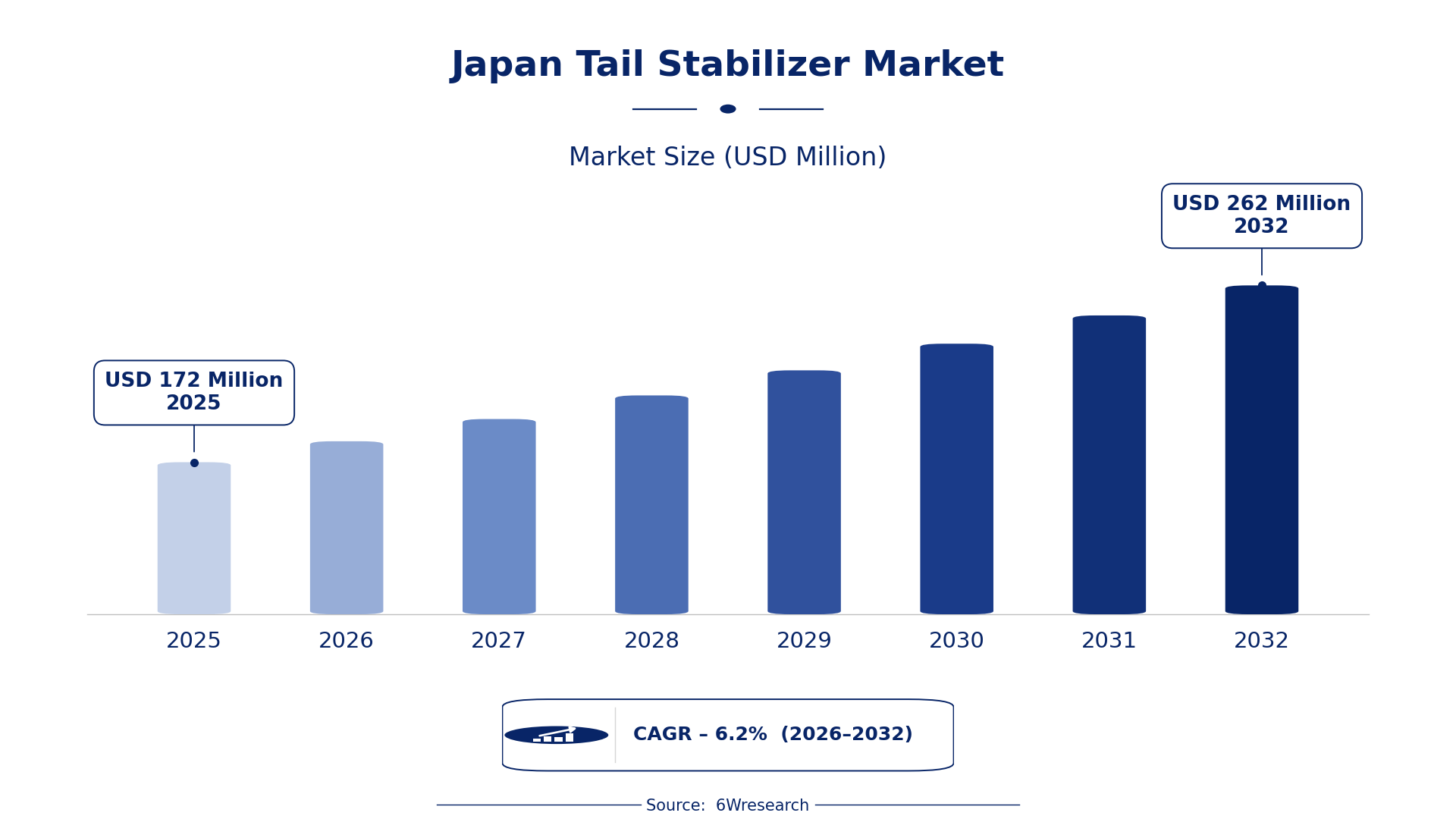
According to 6Wresearch internal database and industry insights, the Japan Tail Stabilizer Market was valued at USD 172 Million in 2025 and is projected to reach USD 262 Million by 2032, growing at a CAGR of approximately 6.2% during 2026–2032.
Japan Tail Stabilizer Market Highlights
| Report Metric | Details |
| Report Name | Japan Tail Stabilizer Market (2026-2032) |
| Market Size 2025 | USD 172 Million |
| Market Size 2032 | USD 262 Million |
| Absolute Growth 2025–2032 | USD 90 Million |
| CAGR 2026–2032 | 6.2% |
| Peak Annual Growth | 6.9% in 2026 |
| Forecast Period | 2026–2032 |
| Historical Data | 2022–2025 |
| Base Year | 2025 |
| Leading Tail Stabilizer, 2025 | Vertical Stabilizer (41% share) |
| Leading Product Type, 2025 | Fixed Fin (41% share) |
| Leading Configuration, 2025 | Composite (52% share) |
| Leading Distribution Channel, 2025 | OEM Sales (40% share) |
| Leading End User Industry, 2025 | Aircraft OEMs (38% share) |
| Fastest-Growing Tail Stabilizer | UAV Stabilizers (8.0% CAGR) |
| Fastest-Growing Product Type | Lightweight Fins (8.6% CAGR) |
| Fastest-Growing Distribution Channel | Online Distributors (8.2% CAGR) |
| Fastest-Growing End User Industry | Drone Manufacturers (7.9% CAGR) |
| Growing Sector | Aerospace Manufacturing |
| Key End Users | Aircraft OEMs, Drone Manufacturers, Aerospace Integrators |
Japan Tail Stabilizer Market Year-wise Growth Rate and Key Drivers (2022–2032)
This graph illustrates the annual growth rates of the market from 2022 to 2032, highlighting a steady upward trajectory and projected market expansion over the forecast period.
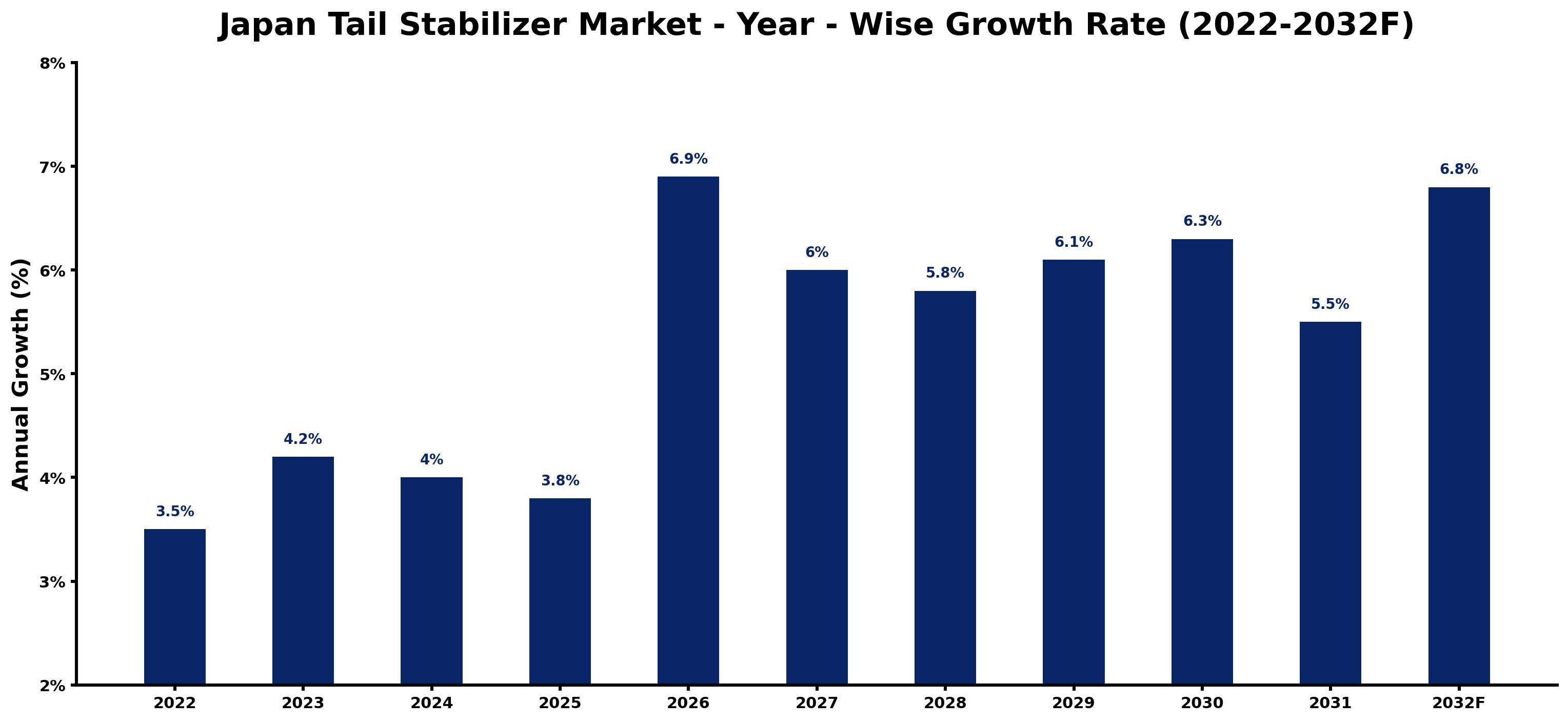
Annual growth estimates for each year appear below with the principal reason behind them, explaining the shifts that set the pace of the market.
| Year | Estimated Annual Growth (%) | Market Rationale |
| 2022 | 3.5 | The market experienced stable growth, driven by ongoing aerospace activities. |
| 2023 | 4.2 | Demand increased as Japan produced over 200 military aircraft, including fighter jets. |
| 2024 | 4.0 | Growth slowed slightly due to market adjustments and production timelines. |
| 2025 | 3.8 | The market continued to grow, supported by investments in aerospace technology. |
| 2026 | 6.9 | Growth peaked as the Ministry of Defense allocated ¥500 billion for aerospace technology development. |
| 2027 | 6.0 | Demand growth slowed as production rates stabilised following peak investments. |
| 2028 | 5.8 | The market continued to grow, driven by increased exports of aerospace products. |
| 2029 | 6.1 | Demand rose as UAV stabilizers gained traction in agricultural applications. |
| 2030 | 6.3 | Growth continued as the Aerospace Innovation Program aimed to enhance competitiveness. |
| 2031 | 5.5 | The market experienced a slowdown as growth rates normalised after rapid expansion. |
| 2032 | 6.8 | Demand is expected to rise as Japan aims for a 20% increase in aerospace exports. |
Note: Market size estimations and growth projections presented in this report are based on 6Wresearch's proprietary forecasting methodology, utilizing the latest available industry data, government publications, and primary research inputs.
Japan Tail Stabilizer Market Synopsis
Tail stabilizers are aerodynamic structures on aircraft that provide stability and control, constructed from materials such as aluminium and composites. Japan's Tail Stabilizer Market is expanding due to strong demand from aircraft manufacturers and military applications. The aerospace sector contributes approximately 1.5% to the national GDP, with a notable emphasis on technological advancements and increased exports, particularly in UAV applications. The Tokyo region acts as a hub for aerospace manufacturing, driving innovation and investment in stabilizer technologies.
Market Dynamics Impact Analysis (2026–2032)
| Factor | Type | Impact | Primary Segment Affected |
| Increased production of military aircraft | Driver | High | Vertical Stabilizer |
| Rising demand for UAV applications | Driver | High | UAV Stabilizers |
| Growing need for fuel-efficient designs | Opportunity | High | Lightweight Fins |
| Expansion of aerospace startups | Opportunity | Medium | Composite |
| Supply chain vulnerabilities | Restraint | High | Aluminum |
| Regulatory compliance costs | Restraint | Medium | Composite |
| High competition in the aerospace sector | Challenge | High | Vertical Stabilizer |
| Technological advancements leading to rapid changes | Challenge | Medium | Fixed Fin |
Evaluation of Drivers in Japan Tail Stabilizer Market (2026–2032)
The main growth drivers and the segments they affect most are set out below.
| Drivers | Primary Segment Affected | Why It Matters (Evidence) |
| Increased military aircraft production | Vertical Stabilizer | Japan produced over 200 military aircraft in 2022, leading to higher stabilizer demand from OEMs. |
| Growing UAV applications | UAV Stabilizers | The use of UAV stabilizers in agricultural applications is increasing, driving demand from drone manufacturers. |
| Demand for lightweight materials | Lightweight Fins | Composite materials account for about 30% of modern aircraft structures, prompting manufacturers to seek efficient designs. |
| Technological advancements in aerospace | Composite | Investment in advanced stabilizer technologies encourages manufacturers to adopt innovative solutions. |
| Support for aerospace startups | Composite | Funding programs from local governments have spurred innovation and growth in the aerospace sector. |
Volumes rise due to increased military aircraft production, with Japan producing over 200 military aircraft in 2022, resulting in heightened demand for vertical stabilizers. The growing utilisation of UAV stabilizers in agricultural applications is boosting purchases from drone manufacturers, as the sector continues to expand. Approximately 30% of modern aircraft structures consist of composite materials, prompting manufacturers to pursue lightweight fins for improved efficiency. This mix of factors is transforming purchasing patterns among manufacturers and suppliers alike.
Evaluation of Restraints in Japan Tail Stabilizer Market
The key brakes on demand, and where they bite hardest, are shown below.
| Market Restraint | Primary Segment Affected | Why It Matters (Evidence) |
| Supply chain vulnerabilities | Aluminum | Dependence on global supply chains for aluminum can lead to delays and increased costs for manufacturers. |
| Regulatory compliance costs | Composite | Compliance with standards like JIS Q 9001 increases operational costs for manufacturers in the aerospace industry. |
| Intense competition in the aerospace sector | Vertical Stabilizer | High competition among manufacturers pressures pricing and profit margins, affecting overall market conditions. |
| Technological advancements requiring constant investment | Fixed Fin | Rapid technological changes necessitate continuous investment, which can strain smaller manufacturers. |
| Market fluctuations due to geopolitical factors | UAV Stabilizers | Geopolitical tensions can disrupt supply chains and affect demand for UAV applications. |
Japan Tail Stabilizer Market Challenges
Sourcing composite materials poses a considerable challenge, as rising global demand elevates prices, leading to increased production costs for local manufacturers. Buyers encounter delays in delivery schedules due to supply chain disruptions, which can extend lead times by up to three months for critical components. Domestic producers find it difficult to compete with foreign firms that utilise advanced manufacturing technologies, risking a loss of market share and compelling them to boost R&D investments by 20%. Skills shortages within the workforce impede the adoption of new technologies, restricting innovation and slowing product development for manufacturers.
Trends in the Japan Tail Stabilizer Market
Four trends stand out in the Japan Tail Stabilizer Market.
- Shift towards Lightweight Materials: Aerospace manufacturers are increasingly adopting lightweight fins to enhance fuel efficiency, with composite materials making up about 30% of modern aircraft structures.
- Rising Demand for UAV Stabilizers: The use of UAV stabilizers is growing in agricultural applications, with notable expansion seen in the drone manufacturing sector, reflecting a broader trend towards automation in farming.
- Increased Focus on Aerospace Innovation: Government initiatives are propelling technological advancements in stabilizers, with funding aimed at boosting competitiveness in the aerospace sector, supporting local manufacturers.
- Growth in Aerospace Startups: Funding programmes from the Tokyo Metropolitan Government have resulted in a 15% increase in aerospace-related employment since 2020, driving innovation and new product development.
Investment Opportunities in the Japan Tail Stabilizer Market
The following opportunities in the Japan Tail Stabilizer Market pair current demand with a clear way in.
- Supply of Lightweight Fins: The growing demand for fuel-efficient designs creates opportunities for suppliers of lightweight fins, particularly in the Tokyo region, where aerospace innovation is encouraged.
- Investment in UAV Stabilizers: The increasing use of UAV stabilizers in agriculture presents an opportunity for manufacturers targeting drone manufacturers, especially in rural areas of Japan.
- Development of Composite Materials: With composite materials accounting for a substantial portion of modern aircraft structures, suppliers can focus on developing innovative composites for aircraft OEMs in Japan.
- Partnerships with Aerospace Startups: Collaborating with aerospace startups in the Tokyo region can provide established manufacturers with access to innovative technologies and new market segments.
Government Initiatives in the Japan Tail Stabilizer Market
The Economic Security Promotion Act, enacted in 2022, supports supply-chain resilience for critical products, including aerospace components. This law mandates manufacturers to ensure stable supplies of essential materials, enhancing the reliability of tail stabilizer production. Additionally, the PRTR Law requires reporting on chemical substances, ensuring environmental compliance in manufacturing processes.
In 2023, the Ministry of Defense allocated ¥500 billion for aerospace technology development, administered by the Ministry of Economy, Trade and Industry (METI). This funding bolsters research and innovation in stabilizer technology, promoting growth in the aerospace sector and strengthening Japan's competitive edge in the global market.
Future Insight of the Japan Tail Stabilizer Market
A policy-driven shift towards advancing aerospace technology will transform the tail stabilizer market by 2032. Increased funding from the Ministry of Defense for aerospace development will empower local manufacturers to innovate and enhance product offerings. The Tokyo Metropolitan Government's support for startups will encourage new solutions and improve competitiveness. By 2025, the expected growth in military aircraft production will create substantial opportunities for suppliers and buyers, broadening the market into new sectors.
Market Segmentation Analysis
Japan Tail Stabilizer Market report covers a detailed analysis of the following market segments:
By Tail Stabilizer – Vertical Stabilizer Leads, UAV Stabilizers Expected to Grow Fastest
According to Saurav Kr Singh, Senior Research Analyst at 6Wresearch, Vertical Stabilizer held 41% of the Japan Tail Stabilizer Market by tail stabilizer in 2025. The Vertical Stabilizer holds the largest share due to its essential role in ensuring aircraft stability, particularly in military aircraft, which saw production of over 200 units in 2022. This component is crucial for control, especially in the Tokyo region, a significant aerospace manufacturing hub. Over 2026–2032, UAV Stabilizers are expected to post the fastest growth, at a CAGR of 8.0%. UAV Stabilizers are experiencing rapid growth driven by the increasing use of drones in agricultural applications, supported by substantial investments in drone technology outlined in the 2023 defense budget. This segment's expansion aligns with Japan's commitment to advancing aerospace innovations. Suppliers should focus on enhancing their UAV Stabilizer offerings to meet the rising demand.
By Product Type – Fixed Fin Leads, Lightweight Fins Expected to Grow Fastest
Fixed Fin took 41% of product type revenue in 2025, more than any other category. Fixed Fin is the leading product type, serving as a standard component in many aircraft designs, ensuring reliability across various models in Japan's aerospace sector. Its established presence is reinforced by the robust production of military aircraft in the country, highlighting its importance. Lightweight Fins are set to record the highest CAGR in this split, 8.6% over 2026–2032. Lightweight Fins are projected to grow rapidly due to their increasing adoption for efficiency in modern aircraft designs, reflecting the industry's shift towards fuel-efficient solutions. This trend indicates a broader movement towards sustainability and cost-effectiveness in aviation. Buyers may benefit from exploring lightweight options to enhance aircraft efficiency and reduce operational costs.
By Configuration – Composite Leads and Records the Fastest Growth
The largest configuration category in 2025 was Composite, at 52% of revenue. Composite materials dominate the configuration segment because of their widespread use for their strength-to-weight ratio, making them ideal for contemporary aircraft designs. This adoption is evident in the practices of many aerospace manufacturers in Japan, showcasing their preference for composites. Its lead should widen, with a projected CAGR of 8.3% during 2026–2032, the highest in this split. The Composite configuration is also the fastest-growing due to its performance advantages and versatility, which are increasingly recognised in the industry. As demand for advanced materials rises, this segment's growth is likely to accelerate further. Suppliers should prioritise composite solutions to align with the evolving demands of the aerospace market.
By Distribution Channel – OEM Sales Leads, Online Distributors Expected to Grow Fastest
In 2025, OEM Sales led the distribution channel split with a 40% share. OEM Sales is the leading distribution channel, serving as the primary route for manufacturers to integrate tail stabilizers into new aircraft designs. This channel's dominance is reflected in the established relationships between OEMs and their component suppliers, ensuring a steady supply. The quickest growth will come from Online Distributors, forecast to expand at a CAGR of 8.2% between 2026 and 2032. Online Distributors are the fastest-growing channel, driven by the increasing demand for aftermarket parts and the convenience of digital purchasing. This shift indicates a changing landscape in how aerospace components are sourced and sold. Suppliers must adapt to the growing trend of online sales to effectively reach a wider customer base.
By End User Industry – Aircraft OEMs Lead, Drone Manufacturers Expected to Grow Fastest
Aircraft OEMs accounted for 38% of the market by end user industry in 2025. Aircraft OEMs represent the largest end user industry for tail stabilizers, as they are the primary users in the design and production of various aircraft models. The substantial output of military aircraft in Japan underscores the significance of this segment for stabilizer demand. Over 2026–2032, Drone Manufacturers are expected to post the fastest growth, at a CAGR of 7.9%. Drone Manufacturers are the fastest-growing end user industry, reflecting the rapid expansion of UAV applications across sectors like agriculture. This growth is supported by government investments aimed at enhancing drone technology and capabilities. Suppliers should consider targeting drone manufacturers to capitalise on this expanding market.
Key Attractiveness of the Report
- 10 Years of Market Numbers
- Historical Data Starting from 2022 to 2025
- Base Year 2025
- Forecast Data until 2032
- Key Performance Indicators Impacting the Market
- Major Upcoming Developments and Projects
Key Highlights of the Report:
- Japan Tail Stabilizer Market Outlook
- Market Size of Japan Tail Stabilizer Market, 2025
- Forecast of Japan Tail Stabilizer Market, 2032
- Historical Data and Forecast of Japan Tail Stabilizer Revenues & Volume for the Period 2022-2032F
- Japan Tail Stabilizer Market Trend Evolution
- Japan Tail Stabilizer Market Drivers and Challenges
- Japan Tail Stabilizer Price Trends
- Japan Tail Stabilizer Porter's Five Forces
- Japan Tail Stabilizer Industry Life Cycle
- Historical Data and Forecast of Japan Tail Stabilizer Market Revenues & Volume By Tail Stabilizer for the Period 2022-2032F
- Historical Data and Forecast of Japan Tail Stabilizer Market Revenues & Volume By Vertical Stabilizer for the Period 2022-2032F
- Historical Data and Forecast of Japan Tail Stabilizer Market Revenues & Volume By Horizontal Stabilizer for the Period 2022-2032F
- Historical Data and Forecast of Japan Tail Stabilizer Market Revenues & Volume By Adjustable Stabilizers for the Period 2022-2032F
- Historical Data and Forecast of Japan Tail Stabilizer Market Revenues & Volume By UAV Stabilizers for the Period 2022-2032F
- Historical Data and Forecast of Japan Tail Stabilizer Market Revenues & Volume By Product Type for the Period 2022-2032F
- Historical Data and Forecast of Japan Tail Stabilizer Market Revenues & Volume By Fixed Fin for the Period 2022-2032F
- Historical Data and Forecast of Japan Tail Stabilizer Market Revenues & Volume By Elevator Section for the Period 2022-2032F
- Historical Data and Forecast of Japan Tail Stabilizer Market Revenues & Volume By Movable Units for the Period 2022-2032F
- Historical Data and Forecast of Japan Tail Stabilizer Market Revenues & Volume By Lightweight Fins for the Period 2022-2032F
- Historical Data and Forecast of Japan Tail Stabilizer Market Revenues & Volume By Configuration for the Period 2022-2032F
- Historical Data and Forecast of Japan Tail Stabilizer Market Revenues & Volume By Composite for the Period 2022-2032F
- Historical Data and Forecast of Japan Tail Stabilizer Market Revenues & Volume By Aluminum for the Period 2022-2032F
- Historical Data and Forecast of Japan Tail Stabilizer Market Revenues & Volume By Alloy + CFRP for the Period 2022-2032F
- Historical Data and Forecast of Japan Tail Stabilizer Market Revenues & Volume By Thermoplastics for the Period 2022-2032F
- Historical Data and Forecast of Japan Tail Stabilizer Market Revenues & Volume By Distribution Channel for the Period 2022-2032F
- Historical Data and Forecast of Japan Tail Stabilizer Market Revenues & Volume By OEM Sales for the Period 2022-2032F
- Historical Data and Forecast of Japan Tail Stabilizer Market Revenues & Volume By Direct Sales for the Period 2022-2032F
- Historical Data and Forecast of Japan Tail Stabilizer Market Revenues & Volume By Defense Suppliers for the Period 2022-2032F
- Historical Data and Forecast of Japan Tail Stabilizer Market Revenues & Volume By Online Distributors for the Period 2022-2032F
- Historical Data and Forecast of Japan Tail Stabilizer Market Revenues & Volume By End User Industry for the Period 2022-2032F
- Historical Data and Forecast of Japan Tail Stabilizer Market Revenues & Volume By Aircraft OEMs for the Period 2022-2032F
- Historical Data and Forecast of Japan Tail Stabilizer Market Revenues & Volume By Aerospace Integrators for the Period 2022-2032F
- Historical Data and Forecast of Japan Tail Stabilizer Market Revenues & Volume By Fighter Jets for the Period 2022-2032F
- Historical Data and Forecast of Japan Tail Stabilizer Market Revenues & Volume By Drone Manufacturers for the Period 2022-2032F
- Japan Tail Stabilizer Import Export Trade Statistics
- Market Opportunity Assessment By Tail Stabilizer
- Market Opportunity Assessment By Product Type
- Market Opportunity Assessment By Configuration
- Market Opportunity Assessment By Distribution Channel
- Market Opportunity Assessment By End User Industry
- Japan Tail Stabilizer Top Companies Market Share
- Japan Tail Stabilizer Competitive Benchmarking By Technical and Operational Parameters
- Japan Tail Stabilizer Company Profiles
- Japan Tail Stabilizer Key Strategic Recommendations
Market Covered
Segments analysed in this report are listed below.
By Tail Stabilizer
- Vertical Stabilizer
- Horizontal Stabilizer
- Adjustable Stabilizers
- UAV Stabilizers
By Product Type
- Fixed Fin
- Elevator Section
- Movable Units
- Lightweight Fins
By Configuration
- Composite
- Aluminum
- Alloy + CFRP
- Thermoplastics
By Distribution Channel
- OEM Sales
- Direct Sales
- Defense Suppliers
- Online Distributors
By End User Industry
- Aircraft OEMs
- Aerospace Integrators
- Fighter Jets
- Drone Manufacturers































