Japan Tank Defeat Systems Market Size & Growth Rate
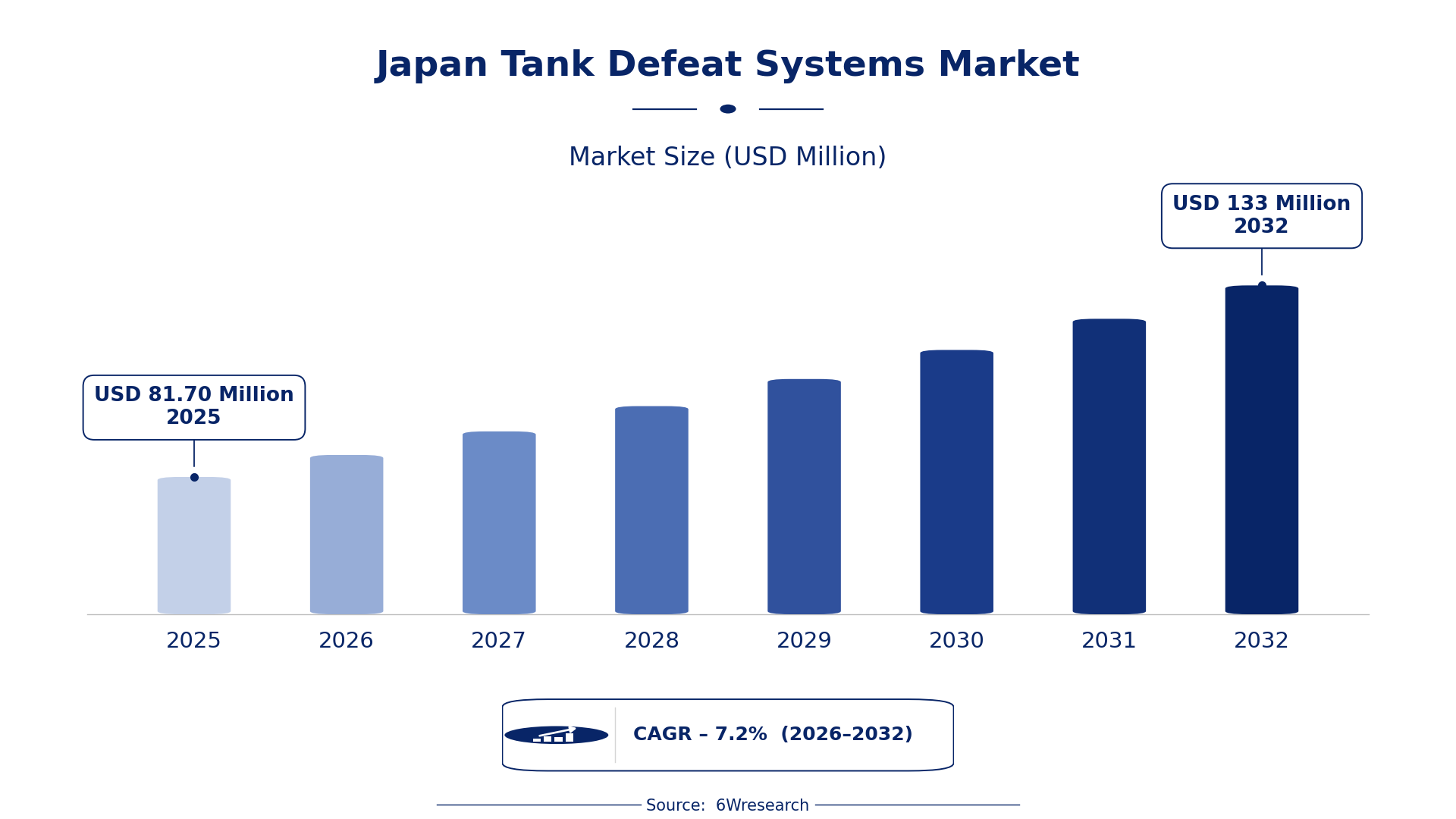
According to 6Wresearch internal database and industry insights, the Japan Tank Defeat Systems Market was valued at USD 81.70 Million in 2025 and is projected to reach USD 133 Million by 2032, growing at a CAGR of approximately 7.2% during 2026–2032.
Japan Tank Defeat Systems Market Highlights
| Report Metric | Details |
| Report Name | Japan Tank Defeat Systems Market (2026-2032) |
| Market Size 2025 | USD 81.70 Million |
| Market Size 2032 | USD 133 Million |
| Absolute Growth 2025–2032 | USD 51.30 Million |
| CAGR 2026–2032 | 7.2% |
| Peak Annual Growth | 8.4% in 2032 |
| Forecast Period | 2026–2032 |
| Historical Data | 2022–2025 |
| Base Year | 2025 |
| Leading Tank Defeat Systems, 2025 | Anti-Tank Missiles (48% share) |
| Leading Product Type, 2025 | Guided Systems (41% share) |
| Leading Mechanism Type, 2025 | Top-Attack Missiles (36% share) |
| Leading Distribution Channel, 2025 | Government Contracts (45% share) |
| Leading End User Industry, 2025 | Infantry Divisions (42% share) |
| Fastest-Growing Tank Defeat Systems | Loitering Munitions (10.2% CAGR) |
| Fastest-Growing Product Type | Kamikaze Drones (10.4% CAGR) |
| Fastest-Growing Distribution Channel | Defense Suppliers (9.7% CAGR) |
| Fastest-Growing End User Industry | Special Forces (9.4% CAGR) |
| Growing Sector | Military Technology |
| Key End Users | Infantry Divisions, Special Forces, Armored Brigades |
Japan Tank Defeat Systems Market Year-wise Growth Rate and Key Drivers (2022–2032)
This graph illustrates the annual growth rates of the market from 2022 to 2032, highlighting a steady upward trajectory and projected market expansion over the forecast period.
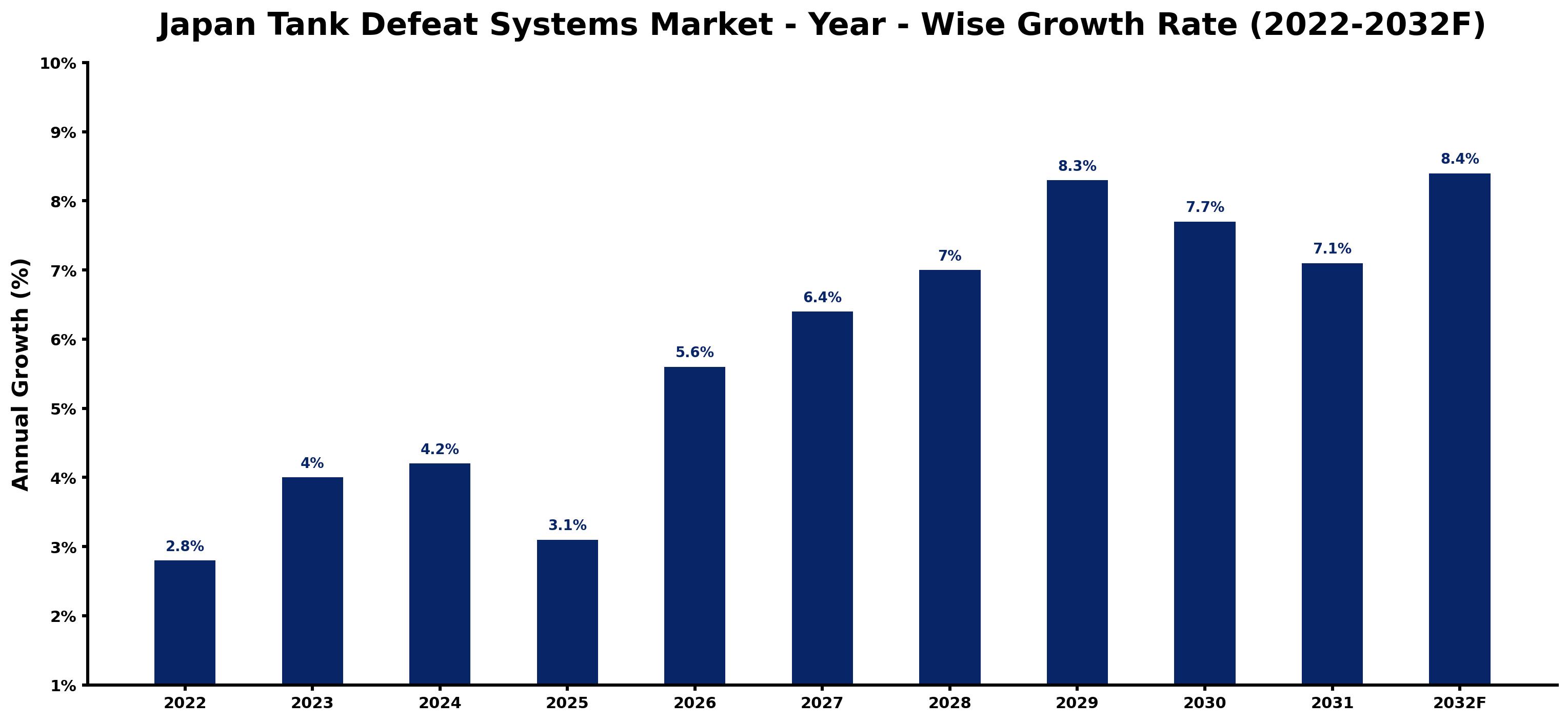
Below, each year's estimated growth is shown next to the factor that most influenced it.
| Year | Estimated Annual Growth (%) | Market Rationale |
| 2022 | 2.8 | The market showed steady activity, driven by ongoing military needs. |
| 2023 | 4.0 | Demand increased due to heightened focus on defense capabilities. |
| 2024 | 4.2 | Growth continued as investment in advanced weaponry rose. |
| 2025 | 3.1 | The growth rate slowed as procurement processes normalised. |
| 2026 | 5.6 | Demand is expected to surge with the introduction of new military strategies. |
| 2027 | 6.4 | Increased funding for defense technology is projected to spur market expansion. |
| 2028 | 7.0 | Investment in advanced systems will continue to drive demand upward. |
| 2029 | 8.3 | The market is expected to experience slower growth as military contracts expand. |
| 2030 | 7.7 | Growth is projected to slow slightly as procurement cycles stabilise. |
| 2031 | 7.1 | Demand will remain strong, supported by ongoing military upgrades. |
| 2032 | 8.4 | The market is expected to peak as advanced systems become operational. |
Note: Market size estimations and growth projections presented in this report are based on 6Wresearch's proprietary forecasting methodology, utilizing the latest available industry data, government publications, and primary research inputs.
Japan Tank Defeat Systems Market Synopsis
Tank Defeat Systems are sophisticated military technologies aimed at neutralising armored vehicles, utilising advanced materials and electronics for battlefield effectiveness. The Japan Tank Defeat Systems Market is expanding, driven by the Self-Defense Forces' operational requirements and substantial government contracts, with an annual defense budget of approximately ¥5 trillion. The focus on advanced weaponry, including anti-tank missiles and loitering munitions, is propelling market growth, with a projected size of USD 133 million by 2032.
Market Dynamics Impact Analysis (2026–2032)
| Factor | Type | Impact | Primary Segment Affected |
| Increased military funding | Driver | High | Anti-Tank Missiles |
| Integration of advanced technologies | Driver | High | Loitering Munitions |
| Growing demand for precision targeting systems | Opportunity | High | Guided Systems |
| Expansion of defense contracts | Opportunity | High | Government Contracts |
| High development costs | Restraint | Medium | Kinetic Energy Weapons |
| Long procurement cycles | Restraint | Medium | Directed Energy Systems |
| Limited domestic production capacity | Challenge | High | APFSDS Rounds |
| Compliance with international standards | Challenge | Medium | Top-Attack Missiles |
Evaluation of Drivers in Japan Tank Defeat Systems Market (2026–2032)
These are the developments adding the most demand over the forecast period.
| Drivers | Primary Segment Affected | Why It Matters (Evidence) |
| Increased military funding | Anti-Tank Missiles | Japan's defense budget of approximately ¥5 trillion supports procurement of anti-tank systems. |
| Integration of advanced technologies | Loitering Munitions | The focus on advanced weaponry drives demand for loitering munitions in military operations. |
| Growing demand for precision targeting systems | Guided Systems | Infantry divisions require guided systems for effective engagement with armored threats. |
| Expansion of defense contracts | Government Contracts | Government contracts account for 45% of the procurement channel, boosting market growth. |
| Investment in directed energy weapon research | Directed Energy Systems | The Japanese government has invested in directed energy systems for future capabilities. |
Much of the new demand traces back to Japan's Self-Defense Forces, which operate over 1,000 tanks, necessitating advanced anti-tank capabilities. The defense budget, approximately ¥5 trillion annually, fuels procurement of systems like anti-tank missiles and loitering munitions. The Tokyo region serves as a hub for defense technology research, boosting local production capabilities. Infantry divisions prioritise guided systems, essential for effective battlefield operations. Investment in directed energy weapon research is projected to stimulate demand for advanced military technologies.
Evaluation of Restraints in Japan Tank Defeat Systems Market
The main factors holding the market back are set out below.
| Market Restraint | Primary Segment Affected | Why It Matters (Evidence) |
| High development costs | Kinetic Energy Weapons | Development expenses for kinetic energy systems can exceed ¥1 billion, limiting production. |
| Long procurement cycles | Directed Energy Systems | Procurement processes for directed energy systems often take several years, delaying market entry. |
| Limited domestic production capacity | APFSDS Rounds | Japan's reliance on foreign suppliers for APFSDS rounds constrains local availability. |
| Compliance with international standards | Top-Attack Missiles | Adherence to ISO 9001 standards increases production costs for top-attack systems. |
| Market fragmentation | Loitering Munitions | Numerous small suppliers lead to competition that can dilute market share. |
Japan Tank Defeat Systems Market Challenges
Japan's Ministry of Defense allocates around ¥5 trillion annually for defence, yet slow technology adoption can hinder critical upgrades, impacting military readiness. A lack of skilled engineers in defence technology results in project delays, wasting valuable resources for producers and extending timelines. Compliance with ISO 9001 standards increases production costs for suppliers, significantly affecting profit margins. Buyers encounter funding challenges as the integration of kamikaze drones into strategies necessitates additional investment, straining budgets and prolonging procurement timelines.
Trends in the Japan Tank Defeat Systems Market
Four trends stand out in the Japan Tank Defeat Systems Market.
- Shift towards Advanced Weaponry: Infantry divisions are increasingly adopting advanced weaponry, focusing on anti-tank capabilities. In 2023, Japan announced a new defence strategy prioritising these systems, which is expected to boost demand.
- Integration of Kamikaze Drones: Kamikaze drones are becoming essential to Japan's defence strategy, enabling precision strikes against armoured vehicles. Their integration is anticipated to rise, with a 20% increase in usage by 2025.
- Expansion of Government Contracts: Government contracts are emerging as the primary procurement method, accounting for 45% of the market. This trend is likely to continue as defence budgets increase, creating more stable revenue streams for suppliers.
- Focus on Directed Energy Weapons: Directed energy weapons are receiving increased attention as a future combat solution. The Japanese government has committed substantial funding towards their development, aiming for operational readiness by 2030.
Investment Opportunities in the Japan Tank Defeat Systems Market
Investors looking at the Japan Tank Defeat Systems Market should consider the following areas.
- Tokyo as a Defense Technology Hub: Tokyo's defence technology research facilities are expanding, creating opportunities for suppliers. With an estimated investment of ¥500 million in 2024, partnerships with local research institutions can facilitate market entry.
- Supplying Advanced Anti-Tank Systems: The demand for advanced anti-tank systems is surging, particularly among infantry divisions. Suppliers can benefit from direct contracts with the government as procurement increases.
- Investment in Loitering Munitions: The rise of loitering munitions presents a timely investment opportunity. Suppliers can enter through partnerships with defence contractors in Japan as demand grows.
- Entry through Government Contracts: Government contracts represent a significant entry point, accounting for 45% of the market. Suppliers can establish joint ventures with local firms to navigate procurement processes effectively.
Government Initiatives in the Japan Tank Defeat Systems Market
The Japan Defense Agency plays a crucial role in military technology development and procurement. The agency has allocated approximately ¥5 trillion annually for defence spending, focusing on advanced weaponry and systems integration. This funding supports the development and acquisition of tank defeat systems, ensuring that the Self-Defense Forces remain equipped with the latest technologies.
Japan's Defense Agency approves various military technologies and allocates funding for their development. In 2023, the agency announced a new strategy focusing on advanced weaponry, including tank defeat systems. This strategy includes funding for research and development projects, ensuring that suppliers can access financial support for effective solutions.
Future Insight of the Japan Tank Defeat Systems Market
Investment in advanced weaponry will create strong demand for Tank Defeat Systems by 2032, with the Ministry of Defense allocating substantial funds for missile development. Japan's focus on directed energy weapon research will improve military effectiveness, enabling suppliers to provide advanced solutions. The adoption of new technologies will streamline production processes, reducing lead times for buyers. Increased international collaboration in defence technology will drive innovation, positioning Japan as a leader in military advancements.
Market Segmentation Analysis
Japan Tank Defeat Systems Market report covers a detailed analysis of the following market segments:
By Tank Defeat Systems – Anti-Tank Missiles Lead, Loitering Munitions Expected to Grow Fastest
According to Saurav Kr Singh, Senior Research Analyst at 6Wresearch, in 2025, Anti-Tank Missiles led the tank defeat systems split with a 48% share. Anti-Tank Missiles dominate the market due to their critical role in neutralising enemy tanks, with Japan's Self-Defense Forces operating over 1,000 tanks that require effective countermeasures. The annual defence budget allocates funds specifically for anti-tank missile development, ensuring a steady supply and demand. Over 2026–2032, Loitering Munitions are expected to post the fastest growth, at a CAGR of 10.2%. Loitering Munitions are experiencing rapid growth as they offer precision strikes on armoured targets, aligning with Japan's new defence strategy focusing on advanced weaponry. The integration of kamikaze drones into defence strategies further fuels this demand, indicating a shift towards more sophisticated attack methods. Suppliers should focus on developing advanced technologies to meet the increasing demand for precision strike capabilities.
By Product Type – Guided Systems Lead, Kamikaze Drones Expected to Grow Fastest
The largest product type category in 2025 was Guided Systems, at 41% of revenue. Guided Systems lead the market due to their precision targeting capabilities, which are vital for Japan's Self-Defense Forces that operate over 1,000 tanks. These systems are essential for effectively neutralising enemy armoured vehicles in various combat scenarios. Kamikaze Drones are set to record the highest CAGR in this split, 10.4% over 2026–2032. Kamikaze Drones are rapidly gaining traction as they are increasingly integrated into Japan's defence strategy for direct attacks on armoured vehicles, reflecting a shift towards advanced weaponry. This trend aligns with Japan's new defence strategy announced in 2023, which prioritises such technologies. Suppliers should focus on developing advanced guided systems and kamikaze drones to meet the growing demand in Japan's military sector.
By Mechanism Type – Top-Attack Missiles Lead and Record the Fastest Growth
With 36% of mechanism type revenue in 2025, Top-Attack Missiles was the largest category. Top-Attack Missiles hold the largest share as they target tanks from above, maximising effectiveness against heavily armoured vehicles. This capability is vital for Japan's infantry divisions, ensuring they can neutralise threats efficiently on the battlefield. Its lead should widen, with a projected CAGR of 10.6% during 2026–2032, the highest in this split. Top-Attack Missiles are also the fastest-growing segment, as their effectiveness continues to be recognised in military strategies, particularly with the increasing focus on advanced weaponry. Their dual role as both leader and fastest reflects a consistent demand for this technology. Manufacturers must prioritise the development of top-attack missile technologies to capitalise on their established market presence and growth potential.
By Distribution Channel – Government Contracts Lead, Defense Suppliers Expected to Grow Fastest
Government Contracts took 45% of distribution channel revenue in 2025, more than any other category. Government Contracts serve as the primary procurement method for military systems in Japan, showcasing the structured approach of the Ministry of Defense in managing an annual budget of approximately ¥5 trillion for defence. This ensures a consistent demand for tank defeat systems across various military branches. Defense Suppliers are projected to grow fastest, at a CAGR of 9.7% during 2026–2032. Defense Suppliers are experiencing the fastest growth as they provide essential components and systems, which are crucial in addressing the increasing complexity of military requirements. This growth signifies a shift towards a more diverse and responsive supply chain in the defence sector. Suppliers should strengthen relationships with defence suppliers to enhance their market reach and adapt to changing procurement dynamics.
By End User Industry – Infantry Divisions Lead, Special Forces Expected to Grow Fastest
Infantry Divisions accounted for 42% of the market by end user industry in 2025. Infantry Divisions are the primary users of tank defeat systems, ensuring that they are equipped with the necessary technology to counter armoured threats effectively. Their operational requirements drive the demand for advanced military technologies. Over 2026–2032, Special Forces are expected to post the fastest growth, at a CAGR of 9.4%. Special Forces are the fastest-growing end user as they require advanced systems for specialized missions, reflecting an increasing focus on tactical versatility in military operations. Their unique operational needs will continue to drive innovation in tank defeat technologies. Suppliers must tailor their offerings to meet the specific needs of special forces to capture this emerging market segment.
Key Attractiveness of the Report
- 10 Years of Market Numbers
- Historical Data Starting from 2022 to 2025
- Base Year 2025
- Forecast Data until 2032
- Key Performance Indicators Impacting the Market
- Major Upcoming Developments and Projects
Key Highlights of the Report:
- Japan Tank Defeat Systems Market Outlook
- Market Size of Japan Tank Defeat Systems Market, 2025
- Forecast of Japan Tank Defeat Systems Market, 2032
- Historical Data and Forecast of Japan Tank Defeat Systems Revenues & Volume for the Period 2022-2032F
- Japan Tank Defeat Systems Market Trend Evolution
- Japan Tank Defeat Systems Market Drivers and Challenges
- Japan Tank Defeat Systems Price Trends
- Japan Tank Defeat Systems Porter's Five Forces
- Japan Tank Defeat Systems Industry Life Cycle
- Historical Data and Forecast of Japan Tank Defeat Systems Market Revenues & Volume By Tank Defeat Systems for the Period 2022-2032F
- Historical Data and Forecast of Japan Tank Defeat Systems Market Revenues & Volume By Anti-Tank Missiles for the Period 2022-2032F
- Historical Data and Forecast of Japan Tank Defeat Systems Market Revenues & Volume By Loitering Munitions for the Period 2022-2032F
- Historical Data and Forecast of Japan Tank Defeat Systems Market Revenues & Volume By Kinetic Energy Weapons for the Period 2022-2032F
- Historical Data and Forecast of Japan Tank Defeat Systems Market Revenues & Volume By Directed Energy Systems for the Period 2022-2032F
- Historical Data and Forecast of Japan Tank Defeat Systems Market Revenues & Volume By Product Type for the Period 2022-2032F
- Historical Data and Forecast of Japan Tank Defeat Systems Market Revenues & Volume By Guided Systems for the Period 2022-2032F
- Historical Data and Forecast of Japan Tank Defeat Systems Market Revenues & Volume By Kamikaze Drones for the Period 2022-2032F
- Historical Data and Forecast of Japan Tank Defeat Systems Market Revenues & Volume By APFSDS Rounds for the Period 2022-2032F
- Historical Data and Forecast of Japan Tank Defeat Systems Market Revenues & Volume By DEW Weapons for the Period 2022-2032F
- Historical Data and Forecast of Japan Tank Defeat Systems Market Revenues & Volume By Mechanism Type for the Period 2022-2032F
- Historical Data and Forecast of Japan Tank Defeat Systems Market Revenues & Volume By Top-Attack Missiles for the Period 2022-2032F
- Historical Data and Forecast of Japan Tank Defeat Systems Market Revenues & Volume By AI-Targeting for the Period 2022-2032F
- Historical Data and Forecast of Japan Tank Defeat Systems Market Revenues & Volume By Tank-Mounted for the Period 2022-2032F
- Historical Data and Forecast of Japan Tank Defeat Systems Market Revenues & Volume By Laser-Guided for the Period 2022-2032F
- Historical Data and Forecast of Japan Tank Defeat Systems Market Revenues & Volume By Distribution Channel for the Period 2022-2032F
- Historical Data and Forecast of Japan Tank Defeat Systems Market Revenues & Volume By Government Contracts for the Period 2022-2032F
- Historical Data and Forecast of Japan Tank Defeat Systems Market Revenues & Volume By Defense Suppliers for the Period 2022-2032F
- Historical Data and Forecast of Japan Tank Defeat Systems Market Revenues & Volume By OEM Procurement for the Period 2022-2032F
- Historical Data and Forecast of Japan Tank Defeat Systems Market Revenues & Volume By Specialty Vendors for the Period 2022-2032F
- Historical Data and Forecast of Japan Tank Defeat Systems Market Revenues & Volume By End User Industry for the Period 2022-2032F
- Historical Data and Forecast of Japan Tank Defeat Systems Market Revenues & Volume By Infantry Divisions for the Period 2022-2032F
- Historical Data and Forecast of Japan Tank Defeat Systems Market Revenues & Volume By Special Forces for the Period 2022-2032F
- Historical Data and Forecast of Japan Tank Defeat Systems Market Revenues & Volume By Armored Brigades for the Period 2022-2032F
- Historical Data and Forecast of Japan Tank Defeat Systems Market Revenues & Volume By Research Facilities for the Period 2022-2032F
- Japan Tank Defeat Systems Import Export Trade Statistics
- Market Opportunity Assessment By Tank Defeat Systems
- Market Opportunity Assessment By Product Type
- Market Opportunity Assessment By Mechanism Type
- Market Opportunity Assessment By Distribution Channel
- Market Opportunity Assessment By End User Industry
- Japan Tank Defeat Systems Top Companies Market Share
- Japan Tank Defeat Systems Competitive Benchmarking By Technical and Operational Parameters
- Japan Tank Defeat Systems Company Profiles
- Japan Tank Defeat Systems Key Strategic Recommendations
Market Covered
This report examines the market across the segments below.
By Tank Defeat Systems
- Anti-Tank Missiles
- Loitering Munitions
- Kinetic Energy Weapons
- Directed Energy Systems
By Product Type
- Guided Systems
- Kamikaze Drones
- APFSDS Rounds
- DEW Weapons
By Mechanism Type
- Top-Attack Missiles
- AI-Targeting
- Tank-Mounted
- Laser-Guided
By Distribution Channel
- Government Contracts
- Defense Suppliers
- OEM Procurement
- Specialty Vendors
By End User Industry
- Infantry Divisions
- Special Forces
- Armored Brigades
- Research Facilities































