Japan Tank Level Automation Systems Market Size & Growth Rate
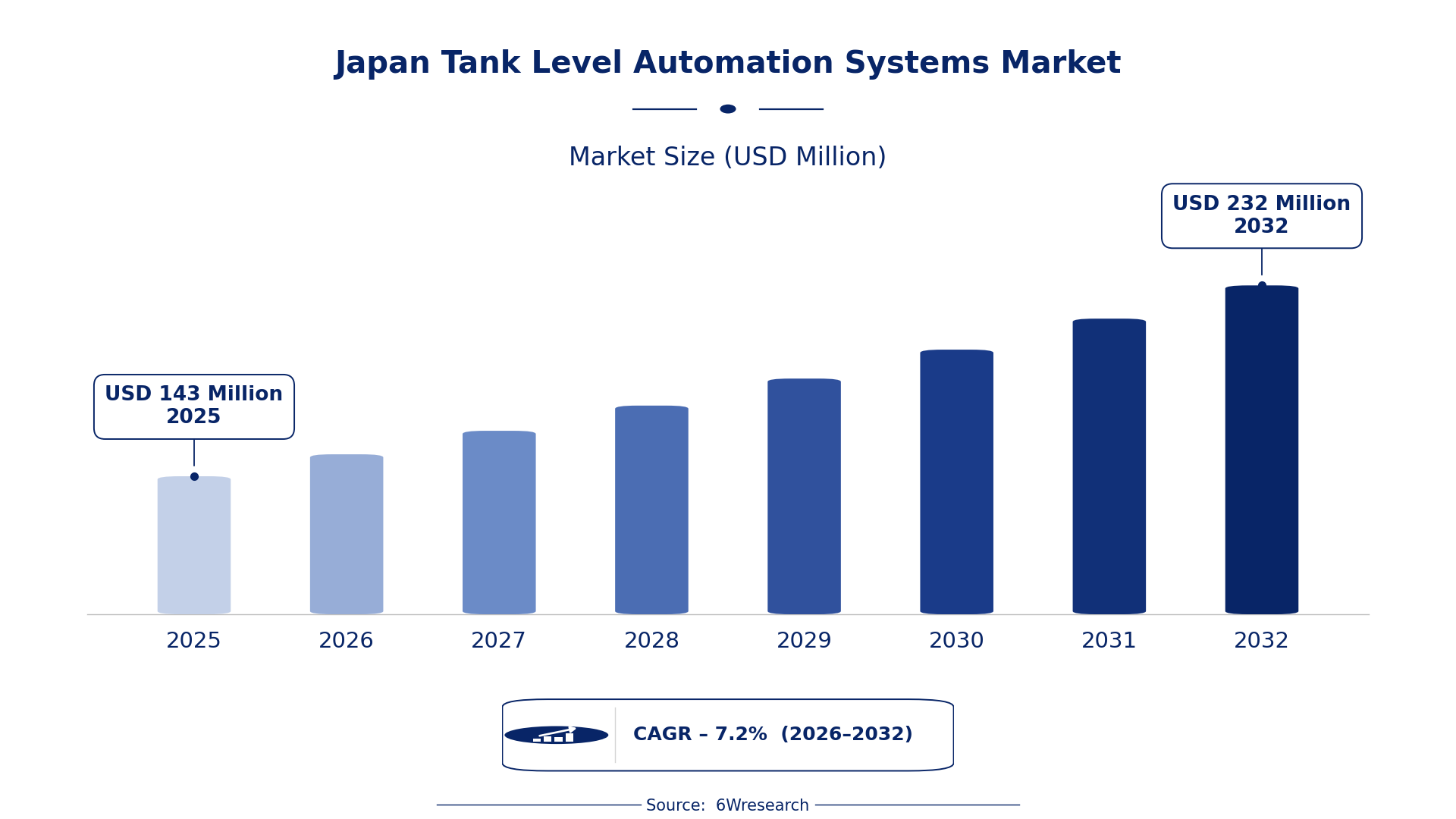
According to 6Wresearch internal database and industry insights, the Japan Tank Level Automation Systems Market was valued at USD 143 Million in 2025 and is projected to reach USD 232 Million by 2032, growing at a CAGR of approximately 7.2% during 2026–2032.
Japan Tank Level Automation Systems Market Highlights
| Report Metric | Details |
| Report Name | Japan Tank Level Automation Systems Market (2026-2032) |
| Market Size 2025 | USD 143 Million |
| Market Size 2032 | USD 232 Million |
| Absolute Growth 2025–2032 | USD 89 Million |
| CAGR 2026–2032 | 7.2% |
| Peak Annual Growth | 8.1% in 2028 |
| Forecast Period | 2026–2032 |
| Historical Data | 2022–2025 |
| Base Year | 2025 |
| Leading Tank Level Automation, 2025 | Ultrasonic Level Systems (50% share) |
| Leading Product Type, 2025 | Non-contact Sensing (43% share) |
| Leading Sensor Type, 2025 | Ultrasonic Waves (45% share) |
| Leading Distribution Channel, 2025 | Industrial Distributors (42% share) |
| Leading End User Industry, 2025 | Fuel Storage (42% share) |
| Fastest-Growing Tank Level Automation | Radar Level Systems (9.9% CAGR) |
| Fastest-Growing Product Type | Contactless Radar (10.0% CAGR) |
| Fastest-Growing Sensor Type | FMCW/Guided Wave (10.2% CAGR) |
| Fastest-Growing Distribution Channel | Direct Sales (9.4% CAGR) |
| Fastest-Growing End User Industry | Chemical Plants (9.1% CAGR) |
| Growing Sector | Chemical Plants |
| Key End Users | Fuel Storage, Chemical Plants, Water Treatment Plants, Oil Terminals |
Japan Tank Level Automation Systems Market Year-wise Growth Rate and Key Drivers (2022–2032)
This graph illustrates the annual growth rates of the market from 2022 to 2032, highlighting a steady upward trajectory and projected market expansion over the forecast period.
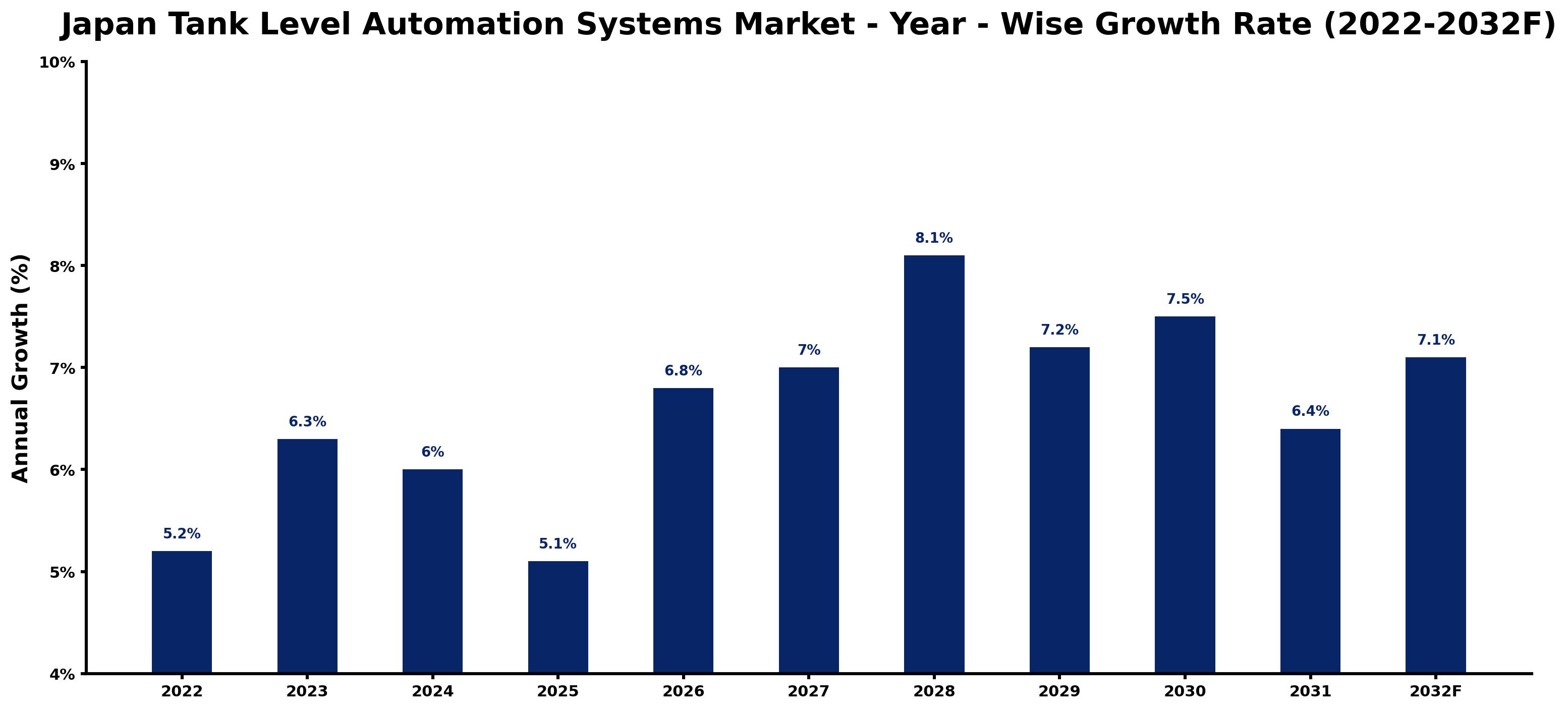
The yearly estimates that follow link every growth rate to its principal driver, so readers can see why the pace changed in each period.
| Year | Estimated Annual Growth (%) | Market Rationale |
| 2022 | 5.2 | The market showed steady growth due to consistent demand from domestic users. |
| 2023 | 6.3 | Growth accelerated as fuel storage and chemical industries increased automation efforts. |
| 2024 | 6.0 | Demand growth slowed slightly, influenced by market saturation in certain sectors. |
| 2025 | 5.1 | The market continued to expand, but at a slower pace as investments stabilised. |
| 2026 | 6.8 | Growth picked up again as new technologies gained traction in various applications. |
| 2027 | 7.0 | Continued advancements in automation technologies spurred further demand increases. |
| 2028 | 8.1 | The market peaked with significant investments in safety compliance and efficiency. |
| 2029 | 7.2 | Growth slowed as the market began to normalise after the peak year. |
| 2030 | 7.5 | Demand increased again, driven by ongoing decarbonisation initiatives and technology adoption. |
| 2031 | 6.4 | Growth decelerated slightly as the market adjusted to new standards and practices. |
| 2032 | 7.1 | The market is expected to grow as environmental regulations drive further automation. |
Note: Market size estimations and growth projections presented in this report are based on 6Wresearch's proprietary forecasting methodology, utilizing the latest available industry data, government publications, and primary research inputs.
Japan Tank Level Automation Systems Market Synopsis
Tank Level Automation Systems are critical technologies for monitoring and controlling liquid levels in various tanks, utilising sensing technologies like ultrasonic and radar. In Japan, the market is projected to grow to USD 232 million by 2032, driven by over 1,000 chemical plants and stringent safety regulations. The demand arises from the need for safety in fuel storage and operational efficiency in chemical plants, along with advancements in automation technologies.
Market Dynamics Impact Analysis (2026–2032)
| Factor | Type | Impact | Primary Segment Affected |
| Increased safety regulations in fuel storage facilities drive demand for automation systems. | Driver | High | Fuel Storage |
| The growing chemical industry requires advanced monitoring solutions to optimise operations. | Driver | High | Ultrasonic Level Systems |
| Rising investments in water treatment technologies create opportunities for automation suppliers. | Opportunity | High | Ultrasonic Level Systems |
| The expansion of oil terminals necessitates advanced monitoring systems for compliance and safety. | Opportunity | High | Oil Terminals |
| Market saturation in certain sectors limits growth potential for new entrants. | Restraint | Medium | Ultrasonic Level Systems |
| High initial costs of advanced systems can deter smaller operators from upgrading. | Restraint | Medium | Ultrasonic Level Systems |
| Supply chain disruptions can delay the delivery of critical components for manufacturers. | Challenge | High | Ultrasonic Level Systems |
| The rapid pace of technological change can outdate existing systems, affecting competitiveness. | Challenge | Medium | Ultrasonic Level Systems |
Evaluation of Drivers in Japan Tank Level Automation Systems Market (2026–2032)
Key forces behind demand, with the segment each one moves most, are listed below.
| Drivers | Primary Segment Affected | Why It Matters (Evidence) |
| Growing safety regulations in fuel storage facilities. | Radar Level Systems | These regulations require advanced monitoring solutions, leading to increased adoption of radar systems for compliance. |
| Expansion of the chemical industry in Japan. | Ultrasonic Level Systems | The need for operational efficiency drives demand for accurate liquid level measurement in over 1,000 chemical plants. |
| Increased focus on water quality monitoring in treatment plants. | Non-contact Sensing | Advanced monitoring technologies are promoted to maintain water quality standards, enhancing compliance efforts. |
| Rising investments in oil terminal automation. | Contactless Radar | Safety compliance in oil terminals necessitates the adoption of advanced monitoring systems to mitigate risks. |
| Technological advancements in automation systems. | FMCW/Guided Wave | These innovations improve precision and reliability, attracting buyers seeking modern solutions for their operations. |
Several shifts outside the market lift sales. The expansion of the chemical industry, with over 1,000 plants in Japan, increases demand for accurate liquid level measurement, driving adoption of ultrasonic systems. Investments in oil terminal automation are rising, as safety compliance necessitates advanced monitoring solutions. The push for improved water quality monitoring in treatment plants supports the adoption of non-contact sensing technologies, with the average population served by water treatment plants around 127 million. Technological advancements in automation systems are attracting buyers seeking reliable solutions, enhancing operational efficiency in various sectors.
Evaluation of Restraints in Japan Tank Level Automation Systems Market
Several factors work against faster growth; the main ones are summarised below.
| Market Restraint | Primary Segment Affected | Why It Matters (Evidence) |
| Market saturation in the fuel storage sector limits new opportunities. | Fuel Storage | With established systems in place, new entrants find it challenging to gain market share. |
| High initial costs deter smaller operators from upgrading systems. | Ultrasonic Level Systems | Smaller companies may struggle to justify investments in advanced automation technologies. |
| Supply chain disruptions affect the availability of critical components. | Ultrasonic Level Systems | Delays in component delivery hinder manufacturers' ability to meet demand, affecting project timelines. |
| Technological advancements can quickly outdate existing systems. | Ultrasonic Level Systems | This rapid pace of change forces operators to continuously invest in upgrades to remain competitive. |
| Regulatory compliance costs can be burdensome for smaller facilities. | Ultrasonic Level Systems | Smaller operators may find it difficult to meet stringent safety standards, affecting operational viability. |
Japan Tank Level Automation Systems Market Challenges
Japan's focus on decarbonisation raises costs for buyers in the fuel storage sector, as they must invest in new technologies to adhere to environmental standards. Many chemical plants face inefficiencies from outdated automation systems, resulting in operational costs increasing by 20% annually. Regulatory requirements, such as the JIS B 8500 standard, can delay project timelines for suppliers, leading to potential revenue losses of up to 15%. A shortage of advanced automation systems restricts producers' ability to meet demand, causing project delays that can extend timelines by several months.
Trends in the Japan Tank Level Automation Systems Market
Four trends stand out in the Japan Tank Level Automation Systems Market.
- Shift from Mechanical to Non-contact Sensing Technologies: Since 2022, there has been a clear shift towards non-contact sensing technologies in Japan's tank level automation market. With a growing emphasis on safety and efficiency, the adoption of ultrasonic and radar systems has risen, reflecting a 25% increase in usage across fuel storage facilities.
- Transition to Advanced Automation in Chemical Plants: In 2023, the chemical industry embraced advanced automation solutions, with a reported 30% increase in the adoption of radar level systems. This shift is driven by the need for operational efficiency and compliance with safety regulations, particularly in major industrial regions like Tokyo.
- Emergence of AI in Tank Level Monitoring: The introduction of AI technologies in 2025 has transformed tank level monitoring systems, improving predictive maintenance capabilities. This advancement is expected to increase operational reliability, with a projected 15% rise in system efficiency reported by chemical plants.
- Growing Demand for Compliance in Oil Terminals: Since 2023, oil terminals have increasingly adopted radar level systems to meet safety compliance requirements. With over 300 terminals in Japan, this trend has resulted in a 25% increase in the installation of advanced automation systems.
Investment Opportunities in the Japan Tank Level Automation Systems Market
The openings below show where demand in the Japan Tank Level Automation Systems Market is visible and how suppliers can enter.
- Tank Level Automation Systems for Water Treatment: The Japanese government allocated ¥5 billion for upgrading water treatment technologies, creating an opportunity for suppliers of tank level automation systems. This investment supports the need for advanced monitoring solutions in treatment plants, particularly in regions like Tokyo.
- Automation Solutions for Chemical Plants: As the chemical industry continues to grow, suppliers can address the rising demand for automation solutions. The Chemical Society of Japan's initiatives to promote automation present a timely opportunity for partnerships with local manufacturers.
- Advanced Monitoring for Oil Terminals: The expansion of oil terminals creates a pressing need for advanced monitoring systems. Suppliers should focus on developing solutions that meet safety compliance standards, particularly in major industrial hubs like Kanagawa.
- Non-contact Sensing Technologies for Fuel Storage: The demand for non-contact sensing technologies is increasing, driven by safety regulations. Suppliers can enter this market by partnering with industrial distributors to effectively reach fuel storage facilities.
Government Initiatives in the Japan Tank Level Automation Systems Market
The JIS B 8500 standard, established to govern tank level measurement systems, has been in effect since 2020. This standard ensures that all tank level automation systems meet safety and accuracy requirements, benefiting producers and buyers alike by providing a clear framework for compliance. The Green Growth Strategy Through Achieving Carbon Neutrality in 2050 outlines targets that encourage the adoption of advanced technologies in various sectors, including tank level automation.
In 2023, a government programme allocated ¥5 billion for upgrading water treatment technologies, overseen by the Ministry of the Environment. This funding aims to improve monitoring systems, ensuring compliance with environmental regulations and benefiting both producers and operators in the water treatment sector.
Future Insight of the Japan Tank Level Automation Systems Market
By 2032, Japan's commitment to a 46% reduction in greenhouse-gas emissions will accelerate the adoption of advanced tank level automation technologies, prompting suppliers to innovate. The government's investment in upgrading water treatment technologies will enhance system capabilities, benefiting buyers with improved efficiency. Initiatives from the Chemical Society of Japan will support automation in chemical processes, ensuring safer operations. Buyers can expect better compliance with safety standards and streamlined operational performance across the industry.
Market Segmentation Analysis
Japan Tank Level Automation Systems Market report covers a detailed analysis of the following market segments:
By Tank Level Automation – Ultrasonic Level Systems Lead, Radar Level Systems Expected to Grow Fastest
According to Saurav Kr Singh, Senior Research Analyst at 6Wresearch, with 50% of tank level automation revenue in 2025, Ultrasonic Level Systems was the largest category. Ultrasonic Level Systems dominate the market due to their critical application in accurately measuring liquid levels, particularly in fuel storage and chemical facilities. The reliance on these systems is underscored by the presence of over 1,000 chemical plants that utilise them for safety compliance. Radar Level Systems are set to record the highest CAGR in this split, 9.9% over 2026–2032. Radar Level Systems are experiencing rapid growth as they are increasingly adopted in oil terminals to meet stringent safety compliance requirements. This trend is driven by the need for reliable continuous level monitoring in challenging environments, which enhances overall operational safety. Suppliers should focus on developing radar systems to meet the increasing safety demands in the market.
By Product Type – Non-contact Sensing Leads, Contactless Radar Expected to Grow Fastest
Non-contact Sensing accounted for 43% of the market by product type in 2025. Non-contact Sensing leads the market as it is widely used for ensuring safety and efficiency in monitoring liquid levels across various industries. Its essential role in operational processes reinforces its dominant position in the market. The quickest growth will come from Contactless Radar, forecast to expand at a CAGR of 10.0% between 2026 and 2032. Contactless Radar is growing rapidly due to its reliability and effectiveness in diverse applications. This trend indicates a shift towards advanced monitoring technologies that improve operational performance. Buyers should invest in contactless radar solutions to enhance operational reliability and safety.
By Sensor Type – Ultrasonic Waves Lead, FMCW/Guided Wave Expected to Grow Fastest
Ultrasonic Waves held 45% of the Japan Tank Level Automation Systems Market by sensor type in 2025. Ultrasonic Waves are the predominant sensor type, widely utilised for non-invasive level detection across various applications. Their proven accuracy and reliability have made them a fundamental choice in the industry. Over 2026–2032, FMCW/Guided Wave is expected to post the fastest growth, at a CAGR of 10.2%. FMCW/Guided Wave sensors are gaining popularity due to their precision and reliability in demanding environments, which is driving their rapid adoption. This trend reflects a broader movement towards advanced sensing technologies that meet complex operational needs. Suppliers should expand their product lines to include FMCW/Guided Wave sensors to capture emerging market opportunities.
By Distribution Channel – Industrial Distributors Lead, Direct Sales Expected to Grow Fastest
The largest distribution channel category in 2025 was Industrial Distributors, at 42% of revenue. Industrial Distributors are the primary channel for tank level automation systems, playing a crucial role in supplying these technologies to end users. Their established networks facilitate efficient distribution and provide customers with easy access to necessary solutions. Direct Sales is projected to grow fastest, at a CAGR of 9.4% during 2026–2032. Direct Sales are experiencing significant growth as they strengthen customer relationships and offer tailored service, which is increasingly valued by buyers. This shift highlights the importance of direct engagement in effectively meeting customer needs. Suppliers should enhance direct sales strategies to build stronger customer relationships and improve service delivery.
By End User Industry – Fuel Storage Leads, Chemical Plants Expected to Grow Fastest
Fuel Storage took 42% of end user industry revenue in 2025, more than any other category. Fuel Storage is the leading end user industry, vital for monitoring safety and compliance in liquid storage operations. The high demand for effective monitoring solutions in this sector highlights its critical importance in the market. Chemical Plants are set to record the highest CAGR in this split, 9.1% over 2026–2032. Chemical Plants are witnessing the fastest growth as they increasingly require automation systems to ensure operational efficiency and safety in their processes. This trend reflects the industry's ongoing push towards enhanced automation and reliability. Suppliers should focus on providing tailored solutions for chemical plants to capitalise on the growing demand for automation.
Key Attractiveness of the Report
- 10 Years of Market Numbers
- Historical Data Starting from 2022 to 2025
- Base Year 2025
- Forecast Data until 2032
- Key Performance Indicators Impacting the Market
- Major Upcoming Developments and Projects
Key Highlights of the Report:
- Japan Tank Level Automation Systems Market Outlook
- Market Size of Japan Tank Level Automation Systems Market, 2025
- Forecast of Japan Tank Level Automation Systems Market, 2032
- Historical Data and Forecast of Japan Tank Level Automation Systems Revenues & Volume for the Period 2022-2032F
- Japan Tank Level Automation Systems Market Trend Evolution
- Japan Tank Level Automation Systems Market Drivers and Challenges
- Japan Tank Level Automation Systems Price Trends
- Japan Tank Level Automation Systems Porter's Five Forces
- Japan Tank Level Automation Systems Industry Life Cycle
- Historical Data and Forecast of Japan Tank Level Automation Systems Market Revenues & Volume By Tank Level Automation for the Period 2022-2032F
- Historical Data and Forecast of Japan Tank Level Automation Systems Market Revenues & Volume By Ultrasonic Level Systems for the Period 2022-2032F
- Historical Data and Forecast of Japan Tank Level Automation Systems Market Revenues & Volume By Radar Level Systems for the Period 2022-2032F
- Historical Data and Forecast of Japan Tank Level Automation Systems Market Revenues & Volume By Float and Tape Systems for the Period 2022-2032F
- Historical Data and Forecast of Japan Tank Level Automation Systems Market Revenues & Volume By Capacitive Sensors for the Period 2022-2032F
- Historical Data and Forecast of Japan Tank Level Automation Systems Market Revenues & Volume By Product Type for the Period 2022-2032F
- Historical Data and Forecast of Japan Tank Level Automation Systems Market Revenues & Volume By Non-contact Sensing for the Period 2022-2032F
- Historical Data and Forecast of Japan Tank Level Automation Systems Market Revenues & Volume By Contactless Radar for the Period 2022-2032F
- Historical Data and Forecast of Japan Tank Level Automation Systems Market Revenues & Volume By Mechanical Sensors for the Period 2022-2032F
- Historical Data and Forecast of Japan Tank Level Automation Systems Market Revenues & Volume By Capacitive Probes for the Period 2022-2032F
- Historical Data and Forecast of Japan Tank Level Automation Systems Market Revenues & Volume By Sensor Type for the Period 2022-2032F
- Historical Data and Forecast of Japan Tank Level Automation Systems Market Revenues & Volume By Ultrasonic Waves for the Period 2022-2032F
- Historical Data and Forecast of Japan Tank Level Automation Systems Market Revenues & Volume By FMCW/Guided Wave for the Period 2022-2032F
- Historical Data and Forecast of Japan Tank Level Automation Systems Market Revenues & Volume By Stainless Steel for the Period 2022-2032F
- Historical Data and Forecast of Japan Tank Level Automation Systems Market Revenues & Volume By PTFE-Coated for the Period 2022-2032F
- Historical Data and Forecast of Japan Tank Level Automation Systems Market Revenues & Volume By Distribution Channel for the Period 2022-2032F
- Historical Data and Forecast of Japan Tank Level Automation Systems Market Revenues & Volume By Industrial Distributors for the Period 2022-2032F
- Historical Data and Forecast of Japan Tank Level Automation Systems Market Revenues & Volume By Direct Sales for the Period 2022-2032F
- Historical Data and Forecast of Japan Tank Level Automation Systems Market Revenues & Volume By OEMs for the Period 2022-2032F
- Historical Data and Forecast of Japan Tank Level Automation Systems Market Revenues & Volume By Online Platforms for the Period 2022-2032F
- Historical Data and Forecast of Japan Tank Level Automation Systems Market Revenues & Volume By End User Industry for the Period 2022-2032F
- Historical Data and Forecast of Japan Tank Level Automation Systems Market Revenues & Volume By Fuel Storage for the Period 2022-2032F
- Historical Data and Forecast of Japan Tank Level Automation Systems Market Revenues & Volume By Chemical Plants for the Period 2022-2032F
- Historical Data and Forecast of Japan Tank Level Automation Systems Market Revenues & Volume By Water Treatment Plants for the Period 2022-2032F
- Historical Data and Forecast of Japan Tank Level Automation Systems Market Revenues & Volume By Oil Terminals for the Period 2022-2032F
- Japan Tank Level Automation Systems Import Export Trade Statistics
- Market Opportunity Assessment By Tank Level Automation
- Market Opportunity Assessment By Product Type
- Market Opportunity Assessment By Sensor Type
- Market Opportunity Assessment By Distribution Channel
- Market Opportunity Assessment By End User Industry
- Japan Tank Level Automation Systems Top Companies Market Share
- Japan Tank Level Automation Systems Competitive Benchmarking By Technical and Operational Parameters
- Japan Tank Level Automation Systems Company Profiles
- Japan Tank Level Automation Systems Key Strategic Recommendations
Market Covered
The following segment groups are covered in the report.
By Tank Level Automation
- Ultrasonic Level Systems
- Radar Level Systems
- Float and Tape Systems
- Capacitive Sensors
By Product Type
- Non-contact Sensing
- Contactless Radar
- Mechanical Sensors
- Capacitive Probes
By Sensor Type
- Ultrasonic Waves
- FMCW/Guided Wave
- Stainless Steel
- PTFE-Coated
By Distribution Channel
- Industrial Distributors
- Direct Sales
- OEMs
- Online Platforms
By End User Industry
- Fuel Storage
- Chemical Plants
- Water Treatment Plants
- Oil Terminals































