Japan Tank-Mix Adjuvants Market Size & Growth Rate
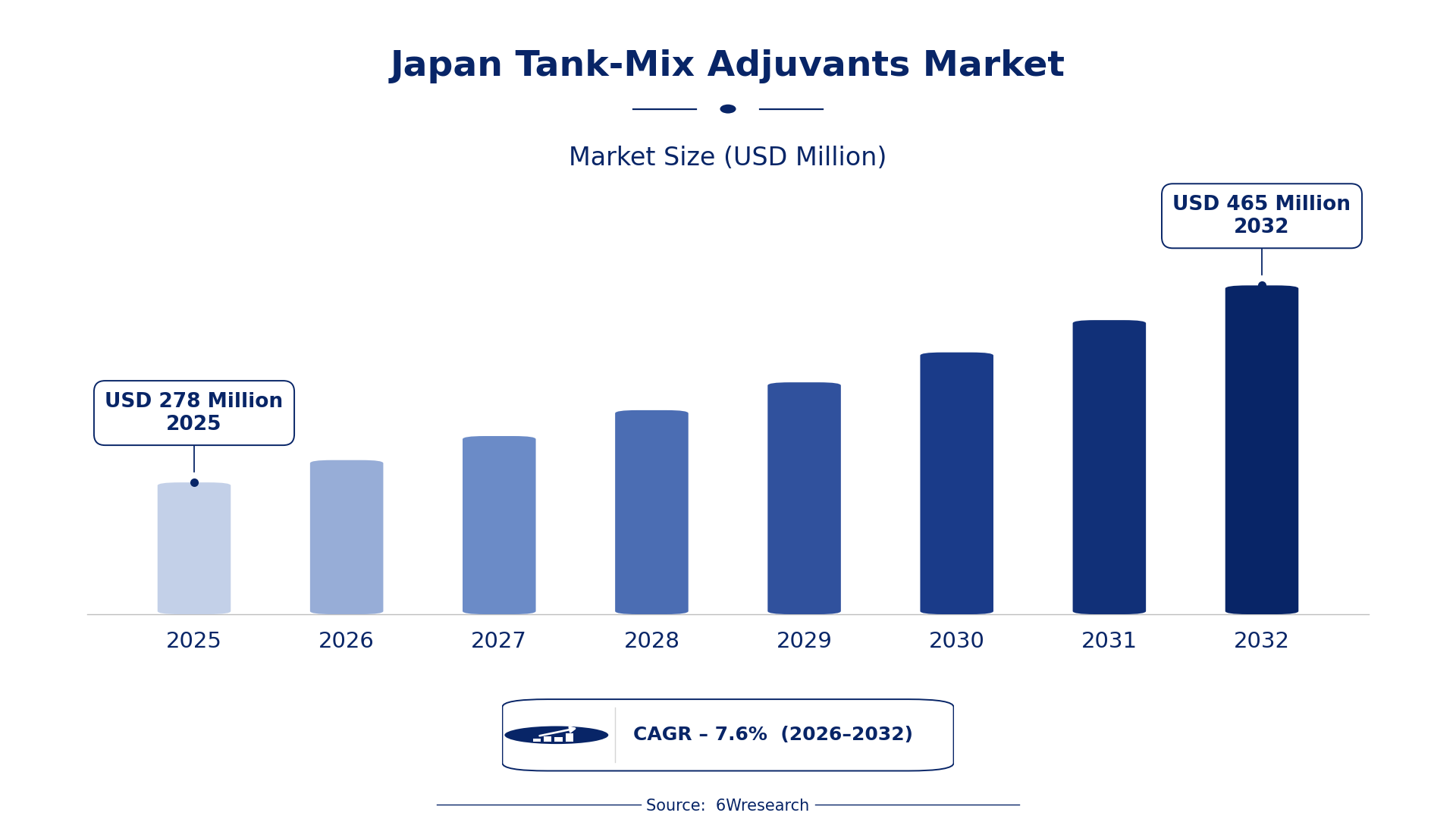
According to 6Wresearch internal database and industry insights, the Japan Tank-Mix Adjuvants Market was valued at USD 278 Million in 2025 and is projected to reach USD 465 Million by 2032, growing at a CAGR of approximately 7.6% during 2026–2032.
Japan Tank-Mix Adjuvants Market Highlights
| Report Metric | Details |
| Report Name | Japan Tank-Mix Adjuvants Market (2026-2032) |
| Market Size 2025 | USD 278 Million |
| Market Size 2032 | USD 465 Million |
| Absolute Growth 2025–2032 | USD 187 Million |
| CAGR 2026–2032 | 7.6% |
| Peak Annual Growth | 9.2% in 2026 |
| Forecast Period | 2026–2032 |
| Historical Data | 2022–2025 |
| Base Year | 2025 |
| Leading Tank-Mix Adjuvants, 2025 | Surfactants (49% share) |
| Leading Product Type, 2025 | Non-Ionic/Anionic (36% share) |
| Leading Adjuvant Class, 2025 | Surface Tension Agents (41% share) |
| Leading Distribution Channel, 2025 | Agri Distributors (52% share) |
| Leading End User Industry, 2025 | Crop Protection (53% share) |
| Fastest-Growing Tank-Mix Adjuvants | Drift Control Agents (9.5% CAGR) |
| Fastest-Growing Product Type | Methylated Seed Oil (10.5% CAGR) |
| Fastest-Growing Adjuvant Class | Spray Penetrants (9.8% CAGR) |
| Fastest-Growing Distribution Channel | Online Platforms (10.2% CAGR) |
| Fastest-Growing End User Industry | Agrochemical Companies (9.4% CAGR) |
| Growing Sector | Crop Protection |
| Key End Users | Farm Operations, Agrochemical Companies, Crop Protection, Agri Distributors |
Japan Tank-Mix Adjuvants Market Year-wise Growth Rate and Key Drivers (2022–2032)
This graph illustrates the annual growth rates of the market from 2022 to 2032, highlighting a steady upward trajectory and projected market expansion over the forecast period.
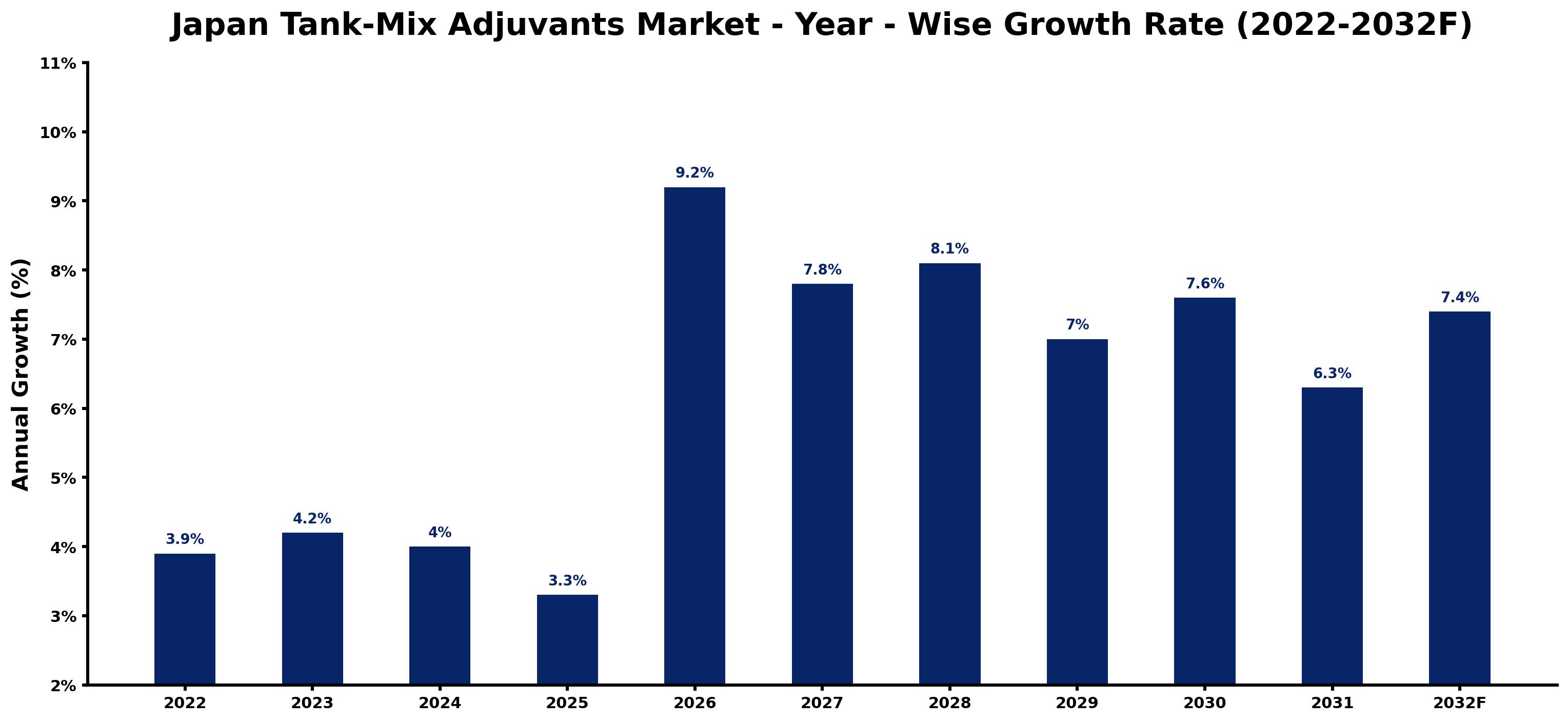
The yearly estimates that follow link every growth rate to its principal driver, so readers can see why the pace changed in each period.
| Year | Estimated Annual Growth (%) | Market Rationale |
| 2022 | 3.9 | The market experienced steady growth as farmers adopted new agricultural practices. |
| 2023 | 4.2 | Increased interest in sustainable farming methods drove faster growth compared to the previous year. |
| 2024 | 4.0 | Growth slowed slightly as farmers adjusted to changing market conditions and regulations. |
| 2025 | 3.3 | The market continued to grow but at a slower pace due to market saturation in some regions. |
| 2026 | 9.2 | A surge in demand for effective pesticide application is anticipated to drive growth this year. |
| 2027 | 7.8 | Growth will decelerate as the market begins to stabilise after a period of rapid expansion. |
| 2028 | 8.1 | Demand is projected to increase again as farmers seek improved efficiency in crop protection. |
| 2029 | 7.0 | The market will experience a slowdown as competition intensifies among suppliers. |
| 2030 | 7.6 | Growth is expected to accelerate as technological advancements in adjuvants gain traction among users. |
| 2031 | 6.3 | A slight slowdown will occur as the market adjusts to new regulatory frameworks. |
| 2032 | 7.4 | Increased focus on organic farming solutions is projected to drive growth further. |
Note: Market size estimations and growth projections presented in this report are based on 6Wresearch's proprietary forecasting methodology, utilizing the latest available industry data, government publications, and primary research inputs.
Japan Tank-Mix Adjuvants Market Synopsis
Tank-mix adjuvants are chemical additives that improve the effectiveness of pesticides and herbicides in agricultural applications. These products optimise spray coverage, reduce drift, and stabilise tank mixtures, making them crucial for effective crop protection. The Japan Tank-Mix Adjuvants Market is growing as over 2 million farmers adopt sustainable practices, driven by a rising demand for efficient pesticide application and government initiatives that promote precision agriculture technologies, leading to increased purchases from agrochemical companies and farmers.
Market Dynamics Impact Analysis (2026–2032)
| Factor | Type | Impact | Primary Segment Affected |
| Growing adoption of precision agriculture technologies | Driver | High | Surfactants |
| Increased focus on sustainable farming practices | Driver | High | Drift Control Agents |
| Rising interest in organic farming solutions | Opportunity | Medium | Water Conditioners |
| Expansion of online distribution channels | Opportunity | Medium | Agri Distributors |
| Strict regulations on pesticide use | Restraint | High | Oil-Based Adjuvants |
| Aging farmer population affecting technology adoption | Restraint | Medium | Non-Ionic/Anionic |
| High costs associated with new technology adoption | Challenge | High | Polymer Solutions |
| Intense competition among suppliers leading to price wars | Challenge | Medium | Buffering Agents |
Evaluation of Drivers in Japan Tank-Mix Adjuvants Market (2026–2032)
The factors lifting demand, and the evidence behind each, are summarised below.
| Drivers | Primary Segment Affected | Why It Matters (Evidence) |
| Increased adoption of precision agriculture technologies | Surfactants | This trend is driven by the promotion of efficient farming, resulting in higher demand for effective adjuvants. |
| Growing focus on sustainable farming practices | Drift Control Agents | Farmers are increasingly adopting practices that minimise environmental impact, boosting demand for products that reduce spray drift. |
| Rising interest in organic farming solutions | Water Conditioners | As organic farming gains popularity, the need for effective adjuvants that optimise water quality is increasing. |
| Expansion of online distribution channels | Agri Distributors | The shift towards e-commerce in agriculture is making adjuvants more accessible to a wider range of farmers. |
| Increasing production value of the agricultural sector | Oil-Based Adjuvants | With the total production value reaching approximately ¥9 trillion, farmers are investing more in effective crop protection solutions. |
A wider customer base explains much of the growth, as the Japanese agricultural sector employs over 2 million farmers who are increasingly adopting precision agriculture technologies. The total production value of the agricultural sector was approximately ¥9 trillion in 2021, prompting farmers to invest in effective adjuvants. The rising interest in organic farming solutions is driving greater demand for water conditioners, which optimise mixing quality. The promotion of sustainable practices encourages farmers to adopt drift control agents, further driving demand. The expansion of online distribution channels is making these products more accessible to farmers, increasing overall market participation.
Evaluation of Restraints in Japan Tank-Mix Adjuvants Market
These are the pressures that could keep growth below its potential.
| Market Restraint | Primary Segment Affected | Why It Matters (Evidence) |
| Strict regulations on pesticide use | Oil-Based Adjuvants | Japan's Ministry of Agriculture enforces stringent pesticide regulations, limiting the types of adjuvants available for use. |
| Aging farmer population affecting technology adoption | Non-Ionic/Anionic | With an average farmer age of around 67 years, the adoption of new technologies is slower, impacting adjuvant use. |
| High costs associated with new technology adoption | Polymer Solutions | Investing in advanced adjuvants can be prohibitively expensive for smaller farms, which limits their use. |
| Limited awareness of adjuvant benefits among farmers | Buffering Agents | Many farmers lack knowledge about the advantages of using buffering agents, resulting in lower demand. |
| Market saturation in certain regions | Surfactants | In some areas, the market for surfactants has become saturated, which slows growth as competition increases. |
Japan Tank-Mix Adjuvants Market Challenges
In 2022, strict regulations on pesticide use limited access to tank-mix adjuvants for over 2 million farmers, delaying effective crop protection. Low technology adoption stands at only 30%, hindering the efficient application of these products and reducing yield potential for producers. An ageing workforce, with the average age of farmers around 67 years, creates skills shortages that restrict the implementation of modern agricultural practices. Rising costs in the agricultural sector, valued at approximately ¥9 trillion in 2021, force farmers to reconsider their input expenditures and seek more cost-effective solutions.
Trends in the Japan Tank-Mix Adjuvants Market
Several trends are reshaping the Japan Tank-Mix Adjuvants Market; the most important are set out below.
- Shift towards Sustainable Farming Practices: There is a noticeable trend of farmers adopting sustainable practices, particularly in the Tohoku region, where government support for eco-friendly agriculture is strong. In 2023, a new program was launched to promote sustainable agriculture, encouraging the use of tank-mix adjuvants.
- Transition from Traditional to Online Distribution Channels: The agricultural sector is experiencing a shift towards online platforms for purchasing adjuvants, with online sales projected to grow at a CAGR of 10.2%. This change is enabling broader access for farmers, especially in rural areas.
- Emerging Demand for Organic Solutions: Growing demand for organic farming solutions is prompting agrochemical companies to adapt their product lines. The Japanese agrochemical market is projected to be influenced by this trend, leading to increased sales of tank-mix adjuvants.
- Increased Focus on Precision Agriculture: Precision agriculture technologies are becoming more prevalent among farmers, with an adoption rate of around 30%. This trend is driving demand for adjuvants that improve the effectiveness of pesticide applications.
Investment Opportunities in the Japan Tank-Mix Adjuvants Market
Investors looking at the Japan Tank-Mix Adjuvants Market should consider the following areas.
- Tohoku Region's Agricultural Expansion: The Tohoku region is expanding its agricultural production, with a strong focus on sustainable practices. This creates opportunities for suppliers of tank-mix adjuvants to meet the growing demand for effective crop protection solutions.
- Partnerships with Agricultural Cooperatives: Collaborating with agricultural cooperatives can provide access to a large farmer base. With approximately 1,000 cooperatives in Japan, establishing partnerships can facilitate distribution and increase market penetration.
- Increasing Demand for Organic Farming Solutions: The market gap for organic-compatible adjuvants is widening, especially as organic farming grows. Suppliers can target agrochemical companies looking to develop organic product lines.
- Investment in Online Sales Channels: The shift towards online purchasing is creating a demand for digital marketing strategies. Suppliers should invest in e-commerce platforms to effectively reach tech-savvy farmers.
Government Initiatives in the Japan Tank-Mix Adjuvants Market
The PRTR Law mandates businesses to report the release of designated chemicals, ensuring safety in agricultural practices. The Green Growth Strategy aims for carbon neutrality by 2050, promoting sustainable agriculture and encouraging the use of tank-mix adjuvants to improve pesticide effectiveness.
In 2023, a program supporting sustainable agriculture practices was launched, administered by the Ministry of Agriculture, Forestry and Fisheries. This initiative includes funding for research and development of efficient pesticide application technologies, benefiting both producers and buyers.
Future Insight of the Japan Tank-Mix Adjuvants Market
By 2032, a shift towards sustainable agriculture will drive suppliers to develop eco-friendly adjuvants, responding to government initiatives. Enhanced government support for precision agriculture technologies will encourage farmers to adopt advanced application techniques, improving efficiency in crop management. Increased interest in organic farming will lead to the creation of new formulations that comply with environmental standards. Agricultural cooperatives will facilitate knowledge sharing, enabling better pesticide application practices that benefit both buyers and suppliers.
Market Segmentation Analysis
Japan Tank-Mix Adjuvants Market report covers a detailed analysis of the following market segments:
By Tank-Mix Adjuvants – Surfactants Lead, Drift Control Agents Expected to Grow Fastest
According to Saurav Kr Singh, Senior Research Analyst at 6Wresearch, Surfactants accounted for 49% of the market by tank-mix adjuvants in 2025. Surfactants hold the largest market share due to their critical role in enhancing pesticide effectiveness, particularly in rice cultivation, which is vital for Japan's agricultural output. With over 2 million farmers relying on these adjuvants, their extensive use solidifies this segment's leading position. Drift Control Agents are set to record the highest CAGR in this split, 9.5% over 2026–2032. Drift control agents are experiencing rapid growth, driven by strict regulations aimed at minimising spray drift during pesticide application, especially in sensitive agricultural areas. This segment's expansion is further supported by government initiatives promoting sustainable agricultural practices. Suppliers must focus on providing drift control agents to meet regulatory standards and farmer demands.
By Product Type – Non-Ionic/Anionic Leads, Methylated Seed Oil Expected to Grow Fastest
In 2025, Non-Ionic/Anionic led the product type split with a 36% share. Non-Ionic/Anionic adjuvants dominate the market as they are commonly used in various pesticide formulations, making them essential for effective crop protection. Their versatility ensures a consistent demand from farmers across different agricultural practices. Over 2026–2032, Methylated Seed Oil is expected to post the fastest growth, at a CAGR of 10.5%. Methylated seed oil is rapidly gaining traction as it significantly improves pesticide absorption, particularly among rice farmers seeking enhanced herbicide performance. This trend indicates a shift towards more effective methods in agricultural applications. Buyers should consider incorporating methylated seed oil to maximise pesticide effectiveness.
By Adjuvant Class – Surface Tension Agents Lead, Spray Penetrants Expected to Grow Fastest
The largest adjuvant class category in 2025 was Surface Tension Agents, at 41% of revenue. Surface tension agents lead the segment as they effectively reduce surface tension, allowing for better coverage of pesticides on crops. Their critical function in ensuring thorough application makes them indispensable for farmers in Japan. Spray Penetrants are projected to grow fastest, at a CAGR of 9.8% during 2026–2032. The rise of spray penetrants is driven by the need for deeper penetration of active ingredients in challenging agricultural environments. This growth indicates a shift towards more efficient application techniques among farmers. Suppliers must invest in developing advanced spray penetrants to cater to evolving agricultural practices.
By Distribution Channel – Agri Distributors Lead, Online Platforms Expected to Grow Fastest
Agri Distributors took 52% of distribution channel revenue in 2025, more than any other category. Agri distributors are the primary channel for tank-mix adjuvants, serving as the main link between manufacturers and farmers. Their established networks ensure a reliable supply of adjuvants to the agricultural sector, facilitating effective distribution. The quickest growth will come from Online Platforms, forecast to expand at a CAGR of 10.2% between 2026 and 2032. Online platforms are emerging as a fast-growing distribution channel, driven by the increasing digitalisation of agricultural sales. This shift reflects changing purchasing behaviours among farmers who value convenience and accessibility. Suppliers should enhance their online presence to cater to the growing segment of digital buyers.
By End User Industry – Crop Protection Leads, Agrochemical Companies Expected to Grow Fastest
With 53% of end user industry revenue in 2025, Crop Protection was the largest category. The crop protection industry is the largest consumer of tank-mix adjuvants, relying heavily on these products for effective pesticide application. The sector's substantial scale guarantees a continuous demand for adjuvants that are crucial for agricultural productivity. Agrochemical Companies are set to record the highest CAGR in this split, 9.4% over 2026–2032. Agrochemical companies are rapidly increasing their use of tank-mix adjuvants to improve product efficacy and comply with regulatory standards. This trend highlights the industry's commitment to enhancing agricultural output and meeting compliance requirements. Suppliers should build strong relationships with agrochemical companies to ensure consistent demand and collaboration.
Key Attractiveness of the Report
- 10 Years of Market Numbers
- Historical Data Starting from 2022 to 2025
- Base Year 2025
- Forecast Data until 2032
- Key Performance Indicators Impacting the Market
- Major Upcoming Developments and Projects
Key Highlights of the Report:
- Japan Tank-Mix Adjuvants Market Outlook
- Market Size of Japan Tank-Mix Adjuvants Market, 2025
- Forecast of Japan Tank-Mix Adjuvants Market, 2032
- Historical Data and Forecast of Japan Tank-Mix Adjuvants Revenues & Volume for the Period 2022-2032F
- Japan Tank-Mix Adjuvants Market Trend Evolution
- Japan Tank-Mix Adjuvants Market Drivers and Challenges
- Japan Tank-Mix Adjuvants Price Trends
- Japan Tank-Mix Adjuvants Porter's Five Forces
- Japan Tank-Mix Adjuvants Industry Life Cycle
- Historical Data and Forecast of Japan Tank-Mix Adjuvants Market Revenues & Volume By Tank-Mix Adjuvants for the Period 2022-2032F
- Historical Data and Forecast of Japan Tank-Mix Adjuvants Market Revenues & Volume By Surfactants for the Period 2022-2032F
- Historical Data and Forecast of Japan Tank-Mix Adjuvants Market Revenues & Volume By Drift Control Agents for the Period 2022-2032F
- Historical Data and Forecast of Japan Tank-Mix Adjuvants Market Revenues & Volume By Water Conditioners for the Period 2022-2032F
- Historical Data and Forecast of Japan Tank-Mix Adjuvants Market Revenues & Volume By Oil-Based Adjuvants for the Period 2022-2032F
- Historical Data and Forecast of Japan Tank-Mix Adjuvants Market Revenues & Volume By Product Type for the Period 2022-2032F
- Historical Data and Forecast of Japan Tank-Mix Adjuvants Market Revenues & Volume By Non-Ionic/Anionic for the Period 2022-2032F
- Historical Data and Forecast of Japan Tank-Mix Adjuvants Market Revenues & Volume By Polymer Solutions for the Period 2022-2032F
- Historical Data and Forecast of Japan Tank-Mix Adjuvants Market Revenues & Volume By Buffering Agents for the Period 2022-2032F
- Historical Data and Forecast of Japan Tank-Mix Adjuvants Market Revenues & Volume By Methylated Seed Oil for the Period 2022-2032F
- Historical Data and Forecast of Japan Tank-Mix Adjuvants Market Revenues & Volume By Adjuvant Class for the Period 2022-2032F
- Historical Data and Forecast of Japan Tank-Mix Adjuvants Market Revenues & Volume By Surface Tension Agents for the Period 2022-2032F
- Historical Data and Forecast of Japan Tank-Mix Adjuvants Market Revenues & Volume By Viscosity Modifiers for the Period 2022-2032F
- Historical Data and Forecast of Japan Tank-Mix Adjuvants Market Revenues & Volume By Ammonium Salts for the Period 2022-2032F
- Historical Data and Forecast of Japan Tank-Mix Adjuvants Market Revenues & Volume By Spray Penetrants for the Period 2022-2032F
- Historical Data and Forecast of Japan Tank-Mix Adjuvants Market Revenues & Volume By Distribution Channel for the Period 2022-2032F
- Historical Data and Forecast of Japan Tank-Mix Adjuvants Market Revenues & Volume By Agri Distributors for the Period 2022-2032F
- Historical Data and Forecast of Japan Tank-Mix Adjuvants Market Revenues & Volume By Direct Sales for the Period 2022-2032F
- Historical Data and Forecast of Japan Tank-Mix Adjuvants Market Revenues & Volume By Retail Agriculture for the Period 2022-2032F
- Historical Data and Forecast of Japan Tank-Mix Adjuvants Market Revenues & Volume By Online Platforms for the Period 2022-2032F
- Historical Data and Forecast of Japan Tank-Mix Adjuvants Market Revenues & Volume By End User Industry for the Period 2022-2032F
- Historical Data and Forecast of Japan Tank-Mix Adjuvants Market Revenues & Volume By Crop Protection for the Period 2022-2032F
- Historical Data and Forecast of Japan Tank-Mix Adjuvants Market Revenues & Volume By Agrochemical Companies for the Period 2022-2032F
- Historical Data and Forecast of Japan Tank-Mix Adjuvants Market Revenues & Volume By Farm Operations for the Period 2022-2032F
- Historical Data and Forecast of Japan Tank-Mix Adjuvants Market Revenues & Volume By Fertilizer Blending for the Period 2022-2032F
- Japan Tank-Mix Adjuvants Import Export Trade Statistics
- Market Opportunity Assessment By Tank-Mix Adjuvants
- Market Opportunity Assessment By Product Type
- Market Opportunity Assessment By Adjuvant Class
- Market Opportunity Assessment By Distribution Channel
- Market Opportunity Assessment By End User Industry
- Japan Tank-Mix Adjuvants Top Companies Market Share
- Japan Tank-Mix Adjuvants Competitive Benchmarking By Technical and Operational Parameters
- Japan Tank-Mix Adjuvants Company Profiles
- Japan Tank-Mix Adjuvants Key Strategic Recommendations
Market Covered
The report covers the following segments.
By Tank-Mix Adjuvants
- Surfactants
- Drift Control Agents
- Water Conditioners
- Oil-Based Adjuvants
By Product Type
- Non-Ionic/Anionic
- Polymer Solutions
- Buffering Agents
- Methylated Seed Oil
By Adjuvant Class
- Surface Tension Agents
- Viscosity Modifiers
- Ammonium Salts
- Spray Penetrants
By Distribution Channel
- Agri Distributors
- Direct Sales
- Retail Agriculture
- Online Platforms
By End User Industry
- Crop Protection
- Agrochemical Companies
- Farm Operations
- Fertilizer Blending































