Japan Target Acquisition Radar Market Size & Growth Rate
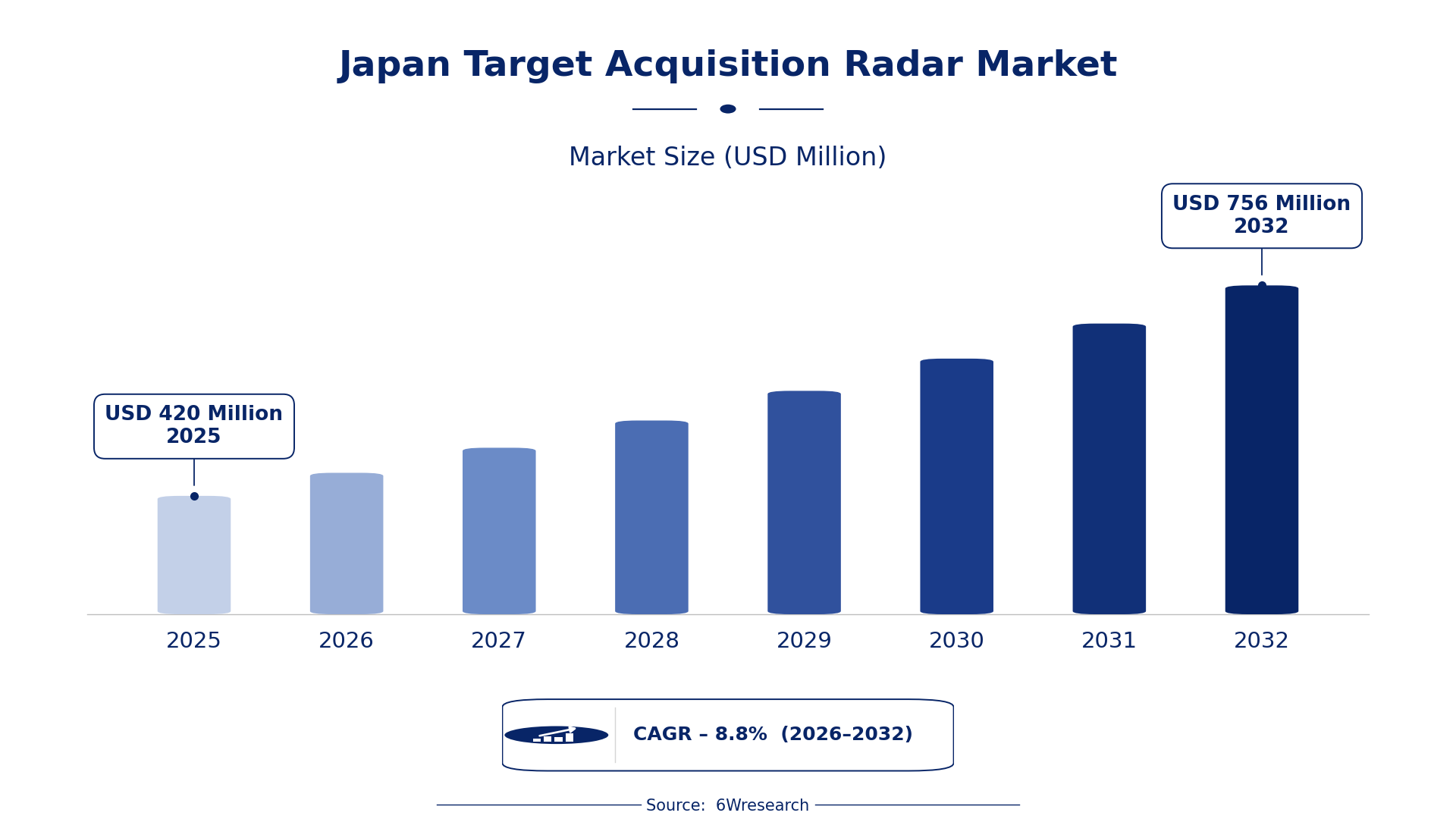
According to 6Wresearch internal database and industry insights, the Japan Target Acquisition Radar Market was valued at USD 420 Million in 2025 and is projected to reach USD 756 Million by 2032, growing at a CAGR of approximately 8.8% during 2026–2032.
Japan Target Acquisition Radar Market Highlights
| Report Metric | Details |
| Report Name | Japan Target Acquisition Radar Market (2026-2032) |
| Market Size 2025 | USD 420 Million |
| Market Size 2032 | USD 756 Million |
| Absolute Growth 2025–2032 | USD 336 Million |
| CAGR 2026–2032 | 8.8% |
| Peak Annual Growth | 9.5% in 2026 |
| Forecast Period | 2026–2032 |
| Historical Data | 2022–2025 |
| Base Year | 2025 |
| Leading Target Acquisition Radar, 2025 | Fire-Control Radar (38% share) |
| Leading Product Type, 2025 | Tracking Systems (50% share) |
| Leading Radar Band, 2025 | X-Band (39% share) |
| Leading Distribution Channel, 2025 | OEMs (42% share) |
| Leading End User Industry, 2025 | Missile Systems (39% share) |
| Fastest-Growing Target Acquisition Radar | Mobile Radar Units (11.5% CAGR) |
| Fastest-Growing Product Type | Ground Deployment (12.0% CAGR) |
| Fastest-Growing Radar Band | L-Band (11.1% CAGR) |
| Fastest-Growing Distribution Channel | Government Contracts (10.8% CAGR) |
| Fastest-Growing End User Industry | Armored Forces (11.0% CAGR) |
| Growing Sector | military operations |
| Key End Users | defense contractors, government agencies, military forces, technology suppliers |
Japan Target Acquisition Radar Market Year-wise Growth Rate and Key Drivers (2022–2032)
This graph illustrates the annual growth rates of the market from 2022 to 2032, highlighting a steady upward trajectory and projected market expansion over the forecast period.
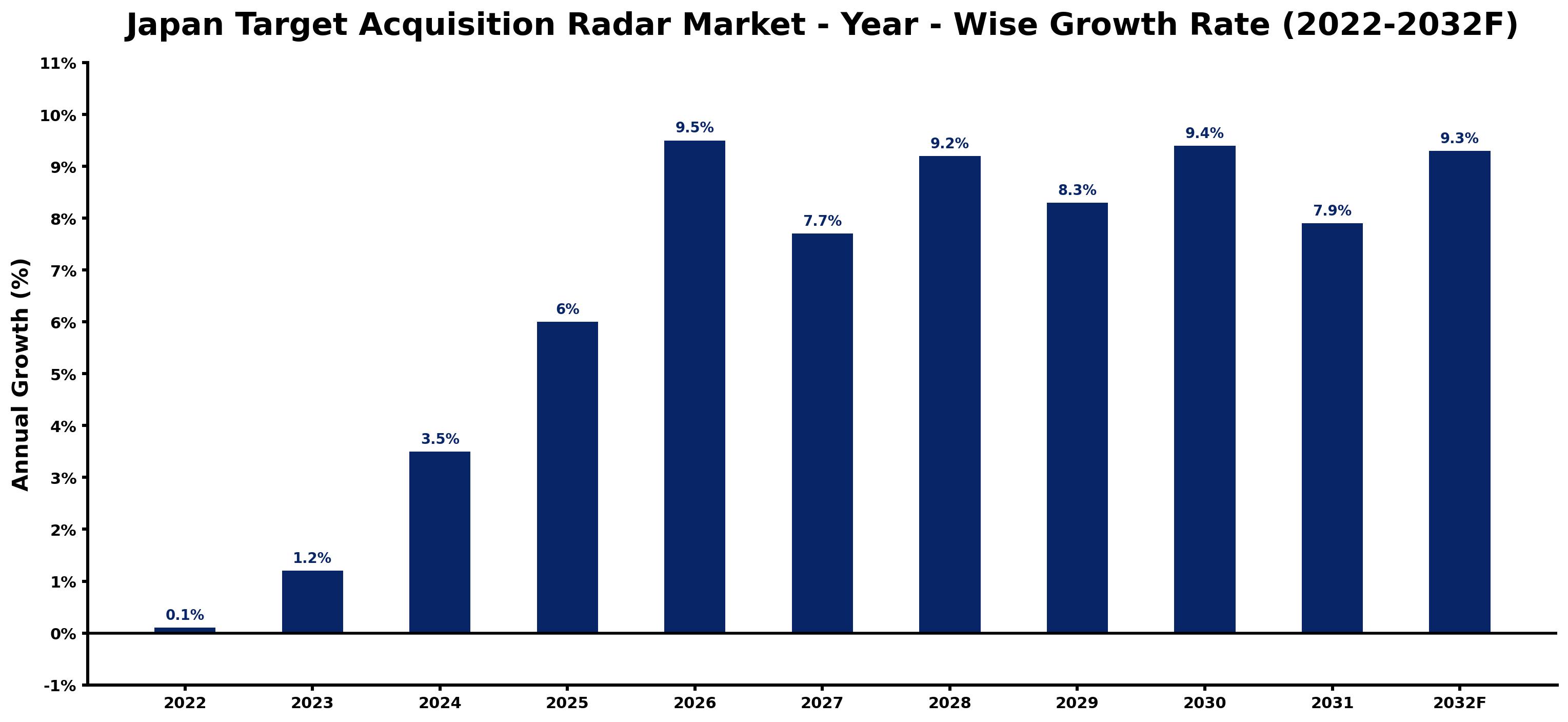
For each year, the table pairs the estimated growth rate with the leading influence on demand, showing how the drivers changed across the period.
| Year | Estimated Annual Growth (%) | Market Rationale |
| 2022 | 0.1 | The market exhibited minimal growth as demand stabilised amid ongoing military operations. |
| 2023 | 1.2 | Growth accelerated due to increased funding for advanced military technology in the defense budget. |
| 2024 | 3.5 | Demand rose further as the Self-Defense Forces expanded their radar capabilities. |
| 2025 | 6.0 | The market reached a historical peak driven by the implementation of new naval defense strategies. |
| 2026 | 9.5 | Growth peaked as investments in missile defense systems surged alongside modernization efforts. |
| 2027 | 7.7 | The market growth is expected to slow slightly as demand stabilises after the peak in 2026. |
| 2028 | 9.2 | Demand is projected to rebound with renewed focus on improving radar systems for military applications. |
| 2029 | 8.3 | Growth is expected to decelerate as the market adjusts to previous high demand levels and ongoing projects. |
| 2030 | 9.4 | A resurgence in demand is anticipated as new projects for radar technology come online. |
| 2031 | 7.9 | Growth is projected to slow again as the market begins to normalise after several years of expansion. |
| 2032 | 9.3 | Demand is expected to increase as new radar systems are deployed, improving operational capabilities. |
Note: Market size estimations and growth projections presented in this report are based on 6Wresearch's proprietary forecasting methodology, utilizing the latest available industry data, government publications, and primary research inputs.
Japan Target Acquisition Radar Market Synopsis
Target Acquisition Radar is a sophisticated technology used for detecting and tracking targets in military operations, employing advanced radar technology and phased array systems for superior performance. The Japan Target Acquisition Radar Market is growing due to a defense budget of approximately 6.8 trillion yen in 2023, which prioritises advanced military technology. The Self-Defense Forces are expanding their radar capabilities as part of a modernisation program, driving demand for missile guidance, surveillance, and reconnaissance applications. This growth is supported by strategic initiatives aimed at strengthening national security and military readiness.
Market Dynamics Impact Analysis (2026–2032)
| Factor | Type | Impact | Primary Segment Affected |
| Increased defense budget allocations | Driver | High | Fire-Control Radar |
| Expansion of radar capabilities by the Self-Defense Forces | Driver | High | Mobile Radar Units |
| Growing demand for advanced missile defense systems | Opportunity | High | Fire-Control Radar |
| Rising interest in UAV-Borne Target Radars for surveillance | Opportunity | Medium | UAV-Borne Target Radars |
| Regulatory compliance costs for radar technology | Restraint | High | Tracking Systems |
| Supply chain disruptions affecting production timelines | Restraint | Medium | Ship-Based Target Radar |
| Competition from international radar technology providers | Challenge | High | Compact AESA |
| Technological advancements requiring constant upgrades | Challenge | Medium | Ground Deployment |
Evaluation of Drivers in Japan Target Acquisition Radar Market (2026–2032)
The factors lifting demand, and the evidence behind each, are summarised below.
| Drivers | Primary Segment Affected | Why It Matters (Evidence) |
| Increased funding for advanced military technology | Fire-Control Radar | Japan's defense budget for 2023 is approximately 6.8 trillion yen, leading to more purchases of radar systems. |
| Modernisation of the Self-Defense Forces | Mobile Radar Units | The SDF is expanding its radar capabilities, improving situational awareness and driving demand. |
| Focus on missile defense systems | Fire-Control Radar | The new naval defense strategy emphasises improved radar systems for maritime security. |
| Growth in UAV applications | UAV-Borne Target Radars | Development of UAV-Borne Target Radars is funded to improve reconnaissance capabilities. |
| Integration of radar systems into new aircraft | Compact AESA | Compact AESA radar systems are being integrated into new fighter aircraft models, increasing demand. |
Behind the steady rise in orders is a notable increase in Japan's defense budget, approximately 6.8 trillion yen for 2023, which is driving demand for advanced military technology. The emphasis on missile defense systems is evident in the new naval defense strategy, which prioritises enhanced radar systems for maritime security. Funding for the development of UAV applications is boosting demand for improved reconnaissance capabilities. The integration of new radar technologies into fighter aircraft models is also contributing to rising orders in the market.
Evaluation of Restraints in Japan Target Acquisition Radar Market
The table below lists the restraints and the evidence behind each.
| Market Restraint | Primary Segment Affected | Why It Matters (Evidence) |
| Regulatory compliance costs for radar technology | Tracking Systems | Compliance with the Electrical Appliance and Material Safety Act increases production costs for manufacturers. |
| Supply chain disruptions affecting production timelines | Ship-Based Target Radar | Global supply chain issues have delayed the delivery of essential components for radar systems. |
| High competition from international radar technology providers | Compact AESA | Local manufacturers face challenges in competing with established international firms offering advanced systems. |
| Technological advancements requiring constant upgrades | Ground Deployment | Rapid advancements in radar technology necessitate ongoing investments in upgrades, straining budgets. |
| Limited domestic production capacity for advanced systems | Fire-Control Radar | The reliance on a few manufacturers limits the ability to scale production quickly. |
Japan Target Acquisition Radar Market Challenges
Japan's defense procurement process complicates access to advanced radar systems, causing delays for military buyers who require timely deliveries for operational readiness. Limited domestic suppliers struggle to meet the growing demand for radar components, which can extend lead times for importers by up to six months. Intense competition among producers drives down prices, leading to compromises on quality that can undermine buyer confidence in radar performance. Rising raw material costs, influenced by global market trends, can increase production expenses by 15%, ultimately raising prices for buyers in the defense sector.
Trends in the Japan Target Acquisition Radar Market
Four trends stand out in the Japan Target Acquisition Radar Market.
- Shift from Traditional to Advanced Radar Systems: Tokyo is experiencing a shift towards advanced radar systems as the Self-Defense Forces modernise their capabilities. In 2023, the government launched a new naval defense strategy focusing on improved radar systems for maritime security.
- Increase in UAV Integration: In 2023, Japan's Ministry of Defense allocated funds for UAV-Borne Target Radars, with an investment of 10 billion yen. This trend reflects the growing importance of drone surveillance in military operations.
- Transition to Compact AESA Technology: The integration of Compact AESA radar systems into new fighter aircraft models began in 2023, improving operational capabilities. This shift is expected to enhance performance while reducing size and weight.
- Expansion of Mobile Radar Units: The Self-Defense Forces are increasing the number of Mobile Radar Units by 2025 to improve situational awareness. This expansion aims to increase flexibility in military operations.
Investment Opportunities in the Japan Target Acquisition Radar Market
Below are the investment opportunities with the strongest case in the Japan Target Acquisition Radar Market.
- Growing Demand for Advanced Missile Defense: With Japan's defense budget reaching 6.8 trillion yen in 2023, there is an opportunity to supply advanced missile defense systems to the Self-Defense Forces, strengthening national security.
- Investment in UAV Technology: Funding for UAV-Borne Target Radars presents an opportunity for suppliers to enter the market, particularly in Tokyo, where defense technology companies are concentrated.
- Enhancing Ship-Based Target Radar Capabilities: The planned increase in Ship-Based Target Radars by 2025 creates an opportunity for manufacturers to supply advanced systems, particularly to naval contractors involved in maritime defense.
- Focus on Ground Deployment Systems: The government’s strategy to enhance ground deployment radar capabilities by 2025 offers a chance for investment in new technologies, particularly for the Ground Self-Defense Force.
Government Initiatives in the Japan Target Acquisition Radar Market
The Electrical Appliance and Material Safety Act regulates the safety of radar systems sold in Japan, ensuring compliance with strict safety standards. This impacts producers, who must invest in testing and certification to meet these requirements, thereby influencing production costs and timelines. The Industrial Standardization Act governs JIS product and test standards, further ensuring quality and safety in radar technology development.
The Japan Defense Agency has allocated 10 billion yen for the development of UAV-Borne Target Radars, administered by the Japan Defense Agency. This funding supports research and development efforts, enabling manufacturers to innovate and improve radar technology.
Future Insight of the Japan Target Acquisition Radar Market
New naval defense strategies will prioritise the integration of advanced ship-based radar systems by 2025, bolstering maritime security. The government will implement an initiative to improve tracking systems for missile defense by 2024, enhancing operational capabilities. As Japan's Ground Self-Defense Force upgrades its radar units, situational awareness will significantly improve for ground operations. Continued collaboration with research institutions will drive innovation in radar technology, ensuring suppliers can meet evolving military needs.
Market Segmentation Analysis
Japan Target Acquisition Radar Market report covers a detailed analysis of the following market segments:
By Target Acquisition Radar – Fire-Control Radar Leads, Mobile Radar Units Expected to Grow Fastest
According to Saurav Kr Singh, Senior Research Analyst at 6Wresearch, Fire-Control Radar took 38% of target acquisition radar revenue in 2025, more than any other category. Fire-Control Radar holds the largest share due to its essential function in missile targeting systems, which are critical for Japan's military strategy. The Self-Defense Forces depend heavily on these systems for accurate engagement during operations. Mobile Radar Units are set to record the highest CAGR in this split, 11.5% over 2026–2032. Mobile Radar Units are growing rapidly as they offer adaptable solutions for diverse military scenarios. The ongoing enhancement of the Ground Self-Defense Force's capabilities significantly contributes to this growth. Suppliers should prioritise the development of Mobile Radar Units to align with the evolving needs of the Self-Defense Forces.
By Product Type – Tracking Systems Lead, Ground Deployment Expected to Grow Fastest
In 2025, Tracking Systems led the product type split with a 50% share. Tracking Systems lead the market as they are crucial for monitoring and engaging moving targets in military operations. Their widespread application within the Self-Defense Forces ensures consistent demand for these systems. The quickest growth will come from Ground Deployment, forecast to expand at a CAGR of 12.0% between 2026 and 2032. Ground Deployment is witnessing the highest growth due to the increasing focus on bolstering ground forces with advanced radar technologies. The Ministry of Defense's initiative to enhance ground deployment capabilities by 2025 is a major factor driving this segment. Buyers will gain from improvements in Ground Deployment systems that enhance their operational capabilities.
By Radar Band – X-Band Leads, L-Band Expected to Grow Fastest
With 39% of radar band revenue in 2025, X-Band was the largest category. X-Band leads the market as it is widely used for high-resolution tracking in military applications, making it indispensable for effective target acquisition. Its application in missile defense systems solidifies its position in Japan's defence strategy. L-Band is projected to grow fastest, at a CAGR of 11.1% during 2026–2032. L-Band is growing at the fastest rate, primarily due to its emerging applications in specific military scenarios. The gradual integration of L-Band systems into existing frameworks is contributing to this growth. Suppliers should explore opportunities to develop L-Band systems to cater to the evolving needs of military operations.
By Distribution Channel – OEMs Lead, Government Contracts Expected to Grow Fastest
The largest distribution channel category in 2025 was OEMs, at 42% of revenue. OEMs dominate the distribution channel as they are the primary manufacturers of radar systems, ensuring a reliable supply to the defence sector. Their established connections with the Self-Defense Forces facilitate ongoing procurement processes. Over 2026–2032, Government Contracts are expected to post the fastest growth, at a CAGR of 10.8%. Government Contracts are the fastest-growing channel, propelled by increased investment in advanced military technologies. The Japanese government's commitment to strengthening defence capabilities creates a promising market opportunity for this segment. Suppliers must adapt their strategies to secure government contracts, which are becoming increasingly crucial for revenue generation.
By End User Industry – Missile Systems Lead, Armored Forces Expected to Grow Fastest
Missile Systems held 39% of the Japan Target Acquisition Radar Market by end user industry in 2025. Missile Systems represent the largest share as they are essential for the targeting and guidance of missiles, a fundamental aspect of Japan's military capabilities. The emphasis on advanced missile systems guarantees sustained demand for associated technologies. Armored Forces are set to record the highest CAGR in this split, 11.0% over 2026–2032. Armored Forces are experiencing rapid growth as the necessity for improved support systems for ground units becomes more evident. The ongoing modernisation of the Ground Self-Defense Force is a key driver of this trend, reflecting a shift in military priorities. Buyers in the Armored Forces sector will actively seek advanced radar solutions to enhance their operational effectiveness.
Key Attractiveness of the Report
- 10 Years of Market Numbers
- Historical Data Starting from 2022 to 2025
- Base Year 2025
- Forecast Data until 2032
- Key Performance Indicators Impacting the Market
- Major Upcoming Developments and Projects
Key Highlights of the Report:
- Japan Target Acquisition Radar Market Outlook
- Market Size of Japan Target Acquisition Radar Market, 2025
- Forecast of Japan Target Acquisition Radar Market, 2032
- Historical Data and Forecast of Japan Target Acquisition Radar Revenues & Volume for the Period 2022-2032F
- Japan Target Acquisition Radar Market Trend Evolution
- Japan Target Acquisition Radar Market Drivers and Challenges
- Japan Target Acquisition Radar Price Trends
- Japan Target Acquisition Radar Porter's Five Forces
- Japan Target Acquisition Radar Industry Life Cycle
- Historical Data and Forecast of Japan Target Acquisition Radar Market Revenues & Volume By Target Acquisition Radar for the Period 2022-2032F
- Historical Data and Forecast of Japan Target Acquisition Radar Market Revenues & Volume By Fire-Control Radar for the Period 2022-2032F
- Historical Data and Forecast of Japan Target Acquisition Radar Market Revenues & Volume By Mobile Radar Units for the Period 2022-2032F
- Historical Data and Forecast of Japan Target Acquisition Radar Market Revenues & Volume By Ship-Based Target Radar for the Period 2022-2032F
- Historical Data and Forecast of Japan Target Acquisition Radar Market Revenues & Volume By UAV-Borne Target Radars for the Period 2022-2032F
- Historical Data and Forecast of Japan Target Acquisition Radar Market Revenues & Volume By Product Type for the Period 2022-2032F
- Historical Data and Forecast of Japan Target Acquisition Radar Market Revenues & Volume By Tracking Systems for the Period 2022-2032F
- Historical Data and Forecast of Japan Target Acquisition Radar Market Revenues & Volume By Ground Deployment for the Period 2022-2032F
- Historical Data and Forecast of Japan Target Acquisition Radar Market Revenues & Volume By Naval Defense for the Period 2022-2032F
- Historical Data and Forecast of Japan Target Acquisition Radar Market Revenues & Volume By Compact AESA for the Period 2022-2032F
- Historical Data and Forecast of Japan Target Acquisition Radar Market Revenues & Volume By Radar Band for the Period 2022-2032F
- Historical Data and Forecast of Japan Target Acquisition Radar Market Revenues & Volume By X-Band for the Period 2022-2032F
- Historical Data and Forecast of Japan Target Acquisition Radar Market Revenues & Volume By L-Band for the Period 2022-2032F
- Historical Data and Forecast of Japan Target Acquisition Radar Market Revenues & Volume By S-Band for the Period 2022-2032F
- Historical Data and Forecast of Japan Target Acquisition Radar Market Revenues & Volume By Ku-Band for the Period 2022-2032F
- Historical Data and Forecast of Japan Target Acquisition Radar Market Revenues & Volume By Distribution Channel for the Period 2022-2032F
- Historical Data and Forecast of Japan Target Acquisition Radar Market Revenues & Volume By OEMs for the Period 2022-2032F
- Historical Data and Forecast of Japan Target Acquisition Radar Market Revenues & Volume By Government Contracts for the Period 2022-2032F
- Historical Data and Forecast of Japan Target Acquisition Radar Market Revenues & Volume By Naval Contractors for the Period 2022-2032F
- Historical Data and Forecast of Japan Target Acquisition Radar Market Revenues & Volume By Drone Manufacturers for the Period 2022-2032F
- Historical Data and Forecast of Japan Target Acquisition Radar Market Revenues & Volume By End User Industry for the Period 2022-2032F
- Historical Data and Forecast of Japan Target Acquisition Radar Market Revenues & Volume By Missile Systems for the Period 2022-2032F
- Historical Data and Forecast of Japan Target Acquisition Radar Market Revenues & Volume By Armored Forces for the Period 2022-2032F
- Historical Data and Forecast of Japan Target Acquisition Radar Market Revenues & Volume By Maritime Operations for the Period 2022-2032F
- Historical Data and Forecast of Japan Target Acquisition Radar Market Revenues & Volume By Tactical Drones for the Period 2022-2032F
- Japan Target Acquisition Radar Import Export Trade Statistics
- Market Opportunity Assessment By Target Acquisition Radar
- Market Opportunity Assessment By Product Type
- Market Opportunity Assessment By Radar Band
- Market Opportunity Assessment By Distribution Channel
- Market Opportunity Assessment By End User Industry
- Japan Target Acquisition Radar Top Companies Market Share
- Japan Target Acquisition Radar Competitive Benchmarking By Technical and Operational Parameters
- Japan Target Acquisition Radar Company Profiles
- Japan Target Acquisition Radar Key Strategic Recommendations
Market Covered
The following segment groups are covered in the report.
By Target Acquisition Radar
- Fire-Control Radar
- Mobile Radar Units
- Ship-Based Target Radar
- UAV-Borne Target Radars
By Product Type
- Tracking Systems
- Ground Deployment
- Naval Defense
- Compact AESA
By Radar Band
- X-Band
- L-Band
- S-Band
- Ku-Band
By Distribution Channel
- OEMs
- Government Contracts
- Naval Contractors
- Drone Manufacturers
By End User Industry
- Missile Systems
- Armored Forces
- Maritime Operations
- Tactical Drones































