Japan Target drones Market Size & Growth Rate
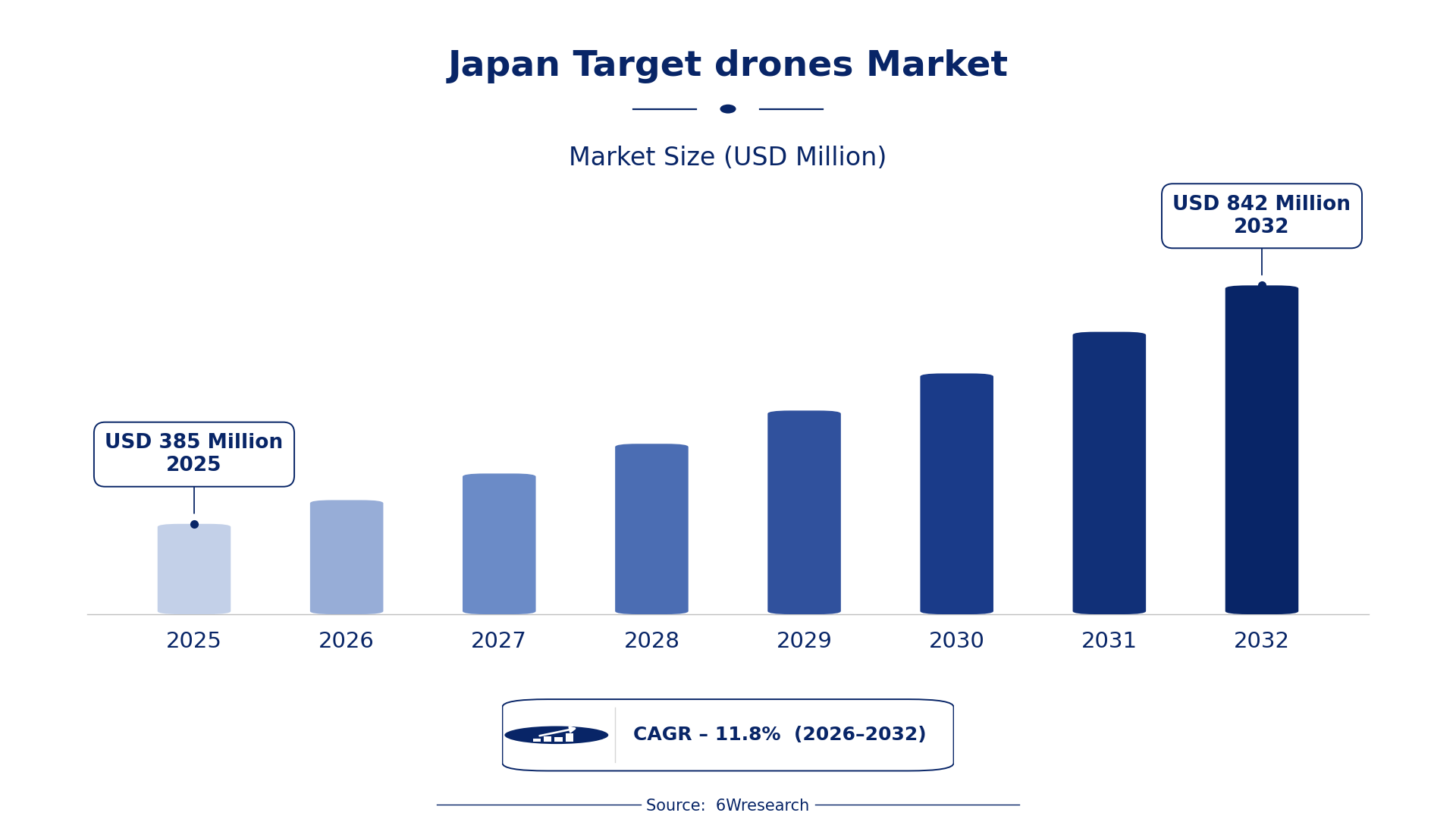
According to 6Wresearch internal database and industry insights, the Japan Target drones Market was valued at USD 385 Million in 2025 and is projected to reach USD 842 Million by 2032, growing at a CAGR of approximately 11.8% during 2026–2032.
Japan Target drones Market Highlights
| Report Metric | Details |
| Report Name | Japan Target drones Market (2026-2032) |
| Market Size 2025 | USD 385 Million |
| Market Size 2032 | USD 842 Million |
| Absolute Growth 2025–2032 | USD 457 Million |
| CAGR 2026–2032 | 11.8% |
| Peak Annual Growth | 14.4% in 2026 |
| Forecast Period | 2026–2032 |
| Historical Data | 2022–2025 |
| Base Year | 2025 |
| Leading End-Use Sector, 2025 | Defense (66% share) |
| Leading Build, 2025 | New Build (62% share) |
| Leading Engine Type, 2025 | IC (40% share) |
| Leading End Use, 2025 | Aerial Targets (45% share) |
| Leading Target Type, 2025 | Full-Scale (47% share) |
| Fastest-Growing End-Use Sector | Commercial (14.0% CAGR) |
| Fastest-Growing Engine Type | Jet (15.3% CAGR) |
| Fastest-Growing End Use | Ground Targets (14.2% CAGR) |
| Fastest-Growing Target Type | Free-Flying (16.0% CAGR) |
| Growing Sector | Defense |
| Key End Users | Military, Government, Research Institutions |
Japan Target drones Market Year-wise Growth Rate and Key Drivers (2022–2032)
This graph illustrates the annual growth rates of the market from 2022 to 2032, highlighting a steady upward trajectory and projected market expansion over the forecast period.
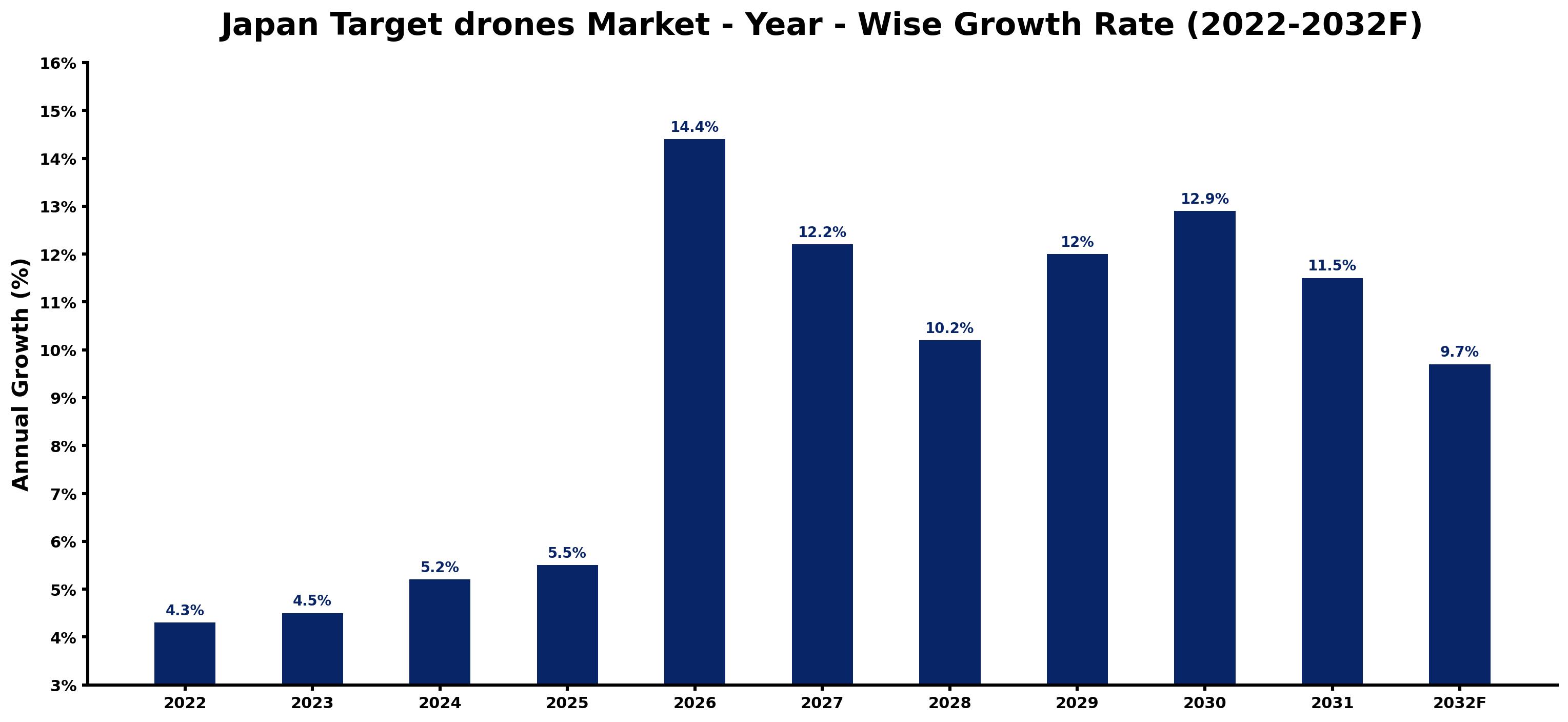
Year by year, the estimates below pair each growth rate with the development that shaped it.
| Year | Estimated Annual Growth (%) | Market Rationale |
| 2022 | 4.3 | The market showed steady growth due to ongoing military training exercises. |
| 2023 | 4.5 | Increased defense budget allocations supported a rise in target drone procurement. |
| 2024 | 5.2 | More training exercises were conducted, boosting demand for target drones. |
| 2025 | 5.5 | The market reached a peak growth rate as military investments intensified. |
| 2026 | 14.4 | Demand surged due to expanded military training programs. |
| 2027 | 12.2 | Growth slowed slightly as the market began stabilising after rapid expansion. |
| 2028 | 10.2 | Continued investment in unmanned systems is expected to contribute to further growth. |
| 2029 | 12.0 | Demand is projected to increase again as joint exercises with allied forces resume. |
| 2030 | 12.9 | The market will continue to expand with new technological advancements. |
| 2031 | 11.5 | Growth is expected to slow as the market matures and demand stabilises. |
| 2032 | 9.7 | A slight slowdown in growth rate reflects market saturation and maturity. |
Note: Market size estimations and growth projections presented in this report are based on 6Wresearch's proprietary forecasting methodology, utilizing the latest available industry data, government publications, and primary research inputs.
Japan Target drones Market Synopsis
Target drones are unmanned aerial vehicles designed for military training and testing, typically made from lightweight materials and equipped for flight control. The Japan Target Drones Market is growing due to increased defense spending, with the defense budget for 2023 reaching approximately 6.8 trillion yen. The Japan Self-Defense Forces conduct over 100 training exercises annually, driving demand for full-scale aerial targets used in combat scenarios and collaborations in drone technology research.
Market Dynamics Impact Analysis (2026–2032)
| Factor | Type | Impact | Primary Segment Affected |
| Increased defense budget allocations drive demand for target drones. | Driver | High | Defense |
| Growing military training exercises necessitate more target drones. | Driver | High | Defense |
| Rising investments in unmanned systems create opportunities for suppliers. | Opportunity | High | New Build |
| Technological advancements in drone capabilities open new markets. | Opportunity | Medium | New Build |
| High development costs limit market entry for new players. | Restraint | High | New Build |
| Limited commercial applications restrict growth potential. | Restraint | Medium | Commercial |
| Regulatory hurdles can delay drone development and deployment. | Challenge | High | New Build |
| Competition from international manufacturers pressures local producers. | Challenge | Medium | Defense |
Evaluation of Drivers in Japan Target drones Market (2026–2032)
Key forces behind demand, with the segment each one moves most, are listed below.
| Drivers | Primary Segment Affected | Why It Matters (Evidence) |
| Increased defense spending supports military training programs. | Defense | Japan's defense budget for 2023 is approximately 6.8 trillion yen, leading to higher procurement of target drones. |
| Annual military training exercises drive demand for target drones. | Defense | The Japan Self-Defense Forces conduct over 100 training exercises annually, increasing the need for aerial targets. |
| Technological advancements improve drone capabilities. | New Build | Local manufacturers are focusing on developing jet engine powered target drones, improving performance and attracting buyers. |
| Collaborations in drone technology research expand market opportunities. | New Build | The Japan Aerospace Exploration Agency collaborates on drone technology research, driving innovation and demand. |
| ISO 9001 standards ensure quality in target drone manufacturing. | New Build | Adherence to ISO 9001 standards guarantees product reliability, appealing to defense buyers. |
The Japan Self-Defense Forces conduct over 100 training exercises annually, increasing demand for target drones. Local manufacturers are developing jet engine powered drones, improving performance and attracting buyers. These factors propel the market forward, creating strong demand for target drones.
Evaluation of Restraints in Japan Target drones Market
These are the pressures that could keep growth below its potential.
| Market Restraint | Primary Segment Affected | Why It Matters (Evidence) |
| High development costs limit market entry for new players. | New Build | The investment required for developing target drones restricts new entrants, impacting competition. |
| Limited commercial applications restrict growth potential. | Commercial | The defense sector dominates, with few commercial uses for target drones, limiting overall market expansion. |
| Regulatory hurdles can delay drone development and deployment. | New Build | Stringent regulations can prolong the approval process for new technologies, affecting timely market entry. |
| Competition from international manufacturers pressures local producers. | Defense | Local manufacturers face challenges from established international players, impacting market share and pricing. |
| Supply chain disruptions can affect production timelines. | New Build | Global supply chain issues can delay the availability of components needed for manufacturing. |
Japan Target drones Market Challenges
In 2023, Japan's defense budget reached approximately 6.8 trillion yen, yet local producers face intense competition from foreign manufacturers, limiting their ability to capture market share and innovate. Rising production costs, particularly due to the need for advanced materials, can inflate prices for buyers, leading to delays in procurement for military training programs. A shortage of skilled workers in drone technology development restricts local production capabilities, making it challenging for producers to respond to increasing demand. Buyers encounter difficulties in obtaining high-quality target drones, as stringent procurement standards from the Japan Defense Agency can extend lead times for essential training exercises.
Trends in the Japan Target drones Market
The shifts below are changing how Japan Target drones Market products are bought and supplied.
- Shift towards Advanced Aerial Targets: The Japan Self-Defense Forces are increasingly adopting advanced aerial targets for training, improving combat readiness. In 2023, over 70% of exercises utilised full-scale drones, reflecting a change in training methodologies.
- Increased Collaboration in Drone Technology: Collaboration between the Japan Aerospace Exploration Agency and defense technology firms has intensified since 2022, leading to innovations in drone capabilities. This partnership is projected to improve operational efficiency in military exercises.
- Focus on Jet Engine Powered Drones: Local manufacturers are prioritising the development of jet engine powered target drones, with a growth rate of 15.3% from 2026 to 2032. This shift aims to meet the demand for higher performance in military training.
- Expansion of Joint Military Exercises: Since 2023, joint military exercises with allied forces have increased, utilising aerial targets extensively. This trend improves interoperability and will continue, driving demand for target drones.
Investment Opportunities in the Japan Target drones Market
The following opportunities in the Japan Target drones Market pair current demand with a clear way in.
- Growing Defense Budget: With Japan's defense budget reaching 6.8 trillion yen in 2023, there is an opportunity for suppliers to invest in advanced target drone technologies to meet military needs.
- Tokyo as a Defense Technology Hub: Tokyo is emerging as a key region for defense technology development, offering opportunities for partnerships with local firms to supply advanced target drones and systems.
- Increasing Demand for Full-Scale Targets: The demand for full-scale target drones is rising, with over 70% of military exercises utilising them. Suppliers can focus on this segment to capture market share.
- Entry through Joint Ventures: Establishing joint ventures with local manufacturers can facilitate entry into the Japanese target drone market, utilising local expertise and compliance with regulations.
Government Initiatives in the Japan Target drones Market
Policy measures impact target drone producers and buyers in Japan. The Building Energy Efficiency Act (2015, amended 2022) mandates energy standards for new buildings, indirectly affecting drone manufacturing facilities. Additionally, the Act on the Rational Use of Energy (1979) requires large energy users to improve energy efficiency, influencing operational standards in production.
The procurement and operational standards for target drones are overseen by the Japan Defense Agency. The agency has funded various projects aimed at improving drone capabilities by 2025, ensuring that manufacturers meet stringent quality and performance criteria. This framework supports buyers by ensuring that only compliant and efficient drones are procured for military use.
Future Insight of the Japan Target drones Market
A new initiative to upgrade capabilities will introduce advanced jet engine powered target drones by 2032, improving performance in military training. Increased investment in the Tokyo region's defence technology development will stimulate innovation in manufacturing processes. Collaborations with research institutions will drive significant advancements in technology, benefiting both buyers and suppliers. Enhanced interoperability in joint exercises with allied forces will strengthen operational readiness, ensuring training exercises remain effective and aligned with contemporary military strategies.
Market Segmentation Analysis
Japan Target drones Market report covers a detailed analysis of the following market segments:
By End-Use Sector – Defense Leads, Commercial Expected to Grow Fastest
According to Shubham Deep, Research Manager at 6Wresearch, the largest end-use sector category in 2025 was Defense, at 66% of revenue. The defense sector commands the largest share due to the extensive use of target drones in military training exercises, with over 100 conducted annually by the Japan Self-Defense Forces. This high frequency of training programmes ensures a steady demand for target drones, solidifying the defense segment's position. Commercial is projected to grow fastest, at a CAGR of 14.0% during 2026–2032. The commercial sector is experiencing rapid growth as local manufacturers focus on developing jet engine powered target drones for research and development purposes. This shift towards advanced technology in commercial applications is expected to drive further expansion in this segment. Suppliers should consider increasing their offerings in the commercial sector to capitalise on this emerging demand.
By Build – New Build Leads and Records the Fastest Growth
New Build held 62% of the Japan Target drones Market by build in 2025. New build target drones hold the largest share due to their continuous development aimed at fulfilling military requirements, particularly through initiatives from the Japan Ministry of Defense. This consistent focus on new models ensures they meet the latest operational standards and technological advancements. The same category is also set to grow fastest, at a CAGR of 13.6% during 2026–2032. The new build segment also exhibits the fastest growth as advancements in technology lead to the creation of more sophisticated target drones. This ongoing development will likely widen the lead as military requirements continue to expand and evolve. Suppliers must prioritise the development of new builds to remain competitive in this growing market.
By Engine Type – IC Leads, Jet Expected to Grow Fastest
In 2025, IC led the engine type split with a 40% share. Internal combustion engines dominate the market due to their efficiency and reliability in military applications, making them the preferred choice for many target drones. This established technology has a strong installed base that supports its continued leadership in the segment. Jet is set to record the highest CAGR in this split, 15.3% over 2026–2032. Jet engines are gaining traction as the fastest growing segment, driven by their ability to provide higher performance for advanced target drones. As military training demands evolve, the preference for jet engines is expected to increase, widening the gap with internal combustion engines. Manufacturers should invest in jet engine technology to meet the rising performance expectations of military clients.
By End Use – Aerial Targets Lead, Ground Targets Expected to Grow Fastest
Aerial Targets took 45% of end use revenue in 2025, more than any other category. Aerial targets lead the market as they are predominantly used in military training exercises, with most target drones specifically designed for aerial practice. This strong focus on aerial training reinforces the significant presence of aerial targets within the market. Over 2026–2032, Ground Targets are expected to post the fastest growth, at a CAGR of 14.2%. Ground targets are the fastest growing segment, primarily due to their application in specific training scenarios that require diverse target types. As military training evolves to be more comprehensive, the demand for ground targets is anticipated to rise. Suppliers should consider expanding their product lines to include ground targets to meet this increasing demand.
By Target Type – Full-Scale Leads, Free-Flying Expected to Grow Fastest
Full-Scale accounted for 47% of the market by target type in 2025. Full-scale targets are favoured for realistic training scenarios, establishing them as the leading type in the market. Their ability to closely replicate actual combat conditions ensures they are widely used in military exercises. Free-Flying is projected to grow fastest, at a CAGR of 16.0% during 2026–2032. Free-flying targets represent the fastest growing category, essential for simulating real-world scenarios that require dynamic target movements. As training methodologies advance, the demand for free-flying targets is expected to increase significantly. Suppliers should focus on developing free-flying target options to align with the evolving needs of military training.
Key Attractiveness of the Report
- 10 Years of Market Numbers
- Historical Data Starting from 2022 to 2025
- Base Year 2025
- Forecast Data until 2032
- Key Performance Indicators Impacting the Market
- Major Upcoming Developments and Projects
Key Highlights of the Report:
- Japan Target drones Market Outlook
- Market Size of Japan Target drones Market, 2025
- Forecast of Japan Target drones Market, 2032
- Historical Data and Forecast of Japan Target drones Revenues & Volume for the Period 2022-2032
- Japan Target drones Market Trend Evolution
- Japan Target drones Market Drivers and Challenges
- Japan Target drones Price Trends
- Japan Target drones Porter's Five Forces
- Japan Target drones Industry Life Cycle
- Historical Data and Forecast of Japan Target drones Market Revenues & Volume By End-Use Sector for the Period 2022-2032
- Historical Data and Forecast of Japan Target drones Market Revenues & Volume By Defense for the Period 2022-2032
- Historical Data and Forecast of Japan Target drones Market Revenues & Volume By Commercial for the Period 2022-2032
- Historical Data and Forecast of Japan Target drones Market Revenues & Volume By Build for the Period 2022-2032
- Historical Data and Forecast of Japan Target drones Market Revenues & Volume By New Build for the Period 2022-2032
- Historical Data and Forecast of Japan Target drones Market Revenues & Volume By Converted for the Period 2022-2032
- Historical Data and Forecast of Japan Target drones Market Revenues & Volume By Engine Type for the Period 2022-2032
- Historical Data and Forecast of Japan Target drones Market Revenues & Volume By IC for the Period 2022-2032
- Historical Data and Forecast of Japan Target drones Market Revenues & Volume By Jet for the Period 2022-2032
- Historical Data and Forecast of Japan Target drones Market Revenues & Volume By Others for the Period 2022-2032
- Historical Data and Forecast of Japan Target drones Market Revenues & Volume By End Use for the Period 2022-2032
- Historical Data and Forecast of Japan Target drones Market Revenues & Volume By Aerial Targets for the Period 2022-2032
- Historical Data and Forecast of Japan Target drones Market Revenues & Volume By Ground Targets for the Period 2022-2032
- Historical Data and Forecast of Japan Target drones Market Revenues & Volume By Marine Targets for the Period 2022-2032
- Historical Data and Forecast of Japan Target drones Market Revenues & Volume By Target Type for the Period 2022-2032
- Historical Data and Forecast of Japan Target drones Market Revenues & Volume By Full-Scale for the Period 2022-2032
- Historical Data and Forecast of Japan Target drones Market Revenues & Volume By Sub-Scale for the Period 2022-2032
- Historical Data and Forecast of Japan Target drones Market Revenues & Volume By Free-Flying for the Period 2022-2032
- Historical Data and Forecast of Japan Target drones Market Revenues & Volume By Towing for the Period 2022-2032
- Historical Data and Forecast of Japan Target drones Market Revenues & Volume By Sporting for the Period 2022-2032
- Historical Data and Forecast of Japan Target drones Market Revenues & Volume By Application for the Period 2022-2032
- Historical Data and Forecast of Japan Target drones Market Revenues & Volume By Combat Training for the Period 2022-2032
- Historical Data and Forecast of Japan Target drones Market Revenues & Volume By Target & Decoy for the Period 2022-2032
- Historical Data and Forecast of Japan Target drones Market Revenues & Volume By Reconnaissance for the Period 2022-2032
- Historical Data and Forecast of Japan Target drones Market Revenues & Volume By Target Identification for the Period 2022-2032
- Historical Data and Forecast of Japan Target drones Market Revenues & Volume By Target Acquisition for the Period 2022-2032
- Historical Data and Forecast of Japan Target drones Market Revenues & Volume By Mode Of Operation for the Period 2022-2032
- Historical Data and Forecast of Japan Target drones Market Revenues & Volume By Autonomous for the Period 2022-2032
- Historical Data and Forecast of Japan Target drones Market Revenues & Volume By Remotely Piloted for the Period 2022-2032
- Historical Data and Forecast of Japan Target drones Market Revenues & Volume By Optionally Piloted for the Period 2022-2032
- Historical Data and Forecast of Japan Target drones Market Revenues & Volume By Payload Capacity for the Period 2022-2032
- Historical Data and Forecast of Japan Target drones Market Revenues & Volume By High (>40 Kg) for the Period 2022-2032
- Historical Data and Forecast of Japan Target drones Market Revenues & Volume By Medium (20 Kg to 40 Kg) for the Period 2022-2032
- Historical Data and Forecast of Japan Target drones Market Revenues & Volume By Low (<20 Kg) for the Period 2022-2032
- Japan Target drones Import Export Trade Statistics
- Market Opportunity Assessment By End-Use Sector
- Market Opportunity Assessment By Build
- Market Opportunity Assessment By Engine Type
- Market Opportunity Assessment By End Use
- Market Opportunity Assessment By Target Type
- Market Opportunity Assessment By Application
- Market Opportunity Assessment By Mode Of Operation
- Market Opportunity Assessment By Payload Capacity
- Japan Target drones Top Companies Market Share
- Japan Target drones Competitive Benchmarking By Technical and Operational Parameters
- Japan Target drones Company Profiles
- Japan Target drones Key Strategic Recommendations
Market Covered
This report examines the market across the segments below.
By End-Use Sector
- Defense
- Commercial
By Build
- New Build
- Converted
By Engine Type
- IC
- Jet
- Others
By End Use
- Aerial Targets
- Ground Targets
- Marine Targets
By Target Type
- Full-Scale
- Sub-Scale
- Free-Flying
- Towing
- Sporting






































