Japan Target Identification AI Market Size & Growth Rate
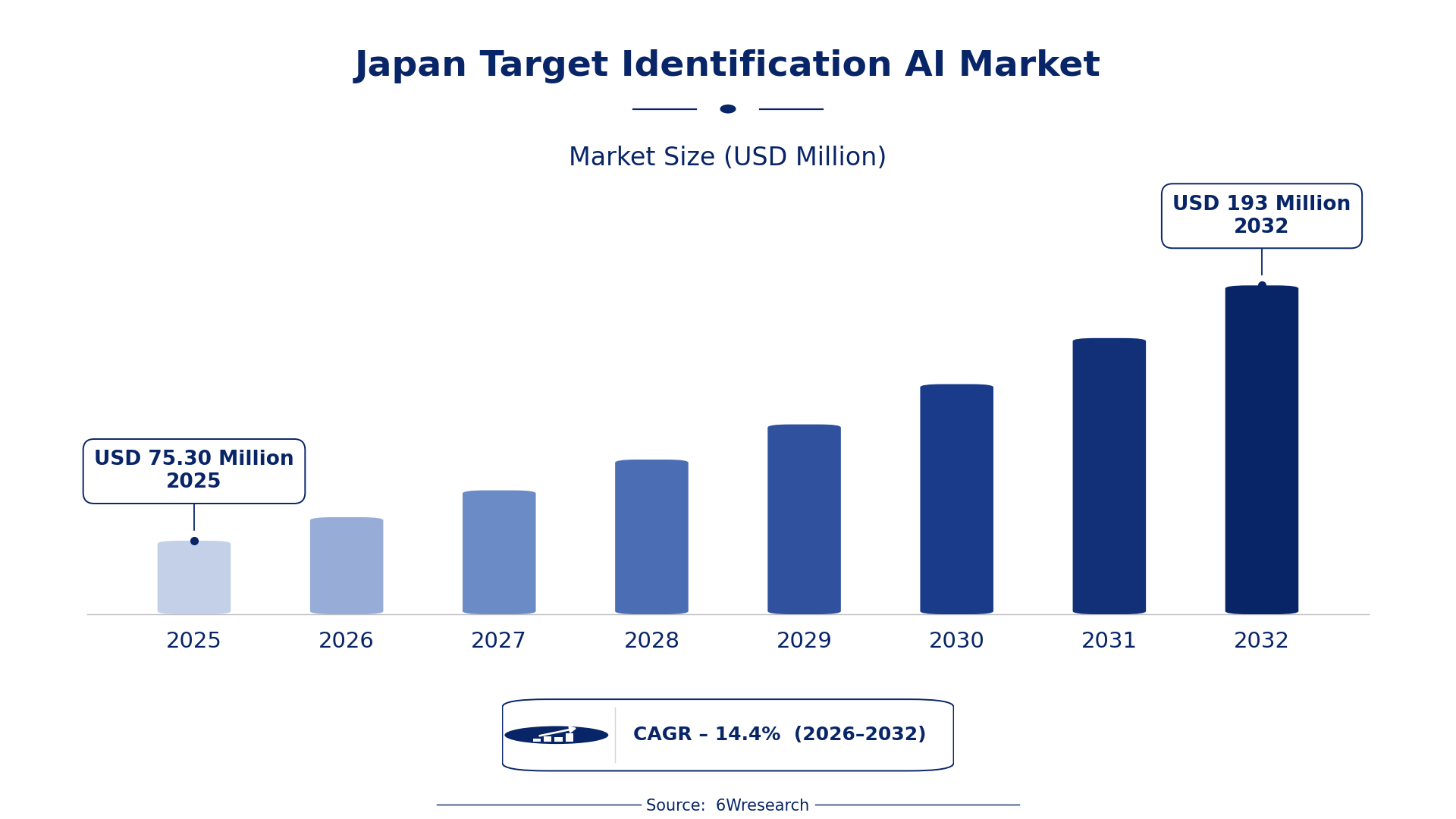
According to 6Wresearch internal database and industry insights, the Japan Target Identification AI Market was valued at USD 75.30 Million in 2025 and is projected to reach USD 193 Million by 2032, growing at a CAGR of approximately 14.4% during 2026–2032.
Japan Target Identification AI Market Highlights
| Report Metric | Details |
| Report Name | Japan Target Identification AI Market (2026-2032) |
| Market Size 2025 | USD 75.30 Million |
| Market Size 2032 | USD 193 Million |
| Absolute Growth 2025–2032 | USD 117.70 Million |
| CAGR 2026–2032 | 14.4% |
| Peak Annual Growth | 19.6% in 2026 |
| Forecast Period | 2026–2032 |
| Historical Data | 2022–2025 |
| Base Year | 2025 |
| Leading Target Identification AI, 2025 | Drone Targeting AI (51% share) |
| Leading Product Type, 2025 | Surveillance AI (46% share) |
| Leading AI Model Type, 2025 | Deep Learning (37% share) |
| Leading Distribution Channel, 2025 | Military Integrators (41% share) |
| Leading End User Industry, 2025 | UAV Operations (42% share) |
| Fastest-Growing Target Identification AI | Satellite Imaging AI (19.6% CAGR) |
| Fastest-Growing Product Type | ISR Systems (20.0% CAGR) |
| Fastest-Growing AI Model Type | Real-time Vision (19.8% CAGR) |
| Fastest-Growing Distribution Channel | Defense Programs (17.3% CAGR) |
| Growing Sector | Defense and Security |
| Key End Users | Government Agencies, Military Integrators, Law Enforcement, UAV Operations |
Japan Target Identification AI Market Year-wise Growth Rate and Key Drivers (2022–2032)
This graph illustrates the annual growth rates of the market from 2022 to 2032, highlighting a steady upward trajectory and projected market expansion over the forecast period.
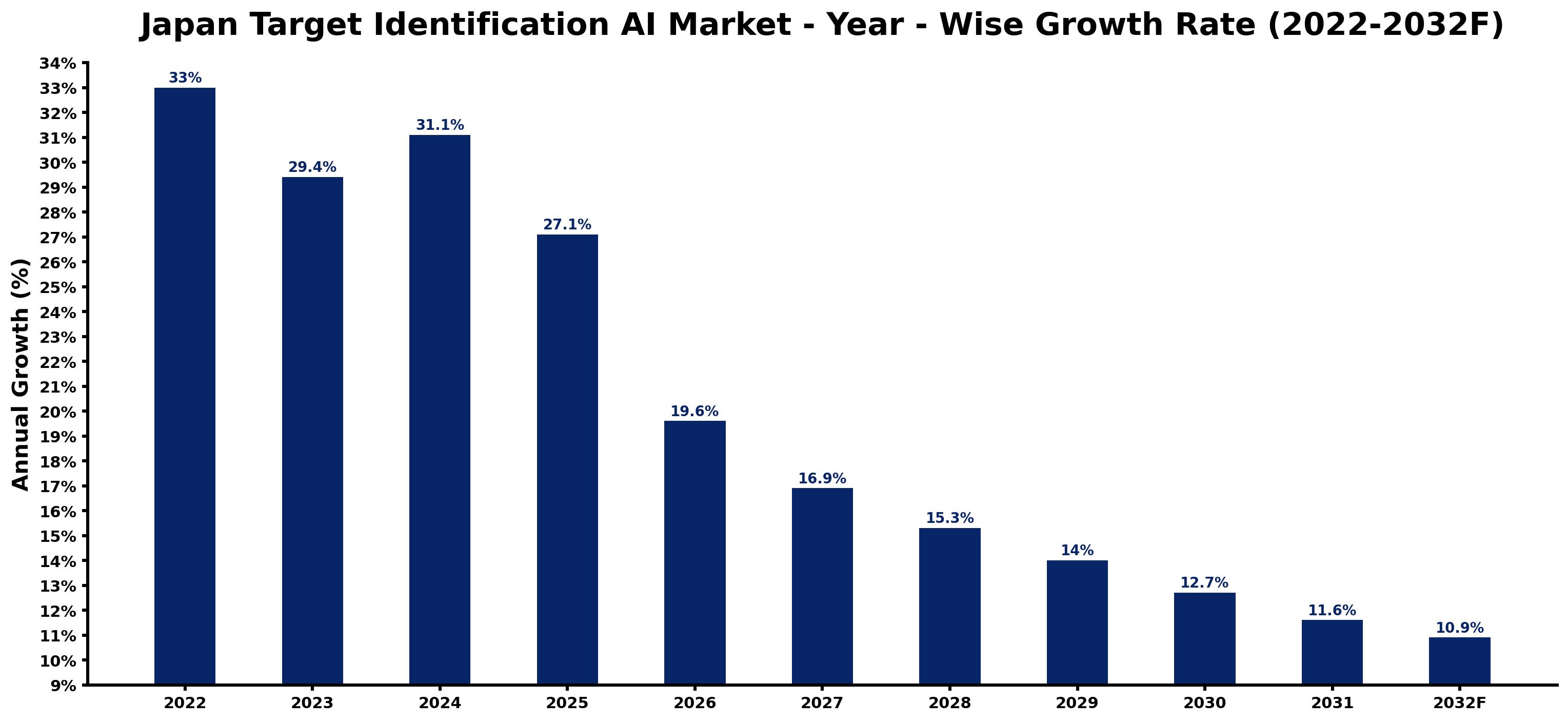
The yearly estimates that follow link every growth rate to its principal driver, so readers can see why the pace changed in each period.
| Year | Estimated Annual Growth (%) | Market Rationale |
| 2022 | 33.0 | The market experienced strong demand due to increased military budgets and AI integration initiatives. |
| 2023 | 29.4 | Growth slowed as the market adjusted to previous high levels of investment and demand. |
| 2024 | 31.1 | A resurgence in spending on advanced surveillance technologies boosted growth rates. |
| 2025 | 27.1 | Investment in AI for military applications continued, but at a reduced pace compared to prior years. |
| 2026 | 19.6 | Demand for AI in defense is expected to peak as integration efforts intensify across military operations. |
| 2027 | 16.9 | Market growth will slow further as saturation in certain segments begins to take effect. |
| 2028 | 15.3 | Continued emphasis on ISR capabilities will maintain steady, albeit slower, growth. |
| 2029 | 14.0 | The market will see a gradual slowdown in growth rates as competition intensifies among providers. |
| 2030 | 12.7 | Investment in AI technologies will remain strong, but growth rates will continue to decelerate. |
| 2031 | 11.6 | The market will stabilise as buyers adjust to new technologies and operational needs. |
| 2032 | 10.9 | Growth is expected to stabilise as the market matures and demand becomes more consistent. |
Note: Market size estimations and growth projections presented in this report are based on 6Wresearch's proprietary forecasting methodology, utilizing the latest available industry data, government publications, and primary research inputs.
Japan Target Identification AI Market Synopsis
Target Identification AI refers to advanced systems that use artificial intelligence for identifying and tracking targets, primarily in military and security applications. The Japan Target Identification AI Market is experiencing growth driven by increased defense spending, with the government allocating approximately 6.8 trillion yen in 2023 for advanced technologies. The Ministry of Defense's AI integration initiative by 2025 and rising investments in drone technology further fuel demand from military operations and government defense programs. This growth reflects a broader trend towards modernising defense capabilities and improving operational efficiency through technology.
Market Dynamics Impact Analysis (2026–2032)
| Factor | Type | Impact | Primary Segment Affected |
| Increased defense spending | Driver | High | Drone Targeting AI |
| Growing demand for surveillance capabilities | Driver | High | Surveillance AI |
| Rising need for precision targeting systems | Opportunity | High | Drone Targeting AI |
| Expansion of AI applications in law enforcement | Opportunity | Medium | Facial Recognition Systems |
| High development costs for AI systems | Restraint | High | Surveillance AI |
| Limited skilled workforce in AI technologies | Restraint | Medium | Drone Targeting AI |
| Technological integration challenges | Challenge | High | ISR Systems |
| Competition from international AI providers | Challenge | Medium | Satellite Imaging AI |
Evaluation of Drivers in Japan Target Identification AI Market (2026–2032)
The table below links each growth driver to the segment it affects and the evidence for it.
| Drivers | Primary Segment Affected | Why It Matters (Evidence) |
| Increased military investment in AI technologies | Drone Targeting AI | Japan's defense budget for 2023 is approximately 6.8 trillion yen, driving demand for advanced targeting systems. |
| Rising focus on surveillance and reconnaissance | Surveillance AI | A program for AI integration in surveillance systems is set for implementation by 2025. |
| Growing adoption of drones in military operations | Drone Targeting AI | Investments in drone technology are increasing, improving operational capabilities in military applications. |
| Demand for improved ISR capabilities | ISR Systems | Funding for enhancing ISR capabilities using AI has been allocated by the government. |
| Focus on border security improvements | Facial Recognition Systems | A strategy to improve border security using AI technologies was launched in 2023. |
Most of the extra volume comes from increased military investment in AI technologies, with Japan's defense budget reaching approximately 6.8 trillion yen in 2023. The Self-Defense Forces are increasing investments in drone technology, which supports enhanced operational capabilities. Funding for ISR capabilities further supports market growth, while the strategy to improve border security using AI technologies drives demand for facial recognition systems.
Evaluation of Restraints in Japan Target Identification AI Market
The main factors holding the market back are set out below.
| Market Restraint | Primary Segment Affected | Why It Matters (Evidence) |
| High development costs for implementing AI systems | Surveillance AI | The integration of advanced AI technologies requires substantial financial investment, limiting market entry. |
| Limited skilled workforce in AI technologies | Drone Targeting AI | A shortage of qualified professionals hampers the development and deployment of AI solutions. |
| Integration challenges with existing military systems | ISR Systems | The complexity of integrating new AI technologies with legacy systems can delay implementation. |
| Regulatory hurdles in AI deployment | Facial Recognition Systems | Strict regulations surrounding data privacy and security can slow down the adoption of facial recognition technologies. |
| Intense competition from international AI providers | Satellite Imaging AI | Local firms face challenges in competing against established international players with advanced technologies. |
Japan Target Identification AI Market Challenges
Japan's military incurs rising costs from advanced technology integration, with the 2023 defense budget at approximately 6.8 trillion yen. This financial strain hampers military buyers' ability to upgrade critical systems effectively. Domestic developers face intense competition as foreign firms penetrate the market, leading to procurement delays for government contracts. Smaller suppliers struggle to adapt to rapid technological advancements in AI, which can overwhelm their resources and hinder their capacity to meet larger clients' demands. Buyers within the Self-Defense Forces may find it difficult to achieve the 30% AI integration target by 2030 due to these persistent challenges.
Trends in the Japan Target Identification AI Market
The trends below show where the Japan Target Identification AI Market is heading.
- Shift towards AI-Driven Surveillance: Tokyo is emerging as a centre for AI-driven surveillance technologies, with the Tokyo Metropolitan Police employing AI for facial recognition in public safety initiatives, reflecting a growing trend in urban security.
- Increased Investment in Drone Technology: The Self-Defense Forces are prioritising improvements in drone capabilities, with investments expected to rise, underscoring the importance of UAV operations in contemporary military strategies.
- Adoption of Real-Time Vision Systems: A noticeable shift towards real-time vision systems is occurring as military integrators adopt these technologies for immediate threat assessment, enhancing operational readiness.
- Expansion of ISR Capabilities: Investment in ISR capabilities is propelling the integration of advanced AI systems, indicating a trend towards improved intelligence gathering.
Investment Opportunities in the Japan Target Identification AI Market
Investors looking at the Japan Target Identification AI Market should consider the following areas.
- Supply of Advanced Surveillance AI: With a projected increase in demand for surveillance technologies, suppliers can concentrate on advanced surveillance AI systems, targeting military integrators and government agencies for collaboration.
- Investment in Drone Targeting AI: The market gap for precision targeting systems is substantial, with a projected growth rate of 19.6% for Drone Targeting AI, making it an appealing investment area for technology providers.
- Development of Facial Recognition Systems: The demand for facial recognition technologies is increasing, particularly among law enforcement agencies, creating opportunities for suppliers to address this need with effective solutions.
- Enhancement of ISR Systems: With a focus on improving ISR capabilities, suppliers can invest in the development of advanced ISR systems, targeting military programmes that require enhanced intelligence solutions.
Government Initiatives in the Japan Target Identification AI Market
The Long-Term Care Insurance Act and the Battery Industry Strategy are important for the development of AI technologies in Japan. The former supports funding for advanced technologies, while the latter targets domestic manufacturing capacity, indirectly benefiting the defense sector by promoting innovation in AI applications. The government has allocated substantial resources to support these initiatives, which impact the Target Identification AI market by ensuring a steady flow of investment and development opportunities.
The National Institute of Advanced Industrial Science and Technology and other agencies are key in implementing AI initiatives. They fund research and development projects aimed at integrating AI into military operations, enhancing the capabilities of Japan's defense forces. These efforts are expected to lead to improved operational efficiencies and advanced technological applications in the field.
Future Insight of the Japan Target Identification AI Market
Japan's military operations will undergo transformation by 2032 as the government advances AI integration, targeting 30% adoption in military operations by 2030. The Ministry of Defense's AI surveillance initiative, set for completion by 2025, will improve operational efficiency. Increased funding for drone technology will facilitate the development of advanced AI applications in security. Collaborative efforts through the Defense Technology Association will accelerate progress, enabling suppliers to meet specific demands and providing buyers with enhanced operational capabilities.
Market Segmentation Analysis
Japan Target Identification AI Market report covers a detailed analysis of the following market segments:
By Target Identification AI – Drone Targeting AI Leads, Satellite Imaging AI Expected to Grow Fastest
According to Saurav Kr Singh, Senior Research Analyst at 6Wresearch, Drone Targeting AI took 51% of target identification ai revenue in 2025, more than any other category. Drone Targeting AI holds the largest share due to its critical role in precision targeting for military operations. The Japanese Self-Defense Forces are significantly increasing investments in drone technology, highlighting the importance of this application. Satellite Imaging AI is set to record the highest CAGR in this split, 19.6% over 2026–2032. Satellite Imaging AI is experiencing rapid growth, driven by its essential function in reconnaissance and surveillance from space. The government's funding for enhancing ISR capabilities directly supports the expansion of this sub-segment. Suppliers should prioritise advancements in drone targeting to satisfy the increasing demand.
By Product Type – Surveillance AI Leads, ISR Systems Expected to Grow Fastest
Surveillance AI held 46% of the Japan Target Identification AI Market by product type in 2025. Surveillance AI dominates the market as it is fundamental for monitoring and threat detection in defence applications. The Tokyo Metropolitan Police's use of AI for public safety underscores its widespread adoption. ISR Systems are projected to grow fastest, at a CAGR of 20.0% during 2026–2032. ISR Systems are growing quickly due to their key role in intelligence, surveillance, and reconnaissance operations. The Ministry of Defense's program for AI integration in surveillance systems by 2025 highlights the urgency for advancements in this area. Buyers must prioritise investments in ISR systems to stay ahead in operational effectiveness.
By AI Model Type – Deep Learning Leads, Real-time Vision Expected to Grow Fastest
Deep Learning accounted for 37% of the market by ai model type in 2025. Deep Learning is the leading model type as it serves as a foundational technology for various defence applications. Its indirect role in enhancing capabilities makes it essential for future advancements. The quickest growth will come from Real-time Vision, forecast to expand at a CAGR of 19.8% between 2026 and 2032. Real-time Vision is the fastest-growing model type, crucial for immediate threat assessment and response. The heightened emphasis on real-time data processing in military operations significantly supports its rapid adoption. Suppliers should focus on developing real-time vision technologies to address the urgent requirements of defence operations.
By Distribution Channel – Military Integrators Lead, Defense Programs Expected to Grow Fastest
With 41% of distribution channel revenue in 2025, Military Integrators was the largest category. Military Integrators dominate the distribution channel as they are vital for deploying advanced solutions within defence environments. Their established connections with military entities ensure consistent demand for these technologies. Over 2026–2032, Defense Programs are expected to post the fastest growth, at a CAGR of 17.3%. Defense Programs are expanding at the fastest rate due to government initiatives actively employing these technologies. The commitment of the Japanese government to integrate advanced systems into military operations by 2030 propels this growth. Suppliers must align their strategies with government initiatives to seize emerging opportunities.
By End User Industry – UAV Operations Lead and Record the Fastest Growth
The largest end user industry category in 2025 was UAV Operations, at 42% of revenue. UAV Operations is the leading end user industry as it incorporates advanced systems for operational efficiency in unmanned vehicles. The increasing investments in drone technology by the Self-Defense Forces underscore the significance of this segment. UAV Operations are also forecast to expand faster than any other category, at a CAGR of 17.7% over 2026–2032. UAV Operations is also the fastest-growing industry, reflecting a surge in demand for advanced solutions in unmanned vehicle applications. The focus on improving operational capabilities ensures sustained growth in this area. Suppliers must innovate within UAV operations to meet the rising demands for efficiency and effectiveness.
Key Attractiveness of the Report
- 10 Years of Market Numbers
- Historical Data Starting from 2022 to 2025
- Base Year 2025
- Forecast Data until 2032
- Key Performance Indicators Impacting the Market
- Major Upcoming Developments and Projects
Key Highlights of the Report:
- Japan Target Identification AI Market Outlook
- Market Size of Japan Target Identification AI Market, 2025
- Forecast of Japan Target Identification AI Market, 2032
- Historical Data and Forecast of Japan Target Identification AI Revenues & Volume for the Period 2022-2032F
- Japan Target Identification AI Market Trend Evolution
- Japan Target Identification AI Market Drivers and Challenges
- Japan Target Identification AI Price Trends
- Japan Target Identification AI Porter's Five Forces
- Japan Target Identification AI Industry Life Cycle
- Historical Data and Forecast of Japan Target Identification AI Market Revenues & Volume By Target Identification AI for the Period 2022-2032F
- Historical Data and Forecast of Japan Target Identification AI Market Revenues & Volume By Facial Recognition Systems for the Period 2022-2032F
- Historical Data and Forecast of Japan Target Identification AI Market Revenues & Volume By Drone Targeting AI for the Period 2022-2032F
- Historical Data and Forecast of Japan Target Identification AI Market Revenues & Volume By Autonomous Vehicle AI for the Period 2022-2032F
- Historical Data and Forecast of Japan Target Identification AI Market Revenues & Volume By Satellite Imaging AI for the Period 2022-2032F
- Historical Data and Forecast of Japan Target Identification AI Market Revenues & Volume By Product Type for the Period 2022-2032F
- Historical Data and Forecast of Japan Target Identification AI Market Revenues & Volume By Surveillance AI for the Period 2022-2032F
- Historical Data and Forecast of Japan Target Identification AI Market Revenues & Volume By Aerial Imaging AI for the Period 2022-2032F
- Historical Data and Forecast of Japan Target Identification AI Market Revenues & Volume By Battlefield AI for the Period 2022-2032F
- Historical Data and Forecast of Japan Target Identification AI Market Revenues & Volume By ISR Systems for the Period 2022-2032F
- Historical Data and Forecast of Japan Target Identification AI Market Revenues & Volume By AI Model Type for the Period 2022-2032F
- Historical Data and Forecast of Japan Target Identification AI Market Revenues & Volume By CNNs/ML Models for the Period 2022-2032F
- Historical Data and Forecast of Japan Target Identification AI Market Revenues & Volume By Real-time Vision for the Period 2022-2032F
- Historical Data and Forecast of Japan Target Identification AI Market Revenues & Volume By Deep Learning for the Period 2022-2032F
- Historical Data and Forecast of Japan Target Identification AI Market Revenues & Volume By Pattern Recognition for the Period 2022-2032F
- Historical Data and Forecast of Japan Target Identification AI Market Revenues & Volume By Distribution Channel for the Period 2022-2032F
- Historical Data and Forecast of Japan Target Identification AI Market Revenues & Volume By Military Integrators for the Period 2022-2032F
- Historical Data and Forecast of Japan Target Identification AI Market Revenues & Volume By OEM Partnerships for the Period 2022-2032F
- Historical Data and Forecast of Japan Target Identification AI Market Revenues & Volume By Defense Programs for the Period 2022-2032F
- Historical Data and Forecast of Japan Target Identification AI Market Revenues & Volume By Government Agencies for the Period 2022-2032F
- Historical Data and Forecast of Japan Target Identification AI Market Revenues & Volume By End User Industry for the Period 2022-2032F
- Historical Data and Forecast of Japan Target Identification AI Market Revenues & Volume By Border Patrol for the Period 2022-2032F
- Historical Data and Forecast of Japan Target Identification AI Market Revenues & Volume By UAV Operations for the Period 2022-2032F
- Historical Data and Forecast of Japan Target Identification AI Market Revenues & Volume By Armored Vehicles for the Period 2022-2032F
- Historical Data and Forecast of Japan Target Identification AI Market Revenues & Volume By Strategic Command for the Period 2022-2032F
- Japan Target Identification AI Import Export Trade Statistics
- Market Opportunity Assessment By Target Identification AI
- Market Opportunity Assessment By Product Type
- Market Opportunity Assessment By AI Model Type
- Market Opportunity Assessment By Distribution Channel
- Market Opportunity Assessment By End User Industry
- Japan Target Identification AI Top Companies Market Share
- Japan Target Identification AI Competitive Benchmarking By Technical and Operational Parameters
- Japan Target Identification AI Company Profiles
- Japan Target Identification AI Key Strategic Recommendations
Market Covered
Coverage by segment is as follows.
By Target Identification AI
- Facial Recognition Systems
- Drone Targeting AI
- Autonomous Vehicle AI
- Satellite Imaging AI
By Product Type
- Surveillance AI
- Aerial Imaging AI
- Battlefield AI
- ISR Systems
By AI Model Type
- CNNs/ML Models
- Real-time Vision
- Deep Learning
- Pattern Recognition
By Distribution Channel
- Military Integrators
- OEM Partnerships
- Defense Programs
- Government Agencies
By End User Industry
- Border Patrol
- UAV Operations
- Armored Vehicles
- Strategic Command































