Japan Targeted Alpha Therapy Market Size & Growth Rate
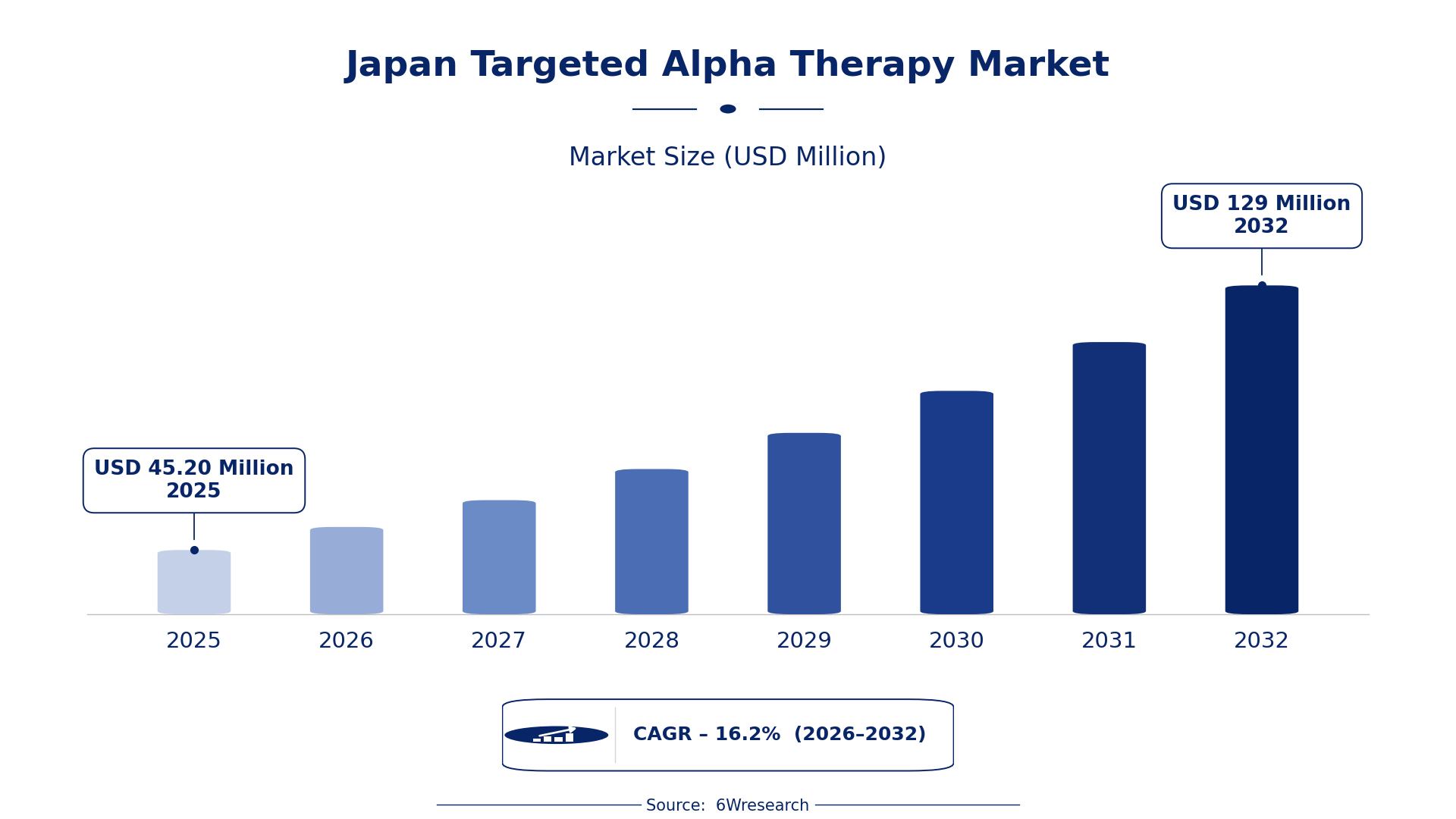
According to 6Wresearch internal database and industry insights, the Japan Targeted Alpha Therapy Market was valued at USD 45.20 Million in 2025 and is projected to reach USD 129 Million by 2032, growing at a CAGR of approximately 16.2% during 2026–2032.
Japan Targeted Alpha Therapy Market Highlights
| Report Metric | Details |
| Report Name | Japan Targeted Alpha Therapy Market (2026-2032) |
| Market Size 2025 | USD 45.20 Million |
| Market Size 2032 | USD 129 Million |
| Absolute Growth 2025–2032 | USD 83.80 Million |
| CAGR 2026–2032 | 16.2% |
| Peak Annual Growth | 17.8% in 2028 |
| Forecast Period | 2026–2032 |
| Historical Data | 2022–2025 |
| Base Year | 2025 |
| Leading Targeted Alpha Therapy, 2025 | Radionuclide Therapy (46% share) |
| Leading Product Type, 2025 | Actinium-225 (51% share) |
| Leading Isotope Type, 2025 | Alpha Emitters (41% share) |
| Leading Distribution Channel, 2025 | Oncology Hospitals (36% share) |
| Leading End User Industry, 2025 | Cancer Treatment (43% share) |
| Fastest-Growing Targeted Alpha Therapy | Clinical Trial Products (22.4% CAGR) |
| Fastest-Growing Product Type | Investigational (23.4% CAGR) |
| Fastest-Growing Isotope Type | Ligand-Targeted (22.5% CAGR) |
| Fastest-Growing Distribution Channel | Direct Supply (20.2% CAGR) |
| Fastest-Growing End User Industry | Research Institutes (20.7% CAGR) |
| Growing Sector | Cancer Treatment |
| Key End Users | Oncology Hospitals, Research Institutes, Specialized Clinics, Cancer Patients |
Japan Targeted Alpha Therapy Market Year-wise Growth Rate and Key Drivers (2022–2032)
This graph illustrates the annual growth rates of the market from 2022 to 2032, highlighting a steady upward trajectory and projected market expansion over the forecast period.
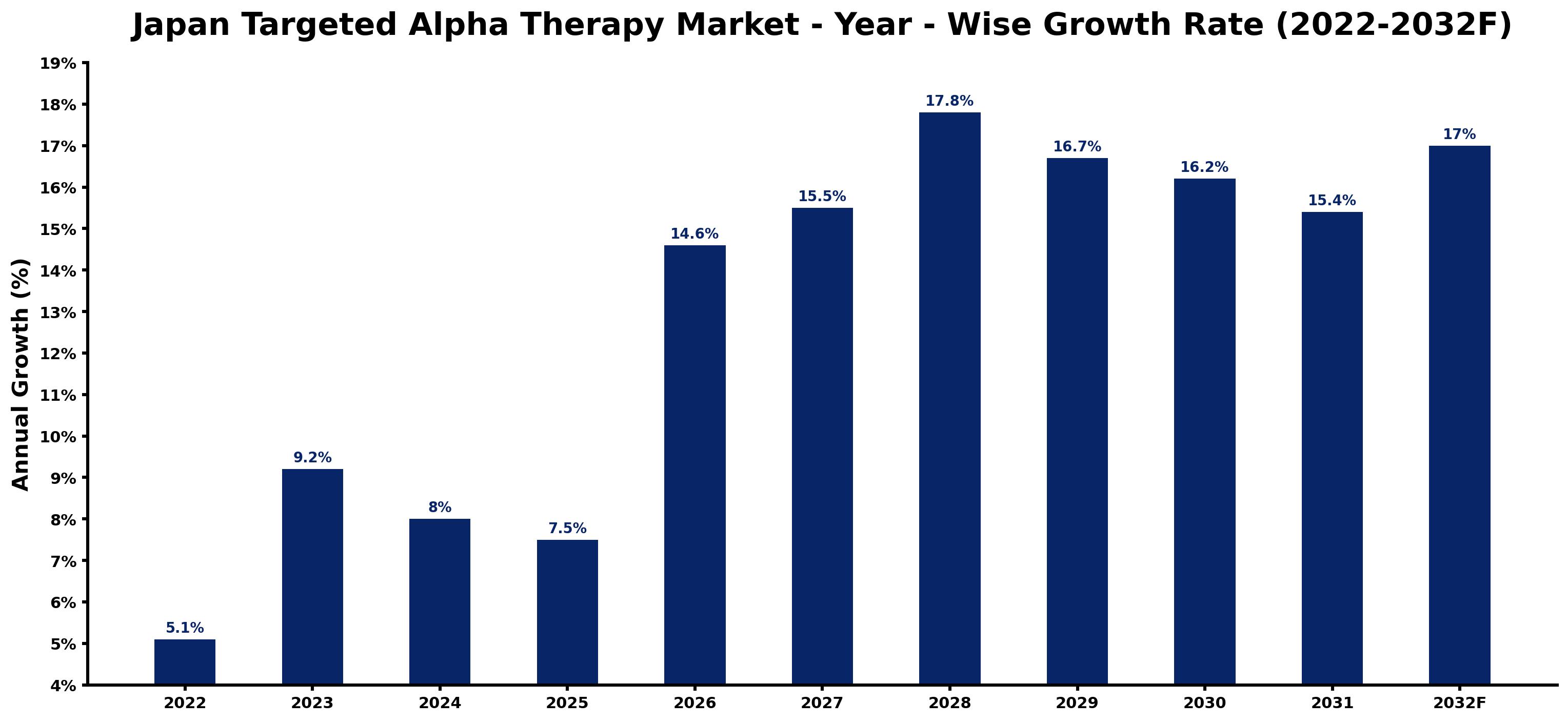
The table below sets out the estimated growth rate for each year and the main factor behind it.
| Year | Estimated Annual Growth (%) | Market Rationale |
| 2022 | 5.1 | The market experienced steady growth due to increased awareness of targeted therapies. |
| 2023 | 9.2 | Demand surged as more oncology hospitals adopted advanced treatment methods. |
| 2024 | 8.0 | Growth slowed slightly as hospitals adjusted to new treatment protocols. |
| 2025 | 7.5 | Market expansion continued, driven by ongoing clinical trials and research. |
| 2026 | 14.6 | Investment in cancer research is expected to accelerate, boosting demand for new therapies. |
| 2027 | 15.5 | Rising patient numbers will further increase the need for targeted treatments. |
| 2028 | 17.8 | The market is projected to peak with advancements in treatment efficacy and accessibility. |
| 2029 | 16.7 | Growth is expected to moderate as the market begins to stabilise after rapid expansion. |
| 2030 | 16.2 | Demand will remain strong, supported by ongoing research and development efforts. |
| 2031 | 15.4 | The market is projected to continue growing as new therapies enter clinical use. |
| 2032 | 17.0 | Increased focus on precision medicine will drive further demand for targeted therapies. |
Note: Market size estimations and growth projections presented in this report are based on 6Wresearch's proprietary forecasting methodology, utilizing the latest available industry data, government publications, and primary research inputs.
Japan Targeted Alpha Therapy Market Synopsis
Targeted Alpha Therapy employs alpha-emitting radionuclides to selectively destroy cancer cells, produced through the conjugation of isotopes with targeting molecules. The Japan Targeted Alpha Therapy Market is expanding, driven by a cancer patient population exceeding 1 million and over 50 oncology hospitals utilising this therapy. Investment in cancer research reached over ¥10 billion in 2023, while ongoing clinical trials in specialised institutions are broadening the applications of this treatment and improving patient outcomes.
Market Dynamics Impact Analysis (2026–2032)
| Factor | Type | Impact | Primary Segment Affected |
| Growing cancer patient population drives demand for effective treatments. | Driver | High | Cancer Treatment |
| Investment in research and development enhances treatment options. | Driver | High | Clinical Trial Products |
| Increasing number of oncology hospitals adopting advanced therapies creates opportunities. | Opportunity | High | Oncology Hospitals |
| Expansion of clinical trial products offers new treatment avenues. | Opportunity | Medium | Clinical Trial Products |
| High costs associated with targeted therapies can limit accessibility. | Restraint | High | Radionuclide Therapy |
| Regulatory compliance can delay product approvals and market entry. | Restraint | Medium | Radionuclide Therapy |
| Limited availability of isotopes can restrict treatment options. | Challenge | High | Radionuclide Therapy |
| Capacity constraints in production facilities may hinder supply. | Challenge | Medium | Radionuclide Therapy |
Evaluation of Drivers in Japan Targeted Alpha Therapy Market (2026–2032)
The factors lifting demand, and the evidence behind each, are summarised below.
| Drivers | Primary Segment Affected | Why It Matters (Evidence) |
| Increasing cancer incidence rates drive demand for targeted therapies. | Cancer Treatment | The growing cancer patient population exceeding 1 million in Japan necessitates effective treatment options. |
| Ongoing clinical trials expand treatment applications and efficacy. | Clinical Trial Products | Research institutes across Japan are conducting multiple clinical trials to validate new therapies. |
| Investment in cancer research supports the development of new therapies. | Radionuclide Therapy | Investment in cancer research reached over ¥10 billion in 2023, facilitating advancements. |
| Adoption of advanced treatment protocols by oncology hospitals increases demand. | Oncology Hospitals | Over 50 oncology hospitals in Japan are utilizing targeted alpha therapy for cancer treatment. |
| Rising awareness of precision medicine boosts interest in targeted therapies. | Radionuclide Therapy | The Japan Society of Nuclear Medicine promotes education on radionuclide therapies, enhancing awareness. |
What keeps demand rising is the increasing incidence of cancer, with over 1 million patients in Japan seeking effective treatments. Investment in cancer research reached ¥10 billion in 2023, enabling the development of new therapies. Ongoing clinical trials at specialised research institutes are broadening the applications of targeted alpha therapy. Adoption of advanced treatment protocols by over 50 oncology hospitals further drives demand.
Evaluation of Restraints in Japan Targeted Alpha Therapy Market
Below are the constraints most often cited by buyers and suppliers, with the segment each affects.
| Market Restraint | Primary Segment Affected | Why It Matters (Evidence) |
| High costs associated with targeted therapies limit accessibility for patients. | Radionuclide Therapy | The expenses involved in treatment can deter patients from seeking advanced options. |
| Regulatory compliance requirements delay product approvals and market entry. | Radionuclide Therapy | Producers must navigate complex regulations, which can prolong the approval process. |
| Limited availability of isotopes restricts treatment options for patients. | Radionuclide Therapy | Dependence on specific isotopes can create bottlenecks in treatment availability. |
| Capacity constraints in production facilities may hinder supply. | Radionuclide Therapy | Production facilities may struggle to meet the growing demand for targeted therapies. |
| Market competition may drive prices down, affecting profitability. | Clinical Trial Products | Increased competition among producers can lead to price reductions, impacting margins. |
Japan Targeted Alpha Therapy Market Challenges
Buyers struggle with a lack of skilled professionals trained in targeted alpha therapy, limiting patient access to advanced treatments. This shortage exists due to the therapy's recent introduction, causing delays in care for over 1 million cancer patients. Suppliers face high production costs stemming from stringent JIS standards for medical isotopes, which raises therapy prices for hospitals. Competition intensifies among hospitals vying for cancer patients, leading to increased marketing expenses that inflate treatment costs for buyers. Buyers also experience inconsistent availability of radionuclides, disrupting treatment schedules and jeopardising patient outcomes.
Trends in the Japan Targeted Alpha Therapy Market
The following changes are redrawing the Japan Targeted Alpha Therapy Market.
- Shift Towards Advanced Cancer Treatment: In 2023, a new program launched by the Ministry of Health aims to improve cancer treatment accessibility, promoting advanced therapies. This initiative has led to increased adoption of targeted alpha therapy in oncology hospitals, supporting patient care.
- Emergence of Clinical Trials for New Therapies: Ongoing clinical trials in specialised research institutes are broadening the applications of targeted alpha therapy. With numerous trials underway, the focus on new treatments is expected to grow, improving patient options.
- Increased Focus on Precision Medicine: The Japan Society of Nuclear Medicine is advocating for education on radionuclide therapies, highlighting the importance of precision medicine. This focus is driving demand for targeted therapies, as healthcare providers seek more effective treatment options.
- Expansion of Oncology Hospitals: Tokyo and Osaka are key regions for advanced cancer treatment facilities. The growth of oncology hospitals in these areas is facilitating the adoption of targeted therapies, responding to the rising cancer patient population.
Investment Opportunities in the Japan Targeted Alpha Therapy Market
The openings below show where demand in the Japan Targeted Alpha Therapy Market is visible and how suppliers can enter.
- Investment in Cancer Research: Investment in cancer research reached over ¥10 billion in 2023, creating opportunities for new therapies. Research institutes are actively seeking partnerships to develop treatments that meet patient needs.
- Growing Demand for Clinical Trial Products: With ongoing clinical trials, there is an opportunity to supply new therapies. Research institutes are in need of advanced treatment options, creating a pathway for new entrants in the market.
- Expansion of Oncology Facilities: The increasing number of oncology hospitals in Tokyo and Osaka presents a chance to supply targeted therapies. Collaborating with local healthcare providers can facilitate market entry and enhance treatment access.
- Focus on Isotope Production: The demand for alpha emitters is rising, driven by their effectiveness in cancer treatment. Investing in isotope production facilities can meet the growing needs of oncology hospitals.
Government Initiatives in the Japan Targeted Alpha Therapy Market
The Water Supply Act (1957) and the Sewerage Act (1958) set foundational standards for healthcare infrastructure, indirectly impacting the availability of medical services. These laws ensure that healthcare facilities maintain adequate water quality and sanitation, which is essential for patient safety and treatment efficacy.
The Ministry of Health, Labour and Welfare (MHLW) administers the NHI drug price standard, which regularly establishes reimbursement prices for therapies. This regulation ensures that targeted alpha therapies are accessible to patients, supporting the overall growth of the market.
Future Insight of the Japan Targeted Alpha Therapy Market
By 2032, oncology hospitals will expand treatment capabilities through advancements in radionuclide therapies and increased investment in cancer research. New programmes initiated by the Ministry of Health will improve patient access to targeted alpha therapy. Clinical trials at various research institutes will produce more effective treatment protocols, benefiting patients and healthcare providers alike. Investment in cancer research reached over ¥10 billion in 2023, allowing suppliers to develop therapies tailored to evolving patient needs.
Market Segmentation Analysis
Japan Targeted Alpha Therapy Market report covers a detailed analysis of the following market segments:
By Targeted Alpha Therapy – Radionuclide Therapy Leads, Clinical Trial Products Expected to Grow Fastest
According to Saurav Kr Singh, Senior Research Analyst at 6Wresearch, Radionuclide Therapy held 46% of the Japan Targeted Alpha Therapy Market by targeted alpha therapy in 2025. Radionuclide Therapy holds the largest share as it is widely implemented in over 50 oncology hospitals in Japan, effectively targeting cancer cells. The support from the Japan Society of Nuclear Medicine's standards ensures its reliability and acceptance in clinical settings. The quickest growth will come from Clinical Trial Products, forecast to expand at a CAGR of 22.4% between 2026 and 2032. Clinical Trial Products are experiencing rapid growth due to ongoing trials in multiple research institutes, which are essential for evaluating new therapies and expanding treatment options. This focus on research will likely increase the adoption of TAT in clinical practice. Suppliers should prioritise partnerships with oncology hospitals to enhance their market presence.
By Product Type – Actinium-225 Leads, Investigational Expected to Grow Fastest
In 2025, Actinium-225 led the product type split with a 51% share. Actinium-225 is the leading product type, recognised for its pivotal role in targeted alpha therapy applications across various oncology treatments. Its established efficacy in combating cancer solidifies its dominant market position. Investigational is projected to grow fastest, at a CAGR of 23.4% during 2026–2032. Investigational products are witnessing swift growth as they are critical for clinical trials aimed at introducing new therapies, reflecting the industry's commitment to advancing treatment options. This trend suggests a robust future demand for innovative therapies. Buyers should stay informed about advancements in investigational products to access the latest treatment options.
By Isotope Type – Alpha Emitters Lead, Ligand-Targeted Expected to Grow Fastest
Alpha Emitters took 41% of isotope type revenue in 2025, more than any other category. Alpha Emitters dominate the market as they are central to the mechanism of targeted alpha therapy, facilitating the precise destruction of cancer cells. Their proven effectiveness in clinical applications makes them the preferred choice among healthcare providers. Over 2026–2032, Ligand-Targeted is expected to post the fastest growth, at a CAGR of 22.5%. Ligand-Targeted isotopes are growing rapidly due to their ability to enhance treatment specificity, which is crucial for improving patient outcomes. This trend indicates a shift towards more personalised therapies in cancer treatment. Suppliers must focus on developing ligand-targeted isotopes to remain competitive in the evolving market.
By Distribution Channel – Oncology Hospitals Lead, Direct Supply Expected to Grow Fastest
The largest distribution channel category in 2025 was Oncology Hospitals, at 36% of revenue. Oncology Hospitals lead the distribution channel as they serve as the primary treatment facilities for patients receiving targeted alpha therapy. Their established infrastructure and oncology expertise are vital for delivering effective patient care. Direct Supply is set to record the highest CAGR in this split, 20.2% over 2026–2032. Direct Supply is expanding quickly as it ensures timely access to therapies, which is essential for patient care in oncology. The growth of this channel will likely enhance treatment accessibility and operational efficiency. Suppliers should improve their logistics to strengthen direct supply capabilities for better market penetration.
By End User Industry – Cancer Treatment Leads, Research Institutes Expected to Grow Fastest
With 43% of end user industry revenue in 2025, Cancer Treatment was the largest category. Cancer Treatment is the leading end user industry, being the main application area for targeted alpha therapy, which addresses the needs of a growing cancer patient population exceeding 1 million. This focus on cancer treatment drives the demand for TAT solutions. The quickest growth will come from Research Institutes, forecast to expand at a CAGR of 20.7% between 2026 and 2032. Research Institutes are the fastest-growing end user as they conduct critical studies on targeted alpha therapy, contributing to the development of new treatment protocols. Their role in advancing research will further stimulate market growth. Investing in collaborations with research institutes can provide suppliers with insights into future trends and innovations.
Key Attractiveness of the Report
- 10 Years of Market Numbers
- Historical Data Starting from 2022 to 2025
- Base Year 2025
- Forecast Data until 2032
- Key Performance Indicators Impacting the Market
- Major Upcoming Developments and Projects
Key Highlights of the Report:
- Japan Targeted Alpha Therapy Market Outlook
- Market Size of Japan Targeted Alpha Therapy Market, 2025
- Forecast of Japan Targeted Alpha Therapy Market, 2032
- Historical Data and Forecast of Japan Targeted Alpha Therapy Revenues & Volume for the Period 2022-2032F
- Japan Targeted Alpha Therapy Market Trend Evolution
- Japan Targeted Alpha Therapy Market Drivers and Challenges
- Japan Targeted Alpha Therapy Price Trends
- Japan Targeted Alpha Therapy Porter's Five Forces
- Japan Targeted Alpha Therapy Industry Life Cycle
- Historical Data and Forecast of Japan Targeted Alpha Therapy Market Revenues & Volume By Targeted Alpha Therapy for the Period 2022-2032F
- Historical Data and Forecast of Japan Targeted Alpha Therapy Market Revenues & Volume By Radionuclide Therapy for the Period 2022-2032F
- Historical Data and Forecast of Japan Targeted Alpha Therapy Market Revenues & Volume By Bioconjugates for the Period 2022-2032F
- Historical Data and Forecast of Japan Targeted Alpha Therapy Market Revenues & Volume By Targeted Nanocarriers for the Period 2022-2032F
- Historical Data and Forecast of Japan Targeted Alpha Therapy Market Revenues & Volume By Clinical Trial Products for the Period 2022-2032F
- Historical Data and Forecast of Japan Targeted Alpha Therapy Market Revenues & Volume By Product Type for the Period 2022-2032F
- Historical Data and Forecast of Japan Targeted Alpha Therapy Market Revenues & Volume By Actinium-225 for the Period 2022-2032F
- Historical Data and Forecast of Japan Targeted Alpha Therapy Market Revenues & Volume By mAb + Isotope for the Period 2022-2032F
- Historical Data and Forecast of Japan Targeted Alpha Therapy Market Revenues & Volume By Nanoparticles for the Period 2022-2032F
- Historical Data and Forecast of Japan Targeted Alpha Therapy Market Revenues & Volume By Investigational for the Period 2022-2032F
- Historical Data and Forecast of Japan Targeted Alpha Therapy Market Revenues & Volume By Isotope Type for the Period 2022-2032F
- Historical Data and Forecast of Japan Targeted Alpha Therapy Market Revenues & Volume By Alpha Emitters for the Period 2022-2032F
- Historical Data and Forecast of Japan Targeted Alpha Therapy Market Revenues & Volume By Ligand-Targeted for the Period 2022-2032F
- Historical Data and Forecast of Japan Targeted Alpha Therapy Market Revenues & Volume By Radiation Carriers for the Period 2022-2032F
- Historical Data and Forecast of Japan Targeted Alpha Therapy Market Revenues & Volume By Mixed Isotopes for the Period 2022-2032F
- Historical Data and Forecast of Japan Targeted Alpha Therapy Market Revenues & Volume By Distribution Channel for the Period 2022-2032F
- Historical Data and Forecast of Japan Targeted Alpha Therapy Market Revenues & Volume By Oncology Hospitals for the Period 2022-2032F
- Historical Data and Forecast of Japan Targeted Alpha Therapy Market Revenues & Volume By Pharma Distributors for the Period 2022-2032F
- Historical Data and Forecast of Japan Targeted Alpha Therapy Market Revenues & Volume By Direct Supply for the Period 2022-2032F
- Historical Data and Forecast of Japan Targeted Alpha Therapy Market Revenues & Volume By CRO Partners for the Period 2022-2032F
- Historical Data and Forecast of Japan Targeted Alpha Therapy Market Revenues & Volume By End User Industry for the Period 2022-2032F
- Historical Data and Forecast of Japan Targeted Alpha Therapy Market Revenues & Volume By Cancer Treatment for the Period 2022-2032F
- Historical Data and Forecast of Japan Targeted Alpha Therapy Market Revenues & Volume By Specialized Clinics for the Period 2022-2032F
- Historical Data and Forecast of Japan Targeted Alpha Therapy Market Revenues & Volume By Research Institutes for the Period 2022-2032F
- Historical Data and Forecast of Japan Targeted Alpha Therapy Market Revenues & Volume By Clinical Trials for the Period 2022-2032F
- Japan Targeted Alpha Therapy Import Export Trade Statistics
- Market Opportunity Assessment By Targeted Alpha Therapy
- Market Opportunity Assessment By Product Type
- Market Opportunity Assessment By Isotope Type
- Market Opportunity Assessment By Distribution Channel
- Market Opportunity Assessment By End User Industry
- Japan Targeted Alpha Therapy Top Companies Market Share
- Japan Targeted Alpha Therapy Competitive Benchmarking By Technical and Operational Parameters
- Japan Targeted Alpha Therapy Company Profiles
- Japan Targeted Alpha Therapy Key Strategic Recommendations
Market Covered
The study includes the following segmentation.
By Targeted Alpha Therapy
- Radionuclide Therapy
- Bioconjugates
- Targeted Nanocarriers
- Clinical Trial Products
By Product Type
- Actinium-225
- mAb + Isotope
- Nanoparticles
- Investigational
By Isotope Type
- Alpha Emitters
- Ligand-Targeted
- Radiation Carriers
- Mixed Isotopes
By Distribution Channel
- Oncology Hospitals
- Pharma Distributors
- Direct Supply
- CRO Partners
By End User Industry
- Cancer Treatment
- Specialized Clinics
- Research Institutes
- Clinical Trials































