Japan Targeted Therapy Drugs Market Size & Growth Rate
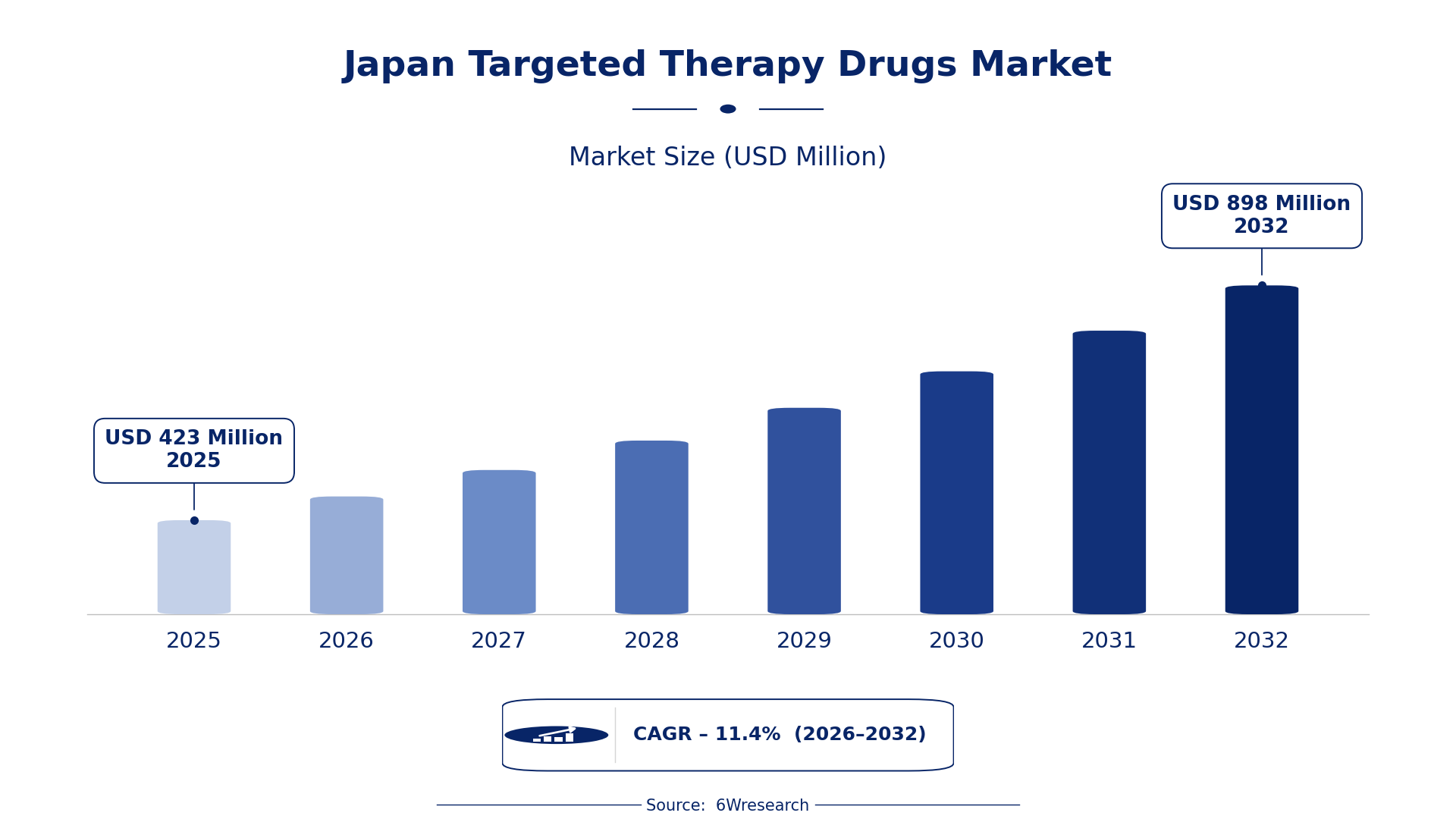
According to 6Wresearch internal database and industry insights, the Japan Targeted Therapy Drugs Market was valued at USD 423 Million in 2025 and is projected to reach USD 898 Million by 2032, growing at a CAGR of approximately 11.4% during 2026–2032.
Japan Targeted Therapy Drugs Market Highlights
| Report Metric | Details |
| Report Name | Japan Targeted Therapy Drugs Market (2026-2032) |
| Market Size 2025 | USD 423 Million |
| Market Size 2032 | USD 898 Million |
| Absolute Growth 2025–2032 | USD 475 Million |
| CAGR 2026–2032 | 11.4% |
| Peak Annual Growth | 12.9% in 2032 |
| Forecast Period | 2026–2032 |
| Historical Data | 2022–2025 |
| Base Year | 2025 |
| Leading Drug Class, 2025 | Kinase Inhibitors (39% share) |
| Leading Target Pathway, 2025 | VEGF/EGFR (40% share) |
| Leading Formulation Type, 2025 | Oral Tablet (44% share) |
| Leading End User, 2025 | Cancer Hospitals (41% share) |
| Fastest-Growing Drug Class | Angiogenesis Inhibitors (15.4% CAGR) |
| Fastest-Growing Target Pathway | VEGFR (15.7% CAGR) |
| Fastest-Growing Formulation Type | IV Infusion (16.1% CAGR) |
| Fastest-Growing End User | Oncology Clinics (14.9% CAGR) |
| Growing Sector | Oncology Clinics |
| Key End Users | Cancer Hospitals, Oncology Clinics, Research Institutions, Pharmaceutical Firms |
Japan Targeted Therapy Drugs Market Year-wise Growth Rate and Key Drivers (2022–2032)
This graph illustrates the annual growth rates of the market from 2022 to 2032, highlighting a steady upward trajectory and projected market expansion over the forecast period.
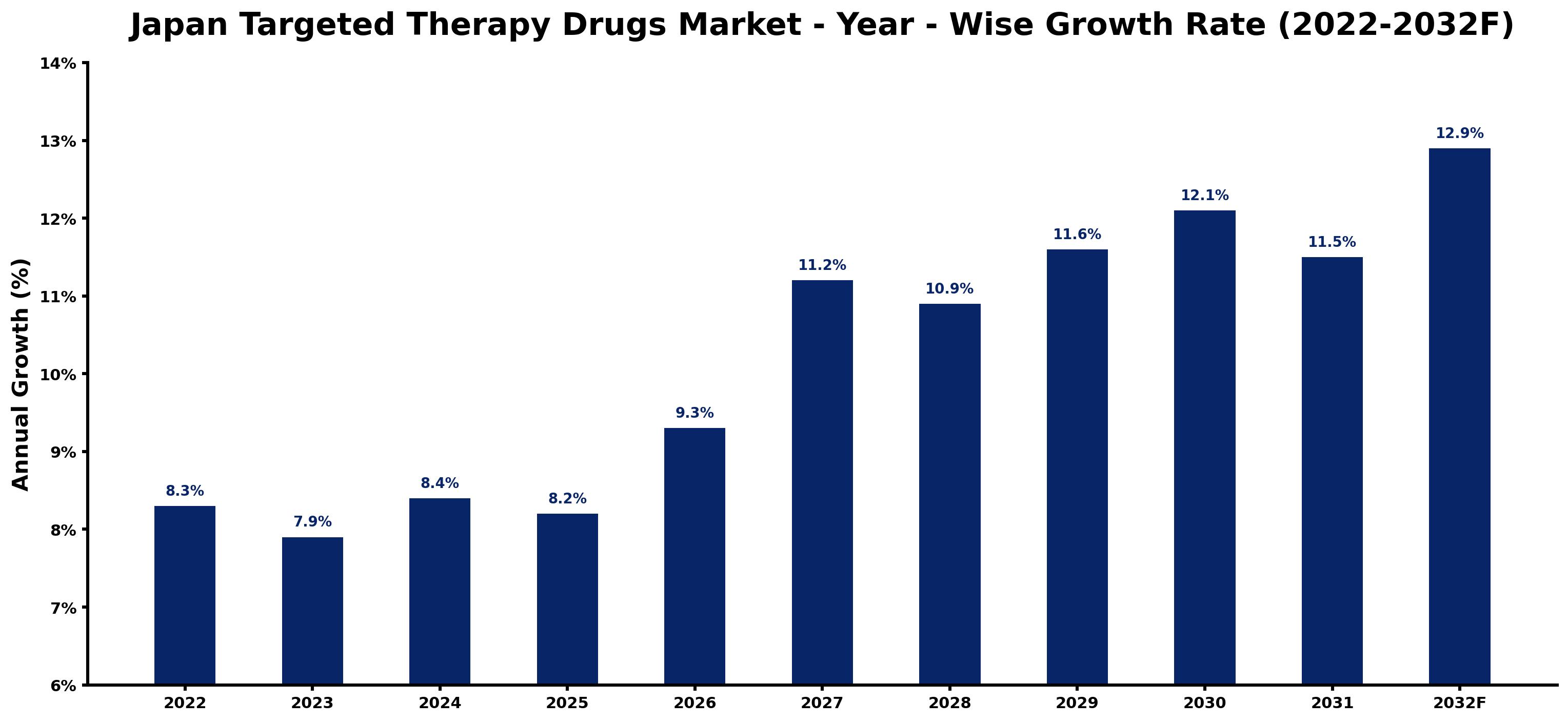
For each year, the table pairs the estimated growth rate with the leading influence on demand, showing how the drivers changed across the period.
| Year | Estimated Annual Growth (%) | Market Rationale |
| 2022 | 8.3 | The market experienced steady growth with a strong number of patients receiving targeted therapies. |
| 2023 | 7.9 | Growth slowed slightly due to market saturation and increased competition among therapies. |
| 2024 | 8.4 | The market saw a resurgence in growth as new therapies gained approval and adoption increased. |
| 2025 | 8.2 | Growth slowed again as the market matured and competition intensified among established therapies. |
| 2026 | 9.3 | Demand is expected to increase as healthcare providers expand their oncology services and treatment options. |
| 2027 | 11.2 | The market will grow as advancements in drug development and patient access continue to improve. |
| 2028 | 10.9 | Growth is projected to slow as the market begins to stabilise with established therapies dominating. |
| 2029 | 11.6 | Demand is expected to rise again as new therapies enter the market and treatment protocols evolve. |
| 2030 | 12.1 | Growth will continue as patient awareness and acceptance of targeted therapies increase. |
| 2031 | 11.5 | The market will see a slight slowdown as the focus shifts to cost management and value-based care. |
| 2032 | 12.9 | Demand is projected to surge with the introduction of breakthrough therapies and expanded treatment guidelines. |
Note: Market size estimations and growth projections presented in this report are based on 6Wresearch's proprietary forecasting methodology, utilizing the latest available industry data, government publications, and primary research inputs.
Japan Targeted Therapy Drugs Market Synopsis
Targeted therapy drugs specifically attack cancer cells by interfering with molecular targets involved in tumor growth. These drugs are vital in treating various cancers, including breast and lung cancer. The Japan Targeted Therapy Drugs Market is expanding due to over 1 million cancer patients receiving treatment, with around 50% of cancer therapies involving these drugs. Key regions like Tokyo and Osaka are increasing treatment capacities, while government initiatives support cancer research and drug approval processes.
Market Dynamics Impact Analysis (2026–2032)
| Factor | Type | Impact | Primary Segment Affected |
| Increasing prevalence of cancer and rising patient population | Driver | High | Kinase Inhibitors |
| Growing adoption of targeted therapies in oncology clinics | Driver | High | Angiogenesis Inhibitors |
| Expansion of oncology clinics in urban areas | Opportunity | Medium | Oncology Clinics |
| Investment in cancer research and development | Opportunity | High | Research Institutions |
| High cost of targeted therapies limiting access | Restraint | High | Cancer Hospitals |
| Regulatory hurdles in drug approval processes | Restraint | Medium | Pharmaceutical Firms |
| Competition from traditional therapies affecting market share | Challenge | High | Cancer Hospitals |
| Need for continuous innovation in drug development | Challenge | Medium | Pharmaceutical Firms |
Evaluation of Drivers in Japan Targeted Therapy Drugs Market (2026–2032)
The following drivers explain most of the expected growth.
| Drivers | Primary Segment Affected | Why It Matters (Evidence) |
| Rising cancer incidence rates | Kinase Inhibitors | In Japan, over 1 million cancer patients are receiving treatment, increasing the demand for targeted therapies. |
| Advancements in drug development technologies | Angiogenesis Inhibitors | New biopharmaceutical techniques are improving the efficacy of targeted therapies, leading to higher adoption rates. |
| Increased funding for cancer research | mTOR Inhibitors | In 2023, a government program allocated ¥10 billion for cancer research, boosting development of targeted therapies. |
| Growing patient awareness of treatment options | CDK Inhibitors | As awareness rises, more patients are seeking targeted therapies, increasing their market penetration. |
| Expansion of oncology treatment facilities | VEGF/EGFR | Key regions like Tokyo and Osaka are increasing their cancer treatment capacities, driving demand for targeted therapies. |
Spending rises because the incidence of cancer in Japan exceeds 1 million patients, which increases demand for targeted therapies. Advancements in biopharmaceutical technologies are increasing treatment efficacy, encouraging healthcare providers to adopt these therapies. The expansion of oncology clinics in urban areas facilitates access to targeted treatments, further driving demand. Patient awareness of available therapies is rising, prompting more individuals to seek these advanced treatment options.
Evaluation of Restraints in Japan Targeted Therapy Drugs Market
The key brakes on demand, and where they bite hardest, are shown below.
| Market Restraint | Primary Segment Affected | Why It Matters (Evidence) |
| High costs of targeted therapies limiting patient access | Cancer Hospitals | The average cost of targeted therapies can exceed ¥1 million per patient per year, restricting affordability. |
| Regulatory delays in drug approvals | Pharmaceutical Firms | The PMDA oversees drug approvals, which can prolong the time to market for new therapies. |
| Limited insurance coverage for certain therapies | Oncology Clinics | Some targeted therapies may not be fully covered, affecting patient access and treatment choices. |
| Market saturation with existing therapies | Research Institutions | As more therapies enter the market, competition increases, making it harder for new products to gain traction. |
| Need for ongoing clinical trials to validate efficacy | CDK Inhibitors | Continuous research and trials are necessary to ensure the effectiveness of new therapies, impacting market conditions. |
Japan Targeted Therapy Drugs Market Challenges
Strict regulations on drug approvals delay the launch of new targeted therapies, forcing hospitals to rely on outdated treatments for over 1 million cancer patients. Intense competition among suppliers leads to price wars, which can compromise drug quality for clinics, affecting patient care. Buyers face exorbitant costs, as the average targeted therapy exceeds ¥1 million per patient per year, limiting access for many individuals. Supply chain disruptions occur due to reliance on specific raw materials, causing delays for producers and hindering timely treatment for patients in need of effective therapies.
Trends in the Japan Targeted Therapy Drugs Market
The trends below show where the Japan Targeted Therapy Drugs Market is heading.
- Shift from Traditional to Targeted Therapies: In Japan, the adoption of targeted therapies is increasing, with over 50% of cancer treatments now involving these drugs. This shift is evident in oncology clinics, where advanced therapies are becoming standard practice.
- Growing Focus on Patient-Centric Treatments: The trend towards patient-centric care is reflected in the rise of personalised medicine, with targeted therapies tailored to individual patient profiles. This approach is supported by guidelines from the Japanese Society of Clinical Oncology.
- Expansion of Cancer Treatment Facilities: Tokyo and Osaka are increasing their cancer treatment capacities, with more oncology clinics opening to accommodate rising patient numbers. This expansion is notable as Japan had over 1 million cancer patients in 2022.
- Increased Investment in Cancer Research: The government allocated ¥10 billion for cancer research in 2023, reflecting a commitment to improving treatment options. This investment is expected to lead to the development of new targeted therapies.
Investment Opportunities in the Japan Targeted Therapy Drugs Market
Investors looking at the Japan Targeted Therapy Drugs Market should consider the following areas.
- Partnerships with Local Research Institutions: Establishing partnerships with local research institutions can improve development capabilities, especially in Tokyo, where cancer research is thriving. This collaboration is key for advancing targeted therapies.
- Expansion of Oncology Clinics in Urban Areas: Investing in the establishment of new oncology clinics in urban areas like Osaka can meet the rising demand. With over 1 million cancer patients, this presents a substantial opportunity for growth.
- Supply of Advanced Biopharmaceutical Technologies: Investing in patient-centric treatment options can attract more patients seeking targeted therapies. This approach aligns with the trend of personalised medicine, which is gaining traction across Japan.
- Development of Innovative Treatment Protocols: Focusing on developing new treatment protocols can improve patient outcomes. With the increasing prevalence of cancer, there is a growing need for effective therapies.
Government Initiatives in the Japan Targeted Therapy Drugs Market
The NHI drug price standard, revised regularly, sets reimbursement prices for drugs, ensuring that targeted therapy drugs are accessible to patients. This measure complements the Clinical Trials Act, which aims to improve treatment access and outcomes for cancer patients.
The PMDA reviews pharmaceuticals and medical devices, ensuring safety and efficacy. This oversight is essential for buyers as it guarantees that only approved therapies reach the market, building patient trust in targeted treatments.
Future Insight of the Japan Targeted Therapy Drugs Market
By 2032, suppliers will see increased collaboration with local facilities, improving access to targeted therapies for buyers. The government's ¥10 billion investment in cancer research will drive breakthroughs in treatment options. Adoption of ISO 9001 standards will improve quality management in drug production, benefiting both suppliers and buyers. Advances in biopharmaceutical techniques will lead to more effective therapies, ultimately resulting in better outcomes for patients undergoing cancer treatment.
Market Segmentation Analysis
Japan Targeted Therapy Drugs Market report covers a detailed analysis of the following market segments:
By Drug Class – Kinase Inhibitors Lead, Angiogenesis Inhibitors Expected to Grow Fastest
According to Saurav Kr Singh, Senior Research Analyst at 6Wresearch, the largest drug class category in 2025 was Kinase Inhibitors, at 39% of revenue. Kinase inhibitors dominate the market due to their widespread application in cancer treatment, with approximately 50% of cancer therapies in Japan involving these drugs. Their targeted mechanism against specific kinases involved in cancer cell growth makes them a preferred option for oncologists. The quickest growth will come from Angiogenesis Inhibitors, forecast to expand at a CAGR of 15.4% between 2026 and 2032. Angiogenesis inhibitors are experiencing rapid growth as they effectively target the blood vessels that supply tumours, which is essential for successful cancer treatment. The recent government funding of ¥10 billion for cancer research is expected to further accelerate advancements in this segment. Suppliers should focus on developing angiogenesis inhibitors to align with the increasing demand in the oncology market.
By Target Pathway – VEGF/EGFR Leads, VEGFR Expected to Grow Fastest
VEGF/EGFR accounted for 40% of the market by target pathway in 2025. The VEGF/EGFR pathway leads the market as it targets key receptors that play a vital role in cancer therapy, consistent with the guidelines set by the Japanese Society of Clinical Oncology. This pathway's emphasis on critical molecular targets solidifies its position in treatment protocols. VEGFR is projected to grow fastest, at a CAGR of 15.7% during 2026–2032. The VEGFR segment is expanding quickly due to its significant role in blocking tumour angiogenesis, which is increasingly acknowledged as crucial in cancer treatment. The ongoing efforts to enhance patient outcomes are driving further investment and research in this pathway. Buyers should prioritise therapies that target the VEGFR pathway to ensure they are accessing the most effective treatment options.
By Formulation Type – Oral Tablet Leads, IV Infusion Expected to Grow Fastest
In 2025, Oral Tablet led the formulation type split with a 44% share. Oral tablets are the leading formulation type, offering ease of administration that enhances patient compliance during treatment. This convenience aligns well with the operational needs of oncology clinics that frequently utilise targeted therapies. IV Infusion is set to record the highest CAGR in this split, 16.1% over 2026–2032. IV infusion is rapidly gaining popularity due to its effectiveness in acute scenarios where prompt medication delivery is necessary. This method is becoming increasingly preferred in cancer hospitals for managing complex treatment cases efficiently. Suppliers must ensure a reliable supply of IV infusion therapies to meet the rising demand in clinical settings.
By End User – Cancer Hospitals Lead, Oncology Clinics Expected to Grow Fastest
With 41% of end user revenue in 2025, Cancer Hospitals was the largest category. Cancer hospitals are the primary end users of targeted therapy drugs, managing a substantial number of patients, with over 1 million cancer patients receiving treatment in Japan. Their established infrastructure is well-suited for administering these complex therapies effectively. Over 2026–2032, Oncology Clinics are expected to post the fastest growth, at a CAGR of 14.9%. Oncology clinics are experiencing the fastest growth as they focus on administering targeted therapies, reflecting a trend towards more specialised cancer care. The increasing establishment of such clinics indicates a shift towards outpatient treatment options. Suppliers should strengthen collaborations with oncology clinics to leverage this expanding segment.
Key Attractiveness of the Report
- 10 Years of Market Numbers
- Historical Data Starting from 2022 to 2025
- Base Year 2025
- Forecast Data until 2032
- Key Performance Indicators Impacting the Market
- Major Upcoming Developments and Projects
Key Highlights of the Report:
- Japan Targeted Therapy Drugs Market Outlook
- Market Size of Japan Targeted Therapy Drugs Market, 2025
- Forecast of Japan Targeted Therapy Drugs Market, 2032
- Historical Data and Forecast of Japan Targeted Therapy Drugs Revenues & Volume for the Period 2022-2032F
- Japan Targeted Therapy Drugs Market Trend Evolution
- Japan Targeted Therapy Drugs Market Drivers and Challenges
- Japan Targeted Therapy Drugs Price Trends
- Japan Targeted Therapy Drugs Porter's Five Forces
- Japan Targeted Therapy Drugs Industry Life Cycle
- Historical Data and Forecast of Japan Targeted Therapy Drugs Market Revenues & Volume By Drug Class for the Period 2022-2032F
- Historical Data and Forecast of Japan Targeted Therapy Drugs Market Revenues & Volume By Kinase Inhibitors for the Period 2022-2032F
- Historical Data and Forecast of Japan Targeted Therapy Drugs Market Revenues & Volume By Angiogenesis Inhibitors for the Period 2022-2032F
- Historical Data and Forecast of Japan Targeted Therapy Drugs Market Revenues & Volume By mTOR Inhibitors for the Period 2022-2032F
- Historical Data and Forecast of Japan Targeted Therapy Drugs Market Revenues & Volume By CDK Inhibitors for the Period 2022-2032F
- Historical Data and Forecast of Japan Targeted Therapy Drugs Market Revenues & Volume By Target Pathway for the Period 2022-2032F
- Historical Data and Forecast of Japan Targeted Therapy Drugs Market Revenues & Volume By VEGF/EGFR for the Period 2022-2032F
- Historical Data and Forecast of Japan Targeted Therapy Drugs Market Revenues & Volume By VEGFR for the Period 2022-2032F
- Historical Data and Forecast of Japan Targeted Therapy Drugs Market Revenues & Volume By PI3K/Akt/mTOR Pathway for the Period 2022-2032F
- Historical Data and Forecast of Japan Targeted Therapy Drugs Market Revenues & Volume By Cell Cycle Proteins for the Period 2022-2032F
- Historical Data and Forecast of Japan Targeted Therapy Drugs Market Revenues & Volume By Formulation Type for the Period 2022-2032F
- Historical Data and Forecast of Japan Targeted Therapy Drugs Market Revenues & Volume By Oral Tablet for the Period 2022-2032F
- Historical Data and Forecast of Japan Targeted Therapy Drugs Market Revenues & Volume By IV Infusion for the Period 2022-2032F
- Historical Data and Forecast of Japan Targeted Therapy Drugs Market Revenues & Volume By Capsule for the Period 2022-2032F
- Historical Data and Forecast of Japan Targeted Therapy Drugs Market Revenues & Volume By Oral for the Period 2022-2032F
- Historical Data and Forecast of Japan Targeted Therapy Drugs Market Revenues & Volume By End User for the Period 2022-2032F
- Historical Data and Forecast of Japan Targeted Therapy Drugs Market Revenues & Volume By Cancer Hospitals for the Period 2022-2032F
- Historical Data and Forecast of Japan Targeted Therapy Drugs Market Revenues & Volume By Oncology Clinics for the Period 2022-2032F
- Historical Data and Forecast of Japan Targeted Therapy Drugs Market Revenues & Volume By Research Institutions for the Period 2022-2032F
- Historical Data and Forecast of Japan Targeted Therapy Drugs Market Revenues & Volume By Pharmaceutical Firms for the Period 2022-2032F
- Japan Targeted Therapy Drugs Import Export Trade Statistics
- Market Opportunity Assessment By Drug Class
- Market Opportunity Assessment By Target Pathway
- Market Opportunity Assessment By Formulation Type
- Market Opportunity Assessment By End User
- Japan Targeted Therapy Drugs Top Companies Market Share
- Japan Targeted Therapy Drugs Competitive Benchmarking By Technical and Operational Parameters
- Japan Targeted Therapy Drugs Company Profiles
- Japan Targeted Therapy Drugs Key Strategic Recommendations
Market Covered
The study includes the following segmentation.
By Drug Class
- Kinase Inhibitors
- Angiogenesis Inhibitors
- mTOR Inhibitors
- CDK Inhibitors
By Target Pathway
- VEGF/EGFR
- VEGFR
- PI3K/Akt/mTOR Pathway
- Cell Cycle Proteins
By Formulation Type
- Oral Tablet
- IV Infusion
- Capsule
- Oral
By End User
- Cancer Hospitals
- Oncology Clinics
- Research Institutions
- Pharmaceutical Firms































