Japan Task Automation AI Market Size & Growth Rate
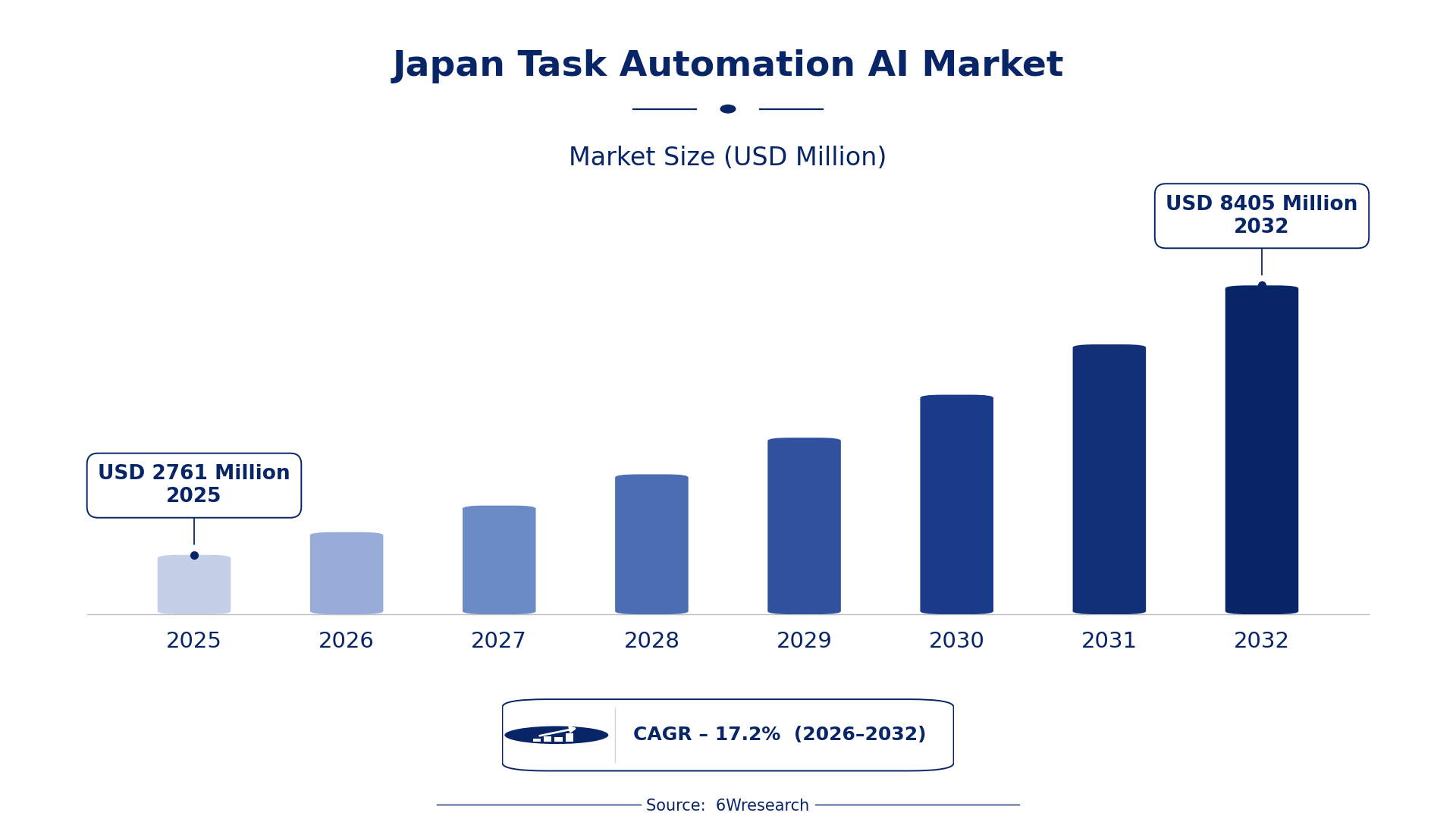
According to 6Wresearch internal database and industry insights, the Japan Task Automation AI Market was valued at USD 2,761 Million in 2025 and is projected to reach USD 8,405 Million by 2032, growing at a CAGR of approximately 17.2% during 2026–2032.
Japan Task Automation AI Market Highlights
| Report Metric | Details |
| Report Name | Japan Task Automation AI Market (2026-2032) |
| Market Size 2025 | USD 2,761 Million |
| Market Size 2032 | USD 8,405 Million |
| Absolute Growth 2025–2032 | USD 5,644 Million |
| CAGR 2026–2032 | 17.2% |
| Peak Annual Growth | 18.9% in 2030 |
| Forecast Period | 2026–2032 |
| Historical Data | 2022–2025 |
| Base Year | 2025 |
| Leading Automation Type, 2025 | Robotic Process Automation (34% share) |
| Leading AI Technology Used, 2025 | ML + Rule-Based Engines (45% share) |
| Leading Use Case, 2025 | Invoice Processing (48% share) |
| Leading End User, 2025 | Enterprises (37% share) |
| Fastest-Growing Automation Type | Workflow Automation (19.0% CAGR) |
| Fastest-Growing AI Technology Used | NLP & Decision Trees (19.8% CAGR) |
| Fastest-Growing Use Case | HR Onboarding (22.5% CAGR) |
| Fastest-Growing End User | Tech Support Teams (22.6% CAGR) |
| Growing Sector | Finance Departments |
| Key End Users | Enterprises, Finance Departments, Tech Support Teams, SaaS Platforms |
Japan Task Automation AI Market Year-wise Growth Rate and Key Drivers (2022–2032)
This graph illustrates the annual growth rates of the market from 2022 to 2032, highlighting a steady upward trajectory and projected market expansion over the forecast period.
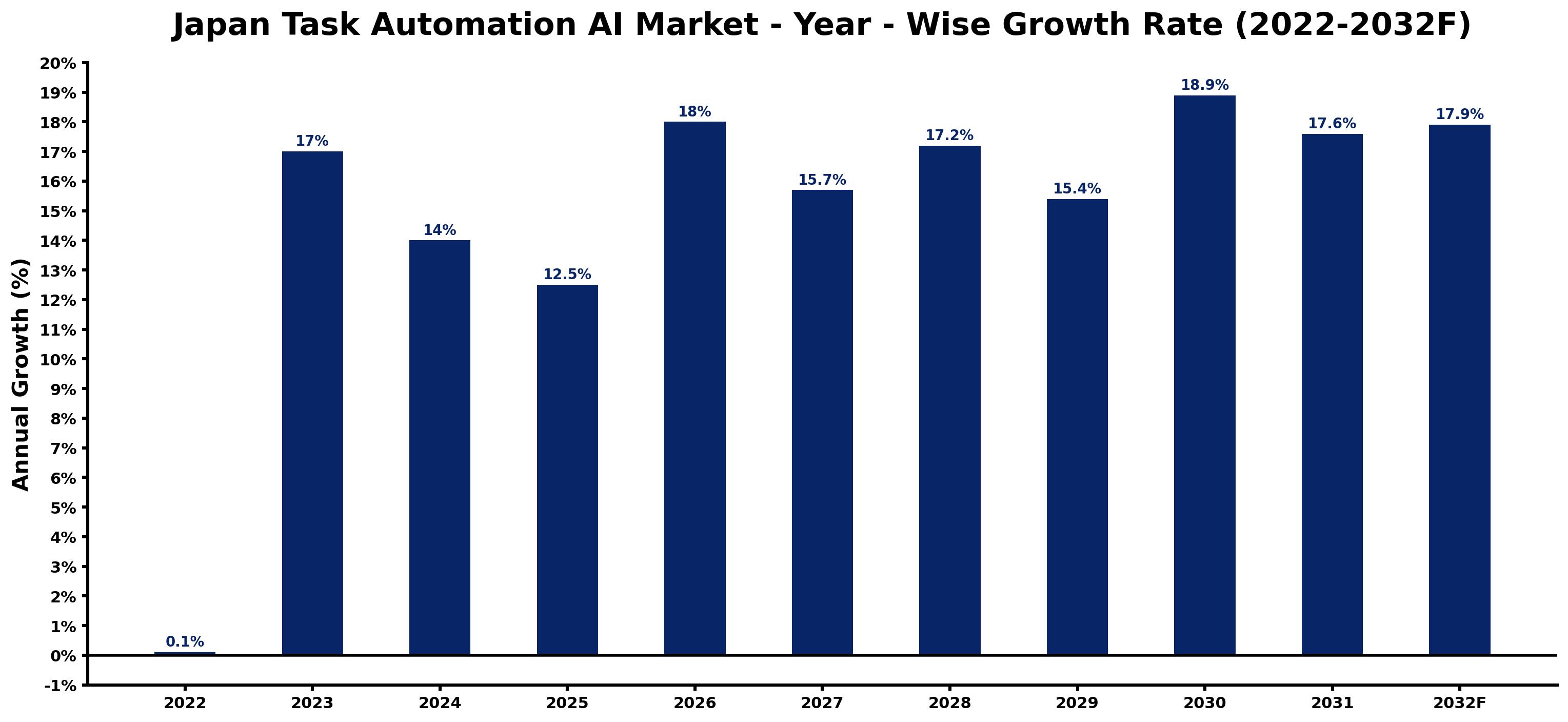
Each row of the following table gives one year's estimated growth and the event or demand shift that explains it.
| Year | Estimated Annual Growth (%) | Market Rationale |
| 2022 | 0.1 | The market was stable, with enterprises beginning to explore automation solutions. |
| 2023 | 17.0 | Demand surged as enterprises recognised the efficiency benefits of task automation. |
| 2024 | 14.0 | Growth slowed as initial excitement tempered and enterprises evaluated implementations. |
| 2025 | 12.5 | The market continued to grow, but at a slower pace as competition increased. |
| 2026 | 18.0 | Growth is expected to accelerate again as more enterprises adopt advanced automation technologies. |
| 2027 | 15.7 | A slowdown is projected as market saturation begins in certain sectors. |
| 2028 | 17.2 | Demand is expected to increase again as new technologies enter the market and attract buyers. |
| 2029 | 15.4 | Growth will slow as buyers become more selective in their automation investments. |
| 2030 | 18.9 | The market is projected to peak due to widespread adoption of task automation across industries. |
| 2031 | 17.6 | A slight slowdown is expected as the market adjusts to high adoption rates. |
| 2032 | 17.9 | Growth is projected to resume as innovations in AI technology stimulate new demand. |
Note: Market size estimations and growth projections presented in this report are based on 6Wresearch's proprietary forecasting methodology, utilizing the latest available industry data, government publications, and primary research inputs.
Japan Task Automation AI Market Synopsis
Task Automation AI automates repetitive tasks using artificial intelligence, improving operational efficiency across sectors such as finance and customer service. The Japan Task Automation AI Market is expanding, driven by more than 70% of enterprises exploring AI solutions for operational efficiency. The AI Strategy 2021 and various initiatives by the Ministry of Economy, Trade and Industry are promoting innovation and investment, propelling market growth as businesses seek to optimise productivity and reduce costs. This growth is supported by a strong interest in automation technologies and a rising number of AI startups in the country.
Market Dynamics Impact Analysis (2026–2032)
| Factor | Type | Impact | Primary Segment Affected |
| Increasing enterprise adoption of automation technologies | Driver | High | Robotic Process Automation |
| Growing demand for operational efficiency in various sectors | Driver | High | Workflow Automation |
| High demand for automation in finance departments | Opportunity | High | Invoice Processing |
| Rising interest in AI-driven solutions among tech support teams | Opportunity | Medium | Tech Support Teams |
| Competition leading to price pressures in the automation sector | Restraint | Medium | Workflow Automation |
| Concerns over data security and compliance with AI applications | Restraint | High | ML + Rule-Based Engines |
| Shortage of skilled professionals in AI and automation | Challenge | High | Tech Support Teams |
| Rapid technological advancements creating uncertainty | Challenge | Medium | Robotic Process Automation |
Evaluation of Drivers in Japan Task Automation AI Market (2026–2032)
The following drivers explain most of the expected growth.
| Drivers | Primary Segment Affected | Why It Matters (Evidence) |
| High enterprise interest in improving operational efficiency | Invoice Processing | Over 70% of enterprises are exploring AI solutions to boost productivity. |
| Investment in AI technologies for competitive advantage | Workflow Automation | Japan's AI Strategy 2021 aims to strengthen global competitiveness in AI. |
| Increased automation in finance departments for cost reduction | Finance Departments | The national minimum wage rose to JPY 1,055 per hour, prompting efficiency measures. |
| Growing integration of automation features in SaaS platforms | SaaS Platforms | The rise of AI startups has increased the availability of new solutions. |
| Expansion of AI research and development funding | Tech Support Teams | In 2023, the government allocated ¥10 billion for AI research initiatives. |
A wider customer base explains much of the growth, as over 70% of enterprises in Japan are exploring AI solutions to improve operational efficiency. The national minimum wage, which rose to JPY 1,055 per hour, has prompted finance departments to adopt automation for cost reduction. The rise of AI startups has increased the availability of new solutions, particularly in tech support. This growing interest in automation technologies is expected to lead to increased adoption across various industries.
Evaluation of Restraints in Japan Task Automation AI Market
These are the pressures that could keep growth below its potential.
| Market Restraint | Primary Segment Affected | Why It Matters (Evidence) |
| Intense competition leading to price pressures | Workflow Automation | As more companies enter the market, pricing strategies are becoming increasingly aggressive. |
| Data security concerns impacting AI adoption | ML + Rule-Based Engines | Enterprises are cautious about implementing AI due to potential data breaches. |
| Limited understanding of AI technologies among some enterprises | Tech Support Teams | A skills gap exists, hindering the effective implementation of automation solutions. |
| Regulatory compliance challenges for AI applications | Invoice Processing | Enterprises must navigate complex regulations, which can delay adoption. |
| Slow integration of automation into existing processes | Finance Departments | Resistance to change within organisations can hinder the speed of implementation. |
Japan Task Automation AI Market Challenges
Japan's outdated technology infrastructure hampers task automation AI adoption, as many firms rely on legacy systems that cannot integrate new solutions, delaying efficiency gains for enterprises. Compliance with ISO/IEC 27001 can take up to six months, extending project timelines for technology support teams. Intense competition among local startups leads to market saturation, complicating decision-making for buyers seeking optimal solutions. A shortage of skilled AI developers means that over 70% of enterprises struggle to find qualified personnel, which stalls implementation efforts across various sectors.
Trends in the Japan Task Automation AI Market
The shifts below are changing how Japan Task Automation AI Market products are bought and supplied.
- AI Promotion Act Accelerating Adoption: The AI Promotion Act, established in 2025, is accelerating the adoption of AI technologies across various sectors. This legislation provides a national framework for AI research and development, promoting innovation and investment in automation solutions.
- Shift Towards Workflow Automation: A notable shift towards workflow automation is occurring as enterprises seek to streamline processes. In 2023, the Tokyo Metropolitan Government supported AI innovation, enhancing the efficiency of business operations.
- Increase in AI Startups: The number of AI startups in Japan has increased by 30% since 2020, indicating a growing interest in automation technologies. This surge is expected to provide diverse solutions for enterprises seeking efficiency.
- Focus on Invoice Processing Automation: Enterprises are increasingly automating invoice processing to improve operational efficiency. This trend is driven by the need for faster financial transactions and improved accuracy in finance departments.
Investment Opportunities in the Japan Task Automation AI Market
Several openings in the Japan Task Automation AI Market merit attention from investors.
- Growing Need for Automation Solutions: With over 70% of enterprises exploring AI solutions, there is a gap in automation services. Tech support teams are particularly in need of advanced solutions to improve efficiency and response times.
- Investment in AI Research and Development: The government allocated ¥10 billion for AI research, creating opportunities for collaboration with local partners. Suppliers can enter the market by aligning with government initiatives to enhance their offerings.
- Expansion of Workflow Automation: The demand for workflow automation is rising, with enterprises seeking to streamline processes. Investing in automation solutions tailored for finance departments can yield substantial returns.
- Increased Adoption of AI Technologies: As the AI Strategy 2021 promotes innovation, there is a growing opportunity for suppliers to offer advanced automation solutions. Collaborating with enterprises in Tokyo can facilitate market entry.
Government Initiatives in the Japan Task Automation AI Market
The AI Promotion Act, established in 2025, builds on the New Robot Strategy from 2015, which aimed to expand robot use across various sectors. This new law updates the framework for AI development, ensuring that producers adhere to revised standards and practices, creating a more effective environment for AI applications.
In 2023, ¥10 billion was allocated for AI research and development, managed by the Ministry of Economy, Trade and Industry. This funding supports various initiatives aimed at boosting AI capabilities, enabling producers to innovate and improve their offerings.
Future Insight of the Japan Task Automation AI Market
By 2032, a shift towards automation technologies will occur as Japan's decarbonisation goals drive increased investment in AI solutions. The government’s JPY 150 trillion decarbonisation initiative will prompt suppliers to innovate and refine their offerings. With a 30% rise in AI startups since 2020, competition will encourage advancements in task automation, providing buyers with a wider array of choices. Collaboration between the Digital Agency and private sectors will create a more effective environment for AI development, ensuring Japan's competitiveness in the global market.
Market Segmentation Analysis
Japan Task Automation AI Market report covers a detailed analysis of the following market segments:
By Automation Type – Robotic Process Automation Leads, Workflow Automation Expected to Grow Fastest
According to Saurav Kr Singh, Senior Research Analyst at 6Wresearch, Robotic Process Automation took 34% of automation type revenue in 2025, more than any other category. Robotic Process Automation holds the largest share as it is extensively utilised for automating routine tasks in finance and human resources, leading to substantial improvements in operational efficiency. Many enterprises in Japan have adopted RPA to enhance productivity across their operations, reflecting its widespread application. The quickest growth will come from Workflow Automation, forecast to expand at a CAGR of 19.0% between 2026 and 2032. Workflow Automation is witnessing the fastest growth as organisations strive to streamline their business processes across departments, reflecting a strong focus on operational efficiency. The ongoing governmental support for AI adoption is further propelling this trend, ensuring continued expansion in this area. Suppliers should prioritise developing solutions in workflow automation to meet the rising demand from businesses.
By AI Technology Used – ML + Rule-Based Engines Lead, NLP & Decision Trees Expected to Grow Fastest
With 45% of ai technology used revenue in 2025, ML + Rule-Based Engines was the largest category. ML + Rule-Based Engines dominate the market because they are essential for various automation solutions, providing critical capabilities for task automation across multiple sectors. This technology is particularly important for enterprises aiming to improve their operational efficiency and effectiveness. NLP & Decision Trees are projected to grow fastest, at a CAGR of 19.8% during 2026–2032. NLP & Decision Trees are experiencing rapid growth as they facilitate better understanding and processing of human language, which is crucial for numerous automation tasks. As businesses increasingly seek to enhance communication and interaction, this segment is expected to expand significantly. Buyers should seek solutions that incorporate NLP capabilities to optimise their automation processes.
By Use Case – Invoice Processing Leads, HR Onboarding Expected to Grow Fastest
In 2025, Invoice Processing led the use case split with a 48% share. Invoice Processing is the leading use case due to its common application in finance departments, where automation significantly boosts efficiency and accuracy. This aligns with Japan's objective of enhancing operational efficiency across various sectors, making it a priority for many enterprises. Over 2026–2032, HR Onboarding is expected to post the fastest growth, at a CAGR of 22.5%. HR Onboarding is gaining momentum as companies automate this process to streamline hiring and reduce time-to-hire. With a growing emphasis on improving HR functions, this use case is well-positioned for substantial growth in the coming years. Suppliers should focus on creating tailored solutions for HR onboarding to address the increasing demand in this area.
By End User – Enterprises Lead, Tech Support Teams Expected to Grow Fastest
The largest end user category in 2025 was Enterprises, at 37% of revenue. Enterprises represent the largest share as they broadly adopt automation solutions to improve overall productivity and operational efficiency. This trend is supported by Japan's national initiatives promoting AI adoption across industries. Tech Support Teams are set to record the highest CAGR in this split, 22.6% over 2026–2032. Tech Support Teams are seeing the fastest growth as they increasingly utilise automation to resolve issues more quickly and efficiently. The rising number of AI startups also contributes to this segment's rapid expansion. Suppliers must consider the unique needs of tech support teams to effectively cater to this growing market.
Key Attractiveness of the Report
- 10 Years of Market Numbers
- Historical Data Starting from 2022 to 2025
- Base Year 2025
- Forecast Data until 2032
- Key Performance Indicators Impacting the Market
- Major Upcoming Developments and Projects
Key Highlights of the Report:
- Japan Task Automation AI Market Outlook
- Market Size of Japan Task Automation AI Market, 2025
- Forecast of Japan Task Automation AI Market, 2032
- Historical Data and Forecast of Japan Task Automation AI Revenues & Volume for the Period 2022-2032F
- Japan Task Automation AI Market Trend Evolution
- Japan Task Automation AI Market Drivers and Challenges
- Japan Task Automation AI Price Trends
- Japan Task Automation AI Porter's Five Forces
- Japan Task Automation AI Industry Life Cycle
- Historical Data and Forecast of Japan Task Automation AI Market Revenues & Volume By Automation Type for the Period 2022-2032F
- Historical Data and Forecast of Japan Task Automation AI Market Revenues & Volume By Robotic Process Automation for the Period 2022-2032F
- Historical Data and Forecast of Japan Task Automation AI Market Revenues & Volume By Workflow Automation for the Period 2022-2032F
- Historical Data and Forecast of Japan Task Automation AI Market Revenues & Volume By Virtual Assistants for the Period 2022-2032F
- Historical Data and Forecast of Japan Task Automation AI Market Revenues & Volume By IT Task Bots for the Period 2022-2032F
- Historical Data and Forecast of Japan Task Automation AI Market Revenues & Volume By AI Technology Used for the Period 2022-2032F
- Historical Data and Forecast of Japan Task Automation AI Market Revenues & Volume By ML + Rule-Based Engines for the Period 2022-2032F
- Historical Data and Forecast of Japan Task Automation AI Market Revenues & Volume By NLP & Decision Trees for the Period 2022-2032F
- Historical Data and Forecast of Japan Task Automation AI Market Revenues & Volume By Generative AI for the Period 2022-2032F
- Historical Data and Forecast of Japan Task Automation AI Market Revenues & Volume By Predictive Algorithms for the Period 2022-2032F
- Historical Data and Forecast of Japan Task Automation AI Market Revenues & Volume By Use Case for the Period 2022-2032F
- Historical Data and Forecast of Japan Task Automation AI Market Revenues & Volume By Invoice Processing for the Period 2022-2032F
- Historical Data and Forecast of Japan Task Automation AI Market Revenues & Volume By HR Onboarding for the Period 2022-2032F
- Historical Data and Forecast of Japan Task Automation AI Market Revenues & Volume By Customer Service for the Period 2022-2032F
- Historical Data and Forecast of Japan Task Automation AI Market Revenues & Volume By System Monitoring for the Period 2022-2032F
- Historical Data and Forecast of Japan Task Automation AI Market Revenues & Volume By End User for the Period 2022-2032F
- Historical Data and Forecast of Japan Task Automation AI Market Revenues & Volume By Finance Departments for the Period 2022-2032F
- Historical Data and Forecast of Japan Task Automation AI Market Revenues & Volume By Enterprises for the Period 2022-2032F
- Historical Data and Forecast of Japan Task Automation AI Market Revenues & Volume By SaaS Platforms for the Period 2022-2032F
- Historical Data and Forecast of Japan Task Automation AI Market Revenues & Volume By Tech Support Teams for the Period 2022-2032F
- Japan Task Automation AI Import Export Trade Statistics
- Market Opportunity Assessment By Automation Type
- Market Opportunity Assessment By AI Technology Used
- Market Opportunity Assessment By Use Case
- Market Opportunity Assessment By End User
- Japan Task Automation AI Top Companies Market Share
- Japan Task Automation AI Competitive Benchmarking By Technical and Operational Parameters
- Japan Task Automation AI Company Profiles
- Japan Task Automation AI Key Strategic Recommendations
Market Covered
The study includes the following segmentation.
By Automation Type
- Robotic Process Automation
- Workflow Automation
- Virtual Assistants
- IT Task Bots
By AI Technology Used
- ML + Rule-Based Engines
- NLP & Decision Trees
- Generative AI
- Predictive Algorithms
By Use Case
- Invoice Processing
- HR Onboarding
- Customer Service
- System Monitoring
By End User
- Finance Departments
- Enterprises
- SaaS Platforms
- Tech Support Teams































