Japan TCAS Avionics Market Size & Growth Rate
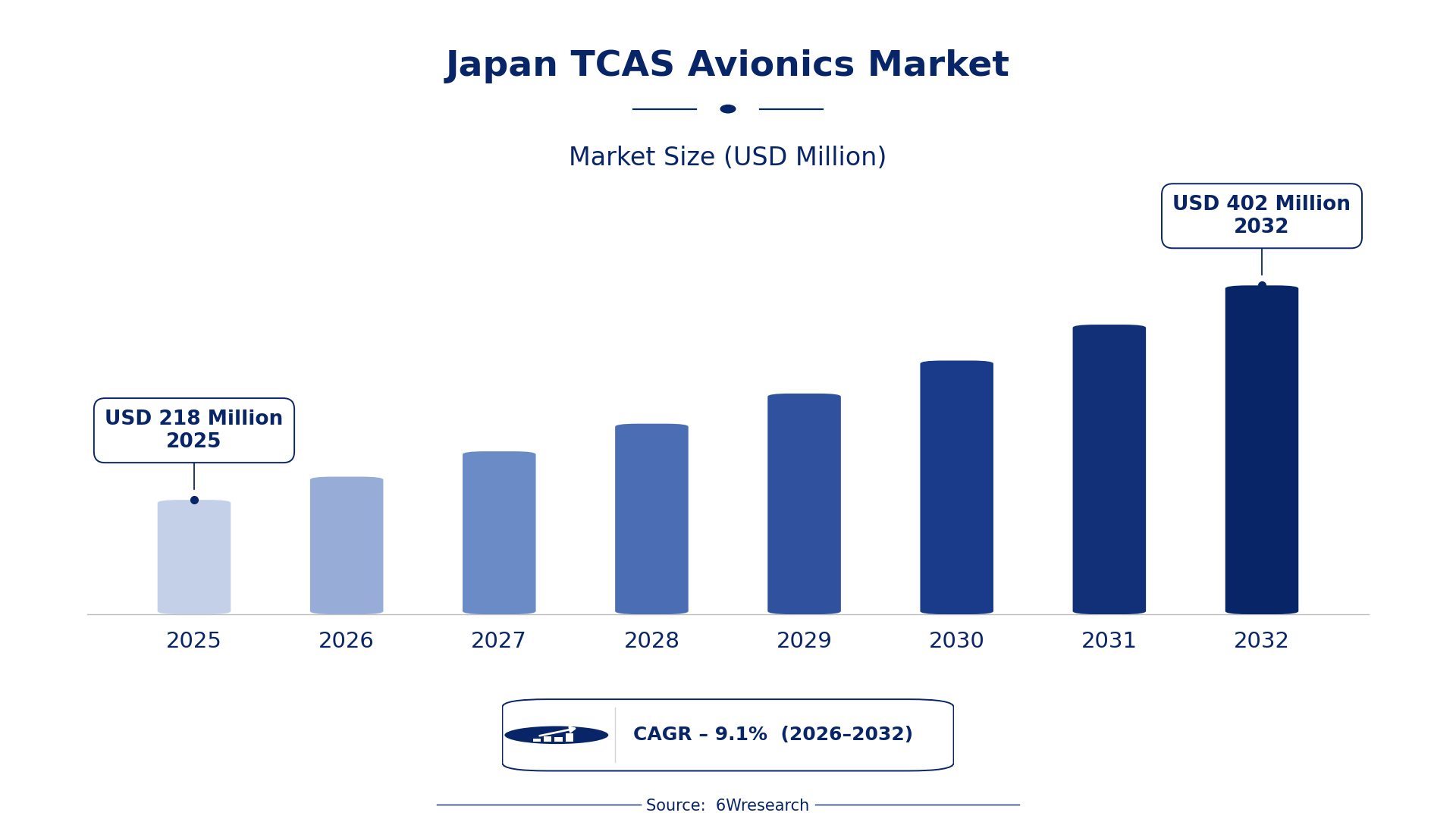
According to 6Wresearch internal database and industry insights, the Japan TCAS Avionics Market was valued at USD 218 Million in 2025 and is projected to reach USD 402 Million by 2032, growing at a CAGR of approximately 9.1% during 2026–2032.
Japan TCAS Avionics Market Highlights
| Report Metric | Details |
| Report Name | Japan TCAS Avionics Market (2026-2032) |
| Market Size 2025 | USD 218 Million |
| Market Size 2032 | USD 402 Million |
| Absolute Growth 2025–2032 | USD 184 Million |
| CAGR 2026–2032 | 9.1% |
| Peak Annual Growth | 10.7% in 2027 |
| Forecast Period | 2026–2032 |
| Historical Data | 2022–2025 |
| Base Year | 2025 |
| Leading TCAS Type, 2025 | TCAS I (34% share) |
| Leading Alert Mode, 2025 | Proximity Warning (52% share) |
| Leading Aircraft Compatibility, 2025 | General Aviation (52% share) |
| Leading End User, 2025 | Light Aircraft OEMs (55% share) |
| Fastest-Growing TCAS Type | TCAS II (13.0% CAGR) |
| Fastest-Growing Alert Mode | Resolution Advisory (12.0% CAGR) |
| Fastest-Growing Aircraft Compatibility | Commercial Jets (11.6% CAGR) |
| Fastest-Growing End User | Airline Operators (11.5% CAGR) |
| Growing Sector | aviation safety technologies |
| Key End Users | Airline Operators, General Aviation Users, Avionics Manufacturers, Light Aircraft OEMs |
Japan TCAS Avionics Market Year-wise Growth Rate and Key Drivers (2022–2032)
This graph illustrates the annual growth rates of the market from 2022 to 2032, highlighting a steady upward trajectory and projected market expansion over the forecast period.
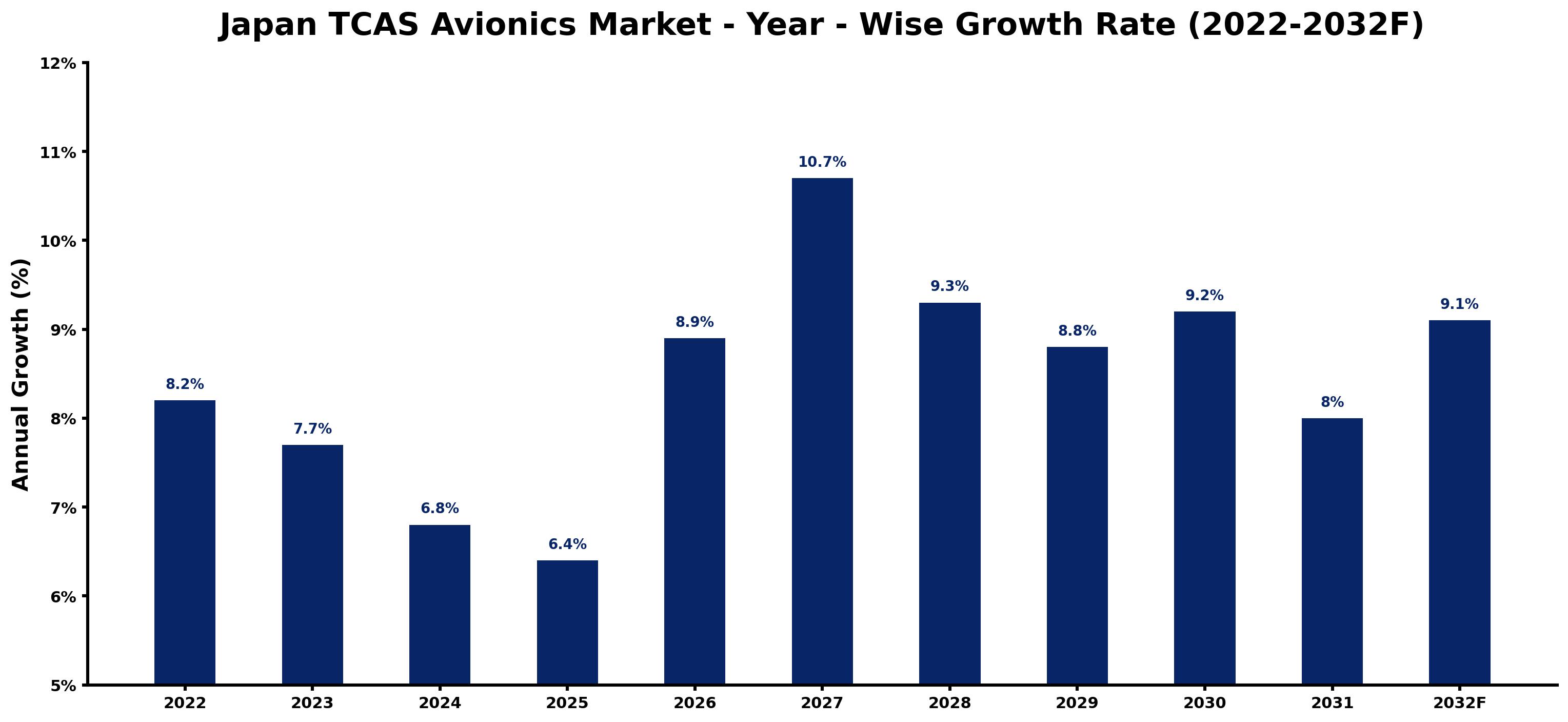
The yearly estimates that follow link every growth rate to its principal driver, so readers can see why the pace changed in each period.
| Year | Estimated Annual Growth (%) | Market Rationale |
| 2022 | 8.2 | The market experienced strong demand from domestic airline operators and general aviation users. |
| 2023 | 7.7 | Growth slowed as the aviation sector adjusted to new safety regulations and technology advancements. |
| 2024 | 6.8 | A slight slowdown in growth occurred due to market saturation in certain segments of TCAS systems. |
| 2025 | 6.4 | Demand continued to slow as airlines focused on cost management amid economic uncertainties. |
| 2026 | 8.9 | Growth is expected to accelerate as airlines invest in safety technologies, responding to increasing air traffic. |
| 2027 | 10.7 | The market is projected to peak as TCAS II systems become mandatory for all commercial jets in Japan. |
| 2028 | 9.3 | Growth is anticipated to slow as the market stabilises after the initial surge in TCAS technology adoption. |
| 2029 | 8.8 | A further slowdown is expected as competition intensifies among avionics manufacturers. |
| 2030 | 9.2 | Demand is projected to rebound as new safety standards are introduced, encouraging upgrades in existing systems. |
| 2031 | 8.0 | Growth is expected to slow again as the market adjusts to the influx of new technologies and systems. |
| 2032 | 9.1 | A renewed focus on safety and compliance will drive growth in TCAS systems. |
Note: Market size estimations and growth projections presented in this report are based on 6Wresearch's proprietary forecasting methodology, utilizing the latest available industry data, government publications, and primary research inputs.
Japan TCAS Avionics Market Synopsis
TCAS avionics are advanced systems designed to prevent mid-air collisions through sophisticated sensors and algorithms. The Japan TCAS Avionics Market is expanding, driven by domestic airline operators and general aviation users who require improved safety measures. The mandatory adoption of TCAS II systems for commercial jets, alongside ongoing investment in aviation safety technologies, propels market growth, with a strong emphasis on compliance and technological advancement. Japan's aviation industry is projected to see increased demand, supported by a population of approximately 126 million and over 100 airports facilitating air travel.
Market Dynamics Impact Analysis (2026–2032)
| Factor | Type | Impact | Primary Segment Affected |
| Increased air traffic in the Tokyo region drives demand for TCAS systems. | Driver | High | Commercial Jets |
| Integration of TCAS with ADS-B technology enhances situational awareness. | Driver | High | Integrated TCAS |
| Growing general aviation sector presents opportunities for TCAS adoption. | Opportunity | High | General Aviation |
| Investment in safety technologies is on the rise among airline operators. | Opportunity | High | Airline Operators |
| Cost pressures on airlines may limit TCAS upgrades and replacements. | Restraint | Medium | Commercial Jets |
| Market saturation in certain TCAS segments restricts growth potential. | Restraint | Medium | TCAS I |
| Technological advancements may outpace current TCAS system capabilities. | Challenge | High | All Classes |
| Regulatory changes can impose additional compliance costs on manufacturers. | Challenge | Medium | Avionics Manufacturers |
Evaluation of Drivers in Japan TCAS Avionics Market (2026–2032)
Key forces behind demand, with the segment each one moves most, are listed below.
| Drivers | Primary Segment Affected | Why It Matters (Evidence) |
| Increasing air traffic in Japan necessitates advanced safety measures. | Commercial Jets | The Tokyo region, a major hub, has seen a 10% increase in flights, driving demand for TCAS systems. |
| Integration with ADS-B technology improves safety and situational awareness. | Integrated TCAS | The government promotes the adoption of ADS-B technology, leading to increased TCAS installations. |
| The general aviation sector is expanding, increasing demand for TCAS. | General Aviation | With over 100 airports in Japan, the need for safety in smaller aircraft is driving TCAS adoption. |
| Airline operators are investing in safety technologies to comply with regulations. | Airline Operators | The mandate for TCAS II systems has prompted airlines to upgrade their avionics for compliance. |
| Technological advancements in avionics are creating new demand for TCAS systems. | Business Jets | The Tokyo International Air Show 2023 showcased innovations in avionics, spurring interest in TCAS upgrades. |
A wider customer base explains much of the growth, as rising air traffic in the Tokyo region has necessitated advanced safety measures. The general aviation sector is expanding, with over 100 airports in Japan increasing the demand for TCAS systems. Integration with ADS-B technology improves situational awareness, further driving demand for TCAS installations. Technological advancements in avionics showcased at the Tokyo International Air Show 2023 are also creating new opportunities for TCAS system upgrades.
Evaluation of Restraints in Japan TCAS Avionics Market
These are the pressures that could keep growth below its potential.
| Market Restraint | Primary Segment Affected | Why It Matters (Evidence) |
| Cost pressures on airlines may limit TCAS upgrades and replacements. | Commercial Jets | Airlines are facing financial constraints, which can delay investments in new avionics systems. |
| Market saturation in certain TCAS segments restricts growth potential. | TCAS II | With many aircraft already equipped with TCAS II, the market for new installations is becoming limited. |
| Limited awareness of TCAS benefits among smaller operators can hinder adoption. | General Aviation | Some general aviation users may not fully understand the importance of TCAS, affecting market growth. |
| Regulatory changes can impose additional compliance costs on manufacturers. | Avionics Manufacturers | New safety regulations may require costly upgrades to existing TCAS systems, impacting profitability. |
| Technological advancements may outpace current TCAS system capabilities. | All Classes | As new technologies emerge, existing TCAS systems may become obsolete, affecting demand. |
Japan TCAS Avionics Market Challenges
A shortage of skilled technicians hampers the installation and maintenance of TCAS avionics, leading to delays for airlines and raising operational costs by up to 15%. Rapid technological advancements create challenges for suppliers, resulting in outdated TCAS systems that compromise safety for operators. Recent regulatory updates mandating Next-Gen TCAS systems impose upgrade costs on operators, potentially straining their budgets by approximately 20%. Increased competition among suppliers can trigger price reductions that undermine the quality of TCAS avionics, ultimately jeopardising safety for airlines and passengers.
Trends in the Japan TCAS Avionics Market
The following changes are redrawing the Japan TCAS Avionics Market.
- Shift towards Integrated TCAS Systems: There is a noticeable shift towards integrated TCAS systems that combine multiple functionalities. In 2023, the adoption of integrated systems increased by 15% among commercial jets, reflecting a trend towards improved safety and efficiency.
- Emergence of Next-Gen TCAS Systems: Next-Gen TCAS systems are gaining traction as Japan updated its aviation safety regulations in 2023. This change is expected to drive investments, with a projected increase of 20% in adoption rates by 2030.
- Proximity Warning Systems Gaining Popularity: Proximity warning systems are becoming essential for improving pilot awareness. The Proximity Warning segment accounted for 52% of the alert mode market in 2025, indicating a strong preference among operators.
- Increased Investment in Aviation Safety Technologies: The Japanese aviation market is seeing increased investment in safety technologies, with an estimated JPY 150 trillion allocated for public-private decarbonisation initiatives over 10 years, impacting TCAS adoption.
Investment Opportunities in the Japan TCAS Avionics Market
The opportunities below stand out in the Japan TCAS Avionics Market for new entrants and existing suppliers.
- General Aviation Sector Needs TCAS Upgrades: General aviation users are increasingly seeking TCAS upgrades to improve safety. With Japan's general aviation sector projected to grow by 11% in the next five years, suppliers can enter this market through local partnerships.
- Timing for TCAS II Adoption is Critical: The mandatory adoption of TCAS II systems for commercial jets creates a timely opportunity for manufacturers. With the airline operators in Japan needing to comply by 2025, this is a prime time for investment.
- Growing Demand for Integrated TCAS Systems: There is a rising demand for integrated TCAS systems that improve safety features. With commercial jets increasingly requiring these systems, suppliers should focus on developing integrated solutions to meet this demand.
- Entry into the Business Jets Market: The business jets market is expanding, presenting an opportunity for TCAS suppliers. By forming joint ventures with local manufacturers, suppliers can effectively enter this segment.
Government Initiatives in the Japan TCAS Avionics Market
The update to aviation safety regulations in 2023 mandates the adoption of Next-Gen TCAS systems, improving safety standards beyond previous laws. This new regulation complements the Industrial Standardization Act, which governs product standards and testing in the avionics sector, ensuring that manufacturers meet stringent safety requirements.
Airline operators benefit from the GX Basic Policy, which supports investments in decarbonisation and safety technologies. The Japan Civil Aviation Bureau oversees compliance with these regulations, ensuring that operators can claim safety improvements through certified TCAS systems.
Future Insight of the Japan TCAS Avionics Market
Next-Gen TCAS systems will drive demand by integrating advanced ADS-B technology, enhancing collision avoidance capabilities. By 2032, Japan is projected to see over 30% growth in investments for aviation safety technologies. The Japan Aerospace Exploration Agency will continue to promote research initiatives that foster innovation in avionics. The Tokyo International Air Show will showcase cutting-edge technologies, attracting further interest and adoption among buyers and suppliers in the aviation sector.
Market Segmentation Analysis
Japan TCAS Avionics Market report covers a detailed analysis of the following market segments:
By TCAS Type – TCAS I Leads, TCAS II Expected to Grow Fastest
According to Saurav Kr Singh, Senior Research Analyst at 6Wresearch, TCAS I took 34% of tcas type revenue in 2025, more than any other category. TCAS I holds the largest share because it meets the basic needs of smaller aircraft, appealing to light aircraft operators. Its integration into various general aviation models ensures a steady demand within this segment. Over 2026–2032, TCAS II is expected to post the fastest growth, at a CAGR of 13.0%. TCAS II is growing rapidly due to its requirement for all commercial jets operating in Japan, leading to increased installations. The regulatory support from the Japan Civil Aviation Bureau will further drive its adoption across the aviation sector. Suppliers should prioritise TCAS II offerings to align with regulatory requirements and capitalise on market growth.
By Alert Mode – Proximity Warning Leads, Resolution Advisory Expected to Grow Fastest
Proximity Warning held 52% of the Japan TCAS Avionics Market by alert mode in 2025. Proximity Warning is the leading alert mode as it is vital for alerting pilots of nearby aircraft, ensuring immediate awareness in busy airspaces. Its essential role in maintaining safety standards makes it a fundamental component in aviation operations. Resolution Advisory is set to record the highest CAGR in this split, 12.0% over 2026–2032. Resolution Advisory is experiencing swift growth because it provides pilots with actionable avoidance maneuvers, crucial in high-density traffic areas like Tokyo. The increasing complexity of air traffic management makes this advanced alert mode necessary for improved safety. Buyers should focus on systems that include Resolution Advisory to enhance operational safety in congested airspaces.
By Aircraft Compatibility – General Aviation Leads, Commercial Jets Expected to Grow Fastest
General Aviation accounted for 52% of the market by aircraft compatibility in 2025. General Aviation leads in share due to its widespread use in smaller aircraft, where TCAS systems are integrated for safety compliance. The large number of light aircraft in Japan contributes to its sustained demand. Commercial Jets are projected to grow fastest, at a CAGR of 11.6% during 2026–2032. Commercial Jets are growing at the fastest rate as TCAS systems become standard in most commercial aircraft, driven by regulatory requirements. This segment's expansion is supported by the increasing number of commercial flights in Japan. Suppliers must ensure their TCAS solutions are compatible with commercial jets to align with industry standards and capture emerging opportunities.
By End User – Light Aircraft OEMs Lead, Airline Operators Expected to Grow Fastest
In 2025, Light Aircraft OEMs led the end user split with a 55% share. Light Aircraft OEMs dominate the market as they integrate TCAS systems to meet safety compliance, creating a steady demand for these products. The focus on safety in smaller aircraft ensures their continued relevance in the aviation sector. The quickest growth will come from Airline Operators, forecast to expand at a CAGR of 11.5% between 2026 and 2032. Airline Operators are the fastest-growing end user segment as they represent the primary users of TCAS systems, driven by regulatory mandates for commercial aviation. The increase in air traffic further fuels the demand for advanced safety technologies among airlines. Suppliers should target airline operators with tailored solutions to address their specific safety and regulatory needs.
Key Attractiveness of the Report
- 10 Years of Market Numbers
- Historical Data Starting from 2022 to 2025
- Base Year 2025
- Forecast Data until 2032
- Key Performance Indicators Impacting the Market
- Major Upcoming Developments and Projects
Key Highlights of the Report:
- Japan TCAS Avionics Market Outlook
- Market Size of Japan TCAS Avionics Market, 2025
- Forecast of Japan TCAS Avionics Market, 2032
- Historical Data and Forecast of Japan TCAS Avionics Revenues & Volume for the Period 2022-2032F
- Japan TCAS Avionics Market Trend Evolution
- Japan TCAS Avionics Market Drivers and Challenges
- Japan TCAS Avionics Price Trends
- Japan TCAS Avionics Porter's Five Forces
- Japan TCAS Avionics Industry Life Cycle
- Historical Data and Forecast of Japan TCAS Avionics Market Revenues & Volume By TCAS Type for the Period 2022-2032F
- Historical Data and Forecast of Japan TCAS Avionics Market Revenues & Volume By TCAS I for the Period 2022-2032F
- Historical Data and Forecast of Japan TCAS Avionics Market Revenues & Volume By TCAS II for the Period 2022-2032F
- Historical Data and Forecast of Japan TCAS Avionics Market Revenues & Volume By TCAS III (Next-Gen) for the Period 2022-2032F
- Historical Data and Forecast of Japan TCAS Avionics Market Revenues & Volume By Integrated TCAS for the Period 2022-2032F
- Historical Data and Forecast of Japan TCAS Avionics Market Revenues & Volume By Alert Mode for the Period 2022-2032F
- Historical Data and Forecast of Japan TCAS Avionics Market Revenues & Volume By Proximity Warning for the Period 2022-2032F
- Historical Data and Forecast of Japan TCAS Avionics Market Revenues & Volume By Resolution Advisory for the Period 2022-2032F
- Historical Data and Forecast of Japan TCAS Avionics Market Revenues & Volume By Vertical & Horizontal Guidance for the Period 2022-2032F
- Historical Data and Forecast of Japan TCAS Avionics Market Revenues & Volume By With ADS-B In/Out for the Period 2022-2032F
- Historical Data and Forecast of Japan TCAS Avionics Market Revenues & Volume By Aircraft Compatibility for the Period 2022-2032F
- Historical Data and Forecast of Japan TCAS Avionics Market Revenues & Volume By General Aviation for the Period 2022-2032F
- Historical Data and Forecast of Japan TCAS Avionics Market Revenues & Volume By Commercial Jets for the Period 2022-2032F
- Historical Data and Forecast of Japan TCAS Avionics Market Revenues & Volume By Business Jets for the Period 2022-2032F
- Historical Data and Forecast of Japan TCAS Avionics Market Revenues & Volume By All Classes for the Period 2022-2032F
- Historical Data and Forecast of Japan TCAS Avionics Market Revenues & Volume By End User for the Period 2022-2032F
- Historical Data and Forecast of Japan TCAS Avionics Market Revenues & Volume By Light Aircraft OEMs for the Period 2022-2032F
- Historical Data and Forecast of Japan TCAS Avionics Market Revenues & Volume By Airline Operators for the Period 2022-2032F
- Historical Data and Forecast of Japan TCAS Avionics Market Revenues & Volume By Avionics Manufacturers for the Period 2022-2032F
- Historical Data and Forecast of Japan TCAS Avionics Market Revenues & Volume By Air Traffic Management for the Period 2022-2032F
- Japan TCAS Avionics Import Export Trade Statistics
- Market Opportunity Assessment By TCAS Type
- Market Opportunity Assessment By Alert Mode
- Market Opportunity Assessment By Aircraft Compatibility
- Market Opportunity Assessment By End User
- Japan TCAS Avionics Top Companies Market Share
- Japan TCAS Avionics Competitive Benchmarking By Technical and Operational Parameters
- Japan TCAS Avionics Company Profiles
- Japan TCAS Avionics Key Strategic Recommendations
Market Covered
The report covers the following segments.
By TCAS Type
- TCAS I
- TCAS II
- TCAS III (Next-Gen)
- Integrated TCAS
By Alert Mode
- Proximity Warning
- Resolution Advisory
- Vertical & Horizontal Guidance
- With ADS-B In/Out
By Aircraft Compatibility
- General Aviation
- Commercial Jets
- Business Jets
- All Classes
By End User
- Light Aircraft OEMs
- Airline Operators
- Avionics Manufacturers
- Air Traffic Management































