Japan Tea Packaging Machinery Market Size & Growth Rate
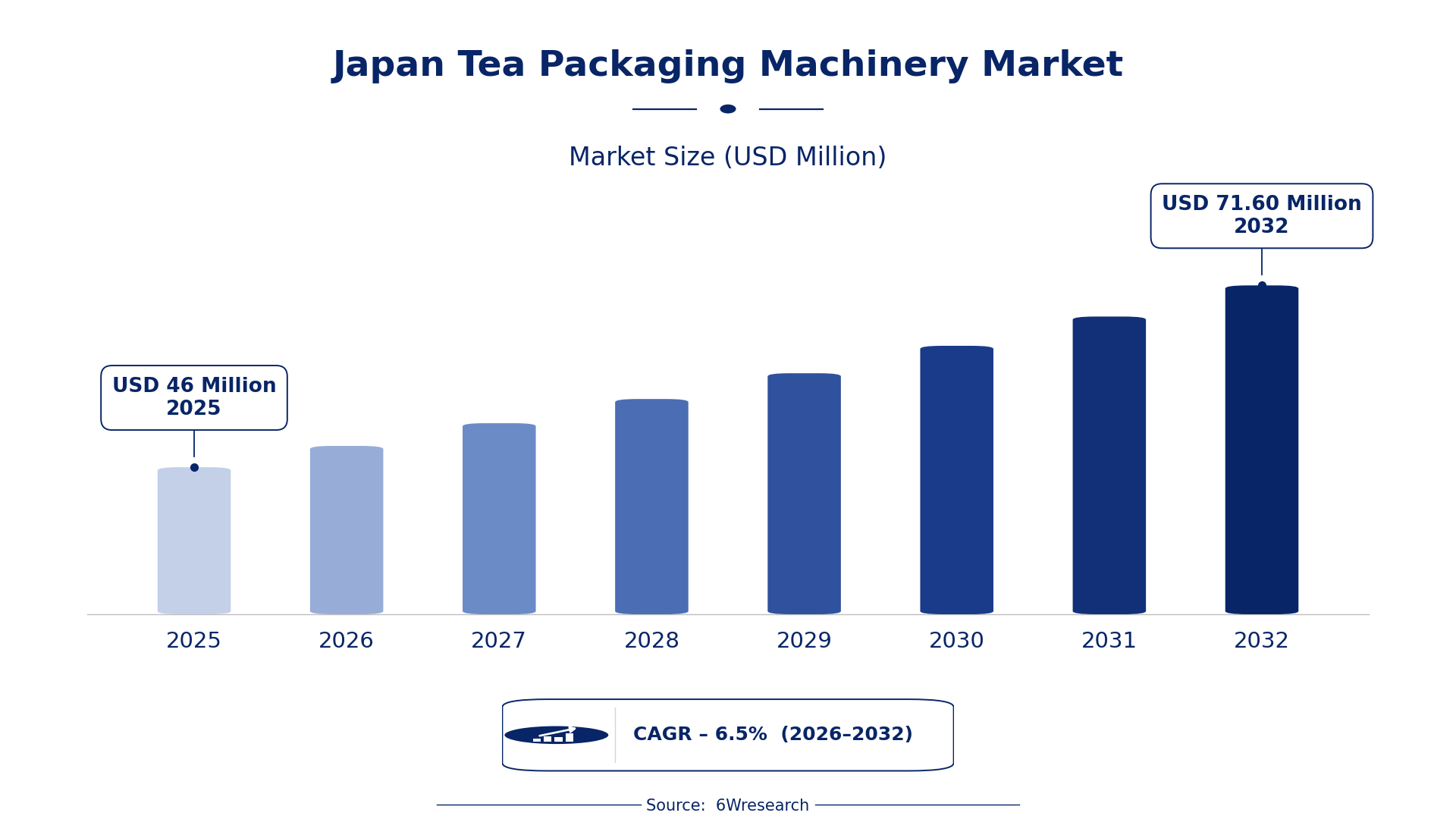
According to 6Wresearch internal database and industry insights, the Japan Tea Packaging Machinery Market was valued at USD 46 Million in 2025 and is projected to reach USD 71.60 Million by 2032, growing at a CAGR of approximately 6.5% during 2026–2032.
Japan Tea Packaging Machinery Market Highlights
| Report Metric | Details |
| Report Name | Japan Tea Packaging Machinery Market (2026-2032) |
| Market Size 2025 | USD 46 Million |
| Market Size 2032 | USD 71.60 Million |
| Absolute Growth 2025–2032 | USD 25.60 Million |
| CAGR 2026–2032 | 6.5% |
| Peak Annual Growth | 7.2% in 2028 |
| Forecast Period | 2026–2032 |
| Historical Data | 2022–2025 |
| Base Year | 2025 |
| Leading Machine Type, 2025 | Tea Bag Machines (38% share) |
| Leading Packaging Style, 2025 | String & Tag Bags (37% share) |
| Leading Automation Level, 2025 | Fully Automated (50% share) |
| Leading End User, 2025 | Tea Processing Plants (37% share) |
| Fastest-Growing Machine Type | Pouch Filling Machines (9.0% CAGR) |
| Fastest-Growing Packaging Style | Stand-up Pouches (8.5% CAGR) |
| Fastest-Growing Automation Level | Automatic (9.1% CAGR) |
| Growing Sector | Tea Processing |
| Key End Users | Tea Processing Plants, Tea Exporters, Regional Tea Blenders, Tea Brands |
Japan Tea Packaging Machinery Market Year-wise Growth Rate and Key Drivers (2022–2032)
This graph illustrates the annual growth rates of the market from 2022 to 2032, highlighting a steady upward trajectory and projected market expansion over the forecast period.
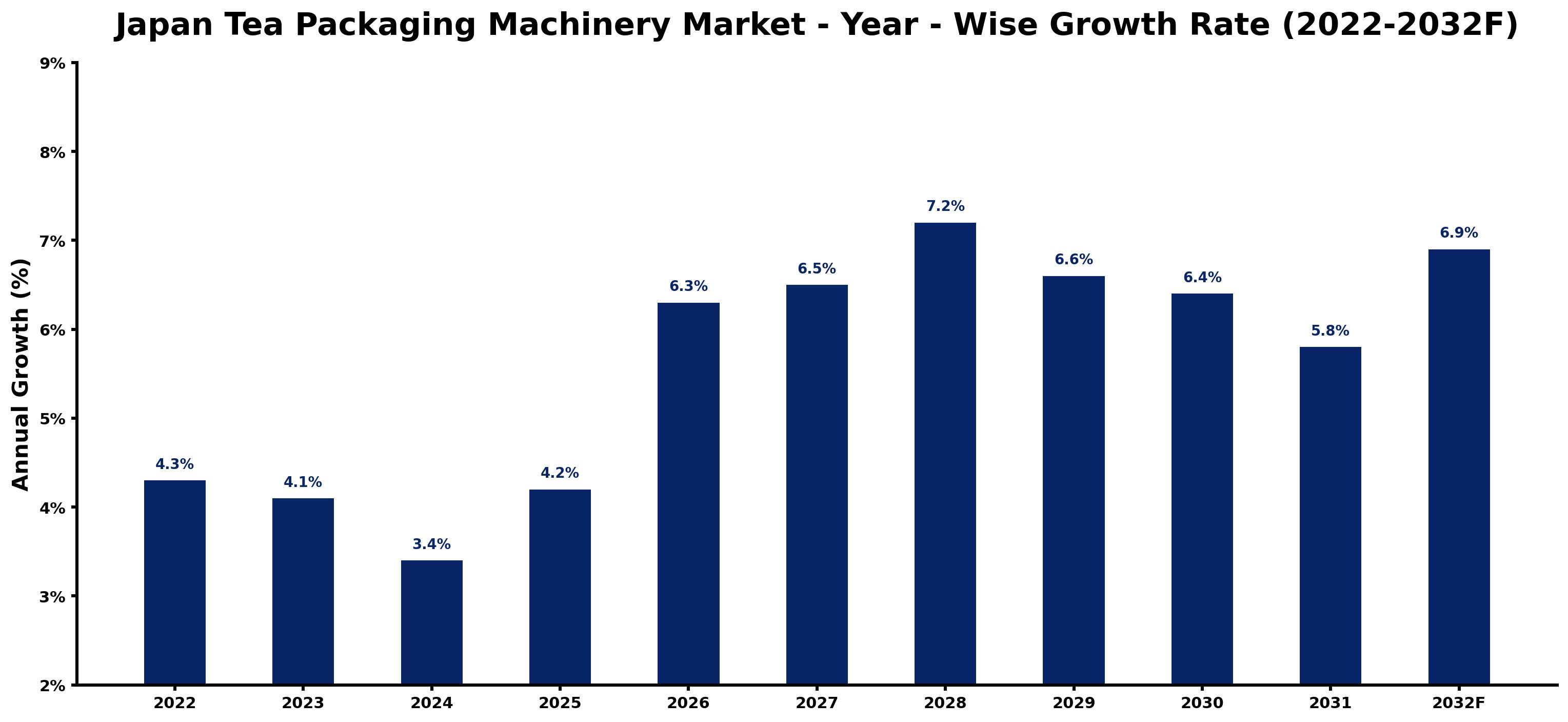
Below, each year's estimated growth is shown next to the factor that most influenced it.
| Year | Estimated Annual Growth (%) | Market Rationale |
| 2022 | 4.3 | The market experienced steady growth due to strong domestic tea consumption. |
| 2023 | 4.1 | Growth slowed as manufacturers faced rising operational costs and wage increases. |
| 2024 | 3.4 | Market expansion continued to decelerate, influenced by fluctuating raw material prices. |
| 2025 | 4.2 | Demand increased as tea processing plants invested in modern packaging technologies. |
| 2026 | 6.3 | Growth is expected to accelerate with the adoption of advanced automation. |
| 2027 | 6.5 | Rising demand for convenience packaging will drive further investment in machinery. |
| 2028 | 7.2 | The market is projected to peak as tea brands focus on efficiency and quality improvements. |
| 2029 | 6.6 | Growth is expected to slow slightly as competition intensifies among local brands. |
| 2030 | 6.4 | Market expansion will continue to decelerate due to saturation in certain segments. |
| 2031 | 5.8 | Demand growth is projected to slow as manufacturers adjust to changing consumer preferences. |
| 2032 | 6.9 | Investment in sustainable packaging solutions is expected to drive growth. |
Note: Market size estimations and growth projections presented in this report are based on 6Wresearch's proprietary forecasting methodology, utilizing the latest available industry data, government publications, and primary research inputs.
Japan Tea Packaging Machinery Market Synopsis
Tea packaging machinery includes equipment designed for packaging tea products such as tea bags and loose leaf tea. Made from stainless steel, these machines incorporate advanced automation technologies to maintain freshness and improve production processes. The Japan Tea Packaging Machinery Market is expanding due to rising domestic demand from over 1,000 tea processing plants and the increasing adoption of automated lines. This growth results from investments in efficiency and quality improvements, reflecting the industry's response to evolving consumer preferences.
Market Dynamics Impact Analysis (2026–2032)
| Factor | Type | Impact | Primary Segment Affected |
| Increased investment in automation technologies | Driver | High | Tea Bag Machines |
| Growing preference for convenient packaging solutions | Driver | High | Stand-up Pouches |
| Rising demand for organic tea products | Opportunity | Medium | Pouch Filling Machines |
| Expansion of tea processing facilities in Shizuoka | Opportunity | Medium | Tea Processing Plants |
| High operational costs due to wage increases | Restraint | High | Tea Bag Machines |
| Fluctuating raw material prices affecting production | Restraint | Medium | Pouch Filling Machines |
| Investment costs for advanced machinery are significant | Challenge | High | Fully Automated |
| Competition among local brands is intensifying | Challenge | Medium | Tea Brands |
Evaluation of Drivers in Japan Tea Packaging Machinery Market (2026–2032)
Demand rests on the following drivers, each shown with the segment it touches most.
| Drivers | Primary Segment Affected | Why It Matters (Evidence) |
| Investment in fully automated packaging lines | Fully Automated | This investment enables tea brands to produce higher volumes, as seen in the growing adoption among tea processing plants. |
| Rising tea consumption rates | Tea Processing Plants | With an annual consumption of approximately 1.5 kg per person, processing plants are increasing machinery purchases to meet demand. |
| Preference for sustainable packaging solutions | Stand-up Pouches | The shift towards eco-friendly packaging is driving demand for machinery that can produce these pouches, particularly in the Shizuoka region. |
| Government support for tea exports | Tea Exporters | Government initiatives are encouraging exporters to invest in better packaging technologies. |
| Technological advancements in packaging machinery | Pouch Filling Machines | Innovations are enabling manufacturers to improve production efficiency, leading to increased orders from regional tea blenders. |
What keeps demand rising is the growing investment in fully automated packaging lines, which improves production efficiency for tea processing plants. With Japan's tea consumption rate at approximately 1.5 kg per person annually, processing facilities are increasingly purchasing machinery to meet this demand. The shift towards sustainable packaging solutions is also notable, particularly for stand-up pouches, which are gaining popularity for their convenience. Innovations in machinery are enabling manufacturers to improve production efficiency, driving orders from regional tea blenders.
Evaluation of Restraints in Japan Tea Packaging Machinery Market
Several factors work against faster growth; the main ones are summarised below.
| Market Restraint | Primary Segment Affected | Why It Matters (Evidence) |
| High operational costs due to wage increases | Tea Bag Machines | Japan's national weighted-average minimum wage rose to JPY 1,055 per hour in October 2024, impacting production costs. |
| Fluctuating raw material prices affecting production | Pouch Filling Machines | Variability in prices for packaging materials can disrupt budgeting for machinery investments. |
| High initial capital required for automation | Fully Automated | The substantial investment needed for advanced machinery can deter smaller producers from upgrading their equipment. |
| Intensifying competition among local brands | Tea Brands | As more brands enter the market, existing players face pressure to innovate and reduce prices. |
| Limited availability of skilled technicians for maintenance | Vacuum Packaging Units | The shortage of qualified personnel can lead to increased downtime for machinery. |
Japan Tea Packaging Machinery Market Challenges
Japan's tea packaging machinery market faces stringent regulations, particularly ISO 22000 compliance, which can elevate operational costs for producers by 15% annually. Buyers encounter rising expenses as the shift towards stand-up pouches increases costs by 20% for smaller brands. A shortage of skilled workers in automation technologies delays production efficiency, resulting in approximately three weeks of downtime for processing plants. Many facilities still utilise outdated machinery, causing a 25% drop in productivity compared to modern automated lines, which impacts output for suppliers.
Trends in the Japan Tea Packaging Machinery Market
Four trends stand out in the Japan Tea Packaging Machinery Market.
- Shift towards Fully Automated Packaging Lines: In recent years, tea brands have increasingly adopted fully automated packaging lines to improve efficiency. By 2023, over 30% of tea processing plants in Japan had upgraded their machinery to fully automated systems, reflecting a growing trend towards automation.
- Transition to Sustainable Packaging Solutions: The Japanese tea industry is moving towards sustainable packaging, with stand-up pouches gaining popularity. In 2022, approximately 25% of tea products were packaged in eco-friendly materials, indicating a shift in consumer preferences.
- Emergence of Organic Tea Products: The Ministry of Agriculture's 2023 program to promote organic tea production has spurred interest in organic tea packaging. This initiative is expected to increase the market share of organic tea products significantly by 2025.
- Growing Demand for Convenience Packaging: Tea consumers are increasingly favouring convenience, leading to a rise in stand-up pouches and single-serve options. By 2025, stand-up pouches are projected to account for 40% of the tea packaging market.
Investment Opportunities in the Japan Tea Packaging Machinery Market
The openings below show where demand in the Japan Tea Packaging Machinery Market is visible and how suppliers can enter.
- Gap in Sustainable Packaging Solutions: With 25% of tea products currently using eco-friendly packaging, there is an opportunity for suppliers to invest in sustainable machinery. Tea brands in Japan are actively seeking partners to develop these solutions.
- Demand from Tea Processing Plants: The over 1,000 tea processing plants in Japan are in need of modern packaging solutions. Investing in automation technologies now can help suppliers tap into this growing market segment.
- Expansion of Tea Processing Facilities in Shizuoka: Shizuoka, accounting for about 40% of Japan's tea production, presents a prime opportunity for investment in packaging machinery. The timing is ideal as local brands seek to improve production efficiency.
- Increasing Export Opportunities: With government support for tea exports, there is a growing need for packaging solutions that meet international standards. Suppliers can enter this market by collaborating with local tea exporters.
Government Initiatives in the Japan Tea Packaging Machinery Market
The Food Sanitation Act amendment of 2018 requires compliance with safety standards for synthetic resins used in food packaging, impacting tea packaging producers by ensuring that all materials are safe for consumers. This regulation is important for maintaining product quality and consumer trust in the tea industry. In 2023, the Ministry of Agriculture launched a program to promote organic tea production, administered by the Japan External Trade Organization. This initiative supports tea producers in adopting organic practices and improving packaging standards to meet market demands.
The Japan External Trade Organization is providing funding to support tea exporters in enhancing their packaging technologies. This funding aims to improve the competitiveness of Japanese tea products in international markets, helping exporters meet global standards.
Future Insight of the Japan Tea Packaging Machinery Market
Investment in advanced automation technologies will surge, creating demand for efficient tea packaging solutions. By 2032, the implementation of automated packaging lines will streamline production processes, benefiting suppliers and reducing costs. The government programme promoting organic tea production will create new market opportunities, encouraging buyers to adopt modern packaging methods. Stricter standards from the Japan Tea Association will elevate product quality, building consumer trust and expanding market access.
Market Segmentation Analysis
Japan Tea Packaging Machinery Market report covers a detailed analysis of the following market segments:
By Machine Type – Tea Bag Machines Lead, Pouch Filling Machines Expected to Grow Fastest
According to Saurav Kr Singh, Senior Research Analyst at 6Wresearch, Tea Bag Machines held 38% of the Japan Tea Packaging Machinery Market by machine type in 2025. Tea bag machines are crucial for the efficient packaging of over 300 million tea bags annually, serving as a backbone for the tea industry. Their widespread adoption across Japan's tea processing plants solidifies their dominant market share and relevance. The quickest growth will come from Pouch Filling Machines, forecast to expand at a CAGR of 9.0% between 2026 and 2032. Pouch filling machines are experiencing rapid growth due to the increasing consumer preference for stand-up pouches, which offer convenience and enhanced shelf appeal. This shift towards appealing packaging formats is driving demand in the market. Suppliers must focus on developing pouch filling solutions to meet changing consumer demands and capture market opportunities.
By Packaging Style – String & Tag Bags Lead, Stand-up Pouches Expected to Grow Fastest
String & Tag Bags accounted for 37% of the market by packaging style in 2025. String and tag bags are prevalent in the market, as they are commonly used for tea bags, providing both functionality and brand visibility. Their established presence in tea packaging contributes to their leading market share. Stand-up Pouches are set to record the highest CAGR in this split, 8.5% over 2026–2032. Stand-up pouches are rapidly gaining popularity for their practicality and aesthetic appeal, particularly for loose leaf and specialty teas. This trend indicates a shift in consumer preferences towards more modern packaging solutions. Manufacturers must adapt to the rising demand for stand-up pouches to remain competitive.
By Automation Level – Fully Automated Leads, Automatic Expected to Grow Fastest
In 2025, Fully Automated led the automation level split with a 50% share. Fully automated systems are preferred for large-scale production, allowing tea processing plants to maximise efficiency and reduce operational costs. This preference is evident as automation becomes standard in modern tea packaging operations. Automatic is projected to grow fastest, at a CAGR of 9.1% during 2026–2032. Automatic systems are growing in popularity as they provide a balance between efficiency and cost, making them attractive to a wider range of tea processors. The trend towards increased automation in production lines supports this growth. Suppliers should invest in automation technologies to capitalise on the expanding market and meet the needs of tea processors.
By End User – Tea Processing Plants Lead and Record the Fastest Growth
The largest end user category in 2025 was Tea Processing Plants, at 37% of revenue. Tea processing plants are the primary users of packaging machinery, representing a substantial portion of market demand. Their continuous operations and need for efficient packaging solutions ensure their leading position in the market. Tea Processing Plants are also forecast to expand faster than any other category, at a CAGR of 8.3% over 2026–2032. The reliance on tea processing plants for packaging machinery ensures sustained growth in this segment, as they increasingly implement advanced technologies to enhance production efficiency. This dual role as both leader and fastest highlights their critical importance in the industry. Suppliers should prioritise building strong partnerships with tea processing plants to secure long-term business relationships.
Key Attractiveness of the Report
- 10 Years of Market Numbers
- Historical Data Starting from 2022 to 2025
- Base Year 2025
- Forecast Data until 2032
- Key Performance Indicators Impacting the Market
- Major Upcoming Developments and Projects
Key Highlights of the Report:
- Japan Tea Packaging Machinery Market Outlook
- Market Size of Japan Tea Packaging Machinery Market, 2025
- Forecast of Japan Tea Packaging Machinery Market, 2032
- Historical Data and Forecast of Japan Tea Packaging Machinery Revenues & Volume for the Period 2022-2032F
- Japan Tea Packaging Machinery Market Trend Evolution
- Japan Tea Packaging Machinery Market Drivers and Challenges
- Japan Tea Packaging Machinery Price Trends
- Japan Tea Packaging Machinery Porter's Five Forces
- Japan Tea Packaging Machinery Industry Life Cycle
- Historical Data and Forecast of Japan Tea Packaging Machinery Market Revenues & Volume By Machine Type for the Period 2022-2032F
- Historical Data and Forecast of Japan Tea Packaging Machinery Market Revenues & Volume By Tea Bag Machines for the Period 2022-2032F
- Historical Data and Forecast of Japan Tea Packaging Machinery Market Revenues & Volume By Pouch Filling Machines for the Period 2022-2032F
- Historical Data and Forecast of Japan Tea Packaging Machinery Market Revenues & Volume By Vacuum Packaging Units for the Period 2022-2032F
- Historical Data and Forecast of Japan Tea Packaging Machinery Market Revenues & Volume By Cartoning Machines for the Period 2022-2032F
- Historical Data and Forecast of Japan Tea Packaging Machinery Market Revenues & Volume By Packaging Style for the Period 2022-2032F
- Historical Data and Forecast of Japan Tea Packaging Machinery Market Revenues & Volume By String & Tag Bags for the Period 2022-2032F
- Historical Data and Forecast of Japan Tea Packaging Machinery Market Revenues & Volume By Stand-up Pouches for the Period 2022-2032F
- Historical Data and Forecast of Japan Tea Packaging Machinery Market Revenues & Volume By Loose Leaf Tea for the Period 2022-2032F
- Historical Data and Forecast of Japan Tea Packaging Machinery Market Revenues & Volume By Boxed Tea Packs for the Period 2022-2032F
- Historical Data and Forecast of Japan Tea Packaging Machinery Market Revenues & Volume By Automation Level for the Period 2022-2032F
- Historical Data and Forecast of Japan Tea Packaging Machinery Market Revenues & Volume By Semi/Full-Automatic for the Period 2022-2032F
- Historical Data and Forecast of Japan Tea Packaging Machinery Market Revenues & Volume By Automatic for the Period 2022-2032F
- Historical Data and Forecast of Japan Tea Packaging Machinery Market Revenues & Volume By Manual/Sensor-Controlled for the Period 2022-2032F
- Historical Data and Forecast of Japan Tea Packaging Machinery Market Revenues & Volume By Fully Automated for the Period 2022-2032F
- Historical Data and Forecast of Japan Tea Packaging Machinery Market Revenues & Volume By End User for the Period 2022-2032F
- Historical Data and Forecast of Japan Tea Packaging Machinery Market Revenues & Volume By Tea Processing Plants for the Period 2022-2032F
- Historical Data and Forecast of Japan Tea Packaging Machinery Market Revenues & Volume By Tea Exporters for the Period 2022-2032F
- Historical Data and Forecast of Japan Tea Packaging Machinery Market Revenues & Volume By Regional Tea Blenders for the Period 2022-2032F
- Historical Data and Forecast of Japan Tea Packaging Machinery Market Revenues & Volume By Tea Brands for the Period 2022-2032F
- Japan Tea Packaging Machinery Import Export Trade Statistics
- Market Opportunity Assessment By Machine Type
- Market Opportunity Assessment By Packaging Style
- Market Opportunity Assessment By Automation Level
- Market Opportunity Assessment By End User
- Japan Tea Packaging Machinery Top Companies Market Share
- Japan Tea Packaging Machinery Competitive Benchmarking By Technical and Operational Parameters
- Japan Tea Packaging Machinery Company Profiles
- Japan Tea Packaging Machinery Key Strategic Recommendations
Market Covered
The following segment groups are covered in the report.
By Machine Type
- Tea Bag Machines
- Pouch Filling Machines
- Vacuum Packaging Units
- Cartoning Machines
By Packaging Style
- String & Tag Bags
- Stand-up Pouches
- Loose Leaf Tea
- Boxed Tea Packs
By Automation Level
- Semi/Full-Automatic
- Automatic
- Manual/Sensor-Controlled
- Fully Automated
By End User
- Tea Processing Plants
- Tea Exporters
- Regional Tea Blenders
- Tea Brands































