Japan Telecom Billing Market Size & Growth Rate
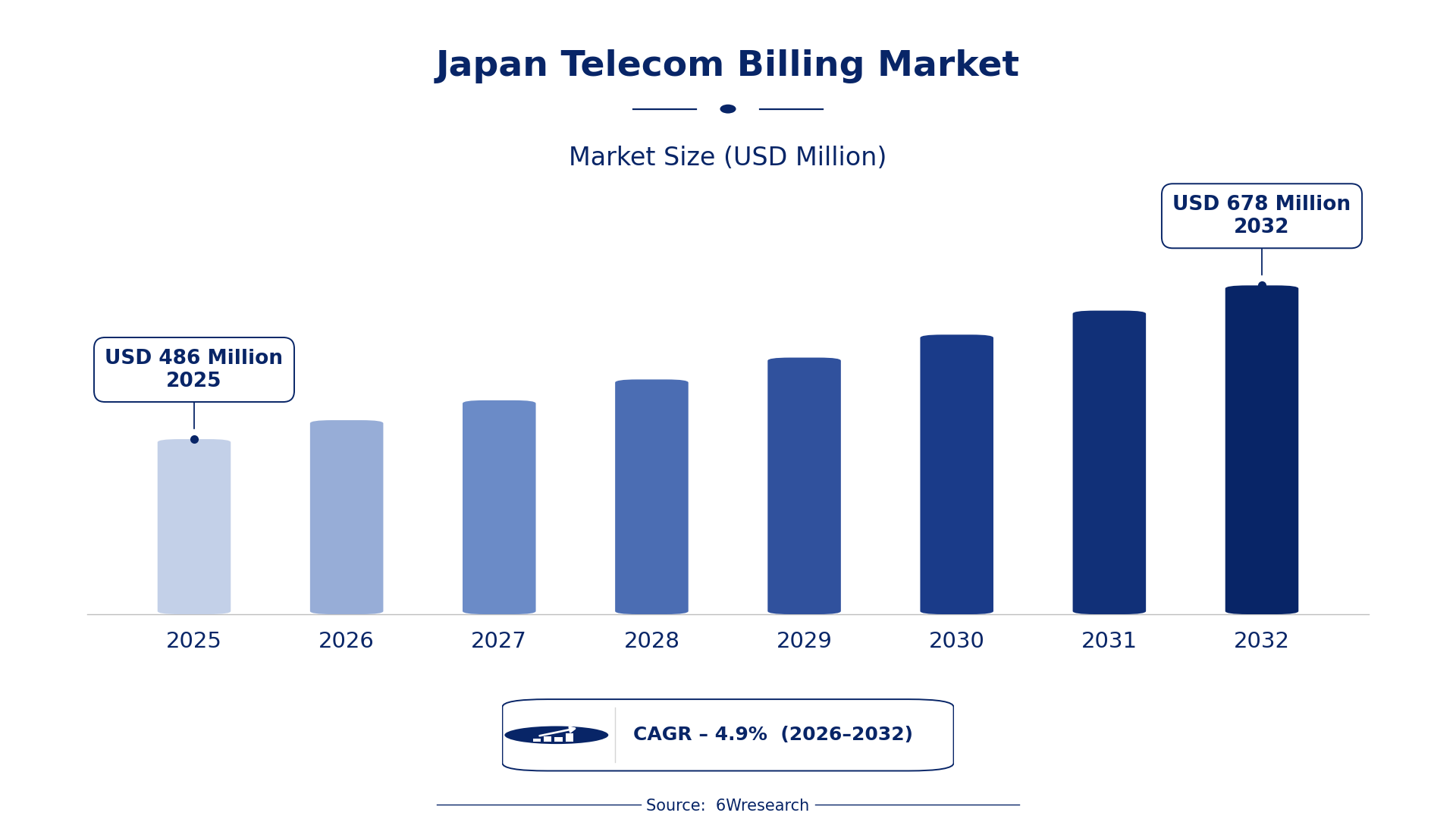
According to 6Wresearch internal database and industry insights, the Japan Telecom Billing Market was valued at USD 486 Million in 2025 and is projected to reach USD 678 Million by 2032, growing at a CAGR of approximately 4.9% during 2026–2032.
Japan Telecom Billing Market Highlights
| Report Metric | Details |
| Report Name | Japan Telecom Billing Market (2026-2032) |
| Market Size 2025 | USD 486 Million |
| Market Size 2032 | USD 678 Million |
| Absolute Growth 2025–2032 | USD 192 Million |
| CAGR 2026–2032 | 4.9% |
| Peak Annual Growth | 6.9% in 2026 |
| Forecast Period | 2026–2032 |
| Historical Data | 2022–2025 |
| Base Year | 2025 |
| Leading Telecom Billing Type, 2025 | Prepaid Billing Systems (41% share) |
| Leading Product Type, 2025 | OSS/BSS Solutions (38% share) |
| Leading Billing Type, 2025 | Prepaid (41% share) |
| Leading Distribution Channel, 2025 | Direct Sales (39% share) |
| Leading End User Industry, 2025 | Mobile Network Operators (50% share) |
| Fastest-Growing Telecom Billing Type | Postpaid Billing Systems (7.0% CAGR) |
| Fastest-Growing Product Type | Customer Management (7.1% CAGR) |
| Fastest-Growing Billing Type | Postpaid (7.5% CAGR) |
| Fastest-Growing Distribution Channel | Online Platforms (6.3% CAGR) |
| Fastest-Growing End User Industry | Telecom Providers (6.7% CAGR) |
| Growing Sector | Telecom Providers |
| Key End Users | Mobile Network Operators, Telecom Providers, Triple Play Operators, MVNOs |
Japan Telecom Billing Market Year-wise Growth Rate and Key Drivers (2022–2032)
This graph illustrates the annual growth rates of the market from 2022 to 2032, highlighting a steady upward trajectory and projected market expansion over the forecast period.
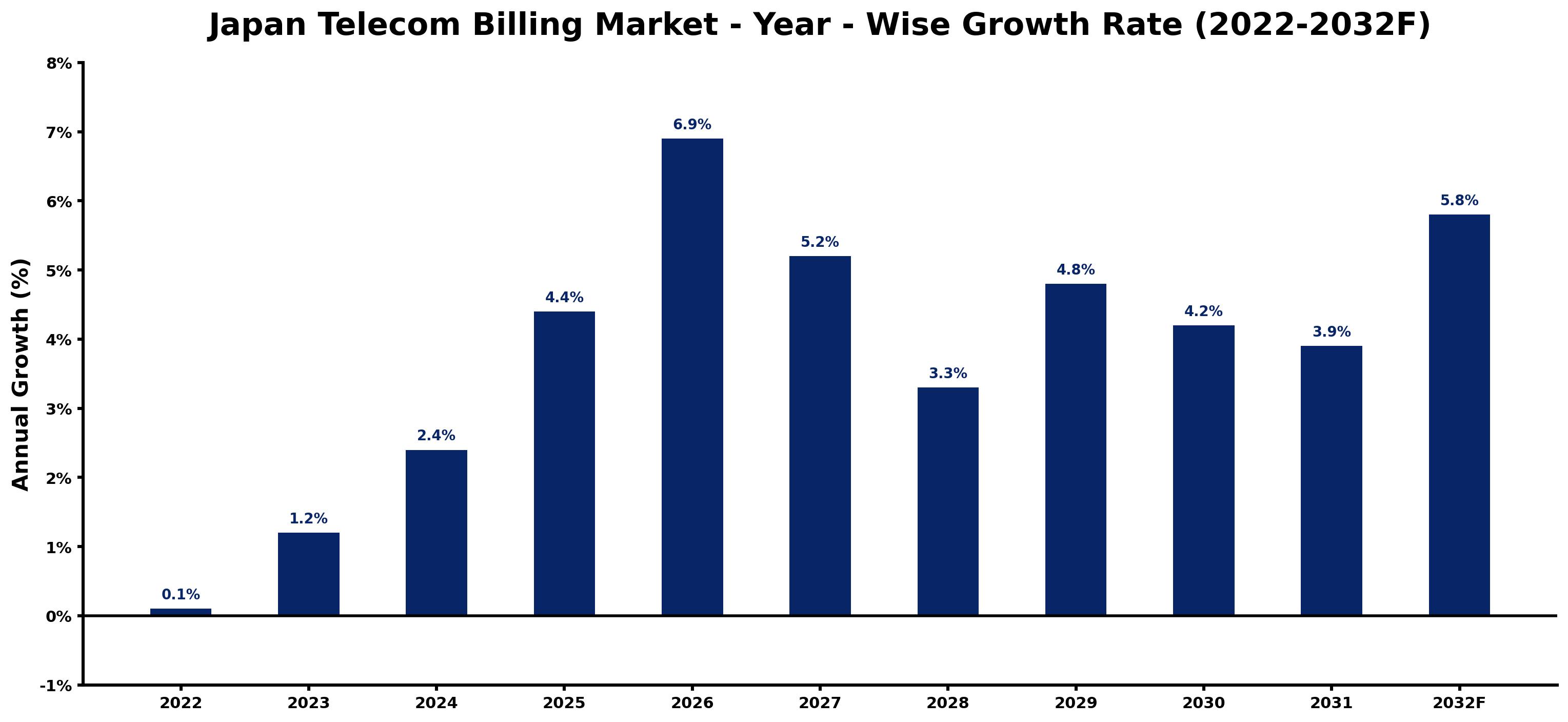
Below, each year's estimated growth is shown next to the factor that most influenced it.
| Year | Estimated Annual Growth (%) | Market Rationale |
| 2022 | 0.1 | The market showed minimal growth due to stabilisation after previous expansions. |
| 2023 | 1.2 | Growth accelerated as telecom providers adopted more advanced billing solutions. |
| 2024 | 2.4 | Demand increased further with the rise of mobile subscriptions and digital services. |
| 2025 | 4.4 | Growth peaked as operators invested heavily in OSS/BSS solutions for efficiency. |
| 2026 | 6.9 | The market is projected to achieve its highest growth rate due to new digital billing initiatives. |
| 2027 | 5.2 | Growth is expected to slow as the market adjusts to the rapid changes of the previous year. |
| 2028 | 3.3 | Continued growth is anticipated, though at a more moderate pace than before. |
| 2029 | 4.8 | Demand is expected to rise again as telecom providers improve service offerings and billing systems. |
| 2030 | 4.2 | Growth is projected to slow slightly as the market stabilises after previous expansions. |
| 2031 | 3.9 | The market is expected to continue growing, albeit at a slower rate as competition intensifies. |
| 2032 | 5.8 | Growth is projected to accelerate again as new technologies and services gain traction. |
Note: Market size estimations and growth projections presented in this report are based on 6Wresearch's proprietary forecasting methodology, utilizing the latest available industry data, government publications, and primary research inputs.
Japan Telecom Billing Market Synopsis
Telecom billing encompasses the technology and processes for managing billing in telecommunications services, including customer account management and payment processing. The Japan Telecom Billing Market is growing due to over 180 million mobile subscriptions and rising demand for advanced billing solutions. The expansion is driven by the growth of mobile network operators and the introduction of digital billing programs.
Market Dynamics Impact Analysis (2026–2032)
| Factor | Type | Impact | Primary Segment Affected |
| Increasing mobile subscriptions drive demand for efficient billing systems. | Driver | High | OSS/BSS Solutions |
| The shift towards digital billing enhances operational efficiency for telecom providers. | Driver | High | Cloud Billing Platforms |
| The rising number of MVNOs creates a need for flexible billing solutions. | Opportunity | High | Prepaid Billing Systems |
| Growing demand for integrated billing solutions offers significant market potential. | Opportunity | High | Integrated Billing |
| Regulatory compliance costs can strain smaller telecom operators' budgets. | Restraint | Medium | Postpaid Billing Systems |
| The complexity of integrating new billing technologies can delay implementation. | Restraint | Medium | Convergent Billing |
| High competition among telecom providers pressures pricing strategies. | Challenge | High | Telecom Providers |
| Rapid technological changes require continuous investment in upgrades. | Challenge | High | Cloud Billing Platforms |
Evaluation of Drivers in Japan Telecom Billing Market (2026–2032)
These are the developments adding the most demand over the forecast period.
| Drivers | Primary Segment Affected | Why It Matters (Evidence) |
| Growth in mobile subscriptions increases demand for billing solutions. | OSS/BSS Solutions | Japan has over 180 million mobile subscriptions as of 2023, leading to higher billing needs. |
| Digital transformation initiatives push telecom operators to adopt advanced billing systems. | Cloud Billing Platforms | The telecom sector contributes approximately 3% to Japan's GDP, driving investment in technology. |
| The rise of MVNOs necessitates flexible billing options to manage diverse customer bases. | Prepaid Billing Systems | As of 2023, there are over 100 MVNOs operating in Japan, enhancing market competition. |
| Increased focus on customer experience drives demand for integrated billing solutions. | Integrated Billing | The average revenue per user (ARPU) for mobile services is approximately $40, motivating better billing. |
| Technological advancements in billing software improve operational efficiency. | SaaS Platforms | ISO/IEC 27001 certification ensures information security, appealing to telecom providers. |
A wider customer base explains much of the growth, as over 180 million mobile subscriptions in Japan create a strong demand for efficient billing systems. The rise of MVNOs increases the need for flexible billing options. The average revenue per user for mobile services is around $40, pushing telecom providers to improve customer experiences through integrated solutions. Digital transformation drives telecom operators to adopt advanced technologies, contributing approximately 3% to Japan's GDP. Technological advancements in billing software also play a role in enhancing operational efficiency across the sector.
Evaluation of Restraints in Japan Telecom Billing Market
The table below lists the restraints and the evidence behind each.
| Market Restraint | Primary Segment Affected | Why It Matters (Evidence) |
| Regulatory compliance costs can be burdensome for smaller operators. | Postpaid Billing Systems | Compliance with the Industrial Standardization Act increases operational expenses for smaller telecom providers. |
| Complex integration of new technologies can delay billing system upgrades. | Convergent Billing | Telecom providers face challenges in integrating new billing solutions with existing systems. |
| Market competition pressures pricing strategies, impacting profitability. | Telecom Providers | Intense competition among providers leads to lower pricing and reduced margins. |
| High initial investment costs for advanced billing solutions can deter adoption. | Cloud Billing Platforms | The need for substantial upfront costs may limit smaller operators from upgrading systems. |
| Limited awareness of advanced billing technologies can slow market growth. | OSS/BSS Solutions | Some telecom providers may not fully understand the benefits of modern billing technologies. |
Japan Telecom Billing Market Challenges
Inefficient billing processes burden producers, as outdated systems hinder their ability to manage over 180 million mobile subscriptions effectively. Importers face pressure to adopt new technologies, with integration delays potentially extending up to six months, impacting their competitiveness. Regulatory requirements from the Ministry of Internal Affairs and Communications impose compliance costs of approximately $500,000 per provider, diverting funds from innovation. Buyers struggle with inaccuracies in digital billing, as the recent program launched in 2023 has not yet addressed their needs, leading to customer dissatisfaction and potential revenue loss.
Trends in the Japan Telecom Billing Market
Buyers and suppliers in the Japan Telecom Billing Market are adjusting to the following trends.
- Shift from Traditional to Digital Billing Solutions: In 2023, Japan has seen a shift towards digital billing solutions, driven by the launch of a program aimed at improving these systems. This transition is expected to streamline billing processes and improve customer satisfaction, with a projected increase in digital adoption.
- Emergence of Integrated Billing Systems: The trend towards integrated billing systems has gained traction, particularly among mobile network operators. In 2023, the demand for integrated solutions increased, enabling operators to manage multiple services efficiently and enhance customer experience.
- Growth of Prepaid Billing Systems: The prepaid billing segment has seen substantial growth, particularly in urban areas like Tokyo. With over 180 million mobile subscriptions, prepaid billing systems are essential for managing customer accounts effectively, leading to a notable increase in adoption in 2023.
- Adoption of Cloud-Based Billing Platforms: The trend towards cloud-based billing platforms is evident, particularly among telecom integrators. In 2023, cloud vendors reported a rise in demand for their services, as providers seek flexibility and scalability in their billing operations.
Investment Opportunities in the Japan Telecom Billing Market
The following opportunities in the Japan Telecom Billing Market pair current demand with a clear way in.
- Timing for Investment: With the market projected to grow, there is a clear opportunity for investment in advanced billing technologies. Telecom providers in urban areas like Tokyo are seeking solutions to enhance their service offerings.
- Gap in Advanced Solutions: The rising demand for efficient billing solutions presents an opportunity for suppliers to fill the gap in advanced technologies. Mobile network operators are particularly keen on adopting new systems to improve customer management.
- Focus on Digital Transformation: As digital transformation accelerates, telecom integrators are looking for innovative billing solutions. This trend is evident in regions with high mobile subscription rates, creating a pathway for new entrants.
- Partnerships for Growth: Local partnerships with telecom providers can facilitate entry into the market for advanced billing solutions. Collaborating with established players can streamline the adoption of new technologies.
Government Initiatives in the Japan Telecom Billing Market
The Telecommunications Business Law regulates telecom billing practices, ensuring that providers adhere to established standards. This law mandates transparency in billing processes and protects consumer rights, which helps maintain trust in the telecom sector. Additionally, the Industrial Standardization Act governs product and test standards, ensuring compliance among telecom providers, which can incur costs of approximately $500,000 for each provider.
The Digital Agency, established in September 2021, leads government digital transformation and common system standards. It supports initiatives to improve digital billing solutions, providing funding for projects that enhance efficiency and customer satisfaction in the telecom sector. This agency plays a crucial role in shaping the future of telecom billing in Japan.
Future Insight of the Japan Telecom Billing Market
The integration of automated billing systems will transform demand for telecom billing solutions by 2032, streamlining operations for suppliers. Compliance with ISO/IEC 27001 standards will enhance information security, giving buyers confidence in data protection. Advanced digital platforms will improve transaction efficiency, benefiting cash flow management for suppliers. By 2032, the telecom market's value is projected to reach around $70 billion, driven by increased adoption of advanced billing practices and improved customer experiences.
Market Segmentation Analysis
Japan Telecom Billing Market report covers a detailed analysis of the following market segments:
By Telecom Billing Type – Prepaid Billing Systems Lead, Postpaid Billing Systems Expected to Grow Fastest
According to Saurav Kr Singh, Senior Research Analyst at 6Wresearch, Prepaid Billing Systems held 41% of the Japan Telecom Billing Market by telecom billing type in 2025. Prepaid billing systems dominate the market due to their essential role in managing over 180 million mobile subscriptions in Japan. This segment is particularly vital for operators who serve a large base of prepaid customers, ensuring effective account management. Postpaid Billing Systems are projected to grow fastest, at a CAGR of 7.0% during 2026–2032. Postpaid billing systems are experiencing rapid growth, fuelled by a notable increase in average revenue per user, which stands at approximately $40. As consumer preferences shift towards postpaid plans, the demand for advanced billing solutions is expected to rise. Suppliers should enhance postpaid billing capabilities to capture the growing customer base.
By Product Type – OSS/BSS Solutions Lead, Customer Management Expected to Grow Fastest
OSS/BSS Solutions accounted for 38% of the market by product type in 2025. OSS/BSS solutions hold the largest share as they are essential for managing operational and business support systems in the telecom sector. Their integration into various telecom processes makes them indispensable for service providers across Japan. Customer Management is set to record the highest CAGR in this split, 7.1% over 2026–2032. Customer management is experiencing the fastest growth due to the increasing emphasis on improving customer relationships and satisfaction in the telecom industry. This trend indicates a shift towards prioritising customer-centric solutions in billing. Buyers will benefit from investing in customer management solutions to improve retention and service quality.
By Billing Type – Prepaid Leads, Postpaid Expected to Grow Fastest
In 2025, Prepaid led the billing type split with a 41% share. Prepaid billing is the largest segment as it is crucial for managing the extensive prepaid telecom services prevalent in Japan. This billing type is vital for operators catering to a significant number of prepaid customers, ensuring seamless transactions. The quickest growth will come from Postpaid, forecast to expand at a CAGR of 7.5% between 2026 and 2032. Postpaid billing is growing quickly as more consumers opt for postpaid plans, indicating a shift towards bundled services. This trend highlights a strong demand for sophisticated billing systems to accommodate these users. Suppliers should focus on improving postpaid billing solutions to meet rising consumer demand.
By Distribution Channel – Direct Sales Leads, Online Platforms Expected to Grow Fastest
Direct Sales took 39% of distribution channel revenue in 2025, more than any other category. Direct sales is the leading method for selling telecom billing solutions, enabling tailored offerings that meet the specific needs of telecom operators. This channel is preferred for its capacity to foster direct engagement and build robust client relationships. Over 2026–2032, Online Platforms are expected to post the fastest growth, at a CAGR of 6.3%. Online platforms are rapidly gaining traction as they provide convenient access to billing solutions for a broader audience. This shift towards digital channels reflects changing purchasing behaviours among telecom companies. Suppliers must invest in online platforms to effectively reach a wider customer base.
By End User Industry – Mobile Network Operators Lead, Telecom Providers Expected to Grow Fastest
The largest end user industry category in 2025 was Mobile Network Operators, at 50% of revenue. Mobile network operators are the primary users of telecom billing solutions, driven by their large customer bases and diverse service offerings. Their reliance on efficient billing systems underscores the critical importance of this segment in the telecom sector. Telecom Providers are projected to grow fastest, at a CAGR of 6.7% during 2026–2032. Telecom providers are expanding quickly as they broaden their service offerings and customer reach. This growth highlights the increasing necessity for robust billing systems to support various telecom services. Suppliers should tailor their solutions to meet the specific needs of telecom providers.
Key Attractiveness of the Report
- 10 Years of Market Numbers
- Historical Data Starting from 2022 to 2025
- Base Year 2025
- Forecast Data until 2032
- Key Performance Indicators Impacting the Market
- Major Upcoming Developments and Projects
Key Highlights of the Report:
- Japan Telecom Billing Market Outlook
- Market Size of Japan Telecom Billing Market, 2025
- Forecast of Japan Telecom Billing Market, 2032
- Historical Data and Forecast of Japan Telecom Billing Revenues & Volume for the Period 2022-2032F
- Japan Telecom Billing Market Trend Evolution
- Japan Telecom Billing Market Drivers and Challenges
- Japan Telecom Billing Price Trends
- Japan Telecom Billing Porter's Five Forces
- Japan Telecom Billing Industry Life Cycle
- Historical Data and Forecast of Japan Telecom Billing Market Revenues & Volume By Telecom Billing Type for the Period 2022-2032F
- Historical Data and Forecast of Japan Telecom Billing Market Revenues & Volume By Prepaid Billing Systems for the Period 2022-2032F
- Historical Data and Forecast of Japan Telecom Billing Market Revenues & Volume By Postpaid Billing Systems for the Period 2022-2032F
- Historical Data and Forecast of Japan Telecom Billing Market Revenues & Volume By Convergent Billing for the Period 2022-2032F
- Historical Data and Forecast of Japan Telecom Billing Market Revenues & Volume By Cloud Billing Platforms for the Period 2022-2032F
- Historical Data and Forecast of Japan Telecom Billing Market Revenues & Volume By Product Type for the Period 2022-2032F
- Historical Data and Forecast of Japan Telecom Billing Market Revenues & Volume By OSS/BSS Solutions for the Period 2022-2032F
- Historical Data and Forecast of Japan Telecom Billing Market Revenues & Volume By Customer Management for the Period 2022-2032F
- Historical Data and Forecast of Japan Telecom Billing Market Revenues & Volume By Integrated Billing for the Period 2022-2032F
- Historical Data and Forecast of Japan Telecom Billing Market Revenues & Volume By SaaS Platforms for the Period 2022-2032F
- Historical Data and Forecast of Japan Telecom Billing Market Revenues & Volume By Billing Type for the Period 2022-2032F
- Historical Data and Forecast of Japan Telecom Billing Market Revenues & Volume By Prepaid for the Period 2022-2032F
- Historical Data and Forecast of Japan Telecom Billing Market Revenues & Volume By Postpaid for the Period 2022-2032F
- Historical Data and Forecast of Japan Telecom Billing Market Revenues & Volume By Hybrid for the Period 2022-2032F
- Historical Data and Forecast of Japan Telecom Billing Market Revenues & Volume By Usage-Based for the Period 2022-2032F
- Historical Data and Forecast of Japan Telecom Billing Market Revenues & Volume By Distribution Channel for the Period 2022-2032F
- Historical Data and Forecast of Japan Telecom Billing Market Revenues & Volume By Direct Sales for the Period 2022-2032F
- Historical Data and Forecast of Japan Telecom Billing Market Revenues & Volume By Online Platforms for the Period 2022-2032F
- Historical Data and Forecast of Japan Telecom Billing Market Revenues & Volume By Cloud Vendors for the Period 2022-2032F
- Historical Data and Forecast of Japan Telecom Billing Market Revenues & Volume By Telecom Integrators for the Period 2022-2032F
- Historical Data and Forecast of Japan Telecom Billing Market Revenues & Volume By End User Industry for the Period 2022-2032F
- Historical Data and Forecast of Japan Telecom Billing Market Revenues & Volume By Mobile Network Operators for the Period 2022-2032F
- Historical Data and Forecast of Japan Telecom Billing Market Revenues & Volume By Telecom Providers for the Period 2022-2032F
- Historical Data and Forecast of Japan Telecom Billing Market Revenues & Volume By Triple Play Operators for the Period 2022-2032F
- Historical Data and Forecast of Japan Telecom Billing Market Revenues & Volume By MVNOs for the Period 2022-2032F
- Japan Telecom Billing Import Export Trade Statistics
- Market Opportunity Assessment By Telecom Billing Type
- Market Opportunity Assessment By Product Type
- Market Opportunity Assessment By Billing Type
- Market Opportunity Assessment By Distribution Channel
- Market Opportunity Assessment By End User Industry
- Japan Telecom Billing Top Companies Market Share
- Japan Telecom Billing Competitive Benchmarking By Technical and Operational Parameters
- Japan Telecom Billing Company Profiles
- Japan Telecom Billing Key Strategic Recommendations
Market Covered
Coverage by segment is as follows.
By Telecom Billing Type
- Prepaid Billing Systems
- Postpaid Billing Systems
- Convergent Billing
- Cloud Billing Platforms
By Product Type
- OSS/BSS Solutions
- Customer Management
- Integrated Billing
- SaaS Platforms
By Billing Type
- Prepaid
- Postpaid
- Hybrid
- Usage-Based
By Distribution Channel
- Direct Sales
- Online Platforms
- Cloud Vendors
- Telecom Integrators
By End User Industry
- Mobile Network Operators
- Telecom Providers
- Triple Play Operators
- MVNOs































