Japan Telecom Chipset Market Size & Growth Rate
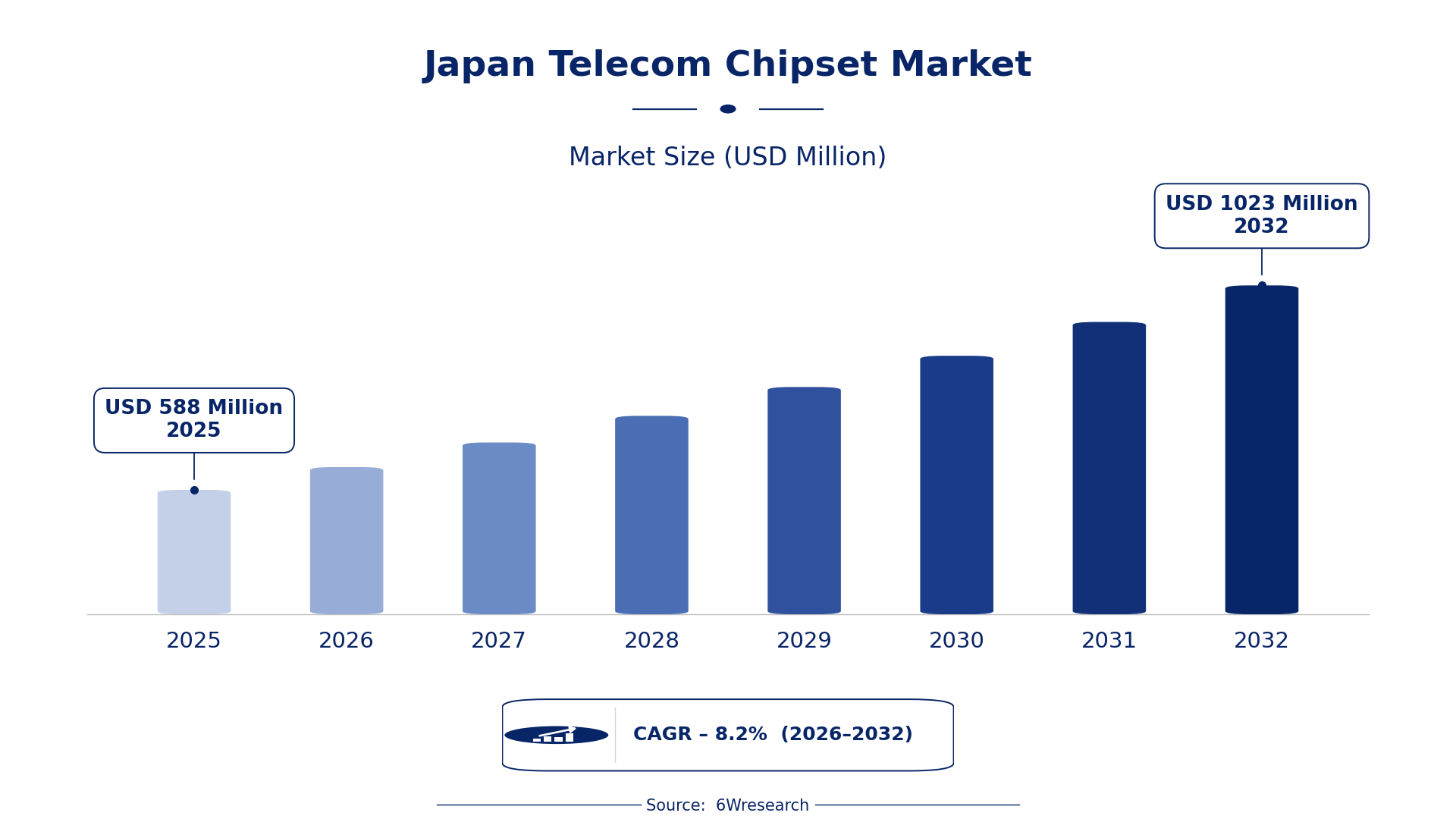
According to 6Wresearch internal database and industry insights, the Japan Telecom Chipset Market was valued at USD 588 Million in 2025 and is projected to reach USD 1,023 Million by 2032, growing at a CAGR of approximately 8.2% during 2026–2032.
Japan Telecom Chipset Market Highlights
| Report Metric | Details |
| Report Name | Japan Telecom Chipset Market (2026-2032) |
| Market Size 2025 | USD 588 Million |
| Market Size 2032 | USD 1,023 Million |
| Absolute Growth 2025–2032 | USD 435 Million |
| CAGR 2026–2032 | 8.2% |
| Peak Annual Growth | 10.2% in 2027 |
| Forecast Period | 2026–2032 |
| Historical Data | 2022–2025 |
| Base Year | 2025 |
| Leading Telecom Chipset Type, 2025 | Baseband Processors (34% share) |
| Leading Product Type, 2025 | 4G/5G Chipsets (41% share) |
| Leading Chipset Type, 2025 | RF + Modem (44% share) |
| Leading Distribution Channel, 2025 | OEM Supply (42% share) |
| Leading End User Industry, 2025 | Smartphone Manufacturers (40% share) |
| Fastest-Growing Telecom Chipset Type | Optical Communication ICs (11.0% CAGR) |
| Fastest-Growing Product Type | mmWave Chips (11.4% CAGR) |
| Fastest-Growing Chipset Type | Silicon Photonics (11.2% CAGR) |
| Fastest-Growing Distribution Channel | Online Platforms (10.5% CAGR) |
| Fastest-Growing End User Industry | Data Centers (10.7% CAGR) |
| Growing Sector | Data Centers |
| Key End Users | Smartphone Manufacturers, Telecom Infrastructure, Wireless Equipment OEMs, Data Centers |
Japan Telecom Chipset Market Year-wise Growth Rate and Key Drivers (2022–2032)
This graph illustrates the annual growth rates of the market from 2022 to 2032, highlighting a steady upward trajectory and projected market expansion over the forecast period.
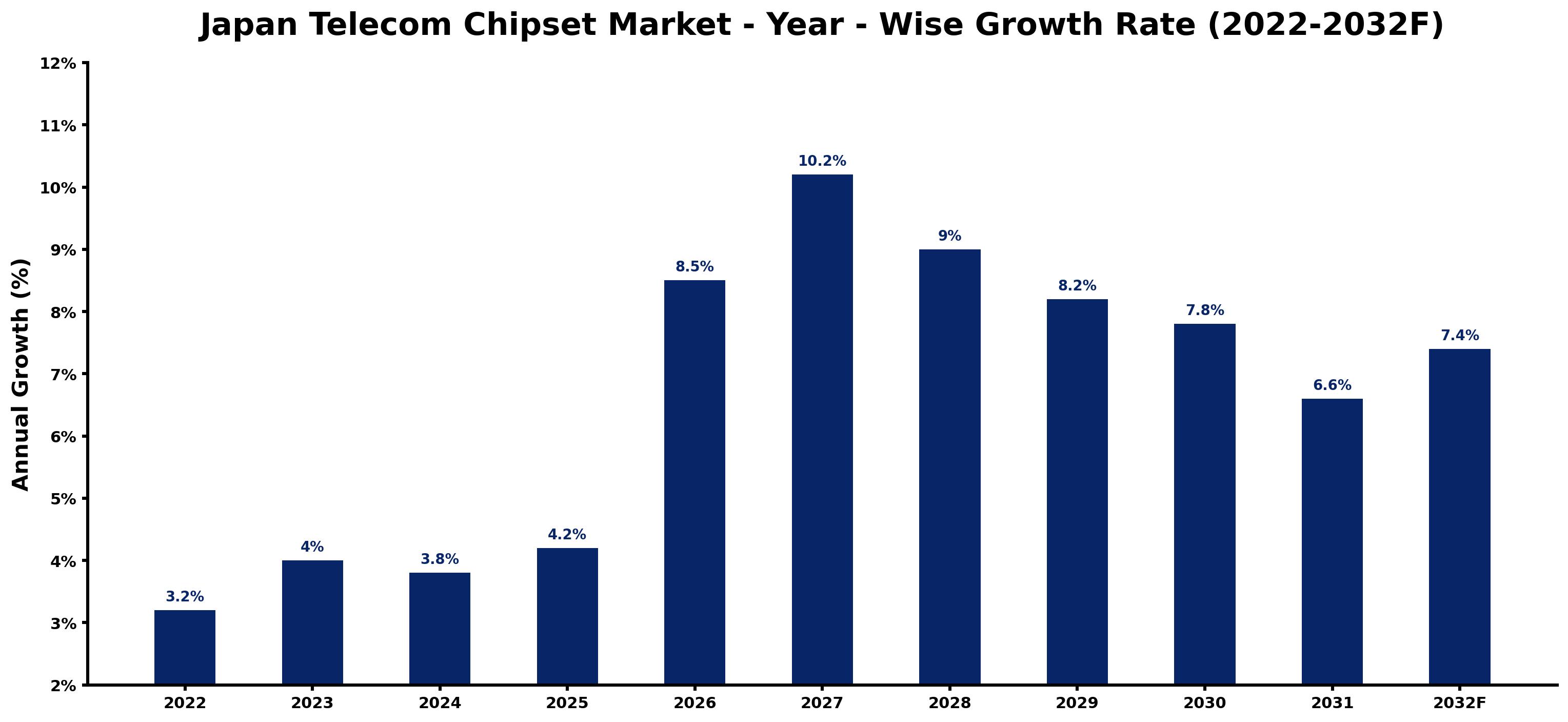
The following figures match every annual growth estimate with the main market development of that year, giving the reasoning behind each rise or slowdown.
| Year | Estimated Annual Growth (%) | Market Rationale |
| 2022 | 3.2 | Telecom investment remained stable, supporting growth in chipset demand. |
| 2023 | 4.0 | Increased smartphone adoption contributed to a rise in chipset purchases. |
| 2024 | 3.8 | Market growth slowed slightly due to saturation in some segments. |
| 2025 | 4.2 | Infrastructure upgrades led to a faster growth rate in chipset demand. |
| 2026 | 8.5 | Investment in 5G technology is expected to boost market growth. |
| 2027 | 10.2 | Peak growth will be driven by extensive 5G network rollouts across Japan. |
| 2028 | 9.0 | Market growth is projected to slow as the initial surge in 5G adoption stabilises. |
| 2029 | 8.2 | Continued demand for advanced telecom solutions will maintain growth. |
| 2030 | 7.8 | Market growth is anticipated to decelerate as competition intensifies among suppliers. |
| 2031 | 6.6 | Technological advancements in chipsets will support ongoing market expansion. |
| 2032 | 7.4 | Rising demand for connectivity solutions will spur further growth. |
Note: Market size estimations and growth projections presented in this report are based on 6Wresearch's proprietary forecasting methodology, utilizing the latest available industry data, government publications, and primary research inputs.
Japan Telecom Chipset Market Synopsis
Telecom chipsets are semiconductor devices crucial for processing signals in telecommunications, primarily utilised in smartphones and telecom infrastructure. The Japan Telecom Chipset Market is experiencing growth driven by increased smartphone adoption and investments in 5G technology. With a population of approximately 126 million, Japan's telecom sector is supported by a government initiative launched in 2023 to improve connectivity, which further stimulates demand for chipsets across various applications. The total number of mobile subscriptions in Japan is around 180 million, reflecting strong market potential.
Market Dynamics Impact Analysis (2026–2032)
| Factor | Type | Impact | Primary Segment Affected |
| Increased investment in 5G infrastructure | Driver | High | 4G/5G Chipsets |
| Growing smartphone penetration | Driver | High | Baseband Processors |
| Rising demand for high-speed data transmission | Opportunity | High | Optical Communication ICs |
| Expansion of online sales channels | Opportunity | Medium | Online Platforms |
| Supply chain disruptions affecting semiconductor production | Restraint | High | RF Front-End Chips |
| High competition among chipset manufacturers | Restraint | Medium | mmWave Chips |
| High production costs for advanced chipsets | Challenge | High | Silicon Photonics |
| Technological obsolescence of older chipsets | Challenge | Medium | Transceiver Chips |
Evaluation of Drivers in Japan Telecom Chipset Market (2026–2032)
Demand rests on the following drivers, each shown with the segment it touches most.
| Drivers | Primary Segment Affected | Why It Matters (Evidence) |
| Investment in 5G infrastructure | 4G/5G Chipsets | Japan's telecom infrastructure investment was estimated at 1 trillion yen in 2022, driving demand for modern chipsets. |
| Rising smartphone penetration | Baseband Processors | The total number of mobile subscriptions in Japan is around 180 million, increasing the need for efficient signal processing. |
| Demand for high-speed data transmission | Optical Communication ICs | Japan's strong focus on developing silicon photonics technology drives the need for high-speed data solutions. |
| Expansion of online sales channels | Online Platforms | The growing trend of online purchasing is reflected in the increasing sales through digital platforms. |
| Government initiatives promoting telecom advancements | RF Front-End Chips | The 5G promotion program launched in 2023 aims to increase connectivity, raising demand for RF solutions. |
Several shifts outside the market lift sales. Investment in 5G infrastructure, estimated at 1 trillion yen in 2022, fuels demand for 4G/5G chipsets, as Japan seeks to improve its telecom capabilities. The total number of mobile subscriptions in Japan is around 180 million, driving the need for baseband processors. The focus on silicon photonics technology supports the demand for optical communication ICs, essential for high-speed data transmission. The expansion of online sales channels has led to increased purchases of telecom chipsets, as consumers prefer digital platforms for their convenience.
Evaluation of Restraints in Japan Telecom Chipset Market
The key brakes on demand, and where they bite hardest, are shown below.
| Market Restraint | Primary Segment Affected | Why It Matters (Evidence) |
| Stringent regulations from the Ministry of Internal Affairs and Communications | Baseband Processors | Producers face delays in product approvals, impacting time-to-market for new chipsets. |
| Supply chain disruptions due to reliance on foreign semiconductor materials | Baseband Processors | Importers experience increased costs that can rise by 15% during shortages. |
| Intense competition among local manufacturers | Baseband Processors | Buyers struggle with price reductions that may affect the quality of available chipsets. |
| Skills shortages in advanced semiconductor manufacturing technologies | Baseband Processors | Hindered production efficiency causes delays that can extend lead times by up to three weeks. |
| Limited investment in research and development | Baseband Processors | This restricts innovation and the introduction of next-generation chipsets. |
Japan Telecom Chipset Market Challenges
Japan's telecom chipset market faces stringent regulations from the Ministry of Internal Affairs and Communications, which can delay product approvals by up to six months, impacting producers' time-to-market. Importers struggle with supply chain disruptions caused by reliance on foreign semiconductor materials, leading to a 15% increase in costs during shortages. Buyers experience intense competition among local manufacturers, driving prices down and potentially compromising chipset quality. Skills shortages in advanced semiconductor manufacturing reduce production efficiency, causing lead times for telecom infrastructure projects to extend by up to three weeks.
Trends in the Japan Telecom Chipset Market
The shifts below are changing how Japan Telecom Chipset Market products are bought and supplied.
- Shift Towards 5G Adoption: Japan's 5G adoption rate reached 20% in 2023, reflecting a transition in telecom infrastructure. This shift will drive demand for advanced chipsets, particularly in urban areas like Tokyo.
- Increase in Online Sales Channels: Smartphone manufacturers are increasingly turning to online platforms for chipset procurement, with online sales projected to grow by 10.5% annually. This trend allows for wider market reach and convenience for buyers.
- Focus on Silicon Photonics Technology: The development of silicon photonics technology is gaining traction, with Japan positioning itself as a leader in high-speed optical communication. This shift is projected to improve the performance of telecom networks.
- Expansion of Telecom Infrastructure: The Tokyo region is a major hub for telecom infrastructure development, attracting investments of approximately 1 trillion yen in 2022. This expansion is vital for supporting the growing demand for connectivity.
Investment Opportunities in the Japan Telecom Chipset Market
The openings below show where demand in the Japan Telecom Chipset Market is visible and how suppliers can enter.
- Investment in 5G Infrastructure: With an estimated 1 trillion yen allocated for telecom infrastructure, there is a gap in 5G deployment. Collaborating with local telecom operators can facilitate entry into this market.
- Growing Demand for Optical Communication ICs: As Japan focuses on high-speed data transmission, there is a need for advanced optical communication ICs. Targeting telecom infrastructure projects can provide promising opportunities for suppliers.
- Partnerships with Smartphone Manufacturers: Smartphone manufacturers represent a key buyer group, with a 40% market share in 2025. Establishing partnerships can strengthen market presence and sales potential.
- Expansion of Online Sales Channels: The trend of online purchasing presents an opportunity for suppliers to reach a broader audience. Investing in e-commerce platforms can facilitate market entry.
Government Initiatives in the Japan Telecom Chipset Market
The Semiconductor and Digital Industry Strategy, established by METI in June 2021, aims to secure domestic semiconductor manufacturing capabilities. This initiative supports the production of telecom chipsets, ensuring a stable supply chain for manufacturers. The Economic Security Promotion Act, enacted in 2022, further supports supply-chain resilience for critical products, including telecom chipsets, improving overall market stability.
The 5G promotion program launched in 2023 allocates funding to enhance connectivity across Japan. The Ministry of Internal Affairs and Communications oversees this initiative, which aims to increase mobile subscriptions and improve telecom infrastructure.
Future Insight of the Japan Telecom Chipset Market
A policy-driven shift towards improved connectivity will reshape the telecom sector by 2032, prompting suppliers to invest in next-generation technologies. The government's 5G promotion program aims to increase mobile subscriptions to around 200 million. Buyers will benefit from improved chipset performance and stronger compliance with security standards like ISO/IEC 27001. As the Tokyo region continues to develop as a telecom infrastructure hub, it will attract further investments and stimulate innovation in the market.
Market Segmentation Analysis
Japan Telecom Chipset Market report covers a detailed analysis of the following market segments:
By Telecom Chipset Type – Baseband Processors Lead, Optical Communication ICs Expected to Grow Fastest
According to Saurav Kr Singh, Senior Research Analyst at 6Wresearch, Baseband Processors accounted for 34% of the market by telecom chipset type in 2025. Baseband processors are essential for signal processing in devices, particularly in smartphones that cater to Japan's 180 million mobile subscriptions. Their critical role in telecom infrastructure solidifies their leading market position. Over 2026–2032, Optical Communication ICs are expected to post the fastest growth, at a CAGR of 11.0%. Optical communication ICs are experiencing rapid growth due to the rising demand for high-speed data transmission, especially as Japan's 5G adoption reached 20% in 2023. This trend will likely widen the lead of baseband processors as they also benefit from this growth. Suppliers should focus on enhancing their offerings in optical communication ICs to capitalise on this growth trend.
By Product Type – 4G/5G Chipsets Lead, mmWave Chips Expected to Grow Fastest
With 41% of product type revenue in 2025, 4G/5G Chipsets was the largest category. 4G/5G chipsets are fundamental for modern mobile networks, supporting Japan's telecom infrastructure investment of around 1 trillion yen in 2022. Their critical role in enabling connectivity for Japan's population ensures their dominance in the market. The quickest growth will come from mmWave Chips, forecast to expand at a CAGR of 11.4% between 2026 and 2032. mmWave chips are gaining traction as they are increasingly used in high-frequency applications, particularly following the government's 5G promotion program launched in 2023. This focus on advanced connectivity solutions positions mmWave chips for accelerated growth in the coming years. Buyers should consider investing in mmWave technology to stay ahead in the competitive telecom landscape.
By Chipset Type – RF + Modem Leads, Silicon Photonics Expected to Grow Fastest
RF + Modem held 44% of the Japan Telecom Chipset Market by chipset type in 2025. RF + modem chipsets combine functionality for communication, making them indispensable for smartphone manufacturers, who are the primary consumers of chipsets in Japan. Their integration into devices enhances performance and user experience, securing their leading market share. Silicon Photonics are projected to grow fastest, at a CAGR of 11.2% during 2026–2032. Silicon photonics technology enables high-speed optical communication, which is becoming increasingly vital as demand for faster data transmission grows. This technological advancement positions silicon photonics for rapid growth as telecom infrastructure evolves. Suppliers must invest in silicon photonics to meet the rising demand for high-speed communication solutions.
By Distribution Channel – OEM Supply Leads, Online Platforms Expected to Grow Fastest
In 2025, OEM Supply led the distribution channel split with a 42% share. OEM supply serves as the main channel for manufacturers, facilitating the distribution of telecom chipsets directly to major producers in Japan's active telecom industry. This established channel ensures a steady flow of products to meet the needs of smartphone manufacturers and other end users. Online Platforms are set to record the highest CAGR in this split, 10.5% over 2026–2032. Online platforms are emerging as a growing channel for sales, reflecting the shift in consumer purchasing behaviour towards digital solutions. As more buyers seek convenience and accessibility, this segment is expected to expand rapidly. Suppliers should enhance their online presence to capture the increasing demand through digital sales channels.
By End User Industry – Smartphone Manufacturers Lead, Data Centers Expected to Grow Fastest
The largest end user industry category in 2025 was Smartphone Manufacturers, at 40% of revenue. Smartphone manufacturers are the primary consumers of chipsets, driving demand in a market where mobile subscriptions total around 180 million. Their reliance on telecom chipsets for device functionality solidifies their leading position in the industry. Over 2026–2032, Data Centers are expected to post the fastest growth, at a CAGR of 10.7%. Data centers are witnessing increasing demand for connectivity solutions, particularly as the need for robust infrastructure grows alongside 5G adoption. This trend indicates a shift towards enhanced data processing capabilities, positioning data centers for rapid growth. Buyers in the data center sector should prioritise advanced chipset solutions to support their expanding connectivity requirements.
Key Attractiveness of the Report
- 10 Years of Market Numbers
- Historical Data Starting from 2022 to 2025
- Base Year 2025
- Forecast Data until 2032
- Key Performance Indicators Impacting the Market
- Major Upcoming Developments and Projects
Key Highlights of the Report:
- Japan Telecom Chipset Market Outlook
- Market Size of Japan Telecom Chipset Market, 2025
- Forecast of Japan Telecom Chipset Market, 2032
- Historical Data and Forecast of Japan Telecom Chipset Revenues & Volume for the Period 2022-2032F
- Japan Telecom Chipset Market Trend Evolution
- Japan Telecom Chipset Market Drivers and Challenges
- Japan Telecom Chipset Price Trends
- Japan Telecom Chipset Porter's Five Forces
- Japan Telecom Chipset Industry Life Cycle
- Historical Data and Forecast of Japan Telecom Chipset Market Revenues & Volume By Telecom Chipset Type for the Period 2022-2032F
- Historical Data and Forecast of Japan Telecom Chipset Market Revenues & Volume By Baseband Processors for the Period 2022-2032F
- Historical Data and Forecast of Japan Telecom Chipset Market Revenues & Volume By Network Processors for the Period 2022-2032F
- Historical Data and Forecast of Japan Telecom Chipset Market Revenues & Volume By RF Front-End Chips for the Period 2022-2032F
- Historical Data and Forecast of Japan Telecom Chipset Market Revenues & Volume By Optical Communication ICs for the Period 2022-2032F
- Historical Data and Forecast of Japan Telecom Chipset Market Revenues & Volume By Product Type for the Period 2022-2032F
- Historical Data and Forecast of Japan Telecom Chipset Market Revenues & Volume By 4G/5G Chipsets for the Period 2022-2032F
- Historical Data and Forecast of Japan Telecom Chipset Market Revenues & Volume By Packet Handling ICs for the Period 2022-2032F
- Historical Data and Forecast of Japan Telecom Chipset Market Revenues & Volume By mmWave Chips for the Period 2022-2032F
- Historical Data and Forecast of Japan Telecom Chipset Market Revenues & Volume By Transceiver Chips for the Period 2022-2032F
- Historical Data and Forecast of Japan Telecom Chipset Market Revenues & Volume By Chipset Type for the Period 2022-2032F
- Historical Data and Forecast of Japan Telecom Chipset Market Revenues & Volume By RF + Modem for the Period 2022-2032F
- Historical Data and Forecast of Japan Telecom Chipset Market Revenues & Volume By Multi-core ASICs for the Period 2022-2032F
- Historical Data and Forecast of Japan Telecom Chipset Market Revenues & Volume By GaN/GaAs for the Period 2022-2032F
- Historical Data and Forecast of Japan Telecom Chipset Market Revenues & Volume By Silicon Photonics for the Period 2022-2032F
- Historical Data and Forecast of Japan Telecom Chipset Market Revenues & Volume By Distribution Channel for the Period 2022-2032F
- Historical Data and Forecast of Japan Telecom Chipset Market Revenues & Volume By OEM Supply for the Period 2022-2032F
- Historical Data and Forecast of Japan Telecom Chipset Market Revenues & Volume By Direct Sales for the Period 2022-2032F
- Historical Data and Forecast of Japan Telecom Chipset Market Revenues & Volume By Distributors for the Period 2022-2032F
- Historical Data and Forecast of Japan Telecom Chipset Market Revenues & Volume By Online Platforms for the Period 2022-2032F
- Historical Data and Forecast of Japan Telecom Chipset Market Revenues & Volume By End User Industry for the Period 2022-2032F
- Historical Data and Forecast of Japan Telecom Chipset Market Revenues & Volume By Smartphone Manufacturers for the Period 2022-2032F
- Historical Data and Forecast of Japan Telecom Chipset Market Revenues & Volume By Telecom Infrastructure for the Period 2022-2032F
- Historical Data and Forecast of Japan Telecom Chipset Market Revenues & Volume By Wireless Equipment OEMs for the Period 2022-2032F
- Historical Data and Forecast of Japan Telecom Chipset Market Revenues & Volume By Data Centers for the Period 2022-2032F
- Japan Telecom Chipset Import Export Trade Statistics
- Market Opportunity Assessment By Telecom Chipset Type
- Market Opportunity Assessment By Product Type
- Market Opportunity Assessment By Chipset Type
- Market Opportunity Assessment By Distribution Channel
- Market Opportunity Assessment By End User Industry
- Japan Telecom Chipset Top Companies Market Share
- Japan Telecom Chipset Competitive Benchmarking By Technical and Operational Parameters
- Japan Telecom Chipset Company Profiles
- Japan Telecom Chipset Key Strategic Recommendations
Market Covered
Coverage by segment is as follows.
By Telecom Chipset Type
- Baseband Processors
- Network Processors
- RF Front-End Chips
- Optical Communication ICs
By Product Type
- 4G/5G Chipsets
- Packet Handling ICs
- mmWave Chips
- Transceiver Chips
By Chipset Type
- RF + Modem
- Multi-core ASICs
- GaN/GaAs
- Silicon Photonics
By Distribution Channel
- OEM Supply
- Direct Sales
- Distributors
- Online Platforms
By End User Industry
- Smartphone Manufacturers
- Telecom Infrastructure
- Wireless Equipment OEMs
- Data Centers































