Japan Telecom Computing Architecture Market Size & Growth Rate
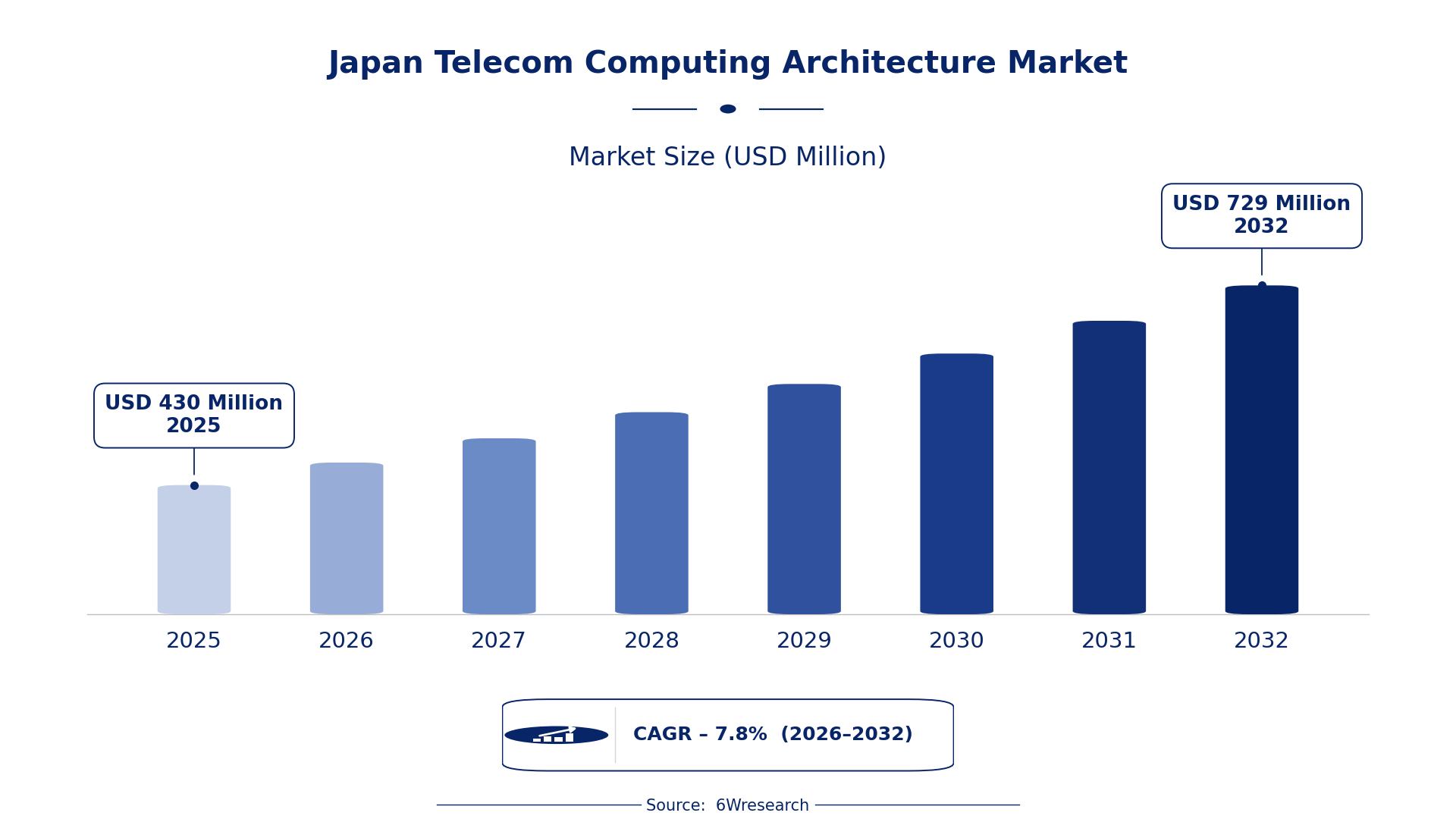
According to 6Wresearch internal database and industry insights, the Japan Telecom Computing Architecture Market was valued at USD 430 Million in 2025 and is projected to reach USD 729 Million by 2032, growing at a CAGR of approximately 7.8% during 2026–2032.
Japan Telecom Computing Architecture Market Highlights
| Report Metric | Details |
| Report Name | Japan Telecom Computing Architecture Market (2026-2032) |
| Market Size 2025 | USD 430 Million |
| Market Size 2032 | USD 729 Million |
| Absolute Growth 2025–2032 | USD 299 Million |
| CAGR 2026–2032 | 7.8% |
| Peak Annual Growth | 8.7% in 2030 |
| Forecast Period | 2026–2032 |
| Historical Data | 2022–2025 |
| Base Year | 2025 |
| Leading Telecom Computing Architecture, 2025 | NFV Infrastructure (48% share) |
| Leading Product Type, 2025 | Modular Chassis (52% share) |
| Leading Architecture Type, 2025 | AdvancedTCA (39% share) |
| Leading Distribution Channel, 2025 | OEMs (48% share) |
| Leading End User Industry, 2025 | 5G Deployment Firms (42% share) |
| Fastest-Growing Telecom Computing Architecture | Edge Computing Platforms (10.2% CAGR) |
| Fastest-Growing Product Type | Virtualized Servers (11.0% CAGR) |
| Fastest-Growing Distribution Channel | System Integrators (10.3% CAGR) |
| Fastest-Growing End User Industry | Telecom Cloud Operators (10.5% CAGR) |
| Growing Sector | Telecommunications |
| Key End Users | Telecom Operators, System Integrators, Cloud Providers, 5G Deployment Firms |
Japan Telecom Computing Architecture Market Year-wise Growth Rate and Key Drivers (2022–2032)
This graph illustrates the annual growth rates of the market from 2022 to 2032, highlighting a steady upward trajectory and projected market expansion over the forecast period.
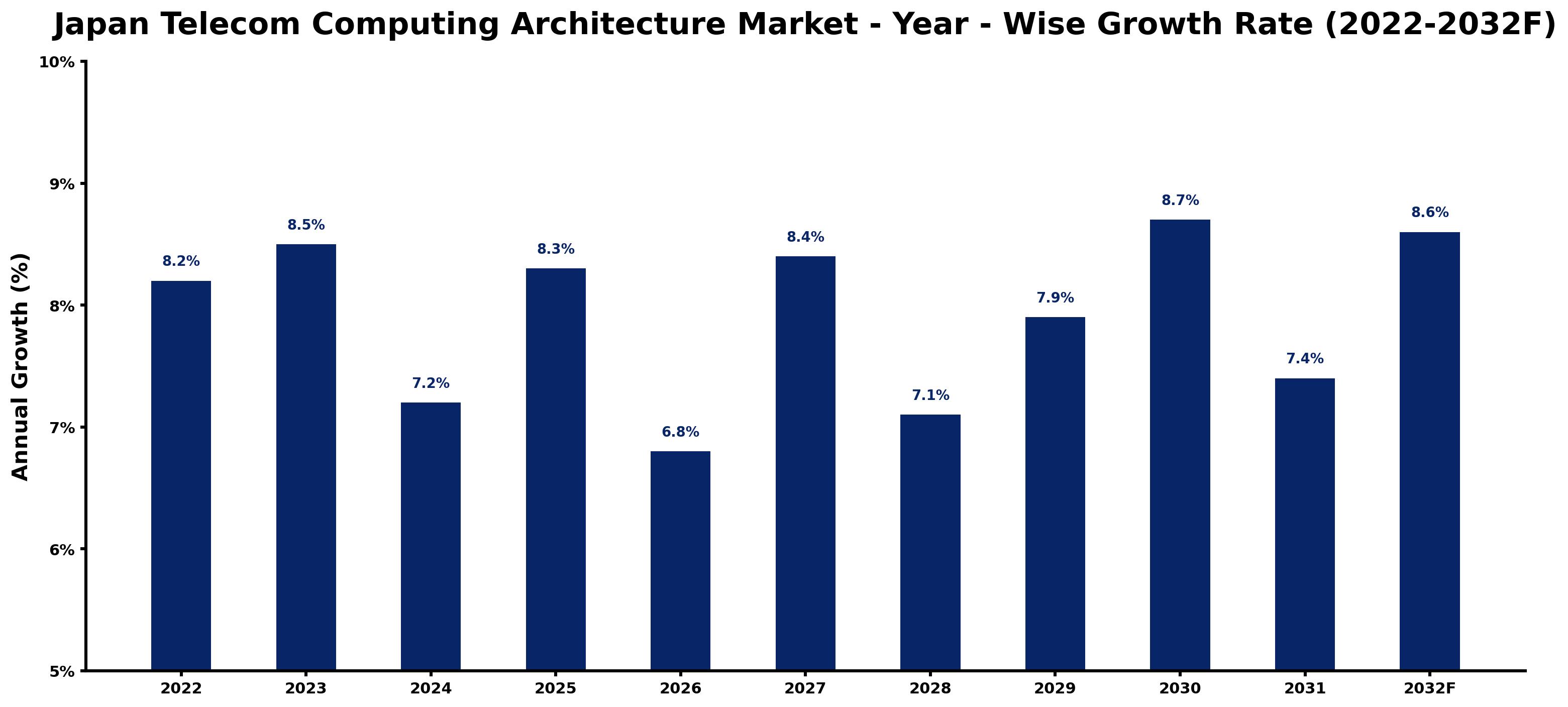
Annual growth estimates for each year appear below with the principal reason behind them, explaining the shifts that set the pace of the market.
| Year | Estimated Annual Growth (%) | Market Rationale |
| 2022 | 8.2 | The market experienced steady growth due to ongoing telecom infrastructure projects. |
| 2023 | 8.5 | Growth accelerated as 5G subscriptions surpassed 20 million, driving demand for advanced systems. |
| 2024 | 7.2 | The market adjusted to earlier rapid expansions and increased competition, leading to slower growth. |
| 2025 | 8.3 | Demand surged again with continued investments in 5G deployment and infrastructure upgrades. |
| 2026 | 6.8 | Growth is expected to slow as the market stabilises after the previous year's surge in demand. |
| 2027 | 8.4 | Increased investments in NFV infrastructure for service delivery will drive market recovery. |
| 2028 | 7.1 | Growth is anticipated to slow again as market saturation begins to impact new investments. |
| 2029 | 7.9 | Telecom operators will focus on improving edge computing capabilities, boosting demand. |
| 2030 | 8.7 | The market is projected to peak with a surge in demand for AdvancedTCA systems. |
| 2031 | 7.4 | Growth is expected to slow as operators consolidate their investments and focus on efficiency. |
| 2032 | 8.6 | Renewed interest in telecom architectures for urban smart solutions will drive market growth. |
Note: Market size estimations and growth projections presented in this report are based on 6Wresearch's proprietary forecasting methodology, utilizing the latest available industry data, government publications, and primary research inputs.
Japan Telecom Computing Architecture Market Synopsis
Telecom Computing Architecture includes systems that support telecommunications operations, primarily through advanced engineering of hardware and software components. The Japan Telecom Computing Architecture Market is expanding, driven by investments in 5G networks and urban infrastructure projects. This market is expected to reach 1.5 trillion yen by 2025, with ongoing demand from 5G deployment firms and telecom cloud operators driving the need for advanced architectures. The integration of edge computing solutions further supports this growth, improving data processing capabilities in urban areas.
Market Dynamics Impact Analysis (2026–2032)
| Factor | Type | Impact | Primary Segment Affected |
| Increasing investments in 5G infrastructure and services drive demand for telecom computing architecture. | Driver | High | 5G Deployment Firms |
| The rise of edge computing solutions creates opportunities for telecom architecture providers. | Opportunity | High | Edge Computing Platforms |
| Regulatory challenges in telecom standards may hinder rapid deployment of new technologies. | Restraint | Medium | NFV Infrastructure |
| The complexity of integrating new systems can slow down adoption rates among telecom operators. | Challenge | High | Telecom Cloud Operators |
| Growing demand for network functions virtualization enhances the need for advanced telecom architectures. | Driver | High | NFV Infrastructure |
| The increasing number of telecom cloud operators presents opportunities for modular solutions. | Opportunity | Medium | Modular Chassis |
| Strict compliance with the Telecommunications Business Act may limit operational flexibility. | Restraint | Medium | Core Network Providers |
| High competition among telecom architecture providers can lead to pricing pressures. | Challenge | Medium | System Integrators |
Evaluation of Drivers in Japan Telecom Computing Architecture Market (2026–2032)
Demand rests on the following drivers, each shown with the segment it touches most.
| Drivers | Primary Segment Affected | Why It Matters (Evidence) |
| Investment in 5G infrastructure | 5G Deployment Firms | This investment is projected to reach 1.5 trillion yen by 2025, driving demand for advanced telecom architectures. |
| Adoption of edge computing solutions | Edge Computing Platforms | Urban areas are deploying edge computing platforms to support smart city applications, improving local services. |
| Growth of telecom cloud operators | Telecom Cloud Operators | The number of telecom cloud operators increased by 15% last year, indicating rising demand for cloud-based solutions. |
| Network functions virtualization adoption | NFV Infrastructure | Telecom operators are investing heavily in NFV infrastructure to improve service delivery efficiency and reduce costs. |
| Increased demand for AdvancedTCA systems | AdvancedTCA | AdvancedTCA systems are widely used in core network operations, boosting capacity and performance across Japan. |
Most of the extra volume comes from investments in 5G infrastructure, projected to reach 1.5 trillion yen by 2025. Telecom operators are increasingly adopting edge computing solutions, which support smart city applications and reduce latency. The number of telecom cloud operators has risen by 15% in the past year, reflecting a growing need for cloud-based services. Operators are making substantial investments in NFV infrastructure to improve service delivery efficiency. AdvancedTCA systems are extensively used in core network operations, improving capacity and performance across Japan's telecom sector.
Evaluation of Restraints in Japan Telecom Computing Architecture Market
Below are the constraints most often cited by buyers and suppliers, with the segment each affects.
| Market Restraint | Primary Segment Affected | Why It Matters (Evidence) |
| Regulatory compliance limits operational flexibility for core network providers. | Core Network Providers | This regulation mandates strict adherence to service standards, impacting deployment timelines. |
| Integration complexity of new systems slows adoption rates among telecom cloud operators. | Telecom Cloud Operators | The need for integration with existing systems can delay implementation. |
| High competition among telecom architecture providers leads to pricing pressures for system integrators. | System Integrators | Increased competition forces providers to lower prices, impacting profitability. |
| Slow adoption of network functions virtualization due to initial investment costs for NFV Infrastructure. | NFV Infrastructure | The upfront costs associated with NFV can deter smaller operators from transitioning. |
| Limited availability of skilled professionals hinders deployment of advanced solutions in edge computing platforms. | Edge Computing Platforms | The shortage of qualified personnel can delay the implementation of new technologies. |
Japan Telecom Computing Architecture Market Challenges
Producers face a skills shortage in telecom engineering, as educational institutions struggle to meet the demand for advanced technical training, resulting in project delays of up to six months for operators. Buyers incur higher costs due to increased competition for telecom solutions, with prices inflating by as much as 20%, which strains budgets and limits investment in new technologies. Competition intensifies as new entrants disrupt the market, forcing established firms to allocate resources to innovation rather than maintenance, which can degrade service quality. Supply chain issues arise from reliance on specific components, causing deployment delays of three to four months for telecom operators.
Trends in the Japan Telecom Computing Architecture Market
Four trends stand out in the Japan Telecom Computing Architecture Market.
- Shift Towards Edge Computing Solutions: Urban areas are increasingly deploying edge computing platforms to reduce latency and improve local services. As of 2023, edge computing deployments are rising, particularly for smart city applications.
- Growing Adoption of NFV Infrastructure: Telecom operators are rapidly implementing network functions virtualization to improve service delivery. This trend is driven by the need for efficient network management, with substantial investments anticipated in the coming years.
- Increased Focus on AdvancedTCA Systems: As demand for high-capacity telecom systems rises, AdvancedTCA systems are becoming the preferred choice for core network operations. This trend is clear in Tokyo, where telecom infrastructure investment is leading the way.
- Expansion of Telecom Cloud Operators: The number of telecom cloud operators is increasing, reflecting the growing demand for cloud-based services. A 15% rise in operators last year highlights the shift towards cloud solutions in telecommunications.
Investment Opportunities in the Japan Telecom Computing Architecture Market
The following areas offer the clearest openings for investors and suppliers in the Japan Telecom Computing Architecture Market.
- Investment in 5G Infrastructure: Tokyo is the leading region for telecom infrastructure investment, with a projected market size of 1.5 trillion yen by 2025. Companies can enter this market by partnering with local telecom operators.
- Growth in Edge Computing Platforms: Urban areas are increasingly deploying edge computing solutions, with a projected CAGR of 10.2%. Suppliers can enter this market by collaborating with system integrators.
- Demand for NFV Infrastructure: The rising need for efficient service delivery creates opportunities in NFV infrastructure. Telecom operators are seeking partners to improve their service capabilities.
- Expansion of Telecom Cloud Services: The increase in telecom cloud operators indicates a growing market for cloud-based telecom services. Entering this market requires establishing partnerships with local providers.
Government Initiatives in the Japan Telecom Computing Architecture Market
The Digital Agency, established in September 2021, leads government digital transformation efforts that benefit telecom architecture providers. The agency promotes common system standards that improve operational efficiency. Additionally, the GX Basic Policy, adopted in 2023, aims for approximately JPY 150 trillion in public-private decarbonisation investment over the next decade, supporting the telecom sector's transition to sustainable technologies.
The Ministry of Internal Affairs and Communications oversees the implementation of the 5G Promotion Strategy, launched in 2022, which encourages investment in telecom infrastructure. This strategy supports telecom operators in deploying advanced systems, enabling them to meet the growing demand for 5G services. The subsidy program for 5G deployment in rural areas, initiated in 2023, further assists operators in expanding their network reach.
Future Insight of the Japan Telecom Computing Architecture Market
By 2032, policy-driven initiatives will transform telecom infrastructure, with strategies like the 5G Promotion Strategy encouraging substantial investment in urban areas. The adoption of edge computing solutions will expand, improving smart city applications and overall service delivery. Telecom operators will increasingly implement NFV infrastructure to streamline service offerings and reduce costs. As a result, the number of 5G subscriptions is expected to exceed 40 million, reflecting a strong demand for advanced communication technologies.
Market Segmentation Analysis
Japan Telecom Computing Architecture Market report covers a detailed analysis of the following market segments:
By Telecom Computing Architecture – NFV Infrastructure Leads, Edge Computing Platforms Expected to Grow Fastest
According to Saurav Kr Singh, Senior Research Analyst at 6Wresearch, NFV Infrastructure took 48% of telecom computing architecture revenue in 2025, more than any other category. NFV Infrastructure holds the largest share as it is crucial for supporting network functions virtualization, which optimises service delivery for telecom operators. The strong demand for efficient operations, particularly in urban regions, reinforces its leading position in Japan's telecom market. The quickest growth will come from Edge Computing Platforms, forecast to expand at a CAGR of 10.2% between 2026 and 2032. Edge Computing Platforms are experiencing rapid growth due to their capability to process data closer to end-users, which significantly reduces latency. The increasing deployment of these platforms in urban smart city initiatives is a key factor propelling this segment forward. Suppliers should focus on integrating NFV and edge computing solutions to meet the demands of telecom operators.
By Product Type – Modular Chassis Leads, Virtualized Servers Expected to Grow Fastest
In 2025, Modular Chassis led the product type split with a 52% share. Modular Chassis leads the market because it is essential for housing telecom hardware in a scalable manner, enabling operators to efficiently expand their infrastructure. The complexity of modern telecom systems necessitates robust and adaptable housing solutions, solidifying its dominance. Virtualized Servers are set to record the highest CAGR in this split, 11.0% over 2026–2032. Virtualized Servers are witnessing the fastest growth as they are critical for hosting virtualised telecom services and applications, which are increasingly sought after. The shift towards cloud-based operations among telecom providers is driving this segment's rapid expansion. Buyers should invest in virtualised server solutions to enhance operational efficiency and adaptability in a competitive market.
By Architecture Type – AdvancedTCA Leads and Records the Fastest Growth
AdvancedTCA held 39% of the Japan Telecom Computing Architecture Market by architecture type in 2025. AdvancedTCA is the leading architecture type due to its widespread adoption for high-capacity telecom systems, ensuring reliability and performance. Its established presence in core network operations across Japan solidifies its market position. The same category is also set to grow fastest, at a CAGR of 11.2% during 2026–2032. AdvancedTCA is also the fastest-growing segment, as its capabilities align with the increasing demand for high-performance telecom solutions. The ongoing expansion of 5G networks will likely further accelerate its adoption. Suppliers should prioritise advancements in AdvancedTCA technologies to capitalise on the growing demand for high-capacity systems.
By Distribution Channel – OEMs Lead, System Integrators Expected to Grow Fastest
OEMs accounted for 48% of the market by distribution channel in 2025. OEMs dominate the distribution channel as they play a pivotal role in manufacturing essential telecom architecture components. Their established relationships with telecom operators ensure a steady supply of necessary equipment, reinforcing their leading position. System Integrators are projected to grow fastest, at a CAGR of 10.3% during 2026–2032. System Integrators are the fastest-growing channel, as they are vital for integrating various components into cohesive systems. The increasing complexity of telecom solutions necessitates their expertise, driving their rapid growth. Suppliers must strengthen collaborations with system integrators to ensure effective integration of their products into telecom solutions.
By End User Industry – 5G Deployment Firms Lead, Telecom Cloud Operators Expected to Grow Fastest
With 42% of end user industry revenue in 2025, 5G Deployment Firms was the largest category. 5G Deployment Firms lead the end-user industry because they are directly involved in implementing telecom architectures for 5G, a primary focus for Japan's telecom sector. Their commitment to advanced infrastructure solutions drives the demand for telecom computing architecture. The quickest growth will come from Telecom Cloud Operators, forecast to expand at a CAGR of 10.5% between 2026 and 2032. Telecom Cloud Operators represent the fastest-growing segment, utilising telecom architecture for cloud-based services that are increasingly in demand. The surge in cloud adoption among enterprises is a significant driver of this growth. Buyers should align their strategies with the needs of telecom cloud operators to capitalise on the shift towards cloud-based telecom services.
Key Attractiveness of the Report
- 10 Years of Market Numbers
- Historical Data Starting from 2022 to 2025
- Base Year 2025
- Forecast Data until 2032
- Key Performance Indicators Impacting the Market
- Major Upcoming Developments and Projects
Key Highlights of the Report:
- Japan Telecom Computing Architecture Market Outlook
- Market Size of Japan Telecom Computing Architecture Market, 2025
- Forecast of Japan Telecom Computing Architecture Market, 2032
- Historical Data and Forecast of Japan Telecom Computing Architecture Revenues & Volume for the Period 2022-2032F
- Japan Telecom Computing Architecture Market Trend Evolution
- Japan Telecom Computing Architecture Market Drivers and Challenges
- Japan Telecom Computing Architecture Price Trends
- Japan Telecom Computing Architecture Porter's Five Forces
- Japan Telecom Computing Architecture Industry Life Cycle
- Historical Data and Forecast of Japan Telecom Computing Architecture Market Revenues & Volume By Telecom Computing Architecture for the Period 2022-2032F
- Historical Data and Forecast of Japan Telecom Computing Architecture Market Revenues & Volume By ATCA Systems for the Period 2022-2032F
- Historical Data and Forecast of Japan Telecom Computing Architecture Market Revenues & Volume By MicroTCA Platforms for the Period 2022-2032F
- Historical Data and Forecast of Japan Telecom Computing Architecture Market Revenues & Volume By NFV Infrastructure for the Period 2022-2032F
- Historical Data and Forecast of Japan Telecom Computing Architecture Market Revenues & Volume By Edge Computing Platforms for the Period 2022-2032F
- Historical Data and Forecast of Japan Telecom Computing Architecture Market Revenues & Volume By Product Type for the Period 2022-2032F
- Historical Data and Forecast of Japan Telecom Computing Architecture Market Revenues & Volume By Modular Chassis for the Period 2022-2032F
- Historical Data and Forecast of Japan Telecom Computing Architecture Market Revenues & Volume By Compact Systems for the Period 2022-2032F
- Historical Data and Forecast of Japan Telecom Computing Architecture Market Revenues & Volume By Virtualized Servers for the Period 2022-2032F
- Historical Data and Forecast of Japan Telecom Computing Architecture Market Revenues & Volume By Edge Servers for the Period 2022-2032F
- Historical Data and Forecast of Japan Telecom Computing Architecture Market Revenues & Volume By Architecture Type for the Period 2022-2032F
- Historical Data and Forecast of Japan Telecom Computing Architecture Market Revenues & Volume By AdvancedTCA for the Period 2022-2032F
- Historical Data and Forecast of Japan Telecom Computing Architecture Market Revenues & Volume By MicroTCA for the Period 2022-2032F
- Historical Data and Forecast of Japan Telecom Computing Architecture Market Revenues & Volume By x86/ARM for the Period 2022-2032F
- Historical Data and Forecast of Japan Telecom Computing Architecture Market Revenues & Volume By SD-WAN Based for the Period 2022-2032F
- Historical Data and Forecast of Japan Telecom Computing Architecture Market Revenues & Volume By Distribution Channel for the Period 2022-2032F
- Historical Data and Forecast of Japan Telecom Computing Architecture Market Revenues & Volume By OEMs for the Period 2022-2032F
- Historical Data and Forecast of Japan Telecom Computing Architecture Market Revenues & Volume By System Integrators for the Period 2022-2032F
- Historical Data and Forecast of Japan Telecom Computing Architecture Market Revenues & Volume By Cloud Providers for the Period 2022-2032F
- Historical Data and Forecast of Japan Telecom Computing Architecture Market Revenues & Volume By Direct Sales for the Period 2022-2032F
- Historical Data and Forecast of Japan Telecom Computing Architecture Market Revenues & Volume By End User Industry for the Period 2022-2032F
- Historical Data and Forecast of Japan Telecom Computing Architecture Market Revenues & Volume By Core Network Providers for the Period 2022-2032F
- Historical Data and Forecast of Japan Telecom Computing Architecture Market Revenues & Volume By 5G Deployment Firms for the Period 2022-2032F
- Historical Data and Forecast of Japan Telecom Computing Architecture Market Revenues & Volume By Telecom Cloud Operators for the Period 2022-2032F
- Historical Data and Forecast of Japan Telecom Computing Architecture Market Revenues & Volume By Edge Service Providers for the Period 2022-2032F
- Japan Telecom Computing Architecture Import Export Trade Statistics
- Market Opportunity Assessment By Telecom Computing Architecture
- Market Opportunity Assessment By Product Type
- Market Opportunity Assessment By Architecture Type
- Market Opportunity Assessment By Distribution Channel
- Market Opportunity Assessment By End User Industry
- Japan Telecom Computing Architecture Top Companies Market Share
- Japan Telecom Computing Architecture Competitive Benchmarking By Technical and Operational Parameters
- Japan Telecom Computing Architecture Company Profiles
- Japan Telecom Computing Architecture Key Strategic Recommendations
Market Covered
The following segment groups are covered in the report.
By Telecom Computing Architecture
- ATCA Systems
- MicroTCA Platforms
- NFV Infrastructure
- Edge Computing Platforms
By Product Type
- Modular Chassis
- Compact Systems
- Virtualized Servers
- Edge Servers
By Architecture Type
- AdvancedTCA
- MicroTCA
- x86/ARM
- SD-WAN Based
By Distribution Channel
- OEMs
- System Integrators
- Cloud Providers
- Direct Sales
By End User Industry
- Core Network Providers
- 5G Deployment Firms
- Telecom Cloud Operators
- Edge Service Providers































