Japan Telecom Cybersecurity Market Size & Growth Rate
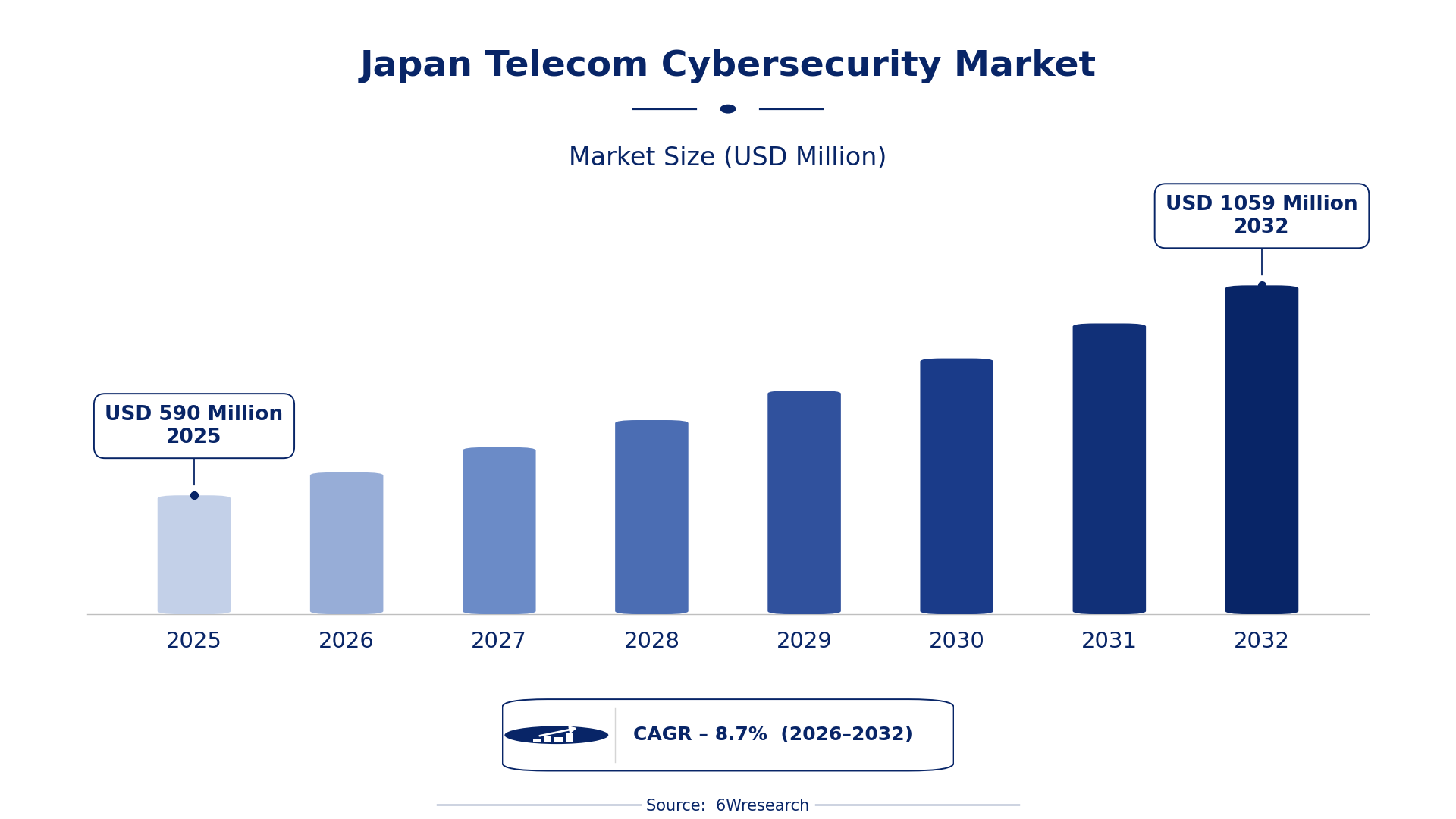
According to 6Wresearch internal database and industry insights, the Japan Telecom Cybersecurity Market was valued at USD 590 Million in 2025 and is projected to reach USD 1,059 Million by 2032, growing at a CAGR of approximately 8.7% during 2026–2032.
Japan Telecom Cybersecurity Market Highlights
| Report Metric | Details |
| Report Name | Japan Telecom Cybersecurity Market (2026-2032) |
| Market Size 2025 | USD 590 Million |
| Market Size 2032 | USD 1,059 Million |
| Absolute Growth 2025–2032 | USD 469 Million |
| CAGR 2026–2032 | 8.7% |
| Peak Annual Growth | 10.3% in 2026 |
| Forecast Period | 2026–2032 |
| Historical Data | 2022–2025 |
| Base Year | 2025 |
| Leading Telecom Cybersecurity Type, 2025 | Network Firewalls (40% share) |
| Leading Product Type, 2025 | NGFW/UTM Devices (43% share) |
| Leading Security Layer, 2025 | Network (38% share) |
| Leading Distribution Channel, 2025 | Security Vendors (40% share) |
| Leading End User Industry, 2025 | ISPs (39% share) |
| Fastest-Growing Telecom Cybersecurity Type | DDoS Protection Tools (11.6% CAGR) |
| Fastest-Growing Product Type | IAM Solutions (11.8% CAGR) |
| Fastest-Growing Security Layer | Application (10.8% CAGR) |
| Fastest-Growing Distribution Channel | SaaS Providers (11.0% CAGR) |
| Growing Sector | ISPs |
| Key End Users | ISPs, Mobile Carriers, Telco Enterprises, Internet Gateways |
Japan Telecom Cybersecurity Market Year-wise Growth Rate and Key Drivers (2022–2032)
This graph illustrates the annual growth rates of the market from 2022 to 2032, highlighting a steady upward trajectory and projected market expansion over the forecast period.
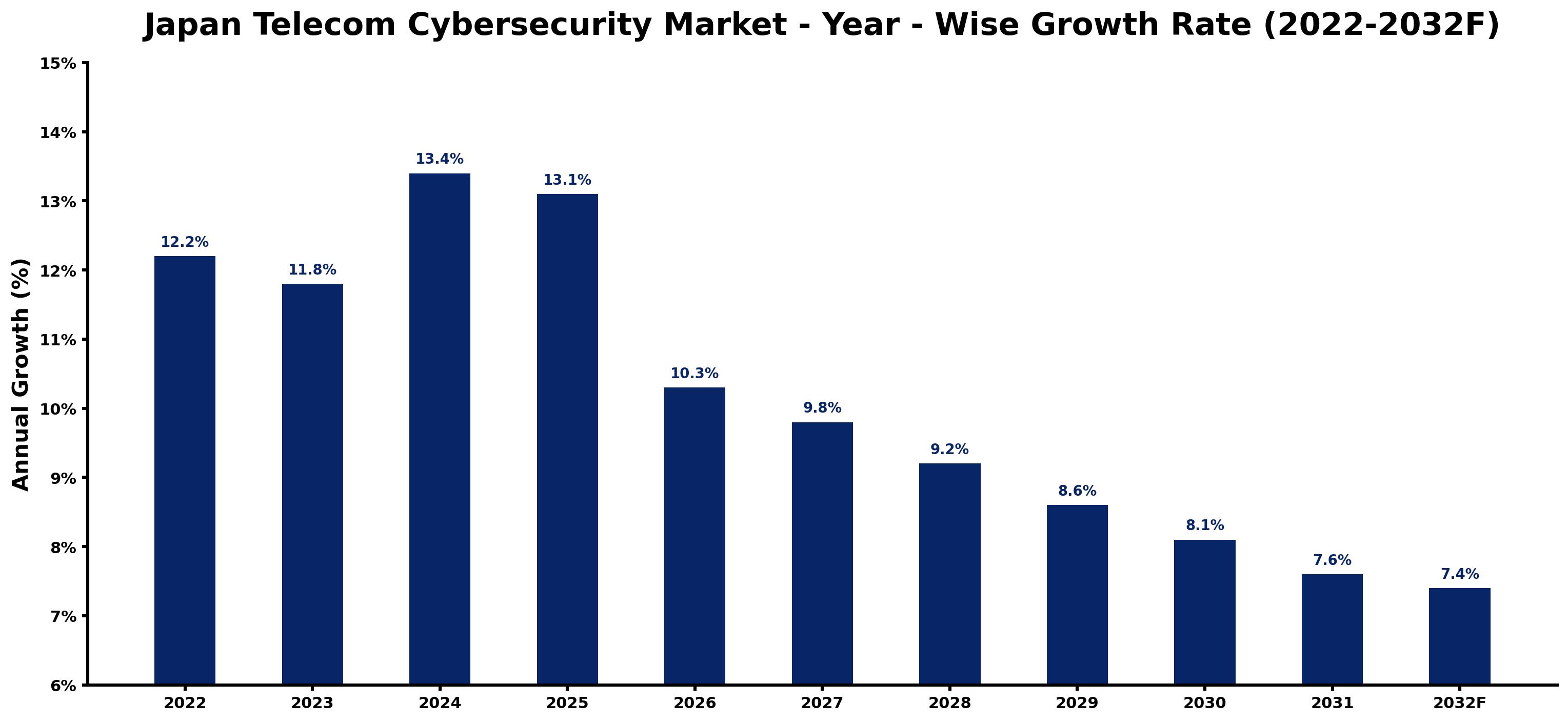
The following figures match every annual growth estimate with the main market development of that year, giving the reasoning behind each rise or slowdown.
| Year | Estimated Annual Growth (%) | Market Rationale |
| 2022 | 12.2 | The telecom sector showed strong demand for cybersecurity solutions amid rising incidents. |
| 2023 | 11.8 | Growth slowed slightly as companies adjusted to new cybersecurity standards and practices. |
| 2024 | 13.4 | Increased investments in security infrastructure led to faster growth in the telecom cybersecurity market. |
| 2025 | 13.1 | Demand continued to rise as mobile subscribers increased, driving the need for security. |
| 2026 | 10.3 | Investment in advanced cybersecurity technologies is expected to sustain growth in the coming years. |
| 2027 | 9.8 | The market is projected to grow steadily as more telecom companies adopt effective security measures. |
| 2028 | 9.2 | Growth is anticipated to continue as the number of cybersecurity incidents remains high. |
| 2029 | 8.6 | The demand for cybersecurity solutions will persist as awareness of threats increases among users. |
| 2030 | 8.1 | Investments in innovative security technologies are projected to support ongoing market growth. |
| 2031 | 7.6 | The adoption of new cybersecurity frameworks is expected to drive demand further in the sector. |
| 2032 | 7.4 | Continued focus on protecting user data will sustain growth in the telecom cybersecurity market. |
Note: Market size estimations and growth projections presented in this report are based on 6Wresearch's proprietary forecasting methodology, utilizing the latest available industry data, government publications, and primary research inputs.
Japan Telecom Cybersecurity Market Synopsis
Telecom cybersecurity involves technologies and practices designed to protect telecommunications networks from cyber threats. The Japan Telecom Cybersecurity Market is valued at approximately ¥10 trillion, driven by over 160 million mobile subscribers. Rising incidents of cyber-attacks, including a 30% increase in DDoS attacks in 2022, highlight the urgent need for effective cybersecurity measures. Ongoing investments in security infrastructure are creating new demand for solutions that ensure data integrity and user privacy, positioning the market for sustained growth.
Market Dynamics Impact Analysis (2026–2032)
| Factor | Type | Impact | Primary Segment Affected |
| Increased investments in cybersecurity technologies | Driver | High | Network Firewalls |
| Growing number of mobile subscribers demanding secure services | Driver | High | DDoS Protection Tools |
| Rising incidents of cyber threats creating demand for protective measures | Opportunity | High | Identity Management Systems |
| Expansion of telecom infrastructure requiring enhanced security solutions | Opportunity | Medium | SIEM Systems |
| High costs associated with data breaches affecting budgets | Restraint | High | NGFW/UTM Devices |
| Limited availability of skilled cybersecurity professionals in the market | Restraint | Medium | IAM Solutions |
| The complexity of integrating new security technologies into existing systems | Challenge | High | Threat Mitigation |
| Regulatory compliance requirements increasing operational costs | Challenge | Medium | Analytics Platforms |
Evaluation of Drivers in Japan Telecom Cybersecurity Market (2026–2032)
Below are the drivers that matter most for revenue growth, with supporting evidence.
| Drivers | Primary Segment Affected | Why It Matters (Evidence) |
| Investment in advanced security technologies | Network Firewalls | This investment is driven by the need to protect network perimeters from unauthorized access, with the telecom sector valued at approximately ¥10 trillion. |
| Growing mobile subscriber base | DDoS Protection Tools | The increase in mobile users necessitates protection against DDoS attacks, with over 160 million subscribers in Japan. |
| Rising cyber threats and incidents | Identity Management Systems | With over 10,000 cybersecurity incidents reported in 2023, demand for identity management solutions is surging. |
| Expansion of telecom infrastructure | SIEM Systems | As telecom networks expand, the need for real-time security analysis becomes critical to ensure service availability. |
| Adoption of cybersecurity standards | NGFW/UTM Devices | The implementation of ISO/IEC 27001 among telecom companies drives demand for integrated security solutions. |
A broader customer base accounts for much of the growth, as investments in advanced security technologies rise in response to escalating cyber threats. The telecom sector, valued at around ¥10 trillion, is experiencing a notable increase in mobile subscribers, surpassing 160 million. This growth necessitates strong protection against cyber threats, with reported attack incidents climbing sharply. The expansion of telecom infrastructure creates a pressing need for real-time security analysis through advanced systems, further propelling the market. The adoption of international security standards is also stimulating demand for thorough solutions, enabling telecom operators to effectively secure their networks.
Evaluation of Restraints in Japan Telecom Cybersecurity Market
These are the pressures that could keep growth below its potential.
| Market Restraint | Primary Segment Affected | Why It Matters (Evidence) |
| High costs associated with data breaches | NGFW/UTM Devices | The average cost of a data breach in Japan is estimated at ¥100 million, straining budgets for cybersecurity investments. |
| Limited availability of skilled cybersecurity professionals | IAM Solutions | The projected number of cybersecurity professionals in Japan is expected to reach 500,000 by 2025, highlighting a skills gap. |
| Complexity of integrating new security technologies | Threat Mitigation | Integrating advanced threat mitigation solutions into existing telecom systems can lead to delays and increased costs. |
| Regulatory compliance requirements increasing operational costs | Analytics Platforms | Compliance with the Telecommunications Business Act adds financial burdens for telecom companies. |
| Fragmented cybersecurity solutions leading to inefficiencies | DDoS Protection Tools | The lack of unified solutions can complicate incident response and increase vulnerability to attacks. |
Japan Telecom Cybersecurity Market Challenges
Japan's telecom cybersecurity market faces a critical technology gap, as many producers struggle to implement advanced security solutions, which exposes networks to increased risks of cyber attacks. Buyers experience rising costs, with the average data breach estimated at ¥100 million, putting financial pressure on smaller firms. Supply chain disruptions occur due to a shortage of cybersecurity professionals, with projections indicating only 500,000 will be available by 2025, limiting firms' ability to manage threats effectively. Skills shortages persist, as the demand for trained personnel exceeds supply, causing delays in project timelines for telecom operators and increasing dependence on external consultants.
Trends in the Japan Telecom Cybersecurity Market
Buyers and suppliers in the Japan Telecom Cybersecurity Market are adjusting to the following trends.
- Shift towards Integrated Security Solutions: The adoption of NGFW/UTM devices is on the rise as telecom companies pursue unified security measures. In 2023, the Tokyo region experienced substantial investments in integrated security systems, reflecting a growing trend towards comprehensive protection.
- Rise of Cloud-Based Security Services: The demand for SaaS providers is increasing, with a projected CAGR of 11.0% as companies seek scalable security solutions. This trend is evident in the rising number of telecom firms embracing cloud-based services for enhanced flexibility.
- Focus on Cybersecurity Awareness Campaigns: In 2023, the Tokyo Metropolitan Government initiated a cybersecurity awareness campaign to inform users about potential threats. This effort aims to reduce incidents and promote best practices among telecom users, improving overall security.
- Emergence of Advanced Threat Detection Technologies: Japan's Cybersecurity Strategy aims to bolster national security by 2025, leading to the development of advanced threat detection technologies. This strategic focus will drive investment in effective security solutions.
Investment Opportunities in the Japan Telecom Cybersecurity Market
The following opportunities in the Japan Telecom Cybersecurity Market pair current demand with a clear way in.
- Partnerships with Local Cybersecurity Firms: Forming joint ventures with local cybersecurity firms can facilitate market entry. The government allocated ¥20 billion for cybersecurity initiatives in 2023, creating avenues for collaboration.
- Investment in Cybersecurity Training Programs: With the projected number of cybersecurity professionals expected to reach 500,000 by 2025, a noticeable skills gap exists. Investing in training can address this shortage and meet market demand effectively.
- Supply of Advanced Threat Mitigation Tools: The rising incidents of DDoS attacks generate demand for advanced threat mitigation tools. Telecom companies can capitalise on this by providing innovative solutions to meet this growing need.
- Expansion of Cybersecurity Research Facilities: The Tokyo region serves as a major hub for telecom cybersecurity investments, offering opportunities for establishing research facilities. This can stimulate innovation and attract talent to the sector.
Government Initiatives in the Japan Telecom Cybersecurity Market
The Digital Agency, established in September 2021, spearheads government digital transformation efforts, setting standards for cybersecurity. This agency's initiatives complement existing regulations like the Telecommunications Business Act, ensuring a unified framework for telecom cybersecurity. The government allocated ¥20 billion for cybersecurity initiatives in 2023, strengthening support for the sector.
The National Institute of Information and Communications Technology (NICT) promotes cybersecurity research and development. It funds various projects aimed at enhancing the cybersecurity infrastructure across Japan, supporting the telecom sector's growth and ensuring compliance with national standards.
Future Insight of the Japan Telecom Cybersecurity Market
The rise of next-generation firewall devices will reshape demand by 2032, as these technologies offer robust protection against evolving cyber threats. Government funding of ¥20 billion for cybersecurity initiatives in 2023 will fortify security infrastructure across the sector. The adoption of ISO/IEC 27001 standards will encourage telecom companies to implement stringent information security management practices. Increased collaboration among industry stakeholders will lead to the development of more effective solutions, benefiting both telecom operators and end-users.
Market Segmentation Analysis
Japan Telecom Cybersecurity Market report covers a detailed analysis of the following market segments:
By Telecom Cybersecurity Type – Network Firewalls Lead, DDoS Protection Tools Expected to Grow Fastest
According to Saurav Kr Singh, Senior Research Analyst at 6Wresearch, in 2025, Network Firewalls led the telecom cybersecurity type split with a 40% share. Network firewalls play a crucial role in safeguarding network perimeters from unauthorised access, making them indispensable in Japan's telecom landscape. Their importance is underscored by the significant demand from urban centres like Tokyo, where cyber threats are prevalent. Over 2026–2032, DDoS Protection Tools are expected to post the fastest growth, at a CAGR of 11.6%. The surge in DDoS attacks, which increased by 30% in 2022, has created an urgent need for DDoS protection tools. This growing concern among organisations to secure their networks will lead to rapid market expansion for these solutions. Suppliers should focus on developing advanced DDoS protection tools to meet the escalating demand.
By Product Type – NGFW/UTM Devices Lead, IAM Solutions Expected to Grow Fastest
NGFW/UTM Devices held 43% of the Japan Telecom Cybersecurity Market by product type in 2025. NGFW/UTM devices are integral for advanced threat protection and network security, making them the preferred choice among telecom operators in Japan. Their ability to consolidate multiple security functions into a single device has driven widespread adoption across the sector. IAM Solutions are projected to grow fastest, at a CAGR of 11.8% during 2026–2032. The increasing need for secure access to telecom services has propelled the growth of IAM solutions, as organisations prioritise user authentication and access control. This trend is expected to continue as cybersecurity threats evolve. Buyers will benefit from investing in IAM solutions to strengthen their security posture.
By Security Layer – Network Leads, Application Expected to Grow Fastest
With 38% of security layer revenue in 2025, Network was the largest category. The network layer is essential for securing telecom infrastructure, serving as the first line of defence against various cyber threats. Its critical function in maintaining service availability and data integrity makes it a priority for telecom operators in Japan. Application is set to record the highest CAGR in this split, 10.8% over 2026–2032. Application security is becoming increasingly important as organisations recognise the need to address application-level vulnerabilities. The rise in sophisticated cyber attacks is expected to accelerate the focus on securing applications. Suppliers should enhance their application security offerings to take advantage of this growing market.
By Distribution Channel – Security Vendors Lead, SaaS Providers Expected to Grow Fastest
Security Vendors accounted for 40% of the market by distribution channel in 2025. Security vendors serve as the primary source for acquiring cybersecurity solutions, providing vital products and services to telecom operators throughout Japan. Their established industry relationships and expertise make them a trusted choice for companies seeking effective security measures. The quickest growth will come from SaaS Providers, forecast to expand at a CAGR of 11.0% between 2026 and 2032. SaaS providers are experiencing rapid growth as they deliver cloud-based security solutions that cater to the flexibility and scalability needs of modern telecom businesses. This trend is likely to continue as more organisations shift to cloud environments. Suppliers should consider forming partnerships with SaaS providers to expand their market reach.
By End User Industry – ISPs Lead and Record the Fastest Growth
The largest end user industry category in 2025 was ISPs, at 39% of revenue. ISPs are the leading users of telecom cybersecurity solutions, driven by the necessity to protect extensive networks and secure customer data. Their significant investments in security infrastructure highlight their pivotal role in Japan's telecom sector. The same category are also set to grow fastest, at a CAGR of 11.3% during 2026–2032. ISPs are also the fastest-growing segment, propelled by rising cyber threats and regulatory demands for enhanced security measures. Their ongoing dedication to cybersecurity will likely drive further growth in this area. Suppliers must align their offerings with the evolving needs of ISPs to remain competitive.
Key Attractiveness of the Report
- 10 Years of Market Numbers
- Historical Data Starting from 2022 to 2025
- Base Year 2025
- Forecast Data until 2032
- Key Performance Indicators Impacting the Market
- Major Upcoming Developments and Projects
Key Highlights of the Report:
- Japan Telecom Cybersecurity Market Outlook
- Market Size of Japan Telecom Cybersecurity Market, 2025
- Forecast of Japan Telecom Cybersecurity Market, 2032
- Historical Data and Forecast of Japan Telecom Cybersecurity Revenues & Volume for the Period 2022-2032F
- Japan Telecom Cybersecurity Market Trend Evolution
- Japan Telecom Cybersecurity Market Drivers and Challenges
- Japan Telecom Cybersecurity Price Trends
- Japan Telecom Cybersecurity Porter's Five Forces
- Japan Telecom Cybersecurity Industry Life Cycle
- Historical Data and Forecast of Japan Telecom Cybersecurity Market Revenues & Volume By Telecom Cybersecurity Type for the Period 2022-2032F
- Historical Data and Forecast of Japan Telecom Cybersecurity Market Revenues & Volume By Network Firewalls for the Period 2022-2032F
- Historical Data and Forecast of Japan Telecom Cybersecurity Market Revenues & Volume By Identity Management Systems for the Period 2022-2032F
- Historical Data and Forecast of Japan Telecom Cybersecurity Market Revenues & Volume By DDoS Protection Tools for the Period 2022-2032F
- Historical Data and Forecast of Japan Telecom Cybersecurity Market Revenues & Volume By SIEM Systems for the Period 2022-2032F
- Historical Data and Forecast of Japan Telecom Cybersecurity Market Revenues & Volume By Product Type for the Period 2022-2032F
- Historical Data and Forecast of Japan Telecom Cybersecurity Market Revenues & Volume By NGFW/UTM Devices for the Period 2022-2032F
- Historical Data and Forecast of Japan Telecom Cybersecurity Market Revenues & Volume By IAM Solutions for the Period 2022-2032F
- Historical Data and Forecast of Japan Telecom Cybersecurity Market Revenues & Volume By Threat Mitigation for the Period 2022-2032F
- Historical Data and Forecast of Japan Telecom Cybersecurity Market Revenues & Volume By Analytics Platforms for the Period 2022-2032F
- Historical Data and Forecast of Japan Telecom Cybersecurity Market Revenues & Volume By Security Layer for the Period 2022-2032F
- Historical Data and Forecast of Japan Telecom Cybersecurity Market Revenues & Volume By Network for the Period 2022-2032F
- Historical Data and Forecast of Japan Telecom Cybersecurity Market Revenues & Volume By Application for the Period 2022-2032F
- Historical Data and Forecast of Japan Telecom Cybersecurity Market Revenues & Volume By Infrastructure for the Period 2022-2032F
- Historical Data and Forecast of Japan Telecom Cybersecurity Market Revenues & Volume By Monitoring for the Period 2022-2032F
- Historical Data and Forecast of Japan Telecom Cybersecurity Market Revenues & Volume By Distribution Channel for the Period 2022-2032F
- Historical Data and Forecast of Japan Telecom Cybersecurity Market Revenues & Volume By Security Vendors for the Period 2022-2032F
- Historical Data and Forecast of Japan Telecom Cybersecurity Market Revenues & Volume By SaaS Providers for the Period 2022-2032F
- Historical Data and Forecast of Japan Telecom Cybersecurity Market Revenues & Volume By Direct Sales for the Period 2022-2032F
- Historical Data and Forecast of Japan Telecom Cybersecurity Market Revenues & Volume By Cloud Integrators for the Period 2022-2032F
- Historical Data and Forecast of Japan Telecom Cybersecurity Market Revenues & Volume By End User Industry for the Period 2022-2032F
- Historical Data and Forecast of Japan Telecom Cybersecurity Market Revenues & Volume By ISPs for the Period 2022-2032F
- Historical Data and Forecast of Japan Telecom Cybersecurity Market Revenues & Volume By Telco Enterprises for the Period 2022-2032F
- Historical Data and Forecast of Japan Telecom Cybersecurity Market Revenues & Volume By Internet Gateways for the Period 2022-2032F
- Historical Data and Forecast of Japan Telecom Cybersecurity Market Revenues & Volume By Mobile Carriers for the Period 2022-2032F
- Japan Telecom Cybersecurity Import Export Trade Statistics
- Market Opportunity Assessment By Telecom Cybersecurity Type
- Market Opportunity Assessment By Product Type
- Market Opportunity Assessment By Security Layer
- Market Opportunity Assessment By Distribution Channel
- Market Opportunity Assessment By End User Industry
- Japan Telecom Cybersecurity Top Companies Market Share
- Japan Telecom Cybersecurity Competitive Benchmarking By Technical and Operational Parameters
- Japan Telecom Cybersecurity Company Profiles
- Japan Telecom Cybersecurity Key Strategic Recommendations
Market Covered
This report examines the market across the segments below.
By Telecom Cybersecurity Type
- Network Firewalls
- Identity Management Systems
- DDoS Protection Tools
- SIEM Systems
By Product Type
- NGFW/UTM Devices
- IAM Solutions
- Threat Mitigation
- Analytics Platforms
By Security Layer
- Network
- Application
- Infrastructure
- Monitoring
By Distribution Channel
- Security Vendors
- SaaS Providers
- Direct Sales
- Cloud Integrators
By End User Industry
- ISPs
- Telco Enterprises
- Internet Gateways
- Mobile Carriers































