Japan Telecom Equipment Upgrade Market Size & Growth Rate
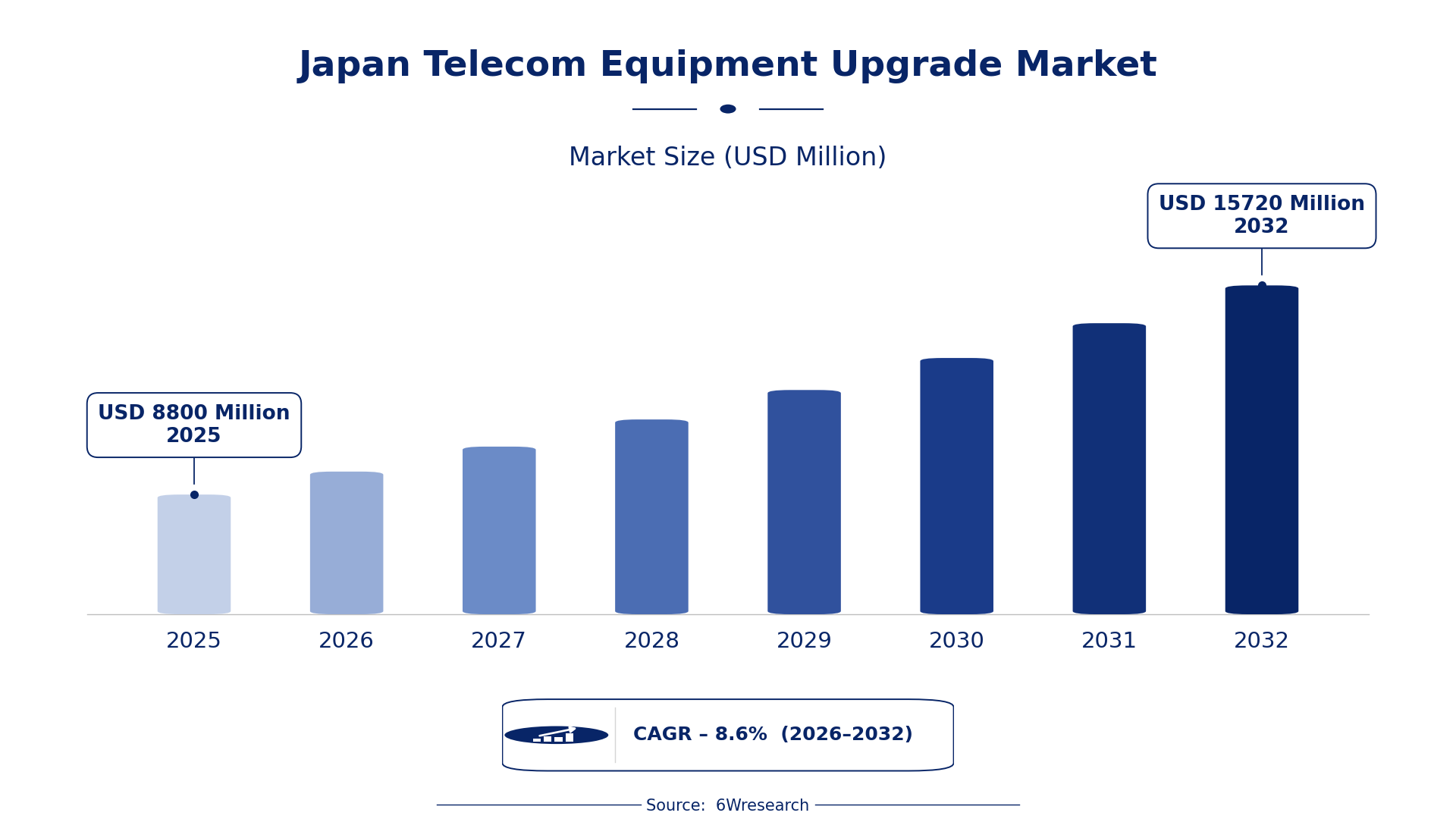
According to 6Wresearch internal database and industry insights, the Japan Telecom Equipment Upgrade Market was valued at USD 8,800 Million in 2025 and is projected to reach USD 15,720 Million by 2032, growing at a CAGR of approximately 8.6% during 2026–2032.
Japan Telecom Equipment Upgrade Market Highlights
| Report Metric | Details |
| Report Name | Japan Telecom Equipment Upgrade Market (2026-2032) |
| Market Size 2025 | USD 8,800 Million |
| Market Size 2032 | USD 15,720 Million |
| Absolute Growth 2025–2032 | USD 6,920 Million |
| CAGR 2026–2032 | 8.6% |
| Peak Annual Growth | 9.2% in 2029 |
| Forecast Period | 2026–2032 |
| Historical Data | 2022–2025 |
| Base Year | 2025 |
| Leading Telecom Equipment Upgrade, 2025 | BTS Hardware Upgrades (41% share) |
| Leading Product Type, 2025 | 4G/5G Antennas (42% share) |
| Leading Upgrade Type, 2025 | RAN Modernization (43% share) |
| Leading Distribution Channel, 2025 | Telecom Suppliers (37% share) |
| Leading End User Industry, 2025 | National Carriers (41% share) |
| Fastest-Growing Telecom Equipment Upgrade | Core Router Upgrades (11.6% CAGR) |
| Fastest-Growing Upgrade Type | Backhaul (12.2% CAGR) |
| Fastest-Growing Distribution Channel | OEM Partnerships (10.3% CAGR) |
| Fastest-Growing End User Industry | Network Operators (10.6% CAGR) |
| Growing Sector | Telecommunications |
| Key End Users | Network Operators, National Carriers, Infrastructure Vendors, Telecom Suppliers |
Japan Telecom Equipment Upgrade Market Year-wise Growth Rate and Key Drivers (2022–2032)
This graph illustrates the annual growth rates of the market from 2022 to 2032, highlighting a steady upward trajectory and projected market expansion over the forecast period.
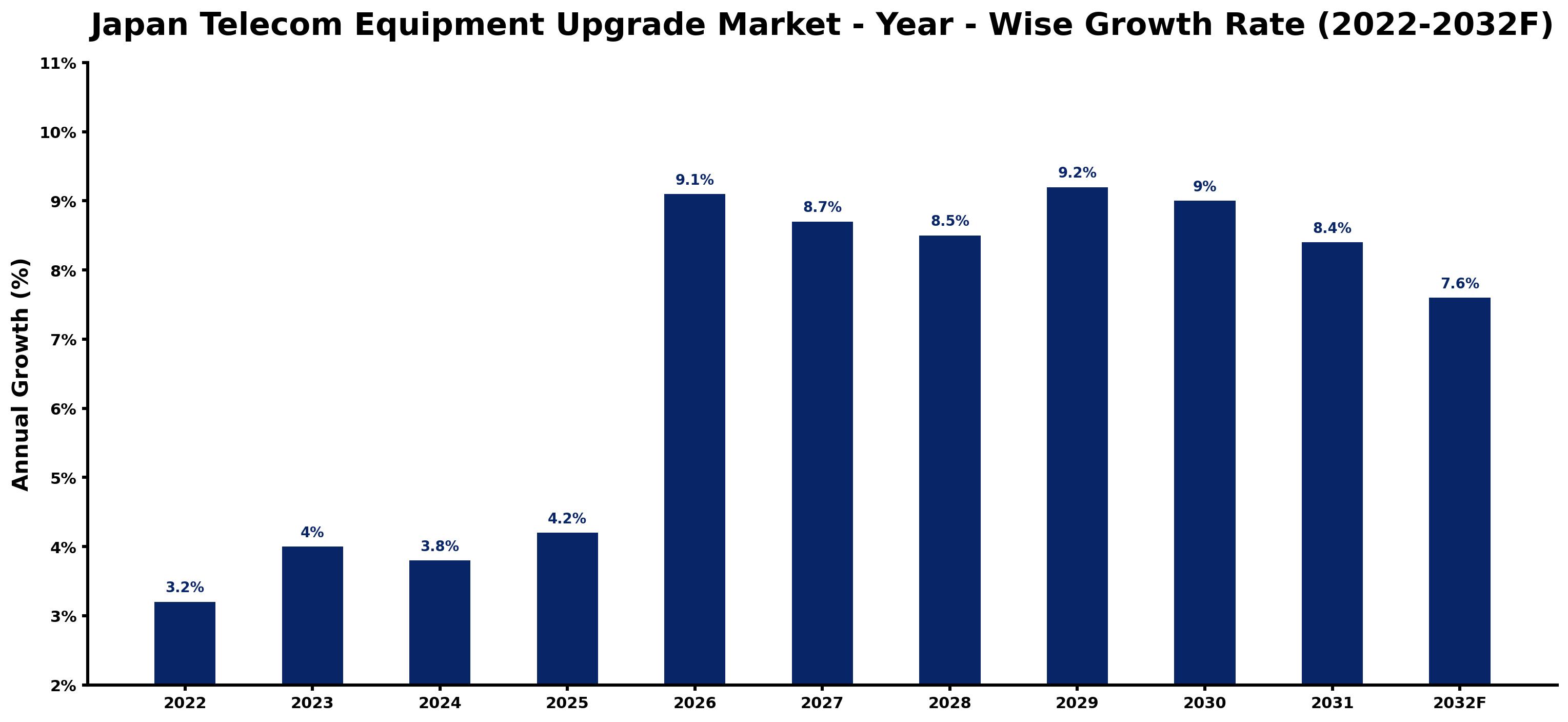
Each row of the following table gives one year's estimated growth and the event or demand shift that explains it.
| Year | Estimated Annual Growth (%) | Market Rationale |
| 2022 | 3.2 | The market experienced steady growth in response to ongoing telecom infrastructure investments. |
| 2023 | 4.0 | Investment in 5G technology surged, driving demand for telecom equipment upgrades. |
| 2024 | 3.8 | Growth slowed as operators adjusted to previous investments and market saturation. |
| 2025 | 4.2 | Telecom operators increased spending on RAN modernization to improve network capabilities. |
| 2026 | 9.1 | A rise in demand for core router upgrades is expected as data traffic increases. |
| 2027 | 8.7 | The market will see a slight slowdown as operators focus on optimizing existing networks. |
| 2028 | 8.5 | Continued investment in optical equipment upgrades is projected to contribute to sustained growth. |
| 2029 | 9.2 | Demand is expected to surge as operators aim for comprehensive 5G coverage across urban areas. |
| 2030 | 9.0 | Growth will moderate as the market approaches saturation in major urban centres. |
| 2031 | 8.4 | The market will continue to grow, driven by ongoing upgrades and new technology adoption. |
| 2032 | 7.6 | A gradual slowdown in growth is expected as the market stabilizes. |
Note: Market size estimations and growth projections presented in this report are based on 6Wresearch's proprietary forecasting methodology, utilizing the latest available industry data, government publications, and primary research inputs.
Japan Telecom Equipment Upgrade Market Synopsis
Telecom equipment upgrades involve improving existing telecommunications infrastructure through advanced technology, including hardware and software enhancements. The Japan Telecom Equipment Upgrade Market is growing due to substantial investments in 5G technology, with over 100 million mobile subscribers driving demand. The projected investment in 5G infrastructure will exceed 3 trillion yen by 2025, as domestic network operators focus on enhancing mobile connectivity and supporting IoT applications.
Market Dynamics Impact Analysis (2026–2032)
| Factor | Type | Impact | Primary Segment Affected |
| Increased investment in 5G infrastructure | Driver | High | RAN Modernization |
| Growing mobile subscriber base | Driver | High | 4G/5G Antennas |
| Demand for enhanced data transmission capabilities | Opportunity | High | Optical Equipment Upgrades |
| Need for improved network reliability in urban areas | Opportunity | High | Core Router Upgrades |
| High costs associated with technology upgrades | Restraint | Medium | BTS Hardware Upgrades |
| Market saturation in urban centres | Restraint | Medium | RAN Modernization |
| Challenges in meeting regulatory requirements | Challenge | High | BTS Hardware Upgrades |
| Competition among telecom operators for market share | Challenge | High | Core Router Upgrades |
Evaluation of Drivers in Japan Telecom Equipment Upgrade Market (2026–2032)
Key forces behind demand, with the segment each one moves most, are listed below.
| Drivers | Primary Segment Affected | Why It Matters (Evidence) |
| Investment in 5G technology | RAN Modernization | 5G infrastructure investment in Japan is projected to exceed 3 trillion yen by 2025, prompting operators to upgrade their networks. |
| Rising mobile data consumption | 4G/5G Antennas | The average data usage per mobile subscriber in Japan is around 10 GB per month, driving demand for improved antenna systems. |
| Expansion of IoT applications | Optical Equipment Upgrades | Telecom equipment upgrades are essential for supporting IoT applications in smart cities, increasing the need for high-speed data transmission. |
| Increased focus on network reliability | Core Router Upgrades | The high density of telecom infrastructure necessitates reliable core routers to manage traffic effectively. |
| Government initiatives for digital infrastructure | BTS Hardware Upgrades | The government allocated 500 billion yen for digital infrastructure improvements by 2025, encouraging telecom operators to upgrade their equipment. |
Buyers are adding capacity as telecom operators invest heavily in 5G technology, projected to exceed 3 trillion yen by 2025. The average data usage per mobile subscriber is around 10 GB per month, leading to increased demand for improved antenna systems. In urban areas, the need for reliable core routers rises due to high infrastructure density. Telecom upgrades support IoT applications in smart cities, further driving demand. Funding for digital infrastructure improvements encourages operators to enhance their systems.
Evaluation of Restraints in Japan Telecom Equipment Upgrade Market
The table below lists the restraints and the evidence behind each.
| Market Restraint | Primary Segment Affected | Why It Matters (Evidence) |
| High costs associated with upgrading technology | BTS Hardware Upgrades | The investment required for hardware upgrades can deter smaller operators from upgrading their infrastructure. |
| Market saturation in urban centres | RAN Modernization | As major urban areas become saturated with telecom infrastructure, growth opportunities diminish for operators. |
| Regulatory compliance challenges | Core Router Upgrades | Operators face complex regulations that can delay upgrade processes and increase costs. |
| Limited availability of skilled technicians | Core Router Upgrades | The shortage of qualified personnel for installation and maintenance can hinder upgrade efforts. |
| Competition driving price pressures | 4G/5G Antennas | Intense competition among telecom operators can lead to reduced margins on equipment upgrades. |
Japan Telecom Equipment Upgrade Market Challenges
Telecom operators face increased costs due to Japan's minimum wage rising to JPY 1,055 per hour, limiting their capacity to invest in infrastructure upgrades. Buyers experience delays in network improvements as evolving regulations require compliance with new standards, potentially extending project timelines by six months. Supply chain disruptions arise from a shortage of advanced technology components, which can postpone projects for operators and hinder service delivery. Regulatory requirements, such as adherence to the Telecommunications Business Law, compel telecom providers to divert funds for compliance, straining their overall budgets.
Trends in the Japan Telecom Equipment Upgrade Market
These developments are changing demand patterns in the Japan Telecom Equipment Upgrade Market.
- Shift towards Improved 5G Coverage: In 2023, Japan launched a national strategy to improve 5G coverage in rural areas, aiming for 100% coverage by 2030. This initiative is expected to increase demand for telecom equipment upgrades, particularly in underserved regions.
- Transition from Legacy Systems to Modern Infrastructure: Since 2022, telecom operators have been transitioning from legacy systems to modern infrastructure, with 50,000 5G base stations established by mid-2023. This shift is driving upgrades in equipment and technology.
- Emergence of IoT-Driven Network Enhancements: The rise of IoT applications has led to increased demand for optical equipment upgrades, with a focus on high-speed data transmission. This trend supports the expansion of smart city initiatives across Japan.
- Prioritisation of Energy Efficiency in Upgrades: Energy-efficient UPS systems are increasingly adopted in telecom facilities, reflecting a broader trend towards sustainability. This shift aligns with the government's GX Basic Policy aimed at decarbonisation.
Investment Opportunities in the Japan Telecom Equipment Upgrade Market
Where to invest in the Japan Telecom Equipment Upgrade Market: the main openings are set out below.
- Partnerships for Improved Infrastructure: Telecom operators can explore joint ventures with infrastructure vendors to improve network capabilities, addressing the projected 3 trillion yen investment gap in 5G technology.
- Investment in Rural Connectivity Solutions: With the government targeting 100% 5G coverage by 2030, opportunities exist for suppliers to provide equipment in rural areas, particularly in regions like Hokkaido.
- Focus on Core Router Upgrades: As data traffic increases, there is a growing need for core router upgrades, particularly among national carriers seeking to improve network efficiency.
- Expansion of Optical Equipment Supply: The demand for optical equipment upgrades is rising, driven by the need for high-speed data transmission. Suppliers can target urban areas like Tokyo for new projects.
Government Initiatives in the Japan Telecom Equipment Upgrade Market
The Industrial Safety and Health Act of 1972 mandates employer responsibilities regarding hazardous substances, impacting telecom equipment producers. The Act on the Rational Use of Energy, established in 1979, requires large energy users to report energy efficiency, influencing telecom operators' operational practices. More recent measures, such as the GX Basic Policy adopted in 2023, aim for substantial public-private investment in decarbonisation, affecting all sectors, including telecommunications.
The Ministry of Internal Affairs and Communications oversees telecom regulations, approving necessary upgrades and ensuring adherence to standards. Funding initiatives, such as the allocation for digital infrastructure improvements, support operators in enhancing their networks.
Future Insight of the Japan Telecom Equipment Upgrade Market
The rollout of new 5G base stations will transform connectivity in Japan by 2030, as the government targets 100% nationwide coverage. By 2025, the commitment to digital infrastructure improvements will see investments surpass 500 billion yen, allowing telecom operators to enhance service delivery and support IoT applications. The national strategy for boosting rural 5G coverage will ensure that underserved areas gain improved connectivity. Adoption of energy-efficient UPS systems will become standard in telecom facilities, providing reliable power supply and contributing to sustainability efforts.
Market Segmentation Analysis
Japan Telecom Equipment Upgrade Market report covers a detailed analysis of the following market segments:
By Telecom Equipment Upgrade – BTS Hardware Upgrades Lead, Core Router Upgrades Expected to Grow Fastest
According to Saurav Kr Singh, Senior Research Analyst at 6Wresearch, with 41% of telecom equipment upgrade revenue in 2025, BTS Hardware Upgrades was the largest category. BTS hardware upgrades hold the largest share as they are crucial for enhancing cellular network capacity and coverage, especially in regions like Tokyo where mobile usage is high. The extensive installed base of over 100 million mobile subscribers necessitates continuous improvements in infrastructure to meet demand. Over 2026–2032, Core Router Upgrades are expected to post the fastest growth, at a CAGR of 11.6%. Core router upgrades are experiencing rapid growth due to their importance in managing the increased data traffic from 5G technology. With over 3 trillion yen projected for 5G infrastructure investment by 2025, this segment's expansion is set to accelerate further. Suppliers should prioritise advanced BTS hardware and core router solutions to capitalise on the increasing demand in the market.
By Product Type – 4G/5G Antennas Lead and Record the Fastest Growth
4G/5G Antennas took 42% of product type revenue in 2025, more than any other category. 4G/5G antennas dominate the market as they are fundamental for expanding and upgrading mobile networks, essential for meeting the needs of over 100 million mobile subscribers. The ongoing investments in 5G infrastructure further solidify their leading position. 4G/5G Antennas are also forecast to expand faster than any other category, at a CAGR of 12.0% over 2026–2032. 4G/5G antennas are also the fastest-growing segment, driven by the increasing data usage of around 10 GB per month per subscriber. As telecom operators modernise their networks to support higher data rates, this segment's growth will continue to accelerate. Buyers should prioritise acquiring 4G/5G antennas to ensure their networks remain competitive and capable of handling future demands.
By Upgrade Type – RAN Modernization Leads, Backhaul Expected to Grow Fastest
RAN Modernization accounted for 43% of the market by upgrade type in 2025. RAN modernization leads the upgrade type segment as it is essential for enhancing radio access networks, which support the growing number of mobile subscribers. The focus on improving connectivity in urban centres like Osaka reinforces RAN modernization's dominant position. Backhaul is projected to grow fastest, at a CAGR of 12.2% during 2026–2032. Backhaul upgrades are the fastest-growing segment, vital for connecting remote sites to the core network and facilitating 5G coverage expansion. The government's goal for 100% 5G coverage by 2030 will significantly propel this segment's growth. Suppliers must invest in backhaul solutions to address the rising demand for connectivity in remote locations.
By Distribution Channel – Telecom Suppliers Lead, OEM Partnerships Expected to Grow Fastest
The largest distribution channel category in 2025 was Telecom Suppliers, at 37% of revenue. Telecom suppliers are the dominant force in the distribution channel segment as they provide essential equipment for upgrades, enabling operators to enhance their infrastructure effectively. Their established connections with national carriers ensure a consistent flow of upgrades in the market. The quickest growth will come from OEM Partnerships, forecast to expand at a CAGR of 10.3% between 2026 and 2032. OEM partnerships are growing rapidly as they provide access to upgraded technology, allowing for quicker implementation of new solutions. As telecom operators modernise their networks, reliance on OEM partnerships is expected to increase. Suppliers should consider OEM partnerships to broaden their market reach and improve their technology offerings.
By End User Industry – National Carriers Lead, Network Operators Expected to Grow Fastest
National Carriers held 41% of the Japan Telecom Equipment Upgrade Market by end user industry in 2025. National carriers are the leading players in the end user industry segment, being the primary users of upgraded telecom equipment. Their substantial investments in 5G infrastructure and network enhancements solidify their dominant role in the market. Over 2026–2032, Network Operators are expected to post the fastest growth, at a CAGR of 10.6%. Network operators represent the fastest-growing segment, increasingly adopting upgraded telecom equipment to cater to the demands of a rising subscriber base. The ongoing transition towards IoT applications further fuels this segment's rapid growth. Suppliers must tailor their products to meet the specific requirements of network operators to effectively capture this expanding market.
Key Attractiveness of the Report
- 10 Years of Market Numbers
- Historical Data Starting from 2022 to 2025
- Base Year 2025
- Forecast Data until 2032
- Key Performance Indicators Impacting the Market
- Major Upcoming Developments and Projects
Key Highlights of the Report:
- Japan Telecom Equipment Upgrade Market Outlook
- Market Size of Japan Telecom Equipment Upgrade Market, 2025
- Forecast of Japan Telecom Equipment Upgrade Market, 2032
- Historical Data and Forecast of Japan Telecom Equipment Upgrade Revenues & Volume for the Period 2022-2032F
- Japan Telecom Equipment Upgrade Market Trend Evolution
- Japan Telecom Equipment Upgrade Market Drivers and Challenges
- Japan Telecom Equipment Upgrade Price Trends
- Japan Telecom Equipment Upgrade Porter's Five Forces
- Japan Telecom Equipment Upgrade Industry Life Cycle
- Historical Data and Forecast of Japan Telecom Equipment Upgrade Market Revenues & Volume By Telecom Equipment Upgrade for the Period 2022-2032F
- Historical Data and Forecast of Japan Telecom Equipment Upgrade Market Revenues & Volume By BTS Hardware Upgrades for the Period 2022-2032F
- Historical Data and Forecast of Japan Telecom Equipment Upgrade Market Revenues & Volume By Core Router Upgrades for the Period 2022-2032F
- Historical Data and Forecast of Japan Telecom Equipment Upgrade Market Revenues & Volume By Optical Equipment Upgrades for the Period 2022-2032F
- Historical Data and Forecast of Japan Telecom Equipment Upgrade Market Revenues & Volume By Power System Upgrades for the Period 2022-2032F
- Historical Data and Forecast of Japan Telecom Equipment Upgrade Market Revenues & Volume By Product Type for the Period 2022-2032F
- Historical Data and Forecast of Japan Telecom Equipment Upgrade Market Revenues & Volume By 4G/5G Antennas for the Period 2022-2032F
- Historical Data and Forecast of Japan Telecom Equipment Upgrade Market Revenues & Volume By High-Speed Routers for the Period 2022-2032F
- Historical Data and Forecast of Japan Telecom Equipment Upgrade Market Revenues & Volume By DWDM/OTN Systems for the Period 2022-2032F
- Historical Data and Forecast of Japan Telecom Equipment Upgrade Market Revenues & Volume By Energy-Efficient UPS for the Period 2022-2032F
- Historical Data and Forecast of Japan Telecom Equipment Upgrade Market Revenues & Volume By Upgrade Type for the Period 2022-2032F
- Historical Data and Forecast of Japan Telecom Equipment Upgrade Market Revenues & Volume By RAN Modernization for the Period 2022-2032F
- Historical Data and Forecast of Japan Telecom Equipment Upgrade Market Revenues & Volume By Backhaul for the Period 2022-2032F
- Historical Data and Forecast of Japan Telecom Equipment Upgrade Market Revenues & Volume By Fiber Enhancement for the Period 2022-2032F
- Historical Data and Forecast of Japan Telecom Equipment Upgrade Market Revenues & Volume By Electrical Upgrades for the Period 2022-2032F
- Historical Data and Forecast of Japan Telecom Equipment Upgrade Market Revenues & Volume By Distribution Channel for the Period 2022-2032F
- Historical Data and Forecast of Japan Telecom Equipment Upgrade Market Revenues & Volume By OEM Partnerships for the Period 2022-2032F
- Historical Data and Forecast of Japan Telecom Equipment Upgrade Market Revenues & Volume By Telecom Suppliers for the Period 2022-2032F
- Historical Data and Forecast of Japan Telecom Equipment Upgrade Market Revenues & Volume By Infrastructure Vendors for the Period 2022-2032F
- Historical Data and Forecast of Japan Telecom Equipment Upgrade Market Revenues & Volume By Direct Sales for the Period 2022-2032F
- Historical Data and Forecast of Japan Telecom Equipment Upgrade Market Revenues & Volume By End User Industry for the Period 2022-2032F
- Historical Data and Forecast of Japan Telecom Equipment Upgrade Market Revenues & Volume By Network Operators for the Period 2022-2032F
- Historical Data and Forecast of Japan Telecom Equipment Upgrade Market Revenues & Volume By National Carriers for the Period 2022-2032F
- Historical Data and Forecast of Japan Telecom Equipment Upgrade Market Revenues & Volume By Metro Networks for the Period 2022-2032F
- Historical Data and Forecast of Japan Telecom Equipment Upgrade Market Revenues & Volume By Tower Companies for the Period 2022-2032F
- Japan Telecom Equipment Upgrade Import Export Trade Statistics
- Market Opportunity Assessment By Telecom Equipment Upgrade
- Market Opportunity Assessment By Product Type
- Market Opportunity Assessment By Upgrade Type
- Market Opportunity Assessment By Distribution Channel
- Market Opportunity Assessment By End User Industry
- Japan Telecom Equipment Upgrade Top Companies Market Share
- Japan Telecom Equipment Upgrade Competitive Benchmarking By Technical and Operational Parameters
- Japan Telecom Equipment Upgrade Company Profiles
- Japan Telecom Equipment Upgrade Key Strategic Recommendations
Market Covered
The study includes the following segmentation.
By Telecom Equipment Upgrade
- BTS Hardware Upgrades
- Core Router Upgrades
- Optical Equipment Upgrades
- Power System Upgrades
By Product Type
- 4G/5G Antennas
- High-Speed Routers
- DWDM/OTN Systems
- Energy-Efficient UPS
By Upgrade Type
- RAN Modernization
- Backhaul
- Fiber Enhancement
- Electrical Upgrades
By Distribution Channel
- OEM Partnerships
- Telecom Suppliers
- Infrastructure Vendors
- Direct Sales
By End User Industry
- Network Operators
- National Carriers
- Metro Networks
- Tower Companies































