Japan Telecom Infrastructure Hardware Market Size & Growth Rate
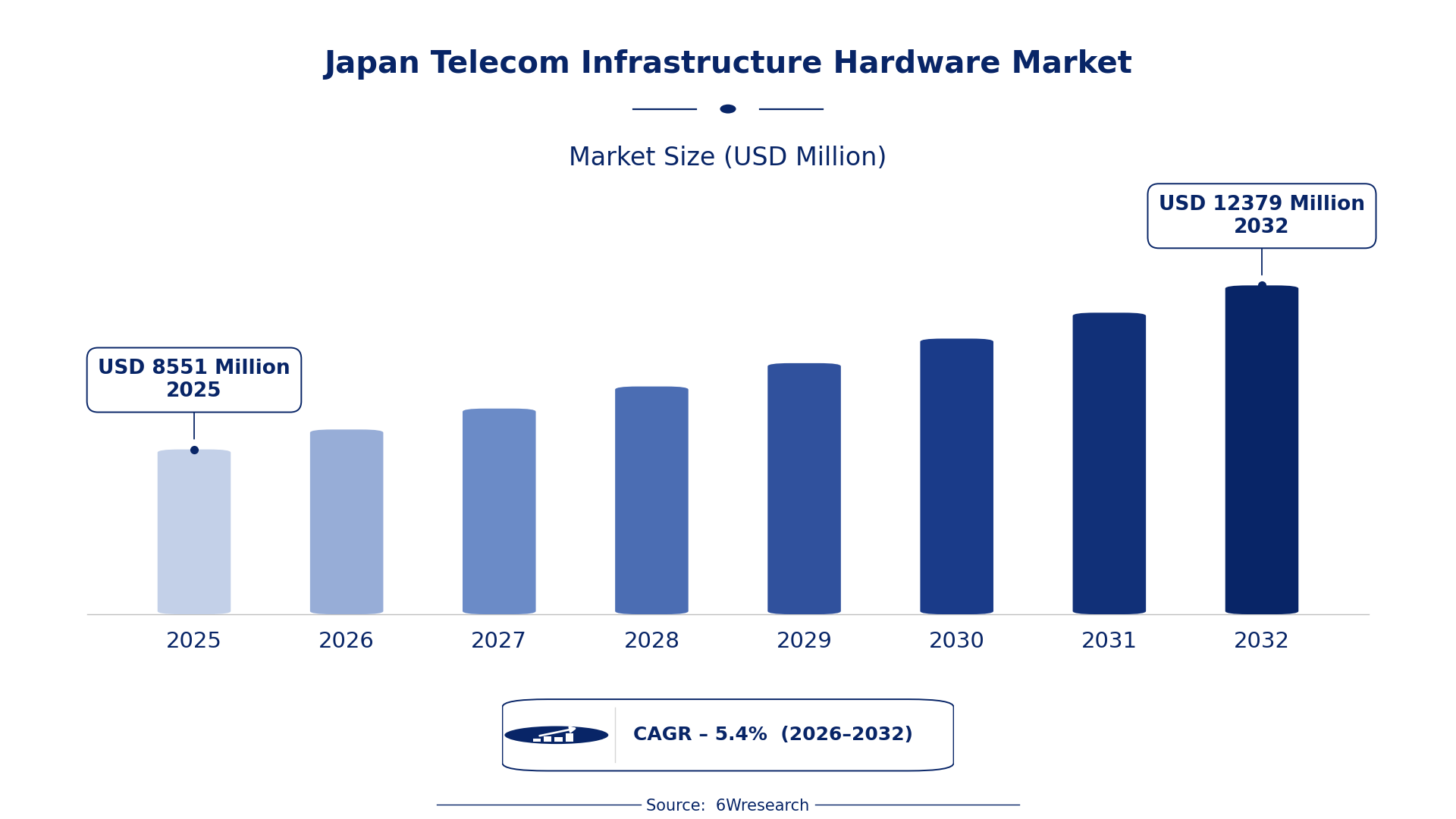
According to 6Wresearch internal database and industry insights, the Japan Telecom Infrastructure Hardware Market was valued at USD 8,551 Million in 2025 and is projected to reach USD 12,379 Million by 2032, growing at a CAGR of approximately 5.4% during 2026–2032.
Japan Telecom Infrastructure Hardware Market Highlights
| Report Metric | Details |
| Report Name | Japan Telecom Infrastructure Hardware Market (2026-2032) |
| Market Size 2025 | USD 8,551 Million |
| Market Size 2032 | USD 12,379 Million |
| Absolute Growth 2025–2032 | USD 3,828 Million |
| CAGR 2026–2032 | 5.4% |
| Peak Annual Growth | 6.4% in 2032 |
| Forecast Period | 2026–2032 |
| Historical Data | 2022–2025 |
| Base Year | 2025 |
| Leading Infrastructure Hardware, 2025 | Radio Access Network (39% share) |
| Leading Product Type, 2025 | RRUs & BBUs (38% share) |
| Leading Component Type, 2025 | 5G NR/LTE (38% share) |
| Leading Distribution Channel, 2025 | Direct Supply (38% share) |
| Leading End User Industry, 2025 | Telecom Operators (45% share) |
| Fastest-Growing Infrastructure Hardware | Fiber Optic Infrastructure (7.3% CAGR) |
| Fastest-Growing Product Type | OLTs/ONTs (8.0% CAGR) |
| Fastest-Growing Component Type | GPON/XGS-PON (8.2% CAGR) |
| Fastest-Growing Distribution Channel | Network Integrators (6.9% CAGR) |
| Fastest-Growing End User Industry | Broadband Providers (7.4% CAGR) |
| Growing Sector | Telecom Operators |
| Key End Users | Telecom Operators, Broadband Providers, Telecom Carriers, Data Center Companies |
Japan Telecom Infrastructure Hardware Market Year-wise Growth Rate and Key Drivers (2022–2032)
This graph illustrates the annual growth rates of the market from 2022 to 2032, highlighting a steady upward trajectory and projected market expansion over the forecast period.
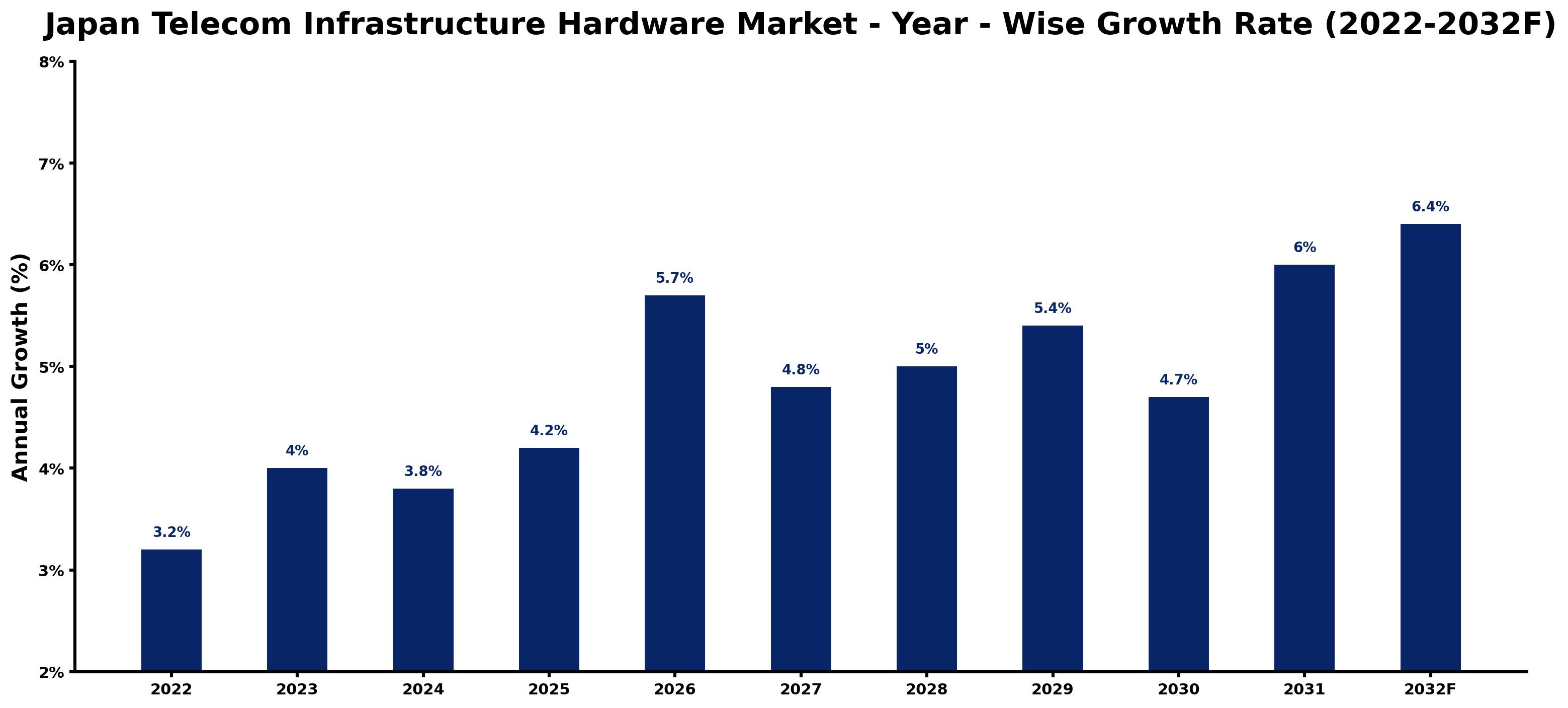
Annual growth estimates for each year appear below with the principal reason behind them, explaining the shifts that set the pace of the market.
| Year | Estimated Annual Growth (%) | Market Rationale |
| 2022 | 3.2 | The market experienced steady growth, supported by ongoing telecom investments. |
| 2023 | 4.0 | Mobile subscriber numbers surpassed 100 million, driving demand for telecom infrastructure. |
| 2024 | 3.8 | Growth slowed slightly due to saturation in urban markets and infrastructure limits. |
| 2025 | 4.2 | A surge in 5G base station deployments drove higher investments in telecom hardware. |
| 2026 | 5.7 | New technologies are expected to accelerate demand for advanced telecom solutions. |
| 2027 | 4.8 | Growth is projected to moderate as the market adjusts to increased capacity. |
| 2028 | 5.0 | Expansion of fiber optic infrastructure is expected to boost demand in urban areas. |
| 2029 | 5.4 | The adoption of GPON technology will continue to improve broadband services. |
| 2030 | 4.7 | Growth is anticipated to slow as the market matures and competition intensifies. |
| 2031 | 6.0 | Increased investments by telecom operators in infrastructure will drive demand higher. |
| 2032 | 6.4 | The market is projected to peak as 5G coverage reaches 100%, boosting infrastructure needs. |
Note: Market size estimations and growth projections presented in this report are based on 6Wresearch's proprietary forecasting methodology, utilizing the latest available industry data, government publications, and primary research inputs.
Japan Telecom Infrastructure Hardware Market Synopsis
Telecom Infrastructure Hardware encompasses critical equipment such as base stations and fibre optics, which are vital for telecommunications networks. The Japan Telecom Infrastructure Hardware Market is growing due to strong demand for mobile and broadband services, supported by over 100 million mobile subscribers and ongoing investments in 5G deployment. The government aims for 100% 5G coverage by 2025, which will further stimulate growth in telecom investments.
Market Dynamics Impact Analysis (2026–2032)
| Factor | Type | Impact | Primary Segment Affected |
| Growing mobile subscriber base | Driver | High | Radio Access Network |
| Investment in 5G infrastructure | Driver | High | Fiber Optic Infrastructure |
| Increasing demand for high-speed internet | Opportunity | High | GPON/XGS-PON |
| Expansion of data centers | Opportunity | Medium | Transmission Systems |
| High costs of advanced technology | Restraint | High | RRUs & BBUs |
| Regulatory compliance requirements | Restraint | Medium | Telecom Operators |
| Limited skilled workforce in telecom | Challenge | High | Radio Access Network |
| Rising competition among suppliers | Challenge | Medium | Telecom Carriers |
Evaluation of Drivers in Japan Telecom Infrastructure Hardware Market (2026–2032)
Below are the drivers that matter most for revenue growth, with supporting evidence.
| Drivers | Primary Segment Affected | Why It Matters (Evidence) |
| Increase in mobile subscribers | Radio Access Network | With over 100 million mobile subscribers, demand for mobile connectivity rises, leading to more base stations being deployed. |
| Government investment in 5G | Fiber Optic Infrastructure | The government allocated 300 billion JPY for digital infrastructure, driving demand for fiber optics in telecom networks. |
| Expansion of broadband services | GPON/XGS-PON | Over 5 million subscribers connected to GPON technology indicate a growing need for high-speed internet solutions. |
| Growth in data center operations | Transmission Systems | A projected 15% growth in data centers by 2025 increases demand for reliable transmission systems. |
| Technological advancements in telecom | 5G NR/LTE | High adoption rates of LTE exceeding 95% among mobile users create a need for advanced 5G infrastructure. |
A wider customer base explains much of the growth, as Japan's telecom infrastructure market benefits from over 100 million mobile subscribers. The projected growth of data centers by 15% by 2025 increases the need for reliable transmission systems. The high LTE adoption rate exceeding 95% among mobile users further pushes demand for advanced 5G infrastructure. The expansion of fiber optic networks is expected to improve service delivery for broadband providers, creating further opportunities for suppliers.
Evaluation of Restraints in Japan Telecom Infrastructure Hardware Market
The main factors holding the market back are set out below.
| Market Restraint | Primary Segment Affected | Why It Matters (Evidence) |
| High costs of advanced technology | RRUs & BBUs | The high costs associated with advanced telecom technology limit investments from smaller operators. |
| Regulatory compliance requirements | Telecom Operators | Telecom Operators face stringent regulations that can delay project implementations and increase operational costs. |
| Limited skilled workforce in telecom | Radio Access Network | A shortage of skilled professionals in the telecom sector hinders the growth of infrastructure projects. |
| Rising competition among suppliers | Telecom Carriers | Intense competition among suppliers can lead to price wars, affecting profitability for telecom carriers. |
| Supply chain disruptions | Fiber Optic Infrastructure | Global supply chain issues can impact the availability of essential components for fiber optic networks. |
Japan Telecom Infrastructure Hardware Market Challenges
Tokyo's telecom infrastructure investments face challenges due to a skills shortage, causing project delays that extend timelines for telecom operators. Buyers incur higher costs from limited local suppliers, inflating prices for essential equipment by up to 15%. Rising material costs, stemming from global supply chain issues, can increase overall expenses for producers by 10%, impacting their profit margins. Competition from new technologies pressures firms to allocate up to 20% of their budgets to advanced solutions, which can detract from critical infrastructure upgrades.
Trends in the Japan Telecom Infrastructure Hardware Market
Buyers and suppliers in the Japan Telecom Infrastructure Hardware Market are adjusting to the following trends.
- Shift towards 5G deployment: The Japanese government aims for 100% 5G coverage by 2025, prompting increased investments in telecom infrastructure. Over 10,000 base stations have already been deployed by 2023, reflecting this trend.
- Expansion of GPON technology: Broadband providers are increasingly adopting GPON technology, with over 5 million subscribers connected in 2023. This shift improves internet service delivery across urban areas.
- Growth in data center infrastructure: Data centres in Japan are expanding rapidly, projected to grow by 15% by 2025. This growth necessitates increased investment in transmission systems and related hardware.
- Increased focus on fibre optics: Tokyo is leading the way in fibre optic infrastructure investments, with the total length of fibre optic cables exceeding 1 million kilometres. This trend supports high-speed internet services.
Investment Opportunities in the Japan Telecom Infrastructure Hardware Market
The following areas offer the clearest openings for investors and suppliers in the Japan Telecom Infrastructure Hardware Market.
- Investment in 5G infrastructure: With the government targeting 100% 5G coverage by 2025, there is an opportunity for suppliers of telecom infrastructure hardware, especially in urban areas where demand is highest.
- Supply of GPON technology: The increasing number of GPON subscribers presents an opportunity for suppliers to provide advanced fibre optic solutions, particularly to broadband providers looking to improve service delivery.
- Expansion of data centres: The projected 15% growth in data centres by 2025 creates a demand for transmission systems and related infrastructure, offering opportunities for investment in this sector.
- Development of training programs: With a limited skilled workforce, there is an opportunity to invest in training programs for telecom professionals, addressing the skills gap in the infrastructure hardware sector.
Government Initiatives in the Japan Telecom Infrastructure Hardware Market
The Economic Security Promotion Act, enacted in 2022, supports supply-chain resilience for critical telecom products. This law ensures that telecom producers can maintain a steady supply of essential materials, improving operational efficiency. The government allocated 300 billion JPY for digital infrastructure development in 2023, which will help modernise telecom networks and support various projects.
The Digital Agency, established in September 2021, leads government digital transformation efforts. It funds projects aimed at improving telecom infrastructure, benefiting telecom operators and broadband providers. The agency oversees the implementation of common system standards, ensuring that infrastructure investments align with national goals.
Future Insight of the Japan Telecom Infrastructure Hardware Market
Advancements in fibre optic technology will reshape demand for telecom infrastructure, enabling faster and more reliable services. By 2032, the total fibre optic cable length in Japan will surpass 1 million kilometres, improving connectivity for users. The growth of IoT devices, projected to reach 10 million by 2025, will create new opportunities for suppliers to innovate. Increased investments in digital infrastructure will enhance network capabilities, allowing buyers to benefit from improved service offerings and efficiency.
Market Segmentation Analysis
Japan Telecom Infrastructure Hardware Market report covers a detailed analysis of the following market segments:
By Infrastructure Hardware – Radio Access Network Leads, Fiber Optic Infrastructure Expected to Grow Fastest
According to Saurav Kr Singh, Senior Research Analyst at 6Wresearch, Radio Access Network held 39% of the Japan Telecom Infrastructure Hardware Market by infrastructure hardware in 2025. The Radio Access Network segment commands a substantial share due to its essential role in mobile connectivity, particularly in urban regions like Tokyo where telecom investments are concentrated. With over 100 million mobile subscribers, this segment is crucial for meeting the demands of a vast user base. The quickest growth will come from Fiber Optic Infrastructure, forecast to expand at a CAGR of 7.3% between 2026 and 2032. The Fiber Optic Infrastructure segment is set for rapid growth, propelled by the government's commitment to achieving 100% 5G coverage by 2025, which requires extensive fibre deployment. The existing infrastructure of over 1 million kilometres of fibre optic cable positions this segment to meet surging demand for high-speed internet. Suppliers must prioritise fibre optic solutions to align with the increasing demand for high-speed connectivity.
By Product Type – RRUs & BBUs Leads, OLTs/ONTs Expected to Grow Fastest
RRUs & BBUs took 38% of product type revenue in 2025, more than any other category. RRUs and BBUs hold the largest share as they are core components for wireless networks, supporting the extensive mobile subscriber base in Japan. Their critical role in facilitating mobile communication makes them indispensable for telecom operators. OLTs/ONTs are projected to grow fastest, at a CAGR of 8.0% during 2026–2032. OLTs and ONTs are projected to grow rapidly as they are key for fibre optic networks, essential for meeting the increasing demand for broadband services. The expansion of fibre infrastructure directly correlates with the rising number of broadband subscribers. Buyers will benefit from investing in OLTs and ONTs to ensure they meet the growing broadband demand effectively.
By Component Type – 5G NR/LTE Leads, GPON/XGS-PON Expected to Grow Fastest
5G NR/LTE accounted for 38% of the market by component type in 2025. 5G NR and LTE are foundational for next-generation networks, making them vital for telecom operators aiming to enhance service delivery. The high adoption rate of LTE, exceeding 95% among mobile users, underscores their importance in the market. GPON/XGS-PON is set to record the highest CAGR in this split, 8.2% over 2026–2032. GPON and XGS-PON are witnessing the fastest growth as they are essential for broadband delivery, especially with government initiatives aimed at improving connectivity. The projected 15% growth in data centres by 2025 will further drive demand for these technologies. Suppliers should concentrate on GPON and XGS-PON technologies to capture the expanding market for broadband solutions.
By Distribution Channel – Direct Supply Leads, Network Integrators Expected to Grow Fastest
With 38% of distribution channel revenue in 2025, Direct Supply was the largest category. Direct Supply is the leading distribution method, ensuring timely delivery of telecom infrastructure hardware to operators. This approach is favoured for its efficiency in addressing the immediate requirements of telecom operators. Over 2026–2032, Network Integrators are expected to post the fastest growth, at a CAGR of 6.9%. Network Integrators are rapidly becoming more significant as they enable system integration, which is vital for the deployment of complex telecom infrastructure. Their growing role supports operators in streamlining operations and enhancing service delivery. Suppliers should consider partnerships with network integrators to improve market reach and service integration.
By End User Industry – Telecom Operators Lead, Broadband Providers Expected to Grow Fastest
In 2025, Telecom Operators led the end user industry split with a 45% share. Telecom Operators represent the largest end-user segment, accounting for over 60% of the market share as they are the primary consumers of infrastructure. Their ongoing investments in network upgrades and expansion are key factors driving demand for telecom infrastructure hardware. The quickest growth will come from Broadband Providers, forecast to expand at a CAGR of 7.4% between 2026 and 2032. Broadband Providers are experiencing the fastest growth as they work to enhance internet services, particularly in urban areas where demand is escalating. Government initiatives aimed at bolstering digital infrastructure further support this growth trajectory. Buyers in the broadband sector should invest in advanced infrastructure to meet the rising demand for internet services.
Key Attractiveness of the Report
- 10 Years of Market Numbers
- Historical Data Starting from 2022 to 2025
- Base Year 2025
- Forecast Data until 2032
- Key Performance Indicators Impacting the Market
- Major Upcoming Developments and Projects
Key Highlights of the Report:
- Japan Telecom Infrastructure Hardware Market Outlook
- Market Size of Japan Telecom Infrastructure Hardware Market, 2025
- Forecast of Japan Telecom Infrastructure Hardware Market, 2032
- Historical Data and Forecast of Japan Telecom Infrastructure Hardware Revenues & Volume for the Period 2022-2032F
- Japan Telecom Infrastructure Hardware Market Trend Evolution
- Japan Telecom Infrastructure Hardware Market Drivers and Challenges
- Japan Telecom Infrastructure Hardware Price Trends
- Japan Telecom Infrastructure Hardware Porter's Five Forces
- Japan Telecom Infrastructure Hardware Industry Life Cycle
- Historical Data and Forecast of Japan Telecom Infrastructure Hardware Market Revenues & Volume By Infrastructure Hardware for the Period 2022-2032F
- Historical Data and Forecast of Japan Telecom Infrastructure Hardware Market Revenues & Volume By Radio Access Network for the Period 2022-2032F
- Historical Data and Forecast of Japan Telecom Infrastructure Hardware Market Revenues & Volume By Fiber Optic Infrastructure for the Period 2022-2032F
- Historical Data and Forecast of Japan Telecom Infrastructure Hardware Market Revenues & Volume By Transmission Systems for the Period 2022-2032F
- Historical Data and Forecast of Japan Telecom Infrastructure Hardware Market Revenues & Volume By Power and Cooling Systems for the Period 2022-2032F
- Historical Data and Forecast of Japan Telecom Infrastructure Hardware Market Revenues & Volume By Product Type for the Period 2022-2032F
- Historical Data and Forecast of Japan Telecom Infrastructure Hardware Market Revenues & Volume By RRUs & BBUs for the Period 2022-2032F
- Historical Data and Forecast of Japan Telecom Infrastructure Hardware Market Revenues & Volume By OLTs/ONTs for the Period 2022-2032F
- Historical Data and Forecast of Japan Telecom Infrastructure Hardware Market Revenues & Volume By Microwave Radios for the Period 2022-2032F
- Historical Data and Forecast of Japan Telecom Infrastructure Hardware Market Revenues & Volume By Batteries/AC Units for the Period 2022-2032F
- Historical Data and Forecast of Japan Telecom Infrastructure Hardware Market Revenues & Volume By Component Type for the Period 2022-2032F
- Historical Data and Forecast of Japan Telecom Infrastructure Hardware Market Revenues & Volume By 5G NR/LTE for the Period 2022-2032F
- Historical Data and Forecast of Japan Telecom Infrastructure Hardware Market Revenues & Volume By GPON/XGS-PON for the Period 2022-2032F
- Historical Data and Forecast of Japan Telecom Infrastructure Hardware Market Revenues & Volume By Backhaul/Longhaul for the Period 2022-2032F
- Historical Data and Forecast of Japan Telecom Infrastructure Hardware Market Revenues & Volume By Site Power Mgmt for the Period 2022-2032F
- Historical Data and Forecast of Japan Telecom Infrastructure Hardware Market Revenues & Volume By Distribution Channel for the Period 2022-2032F
- Historical Data and Forecast of Japan Telecom Infrastructure Hardware Market Revenues & Volume By Direct Supply for the Period 2022-2032F
- Historical Data and Forecast of Japan Telecom Infrastructure Hardware Market Revenues & Volume By Network Integrators for the Period 2022-2032F
- Historical Data and Forecast of Japan Telecom Infrastructure Hardware Market Revenues & Volume By Infrastructure Vendors for the Period 2022-2032F
- Historical Data and Forecast of Japan Telecom Infrastructure Hardware Market Revenues & Volume By Industrial Distributors for the Period 2022-2032F
- Historical Data and Forecast of Japan Telecom Infrastructure Hardware Market Revenues & Volume By End User Industry for the Period 2022-2032F
- Historical Data and Forecast of Japan Telecom Infrastructure Hardware Market Revenues & Volume By Telecom Operators for the Period 2022-2032F
- Historical Data and Forecast of Japan Telecom Infrastructure Hardware Market Revenues & Volume By Broadband Providers for the Period 2022-2032F
- Historical Data and Forecast of Japan Telecom Infrastructure Hardware Market Revenues & Volume By Telecom Carriers for the Period 2022-2032F
- Historical Data and Forecast of Japan Telecom Infrastructure Hardware Market Revenues & Volume By Data Center Companies for the Period 2022-2032F
- Japan Telecom Infrastructure Hardware Import Export Trade Statistics
- Market Opportunity Assessment By Infrastructure Hardware
- Market Opportunity Assessment By Product Type
- Market Opportunity Assessment By Component Type
- Market Opportunity Assessment By Distribution Channel
- Market Opportunity Assessment By End User Industry
- Japan Telecom Infrastructure Hardware Top Companies Market Share
- Japan Telecom Infrastructure Hardware Competitive Benchmarking By Technical and Operational Parameters
- Japan Telecom Infrastructure Hardware Company Profiles
- Japan Telecom Infrastructure Hardware Key Strategic Recommendations
Market Covered
The study includes the following segmentation.
By Infrastructure Hardware
- Radio Access Network
- Fiber Optic Infrastructure
- Transmission Systems
- Power and Cooling Systems
By Product Type
- RRUs & BBUs
- OLTs/ONTs
- Microwave Radios
- Batteries/AC Units
By Component Type
- 5G NR/LTE
- GPON/XGS-PON
- Backhaul/Longhaul
- Site Power Mgmt
By Distribution Channel
- Direct Supply
- Network Integrators
- Infrastructure Vendors
- Industrial Distributors
By End User Industry
- Telecom Operators
- Broadband Providers
- Telecom Carriers
- Data Center Companies































