Japan Telecom Infrastructure Market Size & Growth Rate
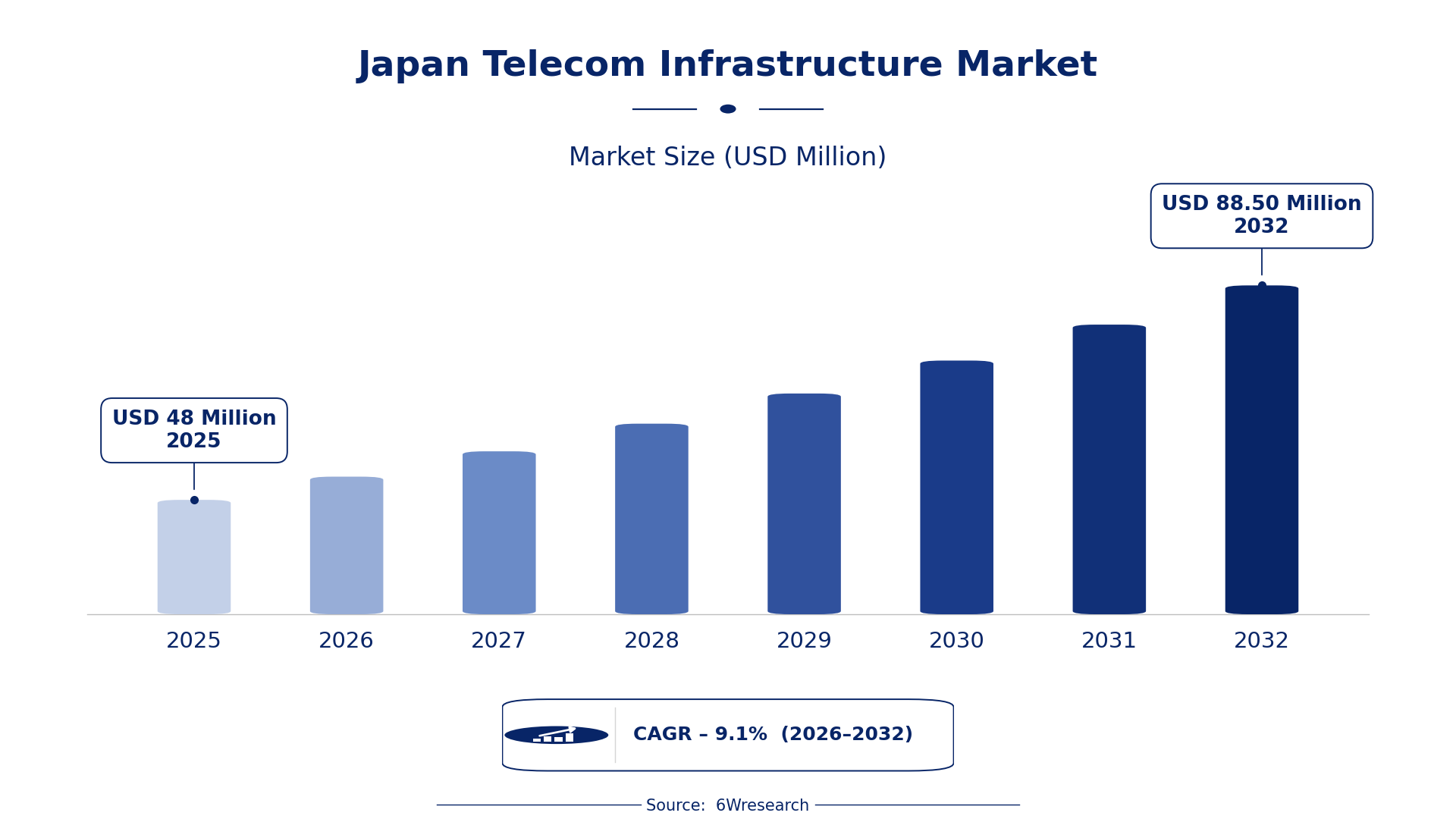
According to 6Wresearch internal database and industry insights, the Japan Telecom Infrastructure Market was valued at USD 48 Million in 2025 and is projected to reach USD 88.50 Million by 2032, growing at a CAGR of approximately 9.1% during 2026–2032.
Japan Telecom Infrastructure Market Highlights
| Report Metric | Details |
| Report Name | Japan Telecom Infrastructure Market (2026-2032) |
| Market Size 2025 | USD 48 Million |
| Market Size 2032 | USD 88.50 Million |
| Absolute Growth 2025–2032 | USD 40.50 Million |
| CAGR 2026–2032 | 9.1% |
| Peak Annual Growth | 10.2% in 2026 |
| Forecast Period | 2026–2032 |
| Historical Data | 2022–2025 |
| Base Year | 2025 |
| Leading Telecom Infrastructure, 2025 | Mobile Infrastructure (48% share) |
| Leading Product Type, 2025 | Towers (33% share) |
| Leading Technology Layer, 2025 | 5G (46% share) |
| Leading Distribution Channel, 2025 | Infra Developers (48% share) |
| Leading End User Industry, 2025 | Mobile Network Operators (41% share) |
| Fastest-Growing Telecom Infrastructure | Data Center Infrastructure (12.2% CAGR) |
| Fastest-Growing Product Type | Cloud/Edge Facilities (13.6% CAGR) |
| Fastest-Growing Distribution Channel | Colocation Providers (11.2% CAGR) |
| Fastest-Growing End User Industry | OTT and CDNs (11.8% CAGR) |
| Growing Sector | Telecom Infrastructure |
| Key End Users | Mobile Network Operators, Internet Providers, Telco Enterprises, OTT and CDNs |
Japan Telecom Infrastructure Market Year-wise Growth Rate and Key Drivers (2022–2032)
This graph illustrates the annual growth rates of the market from 2022 to 2032, highlighting a steady upward trajectory and projected market expansion over the forecast period.
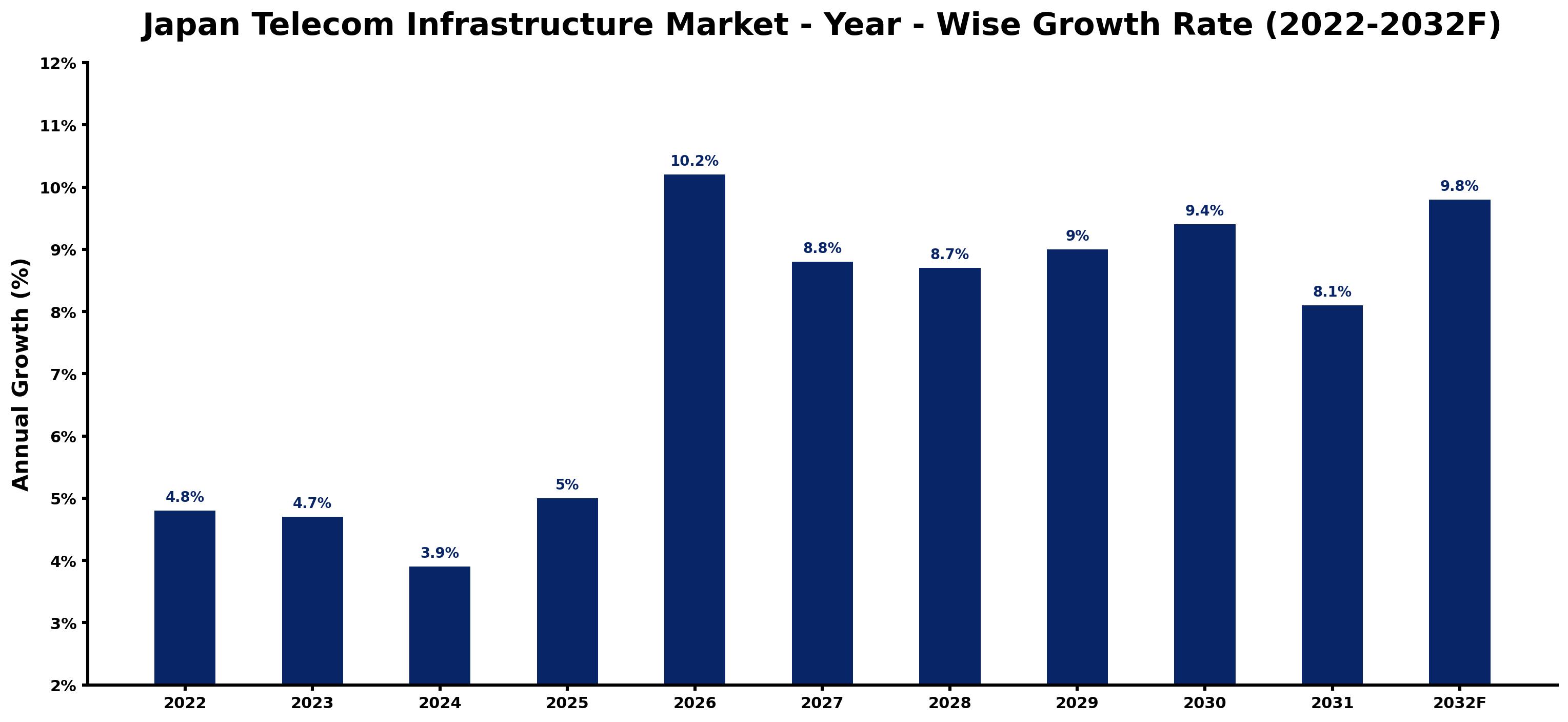
For each year, the table pairs the estimated growth rate with the leading influence on demand, showing how the drivers changed across the period.
| Year | Estimated Annual Growth (%) | Market Rationale |
| 2022 | 4.8 | The market experienced steady growth due to ongoing investments in telecom infrastructure upgrades. |
| 2023 | 4.7 | Growth slowed slightly as the market adjusted to previous expansion rates and demand stabilised. |
| 2024 | 3.9 | A further slowdown occurred as market saturation began to affect new investment levels. |
| 2025 | 5.0 | Growth accelerated as major cities like Tokyo and Osaka increased infrastructure investments. |
| 2026 | 10.2 | The market is expected to peak with strong demand for 5G infrastructure and network upgrades. |
| 2027 | 8.8 | Growth is projected to slow as the market begins to stabilise following the peak investment phase. |
| 2028 | 8.7 | A slight slowdown in growth is anticipated as previous investments mature and demand normalises. |
| 2029 | 9.0 | An increase in demand for data services will drive growth higher again as new technologies emerge. |
| 2030 | 9.4 | The market will see a further rise in demand as internet speeds and connectivity requirements increase. |
| 2031 | 8.1 | Growth is expected to slow again as the market approaches saturation in key urban areas. |
| 2032 | 9.8 | A renewed focus on digital transformation initiatives will spur growth in telecom infrastructure. |
Note: Market size estimations and growth projections presented in this report are based on 6Wresearch's proprietary forecasting methodology, utilizing the latest available industry data, government publications, and primary research inputs.
Japan Telecom Infrastructure Market Synopsis
Telecom infrastructure in Japan encompasses the systems supporting mobile and wireline networks, constructed using advanced technologies like fiber optics. With over 100 million internet subscribers, demand is driven by a population of approximately 125 million and ongoing investments in network upgrades. The 5G Promotion Strategy is improving connectivity, while key regions like Tokyo and Osaka are vital for infrastructure investment, contributing to growth in the Japan Telecom Infrastructure Market.
Market Dynamics Impact Analysis (2026–2032)
| Factor | Type | Impact | Primary Segment Affected |
| Increasing demand for high-speed internet and mobile connectivity | Driver | High | Mobile Infrastructure |
| Expansion of data center capabilities to support cloud services | Driver | High | Data Center Infrastructure |
| Growing need for enhanced connectivity solutions | Opportunity | High | Core Network Infrastructure |
| Demand for advanced telecom solutions in urban areas | Opportunity | High | Wireline Infrastructure |
| Regulatory compliance costs impacting infrastructure investments | Restraint | Medium | Mobile Infrastructure |
| Market saturation in urban areas limiting growth potential | Restraint | Medium | Mobile Infrastructure |
| High initial investment costs for new technologies | Challenge | High | Mobile Infrastructure |
| Competition from alternative communication technologies | Challenge | Medium | Mobile Infrastructure |
Evaluation of Drivers in Japan Telecom Infrastructure Market (2026–2032)
The table below links each growth driver to the segment it affects and the evidence for it.
| Drivers | Primary Segment Affected | Why It Matters (Evidence) |
| High population density driving mobile service demand | Mobile Infrastructure | Japan's population of approximately 125 million necessitates extensive mobile coverage, leading to increased tower installations. |
| Rising internet usage among consumers and businesses | Wireline Infrastructure | With over 100 million internet subscribers, demand for fixed-line services continues to grow. |
| Investment in 5G technology to improve user experience | Core Network Infrastructure | 5G coverage is expected to reach 90% by 2025, spurring infrastructure upgrades. |
| Expansion of data centers to support cloud applications | Data Center Infrastructure | The average internet speed of around 100 Mbps drives the need for efficient data processing capabilities. |
| Government initiatives promoting digital transformation | Mobile Infrastructure | The establishment of the Digital Agency in 2021 supports infrastructure development for improved connectivity. |
Spending rises because the high population density in Japan drives demand for mobile services, prompting extensive tower installations to support connectivity. With over 100 million internet subscribers, fixed-line services are increasingly vital for businesses and consumers. The push for 5G technology improves user experience, as coverage is expected to reach 90% by 2025, prompting infrastructure upgrades. The need for efficient data processing capabilities drives investment in data centers.
Evaluation of Restraints in Japan Telecom Infrastructure Market
Several factors work against faster growth; the main ones are summarised below.
| Market Restraint | Primary Segment Affected | Why It Matters (Evidence) |
| Regulatory compliance costs impacting infrastructure investments | Mobile Infrastructure | The Electrical Appliance and Material Safety Act imposes requirements that increase operational costs for providers. |
| Market saturation in urban areas limiting growth potential | Mobile Infrastructure | High infrastructure density in cities like Tokyo leads to diminishing returns on new investments. |
| High initial investment costs for new technologies | Data Center Infrastructure | The transition to advanced data processing capabilities requires substantial capital investment. |
| Competition from alternative communication technologies | Mobile Infrastructure | Emerging technologies present viable alternatives to traditional telecom services, affecting market share. |
| Slow adoption of new standards affecting deployment speed | Core Network Infrastructure | Compliance with standards like ISO/IEC 27001 can delay infrastructure upgrades. |
Japan Telecom Infrastructure Market Challenges
Japan's telecom buyers encounter supply chain issues due to dependence on a limited number of domestic suppliers for essential components, causing delays in network upgrades by up to six months. Regulatory challenges stem from the stringent oversight by the Ministry of Internal Affairs and Communications, complicating compliance and increasing operational costs by approximately 15% for telecom operators. Buyers face pressure from high consumer expectations for internet speed, risking customer dissatisfaction if they fail to deliver speeds that meet the average of 100 Mbps. Rising costs linked to the '5G Promotion Strategy' can strain budgets, forcing smaller operators to delay vital infrastructure investments.
Trends in the Japan Telecom Infrastructure Market
Several trends are reshaping the Japan Telecom Infrastructure Market; the most important are set out below.
- Mobile Network Operators Adopting 5G Technology: Mobile Network Operators are increasingly adopting 5G technology to meet rising consumer demand for faster internet. By 2025, 5G coverage is expected to reach 90% of the population, improving service delivery.
- Shift Towards Cloud-Based Data Centers: Data Center Infrastructure is shifting towards cloud-based solutions, driven by the need for scalable services. The average internet speed of around 100 Mbps supports this transition, allowing for more efficient operations.
- Increased Investment in Urban Telecom Infrastructure: Investment in urban telecom infrastructure is rising, particularly in key regions like Tokyo and Osaka. This focus is essential as Japan's population density drives higher demand for connectivity solutions.
- Expansion of Fiber Optic Networks: The expansion of fiber optic networks is essential for supporting high-speed internet access. With over 100 million internet subscribers, the demand for reliable connectivity continues to grow.
Investment Opportunities in the Japan Telecom Infrastructure Market
Investors looking at the Japan Telecom Infrastructure Market should consider the following areas.
- Growing Demand for 5G Infrastructure: As 5G coverage is expected to reach 90% by 2025, there is a gap in infrastructure supply. Investing in 5G towers and systems will cater to Mobile Network Operators looking to improve service quality.
- Investment in Data Center Facilities: The need for advanced data processing capabilities is rising, presenting an opportunity to supply data center infrastructure. Urban areas like Tokyo are ideal for establishing new facilities to meet demand.
- Expansion of Wireline Services: With the number of internet subscribers exceeding 100 million, there is a pressing need for improved wireline services. Suppliers can enter this market by partnering with Internet Providers to expand infrastructure.
- Development of Cloud Solutions: The shift towards cloud-based services is creating demand for related infrastructure. Investing in Cloud/Edge Facilities will benefit System Integrators looking to improve service delivery.
Government Initiatives in the Japan Telecom Infrastructure Market
The Digital Agency, established in 2021, leads the government's digital transformation efforts, improving telecom infrastructure through common system standards. This agency supports initiatives that aim to improve connectivity and service delivery, ensuring that telecom providers meet modern demands effectively.
The Ministry of Internal Affairs and Communications oversees telecom regulations, ensuring compliance with the Electrical Appliance and Material Safety Act. This law regulates operations, requiring telecom providers to adhere to safety and service standards, which shapes the infrastructure framework.
Future Insight of the Japan Telecom Infrastructure Market
By 2032, telecom buyers will benefit from expanded 5G coverage reaching 90% of the population, improving mobile communications. The Digital Agency's initiatives will simplify digital transformation, enabling suppliers to implement new technologies more efficiently. Continued investments in fiber optic networks will boost data transmission speeds, with average internet speeds projected to reach 120 Mbps. The adoption of ISO/IEC 27001 standards will improve information security management, creating a more secure telecom environment for users.
Market Segmentation Analysis
Japan Telecom Infrastructure Market report covers a detailed analysis of the following market segments:
By Telecom Infrastructure – Mobile Infrastructure Leads, Data Center Infrastructure Expected to Grow Fastest
According to Saurav Kr Singh, Senior Research Analyst at 6Wresearch, with 48% of telecom infrastructure revenue in 2025, Mobile Infrastructure was the largest category. Mobile infrastructure holds the largest share due to its critical role in providing seamless mobile connectivity across Japan. With over 100,000 mobile towers installed, this segment effectively meets the needs of a population of approximately 125 million. Data Center Infrastructure is set to record the highest CAGR in this split, 12.2% over 2026–2032. Data center infrastructure is experiencing rapid growth as businesses increasingly rely on cloud services and data processing capabilities. The ongoing digital transformation initiatives led by the newly established Digital Agency are significantly contributing to this trend. Suppliers must focus on enhancing mobile infrastructure to meet the growing demand for connectivity.
By Product Type – Towers Lead, Cloud/Edge Facilities Expected to Grow Fastest
Towers took 33% of product type revenue in 2025, more than any other category. Towers dominate the market as they are essential for transmitting mobile signals and ensuring coverage across urban and rural areas. Their significance is underscored by continuous investments in telecom infrastructure in key regions like Tokyo and Osaka. Cloud/Edge Facilities are projected to grow fastest, at a CAGR of 13.6% during 2026–2032. Cloud and edge facilities are witnessing the fastest growth due to the rising demand for low-latency services and efficient data management. The increasing adoption of cloud solutions across various sectors is a major factor driving this growth. Buyers should consider investing in cloud and edge facilities to improve service delivery and meet customer expectations.
By Technology Layer – 5G Leads and Records the Fastest Growth
The largest technology layer category in 2025 was 5G, at 46% of revenue. 5G technology leads the market as it represents the forefront of mobile data capabilities, enabling high-speed connectivity. Its implementation is crucial for addressing the increasing data demands from both consumers and businesses. The same category is also set to grow fastest, at a CAGR of 10.6% during 2026–2032. 5G is also the fastest-growing technology layer, with deployment accelerating to achieve 90% coverage by 2025. This rapid expansion will further solidify its dominance in the telecom infrastructure market, ensuring continued growth. Suppliers must prioritise 5G solutions to capitalise on the increasing demand for high-speed mobile data.
By Distribution Channel – Infra Developers Lead, Colocation Providers Expected to Grow Fastest
In 2025, Infra Developers led the distribution channel split with a 48% share. Infra developers lead the distribution channel as they are critical in constructing and maintaining telecom infrastructure. Their expertise is essential for meeting the rising demand for reliable telecom services across Japan. The quickest growth will come from Colocation Providers, forecast to expand at a CAGR of 11.2% between 2026 and 2032. Colocation providers are experiencing rapid growth, offering essential shared facilities for telecom equipment that cater to various service providers. This trend is driven by the increasing demand for efficient data centre solutions. Suppliers should explore partnerships with colocation providers to expand their market reach.
By End User Industry – Mobile Network Operators Lead, OTT and CDNs Expected to Grow Fastest
Mobile Network Operators held 41% of the Japan Telecom Infrastructure Market by end user industry in 2025. Mobile network operators are the primary users of telecom infrastructure, relying heavily on it to deliver services to consumers. Their substantial market presence drives the demand for robust telecom solutions and infrastructure enhancements. OTT and CDNs are set to record the highest CAGR in this split, 11.8% over 2026–2032. OTT and CDNs are the fastest-growing end user segment, as they depend on telecom infrastructure for efficient content delivery and streaming services. The surge in digital content consumption is a key factor in this growth. Buyers in the OTT and CDN sectors should invest in advanced telecom infrastructure to ensure optimal service delivery.
Key Attractiveness of the Report
- 10 Years of Market Numbers
- Historical Data Starting from 2022 to 2025
- Base Year 2025
- Forecast Data until 2032
- Key Performance Indicators Impacting the Market
- Major Upcoming Developments and Projects
Key Highlights of the Report:
- Japan Telecom Infrastructure Market Outlook
- Market Size of Japan Telecom Infrastructure Market, 2025
- Forecast of Japan Telecom Infrastructure Market, 2032
- Historical Data and Forecast of Japan Telecom Infrastructure Revenues & Volume for the Period 2022-2032F
- Japan Telecom Infrastructure Market Trend Evolution
- Japan Telecom Infrastructure Market Drivers and Challenges
- Japan Telecom Infrastructure Price Trends
- Japan Telecom Infrastructure Porter's Five Forces
- Japan Telecom Infrastructure Industry Life Cycle
- Historical Data and Forecast of Japan Telecom Infrastructure Market Revenues & Volume By Telecom Infrastructure for the Period 2022-2032F
- Historical Data and Forecast of Japan Telecom Infrastructure Market Revenues & Volume By Mobile Infrastructure for the Period 2022-2032F
- Historical Data and Forecast of Japan Telecom Infrastructure Market Revenues & Volume By Wireline Infrastructure for the Period 2022-2032F
- Historical Data and Forecast of Japan Telecom Infrastructure Market Revenues & Volume By Core Network Infrastructure for the Period 2022-2032F
- Historical Data and Forecast of Japan Telecom Infrastructure Market Revenues & Volume By Data Center Infrastructure for the Period 2022-2032F
- Historical Data and Forecast of Japan Telecom Infrastructure Market Revenues & Volume By Product Type for the Period 2022-2032F
- Historical Data and Forecast of Japan Telecom Infrastructure Market Revenues & Volume By Towers, RAN Systems for the Period 2022-2032F
- Historical Data and Forecast of Japan Telecom Infrastructure Market Revenues & Volume By Fiber Backbone for the Period 2022-2032F
- Historical Data and Forecast of Japan Telecom Infrastructure Market Revenues & Volume By EPC, IMS for the Period 2022-2032F
- Historical Data and Forecast of Japan Telecom Infrastructure Market Revenues & Volume By Cloud/Edge Facilities for the Period 2022-2032F
- Historical Data and Forecast of Japan Telecom Infrastructure Market Revenues & Volume By Technology Layer for the Period 2022-2032F
- Historical Data and Forecast of Japan Telecom Infrastructure Market Revenues & Volume By 4G, 5G for the Period 2022-2032F
- Historical Data and Forecast of Japan Telecom Infrastructure Market Revenues & Volume By GPON, Ethernet for the Period 2022-2032F
- Historical Data and Forecast of Japan Telecom Infrastructure Market Revenues & Volume By Virtualized Core for the Period 2022-2032F
- Historical Data and Forecast of Japan Telecom Infrastructure Market Revenues & Volume By Virtual + Physical for the Period 2022-2032F
- Historical Data and Forecast of Japan Telecom Infrastructure Market Revenues & Volume By Distribution Channel for the Period 2022-2032F
- Historical Data and Forecast of Japan Telecom Infrastructure Market Revenues & Volume By Infra Developers for the Period 2022-2032F
- Historical Data and Forecast of Japan Telecom Infrastructure Market Revenues & Volume By Government Bidding for the Period 2022-2032F
- Historical Data and Forecast of Japan Telecom Infrastructure Market Revenues & Volume By System Integrators for the Period 2022-2032F
- Historical Data and Forecast of Japan Telecom Infrastructure Market Revenues & Volume By Colocation Providers for the Period 2022-2032F
- Historical Data and Forecast of Japan Telecom Infrastructure Market Revenues & Volume By End User Industry for the Period 2022-2032F
- Historical Data and Forecast of Japan Telecom Infrastructure Market Revenues & Volume By Mobile Network Operators for the Period 2022-2032F
- Historical Data and Forecast of Japan Telecom Infrastructure Market Revenues & Volume By Internet Providers for the Period 2022-2032F
- Historical Data and Forecast of Japan Telecom Infrastructure Market Revenues & Volume By Telco Enterprises for the Period 2022-2032F
- Historical Data and Forecast of Japan Telecom Infrastructure Market Revenues & Volume By OTT and CDNs for the Period 2022-2032F
- Japan Telecom Infrastructure Import Export Trade Statistics
- Market Opportunity Assessment By Telecom Infrastructure
- Market Opportunity Assessment By Product Type
- Market Opportunity Assessment By Technology Layer
- Market Opportunity Assessment By Distribution Channel
- Market Opportunity Assessment By End User Industry
- Japan Telecom Infrastructure Top Companies Market Share
- Japan Telecom Infrastructure Competitive Benchmarking By Technical and Operational Parameters
- Japan Telecom Infrastructure Company Profiles
- Japan Telecom Infrastructure Key Strategic Recommendations
Market Covered
This report examines the market across the segments below.
By Telecom Infrastructure
- Mobile Infrastructure
- Wireline Infrastructure
- Core Network Infrastructure
- Data Center Infrastructure
By Product Type
- Towers
- RAN Systems
- Fiber Backbone
- EPC
- IMS
- Cloud/Edge Facilities
By Technology Layer
- 4G
- 5G
- GPON
- Ethernet
- Virtualized Core
- Virtual + Physical
By Distribution Channel
- Infra Developers
- Government Bidding
- System Integrators
- Colocation Providers
By End User Industry
- Mobile Network Operators
- Internet Providers
- Telco Enterprises
- OTT and CDNs































