Japan Telecom Innovation Market Size & Growth Rate
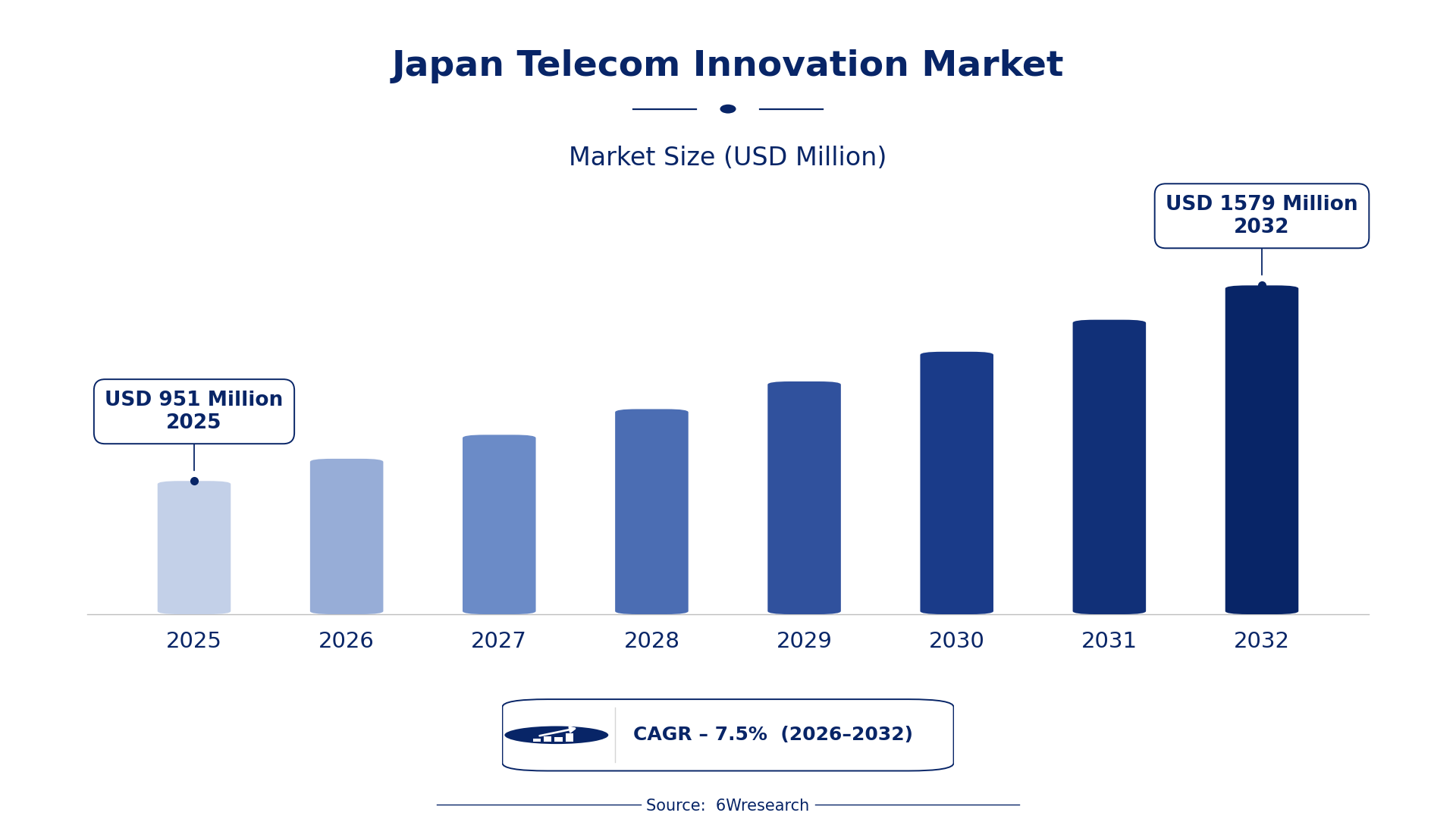
According to 6Wresearch internal database and industry insights, the Japan Telecom Innovation Market was valued at USD 951 Million in 2025 and is projected to reach USD 1,579 Million by 2032, growing at a CAGR of approximately 7.5% during 2026–2032.
Japan Telecom Innovation Market Highlights
| Report Metric | Details |
| Report Name | Japan Telecom Innovation Market (2026-2032) |
| Market Size 2025 | USD 951 Million |
| Market Size 2032 | USD 1,579 Million |
| Absolute Growth 2025–2032 | USD 628 Million |
| CAGR 2026–2032 | 7.5% |
| Peak Annual Growth | 9.5% in 2026 |
| Forecast Period | 2026–2032 |
| Historical Data | 2022–2025 |
| Base Year | 2025 |
| Leading Telecom Innovation Type, 2025 | 6G R&D Systems (43% share) |
| Leading Product Type, 2025 | Prototyping Hardware (52% share) |
| Leading Innovation Domain, 2025 | Sub-THz (40% share) |
| Leading Distribution Channel, 2025 | Research Grants (47% share) |
| Leading End User Industry, 2025 | Academic Labs (42% share) |
| Fastest-Growing Telecom Innovation Type | AI-Based Network Platforms (10.6% CAGR) |
| Fastest-Growing Product Type | Predictive AI Tools (10.4% CAGR) |
| Fastest-Growing Innovation Domain | AI-Enabled (10.2% CAGR) |
| Fastest-Growing End User Industry | Smart Telcos (9.6% CAGR) |
| Growing Sector | Telecom Innovation |
| Key End Users | Academic Labs, Smart Telcos, Defense Telecom, Telecom Startups |
Japan Telecom Innovation Market Year-wise Growth Rate and Key Drivers (2022–2032)
This graph illustrates the annual growth rates of the market from 2022 to 2032, highlighting a steady upward trajectory and projected market expansion over the forecast period.
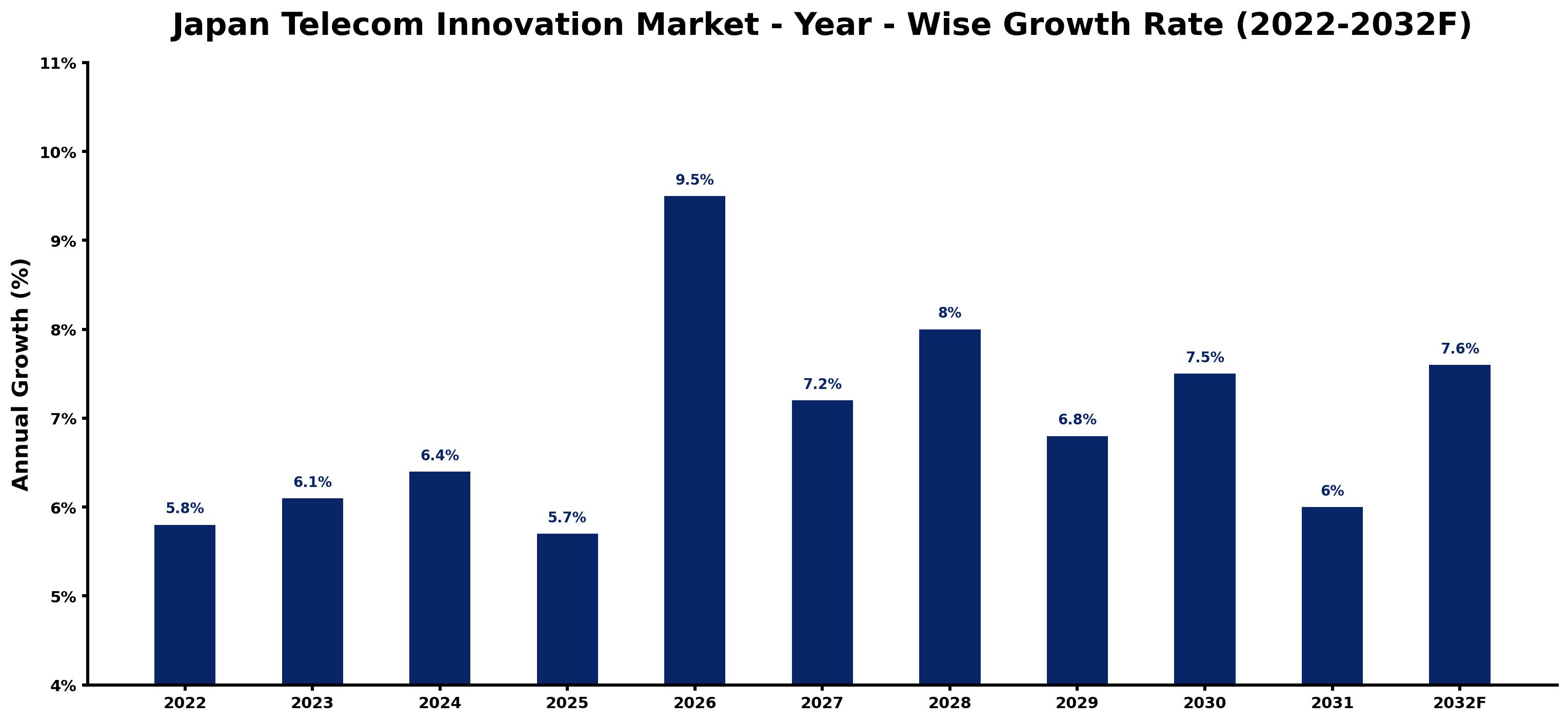
Year by year, the estimates below pair each growth rate with the development that shaped it.
| Year | Estimated Annual Growth (%) | Market Rationale |
| 2022 | 5.8 | The market experienced steady growth, driven by ongoing research initiatives. |
| 2023 | 6.1 | Demand increased as telecom startups expanded their AI-based solutions. |
| 2024 | 6.4 | Innovation in quantum communication technologies propelled growth further. |
| 2025 | 5.7 | Growth slowed slightly due to market saturation in certain segments. |
| 2026 | 9.5 | A surge in investment for 6G R&D led to increased growth. |
| 2027 | 7.2 | The market experienced a slowdown as competition intensified. |
| 2028 | 8.0 | Growth picked up again with advancements in AI-enabled platforms. |
| 2029 | 6.8 | A slight slowdown occurred as the market stabilised. |
| 2030 | 7.5 | Increased funding for telecom innovation spurred growth once more. |
| 2031 | 6.0 | The market slowed down as new technologies began to mature. |
| 2032 | 7.6 | Growth accelerated again with the introduction of new telecom standards. |
Note: Market size estimations and growth projections presented in this report are based on 6Wresearch's proprietary forecasting methodology, utilizing the latest available industry data, government publications, and primary research inputs.
Japan Telecom Innovation Market Synopsis
Telecom Innovation encompasses advanced communication technologies aimed at improving network performance and security, including 6G, AI, and quantum communication. The Japan Telecom Innovation Market is propelled by domestic research efforts and international collaborations, with notable contributions from government initiatives. The total telecom market is projected to reach 10 trillion yen by 2025, driven by a growing number of telecom startups and sustained funding for R&D initiatives.
Market Dynamics Impact Analysis (2026–2032)
| Factor | Type | Impact | Primary Segment Affected |
| Rising investment in 6G R&D initiatives fuels demand for advanced telecom solutions. | Driver | High | 6G R&D Systems |
| The increasing need for secure data transmission drives growth in quantum communication technologies. | Driver | High | Quantum Communication |
| Growing funding for academic research in telecom innovation presents opportunities for new projects. | Opportunity | High | Research Grants |
| The expansion of AI-based network platforms opens new avenues for investment and development. | Opportunity | High | AI-Based Network Platforms |
| Limited awareness of new telecom standards can hinder adoption rates. | Restraint | Medium | Open RAN Innovation |
| High costs associated with R&D in emerging technologies can restrict smaller firms' participation. | Restraint | Medium | Prototyping Hardware |
| Intense competition among telecom startups can lead to market volatility. | Challenge | High | Telecom Startups |
| The rapid pace of technological change can outstrip regulatory frameworks, causing delays. | Challenge | High | Academic Labs |
Evaluation of Drivers in Japan Telecom Innovation Market (2026–2032)
The following drivers explain most of the expected growth.
| Drivers | Primary Segment Affected | Why It Matters (Evidence) |
| Increased government funding for telecom R&D initiatives boosts innovation. | 6G R&D Systems | The government allocated 50 billion yen for telecom R&D in 2023, encouraging more projects. |
| The rise of AI technologies improves network management capabilities. | AI-Based Network Platforms | Tokyo's tech startups are developing AI solutions, driving demand for advanced platforms. |
| Growing international collaborations in telecom research expand market opportunities. | Quantum Communication | The National Institute of Information and Communications Technology leads research in quantum technologies. |
| The push for interoperability in telecom networks supports Open RAN innovations. | Open RAN Innovation | The Tokyo Metropolitan Government funds open RAN initiatives to enhance network flexibility. |
| The need for secure communication drives demand for Quantum Encryption technologies. | Quantum Encryption | The Ministry of Defense's strategy for secure telecom communications by 2025 boosts demand. |
Several shifts outside the market lift sales. In 2023, the government allocated 50 billion yen for telecom R&D initiatives, increasing funding for innovation projects. Tokyo's tech startups are creating AI-based solutions that enhance network management capabilities. The National Institute of Information and Communications Technology is at the forefront of research in quantum communication, broadening market opportunities. The push for interoperability in telecom networks is bolstered by funding for open RAN initiatives, which increase flexibility. The Ministry of Defense's strategy for secure telecom communications by 2025 fuels demand for quantum encryption technologies.
Evaluation of Restraints in Japan Telecom Innovation Market
The table below lists the restraints and the evidence behind each.
| Market Restraint | Primary Segment Affected | Why It Matters (Evidence) |
| Limited awareness of new telecom standards can hinder adoption rates. | Open RAN Innovation | Many firms are unaware of the ISO/IEC 27001 standard, affecting compliance. |
| High costs associated with R&D in emerging technologies can restrict smaller firms' participation. | Prototyping Hardware | Research grants are often insufficient for smaller startups to compete effectively. |
| The complexity of integrating new technologies can slow down implementation. | AI-Based Network Platforms | Many firms face challenges in adopting AI solutions due to integration issues. |
| Market volatility due to intense competition can deter investment. | Telecom Startups | The total telecom market is expected to reach 10 trillion yen by 2025, increasing competition. |
| Regulatory delays can impact the rollout of new technologies. | Quantum Communication | The rapid pace of technological change often outstrips existing regulatory frameworks. |
Japan Telecom Innovation Market Challenges
In 2023, Japan's telecom sector faces a shortfall in advanced technology development, as only 50 billion yen was allocated for R&D initiatives, limiting producers' ability to innovate and compete globally. Buyers encounter rising costs, with the total telecom market projected to reach 10 trillion yen by 2025, leading to increased prices for end-users. A shortage of skilled professionals in AI and quantum communication delays project timelines for producers, affecting their competitiveness. Regulatory compliance with ISO/IEC 27001 standards complicates operations, raising costs for telecom firms and hindering service delivery.
Trends in the Japan Telecom Innovation Market
These developments are changing demand patterns in the Japan Telecom Innovation Market.
- Shift in Academic Labs' Focus: Academic Labs are increasingly prioritising AI-based research since 2023, leading to a 15% rise in AI-related projects. This shift encourages collaboration with startups, driving innovation.
- Transition from Traditional to Open RAN: Funding for open RAN initiatives began in 2023, promoting interoperability in telecom networks. This transition is expected to enhance flexibility and reduce costs.
- Emergence of Quantum Communication: Quantum communication research, led by the National Institute of Information and Communications Technology, gained momentum in 2023, with funding increasing by 20%. This development is vital for secure data transmission.
- Prioritisation of 6G R&D: Since 2021, Japan's focus on 6G R&D has intensified, with the Ministry of Internal Affairs and Communications supporting various initiatives. This prioritisation is essential for maintaining global competitiveness.
Investment Opportunities in the Japan Telecom Innovation Market
Below are the investment opportunities with the strongest case in the Japan Telecom Innovation Market.
- Investment in AI-Based Solutions: With the total telecom market projected to reach 10 trillion yen by 2025, there is a gap in AI-based solutions. Investing in these technologies can attract telecom startups in Tokyo.
- Supply of Prototyping Hardware: Now is an ideal time to supply prototyping hardware, as academic labs are expanding their research capabilities. Collaborating with these institutions can lead to fruitful partnerships.
- Development of Secure Channels: The increasing demand for secure data transmission presents an opportunity for developing secure channels. Engaging with defense telecom sectors can facilitate entry into this market.
- Collaboration with Technology Partners: The rise of AI technologies creates a demand for collaboration with technology partners. Forming joint ventures can improve innovation and market reach.
Government Initiatives in the Japan Telecom Innovation Market
The Industrial Standardization Act, amended in 2019, governs product and test standards for telecom innovations, ensuring compliance among producers. The AI Promotion Act, established in 2025, sets a national framework for AI research and development, promoting advancements in AI-based network platforms. These laws facilitate a structured approach to innovation, driving investment and ensuring that telecom firms adhere to established standards, which ultimately benefits buyers through improved technology and services.
The Digital Agency, established in September 2021, oversees government digital transformation initiatives, including funding for telecom R&D projects. The Japan Society for the Promotion of Science allocates resources for academic research in telecom innovation, supporting buyer groups like academic labs and telecom startups in their development efforts. These agencies play a vital role in enhancing the capabilities of producers, ensuring that innovations meet market demands and regulatory requirements.
Future Insight of the Japan Telecom Innovation Market
The upcoming open RAN initiatives will improve network flexibility and performance, allowing telecom firms to better meet consumer demands. By 2025, the Ministry of Defense's strategy for secure communications will drive advancements in telecom security, benefiting both buyers and suppliers. The National Institute of Information and Communications Technology's research will lead to breakthroughs that improve data transmission speeds. With 40,000 5G base stations already in place, the infrastructure will support the integration of new technologies.
Market Segmentation Analysis
Japan Telecom Innovation Market report covers a detailed analysis of the following market segments:
By Telecom Innovation Type – 6G R&D Systems Lead, AI-Based Network Platforms Expected to Grow Fastest
According to Saurav Kr Singh, Senior Research Analyst at 6Wresearch, 6G R&D Systems took 43% of telecom innovation type revenue in 2025, more than any other category. The 6G R&D Systems segment leads the market due to robust government support, particularly from the Ministry of Internal Affairs and Communications since 2021. This backing establishes a strong foundation for future telecom advancements, attracting both public and private investments. AI-Based Network Platforms are projected to grow fastest, at a CAGR of 10.6% during 2026–2032. AI-Based Network Platforms are experiencing rapid growth as they are essential for optimising network management, with significant attention during the 2023 Telecom Innovation Summit. As 6G systems progress, the demand for these platforms will likely increase, further widening the lead of the 6G segment. Suppliers should align their strategies with government-supported R&D initiatives to capitalise on emerging opportunities.
By Product Type – Prototyping Hardware Leads, Predictive AI Tools Expected to Grow Fastest
Prototyping Hardware held 52% of the Japan Telecom Innovation Market by product type in 2025. Prototyping Hardware holds the largest share as it is crucial during the testing phases of telecom innovations, allowing developers to validate concepts before large-scale production. This reliance on prototyping ensures consistent demand from research institutions and technology developers. Predictive AI Tools are set to record the highest CAGR in this split, 10.4% over 2026–2032. Predictive Tools are rapidly gaining traction as they enhance operational efficiency in network management, which is vital in a data-driven environment. This trend indicates that as telecom innovations advance, the need for predictive capabilities will become increasingly essential. Buyers should invest in predictive tools to improve competitiveness and operational efficiencies.
By Innovation Domain – Sub-THz Leads, AI-Enabled Expected to Grow Fastest
The largest innovation domain category in 2025 was Sub-THz, at 40% of revenue. The Sub-THz segment commands the largest share due to its experimental nature and potential applications in future telecom technologies, attracting significant interest from research institutions. This focus on Sub-THz research is critical for developing next-generation communication systems. The quickest growth will come from AI-Enabled, forecast to expand at a CAGR of 10.2% between 2026 and 2032. AI-Enabled technologies are poised for rapid growth as they are vital for next-generation network solutions, reflecting the industry's shift towards intelligent systems. This growth signifies that as telecom networks develop, AI capabilities will be crucial for maintaining competitive advantages. Suppliers must prioritise AI-enabled solutions to address the rising demand for advanced network functionalities.
By Distribution Channel – Research Grants Lead and Record the Fastest Growth
In 2025, Research Grants led the distribution channel split with a 47% share. Research Grants serve as the primary funding source for innovation projects, providing essential financial support to various telecom initiatives. This established channel ensures that innovative ideas can be effectively transformed into practical applications, sustaining sector growth. The same category are also set to grow fastest, at a CAGR of 9.4% during 2026–2032. Research Grants are also the fastest-growing channel as they support a diverse array of projects, highlighting the increasing focus on funding for telecom innovation. This dual role underscores the importance of grants in driving advancements within the industry. Stakeholders should leverage research grants to effectively bolster their innovation efforts.
By End User Industry – Academic Labs Lead, Smart Telcos Expected to Grow Fastest
Academic Labs accounted for 42% of the market by end user industry in 2025. Academic Labs are the leading end user industry as they function as primary research centres for telecom innovation, driving advancements through thorough experimentation and development. Their foundational role in the ecosystem ensures a steady pipeline of new technologies. Smart Telcos are projected to grow fastest, at a CAGR of 9.6% during 2026–2032. Smart Telcos are emerging as the fastest-growing end user segment, utilising advanced telecom solutions to enhance service delivery and customer experiences. This trend suggests that as technology progresses, telcos will increasingly adopt cutting-edge innovations to maintain their market position. Suppliers should tailor their offerings to meet the specific needs of smart telcos to capture growth opportunities.
Key Attractiveness of the Report
- 10 Years of Market Numbers
- Historical Data Starting from 2022 to 2025
- Base Year 2025
- Forecast Data until 2032
- Key Performance Indicators Impacting the Market
- Major Upcoming Developments and Projects
Key Highlights of the Report:
- Japan Telecom Innovation Market Outlook
- Market Size of Japan Telecom Innovation Market, 2025
- Forecast of Japan Telecom Innovation Market, 2032
- Historical Data and Forecast of Japan Telecom Innovation Revenues & Volume for the Period 2022-2032F
- Japan Telecom Innovation Market Trend Evolution
- Japan Telecom Innovation Market Drivers and Challenges
- Japan Telecom Innovation Price Trends
- Japan Telecom Innovation Porter's Five Forces
- Japan Telecom Innovation Industry Life Cycle
- Historical Data and Forecast of Japan Telecom Innovation Market Revenues & Volume By Telecom Innovation Type for the Period 2022-2032F
- Historical Data and Forecast of Japan Telecom Innovation Market Revenues & Volume By 6G R&D Systems for the Period 2022-2032F
- Historical Data and Forecast of Japan Telecom Innovation Market Revenues & Volume By AI-Based Network Platforms for the Period 2022-2032F
- Historical Data and Forecast of Japan Telecom Innovation Market Revenues & Volume By Quantum Communication for the Period 2022-2032F
- Historical Data and Forecast of Japan Telecom Innovation Market Revenues & Volume By Open RAN Innovation for the Period 2022-2032F
- Historical Data and Forecast of Japan Telecom Innovation Market Revenues & Volume By Product Type for the Period 2022-2032F
- Historical Data and Forecast of Japan Telecom Innovation Market Revenues & Volume By Prototyping Hardware for the Period 2022-2032F
- Historical Data and Forecast of Japan Telecom Innovation Market Revenues & Volume By Predictive AI Tools for the Period 2022-2032F
- Historical Data and Forecast of Japan Telecom Innovation Market Revenues & Volume By Secure Channels for the Period 2022-2032F
- Historical Data and Forecast of Japan Telecom Innovation Market Revenues & Volume By White-box Systems for the Period 2022-2032F
- Historical Data and Forecast of Japan Telecom Innovation Market Revenues & Volume By Innovation Domain for the Period 2022-2032F
- Historical Data and Forecast of Japan Telecom Innovation Market Revenues & Volume By Sub-THz, AI-Enabled for the Period 2022-2032F
- Historical Data and Forecast of Japan Telecom Innovation Market Revenues & Volume By ML for OSS/BSS for the Period 2022-2032F
- Historical Data and Forecast of Japan Telecom Innovation Market Revenues & Volume By Quantum Encryption for the Period 2022-2032F
- Historical Data and Forecast of Japan Telecom Innovation Market Revenues & Volume By Software Defined for the Period 2022-2032F
- Historical Data and Forecast of Japan Telecom Innovation Market Revenues & Volume By Distribution Channel for the Period 2022-2032F
- Historical Data and Forecast of Japan Telecom Innovation Market Revenues & Volume By Research Grants for the Period 2022-2032F
- Historical Data and Forecast of Japan Telecom Innovation Market Revenues & Volume By SaaS Vendors for the Period 2022-2032F
- Historical Data and Forecast of Japan Telecom Innovation Market Revenues & Volume By Technology Partners for the Period 2022-2032F
- Historical Data and Forecast of Japan Telecom Innovation Market Revenues & Volume By Open Source Collaborators for the Period 2022-2032F
- Historical Data and Forecast of Japan Telecom Innovation Market Revenues & Volume By End User Industry for the Period 2022-2032F
- Historical Data and Forecast of Japan Telecom Innovation Market Revenues & Volume By Academic Labs for the Period 2022-2032F
- Historical Data and Forecast of Japan Telecom Innovation Market Revenues & Volume By Smart Telcos for the Period 2022-2032F
- Historical Data and Forecast of Japan Telecom Innovation Market Revenues & Volume By Defense Telecom for the Period 2022-2032F
- Historical Data and Forecast of Japan Telecom Innovation Market Revenues & Volume By Telecom Startups for the Period 2022-2032F
- Japan Telecom Innovation Import Export Trade Statistics
- Market Opportunity Assessment By Telecom Innovation Type
- Market Opportunity Assessment By Product Type
- Market Opportunity Assessment By Innovation Domain
- Market Opportunity Assessment By Distribution Channel
- Market Opportunity Assessment By End User Industry
- Japan Telecom Innovation Top Companies Market Share
- Japan Telecom Innovation Competitive Benchmarking By Technical and Operational Parameters
- Japan Telecom Innovation Company Profiles
- Japan Telecom Innovation Key Strategic Recommendations
Market Covered
The report covers the following segments.
By Telecom Innovation Type
- 6G R&D Systems
- AI-Based Network Platforms
- Quantum Communication
- Open RAN Innovation
By Product Type
- Prototyping Hardware
- Predictive AI Tools
- Secure Channels
- White-box Systems
By Innovation Domain
- Sub-THz
- AI-Enabled
- ML for OSS/BSS
- Quantum Encryption
- Software Defined
By Distribution Channel
- Research Grants
- SaaS Vendors
- Technology Partners
- Open Source Collaborators
By End User Industry
- Academic Labs
- Smart Telcos
- Defense Telecom
- Telecom Startups































