Japan Telecom IT Market Size & Growth Rate
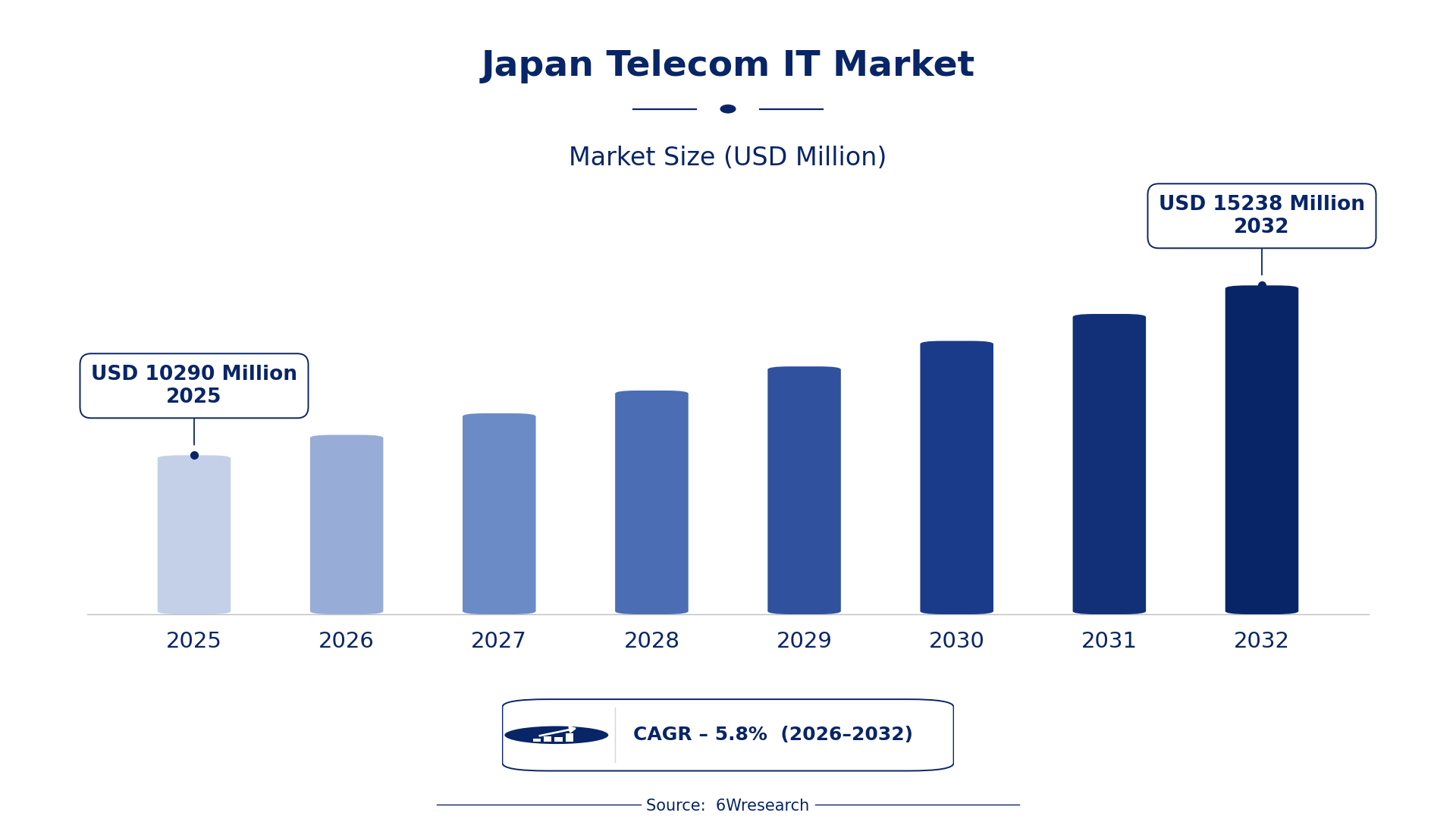
According to 6Wresearch internal database and industry insights, the Japan Telecom IT Market was valued at USD 10,290 Million in 2025 and is projected to reach USD 15,238 Million by 2032, growing at a CAGR of approximately 5.8% during 2026–2032.
Japan Telecom IT Market Highlights
| Report Metric | Details |
| Report Name | Japan Telecom IT Market (2026-2032) |
| Market Size 2025 | USD 10,290 Million |
| Market Size 2032 | USD 15,238 Million |
| Absolute Growth 2025–2032 | USD 4,948 Million |
| CAGR 2026–2032 | 5.8% |
| Peak Annual Growth | 7.4% in 2026 |
| Forecast Period | 2026–2032 |
| Historical Data | 2022–2025 |
| Base Year | 2025 |
| Leading Telecom IT Type, 2025 | OSS/BSS Systems (41% share) |
| Leading Product Type, 2025 | Operational Software (50% share) |
| Leading Solution Category, 2025 | Billing/Support (43% share) |
| Leading Distribution Channel, 2025 | IT Vendors (39% share) |
| Leading End User Industry, 2025 | CSPs (48% share) |
| Fastest-Growing Telecom IT Type | CRM & ERP Solutions (8.4% CAGR) |
| Fastest-Growing Product Type | Business Apps (7.9% CAGR) |
| Fastest-Growing Solution Category | Customer Engagement (8.1% CAGR) |
| Fastest-Growing Distribution Channel | Direct Sales (7.4% CAGR) |
| Fastest-Growing End User Industry | Telecom Enterprises (7.5% CAGR) |
| Growing Sector | Telecommunications |
| Key End Users | CSPs, Telecom Enterprises, IT Vendors |
Japan Telecom IT Market Year-wise Growth Rate and Key Drivers (2022–2032)
This graph illustrates the annual growth rates of the market from 2022 to 2032, highlighting a steady upward trajectory and projected market expansion over the forecast period.
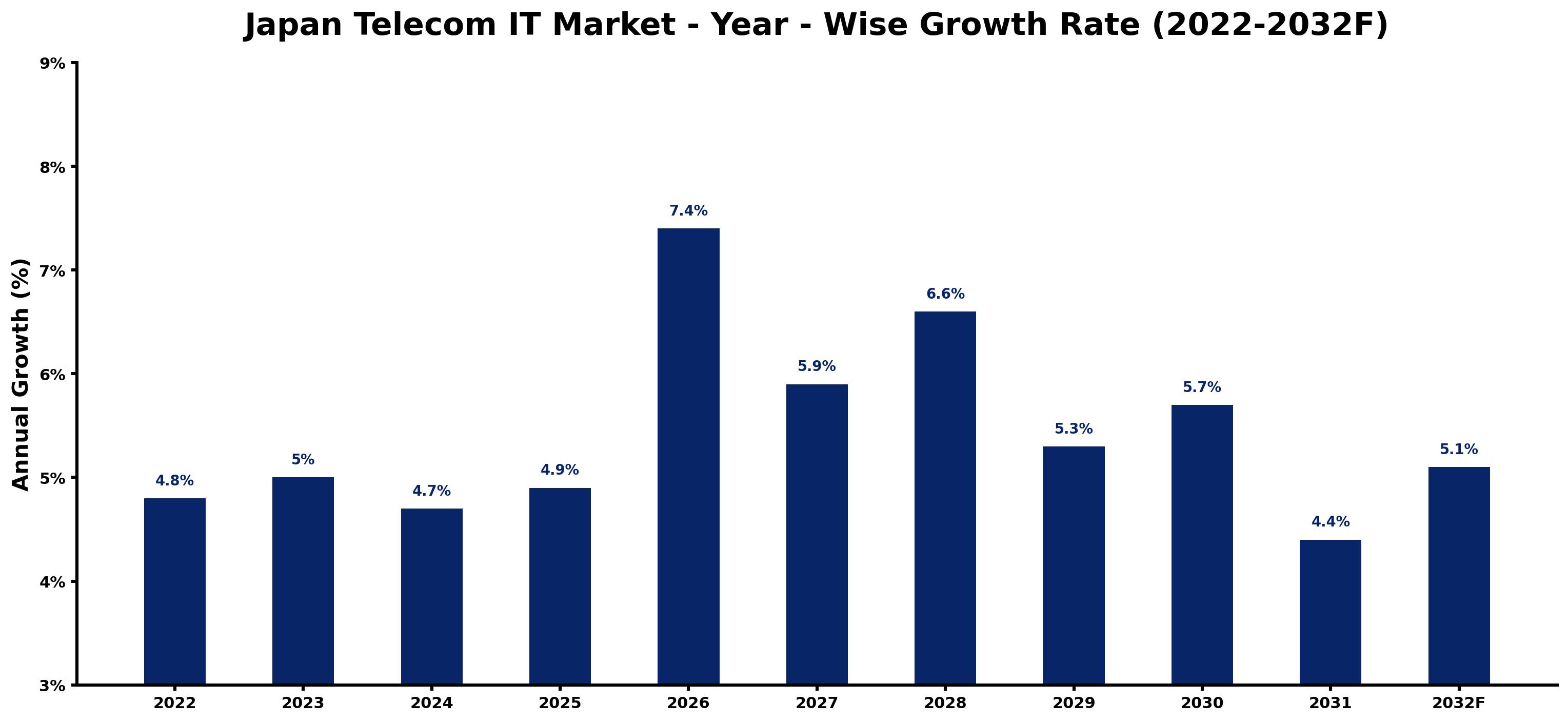
The yearly estimates that follow link every growth rate to its principal driver, so readers can see why the pace changed in each period.
| Year | Estimated Annual Growth (%) | Market Rationale |
| 2022 | 4.8 | The market experienced steady demand from domestic users and technological advancements. |
| 2023 | 5.0 | Growth was driven by increased mobile subscriptions and ongoing network upgrades. |
| 2024 | 4.7 | Demand slowed as market saturation began to affect growth rates. |
| 2025 | 4.9 | Technological investments in 5G infrastructure led to renewed growth in the sector. |
| 2026 | 7.4 | The peak growth rate is expected to be supported by heightened demand for operational software solutions. |
| 2027 | 5.9 | A slowdown is projected as the market adjusts to the rapid growth of previous years. |
| 2028 | 6.6 | Demand is expected to increase again as customer engagement tools gain traction among telecom enterprises. |
| 2029 | 5.3 | Slower growth is anticipated as competition intensifies in the telecom IT sector. |
| 2030 | 5.7 | Growth is projected to pick up due to rising investments in data center management solutions. |
| 2031 | 4.4 | A slowdown is expected as market maturity sets in, affecting new investments. |
| 2032 | 5.1 | Growth is projected to rebound as new technologies and services are introduced to the market. |
Note: Market size estimations and growth projections presented in this report are based on 6Wresearch's proprietary forecasting methodology, utilizing the latest available industry data, government publications, and primary research inputs.
Japan Telecom IT Market Synopsis
Telecom IT includes a variety of technologies and software solutions that support telecommunications operations, such as operational support systems and customer relationship management tools. In Japan, the market benefits from a user base of over 100 million mobile subscribers and continuous investments in 5G infrastructure. The demand is further driven by the need for enhanced customer service and network efficiency, with notable contributions from telecom enterprises and cloud integrators. The total telecom market is valued at approximately $60 billion, underscoring the considerable investment potential in this sector.
Market Dynamics Impact Analysis (2026–2032)
| Factor | Type | Impact | Primary Segment Affected |
| Increasing mobile subscriptions drive demand for operational software solutions. | Driver | High | Operational Software |
| The rise of 5G technology creates opportunities for new telecom IT solutions. | Opportunity | High | Network Analytics Software |
| Regulatory compliance requirements for data management restrict operational flexibility. | Restraint | Medium | Data Center Management |
| High competition among IT vendors leads to pricing pressures. | Challenge | High | IT Vendors |
| Growing customer engagement needs push demand for CRM solutions. | Driver | High | CRM & ERP Solutions |
| Investment in hybrid cloud solutions is essential for modern telecom operations. | Opportunity | Medium | Hybrid Cloud |
| Limited skilled workforce affects the implementation of new technologies. | Restraint | Medium | Operational Software |
| Rapid technological changes require constant adaptation from suppliers. | Challenge | High | Telecom Enterprises |
Evaluation of Drivers in Japan Telecom IT Market (2026–2032)
The main growth drivers and the segments they affect most are set out below.
| Drivers | Primary Segment Affected | Why It Matters (Evidence) |
| Growing mobile subscriptions increase demand for operational software. | Operational Software | With over 100 million mobile subscribers, telecom operators require efficient management tools. |
| Investment in 5G infrastructure boosts network analytics software needs. | Network Analytics Software | The government aims to achieve 99% broadband access by 2025, leading to increased demand for optimization tools. |
| Rising customer engagement rates drive CRM and ERP solution adoption. | CRM & ERP Solutions | The average customer engagement rate is around 75%, prompting operators to improve service delivery. |
| The need for real-time monitoring tools increases demand for operational software. | Real-time Monitoring | CSPs are increasingly adopting real-time monitoring for network reliability, necessitating advanced solutions. |
| The shift towards hybrid cloud solutions increases demand for cloud integrators. | Hybrid Cloud | Cloud integrators are essential for the transition to hybrid solutions in telecom. |
Volumes grow on the back of the increasing number of mobile subscribers, which exceeds 100 million in Japan. This substantial user base drives demand for operational software, essential for managing telecom operations. Investment in 5G infrastructure boosts the need for network analytics software to optimize performance. The average customer engagement rate of around 75% pushes telecom operators to adopt CRM solutions, improving service delivery. Increasing implementation of real-time monitoring tools ensures network reliability, driving further demand for operational software solutions.
Evaluation of Restraints in Japan Telecom IT Market
These are the pressures that could keep growth below its potential.
| Market Restraint | Primary Segment Affected | Why It Matters (Evidence) |
| Regulatory compliance requirements limit operational flexibility for data management solutions. | Data Center Management | Compliance with standards like ISO/IEC 27001 imposes strict guidelines on data handling. |
| High competition among IT vendors leads to pricing pressures on telecom IT solutions. | IT Vendors | Intense competition forces vendors to lower prices, impacting profitability. |
| Limited skilled workforce hampers the implementation of advanced telecom IT solutions. | Operational Software | A shortage of qualified professionals delays the deployment of critical systems. |
| Technological changes require constant adaptation, straining resources for telecom enterprises. | Telecom Enterprises | Rapid advancements necessitate ongoing training and investment in new technologies. |
| Market maturity leads to slower growth rates as saturation occurs. | CRM & ERP Solutions | As the market stabilizes, growth rates are expected to decline. |
Japan Telecom IT Market Challenges
Buyers encounter regulatory hurdles from the Ministry of Internal Affairs and Communications, causing project delays of up to six months that hinder service rollouts for telecom enterprises. Supply chain disruptions stem from reliance on a limited number of technology providers, resulting in potential downtimes that can cost telecom operators millions in lost revenue. Increased competition from tech startups in Tokyo compels established firms to allocate resources to innovation, which can slow down critical infrastructure upgrades. Rising operational costs associated with compliance to ISO/IEC 27001 standards can diminish profit margins for over 80% of telecom operations.
Trends in the Japan Telecom IT Market
The following changes are redrawing the Japan Telecom IT Market.
- Growing Adoption of Real-time Monitoring Tools: CSPs are implementing real-time monitoring tools, with over 75% adopting these solutions to ensure network reliability. This trend reflects the industry's focus on immediate oversight and operational efficiency.
- Shift Towards Hybrid Cloud Solutions: Cloud integrators are facilitating the transition to hybrid cloud solutions, with projections indicating that by 2025, 60% of telecom enterprises will adopt this model. This shift allows for greater flexibility in telecom operations.
- Emergence of Customer Engagement Solutions: Customer engagement solutions are gaining traction, with a projected growth rate of 8.1% by 2026. This trend is evident in the increasing adoption of CRM systems among telecom operators to improve user interactions.
- Rising Demand for Network Analytics Software: Network analytics software is becoming essential for managing Japan's extensive telecom networks, with a significant portion of telecom enterprises investing in these solutions to optimize performance and reliability.
Investment Opportunities in the Japan Telecom IT Market
The opportunities below stand out in the Japan Telecom IT Market for new entrants and existing suppliers.
- Telecom Enterprises Seeking Advanced Solutions: Telecom enterprises are increasingly pursuing advanced operational software solutions to boost efficiency, with the market valued at approximately $60 billion. Collaborating with local tech startups can yield innovative solutions.
- Significant Investment in 5G Infrastructure: With the government aiming for 99% broadband access by 2025, there exists a substantial opportunity for investment in 5G infrastructure. Local partners can facilitate entry into this expanding market.
- Growing Need for CRM Solutions: The rising customer engagement rate of around 75% creates a demand for CRM solutions. Companies can penetrate this market by forming joint ventures with established telecom service providers.
- Expansion of SaaS Platforms: SaaS platforms are expected to grow rapidly, with an anticipated increase in adoption among telecom enterprises. Entering this market through partnerships with cloud integrators can improve service offerings.
Government Initiatives in the Japan Telecom IT Market
The AI Promotion Act, enacted in 2025, complements the existing regulatory framework by providing guidelines for AI development in telecom. This measure aligns with the Digital Agency's initiatives for digital transformation, ensuring that telecom IT solutions meet national standards and improve operational efficiency for providers.
In 2023, the government allocated $500 million to enhance broadband access, overseen by the Ministry of Internal Affairs and Communications. This funding supports the development of telecom infrastructure and improves service delivery across the country.
Future Insight of the Japan Telecom IT Market
By 2032, a shift in government policy will prioritise 5G infrastructure development, aiming for 100% broadband access by 2025. This will encourage suppliers to implement advanced technologies such as real-time monitoring tools, improving network reliability. The adoption of data centre management solutions will assist over 200 telecom enterprises in optimising operations. As cloud integration becomes more widespread, buyers will benefit from enhanced service delivery and operational efficiency, allowing them to respond swiftly to market demands.
Market Segmentation Analysis
Japan Telecom IT Market report covers a detailed analysis of the following market segments:
By Telecom IT Type – OSS/BSS Systems Lead, CRM & ERP Solutions Expected to Grow Fastest
According to Saurav Kr Singh, Senior Research Analyst at 6Wresearch, in 2025, OSS/BSS Systems led the telecom it type split with a 41% share. OSS/BSS systems hold the largest market share as they are critical for managing telecom operations, ensuring efficiency and reliability. These systems are essential for over 80% of telecom activities, making them indispensable for service providers. CRM & ERP Solutions are projected to grow fastest, at a CAGR of 8.4% during 2026–2032. The rapid growth of CRM and ERP solutions is propelled by the increasing demand for effective customer relationship management, particularly in enhancing engagement rates. As telecom companies focus on improving customer satisfaction and retention, this segment is likely to continue expanding. Suppliers must prioritise the development of OSS/BSS capabilities to align with the rising demands from telecom operators.
By Product Type – Operational Software Leads, Business Apps Expected to Grow Fastest
With 50% of product type revenue in 2025, Operational Software was the largest category. Operational software leads the market due to its vital role in daily telecom operations, facilitating seamless service delivery and network management. This software is crucial for over 80% of telecom activities, underscoring its importance for providers. The quickest growth will come from Business Apps, forecast to expand at a CAGR of 7.9% between 2026 and 2032. Business apps are witnessing rapid growth as they provide essential tools that enhance operational efficiency and customer interactions. The increasing demand for integrated solutions in telecom is driving this segment's swift expansion. Buyers should invest in comprehensive operational software to optimise their telecom processes.
By Solution Category – Billing/Support Leads, Customer Engagement Expected to Grow Fastest
Billing/Support accounted for 43% of the market by solution category in 2025. Billing and support solutions hold the largest share as they are core functions for managing telecom revenue, essential for processing transactions and customer inquiries. They play a critical role in overseeing over $50 billion in revenue generated by telecom services. Customer Engagement is set to record the highest CAGR in this split, 8.1% over 2026–2032. Customer engagement solutions are experiencing swift growth as they improve interactions with users, leading to enhanced customer satisfaction and loyalty. This segment's expansion reflects the industry's shift towards prioritising customer experience. Suppliers need to innovate in customer engagement solutions to meet the changing expectations of telecom users.
By Distribution Channel – IT Vendors Lead, Direct Sales Expected to Grow Fastest
IT Vendors took 39% of distribution channel revenue in 2025, more than any other category. IT vendors lead the distribution channel as they are the primary suppliers of telecom IT solutions, providing essential technologies and services to operators. Their established relationships with telecom companies ensure consistent demand for their offerings. Over 2026–2032, Direct Sales is expected to post the fastest growth, at a CAGR of 7.4%. Direct sales are gaining momentum as telecom companies seek more personalised services and tailored solutions. This trend indicates a shift towards closer engagement between suppliers and telecom enterprises, enhancing customer relationships. Suppliers should explore direct sales strategies to strengthen connections with telecom clients.
By End User Industry – CSPs Lead, Telecom Enterprises Expected to Grow Fastest
The largest end user industry category in 2025 was CSPs, at 48% of revenue. CSPs are the largest end user group as they are the primary users of telecom IT solutions, heavily relying on these technologies for operational efficiency. With over 100 million mobile subscribers, CSPs are pivotal in the telecom ecosystem. Telecom Enterprises are projected to grow fastest, at a CAGR of 7.5% during 2026–2032. Telecom enterprises are rapidly adopting telecom IT solutions to enhance their operational capabilities and service offerings. This growth is driven by the need for a competitive edge in a saturated market. Suppliers should tailor their offerings to meet the specific needs of telecom enterprises to capture this expanding market.
Key Attractiveness of the Report
- 10 Years of Market Numbers
- Historical Data Starting from 2022 to 2025
- Base Year 2025
- Forecast Data until 2032
- Key Performance Indicators Impacting the Market
- Major Upcoming Developments and Projects
Key Highlights of the Report:
- Japan Telecom IT Market Outlook
- Market Size of Japan Telecom IT Market, 2025
- Forecast of Japan Telecom IT Market, 2032
- Historical Data and Forecast of Japan Telecom IT Revenues & Volume for the Period 2022-2032F
- Japan Telecom IT Market Trend Evolution
- Japan Telecom IT Market Drivers and Challenges
- Japan Telecom IT Price Trends
- Japan Telecom IT Porter's Five Forces
- Japan Telecom IT Industry Life Cycle
- Historical Data and Forecast of Japan Telecom IT Market Revenues & Volume By Telecom IT Type for the Period 2022-2032F
- Historical Data and Forecast of Japan Telecom IT Market Revenues & Volume By OSS/BSS Systems for the Period 2022-2032F
- Historical Data and Forecast of Japan Telecom IT Market Revenues & Volume By CRM & ERP Solutions for the Period 2022-2032F
- Historical Data and Forecast of Japan Telecom IT Market Revenues & Volume By Network Analytics Software for the Period 2022-2032F
- Historical Data and Forecast of Japan Telecom IT Market Revenues & Volume By Data Center Management for the Period 2022-2032F
- Historical Data and Forecast of Japan Telecom IT Market Revenues & Volume By Product Type for the Period 2022-2032F
- Historical Data and Forecast of Japan Telecom IT Market Revenues & Volume By Operational Software for the Period 2022-2032F
- Historical Data and Forecast of Japan Telecom IT Market Revenues & Volume By Business Apps for the Period 2022-2032F
- Historical Data and Forecast of Japan Telecom IT Market Revenues & Volume By Real-time Monitoring for the Period 2022-2032F
- Historical Data and Forecast of Japan Telecom IT Market Revenues & Volume By Orchestration Tools for the Period 2022-2032F
- Historical Data and Forecast of Japan Telecom IT Market Revenues & Volume By Solution Category for the Period 2022-2032F
- Historical Data and Forecast of Japan Telecom IT Market Revenues & Volume By Billing/Support for the Period 2022-2032F
- Historical Data and Forecast of Japan Telecom IT Market Revenues & Volume By Customer Engagement for the Period 2022-2032F
- Historical Data and Forecast of Japan Telecom IT Market Revenues & Volume By Predictive Analytics for the Period 2022-2032F
- Historical Data and Forecast of Japan Telecom IT Market Revenues & Volume By Hybrid Cloud for the Period 2022-2032F
- Historical Data and Forecast of Japan Telecom IT Market Revenues & Volume By Distribution Channel for the Period 2022-2032F
- Historical Data and Forecast of Japan Telecom IT Market Revenues & Volume By IT Vendors for the Period 2022-2032F
- Historical Data and Forecast of Japan Telecom IT Market Revenues & Volume By Direct Sales for the Period 2022-2032F
- Historical Data and Forecast of Japan Telecom IT Market Revenues & Volume By SaaS Platforms for the Period 2022-2032F
- Historical Data and Forecast of Japan Telecom IT Market Revenues & Volume By Cloud Integrators for the Period 2022-2032F
- Historical Data and Forecast of Japan Telecom IT Market Revenues & Volume By End User Industry for the Period 2022-2032F
- Historical Data and Forecast of Japan Telecom IT Market Revenues & Volume By CSPs for the Period 2022-2032F
- Historical Data and Forecast of Japan Telecom IT Market Revenues & Volume By Telecom Enterprises for the Period 2022-2032F
- Historical Data and Forecast of Japan Telecom IT Market Revenues & Volume By Managed Services for the Period 2022-2032F
- Historical Data and Forecast of Japan Telecom IT Market Revenues & Volume By Telco Cloud Providers for the Period 2022-2032F
- Japan Telecom IT Import Export Trade Statistics
- Market Opportunity Assessment By Telecom IT Type
- Market Opportunity Assessment By Product Type
- Market Opportunity Assessment By Solution Category
- Market Opportunity Assessment By Distribution Channel
- Market Opportunity Assessment By End User Industry
- Japan Telecom IT Top Companies Market Share
- Japan Telecom IT Competitive Benchmarking By Technical and Operational Parameters
- Japan Telecom IT Company Profiles
- Japan Telecom IT Key Strategic Recommendations
Market Covered
Segments analysed in this report are listed below.
By Telecom IT Type
- OSS/BSS Systems
- CRM & ERP Solutions
- Network Analytics Software
- Data Center Management
By Product Type
- Operational Software
- Business Apps
- Real-time Monitoring
- Orchestration Tools
By Solution Category
- Billing/Support
- Customer Engagement
- Predictive Analytics
- Hybrid Cloud
By Distribution Channel
- IT Vendors
- Direct Sales
- SaaS Platforms
- Cloud Integrators
By End User Industry
- CSPs
- Telecom Enterprises
- Managed Services
- Telco Cloud Providers































