Japan Telecom Network Orchestration Market Size & Growth Rate
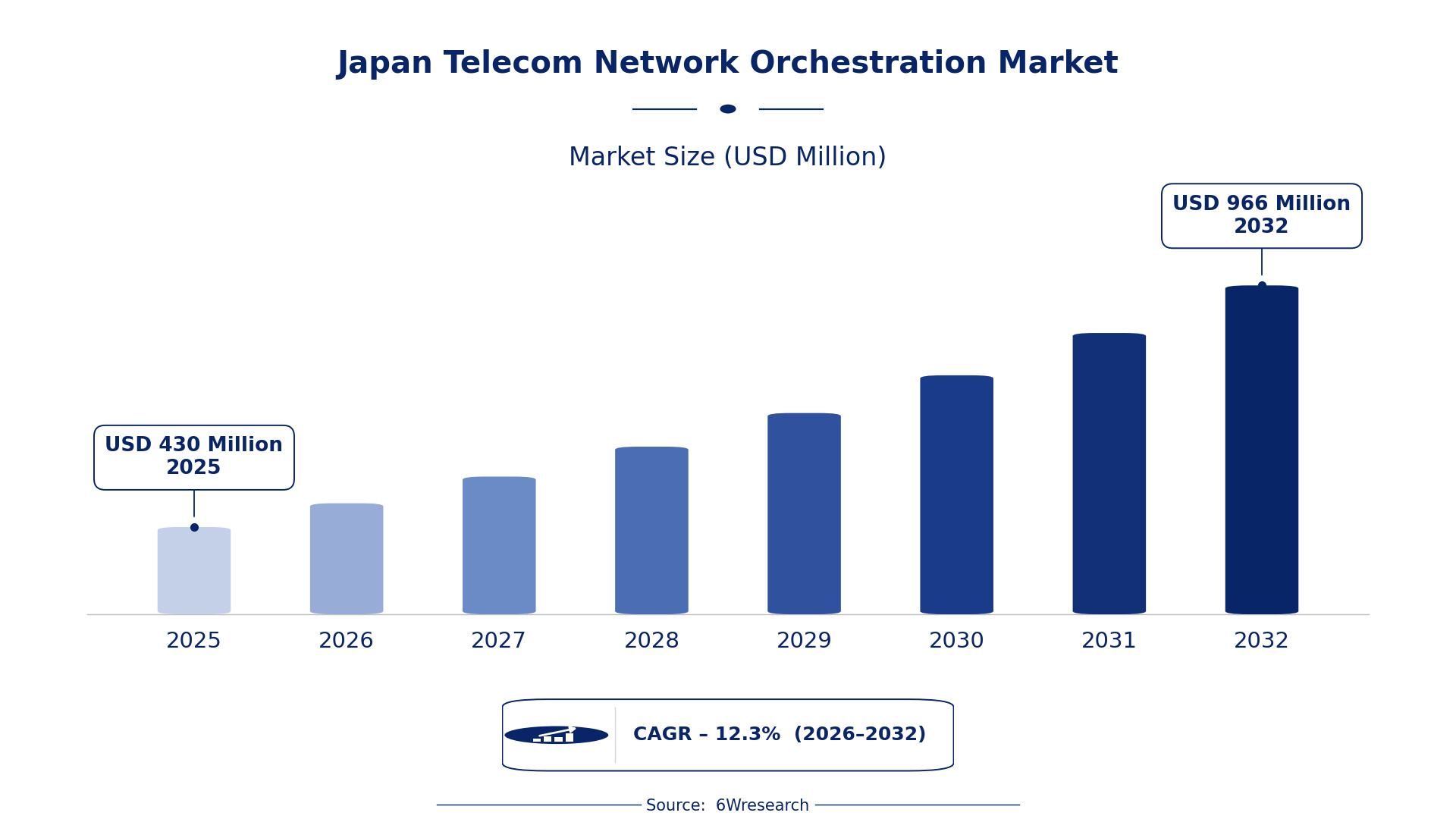
According to 6Wresearch internal database and industry insights, the Japan Telecom Network Orchestration Market was valued at USD 430 Million in 2025 and is projected to reach USD 966 Million by 2032, growing at a CAGR of approximately 12.3% during 2026–2032.
Japan Telecom Network Orchestration Market Highlights
| Report Metric | Details |
| Report Name | Japan Telecom Network Orchestration Market (2026-2032) |
| Market Size 2025 | USD 430 Million |
| Market Size 2032 | USD 966 Million |
| Absolute Growth 2025–2032 | USD 536 Million |
| CAGR 2026–2032 | 12.3% |
| Peak Annual Growth | 14.0% in 2030 |
| Forecast Period | 2026–2032 |
| Historical Data | 2022–2025 |
| Base Year | 2025 |
| Leading Network Orchestration, 2025 | SDN Orchestration (38% share) |
| Leading Product Type, 2025 | Software Controllers (36% share) |
| Leading Platform Type, 2025 | OpenFlow (43% share) |
| Leading Distribution Channel, 2025 | Direct Sales (45% share) |
| Leading End User Industry, 2025 | Network Providers (50% share) |
| Fastest-Growing Network Orchestration | NFV Orchestration (15.8% CAGR) |
| Fastest-Growing Product Type | VNFs Manager (17.7% CAGR) |
| Fastest-Growing Platform Type | MANO Framework (17.9% CAGR) |
| Fastest-Growing Distribution Channel | Cloud Integrators (16.0% CAGR) |
| Fastest-Growing End User Industry | Virtual Telcos (16.6% CAGR) |
| Growing Sector | Virtual Telcos |
| Key End Users | Network Providers, Virtual Telcos, Enterprise Networks, IoT Networks |
Japan Telecom Network Orchestration Market Year-wise Growth Rate and Key Drivers (2022–2032)
This graph illustrates the annual growth rates of the market from 2022 to 2032, highlighting a steady upward trajectory and projected market expansion over the forecast period.
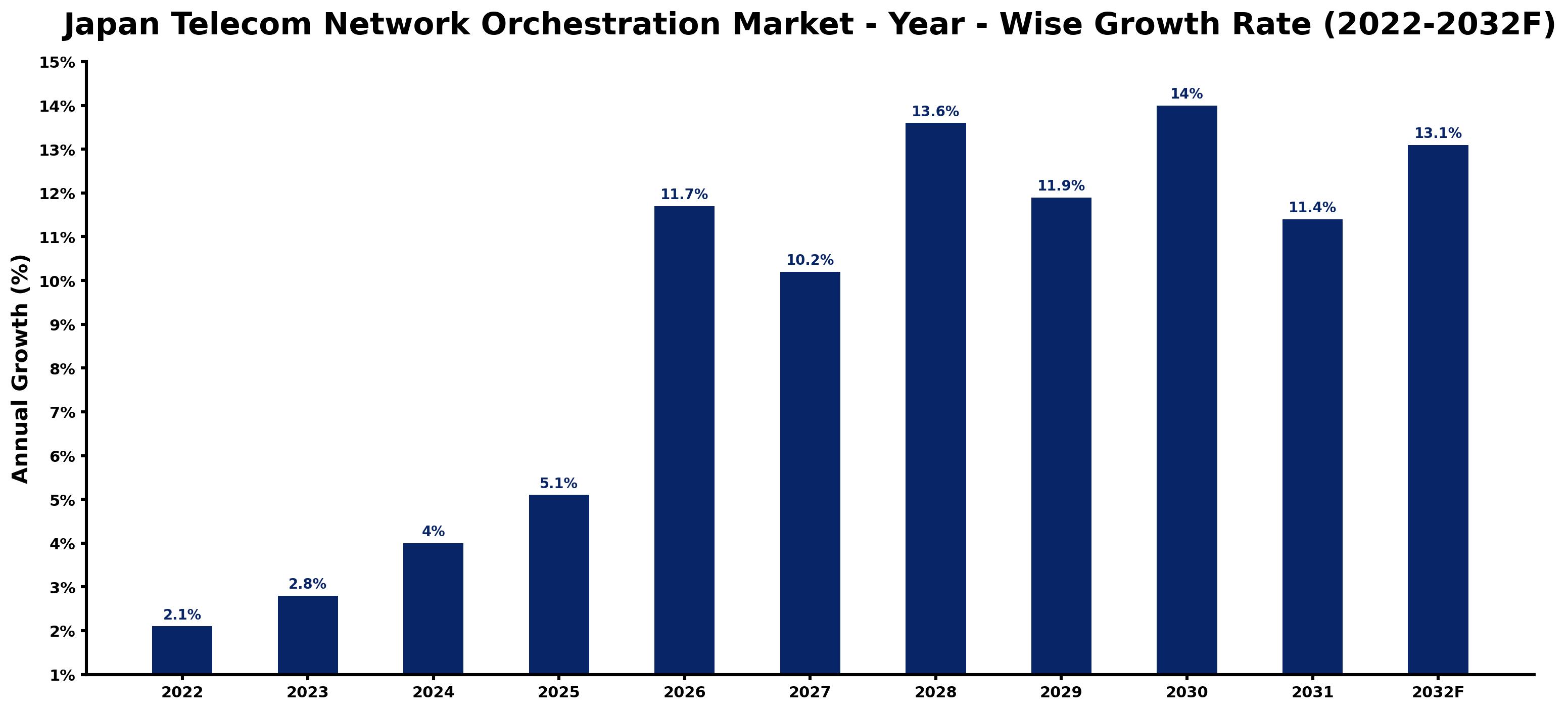
For each year, the table pairs the estimated growth rate with the leading influence on demand, showing how the drivers changed across the period.
| Year | Estimated Annual Growth (%) | Market Rationale |
| 2022 | 2.1 | The market experienced steady growth due to increasing adoption of SDN technologies. |
| 2023 | 2.8 | Growth accelerated as telecom operators improved their network capabilities with orchestration solutions. |
| 2024 | 4.0 | The introduction of new 5G services further stimulated demand for orchestration technologies. |
| 2025 | 5.1 | The market peaked historically as operational efficiencies became a priority for telecom providers. |
| 2026 | 11.7 | Growth is expected to surge as investments in AI and machine learning technologies gain traction. |
| 2027 | 10.2 | The market will continue to grow, but at a slower rate as initial investments mature. |
| 2028 | 13.6 | Demand is projected to increase again as more enterprises adopt orchestration for IoT networks. |
| 2029 | 11.9 | Growth is anticipated to slow slightly as market saturation begins to affect new deployments. |
| 2030 | 14.0 | A peak in growth is expected as 5G networks expand across the country. |
| 2031 | 11.4 | The market will experience a slowdown as growth stabilises following rapid expansion. |
| 2032 | 13.1 | Demand is projected to rise again as new technologies emerge and service offerings expand. |
Note: Market size estimations and growth projections presented in this report are based on 6Wresearch's proprietary forecasting methodology, utilizing the latest available industry data, government publications, and primary research inputs.
Japan Telecom Network Orchestration Market Synopsis
Telecom Network Orchestration automates and manages network resources through software-defined networking and network functions virtualization. This technology improves network efficiency, reduces operational costs, and enables faster service deployment. The Japan Telecom Network Orchestration Market is growing due to rising investments in 5G networks and IoT connectivity. The increasing number of mobile subscribers and the push for digital transformation further drive demand, particularly among network providers and virtual telcos.
Market Dynamics Impact Analysis (2026–2032)
| Factor | Type | Impact | Primary Segment Affected |
| Increasing adoption of SDN technologies | Driver | High | SDN Orchestration |
| Rising demand for 5G services | Driver | High | NFV Orchestration |
| Growing IoT device deployment | Opportunity | High | Edge Orchestration |
| Expansion of virtual telecom operators | Opportunity | Medium | SDN Orchestration |
| High operational costs for telecom providers | Restraint | High | End-to-End Orchestration |
| Complex integration of legacy systems | Restraint | Medium | Software Controllers |
| Talent shortages in network orchestration | Challenge | High | VNFs Manager |
| Rapid technological advancements | Challenge | Medium | Hybrid Controllers |
Evaluation of Drivers in Japan Telecom Network Orchestration Market (2026–2032)
Below are the drivers that matter most for revenue growth, with supporting evidence.
| Drivers | Primary Segment Affected | Why It Matters (Evidence) |
| Growing investments in AI and machine learning | Edge Orchestration | This investment improves network management efficiency, leading to increased purchases by network providers. |
| Expansion of 5G networks | NFV Orchestration | The rollout of 5G services drives demand for orchestration solutions, increasing purchases by telecom operators. |
| Rising number of IoT devices | SDN Orchestration | With projections of 1 billion IoT devices by 2025, demand for orchestration to manage these devices grows. |
| Digital transformation initiatives | End-to-End Orchestration | The push for digitalisation among enterprises boosts the need for orchestration solutions, particularly in enterprise networks. |
| Increase in mobile subscribers | Software Controllers | With over 150 million mobile subscribers, telecom providers are investing in orchestration to improve service delivery. |
Much of the new demand traces back to the increasing investments in AI and machine learning technologies, projected to reach substantial levels by 2025. The expansion of 5G networks is driving telecom operators to adopt orchestration solutions, with the number of mobile subscribers exceeding 150 million. The rising number of IoT devices, projected to hit 1 billion by 2025, necessitates efficient network management.
Evaluation of Restraints in Japan Telecom Network Orchestration Market
Several factors work against faster growth; the main ones are summarised below.
| Market Restraint | Primary Segment Affected | Why It Matters (Evidence) |
| High operational costs for telecom providers | End-to-End Orchestration | Rising costs limit investment in orchestration technologies, affecting network efficiency. |
| Complex integration of legacy systems | Software Controllers | Legacy systems hinder the adoption of new orchestration solutions, delaying implementation. |
| Talent shortages in network orchestration | VNFs Manager | A lack of skilled professionals impacts the ability to implement orchestration effectively. |
| Rapid technological advancements | Hybrid Controllers | Keeping pace with technology changes can strain resources and delay deployments. |
| Market saturation in certain areas | SDN Orchestration | Saturation limits growth opportunities for new entrants and existing providers. |
Japan Telecom Network Orchestration Market Challenges
Buyers in Japan's telecom market face escalating operational costs due to the rising demand for network orchestration solutions. This demand, fuelled by over 150 million mobile subscribers, increases expenses by approximately 20% for telecom operators. Supply chain issues emerge as operators struggle to integrate technologies like SDN and NFV, resulting in service deployment delays of up to six months for buyers. Rapid technological changes necessitate ongoing investments in compliance with standards such as ISO/IEC 27001, complicating financial planning and diverting resources from essential upgrades.
Trends in the Japan Telecom Network Orchestration Market
These developments are changing demand patterns in the Japan Telecom Network Orchestration Market.
- Shift towards AI-Powered Orchestration: The adoption of AI-powered orchestration is increasing among telecom providers, improving operational efficiency. As of 2023, over 30 virtual telecom operators are implementing these solutions, indicating a shift towards automation.
- Transition from Traditional to Cloud-Based Solutions: Telecom operators are increasingly moving towards cloud-based orchestration solutions, driven by the need for flexibility. The number of broadband subscriptions in Japan has surpassed 40 million, supporting this transition.
- Emergence of Edge Computing: Edge computing is becoming essential for managing IoT connectivity, with substantial investments in edge orchestration. By 2025, the number of IoT devices in Japan is projected to reach 1 billion, highlighting this trend.
- Growing Focus on 5G Network Capabilities: The push for 5G network capabilities has led to increased investments in orchestration technologies. The government aims for nationwide 5G coverage by 2025, driving demand for orchestration solutions.
Investment Opportunities in the Japan Telecom Network Orchestration Market
The opportunities below stand out in the Japan Telecom Network Orchestration Market for new entrants and existing suppliers.
- Partnerships with Cloud Integrators: Telecom providers can partner with cloud integrators to improve service delivery. With a projected growth of 16.0% for cloud integrators, this collaboration is timely for network providers.
- Investing in Edge Computing Solutions: The demand for edge computing solutions is rising among IoT networks, presenting a significant opportunity. The Tokyo Metropolitan Government supports innovation in telecom technologies, facilitating entry.
- Expansion into Virtual Telecom Market: With over 30 virtual telecom operators in operation, there is a growing opportunity for orchestration solutions. This market is expanding, making it an ideal time for investment.
- Focus on Digital Transformation Initiatives: As enterprises push for digital transformation, there is a need for orchestration solutions. The Ministry of Economy, Trade and Industry promotes this transformation, creating opportunities for suppliers.
Government Initiatives in the Japan Telecom Network Orchestration Market
The GX Promotion Act, enacted in 2023, complements existing regulations by establishing a framework for green transformation in telecommunications. This act encourages telecom operators to adopt sustainable practices, improving their operational efficiency and compliance with environmental standards. Additionally, it mandates reporting on sustainability initiatives, ensuring accountability among telecom providers.
The Digital Agency, established in September 2021, supports telecom providers in implementing digital transformation strategies. This agency funds projects aimed at improving network capabilities and efficiency, benefiting both producers and consumers in the telecom sector. The agency has approved numerous initiatives, with funding exceeding 10 billion JPY to improve digital infrastructure.
Future Insight of the Japan Telecom Network Orchestration Market
Investment in telecom network orchestration will increase significantly by 2032, driven by the government's 5G strategy and the projected rise in IoT devices to 1 billion. This growth will create substantial demand for orchestration solutions, prompting suppliers to improve their offerings. The integration of AI and machine learning will streamline operations, providing buyers with enhanced efficiency. Achieving nationwide 5G coverage by 2025 will open new business opportunities, revolutionising service delivery and customer interaction.
Market Segmentation Analysis
Japan Telecom Network Orchestration Market report covers a detailed analysis of the following market segments:
By Network Orchestration – SDN Orchestration Leads, NFV Orchestration Expected to Grow Fastest
According to Saurav Kr Singh, Senior Research Analyst at 6Wresearch, SDN Orchestration held 38% of the Japan Telecom Network Orchestration Market by network orchestration in 2025. SDN Orchestration holds the largest share due to its critical role in managing network traffic efficiently, particularly among major telecom operators in Tokyo. The extensive installed base supporting over 150 million mobile subscribers underscores its importance in the market. The quickest growth will come from NFV Orchestration, forecast to expand at a CAGR of 15.8% between 2026 and 2032. NFV Orchestration is experiencing rapid growth as it is essential for virtualising network functions, aligning with the government's 5G strategy aimed at enhancing network capabilities. The projected increase in IoT devices, expected to reach 1 billion by 2025, further accelerates this segment's expansion. Suppliers must focus on NFV solutions to address the rising demand driven by network modernisation.
By Product Type – Software Controllers Lead, VNFs Manager Expected to Grow Fastest
Software Controllers accounted for 36% of the market by product type in 2025. Software Controllers dominate the market as they are vital for controlling network operations, widely utilised by telecom operators to improve efficiency. Their indispensable role in managing orchestration processes solidifies their position in Japan's telecom sector. VNFs Manager is set to record the highest CAGR in this split, 17.7% over 2026–2032. VNFs Manager is witnessing the fastest growth as it is crucial for managing virtual network functions, increasingly important for contemporary telecom infrastructures. The heightened demand for virtualisation solutions significantly contributes to this segment's rapid expansion. Suppliers should prioritise the development of VNFs Manager solutions to seize emerging market opportunities.
By Platform Type – OpenFlow Leads, MANO Framework Expected to Grow Fastest
In 2025, OpenFlow led the platform type split with a 43% share. OpenFlow leads this segment as it is extensively used as a protocol in SDN, providing a reliable framework for network management. Its established presence among telecom operators ensures its ongoing dominance in Japan's orchestration market. Over 2026–2032, MANO Framework is expected to post the fastest growth, at a CAGR of 17.9%. MANO Framework is the fastest-growing platform type as it offers a structured approach for NFV, essential for deploying virtualised services. The increasing emphasis on network efficiency and flexibility drives its swift adoption among service providers. Suppliers should consider enhancing their offerings around MANO Framework to align with market trends.
By Distribution Channel – Direct Sales Leads, Cloud Integrators Expected to Grow Fastest
With 45% of distribution channel revenue in 2025, Direct Sales was the largest category. Direct Sales is the primary distribution channel as it remains the main method for selling orchestration solutions directly to telecom operators. This strategy enables suppliers to maintain close relationships with clients and effectively address specific needs. Cloud Integrators are projected to grow fastest, at a CAGR of 16.0% during 2026–2032. Cloud Integrators are the fastest-growing channel as they facilitate the deployment of orchestration solutions, catering to the rising demand for cloud-based services. Their role in ensuring seamless integration is vital in the current market environment. Suppliers should explore partnerships with Cloud Integrators to broaden their reach and enhance service delivery.
By End User Industry – Network Providers Lead, Virtual Telcos Expected to Grow Fastest
The largest end user industry category in 2025 was Network Providers, at 50% of revenue. Network Providers are the leading segment as they are the primary users of orchestration solutions, heavily relying on these technologies to manage extensive networks. Their substantial investments in network efficiency drive the demand for orchestration services. The quickest growth will come from Virtual Telcos, forecast to expand at a CAGR of 16.6% between 2026 and 2032. Virtual Telcos are the fastest-growing end user industry as they increasingly depend on orchestration for effective service delivery in a competitive landscape. The emergence of these operators signifies a shift towards more agile and flexible network solutions. Suppliers should tailor their offerings to meet the specific needs of Virtual Telcos to capture this expanding market segment.
Key Attractiveness of the Report
- 10 Years of Market Numbers
- Historical Data Starting from 2022 to 2025
- Base Year 2025
- Forecast Data until 2032
- Key Performance Indicators Impacting the Market
- Major Upcoming Developments and Projects
Key Highlights of the Report:
- Japan Telecom Network Orchestration Market Outlook
- Market Size of Japan Telecom Network Orchestration Market, 2025
- Forecast of Japan Telecom Network Orchestration Market, 2032
- Historical Data and Forecast of Japan Telecom Network Orchestration Revenues & Volume for the Period 2022-2032F
- Japan Telecom Network Orchestration Market Trend Evolution
- Japan Telecom Network Orchestration Market Drivers and Challenges
- Japan Telecom Network Orchestration Price Trends
- Japan Telecom Network Orchestration Porter's Five Forces
- Japan Telecom Network Orchestration Industry Life Cycle
- Historical Data and Forecast of Japan Telecom Network Orchestration Market Revenues & Volume By Network Orchestration for the Period 2022-2032F
- Historical Data and Forecast of Japan Telecom Network Orchestration Market Revenues & Volume By SDN Orchestration for the Period 2022-2032F
- Historical Data and Forecast of Japan Telecom Network Orchestration Market Revenues & Volume By NFV Orchestration for the Period 2022-2032F
- Historical Data and Forecast of Japan Telecom Network Orchestration Market Revenues & Volume By End-to-End Orchestration for the Period 2022-2032F
- Historical Data and Forecast of Japan Telecom Network Orchestration Market Revenues & Volume By Edge Orchestration for the Period 2022-2032F
- Historical Data and Forecast of Japan Telecom Network Orchestration Market Revenues & Volume By Product Type for the Period 2022-2032F
- Historical Data and Forecast of Japan Telecom Network Orchestration Market Revenues & Volume By Software Controllers for the Period 2022-2032F
- Historical Data and Forecast of Japan Telecom Network Orchestration Market Revenues & Volume By VNFs Manager for the Period 2022-2032F
- Historical Data and Forecast of Japan Telecom Network Orchestration Market Revenues & Volume By Hybrid Controllers for the Period 2022-2032F
- Historical Data and Forecast of Japan Telecom Network Orchestration Market Revenues & Volume By Edge Controllers for the Period 2022-2032F
- Historical Data and Forecast of Japan Telecom Network Orchestration Market Revenues & Volume By Platform Type for the Period 2022-2032F
- Historical Data and Forecast of Japan Telecom Network Orchestration Market Revenues & Volume By OpenFlow for the Period 2022-2032F
- Historical Data and Forecast of Japan Telecom Network Orchestration Market Revenues & Volume By MANO Framework for the Period 2022-2032F
- Historical Data and Forecast of Japan Telecom Network Orchestration Market Revenues & Volume By AI-Powered for the Period 2022-2032F
- Historical Data and Forecast of Japan Telecom Network Orchestration Market Revenues & Volume By Kubernetes-based for the Period 2022-2032F
- Historical Data and Forecast of Japan Telecom Network Orchestration Market Revenues & Volume By Distribution Channel for the Period 2022-2032F
- Historical Data and Forecast of Japan Telecom Network Orchestration Market Revenues & Volume By Direct Sales for the Period 2022-2032F
- Historical Data and Forecast of Japan Telecom Network Orchestration Market Revenues & Volume By Cloud Integrators for the Period 2022-2032F
- Historical Data and Forecast of Japan Telecom Network Orchestration Market Revenues & Volume By SaaS Platforms for the Period 2022-2032F
- Historical Data and Forecast of Japan Telecom Network Orchestration Market Revenues & Volume By DevOps Partners for the Period 2022-2032F
- Historical Data and Forecast of Japan Telecom Network Orchestration Market Revenues & Volume By End User Industry for the Period 2022-2032F
- Historical Data and Forecast of Japan Telecom Network Orchestration Market Revenues & Volume By Network Providers for the Period 2022-2032F
- Historical Data and Forecast of Japan Telecom Network Orchestration Market Revenues & Volume By Virtual Telcos for the Period 2022-2032F
- Historical Data and Forecast of Japan Telecom Network Orchestration Market Revenues & Volume By Enterprise Networks for the Period 2022-2032F
- Historical Data and Forecast of Japan Telecom Network Orchestration Market Revenues & Volume By IoT Networks for the Period 2022-2032F
- Japan Telecom Network Orchestration Import Export Trade Statistics
- Market Opportunity Assessment By Network Orchestration
- Market Opportunity Assessment By Product Type
- Market Opportunity Assessment By Platform Type
- Market Opportunity Assessment By Distribution Channel
- Market Opportunity Assessment By End User Industry
- Japan Telecom Network Orchestration Top Companies Market Share
- Japan Telecom Network Orchestration Competitive Benchmarking By Technical and Operational Parameters
- Japan Telecom Network Orchestration Company Profiles
- Japan Telecom Network Orchestration Key Strategic Recommendations
Market Covered
The study includes the following segmentation.
By Network Orchestration
- SDN Orchestration
- NFV Orchestration
- End-to-End Orchestration
- Edge Orchestration
By Product Type
- Software Controllers
- VNFs Manager
- Hybrid Controllers
- Edge Controllers
By Platform Type
- OpenFlow
- MANO Framework
- AI-Powered
- Kubernetes-based
By Distribution Channel
- Direct Sales
- Cloud Integrators
- SaaS Platforms
- DevOps Partners
By End User Industry
- Network Providers
- Virtual Telcos
- Enterprise Networks
- IoT Networks































