Japan Telecom Optical Components Market Size & Growth Rate
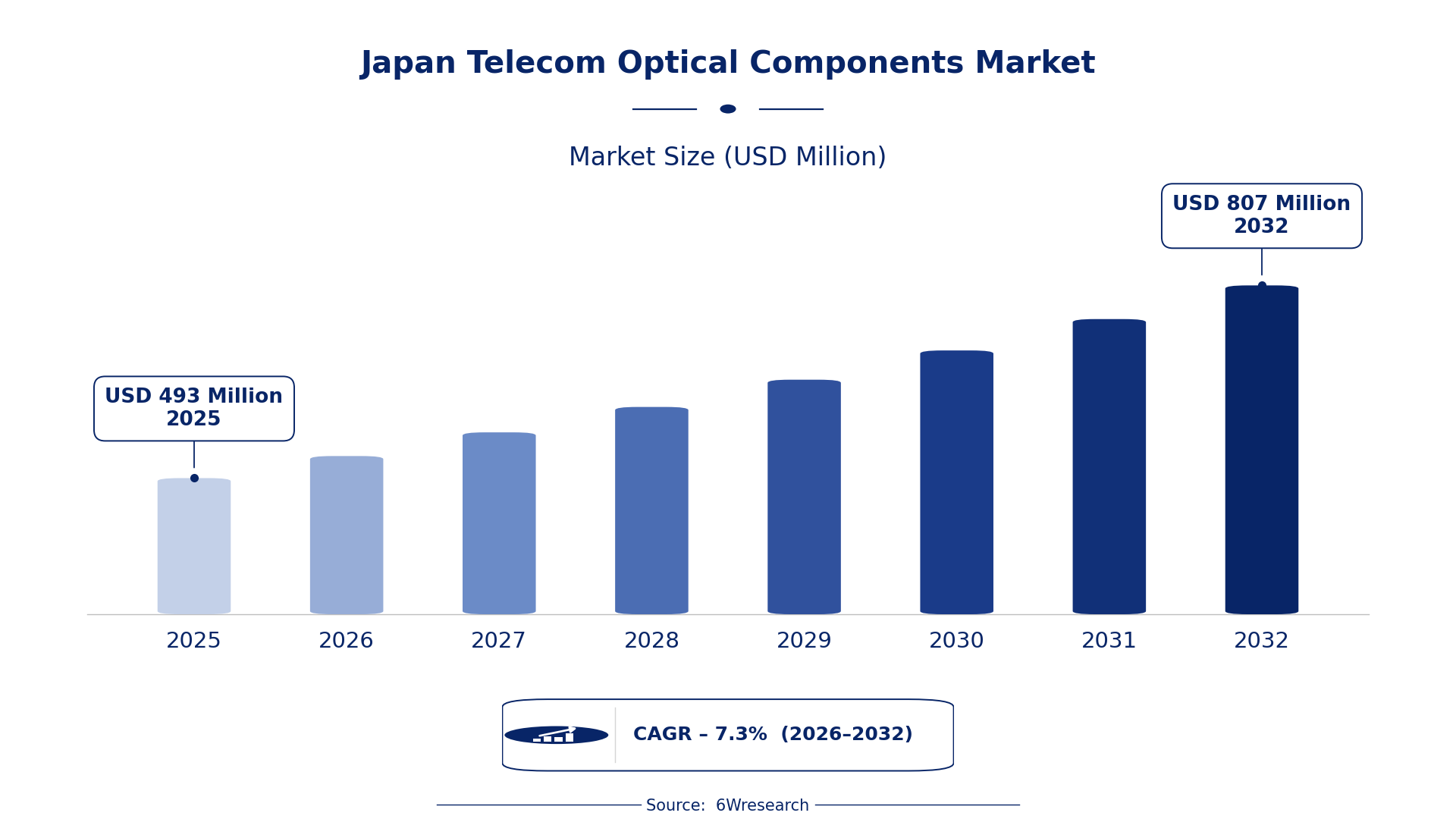
According to 6Wresearch internal database and industry insights, the Japan Telecom Optical Components Market was valued at USD 493 Million in 2025 and is projected to reach USD 807 Million by 2032, growing at a CAGR of approximately 7.3% during 2026–2032.
Japan Telecom Optical Components Market Highlights
| Report Metric | Details |
| Report Name | Japan Telecom Optical Components Market (2026-2032) |
| Market Size 2025 | USD 493 Million |
| Market Size 2032 | USD 807 Million |
| Absolute Growth 2025–2032 | USD 314 Million |
| CAGR 2026–2032 | 7.3% |
| Peak Annual Growth | 8.3% in 2032 |
| Forecast Period | 2026–2032 |
| Historical Data | 2022–2025 |
| Base Year | 2025 |
| Leading Optical Components Type, 2025 | Optical Cables & Connectors (53% share) |
| Leading Product Type, 2025 | SFP/QSFP Modules (46% share) |
| Leading Component Type, 2025 | Fiber/Connector (51% share) |
| Leading Distribution Channel, 2025 | OEM Supply (40% share) |
| Leading End User Industry, 2025 | Data Centers (40% share) |
| Fastest-Growing Optical Components Type | Optical Amplifiers (10.5% CAGR) |
| Fastest-Growing Product Type | EDFA/Raman (11.0% CAGR) |
| Fastest-Growing Component Type | DWDM/Coherent (11.2% CAGR) |
| Fastest-Growing End User Industry | Telecom Exchanges (9.7% CAGR) |
| Growing Sector | telecommunications |
| Key End Users | data centers, telecom exchanges, enterprise networks, metro networks |
Japan Telecom Optical Components Market Year-wise Growth Rate and Key Drivers (2022–2032)
This graph illustrates the annual growth rates of the market from 2022 to 2032, highlighting a steady upward trajectory and projected market expansion over the forecast period.
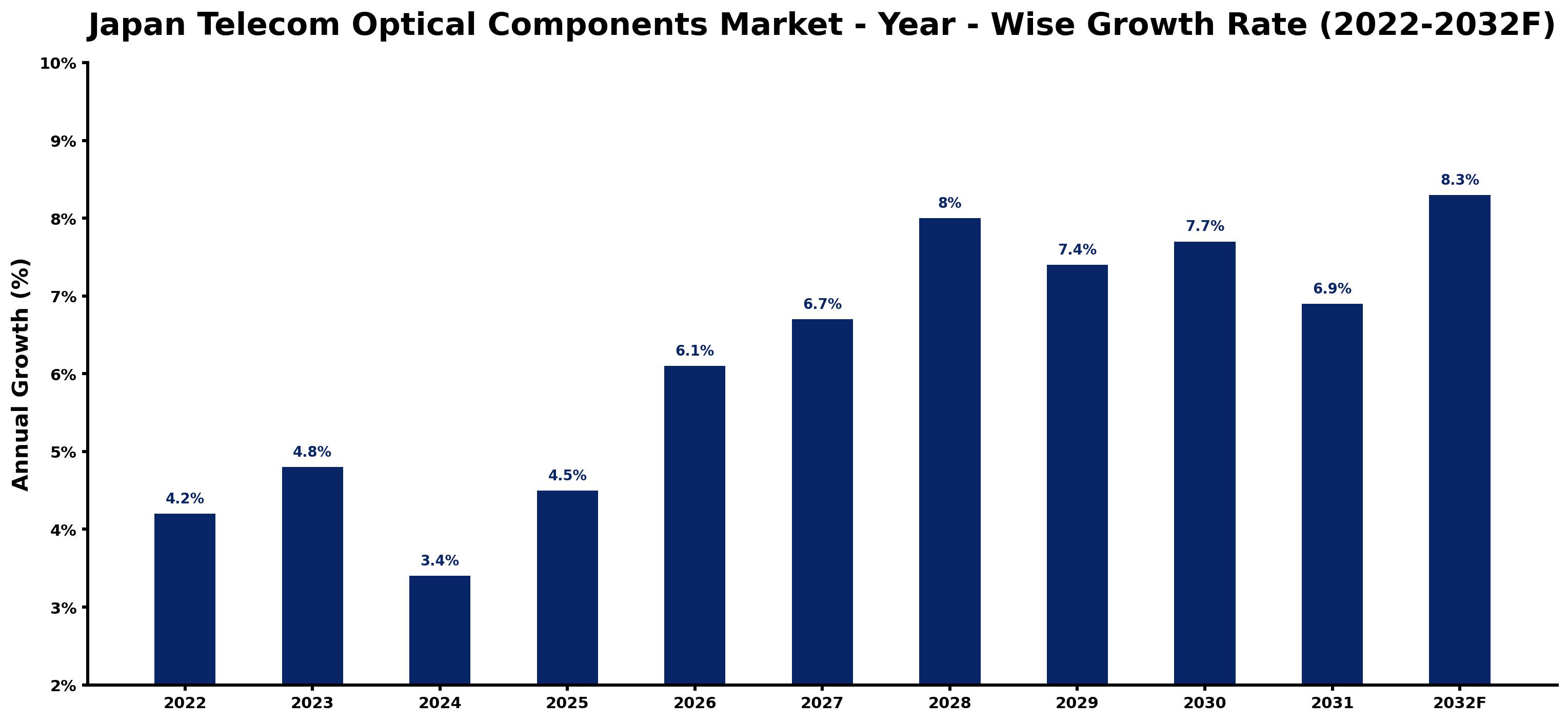
The following figures match every annual growth estimate with the main market development of that year, giving the reasoning behind each rise or slowdown.
| Year | Estimated Annual Growth (%) | Market Rationale |
| 2022 | 4.2 | The market saw steady growth, supported by ongoing infrastructure investments. |
| 2023 | 4.8 | Growth accelerated due to increased demand for high-speed data transmission. |
| 2024 | 3.4 | A slowdown occurred as investments stabilised, yet demand remained strong. |
| 2025 | 4.5 | Growth resumed as new projects in data centers drove demand for components. |
| 2026 | 6.1 | Demand is expected to rise as fiber optic coverage expands to 99%. |
| 2027 | 6.7 | Growth is projected to continue with increased investments in telecom infrastructure. |
| 2028 | 8.0 | The market is set to grow rapidly as technology adoption increases. |
| 2029 | 7.4 | A slight slowdown is anticipated as the market matures and stabilises. |
| 2030 | 7.7 | Growth is expected to rise again as new technologies are introduced. |
| 2031 | 6.9 | A slowdown is projected as the market approaches maturity. |
| 2032 | 8.3 | The market will peak with strong demand for advanced optical components. |
Note: Market size estimations and growth projections presented in this report are based on 6Wresearch's proprietary forecasting methodology, utilizing the latest available industry data, government publications, and primary research inputs.
Japan Telecom Optical Components Market Synopsis
Telecom Optical Components are crucial technologies that enable data transmission over optical fibres, produced through precision engineering. The Japan Telecom Optical Components Market is growing, driven by over 100 data centres and ongoing infrastructure investments. Rising internet speeds, averaging around 100 Mbps, and the government's goal to increase fibre optic coverage to 99% by 2025 are driving further demand for these components. This growth is supported by a strong emphasis on improving network reliability and efficiency throughout the country.
Market Dynamics Impact Analysis (2026–2032)
| Factor | Type | Impact | Primary Segment Affected |
| Growing demand for high-speed data transmission in data centers | Driver | High | Optical Transceivers |
| Expansion of fiber optic networks across urban areas | Driver | High | Optical Amplifiers |
| Increasing investments in telecom infrastructure improvements | Opportunity | High | Optical Cables & Connectors |
| Rising demand for DWDM technology in long-haul networks | Opportunity | Medium | DWDM/Coherent |
| Supply chain disruptions affecting component availability | Restraint | High | Optical Cables & Connectors |
| High production costs impacting pricing strategies | Restraint | Medium | Optical Amplifiers |
| Compliance with stringent quality standards for components | Challenge | High | Optical Transceivers |
| Capacity constraints in manufacturing facilities | Challenge | Medium | Optical Cables & Connectors |
Evaluation of Drivers in Japan Telecom Optical Components Market (2026–2032)
The following drivers explain most of the expected growth.
| Drivers | Primary Segment Affected | Why It Matters (Evidence) |
| Increased data center construction | Optical Transceivers | Over 80% of data centers in Japan utilise optical transceivers, driving demand for these components. |
| Government initiatives to improve fiber optic infrastructure | Optical Amplifiers | The Ministry of Internal Affairs and Communications initiated a programme in 2023 to enhance fiber optic networks. |
| Rising internet speeds necessitating advanced components | Optical Cables & Connectors | The average internet speed in Japan is approximately 100 Mbps, increasing the need for reliable optical connections. |
| Growing adoption of DWDM technology | DWDM/Coherent | Japan has a high adoption rate of DWDM technology, vital for long-haul communication. |
| Investment in telecom exchanges to manage traffic | Optical Switches | With over 1,500 telecom exchanges, the need for efficient optical switches is rising. |
Behind the steady rise in orders sits the rapid expansion of data centers, with over 100 facilities located primarily in Tokyo and Osaka. The average internet speed in Japan drives demand for advanced optical components. In 2023, a programme was launched to improve fiber optic infrastructure, supporting the growth of optical amplifiers. Japan's high adoption rate of DWDM technology in long-haul networks further boosts the need for optical transceivers. Investments in telecom exchanges continue to create demand for optical switches, with over 1,500 facilities managing traffic.
Evaluation of Restraints in Japan Telecom Optical Components Market
The table below lists the restraints and the evidence behind each.
| Market Restraint | Primary Segment Affected | Why It Matters (Evidence) |
| Supply chain disruptions affecting the availability of components | Optical Cables & Connectors | Ongoing global supply chain issues have delayed the production of essential optical components. |
| High production costs impacting pricing strategies | Optical Amplifiers | Rising costs of raw materials have made it challenging for manufacturers to maintain competitive pricing. |
| Compliance with stringent quality standards for components | Optical Transceivers | Manufacturers must adhere to JIS standards, increasing operational costs and complexity. |
| Limited capacity in manufacturing facilities | Optical Cables & Connectors | Existing production facilities are operating at near full capacity, restricting output. |
| Market saturation in urban areas | Optical Switches | As urban markets mature, growth opportunities for optical switches are becoming limited. |
Japan Telecom Optical Components Market Challenges
In 2023, Japan allocated ¥10 billion for telecom infrastructure improvements, yet producers face challenges with strict compliance to ISO/IEC 11801 standards, which delays product rollout and raises costs for manufacturers. Buyers encounter difficulties as the government aims for 99% fibre optic coverage by 2025, creating demand that may surpass supply, risking service interruptions. Rising production costs due to advanced materials and precision engineering pressure suppliers to raise prices, potentially deterring smaller buyers from accessing necessary components. Supply chain disruptions, particularly in optical cables, can lead to project delays, affecting telecom operators' ability to expand services efficiently.
Trends in the Japan Telecom Optical Components Market
Buyers and suppliers in the Japan Telecom Optical Components Market are adjusting to the following trends.
- Initiative to Improve Fiber Optic Infrastructure: In 2023, the Ministry of Internal Affairs and Communications initiated a programme to improve fiber optic networks, aiming for 99% coverage by 2025. This shift will significantly enhance data transmission capabilities across Japan.
- Data Centers Driving Demand for Optical Components: Data centers account for over 40% of telecom infrastructure investments, driving the demand for optical components. With more than 100 data centers in Japan, the need for high-speed connectivity is paramount.
- Adoption of DWDM Technology in Long-Haul Networks: The adoption rate of DWDM technology in Japan's long-haul networks exceeds 70%, reshaping telecom infrastructure. This trend improves data capacity and transmission efficiency.
- Increasing Internet Speeds Fueling Component Demand: The average internet speed in Japan is approximately 100 Mbps, prompting increased investments in optical components. This trend reflects a growing need for advanced technologies in telecommunications.
Investment Opportunities in the Japan Telecom Optical Components Market
Several openings in the Japan Telecom Optical Components Market merit attention from investors.
- Investment in Optical Amplifiers: The optical amplifier market is set for growth, with a projected increase in demand. Data centers are key buyers, necessitating partnerships with local manufacturers for supply.
- Growth in Fiber Optic Networks: With a target to increase fiber optic coverage to 99% by 2025, there is an opportunity to supply fiber optic components. Collaborating with local telecom providers can facilitate market entry.
- Supply of DWDM Technology Solutions: The demand for DWDM technology is increasing, with over 70% adoption in long-haul networks. Suppliers can target telecom exchanges to meet this growing need.
- Boosting Optical Transceiver Production: As optical transceivers are critical for over 80% of data centers, there is a gap in production capacity. Establishing joint ventures with local firms can strengthen market presence.
Government Initiatives in the Japan Telecom Optical Components Market
The Economic Security Promotion Act, enacted in 2022, supports supply-chain resilience for critical products, including telecom optical components. This act encourages manufacturers to invest in local production capabilities, ensuring a steady supply of necessary components for the telecom industry.
In 2023, a budget of ¥10 billion was allocated for telecom infrastructure improvements, administered by the Ministry of Internal Affairs and Communications. This funding aims to enhance fibre optic networks and expand coverage, benefiting both producers and buyers.
Future Insight of the Japan Telecom Optical Components Market
The launch of new fibre optic infrastructure projects will improve connectivity in urban areas by 2025, benefiting buyers through enhanced data transmission speeds. By adopting advanced MEMS technology in optical switches, suppliers will increase efficiency and reliability in long-haul networks. The implementation of JIS standards for optical connectors will streamline production processes, reducing costs for manufacturers. Japan's telecom market is set for considerable investments, with fibre optic connections expected to reach approximately 30 million, further strengthening network expansion and reliability.
Market Segmentation Analysis
Japan Telecom Optical Components Market report covers a detailed analysis of the following market segments:
By Optical Components Type – Optical Cables & Connectors Lead, Optical Amplifiers Expected to Grow Fastest
According to Saurav Kr Singh, Senior Research Analyst at 6Wresearch, the largest optical components type category in 2025 was Optical Cables & Connectors, at 53% of revenue. Optical Cables & Connectors dominate the market due to their essential role in linking various components within telecom networks. The reliance of Japan's data centers on these connections ensures a steady demand for these components. Optical Amplifiers are projected to grow fastest, at a CAGR of 10.5% during 2026–2032. The growth of Optical Amplifiers is fuelled by their critical function in boosting signal strength over long distances, especially as Japan's telecom infrastructure expands. This increasing dependence on amplifiers will likely accelerate their adoption further. Suppliers should focus on enhancing the quality and availability of optical cables and connectors to meet the rising demand.
By Product Type – SFP/QSFP Modules Lead, EDFA/Raman Expected to Grow Fastest
With 46% of product type revenue in 2025, SFP/QSFP Modules was the largest category. SFP/QSFP Modules hold the largest share as they are vital for high-speed data transfer, especially in data centres and telecom exchanges. Their widespread use in Japan's advanced telecom infrastructure underpins their market dominance. EDFA/Raman is set to record the highest CAGR in this split, 11.0% over 2026–2032. The rapid growth of EDFA/Raman modules is driven by their critical function in amplifying signals in fibre optics, essential for maintaining high data rates. As fibre optic connections increase, the demand for these amplifiers will surge. Buyers will benefit from investing in SFP/QSFP modules to ensure optimal data transfer speeds in their networks.
By Component Type – Fiber/Connector Leads, DWDM/Coherent Expected to Grow Fastest
Fiber/Connector accounted for 51% of the market by component type in 2025. Fiber/Connector components lead the market as they are fundamental for establishing fibre optic links, which are vital for efficient data transmission. The extensive network of fibre optic connections in Japan amplifies their importance. Over 2026–2032, DWDM/Coherent is expected to post the fastest growth, at a CAGR of 11.2%. The DWDM/Coherent segment is experiencing rapid growth due to its significance in maximising data capacity across telecom networks. As data consumption continues to rise, the demand for these advanced technologies will increase correspondingly. Suppliers should prioritise the enhancement of fibre and connector production to support the expanding fibre optic infrastructure.
By Distribution Channel – OEM Supply Leads and Records the Fastest Growth
In 2025, OEM Supply led the distribution channel split with a 40% share. OEM Supply is the leading distribution channel as it provides essential components for various manufacturers, ensuring a reliable supply chain. This channel's stability is crucial in fulfilling the demands of Japan's robust telecom market. Its lead should widen, with a projected CAGR of 9.8% during 2026–2032, the highest in this split. OEM Supply is also the fastest-growing channel due to its adaptability and responsiveness to the changing needs of manufacturers. As the market expands, the efficiency of this channel will further contribute to its growth. Suppliers must strengthen partnerships with OEMs to capitalise on the increasing demand for telecom optical components.
By End User Industry – Data Centers Lead, Telecom Exchanges Expected to Grow Fastest
Data Centers took 40% of end user industry revenue in 2025, more than any other category. Data Centers constitute the largest end user industry, being critical for data processing and storage, which drives substantial demand for telecom optical components. The concentration of data centers in urban areas like Tokyo reinforces this trend. Telecom Exchanges are projected to grow fastest, at a CAGR of 9.7% during 2026–2032. Telecom Exchanges are the fastest-growing end user segment, essential for managing telecommunications traffic as network demands rise. Continuous upgrades in Japan's telecom infrastructure will significantly fuel this growth. Buyers in the telecom sector should prioritise upgrading their exchanges to effectively manage the increasing traffic.
Key Attractiveness of the Report
- 10 Years of Market Numbers
- Historical Data Starting from 2022 to 2025
- Base Year 2025
- Forecast Data until 2032
- Key Performance Indicators Impacting the Market
- Major Upcoming Developments and Projects
Key Highlights of the Report:
- Japan Telecom Optical Components Market Outlook
- Market Size of Japan Telecom Optical Components Market, 2025
- Forecast of Japan Telecom Optical Components Market, 2032
- Historical Data and Forecast of Japan Telecom Optical Components Revenues & Volume for the Period 2022-2032F
- Japan Telecom Optical Components Market Trend Evolution
- Japan Telecom Optical Components Market Drivers and Challenges
- Japan Telecom Optical Components Price Trends
- Japan Telecom Optical Components Porter's Five Forces
- Japan Telecom Optical Components Industry Life Cycle
- Historical Data and Forecast of Japan Telecom Optical Components Market Revenues & Volume By Optical Components Type for the Period 2022-2032F
- Historical Data and Forecast of Japan Telecom Optical Components Market Revenues & Volume By Optical Transceivers for the Period 2022-2032F
- Historical Data and Forecast of Japan Telecom Optical Components Market Revenues & Volume By Optical Amplifiers for the Period 2022-2032F
- Historical Data and Forecast of Japan Telecom Optical Components Market Revenues & Volume By Optical Switches for the Period 2022-2032F
- Historical Data and Forecast of Japan Telecom Optical Components Market Revenues & Volume By Optical Cables & Connectors for the Period 2022-2032F
- Historical Data and Forecast of Japan Telecom Optical Components Market Revenues & Volume By Product Type for the Period 2022-2032F
- Historical Data and Forecast of Japan Telecom Optical Components Market Revenues & Volume By SFP/QSFP Modules for the Period 2022-2032F
- Historical Data and Forecast of Japan Telecom Optical Components Market Revenues & Volume By EDFA/Raman for the Period 2022-2032F
- Historical Data and Forecast of Japan Telecom Optical Components Market Revenues & Volume By OXC/MEMS for the Period 2022-2032F
- Historical Data and Forecast of Japan Telecom Optical Components Market Revenues & Volume By Patch Cords/Plugs for the Period 2022-2032F
- Historical Data and Forecast of Japan Telecom Optical Components Market Revenues & Volume By Component Type for the Period 2022-2032F
- Historical Data and Forecast of Japan Telecom Optical Components Market Revenues & Volume By DWDM/Coherent for the Period 2022-2032F
- Historical Data and Forecast of Japan Telecom Optical Components Market Revenues & Volume By Long-Haul for the Period 2022-2032F
- Historical Data and Forecast of Japan Telecom Optical Components Market Revenues & Volume By Photonic Layer for the Period 2022-2032F
- Historical Data and Forecast of Japan Telecom Optical Components Market Revenues & Volume By Fiber/Connector for the Period 2022-2032F
- Historical Data and Forecast of Japan Telecom Optical Components Market Revenues & Volume By Distribution Channel for the Period 2022-2032F
- Historical Data and Forecast of Japan Telecom Optical Components Market Revenues & Volume By OEM Supply for the Period 2022-2032F
- Historical Data and Forecast of Japan Telecom Optical Components Market Revenues & Volume By Component Distributors for the Period 2022-2032F
- Historical Data and Forecast of Japan Telecom Optical Components Market Revenues & Volume By Optical Vendors for the Period 2022-2032F
- Historical Data and Forecast of Japan Telecom Optical Components Market Revenues & Volume By Retail + Online for the Period 2022-2032F
- Historical Data and Forecast of Japan Telecom Optical Components Market Revenues & Volume By End User Industry for the Period 2022-2032F
- Historical Data and Forecast of Japan Telecom Optical Components Market Revenues & Volume By Data Centers for the Period 2022-2032F
- Historical Data and Forecast of Japan Telecom Optical Components Market Revenues & Volume By Metro Networks for the Period 2022-2032F
- Historical Data and Forecast of Japan Telecom Optical Components Market Revenues & Volume By Telecom Exchanges for the Period 2022-2032F
- Historical Data and Forecast of Japan Telecom Optical Components Market Revenues & Volume By Enterprise Networks for the Period 2022-2032F
- Japan Telecom Optical Components Import Export Trade Statistics
- Market Opportunity Assessment By Optical Components Type
- Market Opportunity Assessment By Product Type
- Market Opportunity Assessment By Component Type
- Market Opportunity Assessment By Distribution Channel
- Market Opportunity Assessment By End User Industry
- Japan Telecom Optical Components Top Companies Market Share
- Japan Telecom Optical Components Competitive Benchmarking By Technical and Operational Parameters
- Japan Telecom Optical Components Company Profiles
- Japan Telecom Optical Components Key Strategic Recommendations
Market Covered
The report covers the following segments.
By Optical Components Type
- Optical Transceivers
- Optical Amplifiers
- Optical Switches
- Optical Cables & Connectors
By Product Type
- SFP/QSFP Modules
- EDFA/Raman
- OXC/MEMS
- Patch Cords/Plugs
By Component Type
- DWDM/Coherent
- Long-Haul
- Photonic Layer
- Fiber/Connector
By Distribution Channel
- OEM Supply
- Component Distributors
- Optical Vendors
- Retail + Online
By End User Industry
- Data Centers
- Metro Networks
- Telecom Exchanges
- Enterprise Networks































