Japan Telecommunication Satellite Market Size & Growth Rate
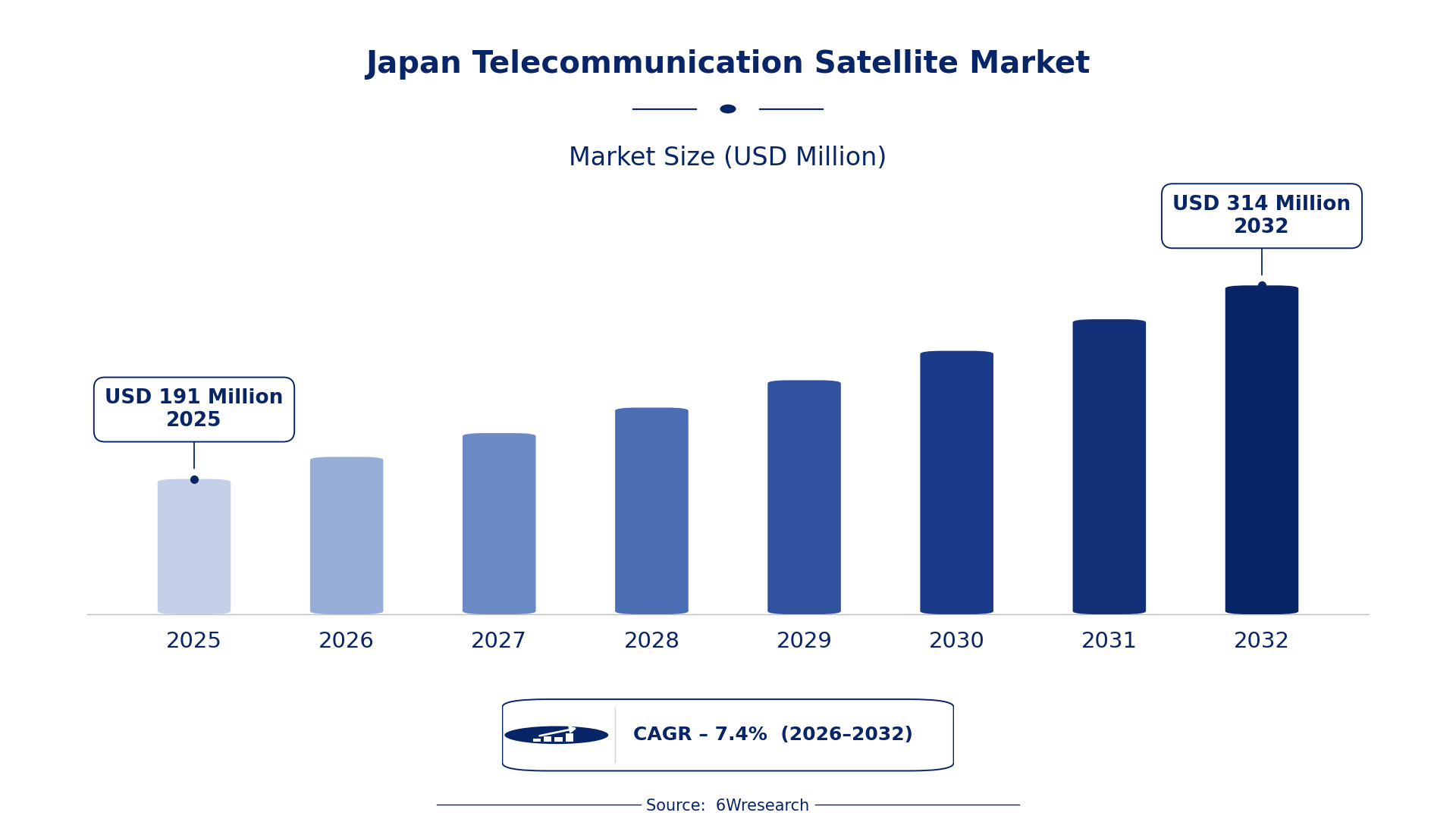
According to 6Wresearch internal database and industry insights, the Japan Telecommunication Satellite Market was valued at USD 191 Million in 2025 and is projected to reach USD 314 Million by 2032, growing at a CAGR of approximately 7.4% during 2026–2032.
Japan Telecommunication Satellite Market Highlights
| Report Metric | Details |
| Report Name | Japan Telecommunication Satellite Market (2026-2032) |
| Market Size 2025 | USD 191 Million |
| Market Size 2032 | USD 314 Million |
| Absolute Growth 2025–2032 | USD 123 Million |
| CAGR 2026–2032 | 7.4% |
| Peak Annual Growth | 8.4% in 2026 |
| Forecast Period | 2026–2032 |
| Historical Data | 2022–2025 |
| Base Year | 2025 |
| Leading Satellite Type, 2025 | Geostationary Satellites (47% share) |
| Leading Product Type, 2025 | Fixed Communication (44% share) |
| Leading Orbit Class, 2025 | GEO (36% share) |
| Leading Distribution Channel, 2025 | Satellite Builders (46% share) |
| Leading End User Industry, 2025 | National Carriers (37% share) |
| Fastest-Growing Satellite Type | LEO Satellites (10.2% CAGR) |
| Fastest-Growing Product Type | Internet Constellations (10.4% CAGR) |
| Fastest-Growing Orbit Class | LEO (9.5% CAGR) |
| Fastest-Growing Distribution Channel | Satellite Operators (9.2% CAGR) |
| Fastest-Growing End User Industry | Broadband Providers (9.6% CAGR) |
| Growing Sector | broadband services |
| Key End Users | national carriers, broadband providers, government services, military |
Japan Telecommunication Satellite Market Year-wise Growth Rate and Key Drivers (2022–2032)
This graph illustrates the annual growth rates of the market from 2022 to 2032, highlighting a steady upward trajectory and projected market expansion over the forecast period.
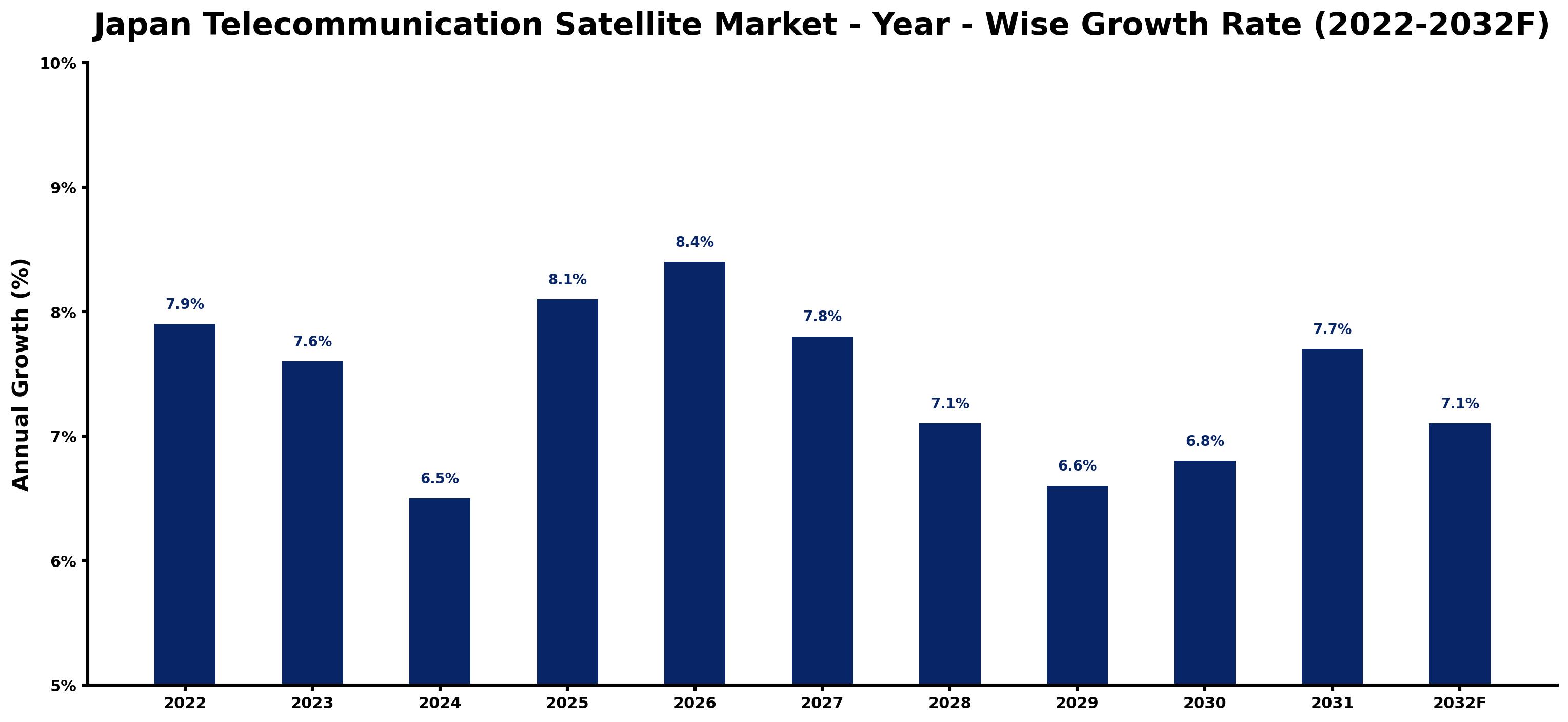
Each row of the following table gives one year's estimated growth and the event or demand shift that explains it.
| Year | Estimated Annual Growth (%) | Market Rationale |
| 2022 | 7.9 | The market experienced steady growth due to strong demand from national carriers. |
| 2023 | 7.6 | Broadband providers adjusted their satellite strategies, resulting in slightly slower growth. |
| 2024 | 6.5 | Competitive pressures led to a reduced growth pace in the market. |
| 2025 | 8.1 | The government launched initiatives to improve satellite capabilities, accelerating growth. |
| 2026 | 8.4 | Investment in satellite technology and infrastructure is expected to peak this year. |
| 2027 | 7.8 | The market is projected to stabilise after the peak in investment, slowing growth. |
| 2028 | 7.1 | Competition is intensifying, leading to a slower growth rate in the market. |
| 2029 | 6.6 | Broadband providers are expanding their satellite services, maintaining steady growth. |
| 2030 | 6.8 | New satellite technologies are expected to drive an uptick in growth this year. |
| 2031 | 7.7 | Advancements in satellite communications will increase market demand significantly. |
| 2032 | 7.1 | The market is projected to slow as it matures and competition intensifies. |
Note: Market size estimations and growth projections presented in this report are based on 6Wresearch's proprietary forecasting methodology, utilizing the latest available industry data, government publications, and primary research inputs.
Japan Telecommunication Satellite Market Synopsis
Telecommunication satellites serve as vital spacecraft for communication, enabling services such as television broadcasting and internet connectivity. The Japan Telecommunication Satellite Market is expanding, driven by national carriers and broadband providers. With approximately 40 million broadband subscribers, the demand for advanced satellite technologies is increasing. This combination of factors is propelling investments in the sector, indicating strong growth potential.
Market Dynamics Impact Analysis (2026–2032)
| Factor | Type | Impact | Primary Segment Affected |
| Rising demand for broadband services drives the need for satellite technology. | Driver | High | Broadband Providers |
| Government initiatives promote satellite technology advancements. | Driver | High | National Carriers |
| Emerging demand for internet constellations creates new market opportunities. | Opportunity | High | Internet Constellations |
| Investment in rural satellite services is increasing to bridge connectivity gaps. | Opportunity | Medium | Broadband Providers |
| High competition among satellite manufacturers may limit market growth. | Restraint | High | Satellite Builders |
| Regulatory challenges in satellite launches can delay projects. | Restraint | Medium | Space Launch Partners |
| High costs of satellite manufacturing can restrict new entrants. | Challenge | High | Satellite Builders |
| Technological obsolescence poses risks for existing satellite operators. | Challenge | Medium | Satellite Operators |
Evaluation of Drivers in Japan Telecommunication Satellite Market (2026–2032)
The table below links each growth driver to the segment it affects and the evidence for it.
| Drivers | Primary Segment Affected | Why It Matters (Evidence) |
| Growing broadband subscriber base increases demand for satellite services. | Broadband Providers | Approximately 40 million subscribers in Japan seek improved connectivity. |
| Government initiatives boost investment in satellite technology. | National Carriers | The 'National Space Policy' promotes partnerships in satellite technology. |
| Increased adoption of LEO satellites for low-latency internet services. | LEO Satellites | The demand for faster internet solutions drives investment in LEO technology. |
| Rural connectivity initiatives prompt broadband providers to invest in satellite solutions. | Fixed Communication | Japan's geography necessitates satellite technology for remote areas. |
| Rising international collaboration enhances technology transfer in satellite manufacturing. | Satellite Builders | The 'National Space Policy' promotes partnerships in satellite technology. |
Much of the new demand traces back to the growing number of broadband subscribers, approximately 40 million, who require better connectivity. The adoption of LEO satellites is rising as demand for low-latency internet services grows, particularly in rural areas. Geographical challenges in Japan necessitate satellite solutions for remote connectivity.
Evaluation of Restraints in Japan Telecommunication Satellite Market
Below are the constraints most often cited by buyers and suppliers, with the segment each affects.
| Market Restraint | Primary Segment Affected | Why It Matters (Evidence) |
| High manufacturing costs limit the entry of new satellite builders. | Satellite Builders | The cost of developing advanced satellites can exceed hundreds of millions of dollars. |
| Regulatory hurdles can delay satellite launches and operations. | Space Launch Partners | Compliance with strict regulations can extend project timelines by several months. |
| Intense competition among existing players may restrict profit margins. | Satellite Operators | Market saturation leads to price wars, affecting profitability. |
| Technological obsolescence risks existing operators' market position. | Satellite Operators | Rapid advancements in technology can render older models less competitive. |
| Limited applications for MEO satellites restrict market growth. | MEO Satellites | The lack of widespread adoption in Japan hampers potential revenue. |
Japan Telecommunication Satellite Market Challenges
Delays in satellite deployment affect broadband providers, with regulatory approvals extending timelines by up to six months. Rising costs stemming from skilled labour shortages impact suppliers, as wage increases of 20% for satellite engineers put pressure on budgets. Outdated infrastructure hinders technology adoption, causing operational costs to rise by 15% for satellite manufacturers, ultimately delaying service availability. Compliance with ISO 9001 standards complicates manufacturing processes, leading to potential revenue losses of around 10% for producers who fail to meet compliance deadlines.
Trends in the Japan Telecommunication Satellite Market
Buyers and suppliers in the Japan Telecommunication Satellite Market are adjusting to the following trends.
- Shift to LEO Satellites for Internet Services: Since 2023, Japan has experienced a marked shift towards LEO satellites for internet services, driven by the demand for low-latency solutions. This transition is reflected in a projected growth rate of 10.2%.
- Transition to Improved Satellite Communication Standards: The Japanese telecommunications sector is moving towards improved satellite communication standards, guided by national policies. This shift aims for compliance by 2025, enhancing interoperability and service quality.
- Emergence of Internet Constellations: The growing demand for global internet coverage has led to the emergence of internet constellations in Japan. This trend is supported by a projected growth rate of 10.4% for this segment, reflecting the need for extensive connectivity solutions.
- Increased Investment in Satellite Technology: Investment in satellite technology is increasing, particularly in the Kanto region, where advancements are being made. The Japanese government aims to enhance satellite capabilities through strategic investments targeting JPY 150 trillion over the next decade.
Investment Opportunities in the Japan Telecommunication Satellite Market
The openings below show where demand in the Japan Telecommunication Satellite Market is visible and how suppliers can enter.
- Kanto Region as a Hub for Satellite Manufacturing: The Kanto region is becoming a key hub for satellite manufacturing, backed by local expertise. With over 30 operational geostationary satellites, there is a rising demand for advanced manufacturing capabilities.
- Broadband Providers Seeking Satellite Solutions: Broadband providers are actively pursuing satellite solutions to enhance rural connectivity. With around 40 million subscribers, the demand for reliable internet services is driving investments in satellite technologies.
- Investment in Internet Constellations: The increasing demand for global internet coverage offers a notable opportunity for investment in internet constellations. This segment is drawing interest from various stakeholders due to its growth potential.
- Partnerships for Satellite Launch Services: There is a growing necessity for partnerships in satellite launch services, particularly with Space Launch Partners. This collaboration can enable timely launches and improve operational efficiency.
Government Initiatives in the Japan Telecommunication Satellite Market
The Industrial Safety and Health Act, established in 1972, mandates employer responsibilities for hazardous materials in satellite manufacturing. This law ensures safety standards are upheld, promoting a secure working environment for manufacturers. The Building Energy Efficiency Act, amended in 2022, requires new facilities to meet energy efficiency standards by April 2025, further improving operational sustainability.
JAXA oversees satellite launches and space missions in Japan, approving projects that align with national objectives. The Ministry of Internal Affairs and Communications regulates telecommunications standards, ensuring compliance with laws that affect satellite operations. These agencies facilitate the growth of the telecommunication satellite market.
Future Insight of the Japan Telecommunication Satellite Market
New satellite manufacturing facilities in the Kanto region will boost local production capabilities, enabling faster deployment of communication systems. By 2032, the integration of AI in satellite operations will streamline processes and reduce costs for suppliers. The 'Space Development Strategy' aims to enhance satellite technology usage, allowing buyers to access improved communication services. With around 40 million broadband subscribers in Japan, suppliers must adapt to meet the growing demand for reliable connectivity.
Market Segmentation Analysis
Japan Telecommunication Satellite Market report covers a detailed analysis of the following market segments:
By Satellite Type – Geostationary Satellites Lead, LEO Satellites Expected to Grow Fastest
According to Saurav Kr Singh, Senior Research Analyst at 6Wresearch, Geostationary Satellites held 47% of the Japan Telecommunication Satellite Market by satellite type in 2025. Geostationary satellites hold the largest share due to their ability to deliver stable communication over fixed locations, which is vital for national carriers. With over 30 operational geostationary satellites, they form the backbone of Japan's telecommunication infrastructure. Over 2026–2032, LEO Satellites are expected to post the fastest growth, at a CAGR of 10.2%. LEO satellites are experiencing rapid growth as they enable low-latency communication, essential for internet services in rural areas. The increasing adoption of satellite technology by broadband providers is a key factor contributing to this surge. Suppliers should focus on enhancing LEO satellite capabilities to meet the rising demand for efficient internet connectivity.
By Product Type – Fixed Communication Leads, Internet Constellations Expected to Grow Fastest
Fixed Communication accounted for 44% of the market by product type in 2025. Fixed communication leads the market as it is critical for maintaining stable communication links across various applications, particularly for national carriers. This segment's established presence ensures continued demand from both public and private sectors. Internet Constellations are set to record the highest CAGR in this split, 10.4% over 2026–2032. Internet constellations are the fastest-growing segment, driven by the rising demand for global internet coverage, especially in underserved areas. This trend indicates a shift towards more flexible and expansive communication solutions. Buyers are likely to benefit from advancements in internet constellation technologies, improving access and service quality.
By Orbit Class – GEO Leads, LEO Expected to Grow Fastest
The largest orbit class category in 2025 was GEO, at 36% of revenue. GEO is the dominant orbit class for communication satellites, providing reliable coverage and stability for various telecommunication applications. Its established infrastructure supports a wide range of services, making it the preferred choice among national carriers. LEO is projected to grow fastest, at a CAGR of 9.5% during 2026–2032. LEO is the fastest-growing orbit class, particularly for internet services, as it offers reduced latency and improved connectivity. The ongoing efforts to expand global internet access are driving this growth. Suppliers should allocate resources towards LEO technologies to capitalise on the increasing demand for low-latency communication solutions.
By Distribution Channel – Satellite Builders Lead, Satellite Operators Expected to Grow Fastest
With 46% of distribution channel revenue in 2025, Satellite Builders was the largest category. Satellite builders lead the distribution channel as key players in satellite manufacturing, ensuring the supply of advanced telecommunication satellites. Their established expertise and processes are crucial for meeting market demands effectively. The quickest growth will come from Satellite Operators, forecast to expand at a CAGR of 9.2% between 2026 and 2032. Satellite operators are witnessing the fastest growth as they manage satellite communication services, propelled by the increasing demand for connectivity. This trend indicates a shift towards service-oriented operations within the sector. Buyers can expect more competitive service offerings as satellite operators enhance their capabilities to meet market needs.
By End User Industry – National Carriers Lead, Broadband Providers Expected to Grow Fastest
National Carriers took 37% of end user industry revenue in 2025, more than any other category. National carriers are the primary consumers of telecommunication satellites, relying on them for essential communication services across Japan. Their substantial market presence ensures a steady demand for satellite technology. Over 2026–2032, Broadband Providers are expected to post the fastest growth, at a CAGR of 9.6%. Broadband providers are experiencing the fastest growth as they increasingly utilise satellites to enhance internet services, especially in rural regions. This trend reflects the changing communication requirements in Japan. Suppliers must adapt their offerings to align with the evolving needs of broadband providers to capture emerging opportunities.
Key Attractiveness of the Report
- 10 Years of Market Numbers
- Historical Data Starting from 2022 to 2025
- Base Year 2025
- Forecast Data until 2032
- Key Performance Indicators Impacting the Market
- Major Upcoming Developments and Projects
Key Highlights of the Report:
- Japan Telecommunication Satellite Market Outlook
- Market Size of Japan Telecommunication Satellite Market, 2025
- Forecast of Japan Telecommunication Satellite Market, 2032
- Historical Data and Forecast of Japan Telecommunication Satellite Revenues & Volume for the Period 2022-2032F
- Japan Telecommunication Satellite Market Trend Evolution
- Japan Telecommunication Satellite Market Drivers and Challenges
- Japan Telecommunication Satellite Price Trends
- Japan Telecommunication Satellite Porter's Five Forces
- Japan Telecommunication Satellite Industry Life Cycle
- Historical Data and Forecast of Japan Telecommunication Satellite Market Revenues & Volume By Satellite Type for the Period 2022-2032F
- Historical Data and Forecast of Japan Telecommunication Satellite Market Revenues & Volume By Geostationary Satellites for the Period 2022-2032F
- Historical Data and Forecast of Japan Telecommunication Satellite Market Revenues & Volume By LEO Satellites for the Period 2022-2032F
- Historical Data and Forecast of Japan Telecommunication Satellite Market Revenues & Volume By MEO Satellites for the Period 2022-2032F
- Historical Data and Forecast of Japan Telecommunication Satellite Market Revenues & Volume By SATCOM Equipment for the Period 2022-2032F
- Historical Data and Forecast of Japan Telecommunication Satellite Market Revenues & Volume By Product Type for the Period 2022-2032F
- Historical Data and Forecast of Japan Telecommunication Satellite Market Revenues & Volume By Fixed Communication for the Period 2022-2032F
- Historical Data and Forecast of Japan Telecommunication Satellite Market Revenues & Volume By Internet Constellations for the Period 2022-2032F
- Historical Data and Forecast of Japan Telecommunication Satellite Market Revenues & Volume By Navigation Systems for the Period 2022-2032F
- Historical Data and Forecast of Japan Telecommunication Satellite Market Revenues & Volume By Terminals & Dishes for the Period 2022-2032F
- Historical Data and Forecast of Japan Telecommunication Satellite Market Revenues & Volume By Orbit Class for the Period 2022-2032F
- Historical Data and Forecast of Japan Telecommunication Satellite Market Revenues & Volume By GEO for the Period 2022-2032F
- Historical Data and Forecast of Japan Telecommunication Satellite Market Revenues & Volume By LEO for the Period 2022-2032F
- Historical Data and Forecast of Japan Telecommunication Satellite Market Revenues & Volume By MEO for the Period 2022-2032F
- Historical Data and Forecast of Japan Telecommunication Satellite Market Revenues & Volume By Ground Segment for the Period 2022-2032F
- Historical Data and Forecast of Japan Telecommunication Satellite Market Revenues & Volume By Distribution Channel for the Period 2022-2032F
- Historical Data and Forecast of Japan Telecommunication Satellite Market Revenues & Volume By Satellite Builders for the Period 2022-2032F
- Historical Data and Forecast of Japan Telecommunication Satellite Market Revenues & Volume By Space Launch Partners for the Period 2022-2032F
- Historical Data and Forecast of Japan Telecommunication Satellite Market Revenues & Volume By Satellite Operators for the Period 2022-2032F
- Historical Data and Forecast of Japan Telecommunication Satellite Market Revenues & Volume By Defense Integrators for the Period 2022-2032F
- Historical Data and Forecast of Japan Telecommunication Satellite Market Revenues & Volume By End User Industry for the Period 2022-2032F
- Historical Data and Forecast of Japan Telecommunication Satellite Market Revenues & Volume By National Carriers for the Period 2022-2032F
- Historical Data and Forecast of Japan Telecommunication Satellite Market Revenues & Volume By Broadband Providers for the Period 2022-2032F
- Historical Data and Forecast of Japan Telecommunication Satellite Market Revenues & Volume By Government Services for the Period 2022-2032F
- Historical Data and Forecast of Japan Telecommunication Satellite Market Revenues & Volume By Military & Airlines for the Period 2022-2032F
- Japan Telecommunication Satellite Import Export Trade Statistics
- Market Opportunity Assessment By Satellite Type
- Market Opportunity Assessment By Product Type
- Market Opportunity Assessment By Orbit Class
- Market Opportunity Assessment By Distribution Channel
- Market Opportunity Assessment By End User Industry
- Japan Telecommunication Satellite Top Companies Market Share
- Japan Telecommunication Satellite Competitive Benchmarking By Technical and Operational Parameters
- Japan Telecommunication Satellite Company Profiles
- Japan Telecommunication Satellite Key Strategic Recommendations
Market Covered
This report examines the market across the segments below.
By Satellite Type
- Geostationary Satellites
- LEO Satellites
- MEO Satellites
- SATCOM Equipment
By Product Type
- Fixed Communication
- Internet Constellations
- Navigation Systems
- Terminals & Dishes
By Orbit Class
- GEO
- LEO
- MEO
- Ground Segment
By Distribution Channel
- Satellite Builders
- Space Launch Partners
- Satellite Operators
- Defense Integrators
By End User Industry
- National Carriers
- Broadband Providers
- Government Services
- Military & Airlines































