Japan Telehealth Software Market Size & Growth Rate
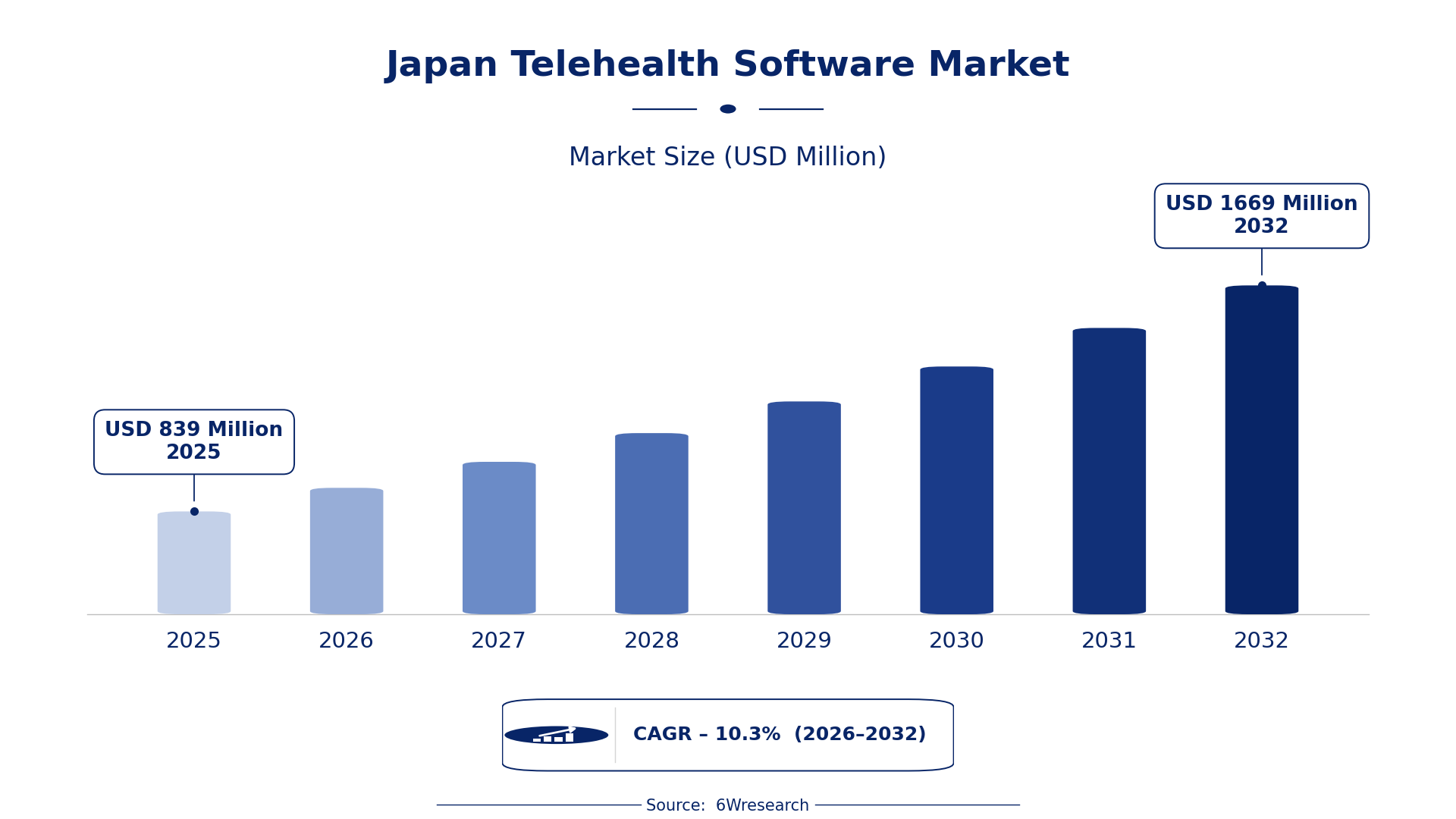
According to 6Wresearch internal database and industry insights, the Japan Telehealth Software Market was valued at USD 839 Million in 2025 and is projected to reach USD 1,669 Million by 2032, growing at a CAGR of approximately 10.3% during 2026–2032.
Japan Telehealth Software Market Highlights
| Report Metric | Details |
| Report Name | Japan Telehealth Software Market (2026-2032) |
| Market Size 2025 | USD 839 Million |
| Market Size 2032 | USD 1,669 Million |
| Absolute Growth 2025–2032 | USD 830 Million |
| CAGR 2026–2032 | 10.3% |
| Peak Annual Growth | 11.8% in 2031 |
| Forecast Period | 2026–2032 |
| Historical Data | 2022–2025 |
| Base Year | 2025 |
| Leading Telehealth Software, 2025 | Video Conferencing Platforms (40% share) |
| Leading Product Type, 2025 | Virtual Clinics (33% share) |
| Leading Deployment Model, 2025 | Cloud/Web-Based (40% share) |
| Leading Distribution Channel, 2025 | SaaS Providers (45% share) |
| Leading End User Industry, 2025 | Hospitals (51% share) |
| Fastest-Growing Telehealth Software | AI Symptom Checker (14.5% CAGR) |
| Fastest-Growing Product Type | Chatbot Platforms (14.6% CAGR) |
| Fastest-Growing Deployment Model | ML-Based (15.6% CAGR) |
| Fastest-Growing Distribution Channel | Online Subscriptions (15.0% CAGR) |
| Fastest-Growing End User Industry | Digital Health Startups (14.1% CAGR) |
| Growing Sector | Healthcare |
| Key End Users | Hospitals, Multi-Specialty Clinics, Independent Practices, Digital Health Startups |
Japan Telehealth Software Market Year-wise Growth Rate and Key Drivers (2022–2032)
This graph illustrates the annual growth rates of the market from 2022 to 2032, highlighting a steady upward trajectory and projected market expansion over the forecast period.
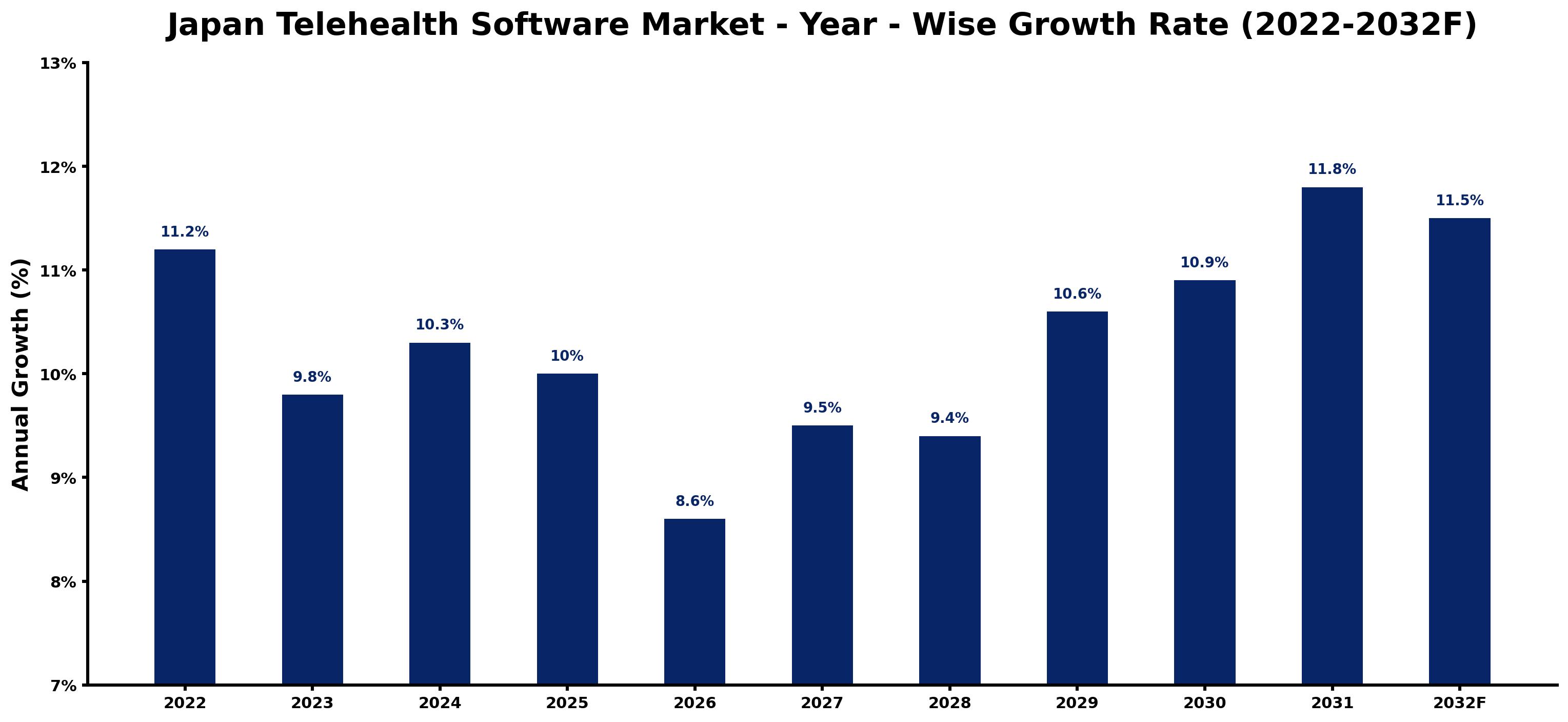
The following figures match every annual growth estimate with the main market development of that year, giving the reasoning behind each rise or slowdown.
| Year | Estimated Annual Growth (%) | Market Rationale |
| 2022 | 11.2 | The market showed strong growth as telehealth adoption increased among healthcare providers. |
| 2023 | 9.8 | Demand growth slowed as hospitals adjusted to integrating telehealth solutions into existing systems. |
| 2024 | 10.3 | The market rebounded with faster growth driven by increased user adoption and technological advancements. |
| 2025 | 10.0 | Growth slowed slightly as market saturation began to affect new telehealth implementations. |
| 2026 | 8.6 | The market growth rate is expected to decrease as competition intensifies among telehealth providers. |
| 2027 | 9.5 | Growth is projected to accelerate as more healthcare facilities adopt advanced telehealth solutions. |
| 2028 | 9.4 | Demand growth is anticipated to slow due to market maturity and increased competition among providers. |
| 2029 | 10.6 | The market is expected to experience a resurgence as new technologies improve telehealth service delivery. |
| 2030 | 10.9 | Growth is projected to continue rising as healthcare providers expand their telehealth offerings. |
| 2031 | 11.8 | The market is expected to peak with the highest growth rate driven by widespread acceptance of telehealth. |
| 2032 | 11.5 | Growth is projected to slow slightly as the market reaches a more stable phase of development. |
Note: Market size estimations and growth projections presented in this report are based on 6Wresearch's proprietary forecasting methodology, utilizing the latest available industry data, government publications, and primary research inputs.
Japan Telehealth Software Market Synopsis
Telehealth software includes digital platforms for remote healthcare delivery, such as video consultations and patient management tools. The Japan Telehealth Software Market is expanding rapidly, driven by over 70% of hospitals adopting telehealth solutions and a growing elderly population. Investment in telehealth technology, supported by government initiatives, fuels demand, particularly in urban areas with high concentrations of telehealth startups.
Market Dynamics Impact Analysis (2026–2032)
| Factor | Type | Impact | Primary Segment Affected |
| Growing elderly population increases demand for accessible healthcare solutions. | Driver | High | Video Conferencing Platforms |
| Integration of telehealth into existing healthcare systems enhances service delivery. | Driver | High | EHR Integration Software |
| High demand for remote healthcare solutions in rural areas creates opportunities for expansion. | Opportunity | High | Virtual Clinics |
| Investment in AI-driven tools for telehealth is on the rise, enhancing service capabilities. | Opportunity | Medium | AI Symptom Checker |
| Concerns over data security and privacy may hinder telehealth adoption. | Restraint | High | Cloud/Web-Based |
| Regulatory challenges can delay the implementation of telehealth solutions. | Restraint | Medium | SaaS Providers |
| High competition among telehealth providers can limit market share for new entrants. | Challenge | High | Medical Software Vendors |
| Rapid technological changes require constant updates to telehealth systems, increasing costs. | Challenge | Medium | Online Subscriptions |
Evaluation of Drivers in Japan Telehealth Software Market (2026–2032)
Demand rests on the following drivers, each shown with the segment it touches most.
| Drivers | Primary Segment Affected | Why It Matters (Evidence) |
| Increased healthcare expenditure drives demand for telehealth solutions. | EHR Integration Software | Japan's national medical care expenditure was about JPY 46.7 trillion in fiscal 2022, prompting hospitals to invest in efficient systems. |
| Adoption of telehealth by hospitals enhances patient access to care. | Video Conferencing Platforms | Over 70% of hospitals in Japan have integrated telehealth software, improving service delivery. |
| The aging population necessitates more remote healthcare options. | Virtual Clinics | 29.3% of Japan's population was aged 65 or older in September 2024, increasing demand for telehealth. |
| Government support for digital health initiatives boosts telehealth adoption. | Cloud/Web-Based | The Japanese government allocated ¥5 billion for telehealth technology development in 2023. |
| Growing patient acceptance of telehealth services increases usage rates. | AI Symptom Checker | The average patient satisfaction score for telehealth consultations in Japan is 85%, encouraging wider adoption. |
Spending rises because healthcare expenditure in Japan reached approximately JPY 46.7 trillion in 2022, prompting hospitals to invest in telehealth solutions. Over 70% of hospitals have adopted telehealth software, improving patient access to care. The aging population, with 29.3% aged 65 or older, drives demand for remote healthcare options. Patient satisfaction scores averaging 85% encourage more users to embrace telehealth services, increasing overall demand.
Evaluation of Restraints in Japan Telehealth Software Market
The main factors holding the market back are set out below.
| Market Restraint | Primary Segment Affected | Why It Matters (Evidence) |
| Data security concerns may limit telehealth adoption among patients. | Cloud/Web-Based | With rising cyber threats, patients are hesitant to share sensitive information through telehealth platforms. |
| Regulatory hurdles can slow down the deployment of telehealth solutions. | SaaS Providers | Compliance with the Pharmaceuticals and Medical Devices Agency regulations can delay implementation. |
| High competition among telehealth providers can restrict market entry for new players. | Medical Software Vendors | Established providers dominate the market, making it difficult for newcomers to gain traction. |
| Rapid technological advancements require constant updates, increasing operational costs. | Online Subscriptions | Providers must invest in ongoing development to keep up with evolving telehealth technologies. |
| Limited reimbursement policies for telehealth services can deter healthcare providers from adopting solutions. | EHR Integration Software | The Health Insurance Bureau of Japan is evaluating reimbursement policies, affecting provider willingness. |
Japan Telehealth Software Market Challenges
Regulatory barriers complicate telehealth software deployment, as compliance with the Pharmaceuticals and Medical Devices Agency can delay market entry by six months for producers. Intense competition among over 8,100 hospitals adopting telehealth solutions drives prices down, squeezing profit margins for suppliers and limiting their capacity for innovation. Rapid technological advancements necessitate clinics to invest up to JPY 5 million annually for software updates, straining their budgets. Supply chain disruptions for software components can postpone service launches, restricting patient access and satisfaction, particularly in rural areas where telehealth is crucial.
Trends in the Japan Telehealth Software Market
Below are the shifts with the largest effect on the Japan Telehealth Software Market.
- Shift Towards AI-Driven Telehealth Solutions: The Japan Telemedicine and Telecare Association reports a 30% increase in AI-driven symptom checkers in 2023, reflecting a shift towards more efficient patient assessment tools.
- Growing Adoption of Telehealth in Rural Areas: In 2023, the Japanese government launched a program to improve telehealth accessibility in rural areas, addressing healthcare disparities and improving service delivery.
- Increased Integration of Telehealth in Multi-Specialty Clinics: As of 2023, 80% of multi-specialty clinics in urban areas have integrated telehealth services, demonstrating a trend towards comprehensive healthcare solutions.
- Expansion of Cloud-Based Telehealth Solutions: Cloud-based telehealth solutions accounted for 75% of independent practices in Japan in 2023, indicating a preference for flexible and accessible healthcare delivery.
Investment Opportunities in the Japan Telehealth Software Market
Several openings in the Japan Telehealth Software Market merit attention from investors.
- Timing for Investment in Telehealth Solutions: With over 70% of hospitals adopting telehealth software, there is a substantial opportunity for investment in advanced telehealth solutions to meet growing demand.
- Gap in Telehealth Accessibility in Rural Areas: The Japanese government allocated ¥5 billion for telehealth technology development, highlighting the need for solutions that improve accessibility in underserved regions.
- Demand for AI-Driven Tools in Telehealth: The increasing usage of AI-driven symptom checkers, which saw a 30% rise in 2023, presents an opportunity for investment in advanced telehealth technologies.
- Expansion of Telehealth in Independent Practices: Cloud-based solutions are preferred by 65% of independent practices, indicating a need for providers to develop tailored software for this segment.
Government Initiatives in the Japan Telehealth Software Market
The Pharmaceuticals and Medical Devices Agency, established in 2004, regulates telehealth software in Japan, ensuring compliance with safety and efficacy standards. The Next-Generation Medical Infrastructure Act, enacted in 2017, allows for anonymisation of medical data for research, supporting telehealth innovation.
In 2023, the Japanese government allocated ¥5 billion for telehealth technology development, with the Digital Agency overseeing the implementation of digital health initiatives. This funding aims to improve telehealth accessibility and integration across healthcare systems.
Future Insight of the Japan Telehealth Software Market
AI-driven symptom checkers will reshape demand for telehealth services by 2032, increasing patient engagement and satisfaction. The government's programme to enhance telehealth accessibility in rural areas will broaden the market, benefiting both buyers and suppliers. EHR integration will remain critical, with 90% of facilities expected to implement sophisticated systems to optimise operations. SaaS delivery models will dominate, accounting for 75% of deployments, facilitating scalable and efficient service delivery.
Market Segmentation Analysis
Japan Telehealth Software Market report covers a detailed analysis of the following market segments:
By Telehealth Software – Video Conferencing Platforms Lead, AI Symptom Checker Expected to Grow Fastest
According to Saurav Kr Singh, Senior Research Analyst at 6Wresearch, the largest telehealth software category in 2025 was Video Conferencing Platforms, at 40% of revenue. Video conferencing platforms are essential for remote consultations, facilitating direct communication between patients and healthcare providers. Their widespread adoption by over 70% of hospitals underscores their crucial role in enhancing healthcare delivery in Japan. The quickest growth will come from AI Symptom Checker, forecast to expand at a CAGR of 14.5% between 2026 and 2032. The AI symptom checker has experienced a notable 30% increase in usage in 2023, as it effectively aids in initial patient assessments. This growth indicates a strong trend towards integrating advanced technology to improve patient engagement and care. Suppliers should focus on developing user-friendly assessment tools to meet the increasing demand for enhanced patient interaction.
By Product Type – Virtual Clinics Lead, Chatbot Platforms Expected to Grow Fastest
Virtual Clinics accounted for 33% of the market by product type in 2025. Virtual clinics provide comprehensive remote healthcare services, effectively addressing a wide range of patient needs. Their ability to deliver full-service healthcare has made them a preferred choice among healthcare providers across Japan. Over 2026–2032, Chatbot Platforms are expected to post the fastest growth, at a CAGR of 14.6%. Chatbot platforms are rapidly gaining traction as they improve patient interaction and support by offering immediate responses to inquiries. This capability is becoming increasingly important in the evolving telehealth landscape. Buyers should explore the implementation of chatbot solutions to enhance patient engagement and satisfaction.
By Deployment Model – Cloud/Web-Based Leads, ML-Based Expected to Grow Fastest
In 2025, Cloud/Web-Based led the deployment model split with a 40% share. Cloud/web-based solutions offer significant flexibility and accessibility, making them the leading deployment model for telehealth software in Japan. This model effectively meets the requirements of both healthcare providers and patients for remote access. ML-Based is set to record the highest CAGR in this split, 15.6% over 2026–2032. ML-based deployment models are gaining popularity as they facilitate enhanced data analysis and insights. This trend suggests a shift towards more sophisticated software solutions within the healthcare sector. Suppliers should prioritise the development of advanced analytical features to attract clients seeking improved operational outcomes.
By Distribution Channel – SaaS Providers Lead, Online Subscriptions Expected to Grow Fastest
SaaS Providers took 45% of distribution channel revenue in 2025, more than any other category. SaaS providers are the dominant distribution channel for telehealth solutions, delivering software as a service that ensures seamless updates and scalability. This model is crucial for healthcare providers needing efficient and adaptable solutions. Online Subscriptions are projected to grow fastest, at a CAGR of 15.0% during 2026–2032. Online subscriptions are increasingly favoured, providing users with continuous access to services. This trend highlights a shift towards more flexible and consumer-friendly payment models in the telehealth market. Suppliers should consider subscription-based offerings to enhance customer retention and overall satisfaction.
By End User Industry – Hospitals Lead, Digital Health Startups Expected to Grow Fastest
Hospitals held 51% of the Japan Telehealth Software Market by end user industry in 2025. Hospitals are the primary users of telehealth services, utilising these platforms to enhance patient care and streamline operational processes. Their pivotal role in the healthcare system drives the demand for telehealth software solutions. The quickest growth will come from Digital Health Startups, forecast to expand at a CAGR of 14.1% between 2026 and 2032. Digital health startups are rapidly innovating and expanding telehealth solutions, which accelerates growth in the industry. Their agility in adapting to market changes positions them favourably for future advancements. Suppliers need to collaborate with digital health startups to remain competitive and responsive to emerging market trends.
Key Attractiveness of the Report
- 10 Years of Market Numbers
- Historical Data Starting from 2022 to 2025
- Base Year 2025
- Forecast Data until 2032
- Key Performance Indicators Impacting the Market
- Major Upcoming Developments and Projects
Key Highlights of the Report:
- Japan Telehealth Software Market Outlook
- Market Size of Japan Telehealth Software Market, 2025
- Forecast of Japan Telehealth Software Market, 2032
- Historical Data and Forecast of Japan Telehealth Software Revenues & Volume for the Period 2022-2032F
- Japan Telehealth Software Market Trend Evolution
- Japan Telehealth Software Market Drivers and Challenges
- Japan Telehealth Software Price Trends
- Japan Telehealth Software Porter's Five Forces
- Japan Telehealth Software Industry Life Cycle
- Historical Data and Forecast of Japan Telehealth Software Market Revenues & Volume By Telehealth Software for the Period 2022-2032F
- Historical Data and Forecast of Japan Telehealth Software Market Revenues & Volume By Video Conferencing Platforms for the Period 2022-2032F
- Historical Data and Forecast of Japan Telehealth Software Market Revenues & Volume By EHR Integration Software for the Period 2022-2032F
- Historical Data and Forecast of Japan Telehealth Software Market Revenues & Volume By Scheduling & Billing Tools for the Period 2022-2032F
- Historical Data and Forecast of Japan Telehealth Software Market Revenues & Volume By AI Symptom Checker for the Period 2022-2032F
- Historical Data and Forecast of Japan Telehealth Software Market Revenues & Volume By Product Type for the Period 2022-2032F
- Historical Data and Forecast of Japan Telehealth Software Market Revenues & Volume By Virtual Clinics for the Period 2022-2032F
- Historical Data and Forecast of Japan Telehealth Software Market Revenues & Volume By Patient Records Sync for the Period 2022-2032F
- Historical Data and Forecast of Japan Telehealth Software Market Revenues & Volume By Admin Portals for the Period 2022-2032F
- Historical Data and Forecast of Japan Telehealth Software Market Revenues & Volume By Chatbot Platforms for the Period 2022-2032F
- Historical Data and Forecast of Japan Telehealth Software Market Revenues & Volume By Deployment Model for the Period 2022-2032F
- Historical Data and Forecast of Japan Telehealth Software Market Revenues & Volume By Cloud/Web-Based for the Period 2022-2032F
- Historical Data and Forecast of Japan Telehealth Software Market Revenues & Volume By API-Based for the Period 2022-2032F
- Historical Data and Forecast of Japan Telehealth Software Market Revenues & Volume By On-Prem/Cloud for the Period 2022-2032F
- Historical Data and Forecast of Japan Telehealth Software Market Revenues & Volume By ML-Based for the Period 2022-2032F
- Historical Data and Forecast of Japan Telehealth Software Market Revenues & Volume By Distribution Channel for the Period 2022-2032F
- Historical Data and Forecast of Japan Telehealth Software Market Revenues & Volume By SaaS Providers for the Period 2022-2032F
- Historical Data and Forecast of Japan Telehealth Software Market Revenues & Volume By Direct Licensing for the Period 2022-2032F
- Historical Data and Forecast of Japan Telehealth Software Market Revenues & Volume By Medical Software Vendors for the Period 2022-2032F
- Historical Data and Forecast of Japan Telehealth Software Market Revenues & Volume By Online Subscriptions for the Period 2022-2032F
- Historical Data and Forecast of Japan Telehealth Software Market Revenues & Volume By End User Industry for the Period 2022-2032F
- Historical Data and Forecast of Japan Telehealth Software Market Revenues & Volume By Hospitals for the Period 2022-2032F
- Historical Data and Forecast of Japan Telehealth Software Market Revenues & Volume By Multi-Specialty Clinics for the Period 2022-2032F
- Historical Data and Forecast of Japan Telehealth Software Market Revenues & Volume By Independent Practices for the Period 2022-2032F
- Historical Data and Forecast of Japan Telehealth Software Market Revenues & Volume By Digital Health Startups for the Period 2022-2032F
- Japan Telehealth Software Import Export Trade Statistics
- Market Opportunity Assessment By Telehealth Software
- Market Opportunity Assessment By Product Type
- Market Opportunity Assessment By Deployment Model
- Market Opportunity Assessment By Distribution Channel
- Market Opportunity Assessment By End User Industry
- Japan Telehealth Software Top Companies Market Share
- Japan Telehealth Software Competitive Benchmarking By Technical and Operational Parameters
- Japan Telehealth Software Company Profiles
- Japan Telehealth Software Key Strategic Recommendations
Market Covered
Coverage by segment is as follows.
By Telehealth Software
- Video Conferencing Platforms
- EHR Integration Software
- Scheduling & Billing Tools
- AI Symptom Checker
By Product Type
- Virtual Clinics
- Patient Records Sync
- Admin Portals
- Chatbot Platforms
By Deployment Model
- Cloud/Web-Based
- API-Based
- On-Prem/Cloud
- ML-Based
By Distribution Channel
- SaaS Providers
- Direct Licensing
- Medical Software Vendors
- Online Subscriptions
By End User Industry
- Hospitals
- Multi-Specialty Clinics
- Independent Practices
- Digital Health Startups































