Japan Telehealth Triage AI Market Size & Growth Rate
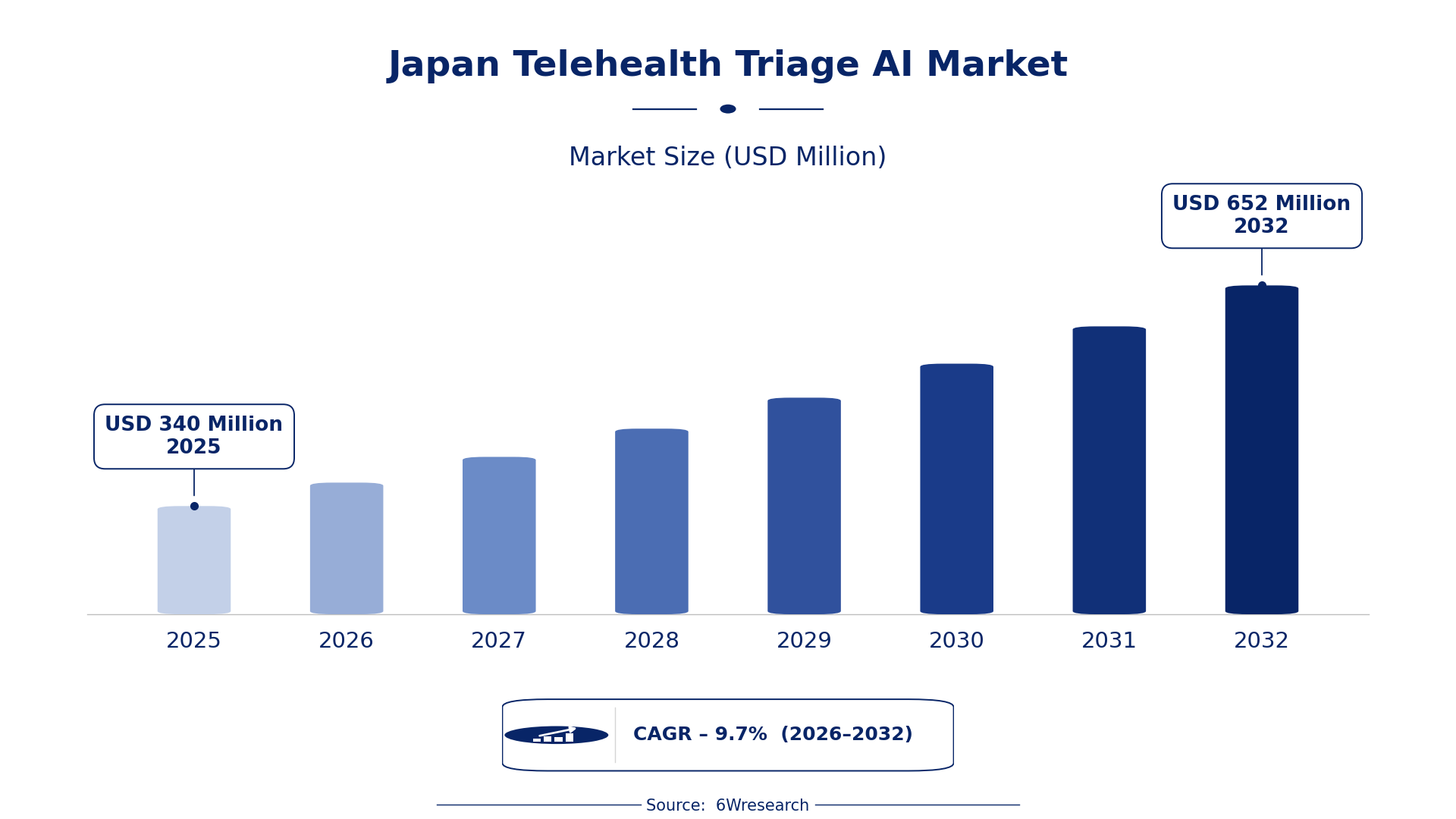
According to 6Wresearch internal database and industry insights, the Japan Telehealth Triage AI Market was valued at USD 340 Million in 2025 and is projected to reach USD 652 Million by 2032, growing at a CAGR of approximately 9.7% during 2026–2032.
Japan Telehealth Triage AI Market Highlights
| Report Metric | Details |
| Report Name | Japan Telehealth Triage AI Market (2026-2032) |
| Market Size 2025 | USD 340 Million |
| Market Size 2032 | USD 652 Million |
| Absolute Growth 2025–2032 | USD 312 Million |
| CAGR 2026–2032 | 9.7% |
| Peak Annual Growth | 10.2% in 2027 |
| Forecast Period | 2026–2032 |
| Historical Data | 2022–2025 |
| Base Year | 2025 |
| Leading AI Application Area, 2025 | Symptom Assessment (42% share) |
| Leading Deployment Mode, 2025 | Cloud-Based (47% share) |
| Leading Patient Interaction Type, 2025 | Chatbot Interface (51% share) |
| Leading End User, 2025 | Hospitals (43% share) |
| Fastest-Growing AI Application Area | Decision Support (11.4% CAGR) |
| Fastest-Growing Deployment Mode | Mobile App (13.9% CAGR) |
| Fastest-Growing End User | Telehealth Startups (12.3% CAGR) |
| Growing Sector | Decision Support |
| Key End Users | Symptom Assessment, Urgency Classification, Decision Support, Follow-Up Recommendation |
Japan Telehealth Triage AI Market Year-wise Growth Rate and Key Drivers (2022–2032)
This graph illustrates the annual growth rates of the market from 2022 to 2032, highlighting a steady upward trajectory and projected market expansion over the forecast period.
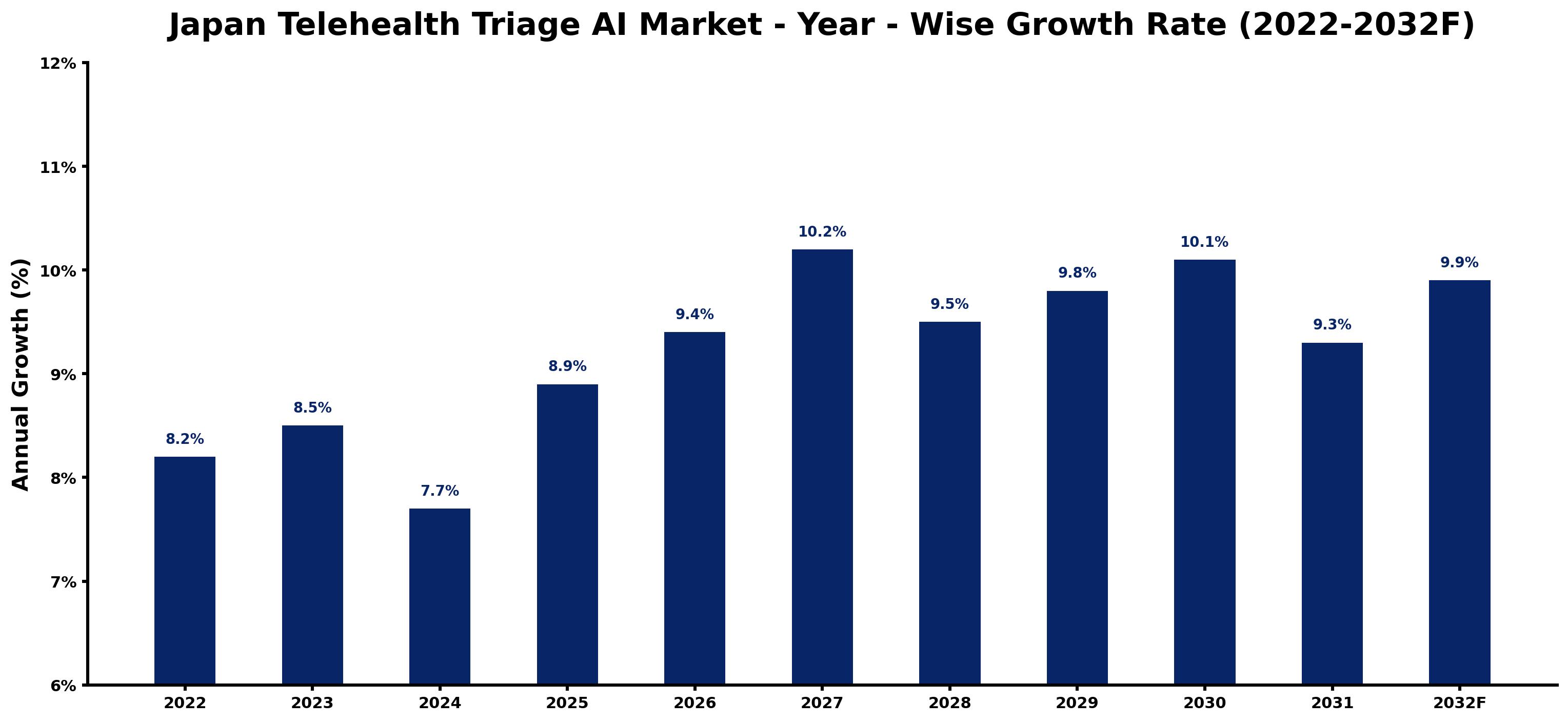
Below, each year's estimated growth is shown next to the factor that most influenced it.
| Year | Estimated Annual Growth (%) | Market Rationale |
| 2022 | 8.2 | The market showed strong activity with over 1,200 telehealth startups operating across the country. |
| 2023 | 8.5 | Growth accelerated as more than 70% of primary care providers reported using telehealth triage AI. |
| 2024 | 7.7 | The market experienced a slowdown as the average wait time for in-person consultations increased. |
| 2025 | 8.9 | Demand surged with 30% of hospitals implementing telehealth solutions to improve patient management. |
| 2026 | 9.4 | The market is expected to continue growing as telehealth usage is projected to increase significantly by 2025. |
| 2027 | 10.2 | The peak growth year will see heightened investments in telehealth infrastructure and technology. |
| 2028 | 9.5 | Growth is anticipated to slow slightly as hospitals adjust to increased telehealth adoption rates. |
| 2029 | 9.8 | Demand is expected to rise again as virtual clinics expand significantly in urban areas. |
| 2030 | 10.1 | The market will grow as healthcare professionals receive training in telehealth practices. |
| 2031 | 9.3 | Growth is projected to slow as the market stabilises after rapid expansion in previous years. |
| 2032 | 9.9 | The market will see renewed growth driven by ongoing technological advancements and integration. |
Note: Market size estimations and growth projections presented in this report are based on 6Wresearch's proprietary forecasting methodology, utilizing the latest available industry data, government publications, and primary research inputs.
Japan Telehealth Triage AI Market Synopsis
Telehealth Triage AI is a technology that uses artificial intelligence to assess patient symptoms, classify urgency, and support healthcare providers. The Japan Telehealth Triage AI Market is expanding due to increasing demand from medical facilities, with over 30% of hospitals adopting telehealth solutions. This growth stems from a rise in telehealth startups, government initiatives aiming for a 50% increase in telehealth usage by 2025, and the need for efficient healthcare solutions, particularly as the average wait time for in-person consultations reaches 2-3 weeks.
Market Dynamics Impact Analysis (2026–2032)
| Factor | Type | Impact | Primary Segment Affected |
| Growing elderly population driving demand for efficient healthcare solutions | Driver | High | Symptom Assessment |
| Increased telehealth startup activity enhancing service offerings | Driver | High | Decision Support |
| Expansion of telehealth services in urban areas creating new market opportunities | Opportunity | High | Virtual Clinics |
| Government funding programs supporting telehealth initiatives | Opportunity | High | Telehealth Startups |
| Concerns over data security affecting adoption rates | Restraint | Medium | Cloud-Based |
| High implementation costs for advanced AI systems limiting access | Restraint | Medium | On-Premise |
| Limited infrastructure in rural areas hindering telehealth expansion | Challenge | High | Web Platform |
| Regulatory compliance requirements delaying product approvals | Challenge | Medium | Chatbot Interface |
Evaluation of Drivers in Japan Telehealth Triage AI Market (2026–2032)
The main growth drivers and the segments they affect most are set out below.
| Drivers | Primary Segment Affected | Why It Matters (Evidence) |
| Aging population requiring immediate symptom assessment | Symptom Assessment | 29.3% of Japan's population was aged 65 or older in September 2024, increasing the need for efficient healthcare solutions. |
| Rise in telehealth startups improving service accessibility | Decision Support | With over 1,200 telehealth startups in 2022, the market is expanding rapidly, leading to more diverse solutions. |
| Government initiatives promoting telehealth usage | Virtual Clinics | The government aims to increase telehealth usage by 50% by 2025, encouraging more healthcare providers to adopt these solutions. |
| Integration of AI technologies in healthcare systems | Cloud-Based | Japan's healthcare system is increasingly adopting AI technologies to improve efficiency and patient care. |
| Growing demand for remote healthcare solutions | Mobile App | The average wait time for in-person consultations is 2-3 weeks, driving patients towards telehealth options. |
Much of the new demand traces back to Japan's aging population, with a significant portion requiring efficient healthcare solutions. The telehealth startup sector is improving service accessibility and driving innovation. The average wait time for in-person consultations is 2-3 weeks, pushing patients towards remote healthcare solutions. The integration of AI technologies in healthcare systems supports the rise of telehealth services across the nation.
Evaluation of Restraints in Japan Telehealth Triage AI Market
The key brakes on demand, and where they bite hardest, are shown below.
| Market Restraint | Primary Segment Affected | Why It Matters (Evidence) |
| Concerns regarding data security affecting user trust | Cloud-Based | The JIS X 0120 standard governs telehealth data security, impacting adoption rates among healthcare providers. |
| High costs associated with implementing advanced AI systems | On-Premise | Japan's national medical care expenditure was about JPY 46.7 trillion in fiscal 2022, limiting budget allocations for new technologies. |
| Limited internet access in rural areas hindering telehealth expansion | Web Platform | Approximately 30% of Japan's population resides in rural areas, where internet connectivity remains a challenge. |
| Regulatory hurdles delaying product approvals | Chatbot Interface | Compliance with the PMD Act can prolong the time to market for new telehealth solutions. |
| Resistance to change among traditional healthcare providers | Decision Support | Many healthcare professionals are accustomed to conventional methods, slowing the adoption of new solutions. |
Japan Telehealth Triage AI Market Challenges
Many healthcare providers struggle with outdated technology, as numerous telehealth solutions still rely on legacy systems. This issue arises from the slow adoption of new technologies, causing delays of up to 18 months for hospitals implementing modern solutions. Distributors face rising costs due to strict compliance with the JIS X 0120 standard, increasing operational expenses by 15%. Buyers encounter longer wait times for consultations, averaging 2-3 weeks, which can lead to patient dissatisfaction and potential revenue loss for clinics. Training shortages hinder effective deployment, with current capacity falling short of the government's goal to train 10,000 professionals by 2025, impacting service quality for patients.
Trends in the Japan Telehealth Triage AI Market
These developments are changing demand patterns in the Japan Telehealth Triage AI Market.
- Shift from In-Person to Telehealth Consultations: In 2023, telehealth consultations reached 5 million, reflecting a shift towards remote healthcare solutions. This trend appears as patients seek immediate care through telehealth due to increasing wait times for in-person consultations.
- Transition from Traditional to AI-Driven Triage: The Integrated Health and Social Care Strategy, initiated in 2023, promotes the use of AI technologies in healthcare. This shift is clear as over 70% of primary care providers report using telehealth triage AI, improving patient management.
- Emergence of Mobile Telehealth Solutions: The mobile app segment is growing rapidly, with a projected CAGR of 13.9% from 2026 to 2032. This trend is visible in urban areas where patients increasingly prefer on-the-go access to healthcare services.
- Prioritisation of Data Security Standards: The JIS X 0120 standard is becoming increasingly important as telehealth adoption rises. This focus on data security builds trust among users and ensures compliance with regulations.
Investment Opportunities in the Japan Telehealth Triage AI Market
The openings below show where demand in the Japan Telehealth Triage AI Market is visible and how suppliers can enter.
- Partner with Telehealth Startups: With over 1,200 telehealth startups in Japan, partnering with these innovators can provide access to cutting-edge solutions. Investing in AI-driven platforms is timely as the government aims for a 50% increase in telehealth usage by 2025.
- Supply Advanced AI Solutions: Healthcare providers are seeking advanced telehealth solutions to meet rising demand. With over 30% of hospitals adopting these technologies, investing in AI-driven platforms can yield substantial returns.
- Focus on Mobile App Development: The mobile app segment is projected to grow significantly, making it an ideal area for investment. Collaborating with virtual clinics can enhance service delivery and patient engagement.
- Invest in Training Programs: As the government aims to train 10,000 healthcare professionals by 2025, there is a pressing need for training programs. Investing in educational initiatives can help bridge the skills gap in telehealth.
Government Initiatives in the Japan Telehealth Triage AI Market
The 2023 telehealth subsidy program introduces a budget of ¥10 billion to support the adoption of telehealth solutions. This measure provides direct financial assistance to healthcare providers, enabling them to integrate advanced technologies into their practices and improve patient care.
The Pharmaceuticals and Medical Devices Agency (PMDA) oversees the approval of telehealth solutions, ensuring compliance with safety standards. This agency plays a key role in facilitating the entry of innovative telehealth technologies into the market, promoting their adoption among healthcare providers.
Future Insight of the Japan Telehealth Triage AI Market
The government's initiatives will drive a substantial increase in telehealth adoption by 2032. Telehealth consultations are expected to surpass 10 million annually, reflecting greater acceptance among patients and providers. New training programs will ensure healthcare professionals acquire necessary skills, improving service delivery. Funding initiatives will support the integration of advanced AI technologies, enhancing resource allocation and patient outcomes.
Market Segmentation Analysis
Japan Telehealth Triage AI Market report covers a detailed analysis of the following market segments:
By AI Application Area – Symptom Assessment Leads, Decision Support Expected to Grow Fastest
According to Prakhar Dixit, Senior Research Analyst at 6Wresearch, Symptom Assessment held 42% of the Japan Telehealth Triage AI Market by ai application area in 2025. Symptom Assessment commands the largest share as it provides immediate evaluation of patient symptoms, essential for timely healthcare decisions. This area is particularly important given that over 70% of primary care providers report utilising telehealth triage AI. Over 2026–2032, Decision Support is expected to post the fastest growth, at a CAGR of 11.4%. The Decision Support area is witnessing rapid growth due to the increasing integration of advanced technologies in Japan's healthcare system, which assists healthcare professionals in making informed choices. Government initiatives aimed at enhancing telehealth usage further fuel this upward trend. This indicates that suppliers should prioritise the development of effective decision support tools to meet the rising market demand.
By Deployment Mode – Cloud-Based Leads, Mobile App Expected to Grow Fastest
Cloud-Based accounted for 47% of the market by deployment mode in 2025. Cloud-Based deployment leads the market as it facilitates scalable and flexible access to AI tools, which is essential for hospitals managing large patient volumes. This deployment mode is particularly relevant for over 30% of hospitals in Japan that have adopted telehealth solutions. Mobile App is set to record the highest CAGR in this split, 13.9% over 2026–2032. Mobile App deployment is growing quickly as it allows patients to access triage services conveniently, addressing the rising demand for accessible healthcare options. The launch of a new telehealth subsidy program in 2023 further supports the growth of mobile solutions. Buyers will gain from investing in mobile-friendly solutions to improve patient engagement and accessibility.
By Patient Interaction Type – Chatbot Interface Leads and Records the Fastest Growth
The largest patient interaction type category in 2025 was Chatbot Interface, at 51% of revenue. The Chatbot Interface dominates the market as it provides automated symptom assessment, streamlining the triage process for healthcare providers. This method is widely adopted due to its efficiency in handling patient inquiries. The same category is also set to grow fastest, at a CAGR of 11.0% during 2026–2032. Chatbot Interface is also the fastest-growing type, as its automation capabilities are increasingly recognised for improving patient interaction and satisfaction. The integration of AI technologies in healthcare is expected to further boost its adoption. Suppliers should prioritise the development of advanced chatbot technologies to capture the growing demand for automated patient interactions.
By End User – Hospitals Lead, Telehealth Startups Expected to Grow Fastest
With 43% of end user revenue in 2025, Hospitals was the largest category. Hospitals account for the largest share of the market as they employ technology for efficient patient management, crucial in a system with approximately 8,100 hospitals. Their established infrastructure effectively facilitates the integration of telehealth solutions. Telehealth Startups are projected to grow fastest, at a CAGR of 12.3% during 2026–2032. Telehealth Startups are the fastest-growing end-user group as they rapidly deploy telehealth solutions, addressing the increasing demand for digital health services. The growth in the number of telehealth startups in Japan highlights a vibrant market for innovative solutions. This suggests that suppliers should consider partnerships with telehealth startups to leverage their agility and innovative strategies.
Key Attractiveness of the Report
- 10 Years of Market Numbers
- Historical Data Starting from 2022 to 2025
- Base Year 2025
- Forecast Data until 2032
- Key Performance Indicators Impacting the Market
- Major Upcoming Developments and Projects
Key Highlights of the Report:
- Japan Telehealth Triage AI Market Outlook
- Market Size of Japan Telehealth Triage AI Market, 2025
- Forecast of Japan Telehealth Triage AI Market, 2032
- Historical Data and Forecast of Japan Telehealth Triage AI Revenues & Volume for the Period 2022-2032F
- Japan Telehealth Triage AI Market Trend Evolution
- Japan Telehealth Triage AI Market Drivers and Challenges
- Japan Telehealth Triage AI Price Trends
- Japan Telehealth Triage AI Porter's Five Forces
- Japan Telehealth Triage AI Industry Life Cycle
- Historical Data and Forecast of Japan Telehealth Triage AI Market Revenues & Volume By AI Application Area for the Period 2022-2032F
- Historical Data and Forecast of Japan Telehealth Triage AI Market Revenues & Volume By Symptom Assessment for the Period 2022-2032F
- Historical Data and Forecast of Japan Telehealth Triage AI Market Revenues & Volume By Urgency Classification for the Period 2022-2032F
- Historical Data and Forecast of Japan Telehealth Triage AI Market Revenues & Volume By Decision Support for the Period 2022-2032F
- Historical Data and Forecast of Japan Telehealth Triage AI Market Revenues & Volume By Follow-Up Recommendation for the Period 2022-2032F
- Historical Data and Forecast of Japan Telehealth Triage AI Market Revenues & Volume By Deployment Mode for the Period 2022-2032F
- Historical Data and Forecast of Japan Telehealth Triage AI Market Revenues & Volume By Cloud-Based for the Period 2022-2032F
- Historical Data and Forecast of Japan Telehealth Triage AI Market Revenues & Volume By On-Premise for the Period 2022-2032F
- Historical Data and Forecast of Japan Telehealth Triage AI Market Revenues & Volume By Mobile App for the Period 2022-2032F
- Historical Data and Forecast of Japan Telehealth Triage AI Market Revenues & Volume By Web Platform for the Period 2022-2032F
- Historical Data and Forecast of Japan Telehealth Triage AI Market Revenues & Volume By Patient Interaction Type for the Period 2022-2032F
- Historical Data and Forecast of Japan Telehealth Triage AI Market Revenues & Volume By Chatbot Interface for the Period 2022-2032F
- Historical Data and Forecast of Japan Telehealth Triage AI Market Revenues & Volume By Voice-Based for the Period 2022-2032F
- Historical Data and Forecast of Japan Telehealth Triage AI Market Revenues & Volume By Multilingual Access for the Period 2022-2032F
- Historical Data and Forecast of Japan Telehealth Triage AI Market Revenues & Volume By Integrated EHR for the Period 2022-2032F
- Historical Data and Forecast of Japan Telehealth Triage AI Market Revenues & Volume By End User for the Period 2022-2032F
- Historical Data and Forecast of Japan Telehealth Triage AI Market Revenues & Volume By Primary Care Providers for the Period 2022-2032F
- Historical Data and Forecast of Japan Telehealth Triage AI Market Revenues & Volume By Hospitals for the Period 2022-2032F
- Historical Data and Forecast of Japan Telehealth Triage AI Market Revenues & Volume By Telehealth Startups for the Period 2022-2032F
- Historical Data and Forecast of Japan Telehealth Triage AI Market Revenues & Volume By Virtual Clinics for the Period 2022-2032F
- Japan Telehealth Triage AI Import Export Trade Statistics
- Market Opportunity Assessment By AI Application Area
- Market Opportunity Assessment By Deployment Mode
- Market Opportunity Assessment By Patient Interaction Type
- Market Opportunity Assessment By End User
- Japan Telehealth Triage AI Top Companies Market Share
- Japan Telehealth Triage AI Competitive Benchmarking By Technical and Operational Parameters
- Japan Telehealth Triage AI Company Profiles
- Japan Telehealth Triage AI Key Strategic Recommendations
Market Covered
This report examines the market across the segments below.
By AI Application Area
- Symptom Assessment
- Urgency Classification
- Decision Support
- Follow-Up Recommendation
By Deployment Mode
- Cloud-Based
- On-Premise
- Mobile App
- Web Platform
By Patient Interaction Type
- Chatbot Interface
- Voice-Based
- Multilingual Access
- Integrated EHR
By End User
- Primary Care Providers
- Hospitals
- Telehealth Startups
- Virtual Clinics































